
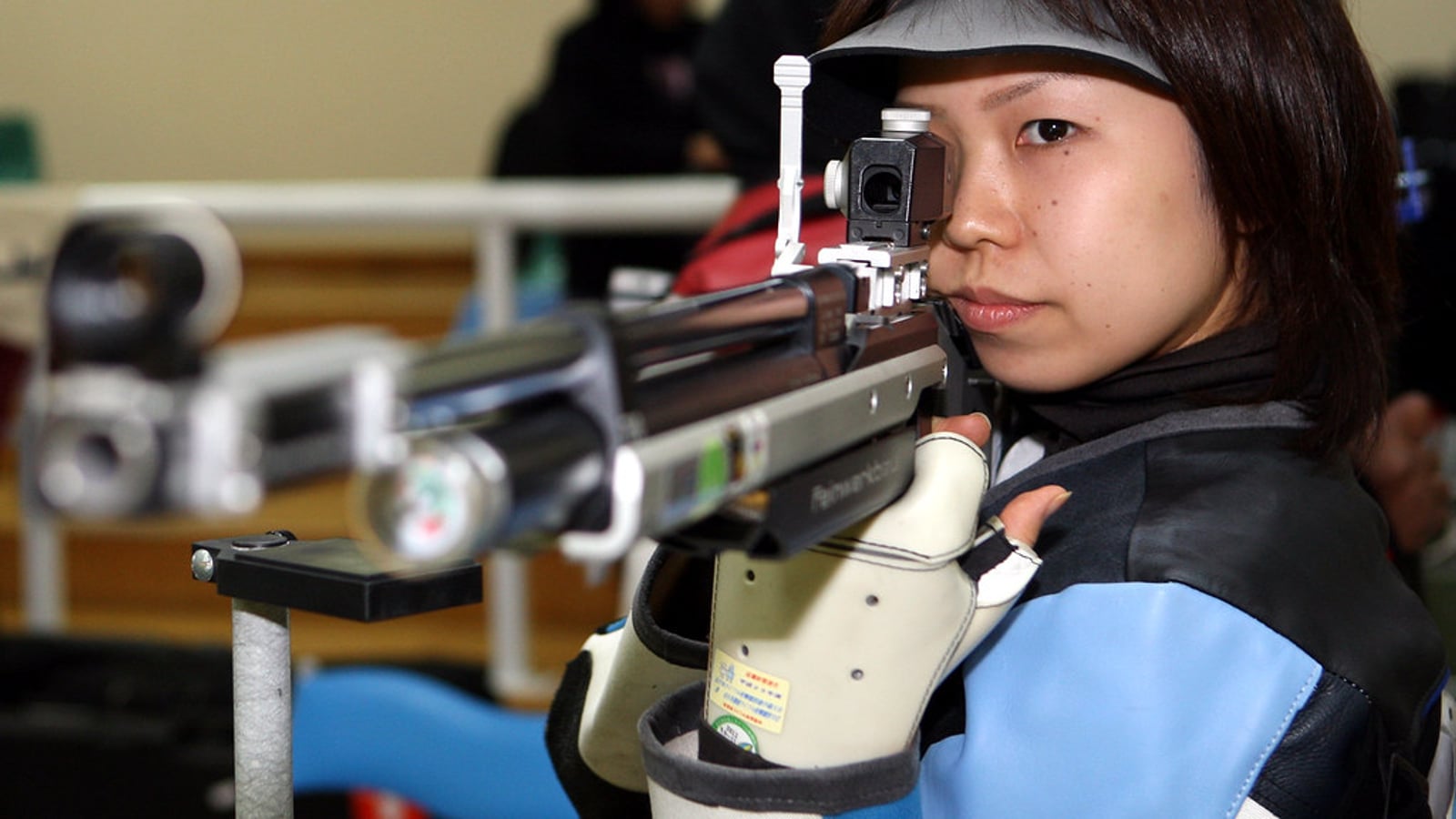
A sport where mixed participation is growing, but not everywhere yet
Shooting sports remain predominantly male in France, but the gap narrows every year. In many FFTir clubs, the share of licensed women has risen noticeably over the last decade, driven by the Olympic disciplines (rifle, 10m pistol) and by the boom in dynamic shooting.
That’s not a coincidence. This sport demands neither brute strength nor a particular build: it demands precision, breath control, and technical rigor — qualities that have nothing to do with the shooter’s sex.
Still, starting out as a woman in this sport sometimes raises concrete questions men never ask themselves: will the equipment even fit me? Will I be taken seriously on the firing line? Will I feel like I belong in a locker room or a range designed by and for a predominantly male crowd for decades?
This article tackles these questions head-on, without minimizing them and without dramatizing them either. The goal: to give you concrete pointers so you can start well, choose gear that suits you, and learn to recognize a club where you’ll progress with peace of mind.
It’s also worth recalling a simple, verifiable fact: shooting sports have been part of the Olympic Games since 1896, and women’s events have been on the program for several decades, with podiums contested at the same level of demand as the men’s events. So this isn’t a sport women are discovering today — it’s a sport where their institutional presence is old, even if its mainstream visibility is more recent.
What’s really changing today is access. A generation ago, a woman who wanted to join a shooting club often had to know someone in the scene, or justify her request to instructors who didn’t expect to see her. Today, signing up works like for any other sport: a discovery day, an administrative file, a trial period. The social barrier has largely disappeared; what’s left are practical barriers, and those are the ones we’re going to dismantle one by one.
The real problem of poorly fitted equipment
For a long time, the sport-shooting industry designed its gear around average male builds: wide grips, sight-line lengths made for large hands, vests and jackets cut with no real variation for different body shapes. This isn’t a myth or an exaggerated complaint — it’s a reality documented by many female instructors and by manufacturers themselves, who have since adjusted their ranges.
Concretely, a pistol grip that’s too wide prevents a proper hold: the trigger no longer lands on the right part of the finger, the index finger pulls at an angle instead of straight back, and the group opens up without the shooter understanding why. This actually affects anyone with small hands, man or woman, but it statistically affects more women.
Another real issue: a rifle or shotgun stock that’s too long forces you to extend your arm and breaks the natural shoulder position. Recoil is then poorly absorbed and lands on the collarbone instead of being soaked up by the muscle mass of the shoulder and back. Result: bruises, apprehension, then anticipation of the recoil that degrades precision even further.
The good news: these problems almost always get fixed through adjustment, not by giving up the discipline. A stock adjustable in length of pull (LOP), set to the right measurement, changes everything. A set of interchangeable pistol grip panels does too. These are standard adjustments, available on most mid-range and high-end gear.
Another friction point, less often discussed, concerns hearing and eye protection. Standard ear defenders are calibrated for an average male head size: too wide, they slip in the prone position or during fine aiming, let noise through on the sides, and break cheek contact with the stock. Shooting glasses have the same problem: a frame that’s too wide slides down the nose bridge with every head movement, forcing constant readjustment that breaks concentration.
Here too the solution is simple but has to be actively requested: ear defenders with adjustable tension shells and glasses frames in smaller sizes exist at several manufacturers specializing in precision shooting. A serious gunsmith or instructor will point you to these references without any trouble if the question is asked clearly.
Finally, the question of the overall size of the firearm deserves some nuance: the weight and bulk of a pistol or rifle aren’t insurmountable obstacles — they simply require a somewhat longer period of muscular adaptation for some beginners. This adaptation period is nothing abnormal; it also affects many smaller-built men who start out with gear too heavy for their current muscle mass. Physical progression is an integral part of technical learning, just as much as precision of movement.
Clubs that were historically unwelcoming, but are changing
Let’s say it plainly: some shooting clubs have long had a closed-locker-room vibe, with dated reflexes — the seasoned shooter who explains technique without being asked, the clumsy remark about “a woman shooting,” a complete lack of restrooms or storage designed for a mixed audience. These situations still exist in some places.
But the underlying trend is clearly positive. The federation has been pushing outreach efforts for several years now, with targeted open days, dedicated discovery sessions, and communications that highlight women shooters at every level. Many clubs have also seen their boards diversify, with female instructors now present in leadership roles.
An experienced instructor, whom many clubs now feature in their introductory sessions, sums it up this way: what matters isn’t finding a perfect club on the first try, but quickly learning to spot the signs of a club that works well for you — and not hesitating to try another one if the vibe doesn’t suit you.
Signs of a healthy club to look for from the very first trial session:
- The instructor addresses safety and technique directly to you, not to your partner or whoever came with you, if you showed up accompanied.
- Questions about equipment or adjustments get a technical answer, not a brush-off like “don’t worry about that.”
- There’s at least one other regular female shooter at the club, a sign the environment isn’t hostile by default.
- The locker rooms and restrooms are clean and clearly either mixed or separated, not some vague corner thrown together.
If a club ticks none of these boxes and the atmosphere makes you uncomfortable from the first visit, it’s perfectly legitimate to look elsewhere. France has hundreds of FFTir-affiliated clubs: the diversity of atmospheres is real, and you have the right to choose yours.
One structural point is worth clarifying: club boards often remain predominantly male, simply because the historical membership is statistically made up of men who’ve been practicing for a long time. That says nothing about the quality of welcome a new female member will get — many of these boards actively push for greater gender diversity among their members, aware that a mixed membership benefits club life both athletically and financially. A club that’s recruiting wants members who stick around, not people who leave after three sessions.
It’s also worth distinguishing between two kinds of clumsiness, because the right response isn’t the same for both. Clumsiness born of ignorance — someone who’s simply never had a woman shooter in front of them and adapts their language poorly — usually corrects itself within one or two sessions, once the person realizes you know what you’re doing. Clumsiness born of contempt — a condescending tone that persists even after you’ve demonstrated your competence — is a different signal, one that justifies raising it with the club’s leadership rather than waiting for it to pass on its own.
Choosing your discipline without being swayed by stereotypes
No shooting discipline is “for men” or “for women.” The rankings in Olympic rifle and pistol show it clearly: performance gaps between categories are minimal, unlike many sports driven by raw strength or power.
A few objective pointers by discipline to help you choose based on your interests, regardless of your sex:
- 10m air rifle: pure precision discipline, standing position demanding in terms of core stability and balance. Very accessible in clubs, loaner gear generally available.
- 10m air pistol: requires good control of breathing and trigger release. Excellent technical entry point, little initial investment needed.
- Dynamic disciplines (IPSC, Steel Challenge): combine precision and movement, shooting at cardboard targets or steel plates. Require more dedicated gear (holster, belt) but no particular physical constraint tied to build.
- Clay shooting: mostly calls on hand-eye coordination and trajectory anticipation. Shoulder recoil is more present here, hence the importance of a shotgun well adjusted for stock length.
The real deciding factor is your own taste: do you prefer the meditative rigor of pure precision, or the adrenaline of timed shooting? Neither answer is “more legitimate” than the other for a woman starting out.
There are also less publicized but very accessible disciplines for a first taste, especially anything falling under recreational category-D shooting: low-power air guns sold without restriction, certain historical or precision replicas. These disciplines require minimal initial investment and let you build the fundamentals of stance and aim without the administrative burden of a category-B or C firearm. Many clubs offer them precisely as an entry point before steering you toward a more specialized discipline.
Black-powder or antique-firearm shooting, available at some clubs, also attracts a varied, mixed crowd, with a heritage and technical dimension different from modern shooting. It’s worth considering if the historical aspect of the equipment interests you as much as the sporting practice itself — again, none of these disciplines is actually gendered in practice.
Equipment: what to check first
Even before thinking about caliber or brand, ergonomics is the absolute priority. Poorly fitted gear forgives nothing, whatever the shooter’s level.
For a handgun, three points to check in hand, with an empty and secured firearm, alongside an instructor:
- The trigger should reach the first joint of the finger without needing to extend the arm or bend the wrist excessively. If that’s not the case, try other grip panels or a different model before investing.
- The thumb must reach the magazine release without you having to change your grip. Otherwise, every reload will disrupt your stance.
- The weight in hand, with an empty magazine, should be sustainable in a static position for several minutes without fatigue tremor. A pistol too heavy for your current muscle mass will degrade your precision through sheer exhaustion, not lack of talent.
For a rifle or shotgun:
- Stock length (LOP) should allow natural cheek weld on the comb without straining the neck or breaking shoulder alignment. Many modern stocks are adjustable in length and comb height — use that adjustment, don’t adapt yourself to the stock’s flaw.
- Recoil should be absorbed by the whole shoulder, not concentrated on the collarbone. A foam recoil pad or an additional stock pad fixes this for minimal cost.
- Total weight, with optics mounted, should stay stable in an extended standing position without tremor in the supporting arm.
On technical clothing: precision-shooting jackets and pants now come in women’s cuts from several specialized manufacturers, with reduced shoulder width and a waist fit that radically changes comfort in prone or extended standing positions. That was barely the case some fifteen years ago. Check with your club or a specialized gunsmith rather than settling for a poorly fitted unisex jacket.
Optics choice also deserves a pause. On a rifle or pistol fitted with a red dot, the distance between eye and lens (the “eye relief”) depends directly on your arm length and head position on the stock. A red dot poorly positioned for your build forces you to hunt for the dot every time you aim instead of seeing it appear naturally, which massively slows down getting on target in dynamic shooting. This adjustment is made when mounting the optic, with a gunsmith or instructor used to that kind of fitting — again, a universal technical point that affects any body type outside the standard.
For holster choice in dynamic disciplines, the same in-hand checking principle applies: a belt or holster poorly fitted to hip width or torso length breaks the smoothness of the draw and can create real discomfort in motion. Several manufacturers now offer belts with a wider adjustment range precisely to cover a broader variety of body types than the old standard.
Stance and biomechanics: the adjustments that actually matter
Beyond equipment, stance is the real lever for progress, and some adjustments deserve particular attention depending on build, regardless of the shooter’s sex.
In standing position with a pistol or rifle, balance is built on the whole skeleton, not on arm strength. A seasoned club shooter often reminds beginners of this: “the gun shouldn’t weigh anything once the stance is correct — it’s just resting on a stable bone structure.” This principle holds for everyone, but it becomes even more decisive when upper-body muscle mass is smaller: technique then replaces strength, and it’s technique that wins out in the long run.
Some concrete postural adjustments to work on with an instructor:
- Core bracing, not just the supporting arm. Well-mastered diaphragmatic breathing stabilizes aim more than a tensed arm.
- The angle of your footing, often underrated. Feet too close together or poorly oriented toward the target create a constant sway that arm strength can never fully compensate for.
- Stock placement in the shoulder pocket for rifle or shotgun disciplines: poor initial placement forces you to compensate with your neck, which tires quickly and breaks precision after a few dozen shots.
- Managing recoil through controlled anticipation rather than rigidity: a body that’s too tense handles recoil poorly, while a supple, well-grounded body absorbs it naturally.
A regional precision-shooting champion, asked about her beginnings, described her technical breakthrough this way: the day she stopped trying to “hold” the gun with her arms and understood she needed to “rest” it on a stable stance, her groups tightened dramatically within a few sessions. This mental shift — from strength to structure — is one of the most universal lessons in precision shooting, whether you’re a man or a woman.
Physiological variation and training consistency
A topic rarely covered in standard guides deserves a place here: physiological variability tied to the menstrual cycle can affect postural stability and recoil perception in some shooters, to widely varying degrees from one person to another. It’s neither systematic nor a limitation in itself, but knowing about it means you don’t need to worry unnecessarily if a session is less stable than another for no obvious technical reason.
The practical response stays the same as for any variation in physical form, whatever the cause: adjust the session’s volume instead of forcing through at all costs, and log how you feel to distinguish a one-off dip from a real recurring technical issue. An experienced instructor is used to this kind of fluctuation across all shooter profiles — fatigue, sleep, work stress produce comparable effects on aiming stability.
On pregnancy and shooting sports, caution is warranted and the rule is simple: this is never decided alone. Medical advice is essential before any practice, particularly regarding noise exposure, prolonged standing, and recoil depending on the discipline. Some clubs offer adjusted schedules or zero-recoil disciplines (air guns) during this period — discuss it directly with the doctor following the pregnancy and with the club’s staff.
Finding a club mentor or informal guidance
Many experienced shooters agree on an underrated factor in progress: having a reference person within your own club, even informally, considerably speeds up integration and the learning curve. It’s not about superior technical skill, but proximity of experience — a shooter who started two or three years ago remembers precisely the sticking points she ran into and knows how to name them simply.
Some clubs structure this mentoring through buddy systems between members, where a more experienced shooter accompanies a newcomer through their first sessions, beyond the strict framework of instructor-led classes. Other clubs have nothing official, but mutual support naturally develops over shared sessions in the same time slot.
If your club doesn’t have this kind of setup, nothing stops you from starting it yourself: offering to share a lane with a more experienced shooter, asking direct questions at the end of a session, or simply sticking around a bit after shooting to talk about gear and adjustments. Most experienced practitioners, men and women alike, appreciate being asked precise questions — it’s a sign of genuine investment in the discipline, not an annoyance.
Online networks and groups dedicated to women shooters, often organized by region or discipline, usefully complement this club dynamic: they let you exchange notes on gear, competition feedback, or welcoming clubs in another city if you move. They never replace hands-on instruction from an instructor, but they broaden your reference circle beyond a single club.
Field accounts: what women shooters say at the club
Beyond the theory, here’s what instructors and experienced shooters regularly report about their experience as beginners, anonymized and generalized to respect the scope of this article.
An instructor at a club near Paris says most women who show up for a discovery session carry a negative assumption about their own physical ability — “I’ll never have enough strength” — when precision shooting actually demands the opposite: relaxation, not strength. This mismatch between the initial belief and technical reality is, in her view, the number-one obstacle to clear right from the first session.
An experienced shooter in the Rhône-Alpes region, licensed for several years in dynamic shooting on cardboard targets, stresses the importance of the first club chosen. She explains switching clubs after a few months, having found no serious technical guidance there, and then progressing much faster in a setting where the staff addressed her with the same rigor as any other member.
Another shooter, a beginner in 10m rifle for less than a year, points to the impact of properly fitted gear: after shooting for several months with a club rifle whose stock length didn’t suit her, a simple adjustment change during a session with personal gear immediately improved her stability and reduced fatigue by the end of the session.
A fourth shooter, practicing clay shooting for several seasons at a club in the southwest, looks back on her initial apprehension about shotgun recoil. Early sessions left her with bruises on the shoulder because of imprecise stock placement, which fed weeks of recoil anticipation — the classic reflex of closing your eyes or pulling your torso back before the shot breaks. Specific work with her instructor on stock placement in the shoulder pocket, combined with an additional recoil pad, solved the problem within a few targeted sessions.
A fifth shooter, competing regionally in 10m pistol, highlights a rarely mentioned aspect: the mental load of regularly being the only woman on the firing line early in her practice. She describes having learned to completely ignore this dimension after a few months, once her competition results spoke for themselves — a ranking makes no distinction of gender, and that, in her view, is the best answer to any lingering doubt, whether it comes from herself or from others.
What these accounts have in common: technique and well-adjusted gear always trump raw strength, and the choice of club directly impacts how fast you progress and how much you enjoy the practice. Each of these testimonies also points to the same conclusion: the obstacles encountered are concrete and identifiable, so they’re solvable one by one, rather than some overarching inevitability to endure.
How to earn respect on the firing line from day one
Certain situations remain common at clubs and deserve to be anticipated, without being dramatized but without being ignored either.
Unsolicited advice is the most common case: someone explains your stance or your movement without you having asked anything. The most effective response remains matter-of-fact neutrality: “Thanks, my instructor is already working on that with me” is enough to shut it down without conflict. You never have to justify your presence or your level to anyone other than your instructors.
If an out-of-line remark or a condescending tone keeps repeating, the most effective move is to raise it directly with the club board or the instructor running the session. Serious clubs take this kind of report seriously, because the club’s image and atmosphere depend directly on it.
Practically speaking, don’t hesitate to explicitly ask for the loaner gear best suited to your build from the very first session, rather than settling for the first pistol or rifle available on the rack. A good club generally has several stock sizes or interchangeable grip panels precisely for this reason.
Finally, joining or crossing paths with other women shooters at the club, even from different disciplines, helps enormously with staying anchored in the practice over time. Many clubs now organize mixed small-group time slots or courses that make these encounters easier, especially during open days at the start of the season.
One more useful habit: never hesitate to ask for a technical instruction to be rephrased if it isn’t clear, even if you feel like “everyone else understood except you.” This is a common bias among beginners in any sport, amplified in some women by the fear of appearing less competent by asking. In practice, an instructor always prefers to rephrase an instruction rather than let a bad habit take hold through silent misunderstanding — safety on the firing line depends directly on it.
On the specific matter of competitions, know that ranking categories in shooting sports are generally mixed or separated depending on discipline and level, with clearly identified women’s podiums in most federation-run competitions. Showing up for your first competition is therefore nothing like a leap into the unknown: organizers are used to welcoming women shooters at every level, from the first regional ranking up to national competitions.
Budget and progress: what to expect in the first year
The first year’s budget doesn’t fundamentally differ between men and women, but certain expense items deserve particular attention tied to the well-fitted gear discussed above.
Plan a budget for:
- FFTir membership and club dues, whose amount varies by structure.
- Introductory sessions and loaner gear, generally included for the first few months.
- A minimal personal setup once you know you’re going to keep going: hearing and eye protection fitted to your face, possibly a jacket or vest in your size if your chosen discipline requires it.
- Ammunition replenishment, an expense item that varies a lot depending on caliber and training frequency — stick to a logic of gradual progression rather than blowing your budget on rounds in the first few months.
When it comes to buying a personal firearm, the same rule applies to any beginner, man or woman: don’t buy before testing several models at the club, and prioritize actual in-hand ergonomics over the reputation of a model seen online. A serious gunsmith will have you try different grip panels or sizes before closing a sale, precisely to avoid a quick resale caused by a poor initial choice.
On the administrative side, a declaration or prefectural authorization may be required depending on the firearm category targeted (category B for most handguns, category C for certain manually operated repeating rifles, category D for low-power air guns sold freely). Processing times vary by prefecture: check directly with your club, which generally supports its members through this process.
An item often forgotten in first-year budgets: the equipment adjustments themselves. An extra set of grip panels, a recoil pad, a properly fitted optic mount each represent modest amounts individually, but they add up if bought piecemeal in a rush rather than anticipated at the time of the initial purchase. Discussing these needs with the gunsmith at the time of the main purchase often lets you bundle them into a more coherent package, or at least avoid repeated trips back to the shop.
Then there’s the question of training rhythm. Consistency matters far more than volume: two short sessions a month with real technical work beat one long, exhausting session followed by three months off. This principle isn’t specific to women, but it takes on particular importance for anyone building up muscular endurance specific to shooting — holding a firearm in a static position works muscle groups rarely used in everyday life, whatever your general fitness level otherwise.
Tracking your progress to stay motivated
One of the best levers for progress, for any beginner shooter, is to keep a precise record of your sessions rather than relying on a general impression of a “good” or “bad” session. Noting distance, firearm used, number of rounds, conditions, and above all the technical feel lets you objectify progress that isn’t necessarily visible to the naked eye from one session to the next.
This is particularly useful for identifying whether an equipment adjustment — stock length, grip panels, comb position — has a real effect on the group, rather than relying on an impression. A digital shooting-log app like PewPewLife lets you compare several sessions with the same gear set up differently, or several settings within the same session, and see in black and white what works for your build.
This methodical approach also defuses a good part of the self-deprecation that affects many beginners: when the numbers show real progress session after session, the question of “am I good enough” quickly becomes secondary to the facts.
Pitfalls to avoid when starting out
A few mistakes come up often among beginners, not from lack of skill but from lack of information available at the right time.
- Accepting poorly fitted loaner gear without flagging it. The reflex to “make do” instead of asking for an adjustment delays technical progress by months in some cases.
- Downplaying your own discomfort with an unwelcoming club atmosphere. Repeated discomfort is a signal worth taking seriously, not excessive sensitivity to be corrected.
- Comparing yourself to the progress of a shooter with ten years of practice. The relevant comparison is always with yourself, session after session.
- Under-investing in personal hearing and eye protection on the assumption that the club’s loaner gear is enough. Protection poorly fitted to your face or ear canal protects poorly, and the discomfort pushes you to remove it at the worst moment.
- Choosing a discipline by default rather than genuine interest. Nothing stops you from trying several disciplines in your first year before specializing.
FAQ
Q: Do you need particular physical strength to shoot well? A: No, precision in shooting rests on stance, core bracing, and breath control, not on raw strength. Most Olympic precision disciplines show minimal performance gaps between categories, proof that technique clearly outweighs muscular power.
Q: How can you tell if a club is genuinely welcoming before signing up? A: Watch whether the instructor addresses safety and technique directly to you, whether other women shoot there regularly, and whether your equipment questions get a real technical answer. One trial session is usually enough to get a feel for the club’s real atmosphere.
Q: Does standard club gear suit small hands or smaller builds? A: Not always by default, but most serious clubs have interchangeable grip panels or several sizes of loaner firearms. Don’t hesitate to explicitly ask for an adjustment from the very first session rather than adapting yourself to poorly fitted gear.
Q: Which discipline would you recommend to a beginner who’s undecided? A: No discipline is better suited based on sex: the choice should be based on personal taste, between pure precision (rifle, 10m pistol) and more dynamic disciplines. Trying several disciplines in your first year helps you find your real preference.
Q: What should you do about an out-of-line remark on the firing line? A: A factual, neutral response is usually enough to shut it down in the moment. If the situation repeats, raising it directly with the instructor or the club board is the most effective move, since serious clubs handle this kind of report attentively.
Q: Do you need specific clothing gear to get off to a good start? A: Not from the very first session — loaner gear is plenty. Once you know you’re sticking with it, a jacket or vest in your size markedly improves comfort in extended positions, and several manufacturers now offer genuinely well-fitted cuts.