Your first session is coming up and you have no idea what to pack in your bag. That’s normal: nobody hands you a list before you sign up, and every club has its own habits. This article gives you a realistic, priority-sorted checklist so you can show up calm and forget nothing.
The idea isn’t to buy everything before you’ve even fired a shot. Most clubs lend beginners the basic gear for their first sessions. This guide clearly separates what’s essential from day one, what’s usually provided on site, and what you might consider buying once you know whether you’re going to keep at it.
Paperwork: the administrative basics everyone forgets
Before you even think about technical gear, there’s paperwork. A shooting range is a regulated environment, and you’ll be turned away without the right documents, even if you’re a future champion marksman.
For your very first taster session, you generally only need a form of ID. The club will have you fill out a registration form and sometimes a simplified health questionnaire before letting you try. Always check by phone or email with the club beforehand, since exact requirements vary from one club to another.
If you become a licensed member (in France, an FFTir license), your paperwork list grows: the license itself (often an app or a card), a medical certificate confirming no contraindication to shooting sports, and your ID. Keep these documents in a dedicated plastic sleeve inside your bag, always in the same spot. Nothing’s more frustrating than digging around for ten minutes at the front desk while the line behind you grows impatient.
Also remember to bring your shooting log if you already have one, whether on paper or digital on your phone. Consistently noting the conditions of each session from the start, even as a beginner, will give you a valuable history to track your progress later. Many shooters regret not starting this habit from their very first sessions, when everything still seemed too muddled to be worth writing down.
One last document deserves a mention, even though it only applies to a minority of newcomers: proof of civil liability insurance, sometimes requested alongside the license for disciplines involving more specific equipment. It’s not systematic, and depends mostly on the club and the discipline practiced, so again the simplest approach is to ask the club directly when signing up rather than assuming a universal rule that doesn’t necessarily exist everywhere in the same form.
Hearing protection: non-negotiable, day one
Here’s the item that needs to be in your bag before anything else: hearing protection. The noise from a gunshot far exceeds the threshold of immediate danger for the ear, and a single unprotected exposure can cause irreversible damage. This isn’t an overcautious precaution, it’s a physiological necessity.
Nearly all clubs lend basic earmuffs or disposable foam earplugs to beginners. So you don’t need to buy anything before your first session. But if you already know you’ll be coming back several times, personal earmuffs or plugs are one of the first purchases worth considering, for hygiene reasons as much as comfort.
Disposable foam earplugs are the simplest and cheapest option: slip a box into your kit, they’re single-use and cost almost nothing. Passive earmuffs offer better comfort over the length of a session but isolate you completely, which hinders communication with the instructor. Electronic earmuffs amplify ambient sound while instantly cutting the noise of the gunshot: pricier, they’re a real comfort upgrade once you shoot regularly, but totally unnecessary for a first taster session.
Safety glasses: the other mandatory safety equipment
The second essential piece of safety equipment: eye protection. Here too, this isn’t a comfort option but a barrier against a real risk. A case that ejects poorly, a shell that bounces back, a lead fragment off a steel target: all these rare but possible incidents aim straight at the shooter’s face.
As with hearing protection, virtually all clubs provide basic safety glasses for introductory sessions. They generally meet the EN166 standard and are more than sufficient to get started. So again, there’s nothing you need to rush out and buy.
If you already wear prescription glasses, mention it to the club before the session: some protective models fit over corrective lenses, others don’t. Custom prescription safety glasses are a purchase to consider later, once you’re sure you’ll keep going, since the price is well above that of standard protective glasses.
What the club provides, what you bring yourself
To settle once and for all what falls under your responsibility and what doesn’t, here’s what a shooting club systematically provides a beginner during their first sessions:
- The firearm itself, suited to the introductory discipline (rifle or pistol depending on the club’s program)
- The ammunition needed for the taster session, included in the trial fee
- Basic hearing and eye protection
- Supervision by a qualified instructor, mandatory for any introduction
- Targets and target holders
This list explains why a first taster session costs almost nothing to prepare materially. The only real hurdle is booking the appointment and not forgetting your ID. Everything else waits until you confirm you want to continue.
Conversely, some items remain your responsibility even for a simple taster session, because they’re personal or tied to your individual comfort:
- A valid ID
- Suitable clothing: covering garments, closed shoes, no low neckline that would let a hot ejected shell casing slip in
- Long hair tied back, to avoid any interference near the face and mechanisms
- A water bottle, since sessions can run long and it’s often warm in an indoor range
- Something to jot down your impressions if you want to start your personal log from day one
The clothing question deserves an extra word, since it’s often overlooked by newcomers. A closed, high collar prevents an ejected shell from lodging against the skin, which is unpleasant without being dangerous, but can trigger an unwanted reflex movement at the wrong moment. Closed shoes are required at most ranges for basic safety reasons around shells falling to the ground.
Once you’re licensed: ammunition and personal gear
Once you’re past the taster stage, if you sign up at the club and get your license, your relationship with gear changes. You’ll probably want your own protective equipment, for hygiene and comfort, rather than systematically using the club’s shared kit.
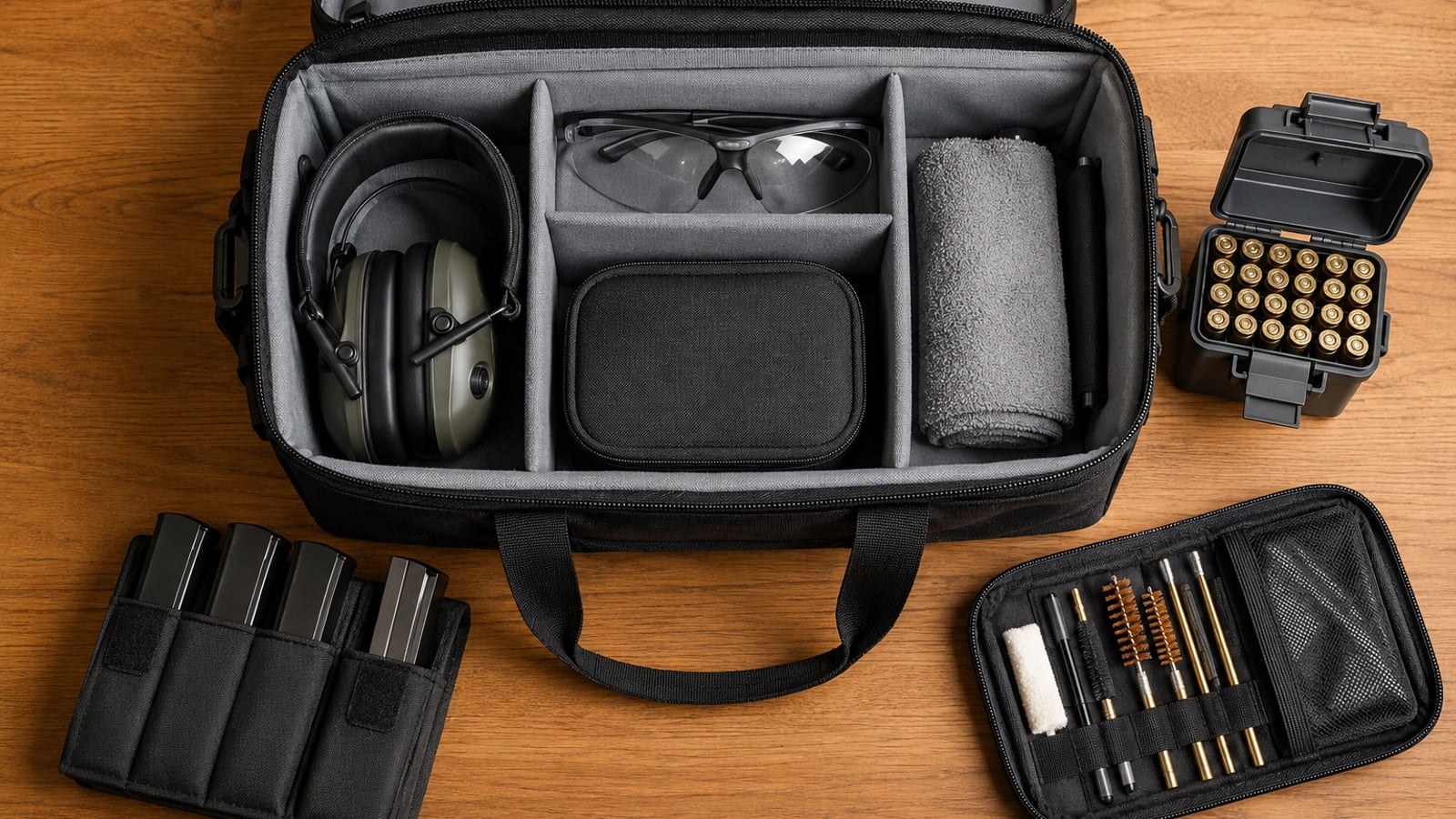
At this stage, your bag starts to organize itself around a few categories: personal protection, a light cleaning kit, personal ammunition if you buy some outside the club’s packages, and accessories specific to your discipline. The exact contents vary hugely depending on whether you practice static precision shooting, dynamic shooting, or clay disciplines, but the basic structure stays the same.
A light cleaning kit becomes relevant as soon as you’re shooting a firearm you keep using from one session to the next, whether at the club or through regular rental. It doesn’t need to be complete: a few patches, a small amount of solvent, a microfiber cloth are enough for basic upkeep after the session, complementing the more thorough cleaning done at home or by the club’s gunsmith.
As long as you’re in the taster phase, ammunition isn’t your bag’s concern: it’s provided by the club and managed directly by the instructor. The question comes up differently once you start buying your own ammunition, whether for regular use at the club or for a personal firearm.
The first habit to build is strict separation of ammunition by caliber, even inside the bag. A separate box or bag per reference avoids any confusion, especially if you practice several disciplines with different calibers. Mixing ammunition in the same container is a mistake that’s all the more silly for being easy to avoid with a bit of organization.
The second point concerns the quantity to carry. For a routine training session, there’s no need to bring much more than what you plan to shoot that day: extended storage in a carry bag, exposed to a vehicle’s temperature swings, isn’t the best way to preserve ammunition over time. The main stock stays stored under good conditions at home, and only the amount needed for the session goes into the bag.
Finally, remember that transporting ammunition follows common-sense rules and sometimes club- or range-specific guidelines (closed container, maximum quantity carried, separation from the firearm itself during transport). If you’re unsure of a specific rule for your situation, the safest bet is to ask your club or federation directly rather than rely on a habit heard elsewhere.
It’s hard to give a single figure since needs vary so much by discipline and the quality tier chosen, but we can at least rank the spending items to help you prioritize once you know you’re continuing.
The first and cheapest item is disposable foam earplugs: their per-unit cost is nearly negligible, and they’re plenty for getting started. The second item, standard EN166-compliant safety glasses, also remains affordable and is often the very first personal purchase of a new license holder, even before considering electronic earmuffs.
The item with the widest range is electronic hearing protection: the price gap between an entry-level model and a more advanced one is significant, and the choice mostly depends on how often you shoot. An occasional shooter probably doesn’t need a top-of-the-line model, while a regular competitor will find real, lasting comfort in one.
The light cleaning kit also stays affordable in its basic version, and can be built up gradually rather than bought as a complete set from the start. As for accessories specific to a discipline (holster, belt, bipod), it’s better to treat them as separate purchases, decided once the discipline is confirmed, rather than expenses folded into the basic bag budget.
Either way, this varies a lot depending on the club, retailer pricing, and personal preferences: the only reliable general rule is to prioritize safety (protective gear) over comfort (specific accessories), and to move item by item rather than investing heavily all at once before you’re certain of your commitment to the discipline.
One last useful budgeting habit is to ask your instructor or more experienced club shooters for advice directly before any fairly significant purchase. A seasoned club shooter has usually already tested several product lines and can point you toward what genuinely fits your use, helping you avoid buying oversized gear for your actual needs, or conversely, an entry-level model that will quickly limit you once your practice intensifies.
Common beginner mistakes with bag contents
The first classic mistake is over-equipping. A beginner anxious about forgetting something tends to want to buy everything before even the first session: a specialized case, a competition belt, very discipline-specific accessories for something they haven’t even tried yet. The result: money spent on gear that’s sometimes unsuited to the discipline they end up choosing.
The second, symmetrical mistake is underestimating the basics and showing up without ID, or with prescription glasses but no idea whether they’re compatible with the club’s loaned protective gear. A simple call to the club before the session settles this in two minutes.
The third mistake concerns forgetting the shooting log, or rather forgetting its existence. Many beginners only start logging their sessions months after starting, once they realize the value of tracking. Starting from the very first session, even very roughly, lets you compare your earliest impressions to your progress six months or a year later. It’s often the best source of motivation during stretches of stagnation.
Finally, a subtler mistake involves hydration and food. Taster sessions sometimes run longer than expected, with waiting time between turns if the group is large. A water bottle and possibly a small snack prevent the drop in concentration toward the end of the session, a moment when handling mistakes are statistically more frequent simply from fatigue.
Choosing the bag itself and organizing well
There’s a lot of talk about what goes in the bag, rarely about the bag itself. For a first session, any sports bag will do the job perfectly: a classic backpack, a soft duffel bag, whatever you already have on hand. No reason to invest in a specialized bag before you even know if you’ll keep going.
Once you’re practicing regularly, the qualities that matter change. Rigid compartments keep electronic earmuffs or optics from getting crushed against the rest of the contents. Easily accessible outer pockets let you pull out your ID and license without dumping everything in front of the desk. A washable or moisture-resistant bottom helps if you’re storing a cleaning kit containing solvent.
Bags sold specifically for sport shooting (often called range bags or shooting totes) offer dedicated compartments for ammunition, protective gear, and small accessories. They’re convenient but absolutely not essential: a well-organized sports bag with a few internal zippered pouches serves exactly the same function for a fraction of the price. The difference lies in the organization, not the label on the bag.
One practical point often overlooked: the physical separation between the compartment holding ammunition and the one holding documents or food. Some ranges require ammunition to be kept in a dedicated bag or box inside the pack rather than loose at the bottom, partly to make entrance checks easier. A small rigid plastic box inside the bag solves this simply.
Beyond the outfit worn during the session, a few extra items deserve a spot in your bag, especially if the club has a locker room or the session is part of a longer outing.
A small towel or a spare t-shirt is useful after a physically demanding session, particularly in clay disciplines where you move a lot between stations, or in dynamic shooting where the cardio effort is real. Nothing mandatory, but the comfort of the ride home matters as much as that of the session itself.
A minimal first-aid kit (bandages, antiseptic) remains a good general idea, even though the club normally has its own regulatory first-aid supplies. It’s not an individual obligation, but a reasonable precaution, as with any sporting activity.
Finally, if the session takes place outdoors (certain clay disciplines, long-range precision shooting), think about the weather: a cap against sun glare that interferes with aiming, a light windbreaker in case of light rain, sunscreen in summer. These details seem trivial, but a physically uncomfortable shooter concentrates less well, and concentration is precisely the most precious resource at the moment of pulling the trigger.
One last case deserves mention: equipment rental. Many clubs offer, in addition to the taster session, a firearm rental package for licensed shooters who don’t yet have their own gear. This intermediate situation, between the one-off day-one loan and buying a personal firearm, calls for slightly adapting the bag’s contents.
In this scenario, the club generally hands you the firearm and sometimes the ammunition on site, but you’re expected to bring your own protective gear if you already have some, along with your shooting log. This is the point where many shooters make the transition from shared to personal gear, item by item rather than all at once.
Check with the club on the exact rental terms: some require a deposit, others require a minimum number of taster sessions before granting access to free rental. These rules vary noticeably from club to club and aren’t obvious, so it’s better to clarify them upfront rather than discover them on site.
What experienced shooters keep in their bag, by profile
To give you an idea of where your bag will evolve toward once you’re more experienced yourself, here’s typically what an experienced club shooter permanently keeps in their bag, regardless of the discipline practiced that day:
- Personal hearing and eye protection, fitted to their build
- An up-to-date shooting log, paper or digital
- License and ID in a dedicated sleeve
- A light cleaning kit for immediate upkeep after the session
- A few basic tools (small screwdriver, spare battery for a red dot sight or electronic earmuffs)
- A minimal first-aid kit
- Water
This core stays remarkably stable, regardless of discipline or the shooter’s level. What changes from one discipline to another is the specific accessories added around it: holster and mag pouches for dynamic shooting, bipod or rest bag for precision, shoulder pad for clays. The administrative and safety base, though, never changes.
This stability of the core is good news for a beginner: once you’ve understood and internalized this basic list, you no longer really need to think before each session. Only the accessories specific to that day’s discipline need a quick check.
The typical contents of a range bag also vary depending on who’s preparing it: a parent accompanying a child at a shooting school doesn’t have the same priorities as a senior returning to the activity after decades away, nor as a woman getting licensed for the first time discovering the discipline.
For a child at a shooting school, the bag remains almost entirely managed by the parent or the club. The personal contents are essentially limited to a water bottle, a small snack, and the accompanying parent’s ID. Technical gear, including protection, is systematically adapted and provided on site, since shooting schools supervise this stage with equipment specifically designed for younger shooters.
For a senior shooter returning to the activity after a long break, a few practical additions are worth slipping into the bag: a cushion or extra support if standing for extended periods becomes uncomfortable, increased attention to hydration, and possibly the up-to-date medical certificate, which carries particular importance at that age to confirm fitness to practice. Nothing dramatic, just comfort adjustments that make for a calm return.
For a woman starting out, the bag’s contents don’t change fundamentally, but some standard equipment (gloves, protective gear, technical clothing) is sometimes cut by default to male proportions. If gear loaned by the club feels poorly fitted, don’t hesitate to flag it: more and more clubs and manufacturers now offer better-adapted sizes and cuts, and you shouldn’t hesitate to ask for an alternative rather than settling for uncomfortable gear that could, over time, harm your technique.
For a shooter with a disability practicing para-shooting, the bag’s contents depend heavily on the type of adaptation needed (specific supports, wheelchair modifications, stabilizing gear). These elements are generally worked out with the club and the referring para-shooting instructor from the very first sessions, and it’s better to build this list directly with them rather than rely on generic recommendations that wouldn’t account for the individual situation.
Either way, the principle stays the same: the administrative and safety base never changes, only the comfort and adaptation adjustments vary from profile to profile. A serious club will know how to guide you on these adaptations from the very first exchanges, often even before the first session.
Adapting your bag to the discipline you’re aiming for
If you already know which discipline you’re heading toward, you can slightly anticipate your bag’s contents, without investing heavily before confirming your choice.
For a precision orientation (10-meter air rifle or air pistol), the contents stay minimal: protective gear, log, and possibly a small mat or a shooting jacket if you’re progressing toward competition, but none of that is necessary to get started.
For a dynamic shooting orientation, the bag will later expand with a holster, a belt, mag pouches. But for a first session, even at a club oriented toward dynamic shooting, the instructor’s supervision and the loaned gear are plenty: these disciplines require a strict pedagogical progression before any access to more advanced gear or scenarios.
For a clay orientation (trap, skeet), expect the club to lend you a suitable shotgun and cartridges. The only relevant personal addition from the start is sometimes a recoil shoulder pad, but it’s often also available as a loan for a taster session.
Either way, the rule stays the same: only buy discipline-specific gear after confirming, through experience, that you genuinely enjoy that discipline. Sport shooting offers enough variety that a hasty discipline choice can turn out to be a poor calculation six months later.
Prepping your bag the night before rather than same-day
One organizational detail changes a lot about how calm a session feels: prepping your bag the night before rather than in a rush the same morning. This habit, mundane for any sport, matters even more for sport shooting because of the administrative dimension of paperwork you can’t afford to forget.
A good practice is to keep a fixed list, on paper or in an app, and check off each item the night before. This avoids the morning stress of hunting for your ID right before leaving, and greatly reduces the risk of arriving at the club only to realize an essential document is missing.
Some shooters permanently keep a “paperwork and documents” pouch that’s never taken apart between sessions: license, medical certificate, ID. This pouch never leaves the bag, unlike clothing or food, which change from one outing to the next. This separation between permanent and variable items greatly simplifies long-term preparation.
For regular sessions at a fixed club, many shooters end up keeping a permanently “ready” bag, with only ammunition and a snack to add at the last minute. It’s an organization that develops with experience, but nothing stops you from taking inspiration from it in your very first weeks of practice.
The competition range bag: a higher standard
Everything above concerns training at the club, where the atmosphere stays relaxed and forgetting a minor item is easily solved on the spot. Competition changes things: the rules are stricter, the organizers generally don’t lend comfort gear, and forgetting something can cost an entire entry.
For a first competition, the bag should systematically include a copy of the rules for the discipline and category entered, the precise day’s schedule with check-in times, and a safety margin of ammunition so you don’t run short mid-event. Experienced competitors generally bring more ammunition than the strict theoretical minimum, to absorb any misfires or verification shots at the start of the match.
Weather also matters more in competition than in training, since unlike a club session, you don’t get to postpone a competition because of rain or wind. A windbreaker, a cap, a pair of thin gloves in cold weather become items you don’t have the luxury of forgetting on the day.
Finally, an up-to-date shooting log takes on particular value in competition: it lets you compare the day’s feel and settings to those of previous training sessions, a valuable reference point for adjusting quickly under unusual conditions. It’s also often while preparing for their first competition that many shooters finally understand the value of the tracking they’d neglected until then.
Maintaining and taking stock of your bag over time
A range bag is never fixed. The contents that suited your first five sessions probably won’t be quite the same six months later, once your practice has become more defined and you’ve identified your own habits. Taking the time for a regular inventory of your bag, every two or three months for example, lets you spot what’s missing, what’s become useless, and what deserves replacing.
The batteries in electronic accessories (earmuffs, a red dot sight if you have one) run out without warning: consistently keeping a spare battery in the bag avoids the frustrating interruption of a session because an accessory dies at the worst moment. Likewise, disposable foam earplugs have a limited hygienic lifespan, and a regularly renewed fresh box costs very little compared to the comfort it provides.
The light cleaning kit also deserves periodic checking: an overly dirty cloth eventually becomes counterproductive, a nearly empty solvent bottle risks leaving you without a solution at the end of a session. These are small details, but it’s precisely these accumulated details that distinguish a well-kept bag from one that sits around for months untouched.
Finally, the periodic inventory is also a chance to check that administrative documents are still valid: an expired license or a medical certificate that lapsed without you noticing can block your access to a session or a competition at the worst possible time. A reminder on your phone, set to the expiration dates, avoids this avoidable bad surprise.
Final checklist before you go
Here’s the summary to copy before your first outing, whatever discipline you’re aiming for:
- ID
- Prior phone confirmation of exact requirements with the club
- Suitable clothing: closed collar, closed shoes, hair tied back if needed
- Water and possibly a light snack
- Shooting log or app, even for a first rough note
- Prescription glasses if you wear them, letting the club know you’ll need them under the protective gear
- Something to jot down your questions for the instructor
What you don’t need to bring for a taster session: personal firearm, ammunition, specialized hearing and eye protection, cleaning kit, discipline-specific accessories. All of that can wait until you know whether you’re continuing.
Keep this list handy for your first outings, then let it evolve naturally with your practice. Sport shooting is a discipline where rigor matters at every step, but that rigor is no obstacle once it becomes second nature: after a few sessions, prepping your bag no longer requires any real thought, and your energy finally focuses on what really matters, technique and the pleasure of improving.
FAQ
Q: Do I need to buy my own hearing and eye protection before my first session? A: No, nearly all clubs lend this basic gear for taster sessions. It’s only worth investing in personal equipment once you’re sure you’ll keep going, for comfort and hygiene reasons.
Q: Can I show up in jeans and sneakers for my first session? A: Yes, generally speaking, what matters is covering clothing and closed shoes. Just avoid low necklines that would let an ejected shell casing land against your skin, and tie back long hair.
Q: Do I already need an FFTir license for a taster session? A: No, most clubs offer open introductory sessions with just an ID and a form filled out on site. The license becomes necessary if you sign up to practice regularly.
Q: Should I start a shooting log from the very first session, even as a complete beginner? A: It’s strongly recommended. Even rough notes on your impressions and early results become a valuable reference for measuring your progress over several months.
Q: What should I do if I wear prescription glasses? A: Mention it to the club before the session. Some protective gear fits over standard corrective lenses, some doesn’t; the club can tell you what they offer and guide you if needed.
Q: What budget should I plan for equipping my own bag once licensed? A: It varies a lot depending on the club, the discipline chosen, and the quality tier picked for each accessory. Better to move forward gradually, item by item, rather than buying everything at once before you’ve even confirmed your interest.