
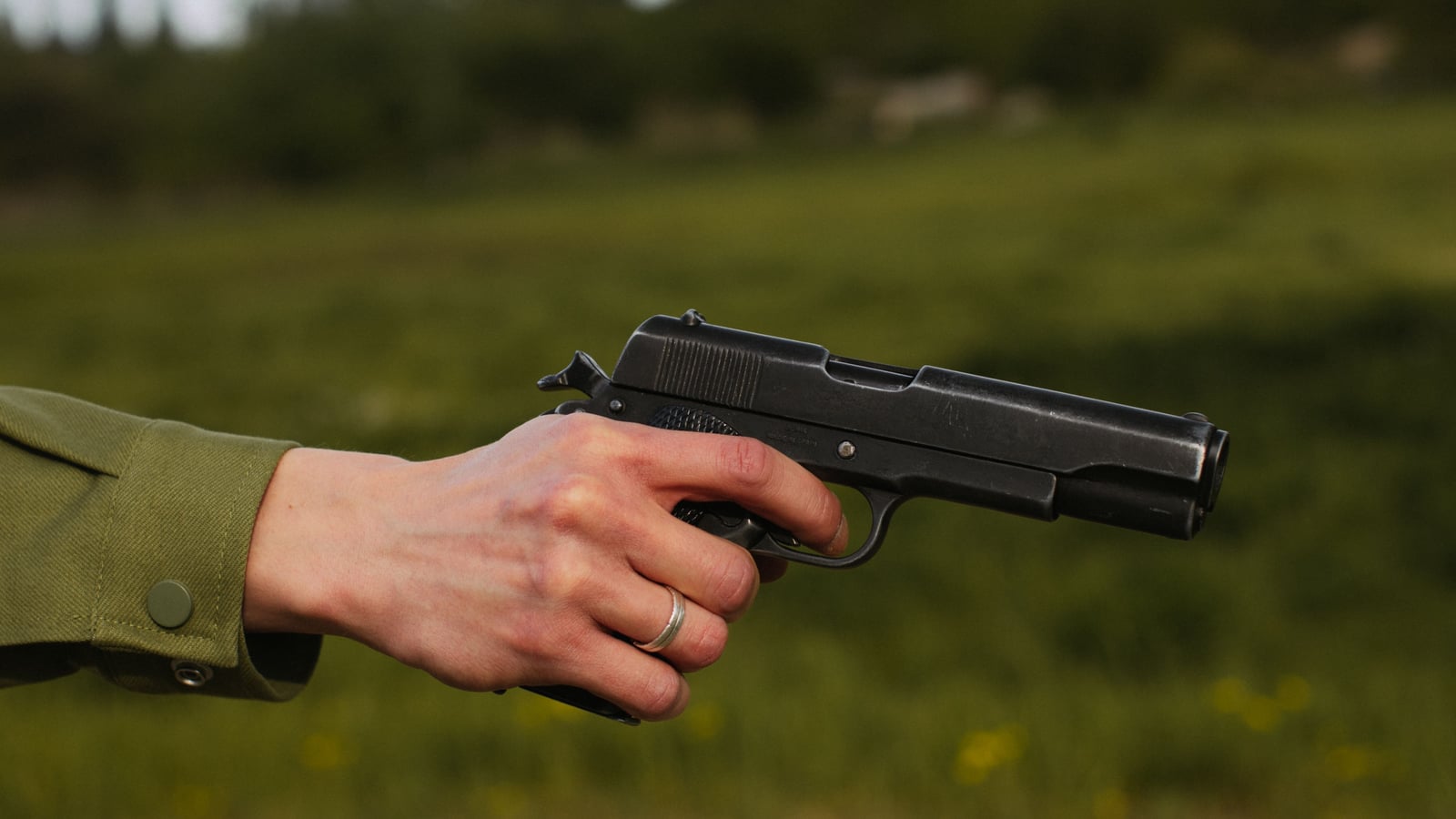
A blind spot that says a lot
Ask a club shooter to show you their 10-meter group with their strong hand, then with their weak hand. In the vast majority of cases, the second group tells a very different story: double or even triple the dispersion, visible tremor, longer aiming time. It’s no surprise, but it reveals an imbalance that few shooters actually work on.
Weak-hand shooting isn’t a circus trick or an instructor’s whim to complicate the session. It’s a brutal reveal of everything your strong hand compensates for without you noticing: insufficient core tension, poor trigger control, badly timed breathing, approximate sight alignment. When the dominant hand does the work, it masks these gaps through habit and strength. The weak hand doesn’t have that crutch.
This isn’t specific to any particular skill level. A beginner discovers their weak hand as completely uncharted territory, with no reference point at all. An experienced shooter, on the other hand, often discovers with surprise that years of experience on the strong side transfer only partially to the other side — which says a lot about how much of a supposedly well-understood, intellectually mastered movement is actually pure, non-transferable automatism.
Many clubs and instructors now see this work as a marker of technical maturity rather than a mere gimmick. A shooter who takes it on seriously often ends up, without meaning to, doing a full audit of their own base technique, because every flaw hidden by the strong hand’s automatism resurfaces immediately and without filter on the weak side.
This article covers why this work deserves a real place in your progression, what’s happening physiologically and technically, how to structure progressive training without hurting yourself or burning out, and why certain sport disciplines have turned it into a full-fledged test rather than an optional exercise.
Muscular symmetry: much more than a question of looks
Sport shooting engages a very specific set of stabilizing muscles: deltoids, forearms, wrist, but also the postural chains of the back and abs that hold the overall body position. A shooter who only practices with their strong hand develops these muscle groups asymmetrically, session after session, year after year.
This asymmetry isn’t just about silhouette. It has direct consequences on overall posture, on the fatigue felt at the end of a session, and sometimes on chronic pain in the shoulder or wrist on the dominant side, which systematically absorbs the entire shooting volume. An experienced instructor sees this regularly in shooters who go years without ever varying their grip.
Working the weak hand rebalances this load. It’s not about achieving perfect symmetry between the two sides of the body — a right-handed shooter will always be stronger and more precise with their right hand — but about reducing the gap so the whole body works more evenly. Over the long term, this reduces the risk of tendinitis and postural pain linked to overusing a single side.
There’s also an interesting side effect on the strong hand itself. Many shooters report that after several weeks of weak-hand work, their dominant hand gains precision, simply because the brain had to consciously relearn movements it previously executed on an imperfect autopilot. This feedback comes up often among experienced practitioners, even if it remains hard to quantify rigorously.
Purely physiologically, it’s also worth remembering that the human body is never perfectly symmetrical to begin with, independent of shooting. Hand dominance often comes with eye dominance, a slight strength difference between the two sides of the body, and sometimes a pre-existing postural asymmetry linked to other activities (job, another sport, an old injury). Weak-hand work in sport shooting doesn’t claim to erase this natural asymmetry, but it avoids making it worse through a practice that would otherwise mechanically reinforce it session after session.
Some sports physiotherapists, consulted by clubs for postural assessments, note that shooters who have practiced exclusively with their strong hand for many years sometimes show slightly shortened muscle chains on one side of the back and shoulders. This finding remains individual and doesn’t apply to every practitioner the same way, but it concretely illustrates why the partial symmetry brought by weak-hand work goes beyond mere shooting comfort.
Versatility: anticipating the unexpected
A shooting sport is never limited to a single scenario. A malfunction, a fall, a temporary physical constraint (a locked wrist, a fatigued shoulder) can force a shooter to continue with their non-dominant hand, even in pure recreational shooting. A shooter who has never trained for this configuration finds themselves helpless at the worst possible moment, whereas even limited training is enough to maintain a minimal level of control.
This versatility also has pedagogical value. A shooter who can shoot with both hands understands the fine mechanics of their movement better, because they have to consciously rebuild it on the weak side instead of reproducing it automatically. This understanding then feeds back into the analysis of their own flaws with the strong hand.
Finally, there’s a less-highlighted practical dimension: some shooters develop, with age or after an injury, a lasting or permanent limitation of their dominant hand. Those who already have some technical background with the weak hand go through this transition with far less loss of level than those who discover everything at that moment, in an already difficult context.
This versatility also echoes in initial training. An instructor teaching a complete beginner has every reason to introduce, even modestly, a few dry-fire repetitions with the non-dominant hand from the very first theoretical sessions. At this stage, neither hand has yet developed strongly ingrained automatism, which makes learning more natural and less marked by the direct comparison that often penalizes more experienced shooters when they take it up late.
Finally, there’s a knowledge-sharing dimension within a club or practice circle: a shooter capable of shooting cleanly with both hands can literally lend a hand to demonstrate a movement to another left- or right-handed practitioner as needed, without having to abstractly describe a movement they only master on one side. This demonstration role remains anecdotal, but it illustrates well that versatility goes beyond purely individual benefit.
What actually changes in the movement
Switching to the weak hand disrupts several reference points that the strong hand had long since automated. The first is the grip: the distribution of finger pressure on the frame or grip changes completely, and you have to empirically find a grip that’s neither too loose nor too tight.
The second disrupted reference point is sight alignment. Many right-handed shooters, shooting left-handed, tend to slightly shift their head or misalign their dominant eye with the sight line, simply because the overall body posture is no longer the same. This phenomenon is amplified if the shooter has never clearly identified their dominant eye beforehand — a point worth checking before even starting this work.
The third reference point is trigger control. With the weak hand, the index finger (or the finger used) doesn’t have the same strength or fine dexterity. The classic risk is jerking the trigger instead of pressing it progressively, which deviates the shot downward or sideways depending on the grip. This is often the point that takes longest to correct, and the one requiring the most dry-fire repetitions before moving to live ammunition.
Finally, breathing and torso positioning also need to be reworked, because overall posture changes slightly when the weak hand is the one supporting the weight of the firearm and managing the aim. A shooter who neglects this aspect finds the same parasitic tension as a complete beginner, despite having years of experience on the other side.
A fifth reference point, often forgotten because it’s very subtle, concerns the body’s natural point-of-aim. With the strong hand, years of practice have unconsciously calibrated foot angle, torso rotation, and shoulder position so the muzzle naturally points at the target without any corrective effort. This calibration doesn’t yet exist on the weak side: the shooter has to consciously rebuild this overall body alignment, often adjusting foot position more noticeably than they expected to need to.
A sixth technical point concerns managing perceived recoil. Many shooters report a more pronounced sensation of recoil with their weak hand, even though the firearm and ammunition are strictly identical. This perception most likely comes from a less firm grip and less well-calibrated anticipation, two parameters that improve with practice rather than with a change of equipment.
Structuring progression without getting discouraged
The biggest mistake a shooter starting this work makes is wanting to immediately match the level of their strong hand. Discouragement comes from this direct comparison, which makes no sense: the two hands don’t have the same neuromuscular history, and it would be illusory to expect such rapid progress.
A realistic progression starts with dry-fire exercises, without ammunition, to rework only the grip, sight alignment, and trigger movement. This phase, often neglected because it seems tedious, conditions everything that follows. A shooter who jumps straight to live fire with a poorly prepared weak hand reinforces bad reflexes instead of correcting them.
Next comes short-distance work, on a simple cardboard target, aiming for grouping rather than score. The idea is to progressively tighten the dispersion before seeking speed or distance. An experienced club shooter often advises not exceeding about thirty rounds per session with the weak hand at the start, to avoid the fatigue that degrades the quality of the movement faster than on the dominant side.
Once a coherent group is achieved at short distance, distance can be increased progressively, accepting that the pace of progress will be slower than with the strong hand. It’s counterproductive to force the same rate of progress on both hands: the body needs more repetitions to automate a new movement than to refine one already acquired.
A final, more advanced stage involves integrating elements of time management or mid-series hand switches, but only once the basic weak-hand movement is stable and reproducible. Skipping this step only reproduces the same errors at a faster pace, without correcting them.
A concrete, simple benchmark used by several instructors is to move on to the next step only when two consecutive sessions show a comparable group, with no regression. This objective criterion avoids progressing too fast based on the flattering impression of a single good session, which could simply be down to luck or a particularly good day rather than a genuine, stable technical gain.
It’s also recommended to alternate, within the same training period, sessions entirely dedicated to the weak hand with mixed sessions where it only comes in as a complement to the strong hand. This alternation avoids the fatigue of an always-identical exercise while maintaining enough practice frequency to avoid losing gains between sessions spaced too far apart.
Frequency and dosage: the key to consistency
Contrary to a common belief, you don’t need to devote half of every session to the weak hand to make progress. Modest but constant consistency gives better results than a one-off intensive session followed by several months without practice. The neuromuscular system needs repetitions spaced out over time to consolidate a new motor pattern.
A common approach is to reserve a fixed portion of each session — say, a tenth to a fifth of the ammunition volume — exclusively for the weak hand, without variation from one session to the next. This consistency allows you to follow a genuine progress curve instead of a constant back-and-forth between isolated attempts.
It’s also useful to vary dry-fire exercises outside of shooting sessions: handling the unloaded, checked firearm to rework grip and sight alignment without consuming ammunition or range time. This complementary work speeds up the automation phase at no extra cost.
The ammunition budget is often the most concrete constraint for many club shooters, especially in a context where prices vary and you have to work with what your personal budget allows. This varies by club, discipline, and local pricing, so it’s hard to give a universal figure here — but the idea of reserving a fixed proportion rather than a fixed volume of the budget helps maintain this consistency even when the total available ammunition volume fluctuates from month to month.
The calendar dimension of this consistency shouldn’t be neglected either. A shooter who practices once a month won’t achieve the same consolidation as one who practices every week, even with an identical cumulative ammunition volume over the year. The number of sessions often matters more than the total number of rounds fired when it comes to consolidating a new motor pattern.
From exercise to test: weak-hand shooting in IPSC
In certain dynamic disciplines like IPSC, weak-hand shooting is no longer just a preparation exercise: it becomes a course constraint explicitly imposed by certain shooting scenarios. The rules can require the shooter to engage a series of cardboard targets or steel plates exclusively with the weak hand, sometimes after a simulated malfunction or a position change mandated by the course.
This requirement transforms weak-hand practice: it’s no longer just a technical bonus, it becomes a direct scoring factor. A shooter who has never seriously trained this skill loses considerable time on these course phases, with misses that heavily penalize the final score, not to mention the penalty factor applied for hits outside the scoring zone.
This competitive reality explains why many IPSC practitioners integrate weak-hand work well ahead of the competition season, not just in the weeks before an event. The consistency mentioned above takes on very concrete meaning here: a shooter who neglects this point often discovers their weakness at the worst possible moment, in the middle of a timed course, in front of a judge and other competitors.
Beyond IPSC, this logic is found in other dynamic formats like Steel Challenge, where certain stages also require a hand switch mid-series. The philosophy remains the same: versatility isn’t a nice-to-have, it’s an evaluated, timed skill.
It’s also worth noting that these rule constraints vary from one organization to another and sometimes change from one season to the next. A shooter preparing for a specific competition would do well to check the current rules with their club or the relevant federation rather than relying on a rule learned several seasons ago that may have changed since.
Equipment and setup: what actually matters
Contrary to a common belief, it’s almost never necessary to invest in specific equipment to work the weak hand. The vast majority of modern handguns are designed symmetrically or nearly symmetrically, allowing indifferent use of either hand without modification.
The main point to watch concerns the sights themselves. A red dot or an iron sight well set up for strong-hand use remains valid for weak-hand use, since the adjustment concerns the projectile’s trajectory and not the hand holding the firearm. What does change, however, is your ability to quickly find the red dot or the sight alignment in your field of view, which depends mostly on your practice, not the equipment.
For rifles, the question is a bit different because some stocks are shaped with a cheek weld oriented for a specific shoulder, notably on high-end precision models. In this case, switching shoulders can noticeably degrade cheek-to-stock contact and thus the repeatability of the sight picture. A shooter who regularly practices both sides with this type of firearm has to accept a comfort compromise on the weak side, unless they invest in an ambidextrous or adjustable stock, which remains a budget decision to weigh against your practice.
On the safety side, one detail deserves mention for side-ejection firearms: the ejection direction of the casings changes trajectory relative to your face depending on which hand is used. This point should be checked before any weak-side session, making sure nothing in your posture or head position needlessly exposes you to the path of ejected casings. An experienced instructor always insists on this point during the first weak-hand sessions with a semi-automatic firearm.
Tracking your progress over time
One of the classic traps of weak-hand work is never objectifying your progress, and thus losing motivation for lack of concrete reference points. Systematically noting your groups, distances, and shooting conditions lets you visualize a real progress curve, even a slow one, rather than relying solely on a one-off impression inevitably biased by fatigue or the day’s mood.
This tracking discipline connects to a broader practice already common among serious shooters for their strong hand: logging every session (discipline, distance, firearm, ammunition, conditions, result) in a shooting log, whether paper or digital. Applying this same rigorous tracking to the weak hand avoids the pitfall of a snap judgment (“I’m bad on this side”) that rests on nothing measurable and discourages more than it helps.
Structured tracking also lets you spot stagnation plateaus before they become discouraging. A shooter who sees, over several sessions, that their group is no longer tightening can consciously adjust one specific parameter — distance, pace, warm-up, ammunition volume — rather than continuing to repeat an exercise that no longer produces progress.
Finally, this tracking has an added benefit: it lets you objectively compare, over the long term, the gap between the strong and weak hand, and observe that it genuinely narrows with consistency, even if the full gap never disappears entirely. This numerical proof, even a modest one, sustains motivation far better than a simple subjective impression from one session to the next.
Common mistakes to avoid
The first mistake, already mentioned, is directly comparing the performance of both hands and getting discouraged by the gap. This comparison brings nothing constructive and often pushes toward premature abandonment of the exercise.
The second mistake is wanting to speed up the rate of fire with the weak hand before achieving a stable group. Speed should never take priority over precision during this learning phase, at the risk of reinforcing flaws instead of correcting them. An experienced instructor often reminds that one slow, clean shot is worth more than ten fast, scattered ones.
The third mistake is neglecting safety during this learning phase. A less coordinated weak hand increases the risk of imprecise firearm handling, particularly during reloading or position changes. It’s essential to consciously slow down these phases as long as dexterity hasn’t been acquired, and to stay especially attentive to muzzle direction at all times.
The fourth, more subtle mistake is neglecting the specific warm-up of the weak side’s wrist and forearm before starting. This limb, less used day to day, can tire or tense up faster than the dominant side, degrading the quality of the movement from the very first shots if no warm-up has been done.
A fifth mistake is working the weak hand only at the end of a session, once general fatigue has already set in. While this approach has value in getting the body used to shooting while fatigued, it shouldn’t be systematic: a shooter who only practices their weak hand while tired unconsciously associates this practice with lower quality, which biases their perception of their actual progress on the movement itself.
A sixth, rarer but real mistake is mechanically imitating the strong hand’s movements without adapting them. Some shooters try to reproduce, mirror-image, exactly what they naturally do on the other side, even though morphology and strength aren’t symmetrical. A personal adjustment, sometimes different from simple symmetry, often gives better results than an overly rigid imitation.
Adapting the work to the discipline you practice
Weak-hand work isn’t structured the same way depending on whether you practice precision shooting, dynamic shooting, or recreational shooting. In precision, the emphasis is almost exclusively on stability and grouping, with no time constraint. In dynamic shooting, you need to integrate a speed-of-positioning component very early on, or you’ll never be ready for a timed course.
For a recreational or beginner shooter, the goal is more modest and mainly oriented toward safety and enjoyment: being able to shoot cleanly with both hands, without necessarily aiming for competitive performance. This approach remains beneficial nonetheless for the muscular symmetry and general versatility mentioned above.
For rifle shooters, the logic differs slightly from that of the handgun: the supporting shoulder entirely changes body posture, which often requires additional adaptation time compared to the handgun, where only the hand and wrist really change roles. A rifle shooter who switches shoulders also has to rethink the alignment of their dominant eye, which can be destabilizing in the first sessions.
For clay shooting, the question arises differently again: the mount is done with the shotgun set on the dominant-eye side, and switching sides means completely rethinking moving-target tracking, not just the static grip. A clay shooter who tries shooting off the non-dominant shoulder often discovers that their trajectory anticipation, built up over years of repetition on just one side, doesn’t transfer automatically — they have to rebuild their swing timing almost from scratch.
For regulation and historical disciplines (service rifle, black powder), the slower rate of fire and the highly codified movement leave more room to integrate weak-hand work without disrupting the logic of the event itself. This is often an appreciated training ground for gently introducing this work before transposing it to disciplines that demand more speed.
The mental side of this learning process
Weak-hand shooting tests something other than pure technique: patience and acceptance of temporary regression. An experienced shooter who has gotten excellent groups with their strong hand for years often struggles with returning to mediocre results, even while rationally knowing it’s normal for a new movement.
This frustration, if not anticipated, pushes shooters to cut sessions short or return too quickly to the strong hand to “reassure themselves.” An experienced instructor often advises ending every weak-hand sequence on a successful shot, however modest, rather than stopping mid-failure — memory of the last repetition weighs more heavily on motivation than the session’s average.
It’s also useful to mentally disconnect this exercise from the usual notion of performance. A shooter who approaches their weak hand with the same demands as their strong hand puts unnecessary pressure on themselves. Considering this practice as genuine, distinct learning, with its own progress milestones, helps sustain motivation over time — the progress stages don’t need to be identical or comparable term for term.
Another underestimated mental aspect is the concentration required at the very start. What has become unconscious automatism with the strong hand becomes, again, a sequence of conscious decisions with the weak hand: positioning fingers, checking alignment, controlling breathing, pressing the trigger. This heavier mental load tires you faster, which is one more reason to keep sessions short at the start.
Complementary exercises and club-based transmission
Weak-hand work isn’t limited to sessions with ammunition. Simple dexterity exercises, done at home or before the session, prepare the ground: repeated handling of an object with a grip similar to the frame or grip, wrist-bracing exercises, or simple everyday ambidexterity (writing, eating, opening a door) with the non-dominant hand to get the brain used to engaging that side.
Dry practice, with the firearm systematically unloaded and checked before any handling, remains the most effective and least costly tool for progressing quickly. Repeating the mount, sight alignment, and trigger pressure dry, several times a week outside the range, clearly speeds up the automation phase without consuming a single round or any range time at the club.
Some shooters also use a simple laser trainer or a sight-tracking app to visualize in real time the stability of their weak-side hold during dry-fire exercises. This immediate visualization helps correct micro-tremors that would otherwise remain invisible, even before moving to live fire.
Targeted, moderate muscle strengthening can also accompany this work: a few wrist and forearm exercises adapted to shooting practice, done outside of sessions, reduce early fatigue on the weak side and allow for holding a stable movement quality longer. A sports professional or physiotherapist remains the best resource for calibrating this work to your morphology and any prior history.
This individual work also benefits from being shared collectively. Instructors who integrate weak-hand shooting into their group sessions report an interesting effect on group dynamics. The most experienced shooters, often used to shining on classic exercises, suddenly find themselves on relatively equal footing with more recent practitioners, because no one has a built-up advantage on this side. This shift often creates positive emulation and unusual mutual support on this specific point.
Pedagogically, an experienced instructor generally introduces this work in small doses, at the end of a session, when strong-hand fatigue naturally invites some variety. It’s also a good moment to introduce the exercise without linking it to the pressure of the session’s main performance, which helps more anxious shooters take it up without excessive apprehension.
A classic group exercise is organizing a small friendly grouping contest, weak-hand only, on a cardboard target, at reduced distance. The absence of real stakes and the playful setting defuse the individual frustration mentioned above, and often let shooters progress faster than working alone in their corner under self-imposed pressure.
Some clubs also organize dedicated time slots, particularly to prepare shooters for dynamic disciplines where hand switching is a rule component. These slots often combine dry fire at the start of the session, then progressive live fire, supervised by an instructor or experienced shooter who can correct grip or alignment flaws specific to the weak hand in real time.
FAQ
Q: How long does it take to make significant progress with the weak hand? A: This varies enormously depending on the shooter, training frequency, and discipline practiced. A clear feeling of improvement generally appears after several weeks of regular work, but it’s better to stay general on this point rather than give a precise figure.
Q: Should you work the weak hand from the very start of sport shooting? A: It’s better to first consolidate a solid technical base with the strong hand before adding this difficulty. An experienced instructor can nonetheless introduce a few dry-fire repetitions very early on, without any pressure for results.
Q: Is weak-hand shooting mandatory in all IPSC competitions? A: No, it depends on the scenario of each course (“stage”), defined by the organizer in compliance with the discipline’s rules. Some stages explicitly require it, others don’t, but a regular competitive shooter will face it sooner or later.
Q: Can you get injured training with your weak hand? A: The main risk isn’t an injury related to shooting itself, but less safe firearm handling due to a lack of initial dexterity. Consciously slowing down handling phases and strictly following basic safety rules reduces this risk.
Q: Do you need to change equipment (firearm, optic) to shoot with the weak hand? A: Generally no, the same firearm works for both hands, especially for handguns. For some highly customized rifles (stock adjusted for a specific shoulder), an adjustment or adaptation may be needed, but this varies by model and should be assessed case by case.
Q: Does the weak hand progress faster for an already experienced shooter than for a complete beginner? A: An experienced shooter benefits from technical reference points already acquired (overall posture, breathing, sighting concepts) that they can partially transfer to the weak hand, which often speeds up certain aspects. The fine dexterity of the weak side still has to be rebuilt almost entirely, regardless of the shooter’s level otherwise.