
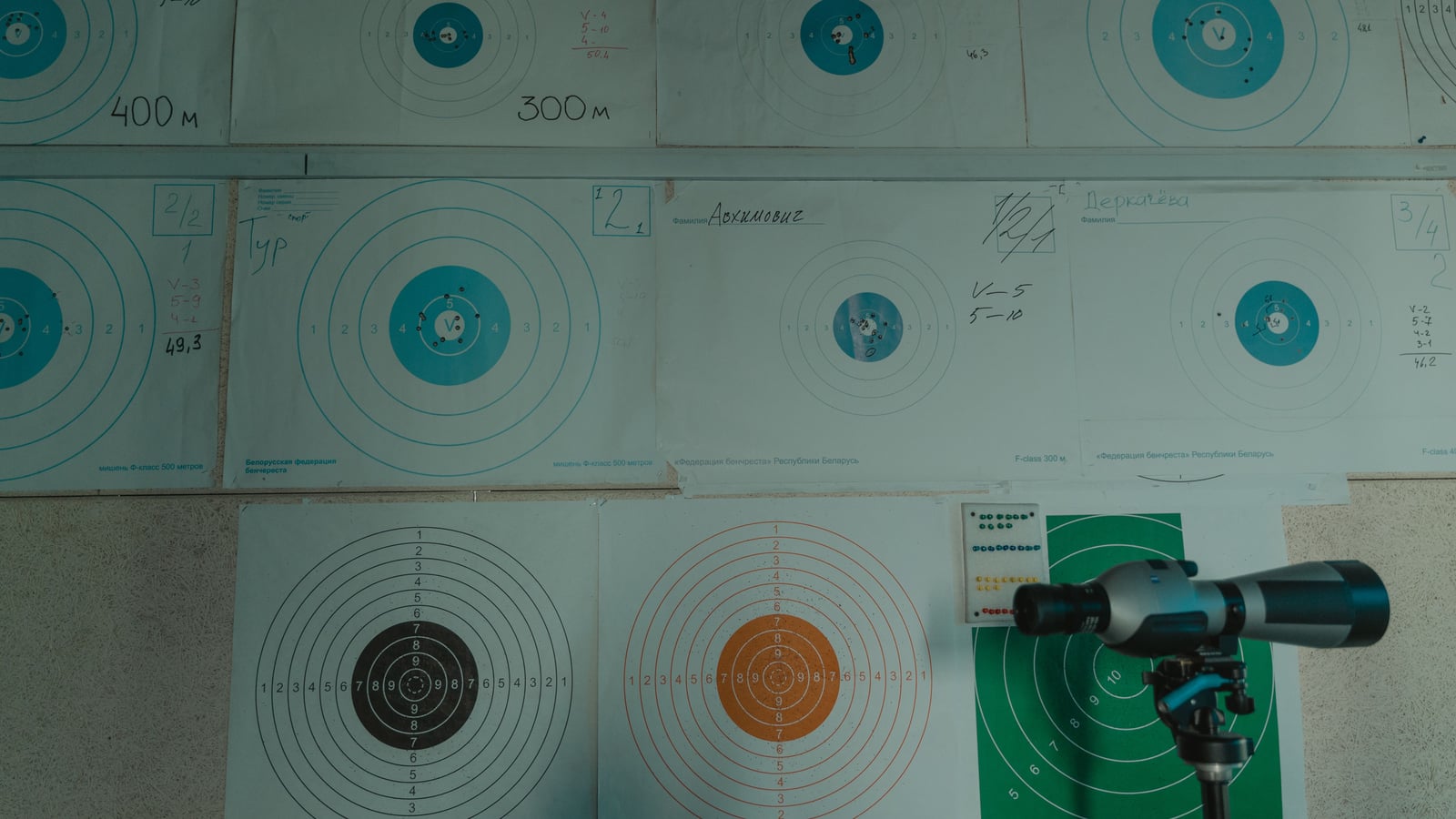
The ballistic coefficient, a widely misunderstood concept
The ballistic coefficient (BC) keeps coming up in long-range shooting conversations, often poorly explained and even more often misused. Many shooters know that a “high” BC is a sign of “good” ammunition, without ever understanding what this number actually measures.
Simply put, BC expresses a projectile’s ability to retain velocity and resist air resistance in flight. The higher this number, the slower the projectile decelerates and the less it drifts under wind, at equal muzzle velocity. It’s an indicator of shape and mass, not an indicator of power or manufacturing quality.
This number only makes sense in a specific context: beyond 200-300 meters, when trajectory drop and wind drift start to weigh heavily on the result. Below that distance, in most club-practiced shooting sports disciplines, BC has little influence on the visible result on target. That doesn’t mean it’s useless to know, it means you need to know when it actually matters.
The classic mistake is reducing ammunition choice to caliber alone, thinking that a “bigger” or “faster” caliber is automatically better at long range. That’s wrong: two ammunitions of different calibers can behave very similarly in flight, or conversely very differently, depending on the actual shape of their respective projectiles. Caliber tells you the diameter. BC tells you how the projectile moves through the air.
This confusion partly comes from the common vocabulary used at the range and in discussions between shooters, where “powerful” is used indiscriminately to describe a caliber with heavy recoil, a loud round, or a round that carries far. Yet these three notions have no automatic mechanical link between them. A round can have moderate recoil and excellent long-range behavior, or the reverse.
BC deserves to be approached as a tool for understanding rather than a number to maximize at all costs. A shooter seriously progressing in precision shooting gains more from understanding why two rounds behave differently than from memorizing a list of BC values without the context that makes them useful. It’s this understanding that later enables informed choices rather than following a trend or a generic recommendation picked up online.
This guide unfolds precisely this logic in order: first what the number actually represents, then how it acts on trajectory and wind drift, then how to use it concretely to choose ammunition suited to your discipline and your practice distances.
What BC concretely measures
The ballistic coefficient compares a real projectile’s ability to retain velocity relative to a theoretical reference projectile, called the standard projectile, whose shape has been standardized by convention. A BC of 0.5 means your projectile decelerates about twice as slowly as this reference projectile under the same air conditions.
Two major calculation conventions coexist on the market: the G1 model, originally designed for more classic flat-base projectile shapes, and the G7 model, more representative of modern projectiles with long ogives and tapered (“boat-tail”) bases, typical of long-range precision shooting. The same physical projectile will have a different G1 BC than its G7 BC, because the reference projectile changes between the two models.
This point is a constant source of confusion: comparing one ammunition’s G1 BC to another’s G7 BC amounts to comparing quantities that don’t speak the same language. To compare two loads against each other, you must absolutely use the same calculation convention on both sides, otherwise the comparison is meaningless.
The manufacturer generally states in its documentation which convention was used for the advertised figure. In case of doubt or missing information, it’s better to look for the manufacturer’s full technical data sheet than to guess, or to go with ammunition whose documentation is clear on this point.
There are also older or more rarely used reference models (G2, G5, G6, G8, among others), each originally designed for a different family of projectile shapes. In practice, the general public in civilian sport shooting almost exclusively encounters G1 and G7 on commercial data sheets, the other models remaining mostly reserved for highly specialized or historical ballistic uses. You don’t need to know them all, but knowing they exist explains why some tools or older documents sometimes display an unexpected third convention.
A simple way to remember the difference between G1 and G7: G1 was for a long time the default reference, even for projectile shapes that didn’t really match it well, simply because it was historically the most widespread convention. G7 gained popularity as long boat-tail projectiles became more common, precisely because it fits this type of shape better and gives more reliable predictions for those projectiles. It’s not that one of the two models is “better” in absolute terms, it’s that you need to choose the one that best matches the actual shape of the projectile being studied.
Why BC depends on shape, not just weight
The most common reflex is to associate high BC with a heavy projectile. That’s a partial but misleading correlation: mass matters, but the projectile’s shape weighs at least as much in the final result.
A long, tapered projectile with a pointed ogive and boat-tail base retains its velocity better than a short flat-base projectile of comparable mass. Shape determines how much the air “grips” the projectile in flight and slows it down. It’s exactly the same logic as an aerodynamic water droplet compared to a cube of the same volume.
The material and mass distribution inside the projectile also play a role. A projectile with a well-positioned center of gravity keeps a more stable trajectory, which limits energy loss from excessive oscillation in flight (the precession phenomenon, linked to the gyroscopic stabilization given by the spin imparted by barrel rifling).
Concretely, this means a lighter but better-profiled projectile can have a higher BC than a heavier projectile with a less refined shape. That’s why long-range precision ammunition relies as much on ogive design as on raw projectile weight.
The tip of the projectile also plays a specific role. Some modern projectiles include a polymer tip rather than a classic metal tip, notably to limit deformation of the projectile’s tip during transport or loading, since even minimal deformation can degrade the actual BC compared to the theoretical design BC. This polymer tip doesn’t fundamentally change the physics at play, but it helps preserve the projectile’s original shape until the shot is fired.
The projectile’s diameter relative to its length, sometimes called its slenderness ratio, also influences BC. A projectile that’s thin and long for its caliber structurally has more potential for a high BC than a short, stubby projectile of the same caliber, provided in-flight stabilization remains adequate. This is one reason why two loads of the same nominal caliber can display very different BCs depending on the projectile design chosen by each manufacturer.
You also need to distinguish the shape of the ogive at the front of the projectile from the shape of its base at the rear. A flat base creates a more pronounced turbulence zone right behind the projectile in flight, which increases overall drag. A boat-tail base reduces this turbulence and improves BC, which explains why nearly all projectiles designed specifically for long range adopt this type of base, sometimes at the cost of slightly more complex manufacturing and therefore a somewhat higher purchase price.
The effect of BC on trajectory drop
Trajectory drop is the vertical distance your projectile loses to gravity between the muzzle and impact. It exists regardless of BC, but a higher BC lets the projectile retain sufficient velocity longer, thereby limiting flight time and thus limiting accumulated drop.
Two rounds fired at the same muzzle velocity but with different BCs won’t have the same drop at 300 meters. The one with the higher BC will “drop” less, simply because it maintains a flatter trajectory over distance, at equal starting velocity.
This phenomenon intensifies with distance: the drop gap between two different BCs stays minimal at 100 meters but becomes clearly visible at 400 or 500 meters. This is one reason BC becomes a serious selection criterion only once the practiced discipline exceeds short distances.
A shooter who compares two loads solely on their advertised box velocity, without looking at BC, may be surprised by very different correction tables between the two, even though the starting velocities seemed close. Muzzle velocity and BC act together, not one without the other, on the final shape of the trajectory.
Another less often mentioned effect concerns the projectile’s residual velocity at impact. A higher BC not only limits drop but also retains more kinetic energy at a given distance, since the projectile slows down more slowly throughout its flight. For certain precision disciplines that require a minimum impact energy threshold, this factor can have concrete importance beyond the trajectory question alone.
You also need to understand that trajectory drop is never linear relative to distance: it accelerates as the projectile slows down, because a slower projectile spends more time covering each subsequent distance increment, and therefore drops more over that increment under gravity, which itself remains constant. This is why a ballistic solver remains indispensable as distance increases: a simple rule-of-three between two known distances never faithfully reproduces this increasing curvature.
Finally, a point that often surprises shooters discovering external ballistics for the first time: the real trajectory is never a simple symmetrical curve. Zeroing your scope or sighting system at a given zero distance (often 100 meters) creates a trajectory that passes slightly above the line of sight at intermediate distances, before dropping back below it beyond a certain distance. BC influences the exact shape of this curve, which makes a properly calibrated solver all the more useful compared to eyeballing an estimate.
The effect of BC on wind drift
Crosswind pushes the projectile off its intended trajectory throughout its entire flight time. The longer this flight time, the more opportunity wind has to accumulate drift. A high BC shortens this flight time at a given distance, which mechanically reduces the drift experienced.
This is often where BC is felt most in practice, more than on vertical drop. Two loads with the same muzzle velocity but different BCs can produce wind drift differences of several centimeters at 300-400 meters, for the same given crosswind.
This explains why some long-range precision shooters deliberately favor ammunition with a higher BC, even at the cost of sacrificing a bit of muzzle velocity or purchase cost. The trade-off is justified as soon as wind becomes a factor that’s difficult to control or estimate at the firing line.
You should also keep in mind that real wind on a range is almost never uniform over the entire trajectory: it can vary in strength and direction between the muzzle and the target, especially on hilly terrain or in the presence of obstacles (trees, buildings, terrain features). A high BC limits the impact of this variability, but never fully cancels it out. No ammunition, however high-performing, replaces a good wind read on the range.
Headwind or tailwind, unlike crosswind, has almost no effect on lateral drift but slightly influences total flight time and thus drop. A headwind very slightly slows the projectile and therefore marginally increases drop, a tailwind produces the opposite effect. These effects generally remain secondary compared to those of a crosswind of the same strength, but a rigorous shooter keeps them in mind on terrain where wind blows along the line of fire rather than perpendicular to it.
The notion of wind angle further complicates matters: a wind blowing at an intermediate angle between pure crosswind and headwind or tailwind produces only a fraction of the effect of a full crosswind, proportional to that angle. Many ballistic solvers precisely require specifying this angle in addition to wind strength, precisely because a 45-degree wind doesn’t deflect the projectile the same way as a perpendicular wind of the same intensity.
A higher BC also indirectly helps limit the margin of error in wind estimation itself. Since real wind is almost always estimated rather than precisely measured over the entire trajectory, ammunition less sensitive to wind thanks to a good BC forgives an imperfect estimate more. That’s one more argument in favor of a high BC for a shooter practicing on terrain where wind is hard to read, for example in the presence of unpredictable local turbulence.
BC and ballistic solvers: an input, not a guarantee
Ballistic calculation apps and custom scope turrets use BC as one of the main input values, along with muzzle velocity, to produce a correction table. An error in the BC entered into the solver directly affects the accuracy of every calculated correction.
The classic trap is blindly entering the BC advertised by the manufacturer on the box, without verifying it. This figure is often measured in a lab under standardized conditions that never exactly reproduce real shooting conditions (altitude, temperature, the day’s atmospheric conditions). The gap between the advertised BC and the actual BC observed in the field can be enough to shift a correction by several centimeters at long range.
Some advanced Doppler radar chronographs allow measuring the projectile’s actual deceleration over part of its trajectory, which makes it possible to calculate a real BC specific to your weapon-ammunition-day’s-conditions combination, rather than relying solely on the manufacturer’s theoretical value. That’s a real gain in accuracy for anyone pushing precision beyond 500 meters.
Failing that equipment, the most accessible method remains the verification shoot: fire a group at a known distance, compare the actual observed drop to the drop predicted by the solver, then slightly adjust the BC entered into the app until the prediction matches the observation. This empirical calibration, while rough, remains more reliable than blindly trusting a figure printed on a box.
Most modern ballistic solvers also offer a so-called “multi-BC” model, or a model segmented by velocity band, rather than a single BC constant across the whole trajectory. This refinement accounts for the fact that a projectile’s actual aerodynamic behavior changes slightly depending on whether it’s still flying supersonic or transitions back to transonic as it slows down. For very long distances, this level of detail can make a measurable difference in the final prediction.
A practical point of caution: two different solvers, even fed with exactly the same input data (BC, velocity, conditions), can produce slightly different results because they don’t use exactly the same underlying mathematical drag model. This isn’t an anomaly, it’s a normal limitation of ballistic modeling. The only way to settle between two slightly diverging solvers always remains comparison against a real verification shoot in the field.
It’s also best to be wary of apps or tools that don’t let you specify whether the G1 or G7 convention is used, or that display no information about the drag model employed. A serious tool, even a free one, always clearly documents which convention it uses, allowing you to check consistency between the BC you enter and the model the solver expects.
The role of altitude and atmospheric conditions
The BC advertised on an ammunition box corresponds to reference atmospheric conditions, generally close to sea level with standardized temperature and pressure. The actual air density, which varies with altitude, temperature, and humidity, directly influences the resistance the projectile encounters in flight.
At high altitude, the air is less dense, resistance encountered by the projectile decreases, and the projectile’s effective behavior approaches that of a BC slightly higher than its nominal value. Conversely, cold, dense air increases resistance and brings behavior closer to a slightly lower BC.
The best ballistic solvers integrate these parameters (altitude, temperature, pressure, humidity) to automatically correct the BC’s effect based on the day’s conditions. This is one reason a firing table printed once and for all loses reliability if you change practice location or shoot in weather conditions very different from those under which the table was established.
A shooter who practices almost exclusively at the same range, at stable altitude and climate, will notice this phenomenon less than a shooter who travels between several competition venues at different altitudes. Documenting the conditions of each long-range outing, in addition to the BC used, helps explain why the same ammunition never behaves exactly the same from one range to another.
Humidity, meaning the moisture content of the air, plays a real but often overestimated role in shooters’ collective imagination. Contrary to a widespread misconception, more humid air is slightly less dense than dry air at equal temperature and pressure, because water vapor molecules are lighter than the nitrogen and oxygen molecules they partially replace. The effect generally remains modest compared to that of temperature or altitude, but the most complete solvers still factor it into their calculations.
Atmospheric pressure itself varies not only with altitude but also with the day’s weather, at a fixed altitude. A low- or high-pressure system passing over a range can change local pressure enough to slightly affect the finest long-range predictions. This is a factor that only very high-level long-range competition shooters actually monitor in detail, but it explains why some solvers ask for the actual pressure of the day rather than a simple approximate altitude.
For practical use in a club or regional competition, it’s not necessary to master all these parameters with scientific precision. Knowing these effects exist, and knowing that a well-informed solver handles them automatically, is largely sufficient for most practitioners. The main thing is to correctly enter altitude and, if possible, the day’s temperature, since these two parameters capture most of the real variation encountered in the field.
Choosing ammunition suited to your precision discipline
BC only has real value as a selection criterion if your discipline is practiced at distances where it actually changes something. Here’s how to gauge your own needs.
- Short- and medium-range precision disciplines (10 m, 25 m, 50 m): BC has very little influence on the visible result on target at these distances. Other criteria matter far more: lot manufacturing consistency, caliber-to-firearm suitability, primer quality.
- Precision rifle at intermediate distance (100 to 300 meters): BC starts to weigh on drop and drift, without becoming the sole criterion. Ammunition with a decent BC, combined with stable muzzle velocity and good lot consistency, remains a relevant choice.
- Long-range precision shooting (beyond 300-400 meters): BC becomes a front-rank criterion, to be weighed against muzzle velocity, the gyroscopic stability provided by your rifling twist rate, and projectile manufacturing consistency.
- Dynamic disciplines on cardboard targets or steel plates at short range: BC is nearly beside the point, priority goes to rate of fire, functional reliability, and consistency for a steady score.
An experienced club shooter starting out in long range often benefits from choosing ammunition with a decent BC but above all well-documented and stable from lot to lot, rather than ammunition boasting a record BC but with an uncertain reputation for consistency. A high BC on paper is useless if every manufacturing lot behaves differently in the field.
Available budget also influences this choice very concretely. High-BC ammunition, often designed with stricter manufacturing tolerances and more refined materials, generally costs more to buy than more conventional ammunition. For regular training use rather than competition, many shooters deliberately choose ammunition with a more modest but notably more affordable BC, reserving high-BC ammunition for outings where performance genuinely matters.
Handloading allows a different approach: rather than choosing among available commercial offerings, the handloader can select a specific projectile based on the BC advertised by the projectile manufacturer itself, independent of the complete cartridge. This approach requires more rigor and handloading skill, but opens up a wider range of possible combinations between projectile, powder, and primer to reach a given performance goal.
It’s also worth distinguishing real need from perceived need. A shooter who practices in a club at distances of 100 to 200 meters, but who occasionally considers entering a longer-range event, doesn’t necessarily need to change their entire usual practice for permanently high-BC ammunition. Dedicated ammunition for the occasion, tested and calibrated beforehand, may be enough without overhauling regular training.
BC and gyroscopic stability: an inseparable pair
A projectile with a high BC, often longer for its mass, requires sufficient spin to remain stable in flight. This spin depends on the barrel’s rifling twist rate (generally expressed as one full rotation over a given distance, for example 1 turn in 20 cm).
A barrel whose twist rate isn’t matched to the projectile’s length can produce insufficient stabilization, sometimes called an “under-stabilized” projectile. The most visible symptom is a group that degrades noticeably as distance increases, even though it looked fine at short range.
Concretely, this means a high BC only translates into real performance if the firearm used has a twist rate compatible with the length of the chosen projectile. Switching to ammunition with a higher BC without checking barrel twist compatibility can give a disappointing result, even worse than the previous ammunition.
Conversely, excessive stabilization (“over-stabilization”), rarer but possible with too tight a twist rate for a short projectile, can also slightly degrade accuracy by altering the projectile’s angle of attack in flight. This topic goes beyond ammunition choice alone and directly involves the choice or setup of the firearm itself. If in doubt about compatibility between a candidate projectile and your firearm’s twist rate, a gunsmith or ballistics specialist remains the best resource to settle the question rather than costly trial-and-error with ammunition.
The concept of the gyroscopic stability factor formalizes this question beyond simple intuition. This factor combines twist rate, muzzle velocity, projectile length and mass, and atmospheric conditions, to estimate whether a given projectile will be properly stabilized in a given firearm. Some online ballistic tools let you calculate this factor before even buying ammunition, avoiding investment in an entire lot only to discover a stabilization problem afterward.
A phenomenon linked to under-stabilization deserves to be known: “keyholing,” where the projectile strikes the target sideways rather than nose-first, leaving an elongated or oval-shaped impact instead of a regular round hole. This very clear visual symptom almost always signals a serious stabilization problem, well beyond a simple progressive group degradation. A shooter observing this kind of impact should immediately review the compatibility between their projectile and their firearm’s twist rate, rather than continuing to fire the same combination.
Ambient temperature also influences, more subtly, the actual stability factor, because air density changes with it and slightly alters the resistance encountered by the spinning projectile. A weapon-ammunition combination that’s just barely stable in warm weather can tip into slight under-stabilization in very cold weather, as denser air requires even more spin for the same level of stabilization. This is a rare but documented scenario among shooters practicing in extreme winter conditions with a combination already close to the stabilization limit.
Reading an ammunition data sheet without getting it wrong
Facing an ammunition data sheet, several pieces of information overlap and it’s easy to misinterpret them in isolation.
- The advertised BC: always check whether it’s a G1 or G7 model, the information should be specified, otherwise stay cautious about comparing with other ammunition.
- The advertised muzzle velocity: keep it in mind as a manufacturer reference value, ideally to be confirmed with your own chronograph on your firearm.
- The projectile mass: a useful reference point, but one that says nothing on its own about in-flight behavior without the associated BC.
- The projectile type: the shape of the ogive and base directly influences the actual BC, beyond the single advertised figure.
- The manufacturing lot: two lots of the same reference can show slight variations in actual BC, especially with mass-manufactured ammunition rather than custom handloaded lots.
Get into the habit of cross-referencing this information rather than trusting a single figure highlighted on the packaging or in an ad. Ammunition with a slightly lower BC but excellent lot consistency can give a more predictable result in the field than ammunition with a record BC but irregular.
Some data sheets present BC as a table across several velocities rather than a single value, which corresponds precisely to the multi-BC approach mentioned above. If this information is available, it’s generally more reliable than a single averaged value, particularly for ammunition explicitly intended for very long range where BC variation with velocity becomes significant.
It’s also worth checking whether the advertised BC was directly measured by the manufacturer on the actual projectile, or simply calculated theoretically from the projectile’s shape using modeling software. Serious manufacturers who use Doppler radar measurement under controlled conditions generally produce more reliable figures than those obtained by simple theoretical geometric calculation. This information isn’t always explicitly communicated, but the manufacturer’s overall reputation and transparency about its testing methods provides a useful indication.
Finally, don’t overlook feedback from other practitioners of your discipline, at the club or at regional meets, on the actual consistency observed with a given ammunition reference. A data sheet describes an expected average behavior, but the cumulative experience of several shooters across several lots over time often reveals nuances no single data sheet can capture.
Common misconceptions about the ballistic coefficient
Certain confusions come up regularly among shooters discovering this concept, both at the club and online.
- Thinking a high BC automatically guarantees better group precision on target: BC influences trajectory and wind sensitivity, not directly the mechanical dispersion of an ammunition lot.
- Comparing a G1 BC to a G7 BC without converting or checking the convention used, which invalidates any conclusion drawn from the comparison.
- Believing an ammunition’s BC stays rigorously identical regardless of flight velocity: in reality, a projectile’s actual BC varies slightly with its velocity (supersonic or transonic regime), which explains why the best solvers use BC models segmented by velocity range rather than a single constant value.
- Completely disregarding BC because you only shoot at short range: that’s broadly sound reasoning for immediate accuracy, but it prevents understanding the same ammunition’s behavior should you one day move to longer distances.
- Thinking that only a “big” caliber or “high” velocity makes a good long-range choice, while ignoring that projectile shape can offset or, conversely, cancel out this apparent advantage.
An experienced instructor at a long-range shooting club often points out that BC is a tool for understanding and prediction, not a general quality score to maximize under all circumstances. The right ammunition choice always depends on actual use, not on an isolated figure to optimize in absolute terms.
Another misconception deserves to be debunked: believing that high-BC ammunition automatically “fixes” poor shooting technique or an optical setup flaw. BC only acts on the theoretical trajectory of the projectile in free flight; it does nothing to compensate for poor scope alignment, a parallax error, or unstable hold at the moment of firing. Much progress wrongly attributed to a “miracle ammunition change” actually comes from an equipment adjustment corrected at the same time.
Some shooters also wrongly believe that a projectile’s BC is a fixed property set in stone by the manufacturer, when in reality it depends on the precise combination between that projectile and the actual flight conditions encountered. Two strictly identical examples of the same projectile, fired at different muzzle velocities depending on the firearm used, can display a slightly different actual BC, simply because they don’t pass through exactly the same velocity regimes in flight.
One last common confusion is thinking BC is tied to a price range, with the most expensive ammunition necessarily having the best BC. That’s not systematic: some premium ammunition mainly optimizes manufacturing consistency and group constancy at short and medium range, without aiming for a record BC, simply because that’s not its intended use. Price reflects overall manufacturing quality and consistency more than the BC figure alone.
Putting it into practice: from ammunition choice to real shooting
Understanding BC in theory is useless if that data never translates into concrete action on the firing line. Here’s a step-by-step approach to actually integrate it into your practice.
Start by identifying the actual distance at which you most often practice your precision discipline. If that distance stays under 200 meters, BC shouldn’t become your main ammunition selection criterion, other factors matter more for your immediate result.
If you’re moving toward longer distances, start systematically checking the advertised BC (with its G1 or G7 convention) on the ammunition you’re considering, cross-referencing it with muzzle velocity and lot consistency documented by the manufacturer or by feedback from other practitioners of your discipline.
Once ammunition is chosen, verify its actual velocity on your firearm with a chronograph rather than trusting the box figure, then calibrate your ballistic solver with that measured velocity. If you have access to a Doppler radar or the option of verification shoots at a known distance, adjust the BC entered in your solver until the prediction matches actual observation.
Finally, log every long-range outing in your shooting notebook: ammunition used, BC entered, atmospheric conditions, distance, and the gap between predicted correction and actual point of impact. This history quickly becomes more useful than any generic data sheet, because it reflects the actual behavior of your weapon-ammunition combination on your own practice grounds.
Also stay alert to changes in ammunition lot, even within a commercial reference you know well. If you notice an unusual gap between your solver’s prediction and the actual point of impact after opening a new box, first check whether the lot number has changed before questioning your optical setup or shooting technique. A new lot can display a slightly different actual BC than the previous one, even with an identical commercial reference.
Making progress on this topic doesn’t require becoming an aerodynamics expert. The essentials boil down to a few simple habits: knowing at what distance range BC actually matters for your practice, checking G1/G7 convention consistency before any comparison, never blindly entering a figure into a solver without at least some field verification, and keeping a record of what actually works rather than relying solely on theory. This simple rigor often makes more of a difference in competition than chasing the highest BC on the market.
Over time, this methodical approach becomes an almost natural habit, much like checking a gas cylinder’s pressure or a barrel’s cleanliness before an important session. The ballistic coefficient then stops being an abstract number read off a box and becomes a parameter you understand, verify, and adjust based on your actual practice — which is exactly the goal in approaching this concept.
FAQ
Q: Is the ballistic coefficient more important than caliber for accuracy? A: BC and caliber answer different questions: caliber concerns the projectile’s diameter, BC concerns its behavior in flight against the air. A bigger caliber doesn’t automatically mean a better BC, it all depends on the shape and mass of the chosen projectile.
Q: Should you use G1 BC or G7 BC? A: The G7 model better matches long boat-tail projectiles typical of long-range precision shooting, while G1 remains common for more classic shapes. What matters most is staying consistent: never compare a G1 BC to a G7 BC without converting both to the same model.
Q: At what distance does BC really become decisive? A: Generally, its effect stays marginal below 200 meters and becomes clearly more visible beyond 300-400 meters, particularly on wind drift. This remains indicative and varies depending on ammunition and the day’s conditions.
Q: Is the BC advertised by the manufacturer always reliable? A: It’s a reference value measured under standardized conditions, which can deviate slightly from the actual behavior observed on your range and with your firearm. Empirical verification through a control shoot or Doppler radar measurement remains the most reliable method if you’re pushing long-range precision.
Q: Does a high BC compensate for a bad barrel twist rate? A: No, a high-BC projectile is often longer and requires sufficient spin to remain stable in flight. Without a suitable twist rate, stabilization can be insufficient and degrade the group, regardless of the BC advertised on the box.
Q: Does BC influence ammunition choice for shooting cardboard targets at short range? A: Very little: at short range, lot manufacturing consistency and caliber-to-firearm suitability matter more than BC. BC really comes into its own only once shooting distance stretches enough for drop and wind drift to become significant.