Why You Need to Understand This
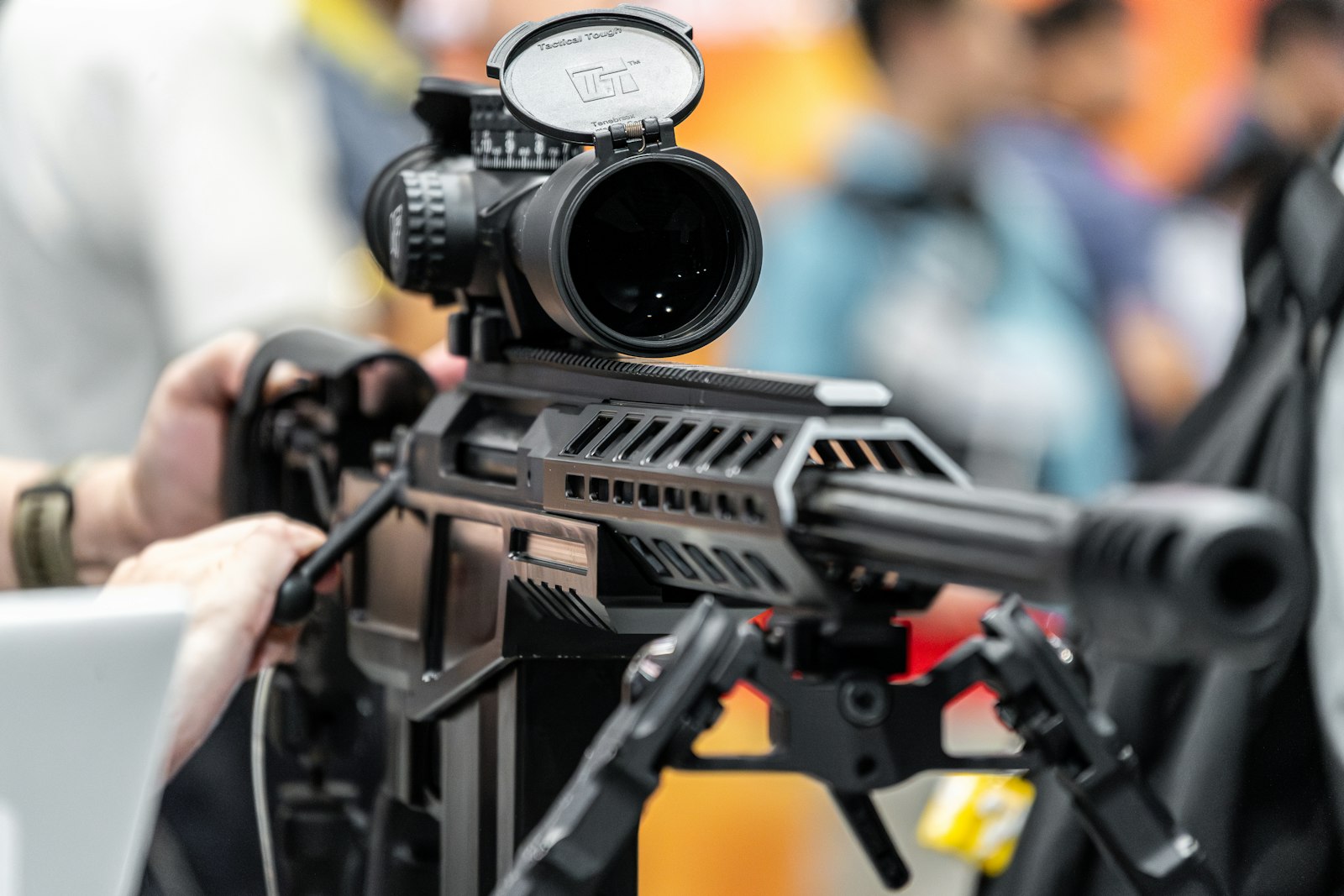
A scope is not an accessory — it’s a measuring instrument. If you can’t read your reticle, you’ll try to shoot at 300 meters by aiming “a bit higher,” and you’ll miss for five years. Ballistics is applied geometry. One hour to understand, a lifetime to apply.
MOA or Mil, Choose Your System
All scopes use one of two angular units:
- MOA (Minute of Angle): 1 MOA ≈ 2.9 cm at 100m, 5.8 cm at 200m, 8.7 cm at 300m. Simple math: it grows linearly.
- Mil (Milliradian): 1 Mil = 10 cm at 100m, 20 cm at 200m, 30 cm at 300m. Even simpler to calculate mentally.
Pick one, NEVER both. The golden rule: your reticle and your turrets must be in the same unit. A MOA scope with MOA turrets, or Mil/Mil. If your reticle is graduated in Mil and your turrets in MOA (it exists on old gear), you’ll make mistakes with every correction.
In Europe, Mil dominates for PRS and tactical shooting. MOA remains common in hunting and US competition. For France, choose Mil-Mil without hesitation.
The Reticle: What You See
Three main families:
- Simple crosshair: for short-distance hunting, not useful in sports.
- Mil-dot or TMR: dots or dashes spaced 1 Mil apart. You can estimate distance, measure drop, correct with holdover.
- Christmas-tree (like Vortex EBR-7C, Athlon APRS): dense at the bottom for long-distance drop, branches for windage. This is the modern PRS standard.
The reticle can be in the first focal plane (FFP) or second focal plane (SFP). FFP: the graduation stays valid at all zoom levels. SFP: the graduation is only accurate at one zoom (usually maximum). For precision sport shooting, FFP, without hesitation.
The BC: Why Your Bullet Doesn’t Fly Straight
A projectile leaving at 850 m/s loses 30 cm over 300m due to gravity — it’s physics, it’s unavoidable. What changes depending on the bullet is its deceleration rate: this is the ballistic coefficient (BC).
- BC 0.200: classic hunting bullet, decelerates quickly. At 800m it’s useless.
- BC 0.500-0.600: Match bullet, like Berger, Hornady ELD-X. Maintains trajectory to 1,000m reasonably.
- BC 0.700+: very heavy projectiles .338 or .50, for 1,500m+.
The higher the BC, the more energy and stability you keep at distance. For standard PRS, aim for BC 0.500 minimum.
Dial or Holdover?
Two methods to correct elevation:
- Dial: you turn your elevation turret to center the reticle on the target. Precise, slow, perfect for static targets.
- Holdover: you use the lower graduations of your reticle to aim without touching the turret. Fast, requires a readable reticle, perfect for engaging multiple distances quickly.
In PRS, you do both depending on the stage. In club 100-300m shooting, dialing is enough.
Reading a Drop Chart
A drop chart tells you how much to correct for each distance. Simplified example for a .308 168 grains:
- 100m: 0
- 200m: 1.1 Mil
- 300m: 2.7 Mil
- 400m: 4.8 Mil
- 500m: 7.3 Mil
- 600m: 10.2 Mil
You generate this table with an app (Strelok Pro, Hornady 4DOF, Applied Ballistics). You enter your cartridge, temperature, altitude, barometric pressure. The app produces the table. You print it and attach it to your rifle stock.
Wind, the Real Challenge
Drop is predictable. Wind is not. At 600m, a 5 km/h crosswind deflects a .308 about 30 cm. Double the wind, double the drift. Is it exponential? No — it’s linear in this range. But wind changes every 50m on the ground.
Learn to read the indicators: grass, mirage, flags. And shoot in several winds before claiming to understand. Wind is probably the skill that separates good from excellent PRS shooters.
Three Common Pitfalls
- Mixing units. A 1/4 MOA click is not 0.1 Mil. You’re off by 3, you miss by 30 cm at 300m.
- Blind trust in your app without verification. The DOPE (Data On Previous Engagement) you log on the range beats any calculator. Shoot, note in your digital shooting log, calibrate.
- Buying a powerful scope without understanding it. A 5-25×56 poorly set up is an expensive 1×1.
FAQ
Q: Variable power scope or fixed? A: Variable 4-16× or 5-25× for 90% of sports shooting. Fixed high magnification (10×, 16×) for pure benchrest, where the rifle doesn’t move.
Q: How much to spend on your first precision scope? A: 600-900€ minimum for reliable turrets, a coherent reticle, and good optics. Below that you’ll have zero shift and twilight too early.
Q: Do I need a laser rangefinder? A: Yes, once you shoot beyond 200m at unknown distances. Budget 200-500€ for a Vortex Ranger or Leica Rangemaster.
After That?
Ballistics on paper is theory. Your real DOPE — actual drop at 300m with your cartridge, your barrel, your altitude — is built shot by shot. That’s exactly what PewPewLife — the digital shooting log for sport shooters does: you log each shot with its distance, turret adjustment, ammunition lot. After 200 rounds, you have a personal drop chart that beats any generic app.
For More
- How to choose your first rifle
- Precision long-range shooting (PRS): equipment and basics
- Breathing and trigger control