
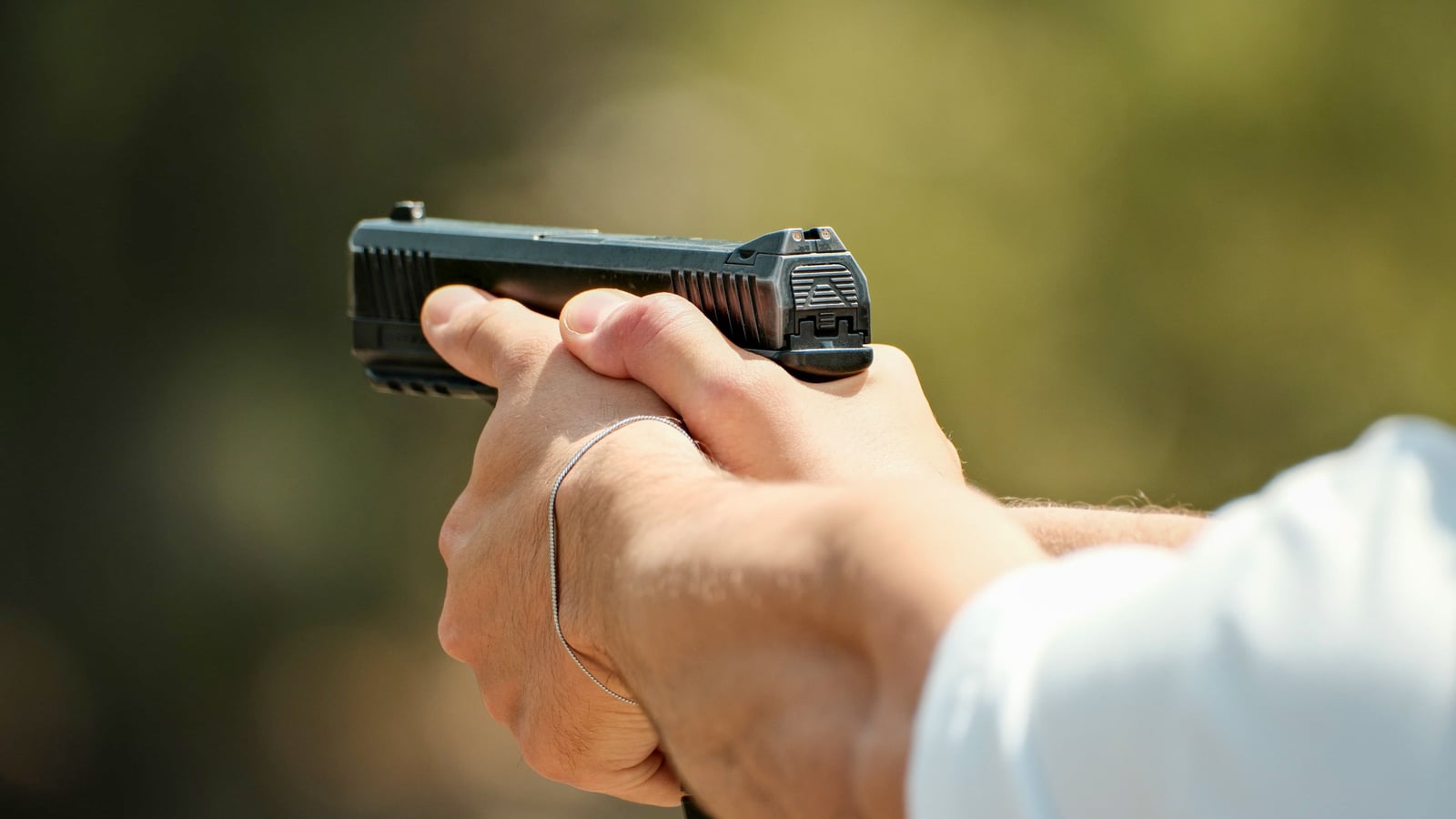
Why the trigger is the real limiting factor of your accuracy
You can have the best gun at the club, an obscenely expensive optic, and a perfect stance — if your finger moves badly on the trigger, your group opens up. That’s the reality a lot of shooters refuse to admit, because it’s more comfortable to blame the gear than your own technique.
Trigger control is the last step in the whole shooting chain. You’ve set your stance, your breathing, your sight picture — and at that exact moment, a stray finger movement can undo all that work. That’s why seasoned club shooters keep repeating that “the trigger is 80% of the result”: it’s not an empty saying, it’s a technical observation.
This article covers the whole topic: the difference between progressive pressure and anticipation, the concept of the surprise break, a series of dry-fire drills to automate the right movement, and the direct link between your trigger management and the spread of your groups on target. The goal is that you walk away with a concrete method, not just theoretical principles.
This trigger work applies to every discipline: 10m rifle, 25m pistol, dynamic shooting on cardboard targets or steel plates. The basic principle doesn’t change, only its application varies depending on the gun and the pace required.
Many shooters spend years investing in gear before seriously tackling this subject, simply because trigger technique is less visible and less gratifying in the short term than a new optic or a new barrel. It’s an understandable but often counterproductive choice: a shooter with entry-level gear and a mastered trigger regularly beats a shooter equipped with top-of-the-line gear but an imprecise finger.
Anticipating the shot: the reflex that destroys your accuracy
Anticipation is the body’s natural reaction to the expected recoil and noise. Your brain knows a detonation is coming, and it tries to prepare for it — often by tensing the muscles, closing the eyes for a split second, or pushing the gun slightly downward just before the shot breaks.
This reflex is sometimes called “flinch” or recoil anticipation. In practice it shows up as an impact that lands low and often slightly to one side, while the shooter will swear they held a perfect sight picture. It’s one of the most reliable diagnoses at the club: an experienced coach spots this characteristic impact point on a training target at a glance.
The problem is that anticipation is largely unconscious. The shooter doesn’t “decide” to move their finger too fast; their nervous system anticipates a strong stimulus and triggers a protective reaction before the shot even breaks. That’s why it’s practically impossible to fix this flaw through willpower alone, or by repeating “this time I won’t move.”
The good news is that this reflex can be desensitized with structured training. The dry-fire drills covered later in this article exist precisely for that: they let you repeat the trigger movement hundreds of times without the noise-recoil component, so the brain learns to stop anticipating it in a disruptive way.
You also have to distinguish occasional anticipation, tied to fatigue or competition stress, from chronic anticipation that’s been ingrained for years. The first corrects itself in a few sessions of targeted vigilance. The second requires real deprogramming work, often with a coach observing the shooter from outside — because you almost never feel your own flinch from the inside.
Perceived noise and recoil intensity also play a role in how much the reflex shows up. A shooter moving from a low-recoil gun to a noticeably more powerful one sometimes rediscovers a flinch they thought they’d fixed long ago, simply because the stimulus is more intense than what their brain had gotten used to. This isn’t a failure of the method — it’s proof that anticipation remains a proportional response to the stimulus, one that needs to be reworked with every significant change in gear.
Properly fitted hearing and eye protection also plays an indirect but real role. A shooter bothered by an overly loud report or an unexpected flash of light more easily develops tensing reflexes. Investing in quality hearing protection isn’t just about comfort or long-term health, then — it removes a source of stimulation that can feed anticipation.
Progressive pressure: the fundamental principle
Progressive pressure means increasing the force applied to the trigger continuously and steadily, without any jerk, until the shot breaks. It’s the exact opposite of a finger that “slaps” the trigger sharply the instant it judges the sight picture to be good.
Concretely, the finger has to follow the pressure increase the way you’d slowly inflate a balloon: a continuous curve, not a series of steps. The moment the pressure becomes jerky — even slightly — the gun moves at the critical instant, and that micro-disturbance translates into centimeters, even tens of centimeters, on a distant target.
A point that’s often misunderstood: progressive pressure doesn’t mean “slow at all costs.” It has to be adapted to the context. In static precision shooting, building pressure can stretch over several seconds. In dynamic shooting on cardboard targets, the same logic of progressiveness applies, but compressed into a fraction of a second — the finger stays fluid, it never becomes an all-or-nothing switch.
To work on this feel, many experienced shooters use the image of a “slider” rather than a “button”: the trigger isn’t a button you press, it’s a slider you move progressively from point A to point B. This simple mental image helps break the sharp-slap reflex, especially in beginners.
You also have to learn to feel your trigger’s break point — the exact moment the mechanism releases the striker. This point varies depending on the gun and its setup: some triggers have a clean, short break, others a longer travel with “slack” before the break. Knowing this point precisely on your gun lets you dose your pressure with more finesse over time.
The overall grip on the gun directly influences the quality of progressive pressure. A grip that’s too tense transmits parasitic tension all the way to the finger, making the trigger movement stiffer and less linear. Conversely, a grip that’s too loose doesn’t stabilize the gun enough to isolate the finger’s movement from the rest of the hand. The balance you’re looking for is a firm but supple grip, where only the finger on the trigger performs the movement, without the rest of the hand tensing in mirror.
A useful drill to isolate this feeling is to work on progressive pressure without aiming at a precise target, simply observing whether the barrel stays still through the whole pressure build-up. If the aimed point moves at the instant the shot breaks, it usually means part of the hand other than the trigger finger is unintentionally involved in the movement.
The surprise break
The concept of the surprise break flows directly from well-executed progressive pressure. If you’re applying truly continuous, steady pressure, you can’t know to within a tenth of a second when the shot will break — and that’s exactly the intended goal.
This idea often surprises beginners, who feel a shooter should “decide” the exact moment the shot breaks, as if consciously pressing a button. In reality, the best club shooters describe the opposite experience: the shot “just goes off” while the shooter maintains their sight picture and progressive pressure, without trying to trigger the release.
This surprise has nothing to do with uncontrolled chance. It results from a fully controlled process where the shooter manages their aim, breathing, and pressure steadily, and lets the gun’s mechanism do the rest once the break threshold is reached. It’s active control that produces a result perceived as passive.
A classic drill to feel this principle concretely is to have a training partner load the gun randomly, sometimes with a round, sometimes empty (with all the required safety precautions and unloaded-gun handling). The shooter doesn’t know whether the shot will actually go off. If their finger anticipates, the flinch movement becomes visible even on an empty chamber — a remarkably effective diagnostic used by many club coaches.
This surprise principle applies differently depending on the discipline. In precision shooting, it plays out fully, over several seconds of building pressure. In dynamic shooting where the pace is fast, the “surprise” window shrinks to a fraction of a second, but the principle stays the same: the finger must never slap the trigger deliberately and abruptly, even at high cadence.
Dry-fire drills to automate the right movement
Dry-fire — training without ammunition — is probably the most powerful and cheapest tool to improve on the trigger. It lets you repeat the movement hundreds of times without using ammo, without the noise or recoil that triggers anticipation — so under ideal conditions to build the right muscle memory.
Before any dry-fire drill, the safety check is non-negotiable: gun unloaded, magazine removed, chamber visually and physically checked, shooting area clear of all ammunition, muzzle always pointed toward a safe direction. This check happens every single session, no exceptions, even if you’re certain you already checked five minutes ago.
Here’s a series of progressive drills to build into your routine:
- The balanced coin: place a small coin or similar flat object on the barrel or front sight of the gun (depending on configuration), and perform a full progressive pressure build-up without dropping the object. If the coin falls, your pressure was jerky somewhere along the way.
- Mental counting: build your pressure while counting steadily in your head, to force a slow, continuous pace rather than a reflexive movement.
- Timed dry trigger pulls: do 10 repetitions of a full progressive pressure build-up, aiming at a precise point on a wall or a neutral target, without trying to go fast. Focus purely on the fluidity of the movement.
- The partner drill mentioned above, to reveal a hidden flinch under near-real conditions.
- Rest-time work, outside of range sessions: a few minutes of trigger handling at home (gun fully unloaded and checked, in a legal and safe setting), to build muscle memory without the pressure of the range.
Consistency beats volume. Five minutes of focused dry-fire, several times a week, produce better results than a single two-hour session right before a competition. The trigger movement automates through spaced-out repetition over time, not through one-off accumulation.
Many experienced shooters build dry-fire into their weekly routine year-round, not just when prepping for competition. It’s this underlying consistency that explains why some practitioners progress faster than others at a comparable ammo volume at the club.
An often-overlooked point: the posture and environment of at-home dry-fire should get as close as possible to real shooting conditions, within what your home allows. Standing in a position close to the one used at the range, rather than training seated or slouched, strengthens the transfer of the automatism to the real situation. The brain more easily associates a movement with a context when the postural cues resemble each other.
It’s also useful to vary the distance of the neutral target used for at-home dry-fire. Aiming at a close point engages concentration differently than a farther one, which lets you work on progressive pressure under varied aiming conditions without leaving your living room. Some shooters even mark several points of different sizes on a dedicated wall, to simulate the increasing difficulty of a target that shrinks with distance.
Finally, dry-fire benefits from being timed occasionally, without speed becoming the main goal. Knowing how long a full, fluid pressure build-up takes gives you an objective benchmark to check, week after week, whether your technique is becoming more natural and less laborious, without ever sacrificing the quality of the movement for speed.
The direct link between the trigger and group dispersion
A scattered group is almost never purely a matter of gear or aim. In the large majority of cases observed at the club, excessive dispersion is explained by inconsistent trigger management — anticipation, slapping, asymmetric pressure on the side of the trigger.
The physical mechanism is simple to understand: at the moment the shot breaks, the gun is still in microscopic motion as long as the projectile hasn’t left the barrel. Any parasitic force applied by the finger at that instant — downward, right, or left depending on the shooter’s handedness — deflects the trajectory proportionally to the shooting distance. The farther the target, the more the error translates into visible centimeters.
That’s why the same shooter can have a tight group at 10 meters and a wide one at 25 or 50 meters with the same gun: the trigger flaw exists in both cases, but its effect is amplified by distance. Many practitioners only discover their trigger problem when they change discipline or shooting distance.
A simple diagnostic is to observe the direction of dispersion. Dispersion that consistently goes in one coherent direction (low-left for a right-hander pressing too hard with the first finger joint, for example) points to a grip or finger-placement flaw rather than a random concentration lapse.
Finger placement on the trigger deserves particular attention, by the way. Placing the first joint, the fingertip, or the joint itself radically changes the force axis and therefore the direction of the deviation. There’s no single universal placement: the best position depends on the shooter’s build, the shape of the trigger, and the discipline practiced, but it has to stay constant from one session to the next to be usable.
Tracking how your groups evolve over time, along with the conditions of each session (distance, gun, ammunition, fatigue), lets you connect a temporary lapse in trigger technique with unusual dispersion on a given day. This is exactly the kind of tracking a digital shooting log makes easier: without structured history, it’s hard to tell a bad day apart from a lasting technical regression.
The role of trigger adjustment in controlling the movement
The mechanical adjustment of the trigger directly influences how easily a shooter can apply clean progressive pressure. A trigger with an unclear break point, a lot of slack before the shot, or a pull weight unsuited to the shooter’s strength, clearly complicates the technical work described above.
That said, this variable needs to be handled carefully: a trigger adjustment never replaces technique. A shooter who systematically anticipates will keep anticipating even with a perfectly tuned trigger — the problem is neurological, not mechanical. A poorly adjusted trigger, on the other hand, can worsen or mask an existing technical flaw.
Any modification to a gun’s trigger mechanism must comply with the applicable legal framework and the manufacturer’s specifications. Depending on the firearm category involved, some work belongs in the hands of a qualified gunsmith rather than personal tinkering. Regulations on firearm modifications vary significantly by country and jurisdiction — the exact rules for a given modification should be checked directly with a licensed gunsmith or the relevant local authority rather than assumed from a generality.
For a beginner, the priority is almost always technique before adjustment. Modifying a trigger to compensate for a flaw in progressive pressure amounts to masking a symptom without treating the cause — the flaw will resurface as soon as the shooter changes gun or discipline.
Adapting the technique by discipline
The principle of progressive pressure and the surprise break stays universal, but its concrete application changes depending on the pace each discipline demands. Understanding these nuances avoids applying a slow-fire method to a context that requires speed, and vice versa.
In precision rifle, building pressure can stretch over several seconds, seeking the moment when the sight picture is most stable within the shooter’s natural breathing cycle. This is the context where the surprise break concept plays out most fully and most slowly.
In speed pistol, the time window shrinks sharply, but the principle stays identical: the finger must stay fluid and never slap the trigger, even at a high rate of fire. An experienced club shooter learns to compress their progressive pressure into a fraction of a second without turning it into an abrupt movement.
In dynamic shooting on cardboard targets or steel plates, the extra difficulty comes from having to string several shots together quickly while keeping clean trigger management on each repetition. This is often where anticipation flaws show up the most, because the shooter is focused on the overall speed of their string rather than each individual trigger movement.
In disciplines using animal-shaped silhouettes on practical shooting courses, precision remains decisive despite the pace, since each silhouette must be hit in a precise zone for the shot to count. The temptation to rush the trigger movement to save time is exactly what makes less experienced shooters miss this kind of target.
Managing competition stress without degrading your trigger
Competition stress is one of the factors that most quickly degrades trigger technique that’s otherwise well mastered in training. The pressure of the clock, the presence of a crowd, or the stakes of the result push the body to speed up its movements and reintroduce anticipation, even in an experienced shooter.
This phenomenon is partly explained by the fact that stress activates the same nerve circuits involved in the recoil-anticipation reflex. The body tries to “get through quickly” a movement perceived as stressful, which runs exactly counter to the slow, progressive pressure you’re aiming for.
A few concrete approaches help limit this degradation:
- Deliberately slow down the perceived pace at the start of a competition string, even at the cost of a few seconds, to recover the progressive-pressure feel worked on in training.
- Focus on a single technical anchor point (the feel of the finger on the trigger, for example) rather than the final result, to bring attention back to the movement rather than the stakes.
- Reproduce in competition the exact preparation routines used in training, so the body finds familiar cues despite the different context.
- Accept that starting a string slightly slower than usual isn’t a problem if the technique stays clean — speed comes back naturally once the tension drops.
A regional champion will often say her best performance came from a string where she deliberately slowed her pace as she felt tension rising, rather than forcing her usual rhythm. It’s as much a mental adjustment as a technical one.
Common mistakes that sabotage trigger work
Certain mistakes come up very regularly among shooters struggling to progress on this subject, even after several months of regular practice. Identifying them often unlocks stalled progress faster than simply piling on training volume.
- Confusing slowness with progressiveness: very slow pressure isn’t automatically progressive. Some shooters slow their movement down so much that they introduce micro-pauses and jerks, recreating the very problem they were trying to avoid.
- Neglecting finger placement: changing finger position on the trigger from one session to the next makes any reliable diagnosis of dispersion impossible.
- Dry-firing without a systematic safety check: skipping this step, even once, is an unacceptable and non-negotiable risk.
- Trying to correct anticipation through willpower alone: as mentioned above, this reflex is largely unconscious. Repeating “don’t move” to yourself generally isn’t enough; the movement has to be desensitized through repetition in dry-fire.
- Ignoring the link with fatigue: trigger management that degrades toward the end of a session or a competition string is often a sign of muscular fatigue in the finger or forearm, not a lack of concentration.
- Not tracking your progress over time: without a session history, it’s very difficult to know whether a trigger flaw is genuinely improving or coming back cyclically depending on fatigue, stress, or the gear used.
An experienced coach observing a shooter from outside often spots in a few minutes what would take months to self-diagnose alone in front of a target. Seeking an outside eye remains one of the most underused levers for progress on this exact subject.
Building a lasting progress routine
Trigger control isn’t a skill you acquire once and for all: it’s ongoing maintenance work, a bit like physical fitness. A shooter who stops all specific work for several months often sees their anticipation flaws gradually return, even after years of practice.
A lasting routine generally combines three elements: regular, short dry-fire sessions, active vigilance during live-fire sessions to spot signs of anticipation, and structured tracking of groups to objectify progress over time rather than relying on a subjective impression.
This structured tracking is valuable because human memory reconstructs sessions optimistically or pessimistically depending on the mood of the moment. Systematically noting the discipline, distance, gun used, conditions, and group result lets you spot real trends: does a given training setup consistently produce better results, or is that an isolated impression tied to a good day?
A well-kept digital shooting log then becomes a full diagnostic tool, not just an administrative record. Cross-referencing data from several sessions lets you distinguish a real technical regression from a normal variation tied to fatigue, stress, or a gear change — a distinction that memory alone can almost never make reliably.
This structured approach also benefits shooters who practice several disciplines in parallel. A practitioner who alternates between precision rifle and dynamic shooting on cardboard targets can, thanks to rigorous tracking, notice that their trigger technique is degrading only in one of the two disciplines during a given period — a valuable signal to target their training instead of working at random across their whole practice.
Finally, keep in mind that progress on this subject is rarely linear. Plateaus, even slight setbacks, are normal and don’t mean the method isn’t working. Consistency in the underlying work, more than occasional intensity, remains the factor that separates shooters who progress lastingly from those who plateau year after year.
Tools that make trigger work easier
Beyond bare-handed dry-fire, several simple tools help objectify and speed up the work on progressive pressure. None is essential, but each provides feedback that training alone doesn’t always reliably supply.
- Barrel movement indicators: certain accessories detect and signal any barrel movement at the instant the shot breaks, letting you objectively know whether the pressure was clean or jerky, without waiting for the result on the target.
- Shooting tracking apps: filming your hand or gun in close-up during a dry-fire string, then reviewing it in slow motion, often reveals parasitic movements invisible in real time.
- Inert practice cartridges: for guns whose striker mechanism doesn’t handle repeated dry-fire well, these dummy cartridges protect the firing pin while still allowing realistic trigger practice.
- A structured session log: noting after each session how the progressive pressure felt, not just the group result, helps build a precise technical memory rather than a general, vague impression.
The main trap with these tools is turning them into a permanent crutch rather than a temporary accelerator. The ultimate goal remains developing a reliable internal feel, without depending indefinitely on outside feedback to know whether the movement was clean.
An experienced club shooter often recommends using these tools in cycles: a few weeks of instrumented work to precisely identify a flaw, then a return to bare training to integrate the correction without a net. This alternation avoids becoming dependent on visual or digital feedback to judge the quality of your own movement.
Progressing by level: from beginner to experienced shooter
Trigger work doesn’t look the same depending on the shooter’s experience and level. A beginner and a long-time experienced practitioner rarely run into the same obstacles, even though the technical principle stays identical for both.
For a beginner, the absolute priority is to build the right automatism from the start rather than correct an ingrained flaw. It’s simpler to learn it right the first time than to relearn it properly after months of bad habits. An experienced coach generally insists, from the very first sessions, on the feel of progressive pressure before even talking about speed or performance on target.
For an intermediate shooter, the difficulty often comes from a progress plateau where the basic technique is acquired, but subtle flaws reappear under fatigue or a higher rate of fire than usual. This is the stage where the fine-grained analysis of group dispersion, mentioned above, becomes particularly useful to identify what still needs correcting.
For an experienced shooter, the challenge often shifts toward consistency under pressure: maintaining the same trigger quality in all circumstances, including in competition, with the fatigue of a long string or facing high stakes. The basic technical work doesn’t change, but mental training and stress management take up a growing share.
Whatever the level, the same logic applies: regularly return to the fundamentals of dry-fire and progressive pressure, even when you feel you’ve “moved past” that stage. Shooters who stagnate or regress after several years of practice have very often neglected this basic work in favor of training focused solely on rounds fired.
FAQ
Q: How long does it take to correct an anticipation problem that’s been there for years? A: This varies enormously depending on how old the reflex is and how consistently dry-fire work is done. Some shooters see a clear improvement in a few weeks of focused practice, others need several months, especially if the flaw is old and deeply ingrained.
Q: Can dry-fire damage a gun if practiced too often? A: It depends heavily on the model and firing-pin mechanism; some guns tolerate repeated dry-fire very well, others need a practice cartridge or a dedicated accessory to protect the firing pin. Check the manufacturer’s recommendations or ask a gunsmith before making it an intensive practice.
Q: Does a lighter trigger pull weight automatically fix anticipation problems? A: No, a lighter trigger pull doesn’t fix an anticipation reflex that remains, above all, neurological. It can make the technical work easier once the method is mastered, but it never replaces training on progressive pressure.
Q: Why is my group clean at short distance but scattered at long distance with the same gun? A: This is a classic sign of a trigger flaw that’s still present but barely visible at short distance, where the angular error translates into just a few centimeters. Over a longer distance, that same angular error is amplified and becomes visible on target.
Q: Should trigger work be different in dynamic competition compared to precision shooting? A: The principle of progressive pressure and the surprise break stays identical, but the time window available is much shorter in dynamic shooting. The goal is to apply the same fluidity of movement, simply compressed into a shorter time, without ever turning the pressure into an abrupt slap.
Q: Does a digital shooting log really help you progress on the trigger? A: It mainly helps objectify progress over time, by cross-referencing each session’s data with the quality of the groups obtained. Without this tracking, it’s hard to distinguish a genuine technical improvement from a simple variation tied to fatigue or stress in the moment.