
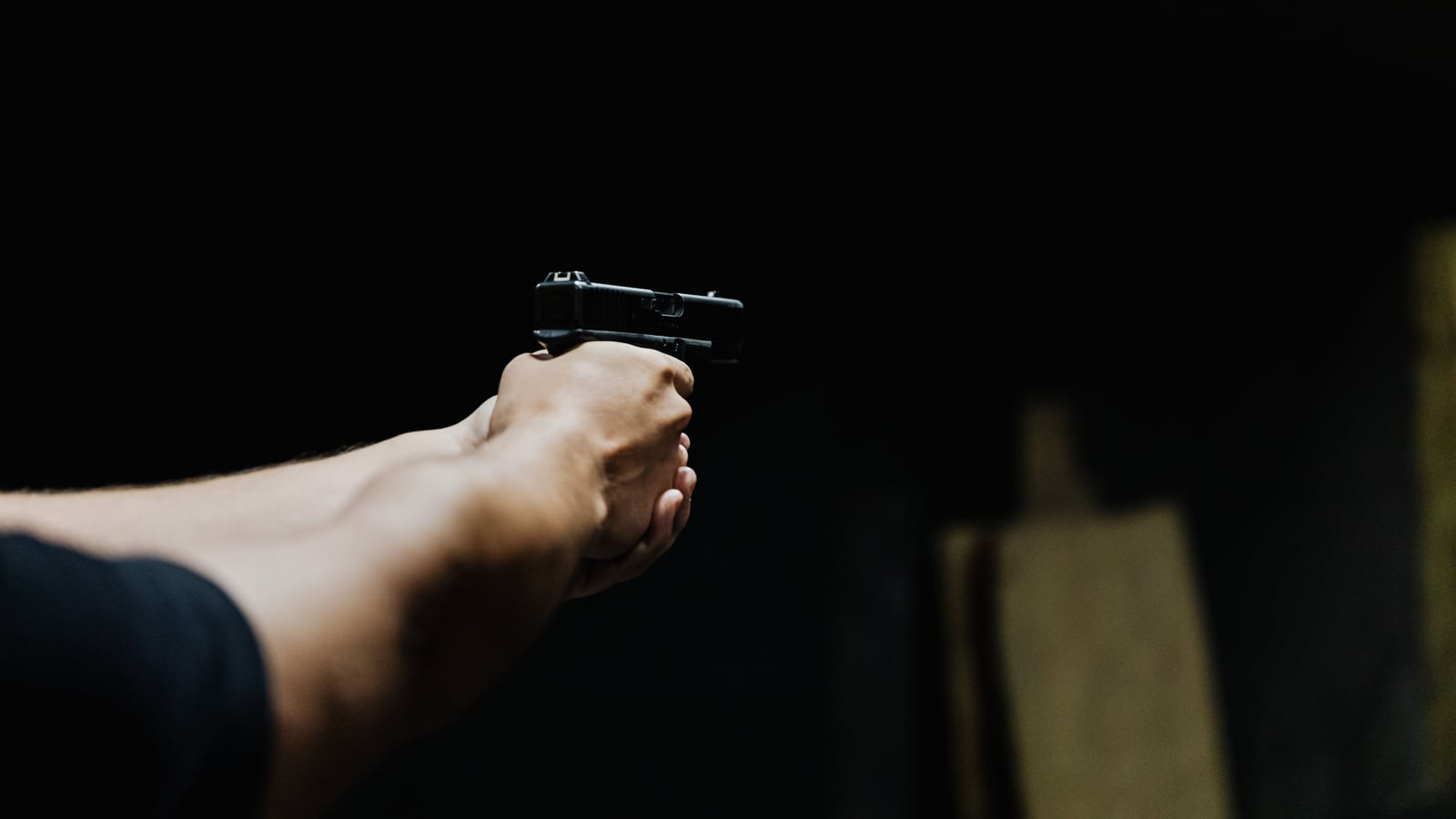
Why grip is underrated
On a range, everyone talks about foot position, breathing, trigger adjustment. Grip, on the other hand, often gets treated as a detail you’ve “got” after your first few sessions. That’s a costly mistake, and it shows directly in your groups.
Your grip is the only real point of contact between you and the gun the instant the shot breaks. Everything that happens before — aiming, breathing, alignment — is useless if your hand transmits a stray movement while the trigger breaks. A poorly built grip amplifies every micro-tremor instead of absorbing it.
What makes this tricky is that there’s no universal grip. The hold that works perfectly for precision pistol becomes a handicap in dynamic shooting, and neither has much in common with holding a rifle. Each discipline imposes its own constraints of speed, recoil, and stability.
An experienced club shooter often tells the beginners he coaches: most groups that spread into a star pattern or drift sideways come down to a hand problem, not a gun problem. Before switching ammo or having the trigger adjusted, it’s worth filming your own grip and analyzing it coldly.
This article breaks down the grip logic specific to each major discipline family, the common threads running through all of them, and the most frequent mistakes found on the targets of shooters at every level. The goal isn’t a single one-size-fits-all recipe, but understanding why each grip is built the way it is.
Grip in precision pistol (10m, 25m, 50m)
In precision shooting, the gun rests almost entirely in the palm, held by a single hand for disciplines that require it (like 10m air pistol or 50m match). The goal isn’t to squeeze hard, but to create a stable bony alignment between the forearm and barrel, so recoil always comes back up the same way.
Pressure is distributed mainly across three points: the base of the thumb (thenar eminence), which fills the back of the grip, the last three fingers, which wrap the grip with moderate, constant pressure, and the index finger, which stays entirely independent from the rest of the hand. This independence of the index finger is non-negotiable in precision — the slightest stray effort transmitted by the other fingers shows up directly on the trigger.
The thumb, in fact, serves almost no gripping function in one-handed precision shooting. It sits relaxed along the frame, sometimes even slightly lifted off. A thumb pressed tight against the grip introduces asymmetric tension that pulls the barrel toward the thumb side at the moment of the shot — a flaw you can easily spot in a group that spreads horizontally instead of staying compact.
Consistency of pressure matters more than its intensity. A grip that varies in force from shot to shot — firmer when the shooter is stressed by a good string, looser at the end of a match from fatigue — produces groups that drift over the course of the string, even if each shot looks fine in isolation. Many shooters actually train their grip endurance dry, without ammo, to stabilize that consistency across an entire competition.
Another often-overlooked point: the angle of the wrist relative to the forearm. In precision, you want a wrist that continues the natural line of the bone, with no break upward or downward. Even a slight break forces the wrist muscles to constantly compensate to keep the gun level, which fatigues the grip well before the end of a 60-shot string.
Grip in dynamic shooting (IPSC, Steel Challenge, USPSA)
In dynamic shooting, the logic almost completely reverses. The goal is no longer the absolute stability of a single isolated shot, but the ability to absorb fast recoil, chain shots together without readjusting the hand, and transition quickly between multiple cardboard or steel targets. Grip becomes a recoil management system rather than a tool of surgical precision.
The hold uses both hands, with a much firmer pressure distribution than in precision: people often talk about a force ratio close to 60% for the weak hand and 40% for the strong hand. The weak hand fills the space left open on the grip and absorbs most of the vertical recoil, letting the gun return to position faster between shots.
The thumbs, this time, play an active role. Both are usually stacked one above the other, pointed forward, along the frame. This so-called “thumbs forward” position helps direct recoil forces forward rather than upward, which shortens the time it takes to recover the sight line between two shots on the same cardboard target.
A very common mistake among dynamic shooting beginners: a grip that’s too symmetrical between both hands, a habit carried over from precision shooting. This “balanced” grip feels intuitively more stable, but in reality it slows down fast recoil management. The weak hand needs to clearly dominate the hold for the system to work at match pace.
The speed of transitioning between targets also imposes a specific constraint: the grip must stay identical, shot after shot, regardless of wrist angle or body position. A shooter who slightly loosens their weak hand while pivoting to a new cardboard target loses most of the benefit of their firm grip, and the recoil of the next shot goes in an unpredictable direction.
Finally, the grip in dynamic shooting must stay identical regardless of ammo or perceived recoil power. Unlike precision, where you can fine-tune from shot to shot, the pace of dynamic shooting leaves no time to recalibrate the hand between repetitions. Consistency of grip matters more than raw intensity.
Grip in rifle: support, cheek weld, and front hand
Rifle changes the game completely once again, because the dominant hand plays almost no role in gun stability. The front hand, the shoulder, and the cheek weld on the stock do most of the work. The hand on the pistol grip mostly just serves to operate the trigger and hold the gun snug against the shoulder.
On the front hand, two schools coexist depending on the discipline. In 10m air rifle standing, the front hand often rests almost flat, with the gun resting on it rather than gripped, sometimes helped by a sling that carries part of the weight. In 50m or 300m rifle, resting on a bipod or shooting bag, the front hand mainly adjusts height and angle rather than actively stabilizing.
The hand on the rear grip should stay as detached as possible from the rest of the motion. A classic mistake is pulling the stock toward the shoulder with this hand at the moment of the shot, which slightly shifts the cheek weld point and offsets the eye relative to the scope or open sights. The typical result on target: a group that stays roughly compact but shifts from shot to shot depending on how tired that hand is.
Finger pressure on the trigger must stay just as independent from the rest of the hand in rifle as in precision pistol. The difference is that the shoulder and cheek support absorb much of the recoil before it reaches the hand, which in theory leaves more room for error — except that margin disappears completely at long range, where the slightest hand deviation translates into centimeters, even tens of centimeters, on target.
Thumb placement in rifle also varies by federation and style: some club shooters place it along the stock, others wrap it around the grip. Neither option is universally superior — what matters is consistency from session to session and the absence of stray tension transmitted to the trigger.
Finger pressure: the most misunderstood variable
Finger pressure on the stock or grip is probably the most poorly taught aspect of grip, because it can’t be reduced to a simple instruction like “squeeze hard” or “squeeze gently.” The right pressure depends on the discipline, the gun, and above all your ability to reproduce it identically on every shot.
In precision, you generally aim for pressure around 30 to 40% of the shooter’s maximum grip strength. This figure is indicative and varies with body type and gun used — what matters isn’t hitting an exact percentage, but staying in a zone where the hand doesn’t shake from fatigue after a few dozen shots, while staying firm enough that the gun doesn’t move in the hand at the moment of recoil.
In dynamic shooting, pressure climbs noticeably, particularly on the weak hand, which can approach near-maximum grip without harming the precision needed at these distances. The speed of the shot sequence justifies this firmness: a weak hand that’s too loose lets the gun visibly drift between two shots on a close steel target.
A phenomenon known as “force irradiation” explains why finger pressure is problematic: when one finger contracts strongly, neighboring fingers tend to contract too, through a neuromuscular reflex. That’s exactly what happens when a shooter squeezes the grip too hard with the last three fingers: the index finger, meant to stay isolated, stiffens slightly without the shooter noticing, and the trigger ends up jerked rather than pressed.
Training this finger independence requires dry-fire repetition, gun unloaded, consciously observing what each finger does while the index finger presses the trigger. An experienced coach will often rest their hand on the shooter’s to directly feel whether stray tension appears at the moment of the simulated shot.
Thumb position: the most visible difference between disciplines
If one single grip element instantly reveals which discipline a shooter practices, it’s thumb position. It’s also the easiest element to fix once you understand the logic, because it doesn’t require any particular strength, just postural awareness.
In one-handed precision, the thumb stays passive, aligned along the frame, sometimes even lifted slightly to avoid touching any surface. A thumb that presses against the slide or grip, even lightly, introduces an asymmetric contact point that systematically deflects the barrel in the same direction on every shot — a flaw you can easily spot because the group always shifts to the same side.
In two-handed dynamic shooting, the “thumbs forward” position mentioned above requires real learning, since it goes against the natural reflex of curling the thumb around the grip. Many beginner shooters unconsciously keep a curled thumb during their first sessions, which reduces recoil control and slows their rate of fire without them understanding why their cardboard groups stay spread out during fast transitions.
In rifle, the thumb question plays out differently depending on whether you’re talking about the front or rear hand. On the front hand, the thumb generally has no active role. On the rear hand, it simply helps stabilize the hold around the pistol grip, without ever trying to pull the stock toward the shoulder — a job that belongs to the shoulder itself, not the hand.
One thing common to all disciplines: a thumb that moves from shot to shot, even in an otherwise correct position, introduces unnecessary variability. Consistency of thumb position, discipline by discipline, often matters more than its theoretically ideal position.
Common mistakes visible on your groups
Certain grip flaws read almost directly off the target, as long as you know what to look for. A group that consistently lands low-left for a right-hander (or low-right for a left-hander) very often betrays recoil “anticipation” combined with stray finger pressure at the moment of the shot — the classic syndrome of a shooter unintentionally “helping” the recoil before it even arrives.
A group that spreads horizontally, without marked vertical dispersion, generally points to a poorly positioned thumb or asymmetric pressure between fingers on the same side of the hand. This is a common flaw among shooters who move from one discipline to another without consciously readjusting their grip — a dynamic-shooting regular who picks up a precision rifle sometimes keeps firm gripping reflexes that no longer suit the exercise at all.
A group that’s overall compact but shifted as a whole relative to the center of the target, without excessive spread, often indicates a hand alignment problem rather than a pressure problem. The hand holds the gun fine, but the initial angle between the forearm and barrel isn’t neutral, which shifts every shot the same way and in the same direction.
In dynamic shooting, a telling sign shows up less on an isolated target than in the sequence of a string: impacts that climb progressively on a cardboard target during a burst of close-together shots betray a weak hand loosening its grip as the shots go on, often from fatigue or a lack of specific grip training.
Finally, an overall scattered group with no dominant direction, no apparent logic, rarely points to a pure grip problem. That kind of random dispersion more often points to a general consistency problem — breathing, body position, stress management — where grip is just one symptom among others rather than the main cause.
Building your grip: a step-by-step method
Fixing a grip doesn’t happen in one session, and especially not by changing everything at once. The most effective method, used by many club coaches, is to isolate one variable at a time and dry-fire long enough for the new position to become a reflex before going back to live ammo.
The first step almost always consists of checking basic alignment: gun in hand, eyes closed, you raise the gun toward an imaginary target, then open your eyes again. If the barrel doesn’t naturally point at the aimed spot, that’s not a sighting problem but a grip or body-position problem that forces you to consciously correct on every shot.
The second step concerns relative finger pressure, discipline by discipline. You isolate the index finger by keeping it entirely passive while the other fingers maintain the hold, then watch whether the barrel moves when you simulate trigger pressure. This exercise repeats over several sessions before adding ammo.
The third step concerns consistency over time. A grip that works for the first five shots of a session but degrades afterward indicates a lack of grip endurance rather than a technique problem. This is trained through hand-strengthening exercises, independent of the range itself, especially for disciplines that demand long strings like 60-shot precision.
The fourth step, often neglected, is filming your own grip from several angles during a real session. Many flaws invisible to the shooter themselves — a thumb that gradually shifts, a weak hand that loosens toward the end of a string — become obvious on playback. An outside eye, a coach or an experienced club shooter, often spots in a few minutes what months of solo practice wouldn’t have revealed.
Equipment and its influence on grip
Grip doesn’t depend solely on the shooter’s technique: the shape of the grip, its texture, and sometimes specific accessories directly change what’s possible or not in terms of hold. A grip that’s too thick for a small hand forces a forceful hold that fatigues faster and transmits more stray tension to the index finger.
Interchangeable grip panels, available on many precision guns and some dynamic ones, let you adapt circumference and hold angle to the shooter’s exact body type. This adjustment, often underused by beginners, sometimes changes feel and precision more than a purely technical adjustment would.
Grip texture plays a different role depending on the discipline. In dynamic shooting, an aggressive texture helps maintain a firm hold despite sweat and rapid-fire sequences. In precision, an overly aggressive texture can, on the contrary, interfere with the fine micro-adjustments of pressure that some shooters actively seek during a string.
Gloves, used in certain rifle disciplines in particular, change the sensation of contact with the stock and require an adjustment period before regaining grip consistency equivalent to a bare hand. Changing gloves mid-season, even for an apparently similar model, can be enough to temporarily throw off an otherwise well-built grip.
You should stay cautious about accessories marketed as miracle solutions to “fix” a faulty grip. A well-chosen accessory makes good technique easier, it never replaces it. A shooter who compensates for a fundamental gripping flaw with equipment rarely progresses as fast as one who first corrects their motion and then adjusts their equipment on top of that.
Grip and fatigue: what changes at the end of a string or match
The grip that works perfectly for the first ten shots of a session isn’t necessarily the one that will hold up for an entire string or a whole match. Muscle fatigue in the forearm and hand gradually changes the pressure applied, often without the shooter being clearly aware of it as it happens.
In precision, this fatigue generally shows up as a progressive loosening of pressure from the last three fingers, leaving the gun slightly more mobile in the hand toward the end of a string. The group from the last shots of a 60-shot string often widens slightly compared to the first ones, a well-known phenomenon among competitive shooters who learn to pace their effort across the entire event rather than just at the start of the string.
In dynamic shooting, fatigue affects the weak hand differently, since it’s continuously worked at near-maximum pressure throughout an entire course of fire. On the last obstacles of a long course, some shooters notice more pronounced muzzle rise after each shot, a sign that the weak hand no longer holds the firmness level from the start of the course.
In rifle, it’s often the rear hand or the shoulder that fatigues first, particularly in a standing position held for a long time. This fatigue can push some shooters to unconsciously compensate by gripping the pistol grip harder, which disturbs the trigger at the critical moment of the shot, even though that hand should stay as relaxed as possible.
Anticipating this fatigue is an integral part of grip training. Specific grip work, independent of shooting sessions themselves, pushes back the moment fatigue starts degrading hold consistency. It’s rarely glamorous work, but it often explains the gap in consistency between an experienced shooter and an intermediate one over a long event.
Differences linked to the shooter’s body type
None of these grip principles apply in exactly the same way from one shooter to another, because hand shape — finger length, palm width, natural grip strength — directly affects what’s achievable on a given gun or not. A technical instruction valid for one hand isn’t necessarily valid for another.
A shooter with small hands often struggles to comfortably reach the trigger at the first finger joint on certain guns, which pushes them to shoot with the second joint instead, with a different effect on pressure direction. That’s not a technique flaw in itself, it’s a physical constraint that calls for an equipment adjustment rather than a motion correction.
Conversely, a shooter with large hands and naturally strong grip strength sometimes has to consciously work at reducing their pressure in precision, where excess firmness hurts just as much as too little. The intuition of “squeeze harder for more control” is misleading in this specific discipline, even though it generally holds true in dynamic shooting.
Shooters with more limited grip strength, for physiological reasons or an old injury, shouldn’t try to reproduce at all costs a grip designed for greater strength. Adjusting the weight of the gun, the trigger, or the geometry of the grip is often more productive than pure strength training, which risks creating compensatory tension elsewhere in the arm.
A regional champion once talked at the club about how long it took her to stop copying the grip of a training partner with a very different body type, and to accept building her own hold from her actual physical constraints rather than an outside model. It’s a stage many shooters go through, often after a frustrating period of stagnation.
Grip and outdoor conditions: heat, cold, sweat
A grip validated during a session in a climate-controlled indoor range doesn’t necessarily behave the same way on an outdoor firing line in midsummer or in cold weather. Hand temperature, skin moisture, and even the thickness of a layer of clothing change the actual contact surface between fingers and grip.
In hot weather, palm sweat reduces natural grip, particularly on smooth grips or ones already polished from use. In dynamic shooting, where the hold must stay firm throughout an entire course, this loss of grip forces some shooters to rethink their usual hold or treat their grip surface with suitable anti-slip products. A grip that slips even slightly during a string produces unpredictable dispersion, very different from a classic pressure flaw.
In precision, sweat causes a different problem: it alters the fine perception of applied pressure, which disrupts a shooter working with very subtle contact sensations. Many club shooters keep a small towel near the firing line for exactly this reason — less for comfort, more to preserve grip consistency from shot to shot.
Cold works in the opposite way, reducing finger sensitivity and slowing the fine reflexes needed for index finger independence. A cold hand tends to tense up overall, which goes directly against the relaxation sought in precision shooting. At outdoor ranges in winter, a warm-up period for the hands before the first string isn’t a luxury but a technical necessity, especially for disciplines requiring fine, constant pressure.
Wearing gloves, when the discipline’s rules allow it, changes things once again. A thin glove can preserve some sensitivity while protecting from cold, but it adds a layer between hand and grip that slightly changes the perception of alignment. A shooter who alternates between sessions with and without gloves needs to accept a readjustment period each time, rather than being surprised by an occasional drop in consistency.
Motor learning of grip: why repetition beats theory
Intellectually understanding the correct position of each finger isn’t enough to reproduce it automatically under the stress of a competition or the fast pace of a dynamic course. Grip, like any fine technical motion, belongs to motor learning: it has to become an automatism stored in muscle memory before it can withstand the pressure of a real context.
This motor storage explains why so many shooters execute a flawless grip in calm practice, then see their hold degrade the moment a result actually matters. Stress often pulls you back toward older, more deeply rooted reflexes, sometimes inherited from another discipline practiced first, or from a period when technique wasn’t yet solid. A recently corrected grip, even a good one, stays fragile until it has fully replaced the old reflex.
Dry-fire practice plays a central role here, more important than many beginners eager to get to live ammo tend to think. Repeating the motion of gripping and pressing the trigger without the noise, recoil, or cost of ammunition lets you multiply the repetitions needed for automation, without fatigue or recoil apprehension getting in the way of the learning. An experienced coach often recommends short but daily dry-fire sessions rather than long occasional ones, precisely because repetition frequency matters more than cumulative duration for anchoring a motor automatism.
Another useful principle: it’s better to train slowly and correctly than fast and approximately, especially in the first weeks of correcting a grip. Speed of execution will come naturally once the motion is automated, whereas the opposite — going fast with a still-imperfect motion — tends to lock in flaws rather than fix them. This can be frustrating for shooters eager to reach the pace of a full dynamic course, but it pays off over time.
Finally, motor learning is never fully locked in once and for all. An injury, a long break in practice, or even just a change of gun can be enough to bring back old reflexes you thought were gone. Regularly returning to grip fundamentals, even for an experienced shooter, remains a worthwhile habit rather than a waste of time.
Switching guns without starting from scratch: transferring a good grip
Many shooters practice with several guns within the same discipline, or switch models mid-season for equipment reasons. Moving from one gun to another should never mean starting from zero on grip, but some adjustments remain necessary to preserve the consistency built with the previous gun.
Gun weight is the first variable to reassess. A gun heavier than the previous one demands more grip endurance to maintain the same pressure across an entire string, which can bring back premature fatigue even in an experienced shooter who thought that problem long solved. Conversely, a lighter gun can create a false impression of ease that leads to unintentionally loosening pressure consistency.
The balance point also changes from gun to gun, even within the same discipline. A rifle whose weight is distributed differently toward the front or back changes the natural distribution of effort between the front hand, shoulder, and rear hand. A shooter who switches models without accounting for this can develop a grip flaw that didn’t exist with their previous gun, even though their base technique hasn’t changed.
Grip circumference and angle also vary between manufacturers, even for guns intended for the same discipline. This is exactly where the interchangeable grip panels mentioned earlier become meaningful: rather than forcing an old gripping reflex onto a different geometry, it’s better to consciously readjust hand position from the first sessions with the new gun, redoing dry-fire alignment checks if needed.
A caliber change, particularly toward more powerful ammo, finally changes recoil perception and can reactivate unintentional anticipation in a shooter who thought that flaw permanently fixed. This phenomenon is well documented among shooters moving from a milder training caliber to a heavier competition one: the technical grip stays identical on paper, but psychological recoil management has to be gradually reworked, often by reintroducing dry-fire sessions or lower-power ammo before returning to competition configuration.
The role of grip in reading your own progress
Tracking how your grip evolves over time is more useful than many shooters imagine, and it goes well beyond simply observing groups at the end of a session. Noting what your hand does, session after session, lets you spot trends that memory alone doesn’t reliably retain over several months of practice.
A training log, paper or digital, that records perceived pressure, fatigue at the end of a string, or adjustments tested during a given session, turns vague impressions into comparable data. A shooter who simply notes “weak hand fatigued after 20 shots” across several consecutive sessions identifies a real endurance issue to work on, where an isolated impression might have been dismissed as just an off day.
This traceability becomes even more valuable during the changes mentioned above — new gun, new grip, new weather season. Without written reference points, it becomes hard to tell a real drop in level apart from a simple normal adjustment period to a new parameter. Many shooters abandon a promising adjustment too early, for lack of a clear record of their real progress across several sessions.
Grip, ultimately, is never a fixed, settled achievement but a living technical parameter, one that evolves with body type, fatigue, equipment, and accumulated experience. Treating it with the same rigor as aiming or breathing, rather than as a detail settled once and for all at the start of practice, remains the most consistent difference between shooters who plateau and those who keep improving year after year.
FAQ
Q: Should I squeeze as hard as possible to stabilize the gun? A: No, except in dynamic shooting on the weak hand, where a firm hold helps manage fast recoil. In precision, too much pressure creates stray tension that transmits to the index finger and disturbs the trigger.
Q: Can the grip learned in dynamic shooting hurt precision shooting? A: Yes, that’s a common mistake among shooters who practice several disciplines. Firm two-handed gripping reflexes don’t suit one-handed precision, which requires a passive thumb and lighter, more constant pressure.
Q: How do I know if my grip is causing my group issues? A: Look at the shape of the dispersion. A systematic shift in one direction often points to grip, while random dispersion with no logic more often comes from breathing or overall body position.
Q: Are interchangeable grip panels really worth the investment? A: For many shooters whose body type doesn’t match the stock grip, yes. Adjusting circumference and angle can improve grip consistency faster than pure technical work, without replacing it.
Q: Should hand fatigue be trained specifically? A: Yes, particularly for disciplines with long strings like 60-shot precision or extended dynamic courses. Grip work independent of shooting sessions helps maintain constant pressure until the end of the event.
Q: Is there a universal grip that works for every gun? A: No. Each discipline imposes its own constraints of speed, recoil, and stability, and grip must be built around those specific constraints rather than copied from one discipline to another.