
Why this topic deserves more than a locked cabinet
Owning a gun and living with children aren’t incompatible. Thousands of licensed shooters in France are parents, and cohabitation goes very well when storage is thought through seriously, not improvised on a tired evening. The problem is never the gun itself: it’s the access you leave, without realizing it, to someone who doesn’t have the maturity to handle it.
A curious child doesn’t reason like an adult. They don’t weigh consequences, they explore. A half-open drawer, a key left lying around, a gun “just for tonight” set on the top shelf: these are details that seem harmless as long as nothing happens, and that become the starting point of a tragedy the day the child discovers them alone.
This guide starts from a simple, non-negotiable principle: storage safety never relies on trust (“they know it’s forbidden”) nor on discretion (“they don’t even know where I keep it”). It relies on real physical barriers, backed up by education that further reduces the residual risk. The two are complementary — neither replaces the other.
The goal of this article is to cover the question as a whole: the separation between the gun and its ammunition, solutions that make access physically impossible for a child, and the awareness-raising that reinforces this physical setup. None of this is theoretical: these are habits a responsible shooter sets up once and for all, then applies without thinking, like a reflex.
The founding principle: separate the gun and the ammunition
The very first rule, the one that reduces risk the most radically, is to never store a loaded gun at home. A gun and its ammunition stored together, in the same cabinet or worse in the same container, cancel out much of the benefit of secure storage.
The logic is simple: even if a child manages to access a gun, it remains an inert object as long as no ammunition can be quickly loaded into it. Physical separation creates a delay, an extra step, an obstacle that doesn’t exist when everything is grouped in one place “to make things simpler if needed.”
Concretely, this means two clearly distinct storage points, ideally in two different rooms of the house, or at the very least in two separately locked cabinets with different locking systems. The gun safe on one side, the locked ammunition box on the other. The fact that a single key opens both cancels out much of the benefit of this separation.
This separation logic also applies to accessories that quickly make a gun functional: bolt, magazine, firing mechanism depending on the type of gun. The more independent steps needed to reassemble a gun ready to fire, the smaller the risk window for a child exploring the house without direct supervision.
An experienced club shooter often sums up this approach in a simple sentence: a stored gun must always be “useless” as it sits, and should only become functional again after a deliberate, considered action by the responsible adult, never by chance.
Making access physically impossible, not just difficult
There’s a huge difference between “hard to find” and “physically impossible to reach.” The first category includes the bad solutions: hiding the gun up high in a closet, sliding it under a mattress, storing it in a suitcase closed with a simple zipper. A child growing up in a house always ends up exploring the corners adults think are secret.
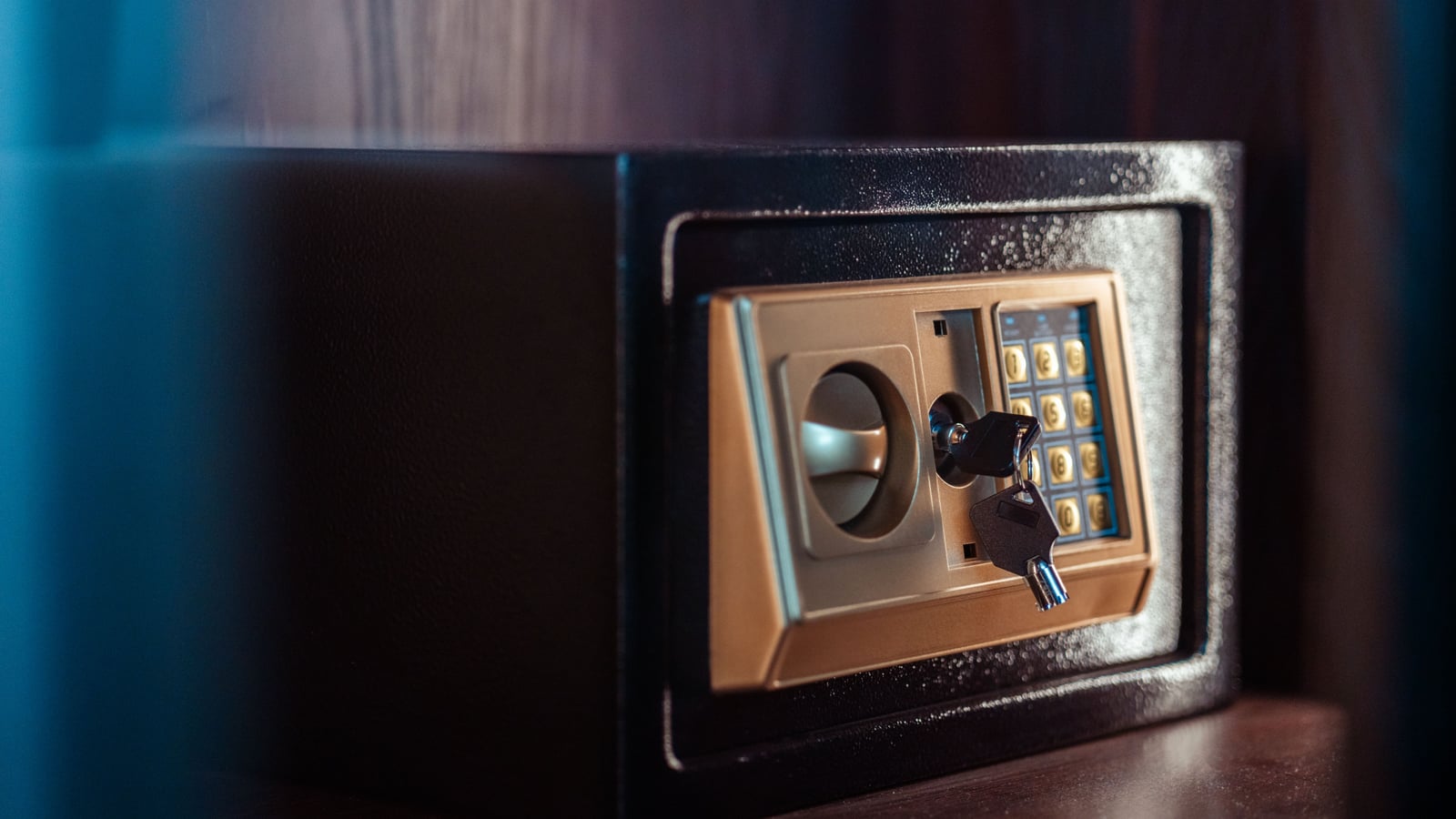
The second category, the one to aim for systematically, relies on a genuinely locked container: a gun safe, an approved strongbox, or at the very least a combination or key padlock on a rigid rack fixed to the wall or floor. Anchoring matters as much as the lock: a light safe you can lift and carry away offers only illusory security.
The choice of container depends on the number of guns owned, the space available, and the budget, and this choice varies a lot from one household to another. What doesn’t vary, however, is the basic requirement: a locking mechanism a child can neither open by fumbling nor bypass by dismantling the cabinet.
The key or access code deserves the same rigor as the safe itself. A key hung near the safe, a padlock code written on a nearby sticky note, a keyring left in a kitchen drawer: these are gaps that cancel out the entire investment made in the container. The key must be carried on you or stored somewhere completely dissociated, that the child can neither see nor associate with the safe.
For households with several guns or regular club practice, an electronic code or fingerprint system can simplify access for the adult while keeping a high level of security, provided you never leave the manufacturer’s default code or an overly obvious code (birth date, simple digit sequence).
The case of ammunition and the vulnerable transport period
Ammunition isn’t a simple side accessory that can be stored anywhere once the gun is secured. It deserves its own storage strategy, with the same requirements for locking and inaccessibility.
A locked ammunition box, kept in a different room from the gun safe, remains the safest configuration. This holds true both for firearm ammunition and for the pellets and lower-caliber cartridges used in category D, which are sometimes treated too lightly because they seem less “dangerous” at first glance.
A child who discovers a box of ammunition with no gun attached has, in the vast majority of cases, no way to make it dangerous on their own. That’s precisely the value of separation: each element taken in isolation loses its risk potential.
An often-overlooked point concerns ammunition left lying around after a shooting session: what stays in a jacket pocket, in a carry bag left in the entryway, or in the car’s glove compartment. The storage ritual must systematically include this end-of-session check, even before thinking about putting the gun itself away.
Storage at home often gets all the attention, while the trip between the club and home is just as real a risk window. A gun transported in an unlocked case, set on the back seat during a stop at the bakery, exposes exactly the same risk as careless storage at home.
The rule to apply is continuity: the security level during transport must match the one at home, not be relaxed on the grounds that the trip is short. A lockable transport case, stored in the trunk of the vehicle rather than within reach, and never left unattended in a parked car, reduces this transition risk.
The moment of coming back home is also when vigilance drops most easily: tiredness after a session, the urge to put things down quickly, children demanding attention. It’s precisely in these moments of letting go that bad habits set in, with no negative intent, simply through end-of-day autopilot.
Building a storage ritual that doesn’t depend on memory
A safety rule that depends on the occasional vigilance of a tired adult will always, sooner or later, be forgotten once. The real goal is to turn storage into an automatic ritual, executed the same way every time after a session, without conscious thought each time.
This ritual can be broken down into a few always-identical steps: check the gun is empty, store it in its locked safe, store the ammunition separately in its own closed container, put the keys back in their dissociated, out-of-sight spot. Repeating this sequence in the same order every time greatly reduces the risk of forgetting.
A well-kept digital shooting log can even serve as a mental trigger for this ritual: logging your session becomes the signal that reminds you, right after, to secure the gear before moving on to something else. That’s not its primary use, but the association of habits works well to anchor a behavior.
This ritual must also resist exceptions. “Just for tonight, I’ll leave it out because I’m leaving early tomorrow” is exactly the kind of one-off exception that, repeated a few times, ends up becoming the new normal without you noticing. A ritual that suffers exceptions is no longer a reliable ritual.
Raising children’s awareness: a complement, never a substitute
Here is the most important point in this entire article: talking to a child about guns, their danger, and how to behave if they come across one, is useful and recommended. But this awareness-raising never replaces physical secure storage. It comes as reinforcement, as a second barrier, not as the first line of defense.
A child remains a child. Their memory of a verbal instruction fades over time, their curiosity can override a learned rule, and a child visiting a friend’s house has received none of these instructions. Relying solely on “they know they mustn’t touch it” amounts to removing the only reliable barrier in the whole setup.
Effective awareness-raising relies on simple messages, repeated without excessive dramatization: if you see a gun, you don’t touch it, you move away, you tell an adult immediately. This message, delivered calmly and regularly, works much better than a single explanation loaded with emotion or vague prohibitions.
Adapting the message to age also matters. A toddler needs a simple, repeated rule (“we don’t touch”), while a teenager can understand a fuller explanation of how it works, the real risks, and the legal responsibility resting on the household’s adults. In both cases, the central message stays the same: a gun is never a toy, never an object to be handled without a responsible adult present.
An experienced instructor who coaches young people at a club often insists on one point: awareness-raising works all the better when it isn’t tied to fear or absolute taboo. A child who is factually shown why a gun deserves respect absorbs the rule better than a child who is simply forbidden without ever getting an explanation.
Repeating the message at regular intervals matters more than a single solemn conversation once in childhood. A brief remark before heading to the club, a question asked after a TV report on the subject, a reminder after a friend mentions having seen a gun at home: each of these ordinary occasions is worth more than a one-time speech followed by years of silence.
It’s also useful to regularly check that the message has genuinely been understood, rather than assuming it’s settled once and for all. Simply asking the child what they’d do if they found a gun somewhere, without dramatizing the question, lets you gauge whether the instruction has sunk in or needs to be reworded.
Visits, extended family, and what changes with age
Your own home isn’t the only environment that needs securing. A child spends time at grandparents’, aunts’ and uncles’, family friends’ houses, and some of these households may themselves own guns without applying the same storage standards.
A direct, non-judgmental conversation with the relatives who regularly host the child lets you check that their own storage practices follow a similar logic. This isn’t an inappropriate intrusion: it’s the same reflex as asking whether a pool is secured before letting a child play there unsupervised.
This vigilance also extends to the friends the child hosts at home. If the household owns guns, it’s reasonable to explain to the invited children’s parents that storage is secure, without detailing the exact location, simply to reassure and normalize the subject rather than hide it like a shameful secret.
Normalizing this topic in conversations between parents also changes the overall perception: a sport shooter’s household that speaks openly about its secure storage, a bit like one would talk about securing a pool or storing household chemicals, helps de-stigmatize a perfectly legal and regulated practice. Silence or awkwardness around the topic rarely serves the actual safety of the children involved.
Security needs also evolve with the child’s maturity, without ever fully disappearing. A toddler who can’t yet open a childproof drawer poses a different risk than a curious teenager physically capable of forcing a simple padlock or reproducing a code they happened to observe.
With a teenager in the house, the standard for lock quality often needs to rise rather than fall. A basic padlock sufficient to stop a six-year-old no longer offers the same guarantee against a determined, mechanically skilled fifteen-year-old. The container must be reassessed as the child grows, not fixed once and for all at the time of purchase.
Conversely, an older teenager can also become an ally in the security setup, particularly if they themselves practice supervised sport shooting at a club. Involving a young shooter in the storage logic, explaining the why rather than a simple ban, builds a responsible relationship with the gun rather than a fascination born of pure prohibition.
Classic mistakes, and how to adapt storage to your home
Certain habits recur regularly among otherwise careful shooters, and deserve to be named clearly. The first is the one-off exception already mentioned: leaving a gun out “just for tonight” for a reason that seems valid in the moment.
The second classic mistake is the key or code shared with the whole household out of sheer convenience, without thinking about who actually needs access. The fewer people who know the location and access code, the more reliable the setup remains over time.
The third mistake is treating secure storage as an administrative box to tick once, rather than a habit to maintain. A safe bought and then poorly used day to day, with the key left “temporarily” on the cabinet next to it, offers no real protection despite the initial investment.
Finally, one last mistake is underestimating category D weapons, air guns or replicas, on the grounds that they seem less dangerous. These weapons deserve the same seriousness in storage as other categories, because a child doesn’t distinguish between legal categories, only between an accessible object and one that isn’t.
These mistakes often take a different shape depending on the home’s layout. Not all houses are alike, and the solution suited to a house with a basement doesn’t necessarily work in a small city apartment. A shooter living in a studio or one-bedroom flat has to work with limited storage space, which often pushes toward compact safes rather than an imposing strongbox.
In an apartment, the question of anchoring becomes trickier: drilling into a load-bearing wall or a light partition doesn’t offer the same solidity as anchoring into a concrete floor in a standalone house. Solutions designed for this case exist, with reinforced anchor points or safes heavy enough not to be easily moved, but the choice deserves specific thought rather than a random purchase.
A house with a basement, garage, or outbuilding generally offers more flexibility to physically separate the gun and ammunition into two different buildings or levels. This layout makes the separation recommended above easier, provided vigilance isn’t relaxed just because the space is bigger: a poorly closed garage or a cellar accessible without a key cancels out the benefit of distance.
Shared housing or flat-sharing poses yet another problem: other adults live under the same roof without necessarily sharing the same sensitivity to the subject. In this case, the container must be locked in a way that prevents access not only for children but also for adults who might, out of ignorance, leave a door open or a key visible.
Finally, a home with a garden or outdoor space frequented by children calls for extra vigilance if occasional shooting activity (supervised air-gun introduction, for example) takes place there sometimes. Equipment used occasionally outdoors must go straight back to the same secure storage right after use, with no exception for the “relaxed” setting of the family garden.
The role of the club and the instructor, and the art of documenting your system
A shooting club affiliated with FFTir isn’t just a place to practice: it’s also a source of concrete reference points on secure storage, often underused by members. Instructors see dozens of different family setups go by and can share useful feedback, without ever giving precise legal advice beyond their role.
Asking the question directly at your club, during a session or a section meeting, often lets you get practical recommendations on safe models used by other parent members, or on mistakes they themselves corrected after the fact. This pooling of experience is worth far more than a solitary internet search, where information sometimes contradicts itself from one site to another.
Some clubs also informally organize exchanges between parent members on these home-safety questions, on the sidelines of shooting slots. It’s not systematic, but it’s worth asking if the subject has never come up at your own club.
The instructor who coaches young shooters can also be a valuable resource if a child in the household starts taking an interest in sport shooting themselves. Supervised progression, with regular safety explanations given by a third party recognized as a technical reference, reinforces the message given at home without duplicating it identically.
Beyond these outside exchanges, a security setup that’s never re-examined at home ends up accumulating small drifts invisible in daily life: a spare key forgotten somewhere, a child who has grown without the container being updated, a newly acquired gun that no longer fits in the original safe and gets stored “for now” elsewhere.
Getting into the habit of reviewing your own storage system once or twice a year lets you spot these drifts before they become a lasting flaw. This review can be as simple as physically checking that each element (gun, ammunition, keys) is in its intended place, and that nothing has been moved “temporarily” without being put back.
This review moment is also a chance to reassess whether the current container is still suited: to the size of the family, the number of guns owned, the children’s ages, and any change of home. A move, in particular, is a risky moment where secure storage can be neglected during settling in, while still-open boxes offer exactly the kind of easy access to poorly stored equipment.
Involving the other parent or the other adult in the household in this regular check also prevents a single person from carrying the whole responsibility for the setup. If that person is away, sick, or simply busy on a day when a one-off exception seems necessary, a second adult aware of the same rules keeps the system consistent.
This documentation can stay very simple: a private note with review dates, adjustments made, and points to watch next time. It’s not about creating extra paperwork, but about keeping a mental or written trace that avoids starting from scratch at every check, and that lets you see, over several years, that the setup has genuinely evolved with the family rather than staying frozen at the needs of day one.
A checklist to structure your own setup
Here are the points to check concretely in your own household, with no imposed order of priority since every home layout is different:
- Are the gun and the ammunition stored in two distinct containers, locked separately?
- Is the main container physically anchored (wall, floor) and not simply set down?
- Is the key or code known only to responsible adults, and stored far from the safe itself?
- Is the storage ritual after each session systematic, including on tired days?
- Does transport between the club and home match the same security level as storage at home?
- Have the children received a clear, age-appropriate message about how to behave around a gun?
- Do the households the child regularly visits apply comparable vigilance?
- Has the setup been reassessed since the child grew, especially into the teenage years?
This list isn’t meant to be exhaustive for every individual situation: an apartment’s layout differs from that of a house with an outbuilding, and the number of guns owned also changes the equation. It serves as a starting point for identifying your own blind spots.
A useful exercise is to go through this list out loud with the other adult in the household, rather than reading it alone in a corner. Verbalizing each point often brings a silent disagreement to light over a practice each of you thought was settled on their own side, for example over the exact spot where the safe key is supposed to permanently be.
It can also be useful to redo this exercise after a significant event in family life: a birth, a child who starts walking then climbing, the start of adolescence, a move, or the acquisition of a new gun that shifts the balance of the existing storage setup. Each of these moments justifies going through the list from the start rather than assuming nothing has changed.
What legal liability says for the gun owner
Beyond personal caution, French regulation imposes secure storage obligations on gun owners, with requirements that vary by the category of gun owned. The general principle stays the same regardless of category: the gun must be kept so it isn’t directly accessible to third parties, and ammunition must be stored separately.
The precise details (required safe type, possible checks) depend on the category and sometimes evolve with regulatory texts, so it’s better to check current requirements with your local authority or gunsmith rather than rely on old information that may have changed. What doesn’t vary, however, is the underlying principle: the law doesn’t just recommend careful storage, it requires it.
This legal dimension also has a concrete consequence in the event of a domestic accident involving a child: the owner’s liability can be engaged if storage wasn’t compliant with the rules in force, regardless of intent. That’s not the main subject of this article, which stays focused on prevention rather than legal consequences, but this reality further reinforces the case for rigorous rather than approximate storage.
On the insurance side, some home or liability insurance contracts include specific clauses tied to owning guns at home, sometimes with storage requirements to meet for the coverage to apply fully. This point deserves to be checked directly with your insurer, since clauses vary from one contract to another and a careful read avoids a bad surprise on the day it would matter most.
This subject is best handled upfront, when signing up or renewing the contract, rather than discovered after a claim. An honest declaration of your practice and storage method to the insurer remains the best way to avoid any later dispute over the validity of the coverage.
Managing special situations and moments of increased risk
Certain situations fall outside the usual framework and deserve separate thought, because classic storage habits don’t directly apply. The first is that of a child with a developmental disorder or a particularly marked curiosity for forbidden objects: in this case, the level of physical security must take precedence even more clearly over education, because understanding of danger may be limited or delayed.
The second situation concerns periods of shared custody, when a child lives alternately in two households that don’t necessarily share the same storage practices. Clear communication between both parents, even in a difficult separation context, remains important on this specific subject, just as with other child-safety questions that span both households.
A renovation or work done at home is another period of increased risk: outside workers move through rooms usually kept closed, furniture gets moved, and the usual storage can be temporarily disrupted. Anticipating these periods by temporarily stepping up vigilance, rather than relaxing it because “everything’s a mess anyway,” prevents a temporary gap from becoming the occasion for an accident.
Finally, the situation of a shooter who’s just starting out, still in the process of acquiring their first safe or strongbox, deserves special mention: secure storage should be in place before the very first gun purchase, not improvised afterward “while finding the right model.” There’s no reason for a waiting period between buying the gun and buying the secure container to exist if the order of priorities is set correctly from the start.
Conclusion: a responsibility built over time
Storing your guns safely when children live at home isn’t a gesture you accomplish once and for all by buying the right safe. It’s a set of habits that gets built, repeated, and adjusted as the family evolves.
Separation between gun and ammunition remains the founding principle, the one that reduces risk most effectively even if something else in the setup fails. Physically impossible access, via a locked and anchored container, forms the non-negotiable physical barrier. Raising children’s awareness finally reinforces this whole, without ever substituting for it.
A responsible shooter doesn’t see these constraints as a burden, but as an integral part of their practice, just like maintaining their equipment or following safety rules at the firing line. The rigor applied on the firing line must extend into the closet where the gun rests between sessions.
This level of requirement is nothing excessive once it becomes an ingrained habit: day to day, it only asks for a few gestures repeated in the same order after each session. The real cost lies almost entirely in the initial setup, choosing the right container, and installing the ritual, not in its ongoing application once everything is in place.
A household with children and a sport shooting practice can coexist peacefully, without constant anxiety or guilty laxity, provided this trio is respected over time: physical separation of gun and ammunition, a genuinely inaccessible container, and ongoing dialogue adapted to the child’s age. It’s a balance that’s built once and then maintained almost without conscious effort.
FAQ
Q: Do you absolutely need two different rooms to separate the gun and the ammunition? A: Two distinct rooms offer the best security, but what matters above all is that both containers are locked separately with different keys or codes. If the home’s space doesn’t allow for two rooms, two separate cabinets in the same room remain clearly preferable to a single container grouping everything together.
Q: Is a simple padlock enough, or do you need a real safe? A: That depends on the number of guns, the age of the children in the household, and the available budget, so the answer varies from family to family. What stays constant is the requirement for a genuine lock and physical anchoring of the container, whatever level is chosen.
Q: From what age can you stop being as strict about storage? A: The level of requirement never drops with age, it simply changes in nature. A capable, curious teenager often justifies a sturdier container than a young child, rather than a relaxation of vigilance.
Q: How do you talk to a child about guns without traumatizing or fascinating them? A: A factual, calm, repeated message works better than one loaded with emotion or absolute taboo. Simply explaining that the gun isn’t a toy and that the thing to do is move away and tell an adult is largely enough, adapted to the child’s level of understanding.
Q: Do category D weapons, like air guns, really need the same strict storage? A: Yes, because a child doesn’t distinguish between legal categories, only between what’s accessible and what isn’t. The seriousness of storage must stay the same, even if the power or legal classification of the gun differs.
Q: What should you do if a relative the child spends time with doesn’t properly secure their guns? A: A direct, non-judgmental conversation, similar to asking about the safety of a pool or a dangerous product, generally helps practices improve. If the situation doesn’t change, it remains reasonable to adjust supervision or the frequency of these visits until the risk is corrected.