
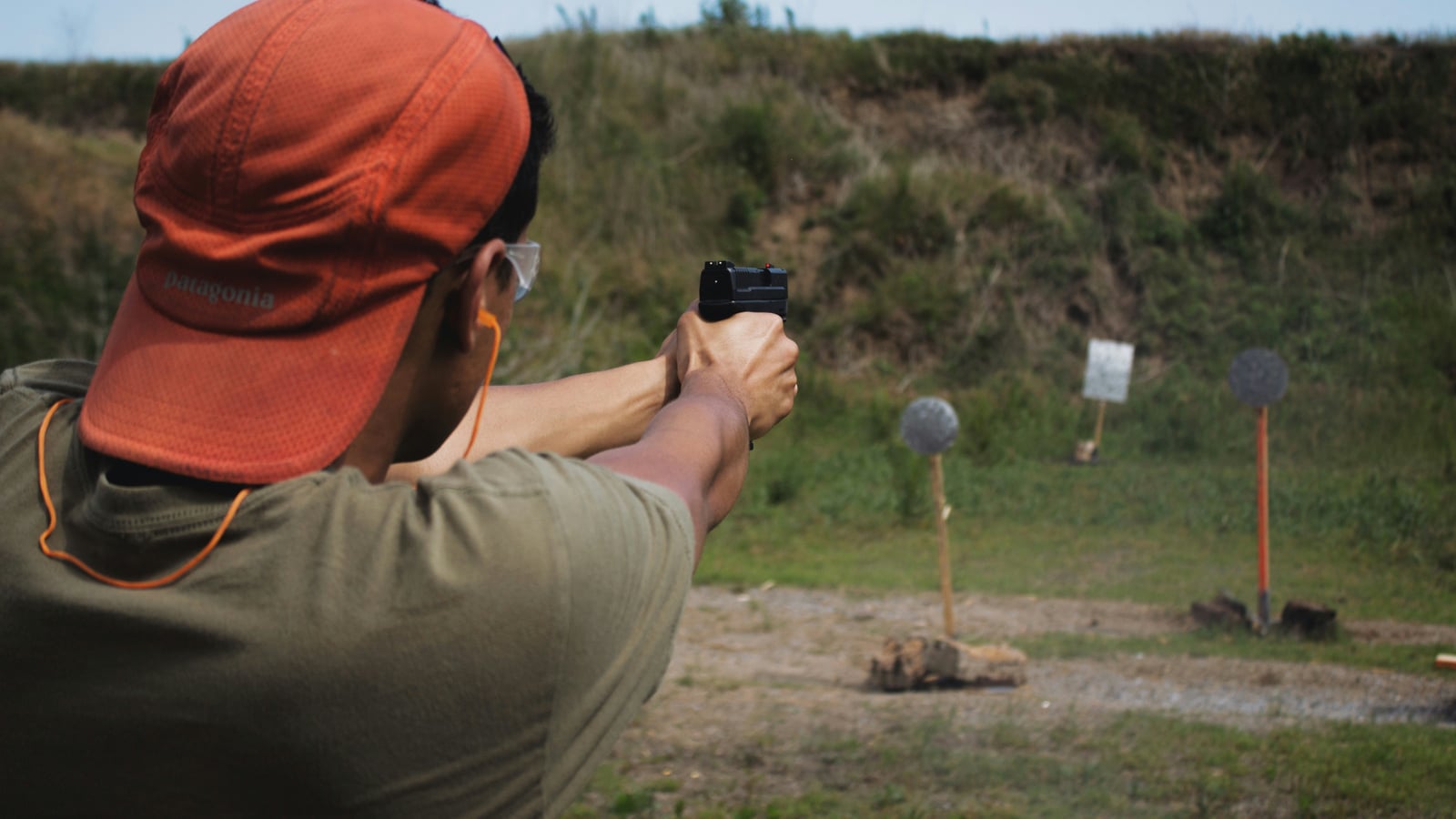
What Steel Challenge actually is
Steel Challenge is a dynamic shooting discipline built on a principle that’s simple to state but demanding to execute: hit a series of steel plates in the fastest possible order, with the timer alone deciding everything. No scenario, no roleplay situation, no complex movement between shooting positions. Just you, your gun, and a fixed course of fire across eight standardized stages.
The discipline was born in the United States in the 1980s before spreading widely across Europe and into the practical shooting scene there via clubs affiliated with dynamic shooting. It shares part of its DNA with IPSC/USPSA, particularly the gear used and a portion of the shooters who practice both, but it stands apart through a far leaner format. It’s often the discipline recommended to a shooter discovering dynamic shooting who wants to grasp the basics of speed and accuracy without the complexity of a scenario-based course.
The scoring principle is what makes Steel Challenge instantly readable, even for an audience new to competitive shooting. A stage is shot over several separately timed runs, and only the best time counts toward the final ranking on that stage. This scoring mechanic, combined with plates that produce an audible sound and visible movement on impact, makes it a particularly spectacular discipline to watch in competition.
This format attracts a specific type of shooter: one who loves working on pure speed, smoothness of movement, and managing the pressure of the clock, without the tactical, terrain-reading component found in other dynamic disciplines. Many club instructors actually use it as a gateway into dynamic shooting, before steering interested shooters toward more complex formats.
The eight standardized stages
The heart of Steel Challenge lies in its eight official stages, each with a fixed, documented plate layout, identical worldwide. This standardization is the major structural difference from classic IPSC/USPSA, where every course of fire is unique and designed specifically for a given match.
Each stage prescribes its own distinct arrangement of cardboard targets and steel plates, with a “stop plate” that must be hit last to validate the run. The number of plates per stage generally sits around five, with distances and angles that change from stage to stage to test different skills: tight transitions, long-range shooting, lateral body offset, or shooting from a constrained starting position.
This standardization brings a concrete benefit for individual progression: a shooter can train on a specific stage at their home club, compare their time against known benchmarks, and track their progress on that exact stage over months. It’s a very different growth mechanic from IPSC, where the constant novelty of courses prevents this kind of direct comparison between sessions.
Shooters discovering the eight stages for the first time are often surprised by how visually simple they look. The difficulty doesn’t come from the complexity of the course, but from the extreme speed required to compare against the discipline’s best times. A stage that looks trivial in slow motion becomes a real technical challenge once you try to run it under two or three seconds.
Pure time scoring: how it works
The Steel Challenge scoring mechanism deserves a detailed look, because it fundamentally differs from the point systems used in other dynamic disciplines. Here, there’s no notion of a scoring zone on a cardboard target evaluated in points: only the timed result counts, down to the second and hundredth of a second.
A stage is typically contested over five independently timed runs. Of those five runs, the best and worst may be dropped depending on the exact match format, and it’s the average or best remaining time that determines the shooter’s final score on that stage. This mechanic leaves some room to breathe: a botched start on one run doesn’t sink the overall result for the stage.
Timing starts at the electronic signal and stops the instant the last plate (the stop plate) falls or pivots under impact. This precision of electronic timing eliminates any possible dispute and makes the ranking fully transparent, which explains a good part of the discipline’s appeal to shooters who love measurable data.
A failed run, whether a complete unmade plate or a plate hit out of order, results in a fixed time penalty added to the actual run time rather than an outright disqualification. This proportionate penalty system encourages taking the risk of speed rather than retreating into excessive caution, while clearly punishing inaccuracy.
The overall match standings add up the scores earned across all eight stages, which rewards consistency as much as performance on any single stage. A shooter who excels on two stages but struggles on the other six will generally rank lower than a shooter who’s more consistent across the whole course.
Allowed gear and divisions
Steel Challenge organizes its competition into equipment divisions, a principle similar to IPSC/USPSA but with its own categories and criteria specific to the discipline. Each division groups guns with comparable characteristics to guarantee fair competition among shooters using roughly the same technical level of gear.
The most accessible division covers stock guns, close to their factory configuration, without heavy trigger work or optical sights added. This is generally the division where a shooter new to Steel Challenge takes their first steps, with a modest budget and gear they may already own for other disciplines.
More permissive divisions allow further modifications: lightened, reworked triggers, recoil compensators, red-dot sights mounted directly on the slide or barrel. These divisions attract experienced shooters looking to optimize every tenth of a second with gear specifically configured for the discipline.
Rifle and lever-action rifle also have their own divisions within Steel Challenge, with their own caliber and configuration rules. This diversity lets shooters coming from different backgrounds (competition pistol, hunting rifle, classic sport shooting) find a division suited to their existing gear without having to immediately invest in dedicated equipment.
Division rankings guarantee that a shooter with a stock pistol is never directly compared to a shooter equipped with ultra-optimized, expensive gear. This logic of dividing by equipment category shows up in most federation-governed dynamic disciplines, and it remains one of the best levers for letting a beginner progress without getting discouraged by configurations out of their budget’s reach.
The fundamental difference from classic IPSC
The most important distinction between Steel Challenge and classic IPSC/USPSA lies in the very nature of the challenge presented to the shooter. Scenario-based IPSC demands solving a fresh tactical problem on every course: an engagement order the shooter must define themselves, complex movement between shooting positions, real-time decision-making during execution. Steel Challenge strips away this problem-solving component to focus exclusively on pure technical execution.
In classic IPSC, the same course of fire is generally only shot once in competition, meaning managing stress and the unexpected is an integral part of the test. In Steel Challenge, repeating five runs on the same standardized stage allows a form of motor automation that IPSC doesn’t permit in the same way, since every course there is unique.
Scoring is another major structural difference. Classic IPSC combines speed and accuracy in a points-per-second formula (the famous “hit factor”), where a poorly placed hit directly penalizes the final score regardless of time. Steel Challenge, with its pure time scoring plus fixed penalties, separates the two notions more cleanly: accuracy becomes a condition to meet rather than a continuous variable to optimize within a combined calculation.
Physical movement also differs radically between the two disciplines. A classic IPSC course can require covering dozens of meters, changing shooting positions, reloading on the move. Most Steel Challenge stages are shot from a nearly fixed position, with minimal shooter movement, which refocuses the exercise on transition speed between targets rather than general mobility.
This format difference has a direct impact on training. A shooter preparing for a season of classic IPSC has to work on stage reading, decision-making, and movement management on top of pure shooting. A Steel Challenge-focused shooter can concentrate most of their preparation on draw speed, smooth transitions, and sight recovery, often making training more efficient for the same time invested.
The start signal and electronic timing
A Steel Challenge run relies entirely on an electronic timer, a central tool of the discipline that’s worth understanding in detail before your first match. This device emits a random audible signal after a variable delay once the shooter is in position, specifically to prevent any anticipation of the start.
The device’s built-in microphone picks up the sound of the first shot to start the clock, then picks up successive impacts on the steel plates to record each split time. This acoustic capture creates a practical condition often underestimated by beginners: a shooting bay that’s too loud, with several bays firing simultaneously nearby, can interfere with signal detection and slightly skew timing if the device isn’t properly isolated or positioned.
The random delay before the start signal, typically between one and four seconds after the range officer’s command to fire, plays an important psychological role in the discipline. It prevents any motor automation based on simple mental counting, forcing the shooter to stay focused on active listening rather than an anticipation that would be penalized as an early start.
An early start, automatically detected by the timer if the first shot occurs before the signal, results in a strict penalty that generally negates the value of the run. It’s one of the most common mistakes among beginners eager to show off their speed, and most club instructors spend part of the introductory session simply teaching shooters to wait for the beep before any finger movement toward the trigger.
Reading the timer after each run gives an overall time, but often also a breakdown of split times between each plate hit. This granular data lets you pinpoint exactly where the room for improvement lies: a correct reaction time to the signal but a slow transition between the third and fourth plate, for instance, directly points to the work needed in training.
The named stages and their technical particularities
Each of the eight official Steel Challenge stages carries its own name and imposes a well-identified configuration, worth knowing before showing up at a club for the first time. This identity specific to each stage is part of the discipline’s culture and serves as a common reference point among shooters worldwide.
Some stages require engaging plates in a line, arranged at increasing distance from left to right or vice versa, which above all demands smooth visual scanning and recoil management between each closely spaced shot. Other stages tighten the plates into a fan around a central point, requiring finer control of short transitions and core stability.
One particular stage requires dealing with a pair of closely spaced plates before hitting an isolated plate farther away, testing the ability to change shooting rhythm mid-run: a quick burst on the first targets, then a controlled slowdown to avoid missing the most demanding plate for accuracy. It’s often this type of stage that most clearly separates skill levels between shooters.
Other configurations require what’s called “face-to-face” shooting, where two symmetrical plates must be engaged in any order before the central stop plate, leaving the shooter a small margin of strategic choice about the optimal engagement order based on their natural aiming position. This limited freedom remains one of the rare tactical decisions the discipline allows within an otherwise fully standardized framework.
Plate distance varies noticeably from stage to stage, with some targets sitting just a few meters from the shooting box while others are considerably farther away, requiring you to recalibrate your aim and shooting rhythm depending on the stage tackled. A shooter who masters a close-plate stage can find themselves thrown off on a long-distance stage if they haven’t varied their training enough across the eight configurations.
Common technical mistakes among beginners
Steel Challenge’s seemingly simple format hides a number of technical traps that consistently crop up among shooters new to the discipline. Identifying them in advance allows for more effective training from the very first sessions.
Rushing the first shot remains the most common mistake. A beginner mainly seeking to impress with speed often neglects proper alignment on the first plate, resulting in a miss that costs far more time than a slightly steadier but accurate first shot. Most instructors repeat that a missed first shot systematically dooms the rest of the run.
Eyes lingering too long on the plate just hit, instead of shifting immediately to the next plate, is another frequent source of lost time. This often unconscious reflex among beginners wanting visual confirmation of the impact is specifically trained by forcing yourself to move your gaze to the next target the instant the shot breaks, without waiting for visual confirmation of the result.
Managing recoil between two closely spaced shots on nearby plates also often causes trouble: a shooter who lets the gun rise fully before bringing it back down to aim loses precious time compared to one who manages a shorter, more efficient sight recovery. This technical point requires specific dry-fire work away from the range, to automate a minimal sight recovery without sacrificing accuracy.
An unnecessary foot movement or posture adjustment between two nearby plates, when the stage doesn’t demand it at all, also slows down many beginners who unconsciously reproduce reflexes from other, more mobile dynamic disciplines. Steel Challenge instead rewards lower-body stability and minimal parasitic upper-body movement.
Finally, sloppy magazine handling or hand positioning between two consecutive runs can create a delay that has nothing to do with the shooting itself, but that directly affects the overall time felt during a competition session. A well-drilled handling routine between each run, regularly reviewed in training, avoids this kind of avoidable time loss.
Mental preparation and managing time pressure
The mental dimension of Steel Challenge deserves particular attention, because the pressure of a publicly displayed clock differs noticeably from the stress felt in a discipline scored purely on points. Many experienced shooters consider managing this stress to be almost as decisive as pure technique once a solid level is reached.
Waiting for the audible signal, with its intentionally random delay, is itself a concentration exercise worth training specifically. Some shooters develop a breathing routine or a visual focus on the first plate during this wait, precisely to keep the mind from drifting toward the clock or already-finished competitors.
The immediate, public comparison of times between shooters, often displayed or announced right after each run, adds social pressure that some beginners don’t anticipate before their first match. An experienced instructor generally advises focusing solely on executing your own course of fire, without letting yourself be distracted by other competitors’ displayed scores during your own series of runs.
Managing a one-off failure, such as a missed plate or a noticeably worse time than usual on a given run, is also an integral part of the mental preparation to work on. The five-run-per-stage format, with the possibility of dropping the worst results depending on the format used, offers a margin for recovery that needs to be exploited mentally rather than letting yourself be thrown off by a botched run and rushing to make up for it on the next one.
Some experienced shooters practice mental visualization of the stage before stepping up to the line: mentally replaying the exact sequence of plates, the planned engagement order, and the aim point on the stop plate, a preparation that resembles techniques used in other timed precision sports. This visualization, combined with a stable physical routine before each run, helps reduce the variability between a shooter’s best and worst attempts.
Steel Challenge in the American practical shooting landscape
In the United States, Steel Challenge is organized primarily through clubs affiliated with the discipline’s governing body, with a competition calendar that, while often less dense than classic USPSA in some regions, has been developing steadily in recent years. A shooter interested in the discipline will do well to check directly with clubs in their area for the exact local offering, which varies noticeably from region to region.
Access to the guns needed to practice Steel Challenge follows the general regulatory framework applicable to civilian competitive shooting in your jurisdiction. Rules and licensing requirements for pistols and rifles vary by state and locality, so it’s worth checking directly with your club or a licensed dealer before any purchase, especially for lever-action rifles used in certain divisions, which may fall under different rules depending on their exact mode of operation.
Some clubs organize open house days for the non-licensed public, under the direct supervision of a certified instructor and with gear loaned on site, allowing people to try the discipline before committing to full membership and the purchase of personal equipment. This is often the best entry point for a shooter still torn between several dynamic disciplines who wants a concrete feel for it before deciding where to invest their time and budget.
The coexistence of Steel Challenge and classic USPSA/IPSC within the same clubs remains common, with many clubs offering both disciplines with separate training slots. This proximity makes it easy for a curious shooter to move from one discipline to the other, since basic gear remains largely compatible between the two practices in most stock divisions.
Why some shooters prefer Steel Challenge
Steel Challenge appeals to a category of shooters for reasons that go well beyond a simple aesthetic preference for steel targets. The immediate readability of the result, a number in hundredths of a second that leaves no room for interpretation, particularly appeals to shooters who like measuring their progress objectively.
The repetitive, standardized nature of the eight stages allows a kind of foundational work that few other dynamic disciplines permit in the same way. A shooter can recreate a stage identically at their home club, precisely compare their time from one session to the next, and pinpoint with certainty where their room for improvement lies: the draw, the first hit, the transition between distant plates.
The short format of each run, generally between two and five seconds depending on the stage and the shooter’s level, makes the discipline physically accessible to a wider audience than classic IPSC. A less mobile or beginning shooter can fully engage with Steel Challenge without their general physical condition becoming a major limiting factor, unlike IPSC courses that sometimes demand greater endurance and mobility.
The spectacular, noisy character of hit steel plates also makes it a discipline particularly appreciated by spectators at open matches, which helps promote it to curious newcomers wanting to discover dynamic shooting. The sharp sound of impact and the visible movement of the plate give an immediate readout of the result, even for a spectator with no technical knowledge of the discipline.
Finally, some shooters simply appreciate the mental dimension specific to pure timing: managing the pressure of an audible countdown, learning to stay smooth despite the stress of performance displayed in real time — skills transferable to other shooting disciplines, including untimed ones.
Getting started with Steel Challenge at a club
A shooter curious to discover Steel Challenge will generally find an open door at affiliated clubs that organize regular introductory sessions or friendly matches. The discipline requires a reasonable initial equipment investment if the shooter already owns a gun suited to a stock division, which makes it more accessible than disciplines demanding more specific gear from the start.
The first session almost always focuses on the handling safety specific to dynamic shooting: trigger discipline while shifting your gaze between targets, strict adherence to permitted shooting angles, systematically holstering the gun between each run. These safety habits take priority over the pursuit of speed until they’re fully mastered, and an experienced instructor will always insist on this before timing even a single run.
Starting gear can stay simple: a reliable stock pistol, a holster suited to a safe draw, and a few spare magazines are enough to start practicing on the basic stages. An experienced club shooter generally recommends mastering accuracy on a fixed target before chasing speed, since the reverse order often leads to imprecise shooting habits that are hard to correct later.
Progress in Steel Challenge follows a fairly readable curve for anyone training regularly: the first time gains come quickly by working on the draw and first shot, then progress slows and requires finer work on transitions between plates and eye management. A regional champion in the discipline often stresses the importance of filming your own runs to spot dead time invisible to the naked eye during execution.
Signing up for a first official competition generally doesn’t require any particular level: the division format lets a beginner compete from their very first serious sessions, with a ranking that honestly reflects their real level against shooters with comparable gear. It’s often one of the best ways to stay motivated and concretely measure your progress over time.
Gear maintenance and reliability in competition
The repetitive, intensive nature of Steel Challenge, with a large number of runs fired quickly over a single competition day, demands particular rigor in maintaining the gear used. A malfunction mid-timed-run costs dearly in time and concentration, far more than in a discipline with a more relaxed pace.
Regular cleaning of the gun between training sessions remains the essential foundation for limiting malfunctions linked to fouling. A pistol or rifle used in Steel Challenge often takes a higher round count than in other recreational practices, which accelerates wear on certain parts and requires more frequent checks of sensitive components like the recoil spring or the extractor.
Ammunition choice directly influences reliability in competition. Many experienced shooters favor ammunition whose behavior in their gun they know perfectly rather than switching brands right before an important event, even if a new load looks promising on paper. Ammunition consistency often matters more than raw performance in a discipline where every miss costs cash on the clock.
Checking gear before every competition deserves a systematic routine: verifying sight tightness, checking the condition of magazines and their springs, testing the trigger to make sure it reacts exactly as it does in training. An experienced instructor generally recommends never testing a new setting on the day of a competition itself, to avoid discovering a problem at the worst possible moment.
The steel plates themselves, though managed by the club or match organization, deserve the shooter’s attention during the stage briefing: knowing their condition, their exact angle, and their distance lets you mentally adjust your course of fire even before the first timed run.
Methodically tracking your sessions, with a digital or paper shooting log noting the times achieved stage by stage, session after session, adds value that many shooters underestimate early in their practice. This traceability lets you spot a gradual drift in times that could signal an emerging equipment problem, even before it results in an outright malfunction in competition.
The move from regular club training to a first official competition represents a milestone in a shooter’s progression in its own right, with its own conventions worth knowing in advance to approach the event calmly.
Signing up for a competition is generally done ahead of time with the organizing club, with a number of spots often limited by the number of available shooting bays and the length of the planned day. Checking early with the organizer about registration procedures, the exact rules applied, and the check-in time avoids unpleasant surprises on the day itself.
A competition generally proceeds with shooters rotating in groups between the eight stages, each group moving successively through each stage in an order set by the organization. This rotation involves waiting time between runs, often used by shooters to watch other competitors, discuss stages already shot, or simply rest before the next series.
The role of the stage range officer is worth understanding well before your first event: they validate each run, announce the time achieved, manage any penalties, and ensure strict adherence to safety rules throughout the shooter’s run. A clear, calm dialogue with the range officer, especially in case of doubt about a plate or an announced time, is an integral part of a competition running smoothly.
A modest first ranking should never discourage a beginner: progress in Steel Challenge is measured first against your own previous times rather than against the overall ranking of a first event. Most experienced shooters actually remember their own modest beginnings before reaching a level that let them aim for higher rankings at regional or national competitions.
The overall atmosphere at a Steel Challenge competition generally remains friendly and far from any excessive tension between competitors, despite the timed nature of the event. More experienced shooters readily share technical advice with beginners between runs, and this culture of mutual help contributes greatly to the discipline’s good reputation among newcomers discovering dynamic shooting through it.
FAQ
Q: Do you need to already shoot USPSA/IPSC to get into Steel Challenge? A: No, Steel Challenge can very well serve as a first dynamic discipline for a beginner. Its standardized format and pure time scoring even make it an often-recommended entry point before moving toward more complex scenario-based courses.
Q: What budget should you plan for getting started in Steel Challenge? A: It varies a lot depending on gear already owned and the division targeted; a stock pistol is more than enough for the most accessible division. Best to check directly with your club to find out exact registration and membership costs before investing in extra gear.
Q: Can you use a rifle in Steel Challenge? A: Yes, the discipline offers dedicated rifle divisions, including lever-action, with their own caliber and configuration rules for these categories. Ask your club about the rifle divisions available locally, as the offering varies by organizer.
Q: Are the targets used only steel plates? A: Most stages use steel plates, but some layouts also include generic cardboard targets depending on the specific stage. None of these targets ever represent a human silhouette; the rules strictly govern their shape.
Q: How long does a full Steel Challenge competition last? A: That depends on the number of shooters registered and the organization chosen by the club, with a full day being common to cover all eight stages with every participant. Contact the event organizer to find out the exact format and planned schedule.
Q: Is the discipline suited to a shooter who doesn’t like competing under pressure? A: Timing is an integral part of Steel Challenge, but nothing stops you from training at a club without aiming for official competition. Many shooters practice purely for the technical enjoyment of the movement, without ever signing up for an official timed event.