
Why a sport shooting glossary
When you walk into a shooting club, you hear a dozen unfamiliar words in the first half hour. An instructor talks about your “grouping,” an experienced shooter mentions their category B file, another comments on the “hit factor” from the last IPSC match. Nobody takes the time to translate everything, and you just nod along pretending to follow.
This glossary brings together more than 130 terms used daily in clubs and competitions. It’s organized by theme: gear, shooting technique, paperwork, and competition. Each definition is short, precise, uses correct civilian sport shooting vocabulary, and ends with a concrete real-world example to anchor the term in an actual club or competition situation.
Keep this page handy during your first months. You can also use it as a quick reference before a competition, to check a rulebook term you come across in an event booklet.
Gear vocabulary: the firearm
These terms describe the parts and physical characteristics of a sport shooting firearm.
- Trigger: the moveable piece pressed by the finger to release the shot. This is the only correct term for that control — the internal mechanism that releases the firing pin is never called this in everyday use. Example: “Your trigger breaks too dry, you’re anticipating the shot” is a common remark from an instructor early in training.
- Barrel: the rifled metal tube (or smooth for some clay disciplines) the projectile travels through. Its length and condition directly affect accuracy. Example: a gunsmith checks the barrel’s condition before approving a used firearm for precision competition.
- Rifling: helical grooves inside the barrel that impart spin to the projectile to stabilize it in flight. Example: fouled rifling after a long session often explains a loss of accuracy toward the end of a string.
- Bolt/breech: the moving part that closes the chamber at the moment of firing and ensures the case is extracted afterward. Example: a jam on a rifle is often cleared by manually working the bolt to free a stuck case.
- Magazine: a removable component that stores ammunition before it’s fed into the chamber, specific to semi-automatic or repeating firearms. Example: an IPSC shooter drills empty magazine changes to shave tenths of a second off a match.
- Cylinder: the rotating drum that holds ammunition in a revolver, distinct from a semi-auto’s magazine. Example: opening the cylinder to visually confirm it’s empty is part of the standard safety routine at the end of a session.
- Front sight: the sighting element fixed at the front of the barrel, aligned with the rear sight. Example: a front sight fouled by black powder smoke can throw off alignment on an older firearm.
- Rear sight: the rear sighting element, adjustable in elevation and windage on most precision firearms. Example: after three impacts drifting right, the instructor suggests correcting the rear sight one click to the left.
- Grip/stock: the part of the firearm held in the hand (handgun) or braced against the shoulder (rifle), often adjustable on competition models. Example: an overly wide grip keeps some shooters with smaller hands from comfortably reaching the trigger.
- Rear sight notch: the notch in the rear sight through which the shooter aligns the front sight. Example: centering the front sight in the notch, with an even gap of light on each side, is the first instruction given to a beginner.
- Trigger pull weight: the force in grams or pounds required to press the trigger, adjustable on many precision firearms. Example: a 10m precision pistol is often set to a very light trigger pull, around 500 grams.
- Trigger travel: the distance the trigger moves from its starting point to the break. Example: shortening trigger travel allows for a crisper release but increases the risk of an accidental discharge if not properly controlled.
- Break point: the exact moment the trigger releases the firing pin after overcoming the mechanism’s resistance. Example: feeling the break point without anticipating it in advance is one of the first skills a beginner works on during dry-fire practice.
- Firing pin: the part that strikes the cartridge’s primer to ignite it. Example: repeated dry-firing prematurely wears the firing pin on some older firearms, which is why snap caps are used.
- Safety (safety lever): a lever or button that mechanically blocks the shot from firing while engaged. Example: the first reflex when picking up a club firearm is checking the safety’s position even before loading it.
- Extractor: the part that grips the rim of the case to pull it from the chamber during the ejection cycle. Example: a worn extractor sometimes leaves a case stuck in the chamber after firing.
- Ejector: the part that throws the case clear of the firearm once the extractor has pulled it from the chamber. Example: on a covered range, ejected cases often land to the shooter’s right, hence the use of brass catchers.
- Chamber: the part of the barrel where the cartridge sits just before firing. Example: a visual chamber check is part of the safety protocol every time a firearm is handled at the club.
Gear vocabulary: optics and accessories
Sighting equipment and accessories form a second essential family of vocabulary.
- Reticle: the visible pattern in a scope or red dot, used as an aiming reference (crosshair, dot, circle). Example: a fine reticle suits precision on a stationary target, a thick reticle makes fast aiming easier in dynamic shooting.
- Red dot: an optical sighting device projecting an illuminated dot onto a lens, without magnification, widely used in dynamic shooting and speed pistol. Example: switching from iron sights to a red dot takes a few sessions to rebuild fast sight references.
- Scope (optic): a magnifying optical device mounted on a long gun, used in precision and long-range shooting. Example: a poorly mounted scope that shifts under recoil ruins the repeatability of settings from one session to the next.
- Magnification: the image enlargement factor a scope provides, expressed as “x” (a 4x magnifies four times). Example: a variable 3-9x magnification adapts equally well to a target at 50m or one at 300m.
- Parallax: the apparent shift between the reticle and the target when the eye isn’t perfectly centered on the optical axis, adjustable on some high-end scopes. Example: a bench-rest shooter systematically adjusts parallax to the exact distance of the target before each string.
- Sling: a strap that supports a rifle on the shoulder or stabilizes the position in prone shooting. Example: a sling tensioned around the forearm noticeably improves stability in the prone position at 50 meters.
- Holster: a container that carries a handgun securely between strings of fire, mandatory in dynamic shooting. Example: IPSC rules require a holster that fully covers the trigger to prevent accidental contact.
- Magazine pouch: a belt accessory that holds spare magazines during a timed event. Example: the order of magazine pouches on the belt changes depending on whether the shooter is right- or left-handed.
- Ear protection (earmuffs / earplugs): passive or active hearing protection, mandatory on every range. Example: electronic earmuffs amplify ambient voices while cutting the noise of the shot, handy for following commands.
- Eye protection (shooting glasses): mandatory equipment against debris (ejected cases, lead particles, clay fragments). Example: at trap shooting, tinted lenses also improve the clay’s contrast against the sky.
- Competition belt: a rigid belt that supports the holster and magazine pouches in dynamic shooting, distinct from a regular belt. Example: a poorly fitted competition belt lets the holster shift during movement on an IPSC stage.
- Tripod / bipod: a support that stabilizes a long gun in the prone or seated position. Example: a height-adjustable bipod lets you adapt the prone position to uneven ground in long-range shooting.
- Shooting mat: a soft surface placed on the ground for the prone position, protecting the elbows and improving comfort. Example: a thick shooting mat reduces fatigue during a precision match lasting several hours in the prone position.
- Shooting bag (sandbag): a rest accessory that stabilizes the front or rear of the stock in bench-rest position. Example: two shooting bags, one under the stock and one under the barrel, can nearly fully isolate the shooter’s input.
- Shooting glove: a reinforced glove that protects the support hand from barrel heat or repeated friction. Example: a shooting glove prevents minor burns after a long trap session on a hot day.
Gear vocabulary: ammunition
Understanding an ammunition spec sheet requires its own vocabulary.
- Caliber: the nominal diameter of the projectile and barrel bore, expressed in millimeters or hundredths of an inch (e.g. .22 LR, 9mm). Example: most Olympic precision disciplines are shot in .22 LR caliber, inexpensive and quiet.
- Case: the metal shell that holds the powder and retains the projectile before firing, ejected after use on semi-automatic firearms. Example: picking up your cases after a session is a common habit among shooters who reload.
- Primer: a small impact-sensitive charge that ignites the powder. Example: a primer that fails to fire on the first strike requires repeating the safety procedure before removing the cartridge.
- Powder: the propellant charge that, when burned, generates the gases that drive the projectile out of the barrel. Example: the amount of powder used in reloading directly affects velocity and felt recoil.
- Bullet: the part of the projectile that leaves the barrel, distinct from the complete cartridge. Example: a heavier bullet often offers better flight stability at long range, at the cost of stronger recoil.
- Muzzle velocity: the projectile’s speed measured as it leaves the barrel, expressed in meters or feet per second. Example: a chronograph set up in front of the firing line lets you verify the muzzle velocity of reloaded ammunition before approving it.
- Reloading: the practice of assembling your own cartridges from cases, primers, powder, and bullets, governed by strict safety rules. Example: a shooter who reloads can tune ammunition to their firearm to optimize grouping.
- Subsonic ammunition: ammunition whose velocity stays below the speed of sound, producing a reduced report. Example: subsonic .22 LR ammunition limits noise on a covered range.
- Blank cartridge: ammunition without a projectile, used for certain supervised exercises or demonstrations. Example: a blank cartridge is subject to the same handling and safety rules as live ammunition.
- Match-grade ammunition: ammunition manufactured with tighter quality tolerances to guarantee consistent grouping. Example: an Olympic precision shooter rarely switches match ammunition lots mid-season to preserve their settings.
- Lot (of ammunition): a batch of cartridges manufactured under the same conditions, whose ballistic consistency can vary from lot to lot. Example: testing several ammunition lots before a championship helps identify the one producing the tightest grouping.
- .22 LR caliber: a low-power caliber very common for introduction and Olympic precision, inexpensive to buy. Example: most clubs offer their first taster sessions in .22 LR caliber.
Technical vocabulary: aiming and shooting
These are the terms you’ll hear most often on the range while learning.
- Sight alignment: the correct overlay of the front sight in the rear sight notch (or the reticle on the target), a basic condition for an accurate shot. Example: losing alignment a split second before release is enough to shift the impact by several centimeters at 25 meters.
- Point of aim / point of impact: the point of aim is where the sights are set, the point of impact is where the shot actually lands on the target; the gap between the two indicates whether an adjustment or a technique fix is needed. Example: a consistent low shift between point of aim and point of impact points first to a sight adjustment rather than a technique flaw.
- Break (of the shot): the exact moment the trigger reaches its break point and the shot fires. Example: too abrupt a break disrupts the alignment just achieved, hence instructors’ insistence on a smooth motion.
- Follow-through: maintaining position and aim during and just after the break, without anticipating recoil. Example: keeping your eyes open and your aim steady during follow-through lets you immediately spot a trajectory flaw.
- Anticipation: a flaw where the shooter reacts to recoil before the shot even fires, a frequent cause of inaccuracy for beginners. Example: a dry-fire drill with a coin balanced on the barrel immediately reveals an anticipation problem.
- Recoil: the firearm’s backward movement caused by the ejection of gases and the projectile, to be absorbed without tensing up. Example: poorly managed recoil on a rifle is often due to insufficient shoulder contact rather than excessive ammunition power.
- Controlled breathing: a technique of timing the shot to a natural pause in breathing to stabilize aim. Example: holding your breath for more than ten seconds before the break actually causes trembling, hence the importance of timing.
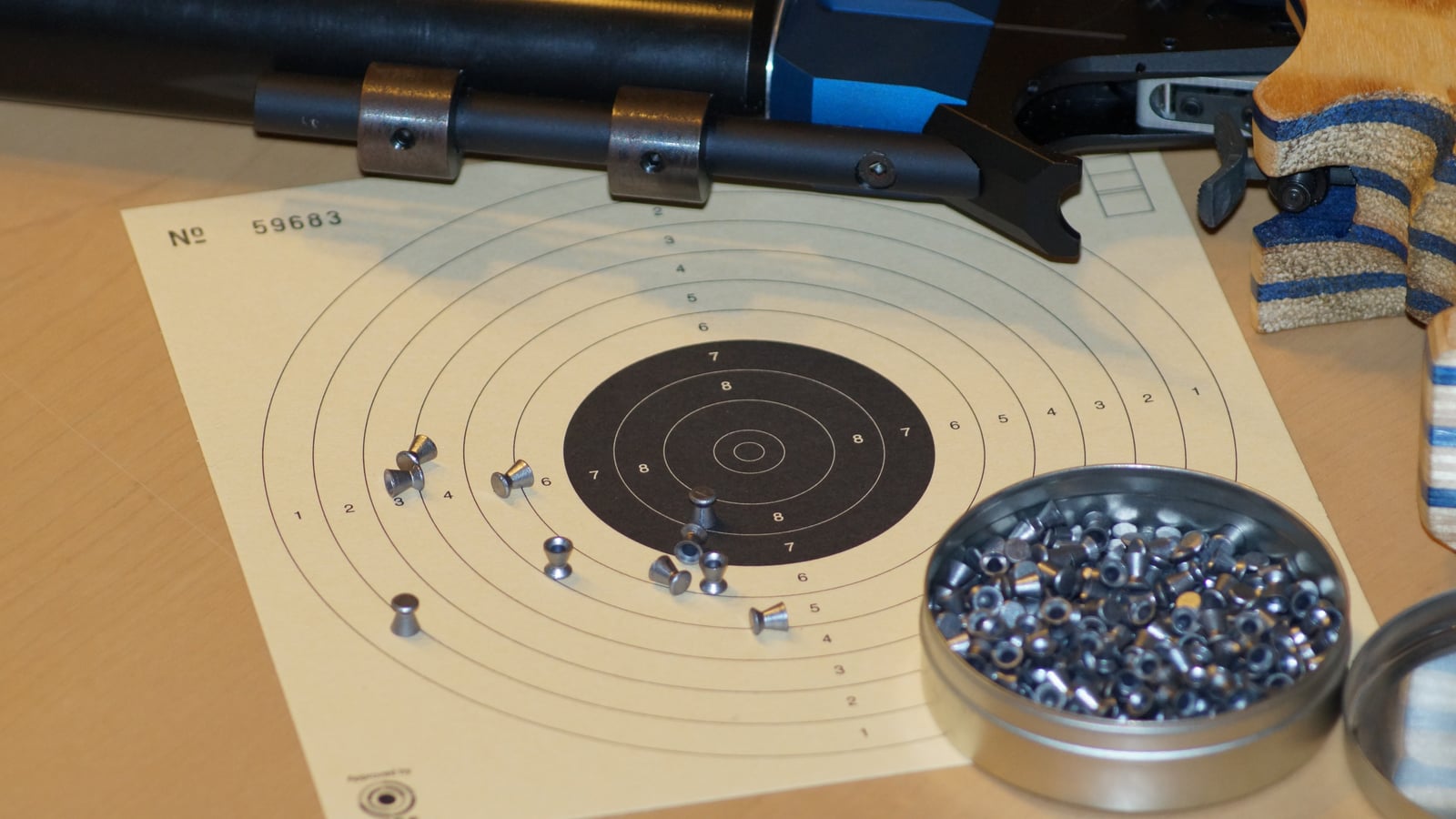
- Grouping: the set of impacts from a string of shots, whose spread measures the consistency of both shooter and gear. Example: a tight but off-center grouping points to a settings issue, while a scattered grouping points more toward technique.
- Zero: adjusting the sights so the point of aim and point of impact coincide at a given distance. Example: a rifle zeroed at 100 meters won’t have the same point of impact at 300 meters, hence the value of knowing its trajectory.
- Shooting position: the body posture adopted while firing — standing, kneeling, or prone depending on the discipline and rules. Example: switching between shooting positions during an Olympic event follows an order set by the rules.
- Stance: the arrangement of footing and torso in dynamic pistol shooting, which varies by school of thought. Example: too closed a stance limits transition speed between two targets on an IPSC stage.
- Grip: the way the firearm is held, decisive for stability and recoil management. Example: too loose a grip on a dynamic pistol noticeably increases recovery time between shots.
- Transition: the swinging movement of aim from one target to the next in dynamic shooting. Example: drilling the transition between two closely spaced plates saves precious time on a Steel Challenge stage.
- Double action / single action: how a firearm’s trigger operates, depending on whether it cocks and releases the firing pin in one motion (double action) or only releases it (single action). Example: a revolver fired double action needs a longer, heavier trigger pull than in single action.
- Instinctive shooting: a fast-aiming technique based on eye-hand coordination rather than precise sight alignment. Example: instinctive shooting is trained mostly at short range, where speed matters more than pinpoint accuracy.
- Draw: the action of pulling the firearm from the holster to engage a target, timed in some dynamic disciplines. Example: a smooth, jerk-free draw is built through dozens of dry repetitions before being attempted in a match.
- Rate of fire (cadence): the time interval between two successive shots, adapted to the discipline and desired accuracy. Example: slowing your rate of fire on a distant target often compensates for a loss of accuracy toward the end of a string.
- Dry fire: training without ammunition, with the firearm unloaded and verified, to work on aiming and trigger technique. Example: ten minutes of dry fire before each session is often enough to correct a persistent anticipation issue.
- Eye dominance: the naturally preferred eye for aiming, not always on the same side as the dominant hand. Example: a right-handed shooter with left eye dominance often has to adapt their aiming position accordingly.
Paperwork vocabulary: license and authorizations
This vocabulary covers the steps needed to practice legally at a club.
- Shooting federation license: an annual title issued by the national shooting federation, certifying sport shooter status and including liability insurance. Example: without a current federation license, a shooter can neither enter an official competition nor prove regular practice to authorities.
- Medical certificate: a document required to issue or renew a license, certifying there’s no medical contraindication to shooting. Example: the club often requests the medical certificate before even the first supervised trial session.
- Category A: a class of firearms banned for private ownership, reserved for military-grade equipment. Example: a civilian sport shooter never has access to a Category A firearm through club practice.
- Category B: a class subject to prefectural authorization, covering most handguns and semi-automatics used at clubs. Example: buying a Category B pistol is conditional on first obtaining an authorization issued by the authorities.
- Category C: a class subject to simple declaration, covering certain hunting firearms and manually operated repeating rifles. Example: a Category C rifle can be acquired after a simple declaration, without going through the authorization process.
- Category D: a class freely sold or subject to simple registration, covering low-power air guns, certain replicas, and certain historical firearms. Example: a Category D air rifle is often suitable for starting family shooting before considering a higher-category firearm.
- Authorization file (category B file): the set of documents filed with the authorities to obtain permission to own a Category B firearm, including the club’s endorsement and the medical certificate. Example: building a complete file from the first application often avoids several months of administrative back-and-forth.
- Club president’s endorsement: a document the affiliated club’s president submits in support of an authorization request. Example: without a favorable endorsement from the club president, a Category B authorization request has little chance of success.
- Gun safe: a secured storage device required for keeping a Category B firearm at home. Example: an administrative inspection may check that the firearm and its ammunition are properly stored in a compliant safe.
- Firearms register: a document tracking a firearm’s chain of ownership, kept by the club or the gunsmith depending on the case. Example: every private transfer of a firearm must be logged in the register to remain traceable in case of inspection.
- Prefectural authorization: an administrative decision granting the right to own a Category B firearm for a limited, renewable period. Example: an expired authorization must be renewed before the deadline to remain legal.
- License renewal: an annual process that renews the federation license, generally accompanied by a new medical certificate per the current schedule. Example: planning ahead for license renewal at the end of the season avoids a gap in insurance coverage before the following season’s first competitions.
- Affiliation (affiliated club): the status of a club recognized by the federation, a requirement for its members to enter official competitions. Example: a shooter switching clubs first checks that the new club is indeed affiliated with the federation.
- Firearm transport (transport declaration): rules governing moving a firearm between home and the range, unloaded and transported separately from ammunition. Example: strict compliance with transport rules applies equally to a simple trip to the club and travel to a regional competition.
- Periodic medical check: a medical exam required at regular intervals to keep holding an authorization or license. Example: a missed periodic medical check can temporarily suspend the renewal of a prefectural authorization.
Competition vocabulary: disciplines and formats
Shooting competitions and their affiliated clubs use terminology specific to each discipline.
- Precision (pistol/rifle): a discipline aiming at a fixed target at a set distance (10m, 25m, 50m depending on the event), scored on a scale of concentric rings. Example: 10-meter pistol precision remains one of the most accessible disciplines for starting official competition.
- Service rifle/pistol shooting: a discipline shot on targets with colored zones, using firearms of caliber and configuration governed by a dedicated rulebook. Example: service arms shooting often attracts precision shooters looking for a discipline with different equipment constraints.
- Trap shooting (clay shooting): a clay discipline involving shooting flying clay targets with a shotgun, available in several formats (trap, skeet, sporting clays). Example: a trap shooting beginner usually starts with trap, the most common format at clubs.
- IPSC: a timed dynamic shooting discipline on cardboard and steel/plate targets arranged in a stage, judged on combined accuracy and speed. Example: an IPSC stage often combines movement, magazine changes, and engaging multiple targets in any order.
- Steel Challenge: a timed dynamic discipline where the shooter engages a series of steel plates in a set order, ranked by fastest time. Example: Steel Challenge appeals to dynamic shooting beginners because each stage has only five plates and a very readable time.
- Hit factor: a performance metric in dynamic shooting combining points scored and time taken — the higher, the better the performance. Example: two shooters can score the same number of points, but the one with the better hit factor wins thanks to a faster time.
- Metallic silhouette: a discipline involving knocking down metal animal silhouettes (chicken, pig, turkey, ram) at various distances. Example: metallic silhouette requires precise calculation of the power needed to knock down each target based on its distance.
- Running target: an event where the target moves laterally in front of the shooter during a timed exposure. Example: running target shooting requires anticipating movement rather than aiming at a fixed point as in classic precision.
- Bench-rest: a precision discipline where the firearm rests on a fixed support, aiming to isolate equipment performance from the shooter’s input. Example: bench-rest often serves as a test bed to validate new reloaded ammunition before using it in an unsupported position.
- Field Target (airgun/crossbow): a precision discipline on miniature animal-silhouette targets arranged along an outdoor course. Example: Field Target with air rifles requires good distance estimation, since distances are often variable and unannounced.
- Olympic rapid fire (25m): a timed pistol event with very short strings on five targets, a historic Olympic discipline. Example: Olympic rapid fire imposes four-second strings that leave very little margin to correct a bad alignment.
- Three positions (3x40 or 3x20): a rifle event combining prone, standing, and kneeling positions in a single competition. Example: the three-position event demands particular endurance, since each position change must recover the same accuracy.
- Sport crossbow shooting: a precision discipline using a crossbow instead of a firearm, practiced at a fixed distance on a target or in a Field Target course. Example: sport crossbow shooting attracts practitioners coming from archery looking for a different kind of precision.
- Stage (course of fire): a sequence of exercises defined for a dynamic shooting event, with a target engagement order and movement constraints. Example: a stage briefing always specifies which areas movement is allowed in and which are off-limits.
- Black powder (historical shooting): a discipline using percussion or flintlock firearms reloaded with black powder, within a regulated heritage framework. Example: the black powder discipline attracts antique firearm enthusiasts who enjoy the ritual of loading before every shot.
Competition vocabulary: scoring and rankings
Once you’re on the firing point, a new set of terms comes into play to understand your score.
- Impact: the mark left by a projectile on the target, counted toward the score. Example: a referee sometimes checks an impact on the border between two zones with a magnifier to settle the point count.
- Zone (or ring): a concentric subdivision of a precision target, each zone worth a decreasing number of points from center to edge. Example: an impact touching the line between two zones is generally counted in the more favorable zone for the shooter, per the rules.
- Bull’s-eye: the central zone of the target, worth the maximum possible points on a precision target. Example: consistently aiming at the bull’s-eye rather than the theoretical center of the target is a reflex built with experience.
- String: a set of shots fired consecutively within a defined time or count, the basic scoring unit in precision. Example: a poorly started ten-shot string can often be salvaged if the shooter stays calm on the remaining shots.
- Match: a complete event combining several strings, whose total forms the shooter’s final score. Example: a 50-meter precision match can involve several dozen shots split into timed strings.
- Ranking: the order of shooters at the end of a competition, established by score or, in case of a tie, by tiebreak criteria. Example: the final ranking of a regional championship often serves as the selection basis for the national level.
- Shoot-off (tiebreaker): an extra string or event organized to rank shooters tied on score. Example: a sudden-death shoot-off can pit two finalists against each other after a perfect tie in the regular string.
- Homologation (record certification): the official validation of a score or record by the federation, under precise equipment and officiating conditions. Example: a record score is only certified after checking the equipment used and strict compliance with the event rules.
- Referee (range officer): the person responsible for overseeing an event, validating scores, and enforcing safety rules. Example: the referee can disqualify a shooter who points their firearm outside the safety angle, even without intent to harm.
- Range commands: a series of standardized verbal instructions (“load,” “fire,” “cease fire”) that pace a session or event at a club. Example: ignoring the “cease fire” command is a serious violation, sanctioned immediately regardless of the current score.
- Procedure penalty: points or time added to a shooter’s score for a procedural error, such as a missed target or a broken engagement order. Example: a procedure penalty in IPSC can cost more on the scoreboard than an impact simply off-center.
- Disqualification (DQ): immediate exclusion from an event for a serious safety violation, regardless of the score achieved. Example: a firearm accidentally pointed backward results in immediate disqualification on most dynamic stages.
- Score sheet: a document recording a shooter’s results for each string or target of an event. Example: checking your score sheet before signing it lets you catch a counting error before it becomes final.
- Alpha, Charlie, Delta (IPSC zones): the naming of scoring zones on an IPSC target, from the most valuable (Alpha) to the least (Delta). Example: consistently aiming for Alpha rather than Charlie improves the final hit factor on a dynamic stage.
- Personal record: the best score or fastest time a shooter has achieved in a given discipline, used to measure progress. Example: logging your personal record in a shooting logbook helps set a realistic goal for the following season.
Safety and useful acronyms
A handful of acronyms and safety rules come up in every discipline — one last pass is worth it.
- Firing line: the defined area shooters fire from, whose access is strictly controlled by the range commands. Example: crossing the firing line without authorization during an active firing phase is sanctioned immediately, even by accident.
- Safety angle (down range): the zone a firearm must remain pointed within at all times to avoid any risk, including outside firing phases. Example: an instructor consistently corrects a beginner who lets their firearm drift outside the safety angle while turning to talk.
- Hammer (cocked position): the state of a firearm ready to fire the instant the trigger is pressed, distinct from an uncocked firearm. Example: on some older firearms, the hammer must be manually cocked before every shot, unlike modern double-action firearms.
- Safety catch: a mechanical device that blocks the trigger or firing pin to prevent an unintentional discharge. Example: engaging the safety catch as soon as a string ends is one of the automatic habits expected from the very first sessions.
- National shooting federation: the body that organizes and regulates civilian sport shooting nationally. Example: the federation publishes the official calendar of sanctioned competitions at regional and national level every year.
- Club grant/subsidy scheme: associative structures or statuses that can help finance part of an affiliated club’s equipment, a term found in internal administrative documents. Example: a club putting together a grant application sometimes mentions such subsidy schemes to fund target equipment.
- ISSF: the international federation that sets the rules for Olympic sport shooting disciplines, the reference for standardized targets and distances. Example: an ISSF-compliant target is essential for a score to be certified at international level.
- Shooting logbook: a document or app tracking a shooter’s sessions, scores, and progress over time, useful both for recreational and competitive shooters. Example: reviewing your shooting logbook before a competition helps identify the conditions under which your best scores were achieved.
- Unloaded / cleared firearm: the verified and announced state of a firearm with no ammunition in the chamber or magazine, a baseline condition for any handling outside of firing. Example: announcing “unloaded” aloud while showing the open chamber is part of the safety ritual at the club.
- Safe area: a dedicated space where a firearm can be handled outside of firing, magazine removed and chamber open, away from any active firing phase. Example: a dynamic shooting club’s safe area allows dry-drawing without live ammunition to train.
- General safety rules: a set of basic rules (always point the firearm in a safe direction, finger off the trigger until aiming, treat every firearm as loaded) taught from the very first session. Example: the four general safety rules are posted on signage in most clubs.
- Finger off the trigger: a safety rule requiring the finger to stay along the frame, off the trigger, until the firearm is aimed at the target. Example: an instructor immediately corrects a beginner who keeps a finger on the trigger while moving, even without intent to fire.
- RSO (range safety officer): a designated person who oversees safety on a dynamic shooting stage and can stop the event if needed. Example: the RSO can immediately halt a stage if a shooter makes a dangerous move, regardless of their current performance.
- Safety briefing: an oral presentation of the rules and flow of an event, given before a match or stage begins. Example: the safety briefing always specifies the off-limits areas and the disqualification conditions specific to that day’s stage.
Additional vocabulary: club life, training, and common gear
One last set of terms comes up often in informal conversation between shooters, without strictly belonging to a single category.
- Instructor (coach): a certified person who guides shooters’ learning and progress within an affiliated club. Example: an instructor tailors advice to the target discipline, since precision and dynamic shooting call for different technical reference points.
- Open/practice session: a time slot during which a licensed member trains without direct instructor supervision, in line with the club’s internal rules. Example: an open session assumes enough independence with basic safety habits, pre-approved by the club.
- Individual firing point (bay): a designated spot assigned to a shooter on the firing line during a session or event. Example: each firing point is equipped with its own target retrieval system, independent of the neighboring one.
- Paper target: a paper impact surface printed with concentric zones or animal silhouettes depending on the discipline. Example: a paper target damaged by humidity can sometimes distort the precise reading of impacts near a zone border.
- Target retrieval system: an electric or manual mechanism that brings the target to the shooter for checking, then sends it back to firing position. Example: the target retrieval system greatly simplifies checking impacts without having to walk out onto the firing line.
- Gunsmith: a licensed professional for selling, maintaining, and repairing firearms, often consulted for related paperwork. Example: a gunsmith can advise on choosing a first firearm suited to the intended discipline and the shooter’s build.
- Maintenance (firearm cleaning): the cleaning and lubrication operations performed after each session to preserve the firearm’s reliability. Example: neglecting maintenance after a black powder session noticeably speeds up barrel corrosion.
- Cleaning rod: a cleaning accessory inserted into the barrel to remove powder and lead residue after firing. Example: running the cleaning rod from barrel to chamber avoids damaging the muzzle.
- Cleaning kit: a set of tools (rod, jags, brushes, solvents) dedicated to the regular cleaning of a sport firearm. Example: a cleaning kit matched to the firearm’s exact caliber avoids damaging the rifling with a rod that’s too wide.
- Transport case: a rigid, lockable container used to transport a firearm between home and the range. Example: the transport case must stay locked for the entire trip, in line with current transport rules.
- Membership dues: the annual amount a licensed member pays for access to an affiliated club’s facilities and supervision. Example: a club’s membership dues sometimes include unlimited access to open sessions, on top of instructor-led slots.
- Supervised slot: a reserved time slot during which an instructor directly oversees the shooters present, often recommended for beginners. Example: a beginner generally signs up for several supervised slots before being cleared for open sessions.
- Competitor (licensed competitive shooter): the status of a licensed member who regularly enters sanctioned events, as opposed to purely recreational practice. Example: moving from recreational shooter to competitor often means more regular training and keeping a detailed shooting logbook.
- Warm-up routine: a series of drills and dry fire done before a session or event to rebuild aiming reference points. Example: skipping the warm-up before a match often results in less accurate first shots than the string’s average.
- Debrief: a discussion with an instructor or between shooters after a session or event, to analyze what needs fixing. Example: the debrief after a competition often reveals that a late-match score drop came from fatigue rather than an equipment issue.
How to use this glossary day to day
A glossary is only worth something if it actually helps in the field. Here are three practical ways to use it without turning it into a chore.
- Re-read the “paperwork” section right before putting together your Category B file or renewing your license — precise terms avoid unnecessary back-and-forth with the authorities.
- Use the “competition” section as a reference before your first official event, to understand the commands and vocabulary in the event rulebook.
- Come back to the “technique” section after a disappointing session: naming the flaw precisely (anticipation, poor follow-through, lost alignment) helps an instructor target the fix.
Mastering the vocabulary never replaces supervised practice, but it speeds up conversations with an experienced instructor or a regional champion you meet at the club. Precise vocabulary also means fewer misunderstandings about safety — and in sport shooting, safety always comes first.
FAQ
Q: Why is the word “hair trigger” absent from this glossary even though it’s often heard? A: That phrase actually refers to an internal part of the trigger mechanism, not the control pressed by the finger. The correct term used throughout this glossary is simply “trigger.”
Q: Do I need to know all this vocabulary before my first club session? A: No, an instructor explains the basics in context from your very first visit. This glossary mainly serves as a reference to check as you encounter a new term.
Q: Is the vocabulary the same across all shooting disciplines? A: The technical core (trigger, aiming, recoil) is common, but each discipline adds its own rules and scoring terms, especially in dynamic and clay shooting.
Q: Where can I find the official definition of a rulebook term not covered here? A: The rulebook for the discipline in question, available from the club or the federation’s website, remains the reference source for any event-specific term.
Q: Does this glossary also cover reloading vocabulary? A: The basics are covered (case, primer, powder, bullet, ammunition lot), but full reloading has its own detailed technical vocabulary — best discussed with an experienced club member already trained in that practice.