
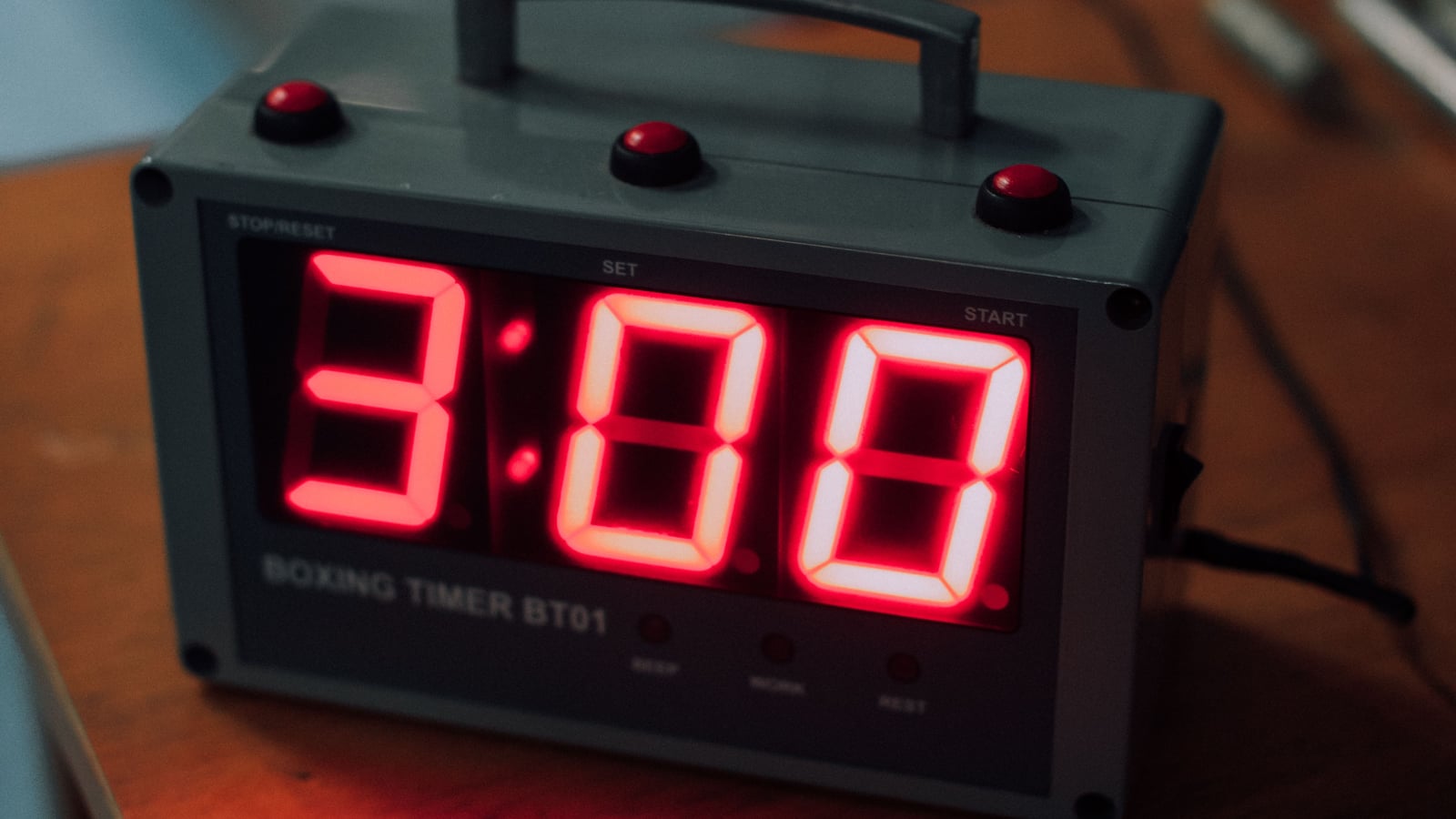
What a shot timer actually does
A shot timer is an electronic unit fitted with a sensitive microphone that detects the sound pressure wave produced by each shot. It measures nothing but sound: no sensor on the gun, no Bluetooth connection to the trigger, just a microphone and an algorithm that isolates the sound spikes characteristic of a shot being fired.
In practice, the device records the exact instant of each detonation from the moment the start signal (the “beep”) triggers. It then calculates two types of data: the time between the beep and the first shot, and the time between each successive shot. All of this to a hundredth of a second.
What makes the tool indispensable is that it replaces a subjective assessment (“I felt like I drew faster”) with a verifiable number. In dynamic shooting, where speed of execution matters as much as accuracy, this shift completely changes how you train.
The unit works just as well on its own at a personal firing point as it does integrated into an entire competition, with centralized timing for every competitor in a match. Its portability and ease of use have made it a standard for decades, long before smartphone apps tried to replace it.
Historically, the tool was born out of a very concrete need in the emerging dynamic disciplines: without an objective measure of time, it was impossible to separate two shooters with equivalent accuracy, or to set consistent standards across multiple bays of the same match. The shot timer filled that gap by providing standardized data, independent of any human referee and their own perception of elapsed time.
This standardization had an important side effect on how shooters train: by giving everyone a common number, it enabled the emergence of structured training methods built around measurable time goals rather than general impressions of smoothness or ease of movement. That same principle underpins the use of the shot timer today, in amateur clubs as much as in top-level competition.
One often underestimated aspect: the shot timer is silent in its internal operation. It gives no audio or visual feedback while recording shots, so as not to disturb the shooter’s concentration. All the data is displayed afterward, once the drill is finished, which encourages staying focused on execution rather than on the number piling up.
Sound detection: how it works technically
The heart of the system is an omnidirectional microphone tuned to pick up the frequencies and sound intensity typical of a firearm detonation. The device applies a sensitivity threshold: below a certain sound level, nothing is recorded (to ignore ambient noise); above it, the spike is identified as a shot.
This sensitivity is adjustable, and it’s a crucial point many beginners overlook. A setting that’s too sensitive picks up echoes, shots fired by the neighboring shooter, or even the sound of a metal case hitting the ground. A setting that’s too weak risks missing a shot, especially with a quiet firearm or in a windy outdoor environment.
Most modern shot timers offer a “review” mode that displays the captured waveform for each shot. This lets you check after a string whether a spike was misread — an echo counted as an extra shot, or the reverse. It’s as much a diagnostic tool as a stopwatch.
An important technical point: the microphone picks up the sound of the shot being fired, not the impact on the target. That means the measured split time is a pure shooting time, independent of the distance to the paper target or steel plate. This characteristic is exactly what allows a reliable comparison between different bays.
The unit’s position directly affects detection quality. Too close to the muzzle, the microphone can saturate on the first shots of a fast string, which throws off the measurement of the following splits until the sensor recovers. Too far away, especially outdoors with headwind, some shots may fall below the detection threshold. The placement distance recommended by the manufacturer, usually stated in the manual, is worth respecting rather than adjusting on instinct.
Some shooting environments pose particular challenges to sound detection. A covered range with reflective walls generates echoes that, in rare cases, can be misread as extra shots if sensitivity is poorly calibrated. Conversely, a very windy outdoor bay scatters part of the sound wave before it reaches the microphone, which may require slightly higher sensitivity compared to indoor use.
The start signal: much more than a simple beep
The start “beep” isn’t just a practical convention, it’s a standardized element in competition rules. Its trigger delay must be random to prevent any anticipation by the shooter, which would throw off the reaction time measurement.
Most shot timers include a configurable random delay, generally between 1 and 4 seconds after activation. The shooter in position therefore never knows exactly when the signal will sound, which faithfully reproduces the tension of a real competition situation.
Some units also let you set a fixed delay, useful in training when you want to focus purely on movement technique without the reaction-to-signal component. This is an important pedagogical nuance: alternate between random and fixed delay depending on the goal of the session.
The beep’s volume is also adjustable, a detail that matters outdoors in wind or indoors with heavy ambient noise from other active bays.
On some multi-target or multi-plate competition stages, a second signal can be used to indicate a procedural requirement, such as mandatory passage through a specific zone. This intermediate signal doesn’t stop the clock: it’s simply an audio cue, with time continuing to run normally until the last valid shot of the stage.
Managing the start signal illustrates the difference between training and competition well. At the club, the same instructor can trigger the signal manually for several shooters in a row, deliberately varying the delay to prevent any anticipation routine. In competition, this variability is governed by the discipline’s rulebook, to guarantee equal treatment for every competitor in a given match.
Split time: the number that changes everything
Split time is the time interval between two consecutive shots. It’s probably the most-used metric in dynamic shooting, because it isolates exactly what the shooter can work on: speed of sight recovery, recoil control, and smoothness of transition between targets.
A long split time can reveal several distinct things: an overly cautious sight-recovery time, recoil management that could be improved, or too slow a transition from one aiming point to another. Without the exact number, it’s nearly impossible to know which of these causes dominates in your practice.
The value of tracking your splits over time is that it objectifies progress. A shooter who regularly works on transitions between paper targets will see their splits gradually drop over several months — a far more reliable progress signal than simply feeling “faster.”
Conversely, a split that suddenly rises after a run of good results is often a sign of fatigue or technical breakdown, which is better caught early. The number doesn’t lie, unlike perception in the heat of the moment.
There’s also a notion of “specialized” split time depending on the type of transition being measured. The split between two shots on the same paper target (often called a double, or pair) mainly tells you about sight-recovery speed after recoil. The split between the last shot on one target and the first shot on the next also factors in the time to move eyes and gun to a new aiming point. Distinguishing these two types of splits lets you target training on the real weakness rather than working blind.
The variance between splits within the same string is also worth watching, not just their average. A shooter with a decent average but very uneven splits (a fast shot followed by a noticeably slower one) generally has a consistency problem rather than a pure speed problem. The shot timer, by keeping the history of each shot in a string rather than just the final average, lets you spot this kind of pattern.
Draw time: measuring the draw from the holster
Draw time is the time between the start signal and the first shot fired, when the drill begins with the gun holstered in a holster approved for dynamic practice. This is a metric specific to disciplines that allow drawing, framed by strict safety rules on holster type and how the gun is holstered.
This time breaks down into several phases: reacting to the audio signal, moving the hand toward the gun, drawing from the holster, presenting the sights, and pressing the trigger for the first shot. The shot timer only measures the overall result, but an experienced shooter knows how to mentally break down this chain to identify where time is being lost.
Working on draw time requires very supervised progression at a club, with an experienced instructor validating every safety step before increasing execution speed. Speed must never take priority over control: a fast but poorly controlled draw is a risk, not a performance.
In training, it’s common to separate work on draw time (dry, or with an unloaded gun, depending on the club’s safety procedures) from work with live ammunition, in order to build the movement without the pressure of recoil before integrating it under real conditions.
Draw time also varies depending on the type of holster used and its individual adjustment: cant angle, retention height, type of integrated passive security system. A shooter who switches holsters should generally expect a temporary rise in draw time while readjusting technique, before recovering and then exceeding their previous level. The shot timer makes it possible to objectify this adaptation period rather than experience it as an unexplained regression.
One safety point is worth repeating: in most clubs and competitions that allow drawing, strict rules limit where and how the gun can be pointed while drawing from the holster, with mandated safety zones and finger contact on the trigger allowed only once the gun is oriented toward the target. These rules don’t fundamentally slow down a well-trained shooter, but they must always take priority over chasing the lowest possible number.
Use in individual training
In a solo session, the shot timer serves mainly as a diagnostic tool. You place the unit on a stable support, far enough away to pick up the sound without saturating the microphone, and run through repetitions of the same drill, noting the displayed times.
A classic protocol is to repeat a simple drill — for example, firing on a paper target at a fixed distance, two shots per string — ten to twenty times in a row, noting each split. The average and consistency of the times give a far more reliable picture of your actual level than a single isolated string.
A common mistake among shooters new to a shot timer is wanting to bring the time down before accuracy has stabilized. An excellent split time with scattered hits has no value in competition, where time is almost always weighted or penalized by accuracy according to the discipline’s scoring system.
The right reflex is to work in stages: stabilize accuracy at a given speed, then progressively speed up only once that accuracy stays consistent. The shot timer lets you objectively verify that each stage is mastered before moving to the next.
An interesting individual drill is to work at “imposed speed” rather than “maximum speed”: set a target split time slightly above your own record, and repeat the drill until you hold it consistently over about ten repetitions. This method avoids the classic pitfall of chasing a one-off record, which often pushes you to sacrifice accuracy for a single fast shot that isn’t representative of your real level.
Individual tracking also benefits from incorporating a physiological context: a split time measured at the start of a session, cold, isn’t directly comparable to a time measured after an hour of intense training. Some shooters systematically note the time of day and felt fatigue level alongside each timed string, which helps correctly interpret differences that would otherwise be attributed solely to technique.
Use at the club, in supervised sessions
At the club, the shot timer becomes a collective tool. An experienced instructor can time several shooters on the same drill and compare the data to tailor individual advice — one shooter might have an excellent draw time but inconsistent splits, another the opposite.
This collective use also allows building progressive drills calibrated on real data rather than impressions. An instructor can set a realistic split-time goal for a given level, based on the club’s timing history rather than figures picked up online that don’t always match a practitioner’s level or equipment.
Sharing data among shooters at the same club also creates healthy emulation, provided the focus stays on individual progress rather than a constant competition between practitioners of different levels.
Some clubs organize sessions specifically dedicated to timing, separate from regular shooting sessions. This format lets several shooters rotate through the same standardized drill, with a single shot timer and one person noting results, rather than multiplying individual units. It also creates a moment of technical exchange between practitioners, where everyone can observe each other’s technique and compare approaches to the same drill.
An experienced instructor also uses the shot timer as a teaching tool to illustrate a concept rather than to rank shooters against each other. Having a beginner shoot the same drill again, with and without a speed instruction, often shows them concretely that their accuracy doesn’t degrade as much as they feared when speeding up slightly — a measurable boost in confidence worth more than any lecture.
Use in IPSC competition
In IPSC competition, timing is no longer an option left to the shooter’s discretion: it’s the range officer who uses their own shot timer to establish the official time for each stage. This time is then combined with hit accuracy on paper targets and steel plates to calculate the final score according to the discipline’s own scoring system (often based on a points-per-second ratio).
The range officer’s shot timer captures every shot fired on the stage, in chronological order, which also allows checking procedural elements such as compliance with target engagement order or the detection of an unauthorized extra shot. The recorded waveform serves as evidence if a shooter disputes their own time.
For the competitor, understanding how range-officer timing works helps better prepare stage strategy. Knowing that every shot is captured individually, including transition times between plates or paper targets, encourages working specifically on sequences rather than raw speed on a single type of shot.
A seasoned club shooter moving up to a regional match often discovers that their solo training splits, measured without the pressure of an officially timed stage, don’t reproduce identically on match day. This is interesting data in its own right: the shot timer also reveals the gap between training performance and performance under pressure.
Reading the final time of an IPSC stage also requires understanding how it factors into the score calculation. The raw time measured by the range officer’s shot timer serves as the denominator in a ratio with the points earned on hits, meaning a very fast time with average hits can sometimes produce a better score than a slower time with perfect hits, depending on the discipline’s exact scoring and stage type. This mechanic pushes experienced competitors to think in “score per second” rather than isolated raw time.
After a stage, many shooters ask to review the range officer’s shot timer data to analyze their own performance: shot order, split distribution across the stage’s different paper targets and plates, longest transition times. This post-stage review, when possible, is one of the best tools for progress in competition, because it shows exactly where time was lost on a real course of fire rather than on a simplified training drill.
Use in Steel Challenge
Steel Challenge is a discipline where timing takes on an even more direct importance, since each stage consists of engaging a series of steel plates in a defined order, with total time being the only scoring data (with no accuracy weighting, unlike IPSC, since hitting the plate is enough to validate the engagement).
This specificity makes the shot timer absolutely central to the discipline: every hundredth of a second counts directly in the standings, without the margin a weighted points system provides. Steel Challenge shooters often develop a particularly fine-grained relationship with their split time, to the point of knowing their reference times by heart on every standard stage type.
Range officiating in Steel Challenge generally uses a shot timer connected to an amplified audio signal, so the start is audible over the ambient noise of an outdoor range with several bays active simultaneously. The accuracy of sound detection becomes even more critical in this noisy environment.
For a shooter starting Steel Challenge after IPSC practice, using a personal shot timer in training helps recalibrate their approach: the discipline demands different risk management, where a missed shot on a plate costs a full makeup shot rather than a simple points penalty.
The format of Steel Challenge stages, generally based on several consecutive runs where the best times count and the worst is dropped, encourages a very specific use of the shot timer in training: rather than aiming for one perfect time, the shooter works on consistency over a series of closely spaced repetitions, to faithfully reproduce competition conditions where consistency matters as much as peak speed.
Since Steel Challenge plates vary in size and distance depending on the stage, the expected split time changes significantly from one position to another. A shooter who only trains on a single standard stage type risks calibrating their speed expectations on a specific case, while the variety of positions in competition demands adaptable technique. Running the shot timer across several different configurations in training avoids this bias.
Common models and their differences
The dedicated electronic shot timer market remains dominated by a handful of specialized manufacturers, with models mainly distinguished by detection sensitivity, unit ergonomics, screen readability in bright sunlight, and battery life.
Entry-level models cover the essential functions: random delay, split measurement, waveform review. More advanced models used at clubs and for official range officiating add features like storing multiple sensitivity profiles, exporting data to a computer, or better weather resistance for intensive outdoor use.
An increasingly common alternative is the smartphone app using the device’s built-in microphone. This solution remains affordable and practical for solo personal training, but it has recognized limits: less consistent microphone sensitivity than a dedicated sensor, risk of interference from notifications or calls, and reliability considered insufficient for official competition range officiating.
The choice between a dedicated unit and an app mainly depends on intended use. For occasional personal training, an app can be enough. For regular, serious practice, or for officiating, a dedicated unit remains the reference in reliability and measurement repeatability. The price of a dedicated unit varies considerably by model and features; check directly with specialized retailers rather than relying on a generic figure.
Integrating the shot timer into a multi-month progress plan
The classic mistake is pulling out the shot timer just to “see your time,” with no protocol behind it. Used this way, the tool becomes a one-off measurement gadget rather than an instrument of real progress.
A more structured approach is to define a fixed drill — a distance, a number of paper targets or plates, a precise sequence — and repeat it identically across several sessions spaced out over time, keeping a history of your times. It’s this continuity that turns isolated numbers into a genuine progress indicator.
Systematically logging your times, whether in a paper notebook or a dedicated shooting-tracking app, lets you visualize trends that a one-off memory doesn’t retain. A progressive drop in average split on an identical drill, measured over several months, is far more solid proof of progress than a single good time achieved on an exceptional day.
It’s also useful to cross-reference shot timer data with an analysis of hit accuracy on the target. A shooter who’s genuinely progressing sees both curves improve together: time going down, grouping staying stable or tightening. If one improves at the expense of the other, that’s a signal to slow the pace of work in order to consolidate fundamentals.
A progress plan structured around the shot timer generally starts with a baseline measurement phase: a few sessions devoted purely to establishing baseline times on a small number of fixed drills, without trying to speed up. This baseline serves as a comparison point for all the work that follows, and avoids the pitfall of judging progress on drills that change from one session to the next.
Next comes a phase of targeted work, where each block of several weeks focuses on one specific aspect identified from the baseline phase’s data: draw time if drawing from the holster slows everything down, single-target split time if sight recovery could be improved, or transitions if moving between paper targets and steel plates takes too long. Working on a single axis at a time lets you precisely measure the effect of training on that specific point, without progress or regression in another aspect clouding the reading of the numbers.
A consolidation phase logically follows each targeted block: revisit the initial baseline drills and check that the improvement achieved on the trained aspect does translate into an overall gain, without degradation elsewhere. This is the moment the shot timer proves its full value as a verification tool rather than a simple one-off measurement.
Over a scale of several months, this measure-work-consolidate cycle can repeat, changing the targeted aspect each time. A seasoned club shooter who follows this kind of method over a full season ends up with a data history far richer than a simple series of isolated good results: they can precisely identify which training blocks produced the most gain, and adjust their next season accordingly.
This cyclical work benefits from being logged somewhere, whether in a paper shooting log or a dedicated app. The shot timer produces the raw data; it’s the discipline of writing it down, sorting it by drill and by date, that turns it into a genuine tool for steering progress rather than a numerical curiosity of the day.
Common mistakes with the shot timer
The first mistake, already mentioned, is prioritizing speed over accuracy. An impressive split time on a missed target means nothing in real practice, whether in training or in competition.
The second mistake concerns a sensitivity setting poorly calibrated for the shooting environment. A covered range with echo, a noisy neighboring bay, or a gun with an atypical report can all throw off detection if the setting isn’t adjusted accordingly before the session.
The third mistake is comparing your times to references found online without accounting for context: the reference shooter’s level, the type of gun used, the drill distance, or the measurement conditions. A useful comparison is made against your own past data, or against benchmarks given by an experienced instructor who knows your actual level.
Finally, a more subtle mistake is neglecting the upkeep of the unit itself: batteries to check regularly, the microphone to protect from dust and powder residue, the unit to be stored away from moisture. A poorly maintained shot timer can produce erratic readings that throw off all your tracking work.
Choosing your shot timer based on your practice profile
A beginner discovering dynamic shooting at a club generally doesn’t need to invest immediately in a dedicated unit. The first sessions take place under the supervision of an experienced instructor, who already has the club’s equipment and who, above all, prioritizes building safety fundamentals before even talking about timed speed.
For a regular practitioner who also trains outside supervised sessions, an entry-level unit is more than enough to cover the needs: reliable split measurement, random delay, basic review mode. Reliability of detection matters more than a rich feature set, which stays secondary for individual use.
A regular competitor who takes part in several IPSC or Steel Challenge matches a year benefits from choosing a more rugged model, designed for intensive outdoor use, with good battery life and decent screen readability in bright sunlight. This is also the profile that benefits most from export or profile-storage features, useful for tracking long-term progress precisely.
Finally, a shooter considering becoming a range officer or match official should refer directly to the rulebook of the discipline concerned, which may impose specific requirements on the type of timing equipment approved for official officiating. These requirements vary by federation and evolve over time, so it’s better to check this point directly with the organizing body rather than relying on general information that could be outdated.
One last, often overlooked, factor concerns ease of use under stress. In competition, a shooter sometimes has to operate their own personal shot timer between stages to check their own pre-match training times, in a context of nerves and tight time management. A unit with a confusing interface, with menus you have to navigate through at length just to review a simple split, becomes a needless source of friction. Testing the unit’s handling under calm conditions, well before the first competition, avoids discovering this flaw at the worst possible moment.
Durability also deserves to factor into the choice. A unit that accompanies a shooter over several seasons goes through drops, dust, sometimes rain outdoors, and significant temperature swings from one range to another. A model known for its ruggedness, even with the same features as a more fragile model, often represents a better long-term investment than a unit richer in options but trickier to maintain over time.
Q: Can a shot timer confuse two shots fired quickly with a single, louder shot? A: It’s possible if sensitivity is poorly set or if the shots are extremely close together in time. The waveform review mode, available on most units, lets you check afterward and recalibrate sensitivity if needed.
Q: Does a smartphone app replace a real shot timer unit? A: For occasional solo training, it can be enough. For regular, serious practice or for officiating, a dedicated unit remains more reliable thanks to a microphone and algorithm specifically designed for this use.
Q: Do you need a shot timer from the very start of dynamic shooting practice? A: It’s not essential in the first sessions, where the priority remains safety and basic technique supervised by an instructor. The tool becomes genuinely useful once the fundamentals are acquired, when execution speed becomes a relevant area of work.
Q: Is split time comparable between two different shooters? A: Only with a lot of caution, since it depends on level, gun, distance, and target type. It’s more useful to compare your own times over time than to measure yourself directly against other practitioners.
Q: Does the shot timer work properly outdoors in the wind? A: Strong wind can disrupt sound detection and require a higher sensitivity setting. Some more rugged models handle these conditions better, but it’s always worth checking the captured waveform at the start of a session.
Q: Can a shot timer be used for disciplines other than dynamic shooting? A: Yes, the tool is also used in speed-shooting formats like TAR, or for any timed shooting drill requiring a precise measurement of reaction time or sequencing, beyond the IPSC or Steel Challenge framework alone.