
The risk nobody sees coming
You wear your hearing protection without question. Electronic earmuffs have become a reflex, almost a badge of the serious shooter. Glasses, on the other hand, too often stay in the bag or sit on top of your head like a fashion accessory.
That’s a mistake in priorities. Progressive hearing loss can be corrected with a hearing aid. A serious eye injury can be permanent in a fraction of a second. The range constantly generates micro-projectiles nobody sees coming - that’s exactly the problem.
Eye risk while shooting isn’t hypothetical. It’s mechanical, repetitive, and it hits beginners just as much as experienced shooters who let their guard down after years without incident. This article explains why eye protection has to be a non-negotiable reflex, what the real risks are by discipline, what the standards actually say, and how to choose glasses suited to your practice.
Casing fragments, an underrated risk
The first and most common danger in everyday practice comes from the firearm itself. On a semi-automatic handgun, the case ejects at high speed, sideways, sometimes unpredictably depending on how worn the extractor or ejector is.
A poorly ejected case can hit the slide, partially fragment, or bounce off a range wall before coming back toward the shooter’s face or the neighbor on the line. There’s a familiar name for this in clubs: “brass to the face.” It happens more often than people think, especially at indoor ranges where cases bounce off side partitions.
A left-handed shooter using a firearm designed for standard right-side ejection is particularly exposed: the case’s trajectory passes right in front of their face instead of flying off to the side. Any club instructor knows this scenario and flags it at the start of every session.
Lever-action rifles and some pump shotguns also eject cases or hulls with enough speed to cause an eye contusion on direct impact. The risk isn’t limited to handguns.
Pellets and fragments in clay disciplines
In clay shooting disciplines (trap, skeet, sporting), the danger changes shape but stays just as real. Shot fired at a clay pigeon shatters the target into fragments that sometimes fall back toward the firing line, carried by wind or by the shot’s trajectory.
A shooter aiming at a high, close target takes a real risk of catching clay fragments or residual shot pellets in the face area. It doesn’t happen every time, but the frequency of sessions makes the cumulative probability significant over a full season.
The ammunition itself can have manufacturing flaws: a primer that pierces, a shell that partially bursts in the chamber of a poorly maintained gun, or defective ammunition. These are rare incidents, but their potential severity justifies systematic protection, not something conditional on how you feel that day.
Target fragments and ricochets in dynamic disciplines
In dynamic disciplines like cardboard target or steel plate shooting, a specific risk exists: the ricochet. A projectile hitting a steel plate at an angle can break into fragments flying in unpredictable directions, including back toward the shooter who just fired.
Shooting distances on steel plates are regulated precisely for this reason: below a certain threshold, the risk of lead or copper-jacket fragments bouncing back toward the shooter increases sharply. Dynamic shooting competition organizers are uncompromising on this point and refuse range access without certified eye protection.
Cardboard target shooting theoretically carries less risk, but stacked cardboard silhouettes or the frame’s metal supports can also throw back fragments on an off-center hit. The rule stays the same at every serious range: no tolerance without glasses.
What the EN166 standard actually guarantees
In Europe, the reference standard for eye protection is EN166. It covers the mechanical resistance of lenses and frame to impact, as well as minimum optical properties (no excessive distortion, scratch resistance depending on the grade).
An EN166-compliant pair carries a marking on the frame indicating its impact resistance class. The most common levels for shooting sports are F (low-energy impact) and B (medium-energy impact); level A (high energy) covers more extreme industrial uses and isn’t the standard reference for civilian shooting sports.
A large pair of sunglasses bought at a supermarket offers no guarantee of impact resistance, even if the lens feels solid to the touch. The difference between EN166 glasses and a regular pair of sport glasses lies in the lens structure and how the frame holds up to a lateral hit, not just the apparent thickness.
Always check the marking on the arm or lens before buying a pair for the range. The absence of marking should be a red flag, regardless of the price tag or how “technical” the product looks.
Overview of tints by light level and discipline
Choosing a tint isn’t just an aesthetic question - it directly shapes visual comfort and therefore shooting performance.
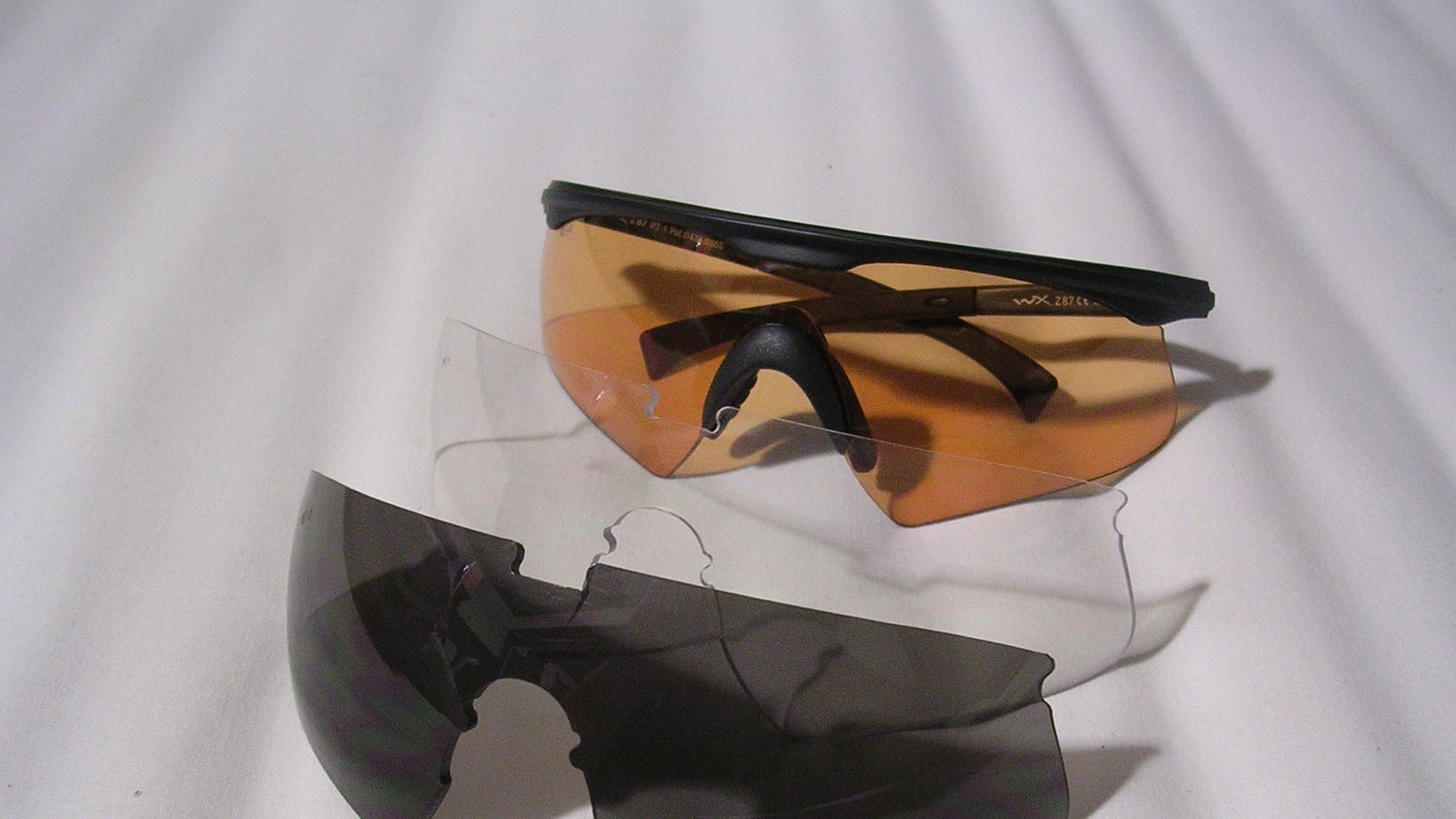
- Clear or slightly yellow lens: ideal indoors or in low light, keeps maximum contrast without darkening the scene. Often the default choice for indoor pistol or rifle ranges at 10m/25m.
- Grey or smoke lens: suited to bright sunshine, cuts overall glare without distorting colors. The all-purpose tint for outdoor use in normal light conditions.
- Orange or vermillion lens: very popular in clay disciplines, boosts contrast between the orange/black target and the sky, making the clay more visible along its flight path.
- Bright yellow lens: useful in overcast weather or late in the day, boosts perceived brightness and improves edge definition in flat light.
- Mirrored or polarized lens: reserved more for general comfort during extended outdoor time, less used in competition where contrast matters more than looks.
Many regular clay shooters or outdoor precision shooters invest in an interchangeable-lens system, letting them adapt the tint to time of day and weather without changing the whole frame.
Integrated vision correction: what you need to know
For a shooter who wears corrective glasses day to day, eye protection comes with an extra optical constraint. Several solutions exist, each with its own trade-offs.
Protective overglasses, worn over regular prescription glasses, remain the simplest and cheapest solution. They can be uncomfortable during long sessions though, and can add extra distance between eye and rear sight in precision shooting, disturbing the sight picture.
Protective glasses with integrated corrective lenses, custom-fitted by an optician, offer noticeably more comfort for regular practice. The extra cost over a standard pair quickly pays off for a shooter practicing several times a month.
A middle option is a corrective clip inserted directly onto the shooting frame, often offered by manufacturers specializing in Olympic precision shooting. This solution lets you precisely adjust the optical axis relative to the dominant eye, an important point in 10m rifle and pistol where the rear sight-front sight-target alignment demands constant sharpness.
In any case, never neglect the correction of your dominant eye in favor of the other: a bad prescription on that eye directly degrades sight quality, far more than a slight imprecision on the non-dominant eye.
Special case: protection in clay and moving-station disciplines
In clay disciplines, the shooter moves their head and tracks the target’s flight path across a wide angle. The frame therefore needs to offer wide peripheral vision, without a thick frame that would block one side of the field of view at the crucial moment of tracking.
Wraparound glasses are widely preferred in these disciplines for this reason: they eliminate the lateral blind spot a regular frame would introduce. They also limit wind and dust intrusion at outdoor ranges, a non-trivial comfort over a hundred-round session.
On moving targets at 10m or 50m with a rifle, where the shooting window is very short, lens optical quality matters even more: any peripheral distortion slows perception of the target’s movement and can cost accuracy at the decisive moment.
Care and lifespan of a pair of shooting glasses
A pair of protective glasses wears out even without visible damage. Micro-scratches build up over time, especially if cleaned with the wrong cloth or stored loose in a range bag in contact with metal objects.
Always clean the lens with clean water or a dedicated product, never dry with an abrasive cloth. A scratched lens no longer offers the same structural strength as a new one, even if the scratch looks superficial to the naked eye.
Store your pair in a dedicated hard case between sessions rather than letting it float around at the bottom of the range bag with the rest of your gear. It’s a simple habit that significantly extends the equipment’s useful life.
Replace the pair as soon as a visible impact mark appears on the lens, even a minor one, even if the glasses still “look fine.” An impact weakens the material’s structure in ways that are often invisible, and a second hit in the same spot can cause sudden failure.
Budget: what it actually costs
Price ranges for EN166-compliant protective glasses vary widely depending on grade and features. A decent entry-level pair with verified EN166 marking stays accessible for any beginner’s budget. Mid-range models with interchangeable lenses and adjustable frames are a reasonable investment for a regular shooter.
High-end models, with custom integrated correction or higher-quality photochromic lenses, mainly target competitors who shoot several times a week and for whom long-term visual comfort becomes a direct performance factor.
In every case, the priority selection criterion remains compliance marking, not the sticker price. A correct, certified pair on a small budget protects far better than an elegant, uncertified pair of sport glasses at a high price.
Common mistakes seen at the club
Certain mistakes come up repeatedly among shooters who neglect eye protection, often out of habit or overconfidence after years without incident.
- Wearing regular uncertified prescription glasses assuming they’re enough, when they offer no structural resistance to impact.
- Pushing glasses up onto the forehead “to see better” while adjusting a firearm or optic, exposing the eyes while other shooters are still active on the line.
- Using a scratched pair for months without replacing it, letting vigilance slip out of habit.
- Neglecting protection during dry-fire or dry-adjustment sessions, forgetting that a handling incident remains possible even without live ammunition if the firearm wasn’t properly checked.
- Choosing a frame too narrow that leaves a visible gap at the sides, especially for prescription glasses wearers with poorly fitted overglasses.
An experienced club instructor generally reminds shooters of these points at the start of the season, but vigilance remains an individual responsibility at every single session, not just during group reminders.
What this changes in your training log
Logging your protective equipment in your shooting journal isn’t just an administrative formality. Noting the purchase date of a pair, any impact observed, or a tint change by season lets you objectively track the equipment’s real wear instead of relying on a subjective impression.
This tracking discipline fits the broader logic of serious sport shooting practice: whatever isn’t written down eventually gets forgotten, whether it’s an optic setting, a technical feeling, or the state of your safety gear. A shooter who structures their equipment log as rigorously as their performance log mechanically reduces their exposure to avoidable incidents.
Anatomy of a pair of protective glasses: what each part does
Understanding how shooting glasses are built helps you make an informed choice rather than a purely aesthetic one. Every part of the frame answers a specific technical constraint.
The lens itself is generally polycarbonate, a material chosen for its impact resistance far superior to standard mineral glass while staying lightweight. Its thickness and surface treatment (anti-scratch, anti-fog) vary by grade, but it’s the nature of polycarbonate that guarantees impact resistance, not just visual thickness.
The frame itself needs to stay rigid at the hinges while offering a minimum of flex to absorb a lateral hit without snapping outright. A frame that’s too rigid transmits impact energy straight to the face, while a properly designed frame dissipates some of that energy through its own controlled deformation.
The temples and side shields (often called “cups” or “temple guards”) close the gap between lens and face to keep a fragment from entering from the side - an entry point regular prescription glasses leave wide open. It’s often this side shield, invisible at first glance, that makes the real difference between a generic sport pair and one designed for shooting.
The nose bridge and pads need to keep the glasses stable without slipping during mounting or aiming, especially in disciplines where the head turns frequently like clays or dynamic shooting. A pair that slips mid-string pushes the shooter to push it back up with a finger in the middle of the drill, recreating exactly the risk you’re trying to avoid.
Why the range requires glasses even before the law does
There’s an important distinction to understand between general regulatory obligation and a range’s internal rule. In most countries, wearing eye and ear protection is generally required by each club’s internal rules and by the national shooting federation’s safety guidelines, rather than spelled out line by line in a law specific to glasses.
In practice, this means no serious instructor will let a shooter, beginner or experienced, get on the firing line without visible eye protection. It’s not left to individual discretion: it’s a condition of access to the range, just like checking that a firearm is unloaded outside of firing phases.
This requirement applies to everyone present on the range, not just the active shooter. An instructor supervising, a shooter waiting their turn next to the line, or a visitor authorized to observe a session must wear the same protection as the person with the gun in hand, because the risk of projectiles isn’t limited to the person pulling the trigger.
Many clubs provide loaner glasses for newcomers during a first taster session, precisely because this rule allows no exception, not even for a simple fifteen-minute try.
Eye protection and young shooters in shooting schools
Supervising younger shooters at a shooting school applies the same principle of rigor, with heightened vigilance due to smaller facial morphology and the child’s lower ability to check their own equipment.
Frames for young shooters need to be fitted to a narrower face shape, with a lower nose bridge and shortened temples, otherwise the child will tend to push back a slipping pair themselves, recreating an unprotected gap during the exercise. Some clubs equipped for introducing younger shooters invest in several frame sizes precisely for this reason.
The instructor carries an added responsibility here: visually checking, before every exercise, that protection stays correctly positioned on the child’s face, rather than just handing it out at the start of the session. This vigilance is an integral part of the teaching progression laid out in a typical shooting school’s organization, where safety systematically takes priority over the young shooter’s performance.
Quick comparison by practice profile
Choosing a pair of glasses mostly depends on how often and what you shoot. Here are a few benchmarks by profile:
- Occasional shooter, varied disciplines: an all-purpose pair with grey or slightly tinted lens, standard wraparound frame, is more than enough. What matters is the EN166 marking and a correct fit to your face.
- Regular indoor precision shooter (10m/25m): favor a clear lens and a lightweight frame, possibly with integrated correction if you wear glasses day to day, for optimal comfort over long static sessions.
- Outdoor clay shooter: invest in an interchangeable lens system (orange, grey, yellow) to adapt to changing light conditions from one session to the next, with a wide frame and clear peripheral field.
- Dynamic shooting competitor: look for a stable frame that doesn’t shift during quick head transitions, with good anti-fog ventilation given the physical effort and fast pace of the event.
- Long-range precision shooter outdoors (PRS/LR): prioritize comfort over duration (several hours at a stretch), paying particular attention to compatibility with a cap or beanie depending on the season.
This profile-based approach mirrors the one already applied to electronic hearing protection: match the gear to actual use rather than defaulting to the flashiest model on the shelf.
What to check before buying, in practice
Before finalizing a purchase, a few concrete checks avoid unpleasant surprises once on the range.
- Confirm the EN166 marking is present directly on the frame or lens, not just on the product packaging, which may refer to a different range.
- Try the pair with your hearing protection already on, electronic or passive: some thick frames create an uncomfortable pressure point once combined with an enclosing earmuff.
- Check for the absence of optical distortion by looking at a straight line (door frame, shelf) through the lens, especially in the peripheral zones of the lens.
- Test retention by moving your head quickly side to side, to simulate target tracking in clays or a transition in dynamic shooting.
- If you wear prescription glasses, check the actual compatibility of the intended overglasses with your own frame rather than assuming “it’ll fit.”
Anti-fog, a detail that decides everything in competition
A technical point underrated by many beginners: fogging on the lens at the critical moment of the shot. It typically occurs during sustained physical effort (movement in dynamic shooting, carrying gear on an outdoor clay course) combined with a sharp temperature swing between outside and a shelter, or simply sweating under an enclosing earmuff.
A lens that fogs up mid-string forces the shooter to either stop the exercise to wipe it, or shoot with degraded vision, which is worse than wearing nothing in that instant but is nowhere near the risk of having no protection at all. The right answer is never to take the glasses off, but to anticipate the problem beforehand.
Surface anti-fog treatments, applied at the factory or via a dedicated spray, significantly reduce this phenomenon. A well-ventilated frame, with enough space between lens and face, also limits condensation compared to a frame pressed too close to the skin.
In disciplines with real physical effort, like biathlon or dynamic shooting with timed movement, this detail becomes a genuine performance factor and not just secondary comfort.
Eye protection at home and during dry-fire
Vigilance about eye protection shouldn’t stop at the range door. Dry-fire sessions at home, though performed without ammunition, carry a residual risk too often ignored: an imperfect chamber check, confusion between a training gun and a real firearm, or a mechanical incident on a poorly maintained gun.
A rigorous shooter applies the same checking discipline to dry-fire as at the range: a dedicated area with no ammunition nearby, triple-checking the empty chamber, and as an extra precaution, wearing basic eye protection during the exercise if it involves a real firearm rather than a dedicated training gun.
Likewise, cleaning and maintenance phases carry their own eye risk, different from shooting: solvent splashes, a spring under tension that escapes during disassembly, powder residue particles that fly up while brushing the barrel. A basic pair of protective glasses, even non-shooting-specific, has every reason to be on the cleaning bench.
What field feedback says
An experienced club instructor consistently reports the same situations at the start of the season during safety briefings for new members: most narrowly-avoided eye incidents involve experienced shooters, not beginners. The reason is simple once you say it out loud: the beginner follows instructions to the letter for lack of personal reference points, while the experienced shooter sometimes develops bad habits after years without incident, pushing their glasses up onto their forehead between strings or occasionally shooting without protection on a gun “they know by heart.”
A regional clay shooting champion, asked in an informal club conversation, sums up the logic in a line many instructors repeat: eye protection is never the factor that costs you a competition, but its absence can cost you an entire season, or even shooting for good. This kind of field feedback, generalizable to any serious practitioner, illustrates why the reflex needs to be built from the very first sessions and never relaxed afterward.
An experienced club shooter, practicing several disciplines in parallel (precision and clays), often recommends newcomers think of their glasses as an integral part of the firearm itself: you don’t take one out without the other, in one single reflex motion before heading to the line.
Insurance, liability, and eye incidents
A rarely discussed aspect concerns the implications of an incident occurring without adequate protection. Shooting federation liability insurance covers bodily injuries occurring within supervised practice, but failing to follow a club’s explicit internal safety rules can complicate a claim or create personal liability for the at-fault shooter toward an injured third party.
Concretely, a shooter who accidentally injures the neighbor on the line with a case fragment, in a context where the victim was wearing regulation glasses but the at-fault shooter had themselves neglected an ancillary safety rule, exposes themselves to consequences that go well beyond the sporting context. This isn’t a point to take lightly, and it alone justifies the systematic rigor clubs demand on this subject.
This point connects to the broader culture of documentary rigor proper to serious sport shooting: just as a shooting log objectifies technical progress, scrupulous and demonstrable compliance with safety rules protects the shooter both athletically and legally in the event of an incident.
Myths worth correcting
Several myths still circulate too often at clubs and deserve to be cleared up once and for all.
- “I already wear prescription glasses, that’s enough.” False: without EN166 marking and suitable side protection, regular prescription glasses don’t offer the structural resistance required against a high-speed particle impact.
- “The risk only concerns the active shooter on the line.” False: anyone present on the range, including an observer or a shooter waiting their turn, remains exposed to the same projectiles.
- “A sturdy pair of sunglasses does the job outdoors.” False: impact resistance can’t be guessed by touch or by how thick the lens looks - it’s verified through the standard marking.
- “After years without incident, the risk has gone down.” False: the mechanical risk stays exactly the same on every shot; a shooter’s experience doesn’t reduce in any way the physical probability of a case fragment or target fragment.
- “Kids on laser or low-power air rifles don’t need protection.” False: the safety reflex is built from the very first shooting school session, regardless of the actual power of the firearm being used at that moment.
Compatibility with the rest of your sighting equipment
Protective glasses don’t exist in isolation from the rest of your sighting equipment, and their integration with the optic in use deserves specific attention depending on the discipline.
In Olympic precision rifle or pistol shooting, the rear sight or scope demands a very precise eye-relief distance. A protective frame that’s too thick at the nose bridge, or temples that are too rigid, can slightly shift the natural head position and therefore the perceived sight picture. Top-level shooters systematically test their protective glasses with their full shooting position before finalizing them for competition, rather than trying them alone in front of a mirror.
In disciplines equipped with a red dot, the tint of the protective lens can slightly alter perceived brightness of the dot. A lens that’s too dark combined with an already low red dot brightness setting can make the dot hard to see, especially in low light. In that case you need to readjust the red dot’s intensity to account for the chosen tint, not the other way around.
For shooters using a magnified scope in long-range precision shooting, eye protection needs to leave enough clearance for the scope’s eyepiece without creating a stray reflection on the protective lens itself. This point is sometimes overlooked at purchase but quickly becomes annoying in the field, particularly in bright sunlight where an unwanted reflection on the protection can distract concentration at the moment of the shot.
Travel, transport, and storage of your glasses
A pair of protective glasses deserves the same transport care as the rest of your sensitive gear, especially when traveling for competition. A dedicated hard case, separate from the one for your sighting optic, prevents accidental knocks in a loaded range bag where items bump against each other during the trip.
When traveling for a competition abroad, or simply to another club, it’s worth bringing a spare pair in addition to your main one. A lens accidentally scratched or a frame damaged during transport should never keep a shooter from taking part in an event they’ve been preparing for for weeks.
Storage at home also deserves a bit of attention: avoid leaving the pair in direct sunlight behind a car window, since prolonged heat exposure can eventually weaken certain surface treatments or slightly warp a frame made of soft material. A simple drawer, sheltered from direct light, next to the rest of your safety gear, is more than enough for optimal storage between sessions.
FAQ
Q: Are my regular prescription glasses enough at the range? A: No, unless they explicitly carry the EN166 marking certifying impact resistance. Standard prescription glasses, even with scratch-resistant polymer lenses, aren’t designed to withstand a high-speed particle impact.
Q: Do I need a different pair for each discipline? A: Not necessarily, but a wraparound frame with interchangeable lenses covers most needs (indoor precision, outdoor clays) with a single piece of equipment adapted by swapping tints.
Q: Do regular sunglasses protect enough? A: No. Without compliance marking and a reinforced frame, they offer no guarantee against a fragment or case-splinter impact, even if the lens looks solid.
Q: How often should I replace my protective glasses? A: As soon as a visible impact mark appears on the lens, or when micro-scratches start hampering a clear view of the target. Without an impact, lifespan mostly depends on care and storage between sessions.
Q: Can you wear protective overglasses over prescription glasses in precision competition? A: Yes, it’s common practice, but it can slightly change the eye-to-rear-sight distance. Many regular shooters eventually prefer a frame with integrated correction for better long-term comfort.
Q: Do kids at shooting school need to wear the same protection as adults? A: Yes, eye protection is mandatory from the very first session, including on laser or low-power air rifles supervised by the club, with no exception based on age or the power of the firearm used.