
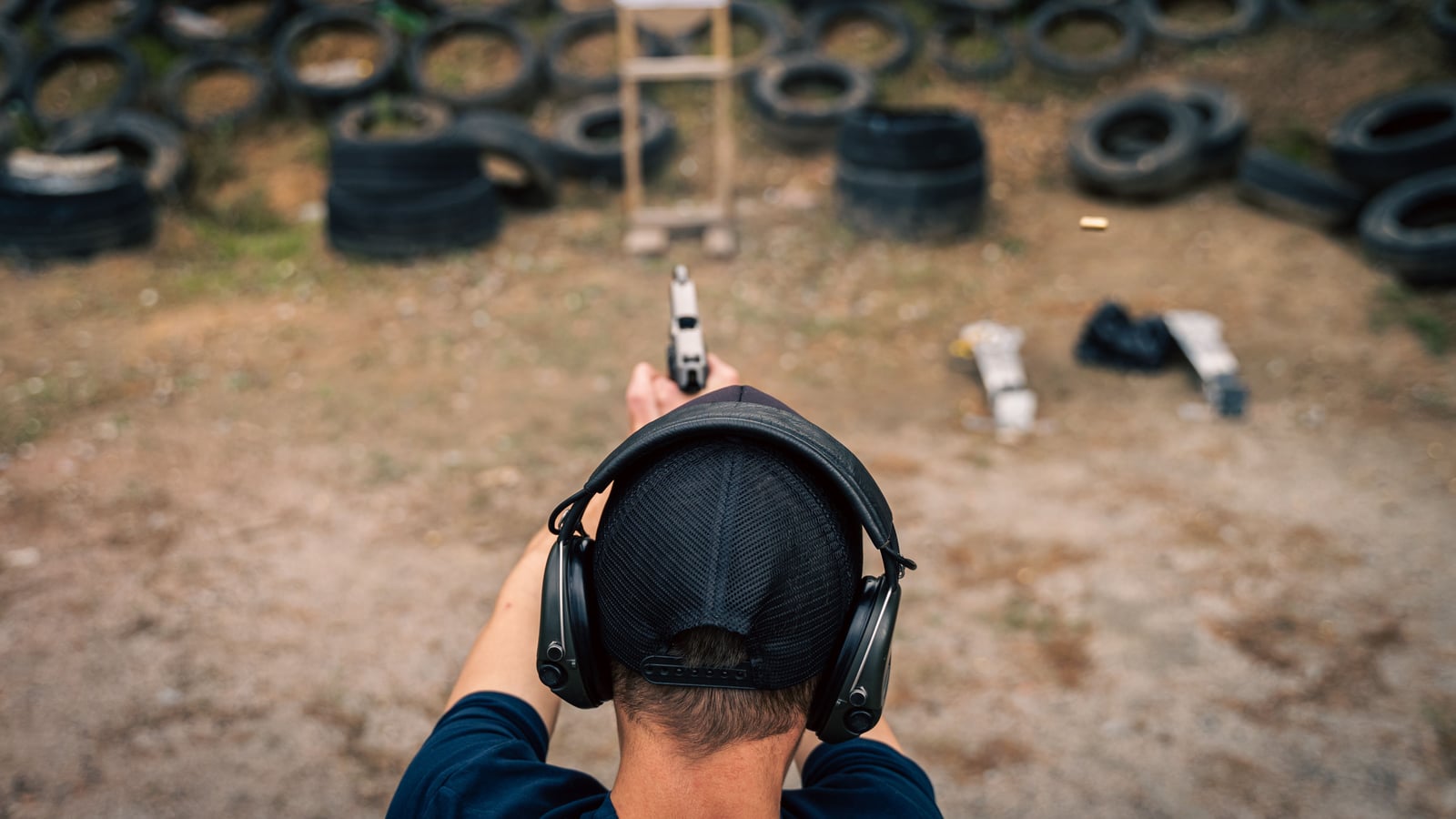
Speed and precision: a false opposition
You often hear that speed and precision are two opposing qualities, as if progressing on one necessarily comes at the expense of the other. That’s a widespread myth that blocks a lot of shooters’ progress, because it pushes them to pick a side instead of looking for balance.
In reality, speed is only a problem when it exceeds your ability to correctly execute every step of the shot process. A shooter who goes fast because they’ve automated their sight picture, their trigger management, and their return to aim isn’t less accurate than a slow shooter: they’ve simply cut the dead time between each step, without skipping a step.
So cadence isn’t “shooting faster” in the raw sense. It’s finding the rate of fire that exactly matches your current technical processing speed. That rate isn’t fixed: it evolves with training, the day’s fatigue, the discipline practiced, and even stress levels in competition.
This article covers the speed/precision balance across disciplines, the idea of a personal rhythm specific to each shooter, and why rushing systematically degrades your group — even in experienced shooters. The goal is to give you a practical framework for identifying your own cadence, not a universal recipe that ignores your level and your discipline.
What cadence actually means depending on the discipline
The idea of rhythm doesn’t mean the same thing in 10m rifle as it does in dynamic shooting on cardboard targets. In pure precision shooting (10m rifle, 50m rifle, 10m pistol), the cadence is slow, and the time between each shot is used to revalidate the entire firing chain: position, breathing, aim, trigger. Going fast in these disciplines makes no sense — the rules themselves allow generous match times.
In speed shooting (25m rapid-fire pistol, dynamic disciplines like IPSC or Steel Challenge), cadence becomes a scoring factor in its own right. Total string time counts as much as the hits, so the notion of personal rhythm takes on a direct competitive dimension: you need to go as fast as your accuracy allows — no faster.
Between the two, disciplines like service pistol/rifle shooting or certain clay events impose intermediate cadences, dictated by the rules or by the nature of the target (a flying clay, a moving target). Here, the rhythm isn’t entirely free: it’s partly imposed by the environment, and the shooter’s job is to adapt to it without being rushed.
Understanding which category your discipline falls into is the first step before working on your cadence. A shooter who applies fast-shooting logic to a pure precision program will simply degrade their results, and conversely a shooter who’s too slow in dynamic shooting loses valuable time without gaining group size beyond a certain threshold.
The notion of personal rhythm
Two shooters at the same technical level can have very different natural cadences, without either being “better” than the other. Personal rhythm depends on individual factors: visual processing speed, muscle tone, the ability to return to position quickly after recoil, stress management.
This rhythm is built through training, not by copying a club partner’s. An experienced club shooter who shoots faster than you doesn’t necessarily have better technique: they may simply have a different natural rhythm, built over years of repetition. Trying to imitate their cadence without having automated the same fundamentals amounts to skipping steps.
The right method is to time your own strings in training and observe where your group starts to open up. This tipping point, specific to each shooter, defines your reference cadence at a given moment. It’s not an absolute number to reach, but a slider you gradually move as your technique becomes automatic.
This work requires rigorous tracking: systematically logging string time alongside score and group size lets you objectively visualize the relationship between the two. Without this tracking, you tend to overestimate your actual speed or underestimate the impact of speeding up on shot dispersion.
Why rushing systematically degrades your group
Rushing is the moment when a shooter accelerates beyond what their technique can keep up with. The symptom is almost always the same: the group opens up, often with a characteristic spread along the axis of the rushed movement (low, or lateral depending on the dominant hand).
The mechanism is simple to understand: each step of the shot process (alignment, breath control, trigger pressure) requires an irreducible minimum of time to be executed correctly. When cadence exceeds that minimum, one or more steps get cut short or skipped, even if the shooter has the subjective impression of having done everything the same way.
It’s one of the most common traps in clubs: a shooter sees a partner shoot fast with a good score, tries to reproduce that speed immediately, and ends up with a degraded group without understanding why. The partner in question probably took months, if not years, to reach that cadence without losing precision.
Rushing also affects experienced shooters, particularly under competition pressure. Stress pushes you to want to “get it over with fast,” which artificially speeds up the cadence without the technique having caught up. A regional champion will often say that consciously learning to slow down in a match, when she feels the excitement rising, was a real turning point in her result consistency.
- Typical symptoms of rushing: hits going low, a group spreading along a specific axis, a feeling of “not having had time to see” the sight picture at the moment the shot broke.
- Risky contexts: time-limited competition, fatigue at the end of a session, wanting to keep pace with a faster partner.
- First corrective reflex: consciously return to a slower cadence for a few strings, until you find your reference group again.
Building your cadence in training: the progressive method
The most reliable method for developing your cadence without sacrificing precision is to progress in measured steps, never in leaps. You start from your current stable cadence, the one where your group stays consistent with your usual level, and marginally reduce string time, session after session.
Concretely, this means accepting several sessions at the same rhythm, without trying to speed up every time you go out. Automating a movement requires repetition at a stable cadence before it can be executed faster without a loss of quality. Trying to speed up too soon breaks this automation process.
A useful drill is to shoot a string at a slow, controlled cadence, note the group, then shoot the same string again while reducing total time by 10 to 15%. If the group stays comparable, you can lock in this new cadence over several sessions before trying another reduction. If the group degrades noticeably, go back to the previous level.
- Always compare at an identical cadence, not a random one from string to string: the comparison only makes sense if only one variable changes at a time.
- Accept stalling on a level for several sessions before progressing: that’s a sign automation is happening correctly, not a failure.
- Never force a higher level in competition: match day is for expressing a cadence already earned in training, not for testing a new one.
This step-by-step progression applies just as much to a beginner building their fundamentals as to an experienced shooter chasing tenths of a second in dynamic shooting. Only the time scale changes: the steps are bigger at the start, finer at a high level.
The role of breathing and gear in managing your rhythm
Breathing is directly tied to cadence, particularly in pure precision shooting. The natural breathing cycle creates micro-movements of the torso that disturb sight stability; the classic technique is to fire during a respiratory pause, just after a partial exhale, before the need to breathe becomes pressing again.
This pause lasts only a few seconds, rarely more. A cadence that’s too slow in precision shooting can therefore become counterproductive: if you take too long to break the shot, you overshoot your natural pause, your body demands air, and stability degrades just as much as with classic rushing. So the optimal rhythm isn’t “as slow as possible,” but the one that matches this physiological pause.
In dynamic shooting, breathing is managed differently: the cardiovascular effort of moving between stations raises your breathing rate, and the shooter has to learn to shoot accurately with this faster breath, without artificially trying to recreate the calm breathing of pure precision shooting, which would waste valuable time.
Consciously working on your breathing according to the discipline practiced is one of the most underrated levers for adjusting your cadence. Many shooters hold their breath by reflex when concentrating, which increases trembling and paradoxically pushes toward either rushing or excessive slowing that overshoots the useful pause.
Gear directly influences the sustainable cadence without loss of precision. A manually operated repeating firearm mechanically imposes a handling time between each shot, which naturally structures the shooter’s rhythm. A semi-automatic removes this mechanical constraint, and the only remaining limit becomes the shooter’s ability to revalidate their sight picture between each shot.
Caliber and recoil also play a role: a caliber that generates significant recoil requires more time to return to a stable position after each shot. Trying to impose the cadence of a low-recoil firearm (air rifle, small caliber) on one with heavy recoil is a common mistake among shooters switching discipline or equipment without adjusting their rhythm.
The optic or sighting system also changes the equation. A setup that requires more time to confirm precise alignment (certain long-range precision configurations, for example) mechanically imposes a slower cadence than simple sights used in close-range shooting.
- Manually operated repeater: cadence naturally paced by the manipulation, a good starting point for learning to respect a regular tempo.
- Semi-automatic: cadence limited only by the shooter’s visual revalidation ability, so more demanding in terms of self-discipline.
- Heavy-recoil caliber: plan for a longer return-to-position time before adjusting cadence, or risk pronounced vertical dispersion.
Cadence in competition: managing time pressure and fatigue
In competition, cadence is often disrupted by factors that don’t exist in training: ambient noise, the presence of a jury or timekeeper, and the stakes of the result. These elements push almost every shooter to unconsciously speed up compared to their usual cadence.
The first defense is to know your training cadence precisely, with concrete benchmarks (string time, time per shot depending on discipline). This benchmark serves as a mental reference in a match: if you feel you’re going faster than usual, that’s a warning sign to take seriously, not proof that you’re “on form.”
Some shooters use a pre-shot or pre-string routine, always identical, to anchor a stable rhythm regardless of the external context. This routine can include specific breathing, a fixed sight time before the first trigger movement, or a short mental sequence. What matters is repeatability, not the exact content of the routine.
In dynamic shooting, managing the clock is even more direct since it’s part of the score. An experienced instructor often advises aiming first for consistency of string time across several training sessions before trying to reduce it in a match: a fast but inconsistent time is less reliable in competition than a stable time, even a slightly slower one.
- A concrete training cadence benchmark to carry mentally into a match.
- A fixed, repeatable pre-string routine.
- Priority on consistency of time before pure reduction in a competition context.
Physical and mental fatigue changes your sustainable cadence, often without the shooter realizing it in real time. At the end of a session or the end of a match across several events, the temptation to speed up “to get it over with” is strong — precisely at the moment when the technical capacity to absorb that speed is at its lowest.
This phenomenon is particularly marked in long precision sessions, where the concentration needed to maintain a stable respiratory pause gradually wears out. Shooters often feel a drop in motivation that translates, without them noticing, into a faster cadence to shorten the discomfort.
In dynamic shooting, cardiovascular fatigue accumulated across several stages of a course has the opposite but equally problematic effect: shorter breath sometimes pushes shooters to slow down excessively out of caution, which costs time without a proportional gain in precision.
Knowing how to recognize your own fatigue and consciously adjust your cadence accordingly — rather than letting it passively drift — is one of the skills only the most experienced shooters truly develop. This most often comes from rigorous tracking across several sessions, allowing you to spot the moments in a session where your group recurrently degrades.
Using session tracking to make your cadence objective
Many shooters judge their cadence purely subjectively, based on a momentary impression. This approach is unreliable, because the perception of time distorts under stress or fatigue. A number written down in black and white remains a far more solid reference than a feeling.
Systematically logging, for each session, the string time and the result obtained (score, group size in millimeters, hit factor for dynamic disciplines) lets you build a real personal curve linking speed and precision. This curve often reveals a clear tipping point, different for each shooter and each discipline practiced.
A digital shooting logbook makes this process easier because it centralizes the data with no extra effort compared to a loose note on a paper logbook that’s quickly misplaced. The value isn’t the tool itself, but the consistency of the tracking: a single data point tells you nothing, while a series of data points over several months lets you see a real trend.
- Log string time at every session, not just the final score.
- Cross-reference time and group size to identify your personal tipping point.
- Review the curve regularly to consciously adjust the progression steps mentioned above.
Common mistakes in managing cadence
Certain mistakes come up very often, regardless of the shooter’s level. Knowing them helps you spot them in yourself faster, before they become an entrenched bad habit.
The first mistake is copying another shooter’s cadence without having built the same automatisms. This is common in clubs, where collective emulation naturally pushes people to compare shooting speeds without taking each individual’s level into account.
The second mistake is confusing speed with letting go of focus: some shooters think going faster means concentrating less on each step, when it’s actually the opposite. A well-mastered fast cadence actually requires more intense concentration, condensed into a shorter time.
The third mistake, very common in competition, is changing cadence at the last minute, right before an important event, hoping to gain a few decisive seconds. This kind of last-minute change is almost always counterproductive, because the body hasn’t had time to automate this new rhythm.
- Copying a club partner’s cadence without having the same level of automation.
- Confusing speed with a loss of concentration.
- Changing your cadence right before a competition instead of stabilizing it in training.
- Ignoring the impact of fatigue and stress on the cadence you’re actually holding.
Cadence specifics in clay shooting and dynamic shooting
Clay shooting (trap, skeet, sporting) imposes a completely different cadence constraint than rifle or pistol: the target itself dictates the shooting window. The clay is launched, follows a trajectory, and the shooter has a window of a few tenths of a second to intercept it — so cadence isn’t just a matter of personal rhythm, it’s imposed by the physics of the throw.
Here, rushing takes a specific form: a shooter who mounts the gun too early or fires the instant the clay appears, without giving the eye time to correctly calculate the necessary lead, rarely breaks the target. Conversely, a shooter who waits too long ends up chasing a trajectory that’s already well underway, with a margin for error that shrinks with every fraction of a second.
The notion of personal rhythm still applies, but differently: it shows up in the point on the trajectory where each shooter chooses to break the shot, sometimes called their natural “break point.” An experienced club shooter identifies this point after hundreds of clays, then seeks to reproduce it consistently rather than constantly shifting it.
Cadence work in clay shooting therefore relies less on strict timing than on repeating a consistent mount-and-swing timing. An experienced instructor often observes that a shooter who misses several clays in a row has, without noticing, changed their usual timing — generally by speeding up under accumulated frustration.
- The rhythm here is dictated by the target, not solely by the shooter: accept this constraint rather than fighting it.
- Your personal “break point” is built through repetition, not theoretical calculation.
- A string of consecutive misses often signals a cadence drift linked to frustration, not an equipment issue.
In dynamic shooting (IPSC, Steel Challenge, USPSA), cadence isn’t limited to the interval between two shots on the same target: it includes transitions between targets, movement, and manipulations (magazine changes, opening a door, clearing an obstacle). Many shooters focus their speed work solely on the shooting motion itself, forgetting that these transitions often make up the majority of a course’s total time.
A rushed transition between two cardboard targets produces a characteristic flaw: the first shot on the new target goes off badly, because the eye and the gun haven’t finished stabilizing on the new point of aim. This phenomenon is often more costly in score than a slightly slower shooting cadence on each individual target.
Cadence work in dynamic shooting therefore consists of identifying where time is actually being lost: is it the shooting motion itself, the visual transition between targets, or physical movement between two stations? These three components aren’t worked on the same way, and speeding up the wrong component just shifts the problem without reducing total time.
A classic drill is to break a course down into separately filmed or timed segments — shooting at a fixed station, transition, movement — to precisely identify where overall cadence can improve without sacrificing hit accuracy. This breakdown avoids “pushing” speed globally at random, which almost always degrades net score once accuracy penalties are counted.
- Distinguish pure shooting time, visual transition time, and physical movement time.
- A rushed transition often costs more in score than a slightly slower but stable shot.
- Time each component separately before trying to speed up the whole.
The role of the mental game and the training-to-competition transfer
Knowing your theoretical cadence isn’t enough if your mind doesn’t follow at the moment of the shot. Many shooters know perfectly well, in theory, at what rhythm they should be shooting, but get carried away by the excitement of the moment, by comparing themselves to a visible opponent at the next lane, or by the urge to “go fast” to mask competition stress.
The mental discipline needed to hold a chosen cadence resembles the one developed for managing any other technical parameter: it’s built through conscious repetition, not through willpower alone in the moment. A shooter who has repeated a precise tempo a hundred times in training has a much better chance of keeping it under pressure than one who discovers the concept on match day.
A useful mental exercise is to mentally associate your cadence with a precise bodily sensation rather than an abstract number — the feeling of the respiratory pause mentioned above, or that of returning to position after recoil. This sensation is easier to find again under stress than a simple timing benchmark, which becomes hard to evaluate precisely as adrenaline rises.
You also have to accept that a day of weaker mental form can legitimately push you to slow down your usual cadence, without it being a failure. A regional champion often describes this ability to “return to a more cautious cadence” mid-match as a sign of technical maturity, not weakness — better a solid score at a reduced cadence than a collapsing group from trying at all costs to hold a rhythm that just isn’t working that day.
- The chosen cadence must be anchored through repetition in training, not just understood intellectually.
- Associating your cadence with a bodily sensation rather than an abstract number makes it easier to hold under pressure.
- Knowing how to consciously slow down on a day of weaker mental form is a sign of maturity, not an admission of failure.
Many shooters notice a frustrating gap between their stable training cadence and their actual competition cadence, which is often faster and less accurate. This gap is largely explained by the absence, in classic training, of the pressure elements specific to a match: the presence of an audience or jury, the stakes of ranking, and the noise and bustle of the firing line.
To reduce this gap, some clubs organize training sessions that deliberately simulate part of this pressure: shooting in front of other members, calling out the score out loud, or small informal internal competitions. The goal isn’t to reproduce the entirety of competition stress, which remains difficult to simulate artificially, but to accustom the body and mind to holding a stable cadence even in the presence of a minimum of disruptive factors.
Another lever is to mentally rehearse, even before stepping onto the firing line in a match, the exact sequence of your usual cadence — somewhat like visualization. This mental preparation doesn’t replace physical training of the motion, but it helps limit the unconscious acceleration that shows up in the very first moments of pressure.
You also have to accept that a first competitive outing at a new cadence, even one well-trained beforehand, can result in a dip in results while the body integrates this extra pressure. This is a normal phenomenon that doesn’t call the step-by-step progression method into question: you simply need to revalidate the cadence under match conditions across several competitions before considering it truly acquired.
Adapting your cadence over the long term and according to experience in the sport
Shooting cadence isn’t a fixed goal to reach and then forget: it evolves with experience, gear, and even the shooter’s physical changes over the years. A shooter who’s been practicing for a long time regularly adjusts their cadence without even noticing, according to their technical level at the time.
It’s useful to periodically revisit your reference cadence, especially after an extended training break, a change of gear, or a change of discipline. Picking back up at the same rhythm as before a long break, without revalidating that your technique still holds up, is a frequent source of underperformance after returning.
This progressive, measured approach requires patience, a quality often undervalued in a sport where the temptation to compare immediate scores is constant. An experienced instructor will always remind you that a shooter who builds their cadence methodically over several seasons almost always ends up, eventually, overtaking one who looked for shortcuts by speeding up too soon.
A beginner and a shooter licensed for ten years don’t have the same starting point or the same room for progress on cadence. For a beginner, the absolute priority remains acquiring the basic movements — position, grip, alignment, trigger management — well before any thought of speed. Trying to speed up before these fundamentals are stable is building on sand: cadence has nothing to optimize as long as the movement itself isn’t reliable at low speed.
For an intermediate shooter, cadence becomes a work axis in its own right once the group is broadly stable at a given rhythm. This is often the stage where the step-by-step method described above takes on its full meaning, because the shooter finally has a reliable basis for comparison: they know what “their” normal group looks like, and can therefore detect degradation linked to excess speed.
For an experienced or high-level shooter, cadence work becomes much finer: it’s no longer about gaining whole seconds but fractions of a second, often by optimizing details the intermediate shooter doesn’t even perceive yet — micro-adjustment of grip between two shots, reducing visual recall time after recoil, fluidity of transitions between targets in dynamic shooting. This precision work generally requires an outside eye, that of an experienced instructor or a training partner, because the shooter themselves has a hard time perceiving these micro-details in their own motion.
There’s also a dimension linked to age and physical condition that isn’t specific to sporting level: the ability to recover quickly after an effort or recoil evolves over time, and a shooter who’s been practicing for a long time sometimes has to readjust a cadence that suited them very well years earlier. This isn’t a regression, it’s a normal adaptation, comparable to what any athlete experiences over time.
- Beginner: consolidate the basic movement at a slow cadence before any thought of speed.
- Intermediate: use step-by-step progression once the group is stable and reproducible.
- Experienced: refine fine details, often with the help of an outside eye.
- At any age: accept that optimal cadence can evolve with physical condition, without seeing it as a failure.
Cadence, safety, and gun handling at the firing line
Cadence should never be built at the expense of basic safety rules on the firing line. A shooter who speeds up to the point of neglecting to check their shooting zone, control muzzle direction between shots, or handle manipulations cleanly (reloading, clearing a malfunction) is taking a risk that far outweighs the sporting benefit of a better string time.
This is a point club instructors are particularly vigilant about, especially with shooters discovering dynamic shooting after having practiced only precision shooting: the temptation to go fast before having internalized the safety reflexes specific to movement and manipulation under time pressure is a classic pitfall when starting out in dynamic shooting. The rules of these disciplines actually provide for severe penalties, even disqualification, in the event of a safety violation — a reminder that cadence should never take priority over the rigor of the protocol.
This vigilance must remain constant even in an experienced shooter: the end-of-session or end-of-competition fatigue mentioned above is precisely a moment when safety automatisms can loosen slightly at the same time as technical precision. Consciously slowing down at the end of a course therefore protects both the score and the safety of the entire firing line.
One point to never overlook, even when trying to optimize your speed: the time gained from a faster cadence has absolutely no value if it results in a safety incident, a rule penalty, or a disqualification. Cadence is one performance parameter among others, never a priority above the safety rules of your club or discipline.
FAQ
Q: Should I always aim for a faster cadence to improve? A: No. Cadence only has value if it stays compatible with your group. In pure precision disciplines, a stable, well-controlled cadence is far better than a fast cadence that degrades shot dispersion.
Q: How do I know if I’m rushing? A: The most reliable sign is a group that opens up along a particular axis (often low) even though your sight picture felt correct. If this symptom appears, consciously return to a slower cadence for a few strings.
Q: Is the ideal cadence the same for every discipline? A: No, it depends directly on the type of event. Pure precision shooting requires a slow rhythm structured by breathing, while dynamic disciplines factor total time into the score and demand a much faster cadence, though always limited by achievable accuracy.
Q: Can gear help me shoot faster without losing precision? A: Gear can make certain steps easier (faster sight revalidation, better-controlled recoil), but it never replaces automating the motion. A shooter with solid technique improves their cadence regardless of equipment.
Q: How long does it take to increase cadence without losing precision? A: This varies a lot depending on the shooter, the discipline, and training frequency, so there’s no reliable universal timeframe. Progressing in small, measured steps, validated session after session, remains the safest method regardless of individual learning pace.
Q: Should end-of-session fatigue change how I shoot? A: Yes, it’s better to consciously slow down at the end of a session rather than letting fatigue dictate an involuntary speed-up. Recognizing your own drop in concentration is an integral part of healthy cadence management.