
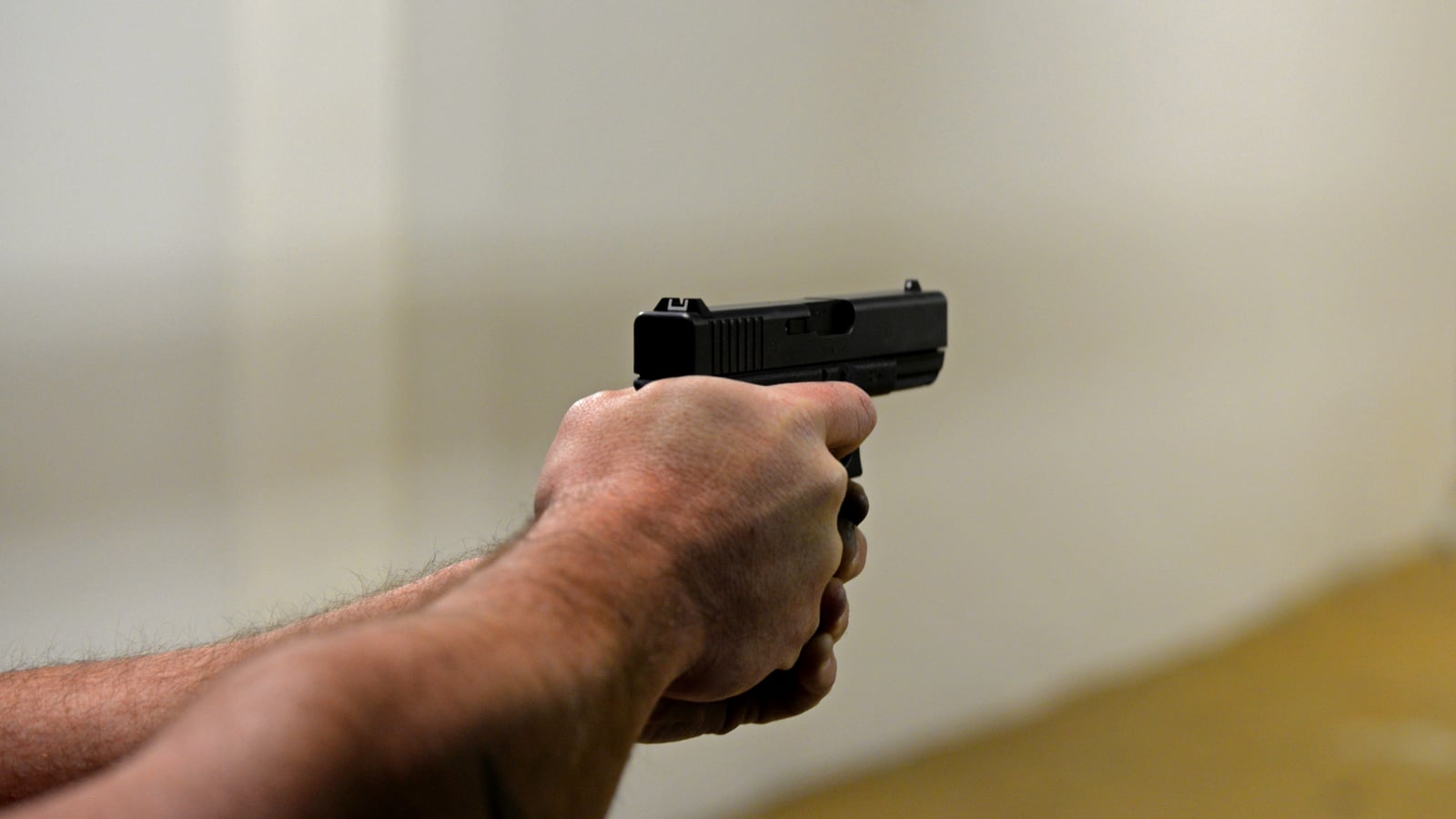
What split time is and why it matters
Split time is the time between two consecutive shot breaks. On a dynamic-shooting timer, it’s the number displayed between each beep of the microphone: 0.18 seconds, 0.25 seconds, sometimes more depending on distance and target difficulty. This number isn’t an end in itself, but it tells you something precise about how you manage your second shot.
A short, consistent split time means you’ve regained a usable sight picture quickly after the first shot broke. A long split time, or one that varies from string to string, usually means you’re waiting for something to settle before you dare press the trigger again. That “something” is often a tension you haven’t identified yet.
Many shooters think the second shot is simply “the same shot, a second time.” That’s wrong. The second shot happens in a body that has just absorbed recoil, with muscles that reacted reflexively to that recoil, and a visual picture that has to rebuild itself after the gun’s movement. Managing that different context is the whole point of second-shot timing.
This topic matters just as much in precision shooting as in dynamic shooting. In 25m rapid fire, the rules impose a time limit for a string of shots on the same target: split time there is constrained by the match clock. In dynamic disciplines (IPSC, Steel Challenge, USPSA), you choose your own rhythm, but a poorly managed rhythm costs points or seconds over an entire stage.
The term “split time” comes from the electronic timing used in dynamic shooting, but the concept itself applies to any discipline that strings together several closely spaced shots. Even without a timer, a 50m rifle shooter firing a rapid string within a time limit is managing, without calling it that, exactly the same balance between speed and muscular release described in this article.
The myth of pure speed
The first mistake, almost universal among shooters starting out in rapid fire or dynamic shooting, is trying to go fast before trying to go accurate. A rushed shooter strings shots together by shrinking the split time, without asking whether their body actually has time to do what needs doing between the two breaks.
This approach produces groups that open up, or missed plates that force an extra shot — which costs far more time than was gained by speeding up. The speed gained on the split time is often lost twice or three times over the moment a shot lands outside the useful zone.
The right learning order is the opposite: first a rhythm that guarantees a usable shot every time, then a gradual reduction of split time once that rhythm is reliable. An experienced coach will typically time students not on their raw speed, but on their speed once missed shots are removed from the calculation. That’s the number that actually improves with training.
The optimal split time is therefore not an absolute value to copy from someone else. It depends on your visual recovery rate, your gun, the shooting distance, and target difficulty. A seasoned club shooter on a close, wide target can afford a much shorter split time than another shooter facing a narrow, distant one.
This myth of pure speed also feeds on a confusion between shooting speed and decision speed. A shooter can decide very quickly to engage a target while still keeping a reasonable split time between the shots themselves. The speed that actually matters for lasting progress is the speed of decision-making and visual acquisition, not the speed of the finger on the trigger. Confusing the two pushes you to accelerate the wrong parameter.
What happens physically between two shots
Between the break of the first shot and the second, a precise physical sequence unfolds, whether you consciously perceive it or not. The gun recoils, your hand and arm absorb that recoil, the gun returns toward its starting position, your eye finds a usable sight picture again, and your finger presses the trigger once more.
How long each of these stages takes depends directly on the state of your muscles at the moment the first shot breaks. If your strong hand is already tense before the shot even fires, the recoil will be absorbed less cleanly, the gun will return less predictably, and your eye will have to wait longer to find a stable image again. That delay feeds directly into split time, but above all into the quality of the second shot.
Conversely, a hand holding the gun with firm but not tense pressure absorbs recoil more consistently. The gun returns on a more predictable path, and the sight picture becomes usable again faster. This is where muscular release becomes central: the second shot isn’t decided by how fast the finger moves, but by the state of the muscles holding the gun.
A point often overlooked: the shoulders and forearms also take part in this absorption. A high, contracted shoulder transmits tension that makes the gun’s return more erratic from shot to shot. A shooter who manages their second shot well typically has a relaxed upper body, with only the muscles actually needed to hold the gun engaged.
Vision also plays a role in this sequence, one often underestimated next to the purely muscular part. After the shot breaks, the eye has to find its fixation point on the sight or the red dot again, which requires a re-centering time specific to each shooter. An eye that tends to follow the gun’s movement rather than staying fixed on a stable reference point takes longer to recover a usable image, which lengthens split time independently of any muscular factor.
This whole sequence, from the first break to the second, unfolds within a fraction of a second, which is why it’s so hard to observe consciously without specific work. Slowing it down mentally in training, by breaking each stage apart (recoil, return, visual re-centering, new press), helps a shooter pinpoint exactly where the weak link in their own sequence sits, rather than working off a vague overall impression of speed or slowness.
Tension, the enemy of rhythm
Tension is the main obstacle to good second-shot timing. It shows up in several ways: a hand gripping the gun harder than necessary, a finger staying pinned on the trigger instead of releasing it just enough, breathing that locks up between two shots.
Tension almost always comes from anticipation. The shooter anticipates the recoil of the second shot, and that anticipation triggers a muscle contraction before the shot has even broken. That contraction disturbs the aim, delays the return of a usable image, and pushes the shooter to wait longer than they should before pressing again. Split time stretches out, and shot quality drops at the same time.
The paradox is that this tension is often invisible to the shooter themselves. They feel “focused,” when they’re actually clenched. The difference between focus and tension is felt in the body: focus comes with broad muscular release, with only the useful muscles engaged; tension comes with diffuse strain, often in the shoulders, the jaw, or the support hand.
Learning to spot your own tension requires body awareness before it requires speed work. A simple exercise is to mentally scan your shoulders, jaw, and support hand right before the first break, and consciously release anything that doesn’t need to be engaged. Repeated, this scan becomes a reflex that accompanies every string.
Fatigue clearly amplifies tension, often without the shooter realizing it. After a long session or several closely spaced strings, the muscles used to hold the gun accumulate residual tension that no longer fully releases between strings. A shooter who notices their split time degrading toward the end of a session should question that accumulated fatigue rather than push harder, which would only pile tension on top of tension already present.
Release between the two shots
Muscular release doesn’t mean “letting go of the gun” between the two shots. It means maintaining only the tension needed to hold and aim, without adding parasitic tension. This is an essential nuance, because excessive release would cause a loss of control over the gun, while insufficient release produces the tension that slows and degrades the second shot.
The right level of release is built up progressively. Dry practice (no ammunition, gun verified unloaded, in a safe setting) lets you feel the difference between a hand holding firmly and a hand clenching reflexively. Repeating the sequence “take the stance, just enough tension, simulated break, partial release, re-tension” dry builds a muscle memory that transfers to live fire.
Release also concerns the face and breathing. A clenched jaw or held breath between two shots adds general tension that ripples down into the hands, even if the shooter doesn’t notice it directly. Consciously releasing the jaw and letting air flow, even in a fast string, contributes to a more consistent return of the gun.
This release between shots shouldn’t turn into a complete pause either. The goal is an intermediate state: relaxed enough for the body to absorb recoil without excessive resistance, tense enough to keep control of the gun and the precision of the aim. This balance is individual and is built through repetition, not through a universal formula.
A useful benchmark for this intermediate level is to compare the grip on the gun to a firm handshake: neither limp nor crushing. This benchmark, passed on by many experienced instructors, helps some shooters quickly find a reference sensation when they tend to grip too hard under the pressure of a timed string.
Application to 25m rapid fire
25m rapid fire imposes a particular framework: a time limit set by the rules for a string of shots on the same target, often strung together with strings at different times. This format forces you to manage split time very consciously, because the clock doesn’t forgive a rhythm that’s too slow, while accuracy is still judged on the hits.
In this context, release between shots has to be compressed into a short time window, which makes the underlying work on tension all the more important. A shooter who has eliminated parasitic tension has more margin within the allotted time, because every stage of the sequence (gun return, visual recovery, new break) unfolds naturally faster, without the speed being forced.
Training specific to 25m rapid fire benefits from isolating split time as its own variable, independent of the string’s total time. Working first on just two shots, seeking the shortest possible split time without losing the group, then lets you extend that quality to longer strings within the time allotted by the rules.
Breath management takes on particular importance here, because the time limit doesn’t allow you to breathe as freely as in slow precision shooting. An experienced shooter learns to manage short, controlled breathing between the shots of the same string, rather than holding their breath for the whole allotted time, which generates growing tension as the string progresses.
Stringing together several strings at different times, typical of 25m rapid fire, adds a further constraint: the shooter has to reset their muscular release between each string, without being able to lean on momentum from the previous one. A shooter who stays tense after a fast string often approaches the next one with residual tension, which degrades their split time from the very first shots of that new string.
Application to dynamic shooting
In dynamic shooting (IPSC, Steel Challenge, USPSA), the second shot gets complicated by an additional variable: it can target the same cardboard target or the same steel plate as the first shot, or a different target entirely. Split time between two shots on the same target doesn’t have the same signature as transition time to a new target, and confusing the two is a common mistake among shooters new to the discipline.
On the same target, the logic stays close to that of 25m rapid fire: muscular release between shots, fast visual recovery, no anticipatory tension. Shooting a close cardboard target or a wide steel plate generally allows a shorter split time than a narrow or distant target, and a shooter who adapts their rhythm to the target’s actual difficulty progresses faster than one who applies a fixed rhythm everywhere.
Moving from one target to another introduces a different transition time, during which the eyes move before the gun follows. This transition time isn’t strictly a split time, but it shares the same principle: the more relaxed the upper body stays while the gaze shifts, the faster and more precisely the gun follows, without jerking.
A dynamic shooting stage often strings together zones where the rhythm needs to slow down (narrow targets, difficult angles, partial obstacles) and zones where it can speed up (wide, close targets). Knowing how to consciously modulate your split time according to each target’s difficulty, rather than maintaining a uniform rhythm, is what separates a shooter who’s progressing from one who’s plateaued. This modulation isn’t improvised: it’s built in training, target by target, with timed feedback.
The shooter’s own movements, between two shooting positions on the same stage, add another dimension to muscular release. A shooter who arrives tense at a new position, because they ran or changed position quickly, has to find a sufficient state of release before even the first shot of the next string. This transition between movement and static shooting is trained specifically, by working a few steps or a position change into dry-practice drills.
Training the timing dry
Dry practice (no ammunition, gun verified unloaded, in a safe setting, never pointed in an unsafe direction) is the most effective tool for building good second-shot timing, because it removes the variable of actual recoil and lets you focus purely on the muscular sequence.
A simple exercise is to simulate two consecutive breaks dry, paying full attention to the state of the strong hand, the support hand, and the shoulders between the two simulated breaks. Repeated regularly, this work builds a memory of release that then transfers to live fire, where recoil adds itself to an already-mastered sequence.
Dry practice also lets you train target transitions in dynamic shooting, by simulating a shift of gaze and gun between two fixed points, with no ammunition at all. This kind of repetition builds a fluidity of movement that later shows up in the field, particularly in the consistency of split time from string to string.
A timer, even a simple one, adds real value to dry practice: it objectifies progress and avoids relying purely on an impression of fluidity that can be misleading. Comparing your dry split time from one session to the next gives a concrete measure of how muscular release is evolving, well before that evolution becomes visible in live fire.
Frequency of dry practice matters more than its duration. Short but regular sessions, several times a week, build a more reliable muscle memory than one long, occasional session. A shooter who fits a few minutes of dry practice into their weekly routine, even outside range days, generally progresses on release faster than one who only works on this point at the club, now and then.
Common mistakes in managing the second shot
The first common mistake is trying to visually catch up with the sight picture too early, before the gun has finished its natural return. This reflex pushes you to press the trigger on a still-unstable image, which degrades the accuracy of the second shot without actually speeding up the split time.
The second mistake is holding your breath between the two shots, especially in strings of more than two rounds. This breath-holding adds a general tension that builds up shot after shot, and explains why the last shot of a long string is often the least well controlled.
The third mistake, very common among shooters discovering timing, is comparing their raw split time to another shooter’s without accounting for context: distance, target size, gun used. A regional champion on a wide target at short distance will always post a shorter split time than a beginner on a narrow, distant target, and that comparison makes no sense if the context differs.
Finally, a subtler mistake is working split time only under easy conditions, on wide, close targets, without ever training on configurations that demand slowing down. A shooter who has only trained pure speed finds themselves helpless facing a target that, on the contrary, requires a longer aiming time, because they haven’t built the capacity to consciously modulate their rhythm.
One last mistake, rarer but real, affects shooters who change guns or configurations frequently without giving their body time to relearn the appropriate release. Every gun has its own recoil and return signature, and a split time built on one gun doesn’t transfer fully to another without an adaptation period, even for an experienced shooter.
Measuring progress without fixating on a single number
Tracking your split time over time has value, provided you do it correctly. The most useful raw data isn’t the fastest split time ever recorded, but the average split time over a whole string, excluding missed or off-zone shots. That average is what actually reflects stable progress.
Logging your split times in a shooting journal, session after session, along with the associated context (distance, target type, gun used), lets you distinguish a real improvement from a mere one-off fluctuation tied to the day’s form. Without this structured tracking, it’s easy to be impressed by one isolated good time that doesn’t represent a stable level.
A shooter progressing in this area will see two indicators move in parallel: an average split time that gradually decreases, and a rate of usable shots that stays stable or increases. If split time decreases while the miss rate increases in parallel, the progress is illusory: the shooter is going faster, but worse.
A shooter starting this kind of tracking can also set a simple intermediate goal: reduce their average split time by a modest amount over several weeks, while strictly maintaining their current success rate. This kind of limited, measurable goal avoids the trap of trying to progress too fast on both fronts at once, which almost always leads to sacrificing accuracy for speed.
It’s also useful to track split time on a single target and transition time between different targets separately, especially in dynamic shooting. These two data points follow distinct logics, and progressing them together without distinguishing them makes the work less effective than targeted training on each one.
A digital shooting journal makes this tracking easier by keeping a full history of sessions, which lets you spot trends over several months rather than only comparing one session to the previous one. A one-off regression on a tired or stressed day doesn’t carry the same meaning as a trend confirmed over several consecutive sessions, and only structured long-term tracking lets you tell the difference.
The role of equipment in second-shot timing
Equipment influences split time, but to a more limited extent than many shooters imagine. The gun’s weight, the quality of the grip fit (grip or stock matched to your build), and the trigger’s tuning all play a role in how fast a gun becomes usable again after a shot breaks.
A heavier gun absorbs part of the recoil through its own inertia, which can make for a more predictable return, provided the shooter doesn’t compensate for that weight with extra tension in the arms. Conversely, a lighter gun returns to position faster, but transmits a greater share of the recoil directly to the body, which demands even more rigorous muscular release to avoid deviations.
Trigger tuning matters too. A long trigger travel or a poorly identified break point pushes the shooter to “search” for the shot break instead of pressing it cleanly, which artificially lengthens split time with no relation to the shooter’s physical condition. Having a qualified professional adjust your trigger, within the limits allowed by the rules and discipline you practice, can remove a bottleneck that has nothing to do with muscular release.
Grip fit to the shooter’s hand size deserves particular attention. A grip that’s too large or too small forces you to compensate with excessive pressure at certain points on the hand, introducing localized tension that’s hard to correct as long as the equipment itself isn’t adjusted. That said, equipment never replaces body work: a tense shooter with perfectly fitted equipment will still be slower than a relaxed shooter with merely adequate equipment.
Finally, sight or optic position influences the speed of visual recovery after recoil. A well-tuned red dot, or mechanical sights well aligned with the shooter’s eye in their natural position, reduce the time needed to recover a usable image. This adjustment should be checked and set beforehand, not during a string of fire.
Regular maintenance of the gun also indirectly influences split time, to a less visible but real extent. A poorly maintained gun can function less consistently from shot to shot, introducing variability in the return to position that the shooter might mistake for a muscular release problem. Checking that the equipment functions consistently eliminates this source of confusion before looking for the cause on the movement side.
Building a teaching progression for timing
Progressing on second-shot timing requires a structured method, not just repetition. The first step is to establish a baseline: fire strings of two shots at a deliberately slow rhythm, verifying that each shot hits the intended zone, before even thinking about the timer. This baseline serves as the reference for all the work that follows.
The second step introduces timing, but only as a measurement tool, not as a goal to minimize at any cost. A shooter logs their average split time over several two-shot strings, under the same conditions (same target, same distance), and seeks to stabilize that number before trying to reduce it. Stability comes before speed.
The third step is to gradually reduce split time in small increments, accepting to step back as soon as a new increment produces off-zone shots. A shooter proceeding this way builds lasting speed, anchored in genuine muscular release, rather than a one-off speed achieved through a forced attempt that doesn’t reproduce reliably.
The fourth step extends the work to strings longer than two shots, observing whether the release held on the first two shots persists through a third, a fourth shot. It’s often at this stage that accumulated muscular fatigue or tension reveals itself, particularly in the shoulders and forearm of the strong hand.
The fifth step, reserved for shooters practicing dynamic disciplines, introduces the variable of movement and target transitions into this already-built progression. Adding this variable too early, before split time on a fixed target has been stabilized, mixes two different learning processes and slows overall progress.
This teaching progression benefits from being shared with a coach or a more experienced club shooter, who can observe from outside signs of tension invisible to the shooter themselves: a shoulder creeping up, breathing that locks up, a gaze that anticipates the next target too soon. An outside eye often spots in a few strings what a shooter alone would take months to identify through introspection.
Second-shot timing under competition pressure
The competition context changes how the second shot is managed, even when the basic technique has been acquired in training. Competition stress tends to reintroduce tension the shooter had eliminated at the club, simply because the perceived stakes change the general physiological state: higher heart rate, shorter breathing, attention partly diverted toward the result rather than the movement.
A seasoned club shooter discovering competition often notices that their usual split time degrades slightly during their first matches, before stabilizing again with experience. This is normal and doesn’t signal a technical regression: it’s a sign that muscular release needs to be consciously rebuilt in a context of heightened stress, before it becomes automatic again.
The solution isn’t to ignore this stress, but to build it into training well ahead of the competition deadline. Simulating time or judgment pressure during regular training sessions — for example by imposing a time limit on yourself or training in front of other club shooters — gets the body used to maintaining muscular release even as the perceived stakes rise.
The pre-shot routine plays a stabilizing role here. Systematically repeating the same preparation sequence before every string, regardless of context (club or competition), gives the body a familiar reference point that facilitates release even when the surrounding environment changes. This routine can be as simple as a fixed order of actions: take the stance, scan the body for tension, breathe, first shot.
Finally, you have to accept that a split time slightly longer in competition than in training isn’t a failure, as long as shot quality holds up. A shooter who favors a slightly more cautious rhythm under stress, rather than forcing a training rhythm they haven’t yet stabilized in that context, generally gets a better overall result.
The post-competition period also deserves a specific analysis of timing, distinct from the usual results analysis. Comparing your competition split time to your training average, match after match, lets you concretely track your ability to maintain muscular release under pressure — an indicator that generally progresses more slowly than raw technical precision, but that eventually stabilizes with accumulated experience.
FAQ
Q: What’s a good split time for a beginner? A: There’s no universal number that works for everyone — it depends on the gun, the distance, and the target. It’s better to track your own progress over time than to aim for a number observed in another shooter.
Q: Should you hold your breath between two shots to go faster? A: No, holding your breath adds tension that degrades the quality of the second shot. Short, controlled breathing between shots actually helps maintain useful muscular release.
Q: Is dry practice really useful for split time? A: Yes, it lets you isolate the muscular sequence of the second shot without the variable of actual recoil, which speeds up learning release. It should always be done with a gun verified unloaded, in a safe setting.
Q: Why does my group open up when I try to go faster? A: That’s generally a sign of anticipatory tension or of visually chasing the sight picture too early, on a still-unstable image. You need to slow the split time down until you find a usable shot again, then re-accelerate gradually.
Q: Is second-shot timing different for pistol and rifle? A: The principles of muscular release and visual recovery are the same, but how the gun returns after recoil differs depending on weight, grip, and point of contact. Optimal split time therefore needs to be trained separately for each gun.
Q: How do I know if my rhythm is limited by my technique or by my equipment? A: Run the same test dry, then with ammunition: if the dry release is fluid but live fire stays jerky, the cause is often tied to recoil apprehension rather than equipment. An experienced coach can also watch your grip to rule out a purely technical cause.