
The format of the event
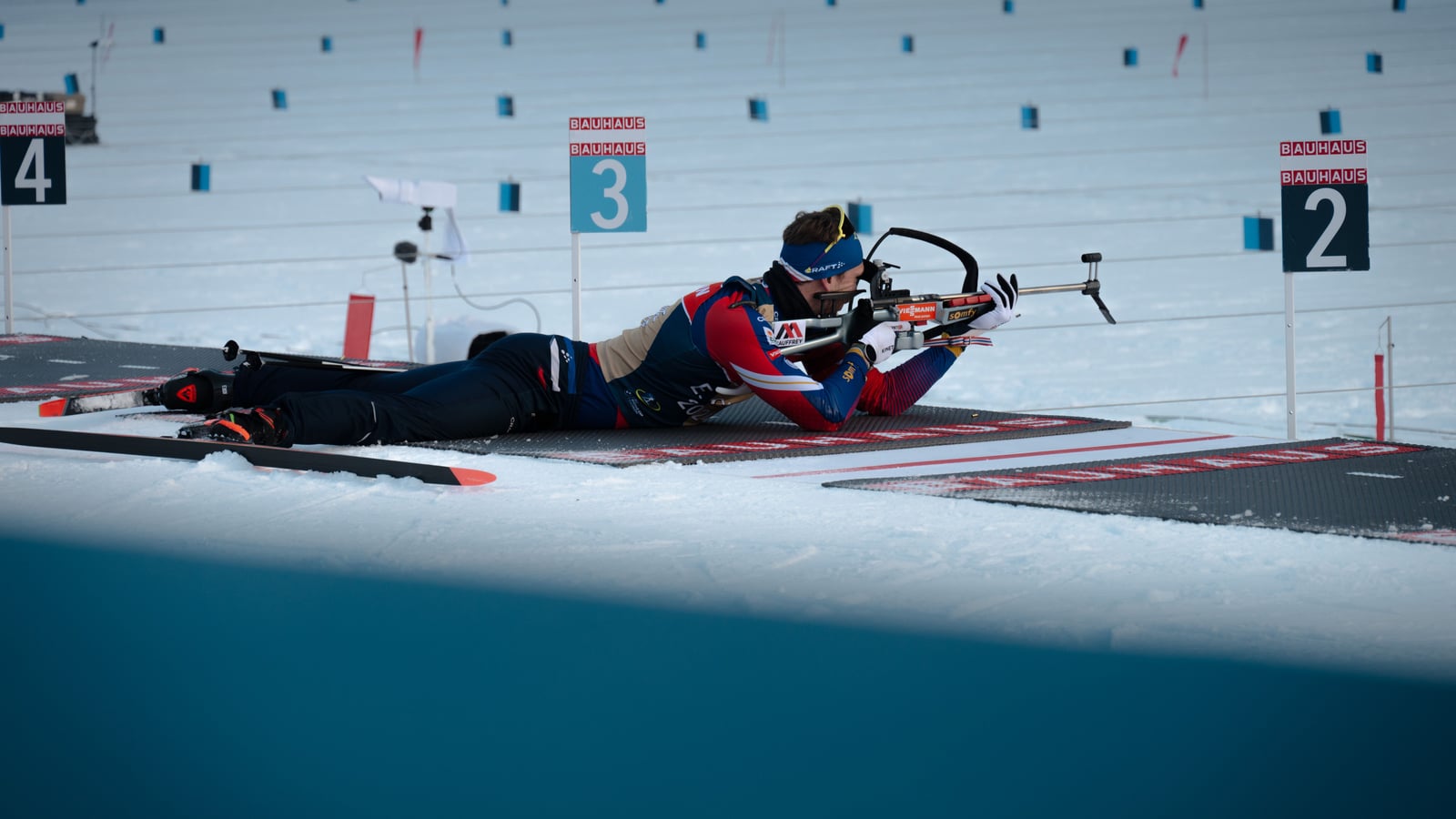
50m rifle prone is shot, as the name suggests, lying down at a distance of 50 metres. It’s one of the most accessible disciplines in civilian sport shooting because it demands less raw physical strength than the standing or kneeling positions. But it remains technically demanding over time.
The classic programme runs over 60 shots, fired within a limited time that varies depending on the rules and competition category. Some school or club events offer reduced formats of 40 or 30 shots for beginners, but the reference format remains 60 shots prone.
The target used shows a classic concentric design, with a black centre and scoring zones that decrease outward. Nothing figurative, just circles to hit with the greatest possible consistency. It’s this repetition of an identical motion, shot after shot, that shapes the entire discipline.
The shooting time is generous compared to other, more dynamic disciplines, which can give the impression that the prone position is “easy”. That’s a beginner’s mistake: the slowness of the format doesn’t reduce the difficulty, it relocates it. Your real opponent is no longer the clock — it’s the consistency of your own body and mind over an hour or more.
At the club, you’ll run into this discipline among young newly licensed shooters just starting out as much as among veteran shooters who’ve practised it for decades. It’s one of the rare civilian sport shooting disciplines where age isn’t a real brake on performance, unlike standing positions which call more heavily on balance and overall muscle tone.
The actual course of a competition session follows a fairly strict timeline: a preparation and sighting-shot period before the scored programme, then the strings that count toward the score, in near-total silence on the firing line. This tightly framed structure contrasts with the sometimes “relaxed” image beginners have of this discipline before they’ve practised it seriously.
The final score is calculated by adding up the points from each hit, with precise tie-break rules at the top of the standings, often based on the number of hits in the narrowest central zone. This scoring mechanic demands a consistency that leaves little room for luck across a full programme.
Calibre, ammunition, and neighbouring 50m disciplines
50m rifle prone is most often shot with a firearm chambered in a small rimfire calibre, known for its accuracy and moderate running cost compared with more powerful calibres. This choice of calibre isn’t trivial: it lets you multiply repetitions in training without a disproportionate ammunition budget, which is precious in a discipline where training volume matters as much as the quality of each shot.
The precise choice of ammunition, within that same calibre, is the subject of personal fine-tuning among the most invested shooters. Two boxes of ammunition of the same nominal calibre can produce noticeably different groups in the same rifle, for manufacturing reasons that often escape simple analysis. Many experienced shooters test several loads on target before settling on their choice for a competition season.
This search for the ammunition best suited to a specific rifle illustrates the overall spirit of the discipline well: nothing is left to chance, every variable is tested, measured, and validated before being locked in. It’s groundwork done ahead of competitions, far from the stress of the firing line, and it contributes directly to the consistency sought on the day of the event.
Storage of ammunition is likewise governed by common-sense rules and regulations that must be scrupulously followed, particularly regarding home security and keeping ammunition separate from the firearm. These specifics, like those for the firearm itself, vary by individual situation and are worth checking directly with your club or the relevant authorities rather than generalising loosely.
The 50-metre distance also hosts several distinct disciplines in civilian sport shooting, and it’s worth placing prone in context relative to these neighbouring disciplines. Some events at this distance are shot across three successive positions — prone, kneeling, and standing — within a single programme, which completely changes the nature of the event compared with prone practised alone.
In a three-position format, postural endurance is compounded by an ability to quickly reset your reference points from one position to another, calling for an adaptability that prone alone doesn’t demand in the same way. A shooter specialised purely in prone may need specific work if they ever want to tackle these combined formats.
Other events at 50 metres are shot with moving targets or faster shooting formats that move completely away from the philosophy of static, slow prone. These disciplines call on almost opposite qualities: reactivity, quick decision-making, managing stress under urgency rather than over duration. Comparing the same shooter’s results across these different 50-metre formats often gives a fairly accurate picture of their natural profile — patient or rather reactive.
This diversity of disciplines at a single distance illustrates a richness specific to civilian sport shooting: the exact same shooting distance can produce radically different experiences depending on the chosen format, the imposed position, and the pace of the event.
Why the prone position isn’t “the easiest”
Many new shooters choose prone thinking they’ll progress faster because the position seems more stable. That’s true at first: you get decent groups fairly quickly, which is rewarding. But past this first plateau, the discipline gets noticeably more complicated.
The apparent stability of the prone position hides an extreme demand for repeatability. Standing, you accept a degree of natural sway and learn to shoot within the movement. Prone, the implicit expectation is that every shot resembles the previous one to the millimetre. The slightest deviation in body placement shows up immediately on the target.
This demand for placement precision turns a seemingly simple exercise into a job of constant micro-adjustments: support elbow position, torso angle, cheek pressure on the stock, breathing. Nothing is ever fully mastered, even after years of practice.
It’s often a shock for shooters coming from a more dynamic discipline. They expect to “rest” in prone and instead discover a discipline that demands an almost obsessive rigour about detail. An experienced coach will tell you: the prone position forgives sloppiness less than any other precision discipline.
This initial disillusionment has a positive effect in the medium term: it forces the shooter to reconsider their very definition of difficulty. Instead of measuring a discipline’s demands by its execution speed, they learn to measure it by its tolerance for error. On that scale, prone ranks among the strictest disciplines that exist in civilian sport shooting.
Another common misunderstanding concerns the notion of “natural talent”. Some beginners progress very quickly in their first sessions and conclude they have a particular gift for this discipline. The reality is more nuanced: the rapid early gains mostly come from correcting big positioning errors, which are easy to spot and fix. The rest of the progression, however, plays out on much finer details that take far longer to anchor.
The physical demand over time
The first trap of 50m rifle prone is believing the physical effort is zero because you’re not moving. In reality, holding a static position for 60 shots, potentially over an hour of shooting, works muscle groups you wouldn’t suspect until you’ve experienced it.
The back, neck, and shoulders absorb prolonged isometric tension. Unlike dynamic effort, where the muscle contracts and releases, here it stays under near-continuous tension. This type of load produces the classic aches of the prone shooter: neck tension, cramping between the shoulder blades, numbness in the support arm.
Breathing also becomes a physical exercise in its own right. The prone shooter learns to slow their breathing rate, timing the shot release on a natural respiratory pause between inhale and exhale. This fine breath control requires progressive training, somewhat like freediving or certain meditation disciplines.
Heart rate also directly affects aiming stability, even in the prone position where the body is largely still. Each beat produces a micro-oscillation transmitted to the rifle through the torso and arms, particularly visible under heavy optical magnification. Top-level shooters learn to time their shot release between two heartbeats, within a stability window of a few tenths of a second that takes years of practice to exploit reliably.
Fatigue sets in insidiously. The first shots of a string are often the cleanest, because the body is still fresh. Toward the end of a 60-shot programme, technical clarity drops as muscular tension rises, which explains why so many shooters lose points on the last strings rather than the first.
An experienced club shooter often makes a point of this: the real physical work isn’t done during competition but beforehand, in the weeks and months of core and postural endurance training. Showing up fit on the day isn’t something you improvise.
Hydration and nutrition before a long session also play an underrated role. Insufficient hydration favours cramps and micro-tremors, two direct enemies of the stability sought in the prone position. Conversely, too heavy a meal before a session slows breathing and weighs on concentration, which is why many regular shooters favour light meals in the hours before a competition.
Outdoor weather conditions, when the discipline is practised outdoors, add a further layer of physical demand. Crosswind shifts the point of impact and requires constantly reading the flags or pennants on the firing line. Heat or cold directly affect finger dexterity on the trigger and the ability to hold a comfortable position over time. A shooter who only trains in stable indoor conditions can be thrown off the day they discover these variables outdoors.
The mental demand: the true discipline of patience
If the physical wears down the body, it’s the mind that decides the final result in 50m rifle prone. This discipline is won or lost in the head, on your ability to repeat an identical motion without ever giving in to haste or over-control.
The main mental enemy is anticipation. A shooter who starts “wanting” the good shot, who anticipates the shot breaking instead of letting it happen at the right moment in the sight picture, loses consistency. It’s a central paradox of precision shooting: the more consciously you chase perfection, the more you risk missing it.
Managing weariness is another challenge specific to this discipline. Repeating an identical motion 60 times over more than an hour generates a kind of mental monotony that can let attention slip. The shooter must learn to find fresh concentration on every shot, without relying on pure autopilot, which often leads to silly mistakes.
Competition stress management adds to this ordinary mental fatigue. Unlike dynamic disciplines where adrenaline can channel stress into action, prone requires managing stress in stillness and silence. There’s nowhere to burn it off physically — it has to be processed on the spot, shot after shot.
A regional champion in this discipline often describes her optimal state of concentration as an in-between: present enough to adjust every parameter, detached enough not to over-analyse every shot. That balance is built over years, not a handful of sessions.
Handling a missed shot mid-string illustrates this mental dimension well. A mentally underprepared shooter often lets a bad shot contaminate the following ones, in a spiral of rumination that worsens the underperformance. A seasoned shooter, by contrast, treats every shot as an independent unit: they briefly analyse the deviation, adjust if needed, then mentally close the file before resuming their usual routine.
This ability to compartmentalise each shot is explicitly trained, sometimes with the help of a coach who deliberately introduces disturbances to get the shooter used to not being thrown off. It’s work similar to the mental preparation used in other precision sports like golf or archery, where managing the isolated error largely determines overall performance across a long competition.
Specific gear: the shooting sling
The shooting sling is the signature accessory of the prone position. It connects the forward arm to the rifle and transfers part of the rifle’s weight to the skeleton rather than to the muscles alone, which reduces fatigue and considerably stabilises the sight line.
Adjusting the sling is an art in itself. Too loose, it provides no real stability. Too tight, it generates excessive pressure that can disrupt blood circulation in the arm and cause annoying numbness partway through a string. The right setting is found through trial and error, and it varies from shooter to shooter depending on build.
There are several types of slings depending on the rules and competition categories, from simple leather or synthetic models to more elaborate systems with an adjustable cuff. The choice often depends on the specific discipline being practised and the federal rules applicable to the competition category.
Learning to fit the sling correctly before every string is an integral part of the prone shooter’s routine. This preparatory step, often overlooked by beginners, nonetheless conditions the entire quality of the position that follows. A poorly placed sling at the start of a string costs dearly across the whole programme.
Sling maintenance also deserves regular attention. Leather or synthetic materials stretch with use and humidity, gradually altering the tension obtained for an apparently identical setting. A rigorous shooter periodically checks that their setting marks still produce the same feel of tension, rather than relying solely on a scale that may have drifted over time.
Specific gear: supports and the shooting mat
The shooting mat is the other cornerstone of prone equipment. It isolates the shooter from the ground, cushions irregularities in the firing line, and helps maintain a stable, reproducible position from one session to the next. Many regular shooters invest in a personal mat rather than using club equipment.
Elbow pads, often built directly into a padded shooting jacket, protect the contact points and reduce the micro-pain caused by prolonged pressure on the elbows. A well-fitted jacket also contributes to the overall rigidity of the position, somewhat like an external frame limiting stray oscillations.
Shooting trousers, often reinforced at the knees and hips, play a similar role for the lower body. This entire technical outfit isn’t an aesthetic gadget: every reinforcement has a precise function in the pursuit of stability and reproducibility of body placement.
The choice and adjustment of this equipment depend heavily on individual build. An experienced coach will often spend several sessions with a new shooter simply fine-tuning these settings before even working on aiming technique itself. It’s a time investment that pays off in the long run.
Optical equipment: sights or scope
Depending on the type of rifle and the rules of the event, aiming is done either with classic mechanical iron sights (front and rear sight) or with a magnifying rifle scope. Both approaches require distinct learning and don’t tax vision the same way over the course of a full programme.
With mechanical sights, the eye must align three points in a theoretically identical plane of focus: the rear sight, the front sight, and the target. This is an exercise that fatigues the eye differently from optical aiming, with a specific ocular tension that builds up across strings. Many beginners underestimate this progressive visual fatigue, which can explain a loss of precision late in the programme, independent of the body’s overall physical fatigue.
With a magnifying scope, the difficulty shifts toward managing magnification and depth of field, as well as increased sensitivity to heat mirage, which can blur the image in hot weather. The dioptre setting must be checked regularly, because a poor optical setting tires the eye without the shooter always being immediately aware of it.
The choice between these two approaches often depends on the precise rules of the targeted event and the equipment available at the club. A beginner would do well to try both configurations before investing in costly personal equipment, to identify which one best suits their vision and their aiming comfort over time.
The shooter profile suited to this discipline
50m rifle prone particularly wins over patient, methodical profiles who are comfortable with repetition and not very sensitive to the apparent monotony of the motion. If you need fast action and constant decision-making to stay motivated, this discipline can instead feel frustrating at first.
Shooters coming from an endurance sport background, such as long-distance running or cycling, often find common ground with this discipline: managing effort over time, accepting progressive discomfort, the ability to maintain a clear intention despite rising fatigue.
Age isn’t an obstacle in this discipline, unlike more dynamic disciplines that call more heavily on explosiveness or standing balance. This is one of the reasons you’ll meet shooters of all ages at the club practising prone at a high competitive level, sometimes long after they’ve given up other, more physically demanding disciplines.
Conversely, highly perfectionist profiles need to learn to manage a natural tendency to over-analyse every shot. This discipline can feed a form of obsession with detail that, poorly channelled, becomes counterproductive. The right balance between rigour and letting go is precisely what distinguishes seasoned shooters from beginners still tense about their technique.
A club that welcomes beginners well will know how to steer a newly licensed member toward this discipline if it detects this patient, methodical profile — or, conversely, redirect them toward a more dynamic discipline if boredom takes over too quickly during the first introductory sessions.
Some shooters deliberately alternate between several disciplines over the course of a season, using prone as a technical and mental anchor between periods of more dynamic practice. This alternation lets them rework the fundamentals of aiming and breath control in a demanding but less time-pressured setting, before returning to disciplines that require more execution speed.
Building your training progressively and avoiding classic mistakes
Starting out in 50m rifle prone doesn’t mean jumping straight into full 60-shot programmes. The classic progression begins with short strings, ten to twenty shots, emphasising the quality of placement over the score obtained.
Dry-fire practice, without ammunition, holds a central place in the progression of any serious shooter in this discipline. Repeating position setup, sling adjustment, finding the aim point, and breath control without firing a single shot lets you memorise the correct sensations without the stress of an immediate result.
This dry-fire practice has an added benefit: it can be done outside the range, at home, in a space large enough and secure enough to handle the unloaded firearm completely safely. Many regular shooters devote several short weekly sessions to this dry-fire work, complementing range sessions that remain more spaced out and more costly in ammunition.
Gradually, shot volume increases and strings get longer to bring training closer to real competition conditions. This is the stage at which the physical and mental endurance dimension discussed earlier becomes a genuine subject of work, rather than a mere theoretical curiosity.
Many clubs structure this progression over several months, even several seasons, before steering a shooter toward their first official competitions. This patience in training reflects exactly the patience the discipline itself demands on the firing line.
The role of the coach or instructor remains central throughout this progression, well beyond the first introductory sessions. An outside eye spots positioning flaws or anticipation tics that the shooter themselves doesn’t always notice, since certain movements become unconscious with repetition. The best progress often comes from joint work between the sensations reported by the shooter and the objective observations of the coach from the outside.
Certain mistakes recur so often among newcomers to this discipline that they deserve explicit mention. The first is fully holding the breath at the moment of shot release: out of excess concentration, the beginner holds their breath far longer than necessary, causing tremors and progressive loss of stability.
The second classic mistake concerns head position on the stock. Many beginners adopt an inconsistent cheek weld from shot to shot, which slightly shifts the sight line without their realising it. A poorly set cheek weld at the start of a session can, on its own, explain scattered groups that a shooter mistakenly blames on a material problem.
The third mistake concerns managing programme time. Some beginners, out of nervousness, fire their shots too quickly at the start of a string and then find themselves having to rush the end of the programme to stay within the allotted time. Learning to pace your shooting time across an entire string is one of the management skills that quickly distinguishes an organised shooter from one still learning.
Finally, many new shooters neglect the sighting-shot phase at the start of a session, eager to begin the scored programme. Yet this phase serves to validate the sight or scope setting and confirm the position before shots actually count. Skipping or rushing it exposes you to unpleasant surprises from the very first shots of the official programme.
The regulatory framework, access to the practice, and the role of the club
Practising 50m rifle prone at a club fits within the French regulatory framework for civilian sport shooting, governed by the federation and by firearms regulations. Rifles used in this discipline most often fall under category C, subject to declaration, or category D for certain compressed-air or entry-level equipment under 20 joules.
Access to the practice systematically goes through a federal licence and the supervision of an affiliated club, at least during the discovery and learning phase. The precise steps for acquiring a personal firearm vary depending on the model and category involved, and it’s best to check directly with your club or the relevant authority rather than relying on generic information found online.
Storage and transport of equipment are likewise governed by precise rules that every licence holder should know before considering independent practice, including for compressed-air rifles depending on their power. Here again, timelines and administrative procedures vary by case and by region, so it’s better to verify these points with your club than to rely on a single figure that may no longer be current.
This regulatory dimension isn’t a secondary administrative detail: it’s an integral part of the responsible sport shooter’s culture, just as much as technical mastery of the motion. A shooter who neglects this dimension isn’t complete in their practice, even if they’ve perfected their prone position.
Safety on the firing line is likewise governed by strict rules specific to this discipline, particularly around handling the firearm between strings, muzzle direction at all times, and the instructions of the range officer supervising each session. These rules, learned from the very first introductory sessions, become automatic habits that must never be relaxed, even after years of regular practice.
Practising 50m rifle prone is rarely a solitary experience, at least during the learning phase. The club remains the near-mandatory entry point for discovering this discipline under good conditions, with access to shared equipment often necessary before investing in personal gear.
Collective emulation plays a non-negligible role in progress, even in a discipline that seems so individual. Watching more experienced shooters, exchanging notes on sling or position settings, comparing impressions after a tough session: these informal interactions often speed up learning far more than poorly directed solo work.
Training slots supervised by a coach remain valuable even for seasoned shooters. A regular outside eye can catch gradual positioning drift that creeps in insidiously over several months, without the shooter always being able to notice it alone. It’s one of the paradoxes of this discipline: the more it demands solitary rigour on the firing line, the more it actually benefits from regular collective coaching.
Tracking your progress over time
Because 50m rifle prone is a discipline of patience, tracking progress over several months or seasons takes on its full meaning. Unlike a discipline where technique changes fast, progress here is often measured in small percentage gains in group consistency, not in spectacular breakthroughs.
Logging your sessions, your sling and position settings, your shooting conditions, and your physical sensations lets you spot trends invisible to the naked eye over a single session. A shooter who notices, for instance, that the last strings of a programme are systematically weaker can target their postural endurance work specifically, rather than overhauling their entire technique.
This rigour in tracking connects directly with the spirit of the digital shooting log: recording every session, every equipment setting, and every sensation makes it possible to objectify a progression that, in this discipline in particular, is slow and hard to perceive without historical data.
Over time, it’s often the most rigorous trackers who progress the most, more than those who rely solely on sheer training volume. The discipline itself rewards method and patience; it’s only logical that progress tracking follows the same philosophy.
Analysing groups over time also helps distinguish an equipment problem from a technique problem. A sudden, sharp shift in grouping after months of consistency points more toward a material cause: a sling that’s moved, a loosened screw, an optical setting accidentally changed. A slow, gradual drift, by contrast, more often points to a quiet erosion of technical rigour that’s best corrected early, before it becomes an ingrained habit.
This ability to precisely diagnose the source of a performance dip, rather than questioning everything after every underperformance, clearly distinguishes experienced shooters from beginners. It’s acquired over time, through experience accumulated session after session, and through data tracking detailed enough to allow this kind of reliable retrospective comparison.
FAQ
Q: Do you need to be very physically strong to practise 50m rifle prone? A: No, raw strength isn’t the key factor in this discipline. Postural endurance and deep core stability matter far more than pure muscular power, which makes this discipline accessible to a wide range of profiles.
Q: What’s the difference between prone and the other rifle shooting positions? A: The prone position offers more natural stability thanks to ground contact points, but in return demands much finer precision in body placement. Standing and kneeling positions tolerate more natural body sway.
Q: Is the shooting sling mandatory in competition? A: Its use depends on the precise rules of the event and the competition category involved. Check with your club or federation to find out the rules that apply to your exact discipline.
Q: How long does it take to progress seriously in this discipline? A: It varies enormously depending on training frequency and the shooter’s profile, but serious progress is generally counted in seasons rather than weeks. It’s a discipline that rewards consistency over time.
Q: Can you start sport shooting directly with 50m rifle prone? A: Yes, it’s actually often a recommended discipline for beginners thanks to the stability of the position, provided you’re supervised by an experienced coach from the very first sessions to avoid bad placement habits.
Q: Why do some shooters prefer prone over dynamic disciplines? A: Because the discipline values patience, method, and consistency over speed of decision-making. Profiles who enjoy refining a single motion to fine mastery often find themselves more at home here than in more dynamic formats.