
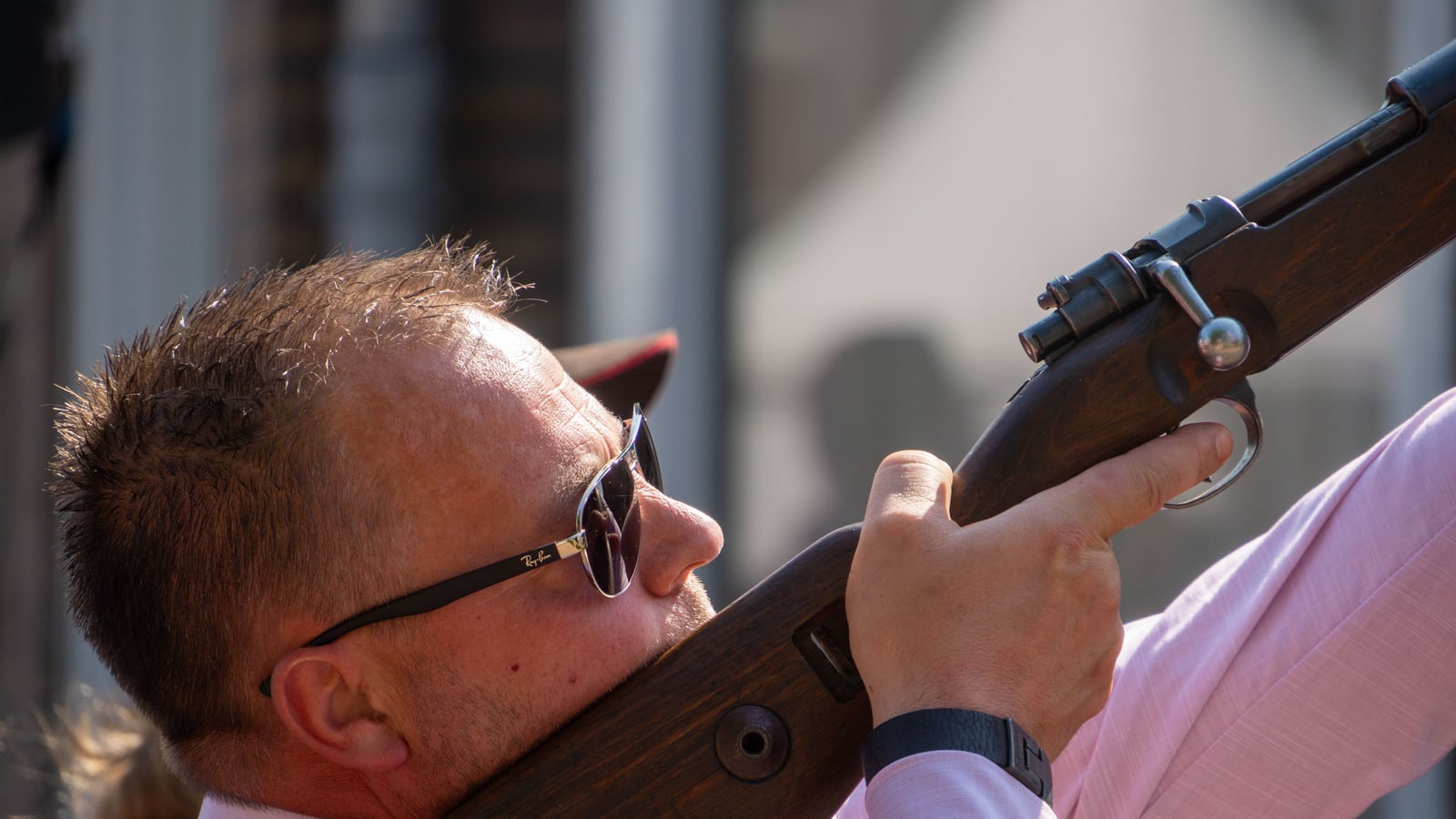
The 3x40, an event that tests everything
The rifle 50m 3x40 is often described as the most complete event in competitive rifle shooting. It doesn’t just measure raw accuracy: it strings together three completely different shooting positions in the same match, with the same rifle and the same rules.
The principle is simple to state: 40 shots prone, 40 shots kneeling, 40 shots standing, for a total of 120 shots. Each position has its own allotted time and its own set of movements, which means a shooter can excel prone and fall apart standing, or the other way around.
That’s exactly what makes the 3x40 interesting to train for: it doesn’t reward a single skill, but the ability to switch between three different body balances without losing focus. A shooter who only works on one position improves quickly on it but plateaus on the overall score as long as the other two are neglected.
The format also exists in a shorter version, the 3x20, with 20 shots per position for a total of 60 shots. It’s the logical entry point before tackling the full format, especially for young shooters or anyone new to one of the three positions.
This article breaks down the three positions one by one, compares the two formats, and covers the gear that stays the same across all three, with no need to change equipment between phases of the same match.
Competitive rifle shooting has been an Olympic discipline since the very first modern Games, and the three-position format is one of the benchmark events at international level. This long-standing recognition explains why the three-position rulebook is so precisely codified: every detail of posture, support, and clothing has been refined over decades of competition to guarantee maximum fairness between shooters.
At club and regional level, the 3x40 and the 3x20 remain events open to any licensed shooter who wants to try them, without needing international competitor status. It’s precisely this accessibility that makes it a reference format for building the whole set of fundamentals of the rifle 50m, well beyond the circle of elite shooters.
Prone position: the most accessible, not the easiest
Prone is almost always the position a shooter starts with in rifle 50m. The body lies on the ground, the rifle rests on the body’s own contact points rather than on an external support, and the base of support is wide.
This wide base explains why prone tolerates small posture flaws better than a standing position: the center of gravity is low, the contact surface with the ground is large, and the body’s natural tremor has less grip on the sight line.
But accessible doesn’t mean easy at a high level. Over 40 shots prone, the slightest variation in the forearm’s contact point or in cheek pressure on the stock carries through dozens of consecutive shots. Consistency of placement becomes the main challenge, far more than raw stability alone.
Sling adjustment plays a central role prone. A properly tensioned sling transfers part of the rifle’s weight to the skeleton rather than the muscles, which reduces fatigue over a long match. A shooter who adjusts their sling poorly feels their hold degrade after the first twenty shots, with the group gradually drifting downward.
Breathing prone follows a rhythm that’s easier to automate than in the other two positions, precisely because the torso is stable and the diaphragm works free of any balance constraint. It’s often the position where a shooter first refines their breathing cycle management before carrying it over, with adjustments, to the less stable positions.
The angle of the body relative to the line of fire also deserves special attention prone. A shooter poorly aligned with their target compensates by slightly twisting the torso or neck to line up the eye with the sight, which creates an asymmetric tension that’s invisible on the first shot but costs fatigue and dispersion over the course of a 40-shot match. Consistently taking the same angle of position, identified and memorized, avoids this kind of silent compensation.
Kneeling position: the unloved middle ground
The kneeling position holds a particular place in the 3x40: it’s technically more demanding than prone but often gets less attention in training, which frequently makes it the weakest position for amateur shooters.
Ground contact is reduced to one knee, one foot, and sometimes part of the heel depending on the technique used. This reduced base introduces a lateral balance challenge that doesn’t exist prone, and the torso has to find a compromise between stability and comfort sustainable over the course of a 40-shot match.
The role of padding under the knee and ankle isn’t cosmetic: it directly determines the ability to hold the position without pain or unwanted muscular compensation. A shooter who shifts their knee mid-match to relieve discomfort loses their reference contact point and sees their group spread without understanding why.
The height of the elbow resting on the knee directly influences the barrel angle and the shoulder’s freedom of movement. A poorly positioned elbow forces a compensating shoulder tension that fatigues quickly and introduces a low-frequency tremor, hard to correct mid-match without starting over.
Many experienced club shooters see the kneeling position as a revealer: it immediately exposes core-stability flaws that stay invisible prone. Improving kneeling often improves, as a side effect, the quality of both prone and standing, because the shooter develops a better awareness of their overall body axis.
The choice of rear foot, flat or on the toes depending on the shooter’s build and habits, noticeably changes weight distribution between knee and ankle. Neither variant is universally superior: it’s an individual setting to test over several sessions before settling on it, and one worth noting down precisely once a satisfactory compromise has been found, so as not to lose it from one session to the next.
Standing position: the position that decides the ranking
Standing is unanimously considered the most demanding of the three, and it’s often the one that decides scores in a close 3x40. The whole body rests on the two feet alone, with no additional ground contact to stabilize the rifle.
The body’s natural tremor, sometimes called postural sway, becomes fully visible here in the movement of the front sight or aiming point on the target. No position eliminates this tremor: the work consists of learning to shoot within a window of relative stability rather than waiting for total stillness that will never come.
Foot position, often perpendicular or slightly angled to the line of fire depending on build, shapes the entire balance of the torso. Small adjustments of a few centimeters in foot spacing or orientation can significantly change the quality of the hold over an entire match.
Placing the left elbow (for a right-handed shooter) on the hip or the iliac crest serves as an essential bony support point. Without this support point, the rifle’s whole weight rests on the arm’s muscular strength alone, which becomes untenable beyond a few shots and brings growing fatigue shot after shot.
Mental management takes on disproportionate importance standing compared with the other two positions. A shooter who panics at the sight wobble tends to trigger at the wrong moment out of anticipation, which degrades the shot far more than the wobble itself would have if the release had been controlled.
Trigger timing standing also differs in its decision logic from the other two positions. Prone or kneeling, a shooter can often wait for a moment of near-perfect stability before releasing the shot. Standing, this prolonged wait is counterproductive, because it gives the natural sway time to take over again. Learning to accept an imperfect but sufficient aiming window, and to release into it without further hesitation, is part of the specific learning that goes with this position.
What actually changes between prone, kneeling, and standing
Beyond the individual descriptions, it’s useful to compare the three positions directly on the criteria that matter for training. The base of support shrinks sharply from one position to the next: wide prone, reduced to an unstable tripod kneeling, minimal with two contact points standing.
Preparation time before each shot follows the opposite logic: the more unstable the position, the more time it takes to find correct alignment before being able to aim calmly. A shooter often rushes standing because they underestimate this setup time compared with prone.
Muscular fatigue also progresses very differently. Prone, it stays broadly stable throughout the match thanks to skeletal support. Kneeling, it builds up locally in the supporting knee and shoulder. Standing, it affects the whole torso and legs, with a risk of clear degradation in the final third of the match if postural endurance hasn’t been specifically trained.
The link between the three positions isn’t just technical, it’s also strategic in managing a 3x40 match. Many experienced shooters choose to shoot prone first to settle into a breathing rhythm, then kneeling to maintain active concentration, and save their best mental clarity for standing, which comes after more than two hours of cumulative effort depending on the pace adopted.
3x20 versus 3x40: two formats, two goals
The 3x20 format uses exactly the same three positions but cuts each phase to 20 shots instead of 40, for a total of 60 shots. The rules for the positions themselves don’t change: it’s the length of the event that differs, not the expected technique.
For a shooter discovering one of the three positions, especially kneeling or standing, the 3x20 makes it possible to face the full format without suffering the cumulative fatigue of the 3x40. It’s a logical teaching step before tackling the long event.
The 3x40 introduces a dimension the 3x20 doesn’t really test: managing physical and mental endurance over a much longer total duration. Holding a stable standing position through the last twenty shots of a 40-shot match, after already going through prone and kneeling, requires specific postural endurance work that the short format doesn’t demand in the same way.
The choice between the two formats often depends on the competition calendar and the shooter’s level. A young shooter, or one early in their progression, frequently shoots 3x20 before switching to 3x40 once each individual position is mastered enough to hold up over the full duration.
There’s no hierarchy of value between the two formats as such: they’re two different events that serve different progression goals. A club that runs both lets each shooter choose the format suited to their current level rather than forcing a single format on everyone.
The gear common to all three positions
One specificity of the 3x40 is that the equipment doesn’t change between the three phases: the same rifle, the same sight, and the same clothing stay with the shooter from prone through to standing, with no equipment change during the event.
The rifle itself stays identical, but its settings may need fine adjustments between positions depending on the model used, particularly stock length or the position of the buttplate, to adapt to the shooter’s changing body shape depending on whether they’re lying down, kneeling, or standing.
The sight, whether it’s an aperture-and-front-sight system or an optical device depending on the competition category, remains the same unit across the three phases. What changes is how the eye lines up on it, since head posture varies noticeably between a prone position and a standing one.
Shooting clothing, particularly the rigid jacket and trousers used in competition, plays a postural support role that stays constant across the three positions. It limits unwanted torso movement and transfers part of the load to the clothing’s structure rather than to the shooter’s muscles alone, which is especially valuable standing.
Shooting shoes, with their rigid sole and ankle support, matter mostly in the standing and kneeling positions, where ground contact determines the whole balance. Prone, their influence is more limited since body weight rests more on the torso and arms than on the feet.
The shooting sling deserves a separate mention: it’s used prone and kneeling to stabilize the rifle through tensioned contact with the forward arm, but it’s generally loosened or removed standing, where its use is either banned or pointless depending on the rules of the category being shot.
The rifle’s total weight, which stays fixed across the three phases, feels very different depending on the position held. A weight that feels perfectly balanced prone, where it rests largely on ground contact points, can feel noticeably heavier standing, where it’s carried entirely by the shooter’s skeleton and muscles. That’s one reason why the choice of a rifle’s weight and balance is often made primarily with the standing position in mind, even if it means compensating slightly prone or kneeling.
The transition between positions, a dead time that counts
What an event’s rulebook doesn’t always show is the transition time between the three positions, which is nonetheless an integral part of managing a 3x40. Moving from prone to kneeling, then from kneeling to standing, requires fully breaking down the firing point and rebuilding the next posture.
This transition time isn’t mentally neutral. A shooter who just finished a prone string feeling good can lose that state of focus while packing away the mat, changing the sling, and setting up for kneeling. The break in rhythm benefits some shooters, who use it to reset their attention, and penalizes those who need continuity to stay focused.
Many experienced club shooters develop a scripted transition routine set in advance: a fixed order of actions to pack up the previous position’s gear and set up the next one’s, always in the same order. This routine reduces the mental load spent on logistics and leaves more resources available for technical focus.
Managing the event’s overall time includes these transitions, even when they aren’t timed separately from actual shooting time. A shooter who dawdles on position changes may end up having to rush the end of a phase to meet the total allotted time, which degrades the quality of the last few shots.
Some clubs run exercises focused purely on transitions, without even firing ammunition, to make the position-change movements automatic. A shooter who has made these transitions purely mechanical gains consistency across the whole event, simply because they no longer spend conscious attention on actions that should have become reflexes.
The most common mistakes on this format
Some mistakes are specific to the 3x40 format and don’t appear, or appear far less, in single-position events. The first is uneven time management across the three phases: a shooter who spends too much time polishing their prone ends up having to rush standing for lack of time, which is the worst possible combination given the relative difficulty of the two positions.
A second common mistake is keeping exactly the same shooting cadence across all three positions, when each requires a different preparation time. A shooter who applies the faster prone rhythm to the standing position denies themselves the time needed to stabilize their aim and degrades their average on that specific phase.
The third classic mistake concerns mental energy management. A shooter can arrive at the start of the standing position already mentally drained by the sustained focus of the two previous phases, even though standing is exactly the position that demands the most clarity. Learning to pace mental energy across the whole event, not just on a single position, is part of the invisible work of the 3x40.
A fourth, more subtle mistake concerns equipment adjustment between positions. A shooter who adjusts their sling or stock position for prone, then forgets to switch to a setting suited to kneeling, may end up shooting an entire position with an equipment compromise that fits neither phase.
Finally, a scoring-management mistake deserves mention: focusing on the cumulative score during the event rather than on the current shot can generate counterproductive pressure, especially if prone or kneeling fell short of expectations. A shooter who dwells on a poor result from a previous position rarely arrives at standing with the mental availability needed to perform well.
A sixth, less visible mistake concerns preparing the firing point before the first shot of each position. A shooter who sets up in a rush, without checking their overall alignment relative to the target or the arrangement of their gear within reach, puts themselves at a disadvantage from the very first shots of the phase. Systematically taking the time to check the setup before firing the first shot, rather than correcting mid-string, avoids a good share of botched phase starts.
The shooting log and building a balanced session
In an event that strings together three positions and 120 shots, memory alone isn’t enough to precisely retain what worked or didn’t on each phase. That’s where a written, structured record earns its full value, far more than in a single-position event where context stays uniform from the first shot to the last.
Noting separately the conditions of each position, the felt quality of posture, and the number of holds needed before releasing each shot builds a basis for comparison from one session to the next. A shooter who only logs their final aggregated score loses all the richness of information that explains why that score was reached.
This level of detail becomes especially useful for spotting trends that aren’t obvious in the moment. A shooter might, for example, notice after several logged sessions that their kneeling position consistently degrades after a certain amount of exertion, which points to a localized muscular endurance issue rather than a technical posture problem.
Digital tracking offers a particular advantage on this three-phase format: it makes it possible to visualize each position’s progress separately over time, rather than relying on an overall average that masks the gaps between positions. A shooter who tracks their data by position over several months sees much more clearly where to focus training efforts, and can build their next session around the position that needs it most rather than splitting time at random.
A typical session might then consist of splitting available time into three unequal blocks, giving more time to the position identified as weakest from the logged data. A shooter who knows their standing has plateaued is better off devoting most of the session to it, even if it means just a brief refresher on the other two positions.
Dry firing, without ammunition, gains particular value on the kneeling and standing positions, where building the posture matters as much as the release itself. An experienced coach often points out that ten minutes of well-built dry firing are worth more than twenty shots fired in a shaky posture. This dry-fire work also deserves to be logged, with its own sensations noted, to check that it actually translates into a real improvement once live ammunition is used.
Beyond raw performance, this tracking helps make progress over time objective. The 3x40 is a format where progress on the standing position, in particular, is sometimes measured over several seasons rather than a few sessions. Without written records, it’s easy to get discouraged by not perceiving real but slow progress, whereas keeping a detailed log by position is precisely what reveals it.
Physical preparation outside the range
Hold quality across the three positions of the 3x40 isn’t built solely at the firing point. Physical work done outside shooting sessions directly influences the ability to hold a stable posture, particularly in the kneeling and standing positions where the body gets no external support.
Abdominal and lower-back bracing determines torso stability standing far more than raw arm strength. A shooter with an underdeveloped core often compensates with excessive shoulder tension, which degrades exactly the fine motor control needed at the moment of release.
Hip and ankle mobility plays an underrated role in the kneeling position. Stiffness in these joints forces an unnatural compensating posture that becomes uncomfortable, even painful, over the course of a 40-shot match. Targeted stretching exercises, practiced regularly outside the range, can significantly improve comfort in the position.
General postural endurance, meaning the ability to hold a static position without moving for an extended time, is also trained independently of shooting. Some shooters incorporate posture-holding exercises inspired by other disciplines demanding stability, adapted to the specific positions of rifle shooting.
The goal isn’t to turn a competitive shooter into a strength athlete, but to recognize that the body is the main tool in this format, well before the rifle itself. An experienced coach often points out that a shooter who completely neglects physical preparation plateaus faster than one who devotes even limited but regular time to it.
Adapting training to the competition season
The competition calendar influences how a shooter should split their work between the three positions of the 3x40. During the preparation period, far from any deadlines, it’s possible to devote entire sessions to a single position to work deeply on its specific flaws.
As a competition approaches, the logic changes: it becomes more useful to reproduce the real conditions of the event, running the three positions in the regulation order and with timing close to what will apply in competition. This kind of real-condition rehearsal prepares both the mental and technical dimensions.
A shooter who never trains by running the three positions back to back sometimes discovers the hard way in competition that their accumulated fatigue completely changes how standing feels compared with what they know from isolated sessions. Reproducing the full sequence beforehand avoids this unpleasant surprise on the day of the event.
The period following a competition also deserves particular, often neglected, attention. It’s the time to objectively analyze, from notes taken during the event, which position weighed most heavily on the final score and why. This after-the-fact analysis directly shapes the content of following sessions rather than relying on a general impression of the competition.
Some shooters deliberately alternate cycles of analytical work, focused on a single position at a time, with cycles of full simulation, so as never to lose sight of both the technical detail and the overall picture of the format. This alternation avoids the pitfall of progressing on each position in isolation without ever checking that this progress actually holds up once the three positions are run together.
Misconceptions to set aside about the 3x40
Some ideas circulate regularly about this format and deserve clarifying, starting with reading shot groups. Many shooters think a vertically dispersed group reads the same way regardless of position, which isn’t true: prone, such dispersion most often points to a cheek-pressure or sling-adjustment issue, whereas kneeling it can come from a relaxing support elbow or calf fatigue, and standing a horizontal dispersion is often more telling than a vertical one, since it points to a lateral balance problem rather than the natural body sway that no standing position ever fully removes.
Comparing groups across the three positions, rather than analyzing them in isolation, also reveals that the same technical flaw, such as anticipating the release, shows up differently depending on the stability of the position. A flaw that stays invisible prone, where stability masks its effects, can become obvious standing, where the slightest disturbance is immediately reflected at the point of impact.
A second misconception is thinking the 3x40 rewards physical strength above all. In reality, fine control and consistency of movement matter far more than raw strength, especially in the kneeling and standing positions where excess muscular tension directly hurts accuracy.
A third misconception is believing that a shooter excellent at an isolated position will automatically perform well on the full format. That’s not always true: managing the sequence, cumulative fatigue, and transitions is a skill in its own right, independent of the technical level on each position taken separately. A shooter can have an excellent standing position when worked in isolation and see that same standing clearly degrade once placed at the end of the event, after the fatigue built up from prone and kneeling.
A fourth misconception concerns equipment: some beginners think top-of-the-line gear will make up for imperfect position technique. Quality equipment helps avoid adding extra constraints, but it doesn’t fix poor elbow placement or a badly adjusted sling. The priority always stays the technical building of posture before the equipment investment.
A fifth misconception holds that standing is purely a matter of innate talent, with some shooters simply being naturally more stable than others. While there are individual variations in postural stability, the vast majority of standing performance comes from specific, repeated work that’s accessible to any shooter who commits to it seriously over time.
Finally, one last misconception is thinking the 3x20 is only for beginners and holds no value for an experienced shooter. This format remains relevant for specifically training the sequencing of the three positions over a shorter duration, or for a shooter returning to competition after a long break who wants to progressively regain their bearings across the three positions before calmly returning to the full 3x40 format.
FAQ
Q: What’s the exact difference between the 3x20 and the 3x40? A: Both events use the same three regulation positions, prone, kneeling, and standing, but the 3x20 counts 20 shots per position against 40 for the 3x40. The 3x40 is therefore twice as long and demands much more physical and mental endurance over its duration.
Q: Do you need to change rifles between the three positions? A: No, the same rifle is used across the three phases of a single event. Some fine adjustments, like stock length, may need tweaking depending on the model and the shooter’s build, but the rifle itself stays identical from start to finish.
Q: Which of the three positions is the hardest? A: Standing is generally considered the most demanding, since the base of support shrinks to two contact points with no additional support at all. It’s often the one that makes the difference in a 3x40’s final ranking.
Q: Which position should you start with when beginning the 3x40? A: Prone is traditionally the first position tackled, since its wide base of support makes it more accessible to beginners. Many clubs then recommend the full 3x20 before moving to the long format once the three positions are sufficiently mastered.
Q: Does the shooting sling get used in all three positions? A: It’s used prone and kneeling to stabilize the forward arm, but it’s generally loosened or not used standing depending on the category’s rules. This varies by competition type and applicable federation rules, so it’s worth checking with your club.
Q: How long does a full 3x40 event last? A: Total duration varies depending on the exact rules and the shooter’s pace, particularly preparation time before each position and breaks between phases. It can add up to several hours total, which is why endurance management is a performance factor in its own right.