
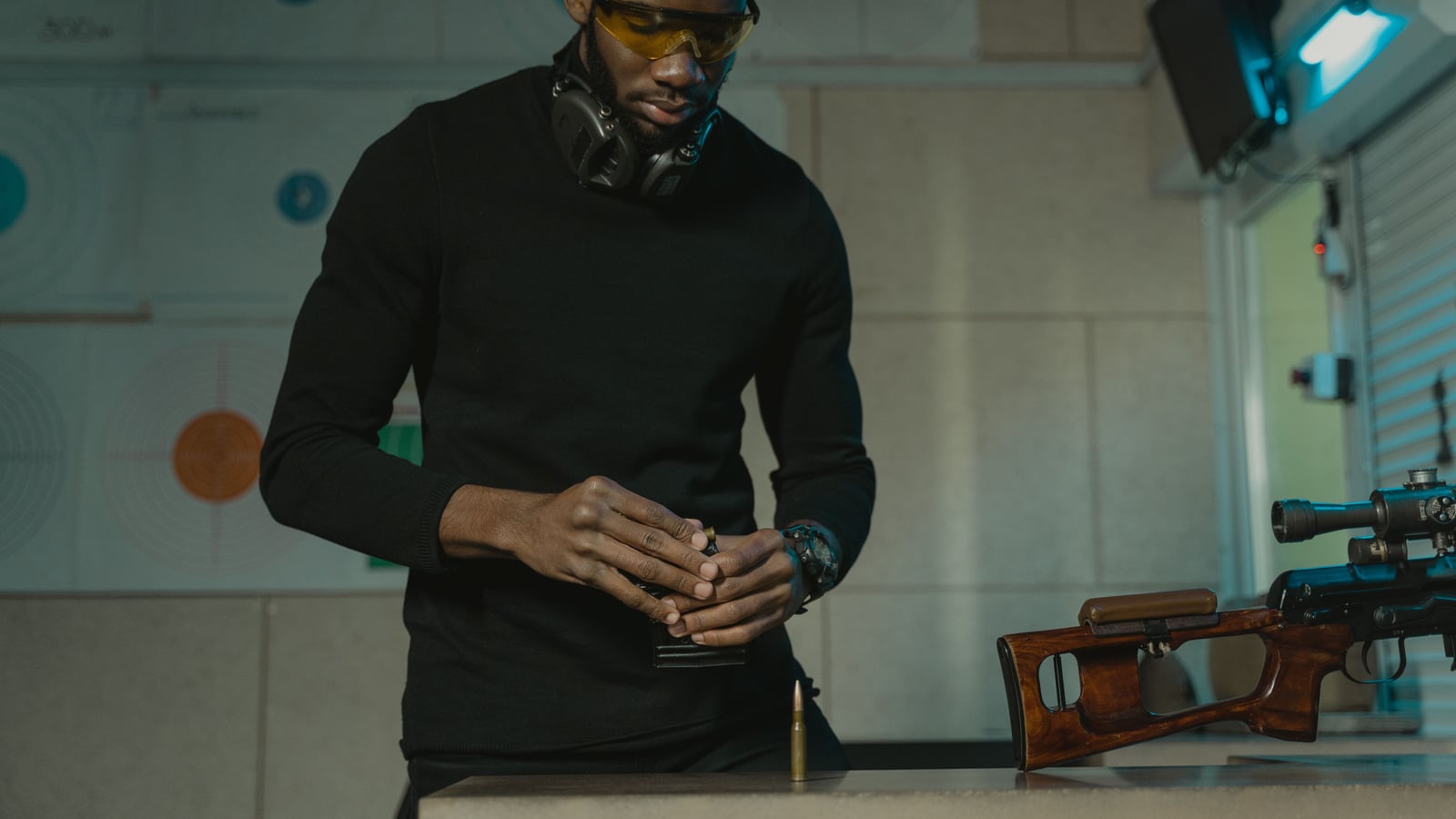
A volunteer role, not a position of authority
The Range Officer (RO) is a licensed shooter who has completed specific training to oversee a dynamic shooting stage. It has nothing to do with an official function tied to an outside profession: it’s a club role, held by volunteers from the club or federation, much like a match referee or a match director.
Any club member who has passed the training can be an RO. On a match weekend, it’s often an experienced shooter who runs a stage in the morning and then shoots on another one himself in the afternoon. This rotation is standard in most IPSC or Steel Challenge clubs: it spreads the workload and prevents the same volunteers from burning out at every match.
The RO has no disciplinary power in the broad sense. His authority is strictly limited to the running of the stage he supervises: he confirms a time, calls a penalty, or stops a run if safety requires it. Any broader dispute goes through the Range Master or the match organizing committee, never through a unilateral decision on the firing line.
Why this position exists
Dynamic shooting involves movement, position changes, and gun handling while in motion — elements that don’t exist in static shooting disciplines. This complexity multiplies the points that need watching: angle of fire, the safety zone in the background, gun handling between two shooting positions.
The RO is there to continuously watch what the shooter, focused on his performance, can’t monitor himself. He checks that every transition respects the safety angle set by the stage designer and that the gun stays pointed at a safe area at all times, including during a reload or a movement.
Without this oversight, a complex stage with several cardboard targets or steel plates spread across a course would quickly become risky. The RO turns a sequence of shots taken on the move into a predictable, controlled activity — which is precisely what allows dynamic shooting to remain a practicable sport at club level.
The concrete responsibilities on a stage
Before the first shooter, the RO walks the stage with the competitor: he reviews the course of fire, the no-shoot zones, the location of cardboard targets and steel plates, and any mandatory gun-handling areas (often called a “safe area” inside the club).
During the run, he positions himself to keep a clear view of the shooter and the backstop, without ever obstructing the shooter’s field of view or movement. He watches for compliance with the angles, the handling of the selector or manual safety depending on the firearm used, and behavior during transitions between targets.
After the last shot, the RO confirms the end of the string, has the shooter show the gun is unloaded in the designated area, then records the time and any penalties before passing the scoresheet on to the match secretary. This final step matters just as much as the observation itself: a transcription error can throw off an entire ranking.
Between shooters, the RO usually takes a short moment to check the overall state of the stage: a slightly shifted cardboard target, a steel plate that has tipped over, or a handling area cluttered with forgotten equipment. This quick check, repeated before every new run, keeps the normal wear of a match day from gradually degrading the course’s safety.
At a sizeable match, several volunteer roles coexist around the RO, and it’s easy to mix them up when starting out. The RO supervises one specific stage, for the duration of a given shooter’s run: his view is local, focused on what’s happening in front of him at that moment. The Range Master (or chief referee, depending on the club’s structure) has an overall view of the match: he settles disputes escalated by ROs, approves stage design before the competition, and remains the final word in case of disagreement over a rule.
There are also secondary roles depending on match size: the statistician who centralizes scores from all stages, the match director who handles the day’s logistics, and sometimes a cross-cutting safety officer overseeing the entire range. These functions often overlap in small clubs, where a handful of volunteers wear several hats on the same day, whereas they’re clearly separated at larger regional matches. This split mainly serves to clarify who decides what, so two volunteers don’t contradict each other in front of a shooter.
Standardized verbal commands
Dynamic shooting runs on a deliberately limited set of fixed commands, repeated identically on every stage. This standardization removes any ambiguity between the RO and the shooter, regardless of the club or region hosting the match.
- “Is the range ready?” (check before the string begins)
- “Load and make ready” or an equivalent announcement authorizing the start of the string
- The audible signal from the electronic shot timer that officially marks the start
- “Stop”, used immediately in case of a safety issue, a malfunction, or a boundary violation
- “Unload and show clear” at the end of the course
- “Chamber clear” followed by “Hammer down” (or “Close”) to close out the gun-check sequence
These phrases are deliberately short and leave no room for ambiguity. An RO must never improvise a different command: standardization is what lets a shooter react by reflex, without having to interpret an unfamiliar sentence under match-day pressure.
The word “Stop” carries absolute weight: as soon as it’s spoken, the shooter must cease all firing and wait for the RO’s instructions before making any other move. This rule overrides everything else, including the shooter’s wish to finish the stage.
This standardization fully proves its worth as soon as a shooter travels from one club to another, or enters a regional match where he meets ROs he’s never seen before. Because the commands are identical everywhere, he doesn’t need to readjust to a local vocabulary: the same reflex works at whatever range he sets his bag down. It’s one of the reasons the sport remains practicable at scale, including at inter-club gatherings organized occasionally throughout the year.
An RO also doesn’t adjust his tone or wording based on how nervous a shooter appears. Some beginners expect a more reassuring, more talkative approach on their first competition stage, but the consistency of the protocol takes precedence over that temptation: it guarantees that every shooter, regardless of experience level, gets exactly the same audible cues to stay oriented in the sequence.
Handling malfunctions during a stage
A malfunction (a jam, a round that fails to fire, a dropped magazine) is part of everyday life in dynamic shooting. The RO’s job is to assess in a split second whether the malfunction poses a safety risk or is simply a performance issue for the shooter to handle himself.
If the gun stays pointed at a safe area and the shooter clears a routine malfunction on his own, the RO generally doesn’t step in: coaching during a stage isn’t his job. But if the gun’s orientation becomes dangerous, if the gun is dropped, or if there’s any doubt about the state of the chamber, an immediate stop is the rule.
After a safety stop, the protocol calls for a supervised restart: checking the state of the gun, the magazine, the shooter’s position, then authorizing resumption from a point defined by the stage rules. An experienced club shooter generally knows that a mishandled restart can cost a disqualification, which is why it pays to stay calm and follow the RO’s instructions without arguing in the moment.
Some situations go beyond a single shooter’s run and require the RO to suspend activity on an entire stage, not just for the current competitor. A sudden change in weather conditions, a steel plate that unexpectedly shifts outside its zone, or an unauthorized person entering a safety area are typical examples. In that case, the RO issues a general stop order, has every gun on the affected line made safe, and waits until the situation is resolved before authorizing any resumption.
This kind of blanket stop remains rare in the day-to-day life of a well-run club, but RO training spends time on it precisely because the rarity of the situation must never translate into hesitation when it actually happens. Communication with other volunteers present (other ROs, match staff, the match secretary) is also part of this broader protocol: a general stop is passed quickly to the whole organizing team so the match resumes in a coordinated way.
What the RO doesn’t do
The RO is not a coach and gives no technical advice during a run, whether on aiming, pace, or movement strategy. His role is limited to safety and procedural compliance, never to improving the observed shooter’s performance.
He also doesn’t decide alone on disciplinary sanctions in cases of repeated problematic behavior: that kind of decision goes up to the organizing committee or the club’s board. The RO reports and documents, but never disqualifies or ejects anyone on his own initiative.
Finally, the RO never substitutes his own judgment for the stage rules or the discipline’s rulebook. If he notices an ambiguity in a stage’s design, he passes the information up to the Range Master or the stage designer rather than improvising a personal interpretation on the line.
The RO also has no authority over the equipment or caliber choices a shooter makes, as long as they comply with the rules of the division they’re entered in and the relevant firearms regulations for the gun they own. He doesn’t check the shooter’s administrative compliance (license validity, authorization from local authorities where applicable): that check falls to match organization beforehand, not to the RO at the stage.
The training required to become an RO
Becoming a Range Officer requires completing a dedicated training course, generally organized at club, regional league, or federation level depending on the discipline. The content covers the theory of verbal commands, the safety rules specific to dynamic shooting, and practical scenarios on a real stage.
The training places particular emphasis on reading safety angles, managing gun-handling areas, and the ability to spot risky situations early, before they turn into an incident. A good part of the work happens through supervised observation: an RO candidate first assists alongside an experienced RO before being certified to work solo.
The exact prerequisites (how long you’ve held your license, how many matches you’ve observed, a written exam) vary by club and federation. It’s best to check directly with your own club or league to find out the training path that applies locally, rather than relying on a general rule that can differ from one organization to another.
Theory alone is never enough to certify an RO candidate. Most training programs require a real hands-on evaluation, assessed by an experienced RO or an authorized instructor, before any final certification. This practical step verifies that the candidate can actually apply the commands and positioning learned in the classroom once faced with the noise, pace, and real pressure of a stage in progress.
Once trained, an RO isn’t locked into that role forever: many go on to become chief referees or stage designers, while others prefer to remain occasional ROs alongside their own shooting.
Many license holders see this training as reserved for club volunteers who are deeply invested in organizing matches, but the value goes well beyond that circle. A shooter who has completed it anticipates the danger areas of a new stage better, because he’s learned to read it with the same reflexes as a safety officer rather than with performance as the sole goal. This dual reading, technical and safety-minded, mechanically lowers the risk of committing a procedural error himself at a match.
It’s also a concrete way to give back to the club what dynamic shooting owes it. A club can only run regular matches if enough license holders agree, at least occasionally, to set aside their own shooting to oversee everyone else’s. A broad rotation among many occasional ROs, rather than a handful of volunteers systematically carrying that load, keeps a club’s community life healthier over time.
Training as an RO also gives a better understanding of certain officiating calls that can seem strict or even arbitrary from the firing line as a competitor. Once trained, a shooter realizes just how much every command, every positioning choice, and every penalty follows a safety logic thought through in advance, rather than a mechanical, disconnected-from-reality application.
Some clubs even offer a progressive training path, where a young license holder starts by passively watching a few stages alongside an experienced RO before taking the full theoretical training. This step-by-step approach avoids rushing a shooter who doesn’t yet have the confidence needed to run a stage alone, while familiarizing him early with the expected reflexes.
RO and shooter: a relationship of mutual trust
A good RO stays unobtrusive. His presence reassures without weighing on the shooter’s concentration: he positions himself to see without getting in the way, speaks little, and only when necessary. This discretion is learned with experience and separates a seasoned RO from a beginner still hesitant about his positioning.
On the shooter’s side, the relationship rests on immediately accepting the RO’s calls, even when there’s disagreement in the moment. Challenging a penalty happens after the stage, calmly, following the appeal procedure set out in the match rules — never by arguing on the line while other shooters wait their turn.
This mutual trust is what allows a match to run smoothly across an entire day, sometimes with several dozen shooters and a handful of ROs rotating between the different stages. A club where this relationship works well generally sees fewer tensions and more volunteers willing to get trained in turn.
A new RO often tends to over-communicate, piling on remarks during a stage when silence is the norm as long as no safety issue arises. This habit, well-intentioned as it is, can disrupt the shooter’s concentration without adding any real value to the course’s safety.
Another classic mistake concerns physical positioning: a beginner RO sometimes stands too far from the shooter out of excessive caution, which keeps him from seeing an important detail, or conversely too close, which can get in the way during a wide movement on a complex stage. Timing verbal commands also often causes trouble at first: announcing the end of the stage too early, or conversely being slow to step in when a safety call should have come immediately. This sense of timing is only built through repeated practice.
Finally, some beginners hesitate to stop a shooter for fear of creating social awkwardness, especially when the shooter is a friend or a well-known club member. That hesitation is exactly what training aims to correct first: safety always comes before relational comfort.
Getting involved as an RO: an investment in the club
A dynamic shooting club that lacks trained ROs mechanically limits the number of matches it can run, or stretches out competition days for lack of enough staff to run several stages in parallel. Training as an RO is therefore a direct service to your own shooting community.
It’s also a different way to experience the sport: watching dozens of shooters on the same stage teaches an enormous amount about stress management, recurring safety mistakes, and the variety of tactical approaches to a course. Many ROs report improving as shooters themselves because of what they observe while overseeing others.
Finally, volunteering as an RO strengthens a club’s community fabric: it’s a role passed down, learned by walking alongside a veteran, and it gives a concrete look at everything happening behind the scenes so a match can run without incident.
Some clubs explicitly recognize this commitment, for instance by giving priority access to certain training slots to their most active volunteers, or by publicly tracking how many matches each person has staffed over the season. This kind of recognition, not mandatory but common, encourages a broader rotation among license holders rather than reliance on a handful of long-standing volunteers.
Positioning and reading a stage: the RO’s quiet skill
The hardest skill for an RO to acquire isn’t memorizing the verbal commands, but the physical positioning during a run. A poorly positioned RO loses sight of part of the stage at a critical moment, or worse, ends up in an area the shooter still needs to move through.
The basic principle is to always stay slightly behind and to the side of the shooter, never in front, never in his line of movement. On a stage with multiple shooting positions, the RO anticipates the shooter’s next move so he can reposition ahead of him, without ever getting ahead of the shooter into an area he still has to cross.
This anticipation is learned by walking the stage several times before shooting begins, mentally visualizing every transition and every angle. An experienced RO knows the stage almost as well as the shooter does, which lets him react before a problem arises rather than simply noting it after the fact.
This positioning also adjusts based on the size of the stage and the number of ROs present at once on the same course. On the longest stages, it’s not uncommon for two ROs to split the supervision, each covering a portion of the layout, coordinating silently through gestures or a brief exchanged glance at the handoff between their respective zones.
Reading the backstop is an integral part of this work: the RO constantly keeps in mind what’s behind each cardboard target or steel plate, so he can immediately spot if an angle of fire drifts toward an area not accounted for in the course design.
The briefing the RO gives the shooter before his run is another pivotal moment, even though it sometimes lasts only a few dozen seconds. An effective briefing follows a simple, repeated structure: a reminder of the start position, the order of engagement for the targets, the mandatory gun-handling areas, and any specific features of the stage such as a trap door, an obstacle, or a constrained shooting position.
This moment also serves to check that the shooter has genuinely understood the stage design, not just listened passively. An experienced RO sometimes asks a short question to confirm understanding, particularly on a safety point that has caused confusion for other shooters earlier in the day. A rushed briefing multiplies the risk of a procedural error; an overly long one tires the shooter’s attention right before a moment demanding maximum focus.
Steel Challenge and IPSC: two different officiating rhythms
The RO’s role isn’t experienced quite the same way across dynamic shooting disciplines. In Steel Challenge, stages are short, repetitive, with a fixed number of steel plates and a mandated order of engagement. The RO develops an almost metronomic rhythm here, with many quick rotations through the day and a timing system that leaves little room for improvisation.
In IPSC, stages are longer, often unique from one match to the next, with complex movement and a number of cardboard targets that varies according to the designer’s layout. The RO spends more time per shooter here, with a heavier cognitive load: he has to follow a different scenario on every new run rather than repeating an identical pattern.
This difference also shapes initial training: an RO who starts out solely in Steel Challenge quickly masters the fundamentals thanks to the repetition of the same stage type, while an IPSC RO needs to develop, more quickly, the ability to read a new course he’s never seen before match day.
Some clubs offer both disciplines under the same roof, letting ROs move between the two formats and broaden their experience. Others stay specialized in one discipline, depending on the club’s historical focus or its members’ preferences.
The basic verbal commands stay identical across both disciplines, which eases an RO’s transition from one to the other. What mainly changes is the rhythm of vigilance required: brief but repeated attention in Steel Challenge, versus sustained but rarer attention in IPSC. A club that trains its ROs across both formats gains flexibility in organizing its match days, without having to double up its volunteer teams depending on the day’s discipline.
The RO’s gear and his own working tools
The dynamic RO doesn’t shoot while officiating, but he needs equipment specific to his role. The electronic shot timer is the central tool: it picks up the audible start signal, measures the shooter’s time from first to last shot, and helps detect any false starts.
A scoresheet or a digital tablet, depending on the match’s setup, is used to log penalties, final time, and any notes on how the stage went. Many clubs have digitized this step with dedicated apps that send results straight to the overall standings, cutting down on manual transcription errors.
The RO’s hearing and eye protection follow the same requirements as for any other shooter or spectator on the line: they’re mandatory for the entire time a firearm might be handled nearby, even for someone not shooting at that exact moment.
Some ROs also use a personal notebook or a notes app to keep track of recurring observations about a given stage, useful for a debrief with the course designer or to improve safety at a future run of the same match.
The type of targets used also directly shapes what the RO needs to watch for. Cardboard targets, often mounted upright on stands, can tip over or shift slightly from wind or a previous shot, sometimes changing the exact angle the shooter needs to take. Steel plates raise a different issue: ricochet risk. The RO checks beforehand that the distance and angle relative to the shooter meet the club’s safety guidelines, and stays alert for any sign of wear or deformation on a plate — a damaged plate is pulled from the course without waiting for the end of the stage.
Finally, the RO monitors the order in which targets are engaged, which must match the layout intended by the stage designer. A shooter who engages targets out of the prescribed order isn’t necessarily at fault from a safety standpoint, but it can trigger a procedural penalty that the RO must note precisely, independent of the timed performance.
Mental load, on-site spectators, and continuous safety improvement
Officiating as an RO demands sustained concentration over several hours, often running through many shooters back to back. Attention fatigue is a real risk: a tired RO relaxes his vigilance on the finer details of a safety angle, precisely when errors become possible.
Most clubs organize regular rotations between ROs over the course of a day, with mandated breaks rather than ones left to individual judgment. An RO who feels his focus slipping should be able to say so without it being seen as a lack of commitment to the club.
Stress management is also part of the role, especially during a real incident when a fast decision has to be made without absolute certainty about the outcome. An experienced instructor often passes this know-how down informally to new ROs, sharing his own experience with tricky situations handled in the past.
This human dimension of the job explains why training is never limited to rule theory alone: the ability to stay calm, clear, and firm in verbal communication during a tense situation matters at least as much as knowing the rulebook.
A dynamic shooting match often draws spectators: shooters’ families, club-curious visitors, or members who simply came to watch that day without competing. The RO isn’t only responsible for the active shooter; he also has to make sure the audience stays within the designated areas, out of any possible line of fire. A child who gets too close to the shooting area, a spectator crossing an aisle at the wrong moment, or a leashed dog getting restless near the line are all situations the RO has to anticipate on top of his main role.
In practice, most clubs clearly mark off spectator areas with visual boundaries (caution tape, cones, signage) to limit how much verbal intervention the RO needs during a stage. But signage never fully replaces human vigilance, especially at matches open to the public where crowds can be harder to manage than on an ordinary training day among license holders. An RO who spots spectators in a risky position doesn’t hesitate to briefly pause the shooter’s preparation until the people concerned back away.
Beyond match day, experienced ROs often contribute indirectly to a club’s ongoing safety improvement. Their feedback after a stage, whether it went smoothly or revealed a design flaw, feeds into board or technical committee discussions about designing future courses.
A stage that produces several minor incidents on the same day, even without serious consequences, is a signal that its design deserves review before its next use. This feedback usually travels from the RO who officiated it to the stage designer or the Range Master, who then adjusts the layout, a target’s angle, or the position of a gun-handling area.
This informal but valuable feedback loop explains why many clubs value their ROs’ accumulated experience when evolving their own internal safety standards, sometimes beyond the minimum required by federal rules. A club that listens to its ROs generally progresses faster than one that treats the role as a mere administrative formality on match day.
This collective dimension is a reminder that the RO’s role doesn’t stop at the timer and the verbal commands: it’s also, over time, an active contribution to the safety culture of an entire club and of dynamic shooting as a whole.
A club that documents this feedback, even informally in a shared report after each match, gradually builds a collective memory useful to its future stage designers. An experienced instructor who has seen several seasons of RO feedback often spots recurring patterns that an isolated designer wouldn’t have caught alone, improving the safety of the club’s entire match calendar over time.
FAQ
Q: Does the Range Officer have any connection to law enforcement or the military? A: No, absolutely none. It’s a civilian volunteer role internal to the club or the shooting sports federation, open to any license holder who has completed the dedicated training.
Q: Can an RO shoot himself during the same match? A: Yes, it’s even common practice. An RO officiates on certain stages and then shoots his own run on other slots, depending on how the club organizes the day.
Q: What happens if the RO yells “Stop” during my run? A: You must immediately cease all firing and offensive movement, keep the gun pointed in a safe direction, and wait for the RO’s instructions before resuming or finishing the end-of-stage procedure.
Q: How long does it take to become an RO? A: It varies by club and federation: training generally combines a theoretical part with a supervised hands-on evaluation, but the exact duration and prerequisites depend on the organization running it.
Q: Can you appeal a penalty given by an RO? A: Yes, through the appeal procedure set out in the match rules, usually handled after the stage with the Range Master or the organizing committee — never by arguing it out on the line.