
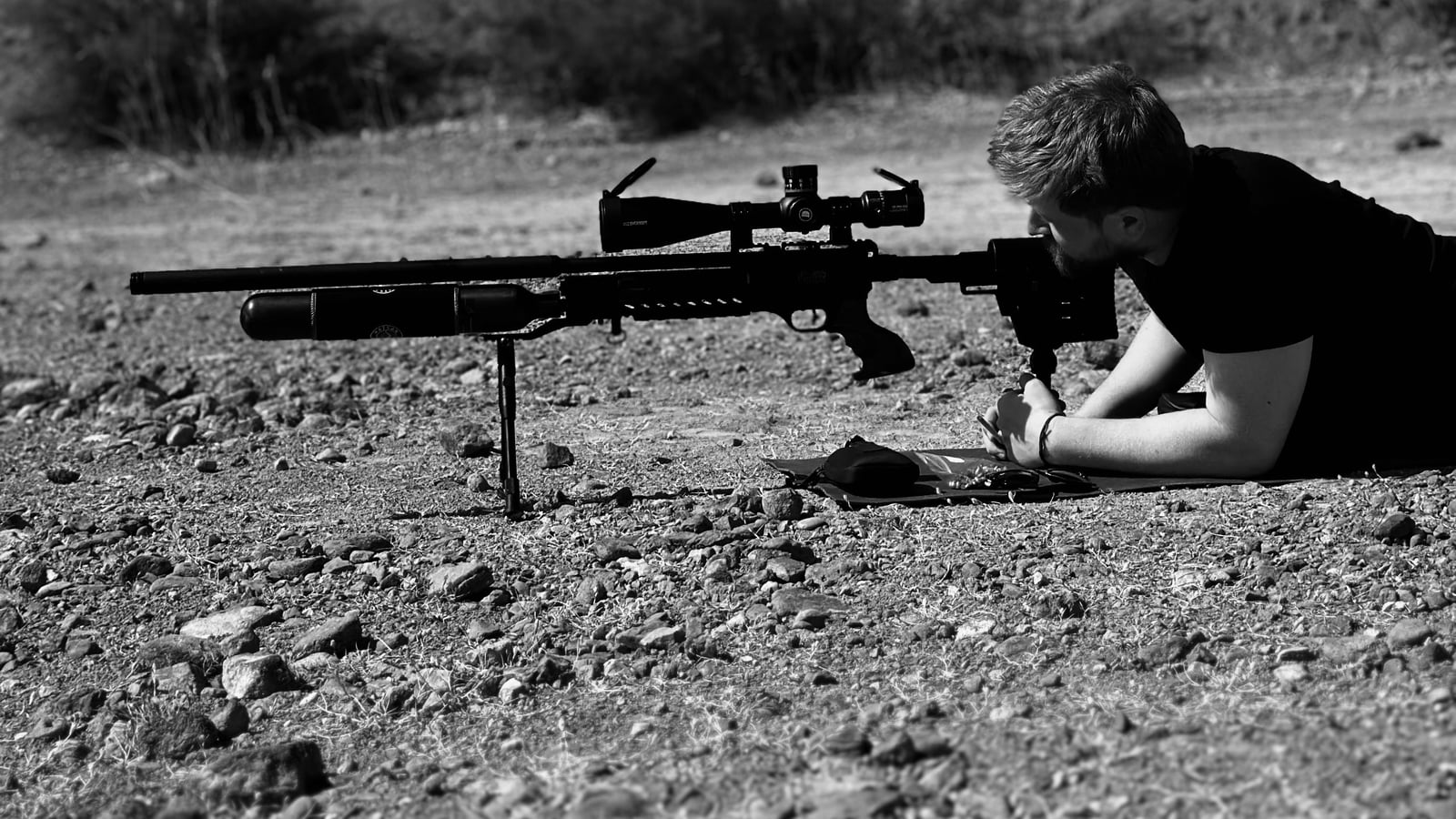
Two schools, one shared passion for long range
PRS and TLD share the same playing field: hitting far targets consistently, despite wind, changing light, and the fatigue that creeps in over a long session. Beyond that common ground, these are two worlds that grew up separately, with different rules, different gear, and a different club culture.
PRS (Precision Rifle Series) was born in the United States within a very “field”-oriented civilian sport-shooting scene: varied courses, improvised positions, gear that evolves from one stage to the next. TLD (Tir Longue Distance), as practiced in France under the FFTir, sits within a more standardized federal framework, with defined equipment categories and more stable match formats.
Any shooter starting out with a precision rifle inevitably hears about both. American PRS videos circulate widely, French clubs organize TLD matches, and confusion between the two is common among people who have practiced neither. This article breaks down the origins, formats, allowed gear, required skills, and the practical way to move from one discipline to the other.
The goal isn’t to declare one discipline “superior.” Both demand real technical mastery, a thoughtful gear investment, and a level of training consistency that few shooting disciplines require. The choice mostly comes down to what’s available at your club, your budget, and the competition style that genuinely motivates you.
This comparative read is aimed both at the shooter who already practices one of the two disciplines and wants to understand the other out of curiosity, and at someone who has never shot long range and is hesitating over which door to walk through. Either way, understanding the respective logic of PRS and TLD saves you from a lot of gear disappointment and poorly calibrated expectations before your first competition.
Origins of PRS: a discipline born on American ground
PRS took shape in the United States out of the “field” precision-shooting culture: matches organized on private land or ranches, with steel targets placed at variable distances, often unknown to the shooter before the stage begins. The founding idea was to reproduce realistic shooting conditions rather than standardized range conditions.
This origin explains much of PRS’s current philosophy: matches unfold across a wide variety of “stages” (shooting scenarios) where the shooter must adapt to unusual positions (a window ledge, a shooting bag resting on an obstacle, a braced standing position) rather than systematically firing prone off a bipod. Scoring is generally cumulative across an entire multi-stage match.
PRS then spread well beyond the United States, with national circuits in several countries and an individual ranking system that follows the shooter from match to match over a season. This international spread explains why more and more French shooters take part in it or draw inspiration from it, even without an equivalent federal structure in France.
Gear evolved alongside the discipline: adjustable stocks with multiple points of adjustment, high-magnification scopes with reticles designed for fast correction calculations, pivoting bipods, multiple shooting bags carried in a technical backpack. PRS has heavily influenced the look and equipment of modern precision shooting, well beyond its own circuit.
This “field” culture also shaped a particular approach to match difficulty: rather than simply increasing distance to make a stage harder, PRS stage designers combine several constraints at once, such as an uncomfortable position paired with a very short time limit and a partially obscured target. This “problem to solve” logic remains the discipline’s most recognizable signature, far more than distance alone.
FFTir’s TLD framework: a structured federal discipline
In France, TLD sits within the framework of the Fédération Française de Tir. That means written, stable regulations, equipment categories defined in advance, and a competition calendar that follows a federal season logic with regional and national rankings.
This federal structure has a direct effect on practice: the TLD shooter knows exactly which equipment category they compete in, what the limits are for their scope, rifle, or ammunition, and this from the moment they join a club. The rules change little from one season to the next, which favors structured, predictable progression.
TLD matches most often take place at distances known in advance or announced before each string, with prepared firing points and often fixed installations belonging to the club or the national range. This predictability contrasts with PRS’s unknown-terrain logic and shapes a different style of preparation: the TLD shooter works hard on consistency at distances they know, rather than on rapid adaptation to the unknown.
TLD also benefits from the classic support structure of FFTir clubs: certified instructors, progression paths with badges or levels, and a mandatory federal license that covers insurance and access to official competitions. It’s a reassuring framework for a beginner, with more institutionalized human support than a more independently organized PRS circuit.
This federal structure also has an effect on collective safety: range commands, safety zones, procedures for changing strings, and weapon-checking procedures are harmonized from club to club across the country. A shooter who changes FFTir clubs after moving finds familiar landmarks again, which greatly eases the continuity of their practice and their federal progression.
Competition format: dynamic course versus standardized string
The most visible difference between the two disciplines is how a match unfolds. In PRS, a competition spans a full day or an entire weekend, broken into about a dozen different stages, each with its own scenario: number of targets, distances, allotted time, mandatory or free shooting position.
The clock is ever-present in PRS. Each stage imposes a limited time (often between 60 and 150 seconds depending on the number of targets), forcing the shooter to manage their firing pace, transitions between positions, and stress just as much as their ballistics. It’s a discipline that blends pure precision with time management.
In TLD, the format is closer to a classic sport-shooting string: a set number of rounds to fire at a given distance, within a generally more comfortable time frame, scored on the precision of the group or impact. Time pressure exists, but it stays secondary to the sheer quality of the shot.
This difference in pace completely changes the match experience. PRS demands physical and mental management of the sequence (breathing, moving between stations, quickly switching parallax or magnification on the scope), while TLD rewards sustained focus and the careful setup of a deliberate shot, with no rush to move.
The number of competitors and the logistical organization of a day also differ. A PRS match generally mobilizes teams of range officers at each stage, with squads rotating throughout the day, requiring organization close to that of a full outdoor sporting event. A TLD competition, with its fixed firing points, is more often organized around a single range where shooters take turns in relays, logistics closer to classic federal sport-shooting competitions.
Distances and target types
The distances worked overlap heavily between the two disciplines, generally from 100 to over 1000 meters depending on level and stage or string, but the way they’re presented differs. In PRS, distances are often announced just before the stage, sometimes estimated by the shooter themselves using a rangefinder, which adds a distance-measurement skill to the exercise.
In federal TLD, string distances are generally known in advance in the competition rules, allowing for finer ballistic preparation ahead of time (pre-calculated correction tables, scope settings anticipated for each distance of the day).
Targets used in both disciplines are overwhelmingly steel plates or cardboard targets with scoring zones, never a human silhouette. Some PRS stages use stylized metal animal silhouettes (generic shapes, no human representation) to vary aiming difficulty, a practice also found in some FFTir club events.
Impact feedback also differs: a steel plate in PRS gives immediate audible and visual feedback that allows for quick follow-up shots, whereas a TLD cardboard target often requires a delayed score check, at the end of the string or via a dedicated spotting scope. This seemingly minor detail heavily influences the training rhythm of each discipline.
Allowed equipment: two category logics
PRS operates with equipment divisions that evolve regularly depending on the organization running the circuit, generally based on the weight of the rifle-and-gear setup and sometimes on caliber or action type. These divisions allow a shooter on a modest budget to compete in a category where they aren’t crushed by top-of-the-line equipment.
TLD, within its federal framework, defines its equipment categories more stably from season to season: stock type, maximum scope magnification, weight limit, sometimes an allowed caliber depending on the event. This regulatory stability makes it easier to plan purchases over several years, without fear that a rule change will make equipment obsolete overnight.
Legally in France, a long-range precision rifle most often falls under Category C (declaration) for the manual-repeater rifles typical of both disciplines, or Category B (prefectural authorization) for certain semi-automatic models used more rarely in this context. The exact classification always depends on the specific model rather than the discipline alone: always check with your gunsmith or federation before any purchase.
Scopes used in both disciplines are technically comparable (high magnification, graduated reticle, exposed adjustment turrets), but reticle choice sometimes differs depending on circuit or club habits: some PRS shooters favor a highly detailed mil reticle for fast correction calculations in timed matches, while some TLD shooters use more classic reticles suited to a deliberate, unhurried shot. This choice remains mostly personal and evolves with experience.
Ammunition and reloading: a practice common to both disciplines
Reloading ammunition holds an important place in both disciplines, for similar reasons: achieving ballistic consistency superior to what commercial ammunition offers, and controlling budget over a significant training volume. A PRS shooter, like a TLD shooter, generally invests in this skill as soon as they take the discipline seriously.
The difference lies mainly in the preferred caliber depending on context. PRS sees a wide diversity of modern calibers optimized for long range, with popular choices evolving quickly according to circuit trends. Federal TLD tends to stay more conservative in the calibers commonly used in clubs, partly because availability at French gun shops and the regulatory framework weigh more heavily on that choice.
In both cases, reloading rigor (precise powder weighing, bullet inspection, muzzle velocity measurement with a chronograph) remains the factor that separates a consistent shooter from one who plateaus. Neither discipline forgives inconsistent ammunition beyond a few hundred meters.
A reassuring common point for anyone torn between the two: the reloading and ballistics knowledge built for one discipline remains almost entirely transferable to the other. It’s not wasted time if you switch disciplines along the way.
Technical skills required by each discipline
PRS heavily calls on the ability to adapt quickly: changing position in a few seconds, stabilizing a weapon on an unstable or improvised rest, managing breathing and heart rate after physically moving between firing points. It’s a discipline that brings precision shooting close to an almost athletic practice.
TLD places more value on consistency over time: maintaining a stable, reproducible position over a large number of shots, managing concentration fatigue over a long string, refining a scope setting with the time needed to make the most of it. It’s a discipline that rewards patience and repeatability of movement.
Reading the wind remains a central skill in both disciplines, but it plays out differently. In PRS, you often have to read the wind quickly, with little time to observe flags or vegetation before shooting. In TLD, the available time generally allows for a calmer read of conditions before each shot, which favors a more methodical learning of this skill for a beginner.
Mental stress management also differs significantly: PRS adds performance stress from the clock in front of watching competitors, while TLD tends to generate stress from prolonged concentration instead. A shooter coming from a calm discipline like fixed-target shooting will often adapt more easily to TLD, while a shooter coming from a dynamic discipline like IPSC will find familiar footing in PRS.
General physical condition also comes into play unevenly depending on the discipline. A PRS shooter benefits from core and joint-mobility work to hold uncomfortable positions without shaking, somewhat like an endurance athlete would train posture before a long event. A TLD shooter benefits more from specific breath-control and targeted muscle-relaxation work, useful for holding a stable prone position throughout an entire string without stray fatigue disrupting the shot.
Progression and club access: two different paths
Access to TLD in France generally goes through an FFTir-affiliated club, with a federal license, a training path supervised by certified instructors, and often progression tiers before access to official competitions. It’s an institutionalized path, reassuring for a beginner looking for a clear framework.
Access to PRS, outside major international competitions, often happens through clubs or associations that organize local matches inspired by the format, sometimes outside the strict federal framework, or through ranges that occasionally host this type of event. Support structure varies more from club to club, with greater weight given to self-teaching through practitioner communities.
Entry cost also differs. PRS, with its often-renewed gear and demanding technical divisions at the top of the leaderboard, can represent a heavier initial investment to compete at a higher level, even though entry-level divisions exist to limit that barrier. TLD, with its more stable equipment categories, often allows progression with gear bought once and kept over several seasons.
In both cases, the advice that consistently comes from experienced instructors stays the same: don’t invest in top-of-the-line gear before confirming, over several supervised sessions, that the discipline genuinely fits your practice and your motivation. Well-adjusted entry-level equipment teaches more than a poorly mastered premium rifle.
Moving from TLD to PRS: what actually changes
An accomplished TLD shooter discovering PRS quickly finds their ballistic footing again: wind reading, correction calculation, and scope-adjustment management are directly transferable skills. What changes is the required execution speed and the variety of positions to master.
The first concrete adjustment concerns carrying gear: a technical backpack with several extra shooting bags, a bipod that can pivot quickly, a stock adjustable enough to adapt to unconventional positions. TLD gear, often designed for a fixed firing point, isn’t always optimal as-is for a mobile PRS stage.
The second adjustment concerns training itself: you need to specifically work on transitions between positions, timed shooting, and quickly building a stable support point on varied rests (a ledge, a bag, a simulated tree trunk). This is different work from repeating a classic deliberate shot, and it often requires a few dedicated sessions before the first competition.
The third adjustment is mental: accepting a slightly less “perfect” shot in the moment in favor of overall speed through the stage. A TLD shooter used to polishing every shot has to learn to let go of some of that standard to gain fluidity, which requires a real shift in mindset during a match.
One last point deserves anticipation: discovering the terrain on match day itself. A TLD shooter used to knowing their distance and position in advance has to learn to quickly read a new environment, spot available rests, and estimate wind conditions without the usual preparation. It’s often this last point, more than pure technique, that takes the most matches before feeling truly comfortable.
Moving from PRS to TLD: what actually changes
The reverse path is just as workable. A PRS shooter joining an FFTir club to practice TLD must first get familiar with the federal regulatory framework: precise equipment categories, club safety procedures, license and competition registration format. It’s as much an administrative adaptation as a technical one.
On the technical side, the main adjustment concerns patience of movement. A PRS shooter, used to the urgency of the clock, must relearn to slow down: carefully setting up, checking every parameter before the shot, accepting a calmer string pace where each shot’s individual precision takes priority over quick succession.
Equipment also requires readjustment: a setup optimized for PRS mobility (lightweight stock, versatile bipod) isn’t necessarily the best performer for a deliberate TLD string, where a heavier, more stable setup can bring a real advantage in group consistency.
Finally, integrating into an FFTir club requires investing in the collective life of the organization: regular supervised training, respecting shared time slots and safety rules, participating in internal competitions before regional events. It’s a social and institutional dimension that the more independent PRS circuit sometimes calls for less directly.
A PRS shooter arriving at an FFTir club also benefits from rethinking their approach to shooting in a group. PRS is often practiced in small squads progressing together through the same stage, in a fairly convivial, chatty atmosphere, whereas a TLD string at a club demands more silence and individual concentration on the firing line, with strict respect for turn-taking among shooters.
Budget and investment: comparing the two disciplines honestly
The entry budget for both disciplines depends enormously on the level targeted and equipment already owned, which makes any precise numerical comparison fragile. It’s more honest to say both disciplines can start with reasonable equipment and grow into a substantial investment depending on the shooter’s competitive ambition.
TLD, thanks to its stable federal framework, often allows equipment to be amortized over several seasons without fear of quick regulatory obsolescence. That’s an argument for simpler long-term budget planning for a shooter starting out with limited means.
PRS, with its equipment divisions evolving according to the circuits, can require more frequent gear renewal to stay competitive in upper categories, even though entry divisions remain accessible on a modest budget. Ammunition consumed in large volume during training (reloading or bulk purchase) remains, in both disciplines, an expense line that’s often heavier over time than the initial rifle purchase.
The general advice that comes up in both communities stays the same: it’s better to rent or borrow gear for one or two trial sessions before any purchase, and to talk with experienced club shooters to calibrate a realistic budget for your situation, rather than trusting a figure presented as universal on a forum.
Ancillary costs also deserve anticipation in both disciplines: travel to matches, which can mean significant distances depending on the density of clubs or organizers in your region, competition entry fees, and regular upkeep of optical and mechanical gear. These recurring costs, often underestimated at the time of the initial purchase, ultimately weigh as much as the initial gear investment over a full season of regular practice.
Ancillary gear: what the match bag reveals
Watching a shooter’s bag before a match often says more than any rulebook. A PRS practitioner generally carries a compartmentalized backpack with several shooting bags of different sizes, a cloth or foldable ground mat, a rangefinder within easy reach, and sometimes a small portable weather station to refine wind reading between stages.
The TLD shooter, on the other hand, more often arrives with a rigid transport case, a dedicated shooting mat set up once for the duration of the string, a spotting scope mounted on a tripod to track their own impacts, and a shooting log where they record their settings by distance. This difference in gear organization directly reflects the pace of each discipline: constant mobility on one side, stable setup on the other.
The chronograph holds a similar place in both practices, but at different moments in the training cycle. The PRS shooter mainly uses it upstream, during reloading sessions, to validate a load before bringing it to a match. The TLD shooter sometimes uses it directly at the club range, especially during group sessions where several shooters compare their muzzle velocities over the same reference distance.
Hearing and eye protection remain identical in both disciplines and allow no compromise: headset or plugs suited to repeated use over the day, impact-resistant shooting glasses. A PRS stage running through several dozen rounds within the same hour taxes hearing almost as much as a long TLD string spread over an afternoon.
The shooting log, whether kept on paper or through a dedicated app, remains the most underrated accessory in both disciplines. Systematically recording the ammunition used, scope settings by distance, observed wind conditions, and the result obtained lets you build, session after session, a personal database far more useful than any generic advice picked up online. This is often what distinguishes, in the medium term, a shooter who’s improving from one who’s stagnating despite a comparable training volume.
Dry-fire training and mental preparation between sessions
Dry-fire work, without ammunition, holds a central place in both disciplines, but with different goals. A PRS shooter mainly uses it to automate transitions between positions: moving from a standing rest to a bag rest in a few seconds, without the manipulation of the weapon disrupting the aim.
A TLD shooter uses dry-fire work more to refine the consistency of trigger release and breath management in a prolonged motionless position. The goal isn’t speed but the perfect repeatability of the same movement, session after session, until it becomes nearly automatic.
Mental preparation differs along the same lines. A PRS shooter often benefits from mentally visualizing the complete sequence of a stage before shooting it, somewhat like an athlete from a dynamic discipline rehearsing a course before the real event. A TLD shooter, meanwhile, gains more from working on managing weariness and lapses of attention over a long string, a mental challenge quite different from managing the momentary stress of a timed stage.
An experienced instructor generally recommends not neglecting this preparation away from the firing line, whatever discipline you choose: the amount of ammunition fired at the club never replaces the underlying work on movement and concentration, which costs only time and can even be practiced at home in a safe space, with no loaded weapon.
Choosing your discipline based on your shooter personality
The choice between PRS and TLD benefits from being based on what genuinely motivates the shooter, more than simple trends or social-media influence. If you like the idea of solving a different problem at each stage, moving physically during a match, and accepting a degree of unpredictability in how the competition unfolds, PRS probably suits your profile better.
If, on the other hand, you prefer the rigor of a stable framework, the satisfaction of a movement repeated and refined over time, and the support of a federal club with clear progression tiers, TLD will probably suit you better. Neither profile is better than the other: they’re two different shooter temperaments, equally legitimate.
Many experienced shooters actually practice both disciplines in parallel, each feeding the other: TLD’s ballistic rigor strengthens individual shot precision in PRS, while the variety of positions worked in PRS improves the shooter’s overall adaptability, including within a more classic TLD framework.
The simplest approach, if the choice remains uncertain, is to watch a match of each discipline as a spectator before committing to a dedicated training cycle. Seeing the actual pace, atmosphere, and real demands of a competition gives far more reliable information than any theoretical description.
Common mistakes when discovering either discipline
The first classic mistake, common to both disciplines, is over-investing in gear before mastering the fundamentals of position and breathing. A top-of-the-line scope or a cutting-edge stock never makes up for a lack of basic training.
The second mistake, more specific to PRS, is neglecting general physical training. The discipline requires moving, crouching, and standing back up quickly with a heavy weapon and gear: a shooter who neglects their basic physical condition tires quickly during a match and sees their precision drop toward the end of the course.
The third mistake, more specific to TLD, is underestimating the importance of administrative and regulatory preparation: showing up at a competition with gear that slightly exceeds the allowed category limits, for lack of carefully rereading the rules beforehand, leads to an avoidable and frustrating disqualification.
The fourth mistake, common to both, is changing too many variables at once between two sessions (new ammunition, new scope setting, new rest position tested the same day). This approach prevents isolating the real cause of an improvement or degradation in grouping, and slows down long-term progress.
The fifth mistake, more insidious, affects PRS and TLD beginners alike: comparing your own results to those posted by other shooters on social media or forums, without accounting for differences in gear, experience, or the day’s shooting conditions. This hasty comparison discourages unnecessarily and sometimes pushes toward unjustified gear purchases, when real progress is measured by the consistency of your own groupings over time, session after session.
FAQ
Q: Is PRS recognized by the FFTir in France? A: PRS remains first and foremost a format born in the United States, practiced in France more informally or through clubs and associations that organize matches inspired by the format. TLD, on the other hand, sits directly within the FFTir’s regulatory framework, with a license and federal ranking.
Q: Can you use the same rifle for PRS and TLD? A: Technically yes, in many cases, but each discipline’s equipment categories (weight, stock type, scope magnification) can limit using the same setup in both frameworks at the competitive level. For leisure or training, a versatile, well-adjusted rifle suits both practices just fine.
Q: Which discipline should you choose to start long-range shooting? A: That mostly depends on what’s available near you: an active FFTir club practicing TLD offers a more structured framework for a beginner, while a local group organizing PRS matches suits you better if you enjoy variety and a timed format from the start.
Q: Is TLD less physically demanding than PRS? A: Generally yes, TLD mainly calls on concentration endurance during a deliberate string, while PRS adds a real physical dimension with quick movement and position changes between the stages of a match.
Q: Do you need to reload your own ammunition to practice these disciplines seriously? A: It’s not mandatory to get started, but most experienced shooters in both disciplines end up reloading to gain ballistic consistency and control budget over a significant training volume. It’s a skill built progressively, often with help from an experienced shooter at the club.
Q: Can you practice PRS or TLD with a Category B weapon? A: Yes, some rifles used in these disciplines fall under Category B, subject to prefectural authorization, notably certain semi-automatic models, but the majority of manual-repeater rifles used fall under Category C, subject to declaration. Always check the exact classification of the model you’re considering with your gunsmith or federation.