
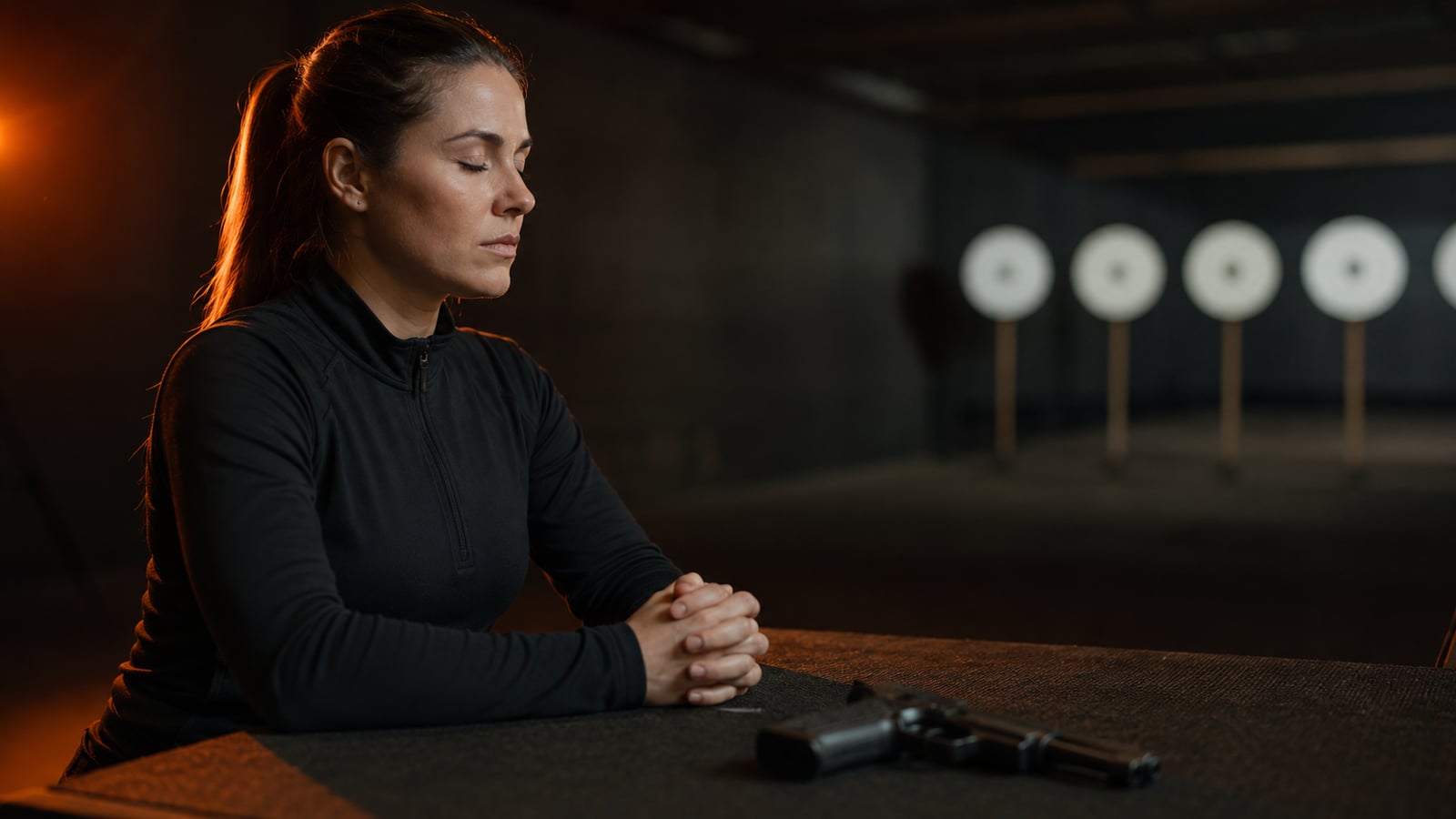
Why a ritual really changes your performance
You’ve probably already noticed the difference between a match day where everything flows naturally and a day where you’re improvising every step. That’s not luck. It’s a matter of structure, set up in advance and repeated often enough to become automatic.
A pre-match routine isn’t some mental gimmick reserved for shooters who are already performing well. It’s a tool that offsets a very concrete problem: on competition day, your brain has to handle an emotional stake on top of the technical work. Every unprepared decision that day burns mental energy you no longer have available to aim and release your shot cleanly.
An experienced club shooter who repeats the same actions before every competition string, year after year, isn’t doing it out of superstition. They do it because that ritual removes dozens of unnecessary micro-decisions: what to do on arrival, how to warm up, in what order to prep your gear. All that load is already settled before you even set foot on the firing line.
This article covers the full build of a pre-competition routine: sleep, physical and technical warm-up, visualization, and why the consistency of the ritual mechanically reduces stress. You’ll also find concrete, generic examples, with no invented details about any real person.
It’s also worth being honest about what a routine doesn’t do. It never replaces the technical work accumulated in training, it doesn’t make up for months of inconsistency, and it guarantees no numerical result. What it does is put your brain and body in the best possible conditions to express what you’ve already worked on. It’s a multiplier of preparation, not a substitute for it.
That distinction matters because it avoids a classic trap: believing that by endlessly polishing your mental routine, you can ignore real technical gaps. A well-built pre-match ritual adds to serious foundational work, it never replaces it. Keep that in mind through every section that follows: every tool described here exists to free up mental resources for your technique, not to stand in for it.
Sleep, the invisible foundation of your performance
Before talking about warm-up or visualization, it’s worth dwelling on what happens the night before the match, because that’s often the most neglected step. A shooter who shows up to competition after a short or restless night starts with a deficit that no mental technique fully makes up for.
Sleep directly affects two things critical to precision shooting: hand stability and sustained concentration. A fatigued nervous system produces more micro-tremors and attention that drops off faster over long strings. That’s not an opinion, it’s a well-documented physiological consequence of insufficient recovery.
The pre-match sleep routine isn’t just about “sleeping well the night before.” An experienced coach will instead emphasize the two nights before the match, because the body partially compensates for one bad night if the one before it was solid. A single too-short night right before an important competition weighs less if the preceding days were regular.
Concretely, that means setting stable bedtimes during the week leading up to the match, avoiding screens late at night, and above all avoiding improvising a radically different sleep schedule the night before competition compared to your habits. The body hates abrupt rhythm breaks more than it hates a slightly imperfect but stable rhythm.
If competition anxiety keeps you awake the night before, that’s not a catastrophe either. One occasional sleepless night degrades performance but rarely dramatically if the rest of the preparation is solid. The real risk is stringing together several short nights during the preceding week because stress accumulates unmanaged.
Diet in the preceding days also deserves a place in this reflection, even though it’s rarely highlighted. A meal that’s too heavy or unusual the night before can disrupt sleep and leave a feeling of heaviness on match morning. The logic is the same as for sleep schedule: stability beats last-minute optimization. Eating what your body already knows well is better than testing a new food the night before an important deadline.
Hydration follows the same principle of regularity. A slightly dehydrated shooter experiences more eye fatigue and muscle tension, both of which directly harm hold stability. Nothing complicated to set up: drink regularly throughout the preceding day, without waiting for the sensation of thirst, and avoid excess late caffeine that would disrupt a night already under tension.
Some shooters add an end-of-day ritual to this sleep routine that helps them switch off mentally: short reading, light stretching, or simply cutting screens half an hour before bed. The goal isn’t to add another constraint, but to signal to your body that the active phase of the day is over, which makes falling asleep easier even under competition tension.
Structuring the physical warm-up before the firing line
A shooter’s warm-up has nothing to do with an endurance athlete’s, but it remains essential. The shooting motion relies on fine control of small muscle groups (shoulder, forearm, fingers) that benefit from being engaged progressively before the real effort.
A typical warm-up routine starts with gentle general mobilization: shoulder rotations, light neck and back stretches, a few wrist flexions. The idea isn’t to tire the body but to pull it out of the inertia of travel or waiting. A body still “cold” at the start of a string produces a less stable hold than that same body fifteen minutes later.
Next comes the discipline-specific warm-up. For a static precision shooter, that often means a few dry position setups, without ammunition, to recover the feel of the stance before the first real shot. For someone practicing dynamic disciplines, warm-up also includes movement drills and dry transitions to refresh the paths between shooting zones.
Dry fire holds a special place in this phase. Repeating shot preparation, alignment, and trigger management without ammunition reactivates the motor program without the stress of a visible impact. An experienced coach generally recommends about ten dry repetitions before the first live shots in competition, more if conditions (cold, wind, jet lag) require a longer adaptation time.
The warm-up must also respect timing consistent with your relay time. Too early, and the effect fades before the actual start. Too late, and you step onto the line still searching for your feel. Most experienced shooters time their warm-up to finish 10 to 15 minutes before the official call, leaving margin to handle the unexpected (gear, schedule change, queue) without rushing everything.
A point often overlooked concerns visual warm-up. Eyes also need adaptation time, particularly when moving from a dark environment (indoors, car ride) to the brightness of an outdoor line or a very bright range. A few minutes spent looking at the target or shooting area before the technical warm-up let the eye adjust, which avoids a loss of sharpness on the first shots.
Weather directly affects how long this warm-up needs to be. In cold weather, muscles and tendons need more time to regain their usual suppleness, and hands lose fine sensitivity on the trigger faster. A shooter competing in winter or in an unheated range benefits from slightly extending the general mobilization phase and keeping hands covered as long as possible before the first shot.
Here are the benchmarks most experienced shooters use to set the duration of this warm-up:
- Gentle general mobilization: 5 to 10 minutes.
- Discipline-specific position setup or dry transitions: 10 to 15 minutes.
- Dry-fire repetitions targeting the trigger motion: at least about ten repetitions.
- Visual adaptation to the light on the firing line: a few minutes, ideally before the rest.
- Safety margin before the official call: 10 to 15 unplanned minutes, to absorb the unexpected.
These benchmarks aren’t absolute rules, they vary with discipline, weather, and individual experience. What matters is setting your own version of this template in training, so you no longer have to improvise it on match day.
Preparing your gear: a ritual in its own right
Gear preparation is an integral part of the routine, even though it looks purely logistical. Checking your firearm, ammunition, hearing protection, and accessories in a fixed order avoids forgetting things, but above all serves a mental purpose: turning a potentially anxiety-inducing task into an automatic, reassuring gesture.
A shooter who packs their bag the night before, always in the same order, eliminates a source of diffuse stress on match morning. It also avoids compulsive last-minute checks which, paradoxically, increase anxiety instead of reducing it. The gear ritual needs to be wrapped up early enough that you no longer think about it once you’re on site.
For disciplines requiring fine adjustments (parallax, red dot height, stock fit), match day is never the moment to experiment with a change. The rule most experienced shooters apply is simple: no adjustment changes the night before or the day of a match, except in absolute emergency due to equipment failure. Competition is fought with gear that was set and validated beforehand, not with a last-minute tweak that sounds good in theory but introduces an uncontrolled variable.
This equipment discipline connects directly to the stress question: the more technical unknowns there are on match day, the more the mental load available for pure concentration decreases. Gear that’s adjusted, checked, and familiar frees up cognitive resources for what matters, the shooting itself.
A written gear checklist, even a simple one, remains one of the most underused tools among club shooters. It lets you check the following items in the same order at every competition:
- The firearm and its general condition (function, cleanliness, safety mechanism).
- Sufficient ammunition, with a margin beyond the strict minimum.
- Hearing and eye protection, including a spare pair.
- Discipline-specific accessories (extra magazines, bipod, shooting bag, scorebook).
- Administrative documents required by the organizers (license, permit, ID as applicable).
This list doesn’t need to be the same for everyone. What matters is that it stays stable from one competition to the next for you personally, so that checking it becomes a quick, reassuring gesture rather than an added source of doubt.
One last point worth mentioning: how the bag itself is packed. A bag organized the same way every time, with each item in its usual place, lets you find an accessory quickly under pressure, without rummaging or panicking. It’s a seemingly minor logistical detail, but it directly contributes to the sense of control that reduces stress before the start.
Mental visualization, before and during warm-up
Visualization isn’t some esoteric technique reserved for the initiated; it’s a mental training tool built on a simple principle: the brain activates similar motor circuits when it precisely imagines a movement and when it actually performs it. Mentally rehearsing your string before shooting it physically therefore reinforces the motor program without extra risk or fatigue.
An effective pre-match visualization session generally follows a precise template: settle in, close your eyes, then mentally run through the entire string, from getting into position to follow-through, including breathing and visual alignment. A regional champion who has practiced this method for years insists on one point: visualization must include the sensations (the weight of the firearm, the feel of the finger on the trigger) and not just the visual image, otherwise the effect stays superficial.
There’s an important difference between visualizing a perfect string and visualizing a realistic one. Projecting yourself only onto center hits can create a mismatch if match reality throws in something unexpected (wind, fatigue, ambient noise). A more useful visualization also includes handling a lesser shot, along with the mental recovery that follows, to prepare the brain to stay stable even if things don’t unfold exactly as planned.
The duration of this phase stays deliberately short, more a matter of a few focused minutes than one long diluted session. The goal is to activate the muscle memory of the motion right before the action, not to meditate indefinitely. Many shooters place this step right after the physical warm-up and just before the call to the line, so the effect is still fresh when they shoot.
Breathing naturally accompanies this visualization phase. Deliberately slowing your breathing rate during the mental exercise helps anchor a calm state that then carries over to the first real shot. Some shooters pair slow, deep breathing with the exact moment they visualize releasing the shot, to create a direct link between the mental image and the desired bodily sensation.
There’s also a short version of visualization, usable directly on the line between two strings or just before the first shot of a stage. It only lasts a few seconds: briefly close your eyes, mentally revisit the key motion (the alignment, or the smooth movement between two shooting zones), then reopen your eyes and carry on. This condensed version is especially useful in dynamic disciplines where time between steps is tight.
A shooter new to visualization practice shouldn’t expect an immediate, spectacular effect. Like any mental skill, it’s built through repetition. Early sessions often require conscious effort to keep the image clear, and that effort decreases with practice until it becomes an almost automatic reflex before every important string.
Why the consistency of the ritual reduces stress
The mechanism behind a routine’s effectiveness isn’t magic, it’s cognitive. A sequence repeated enough times becomes an automatic script that your brain runs without conscious decision-making effort. The fewer decisions there are to make on match day, the less room there is for the doubt and hesitation that feed stress.
This principle rests on a simple observation seen across most elite athletes, in every discipline: uncertainty is one of the main drivers of performance anxiety. A stable routine reduces the uncertainty around how the morning unfolds, even though it obviously can’t change the outcome of the shooting itself.
There’s also an anchoring effect. Repeating the same actions in the same order before every competition sends an implicit signal to the brain: “this sequence has already worked, this situation is familiar.” That sense of familiarity, even artificially built through repetition, calms part of the stress response normally triggered by the unknown.
A point often misunderstood: the routine shouldn’t be so rigid that it becomes a source of anxiety itself if some outside element disrupts it (transport delay, schedule change, borrowed gear in an emergency). A well-built routine has a non-negotiable core (technical warm-up, short visualization) and a flexible periphery that can adapt without everything else collapsing. A shooter who panics the moment one detail of their routine changes hasn’t built a solid ritual, they’ve built a fragile dependency.
This stress-reduction mechanism through repetition isn’t unique to shooting sports; it’s found in most disciplines where performance depends on a fine motion under pressure. What changes from one discipline to another is the concrete content of the routine, not the principle that makes it effective. Understanding that principle actually lets you build your own tailored routine rather than copying someone else’s as-is, since what matters is consistency and repetition, not the exact detail of each step.
There’s finally a positive side effect of the routine rarely mentioned: it also helps you better distinguish a day when something is genuinely wrong (unusual pain, faulty equipment, abnormal fatigue) from simple competition nerves. When everything else in the ritual proceeds normally, a signal that falls outside the ordinary becomes easier to spot and take seriously, instead of being drowned out in the general noise of competition stress.
Adapting your routine to your discipline
A routine relevant for a static precision shooter at 10 or 50 meters doesn’t necessarily look like one for a practitioner of dynamic disciplines like IPSC or Steel Challenge. The constraints of time, movement, and stress management aren’t the same.
For static precision disciplines, the routine emphasizes postural stability, repetition of the aiming motion, and a breathing rhythm set to each shot. The time available is generally longer, which allows for a more extended warm-up and visualization routine before the first string starts.
For dynamic disciplines, where stages run one after another on cardboard targets or steel plates with tight timing, the pre-match routine focuses more on physical activation (mobility, dry transitions, magazine management) and a short, very concrete visualization of the stage, often done right after the walk-through allowed before the start.
For regulated or historical disciplines (antique firearms, black powder), the equipment routine takes on an even bigger role, because these firearms often require longer preparation (loading, checking specific mechanisms) that must be integrated into the ritual without rushing, or it destabilizes the rest of the mental sequence.
For clay target disciplines (trap, skeet, sporting), the pre-match routine incorporates an extra element: observing wind and light conditions on the field before the first target. An experienced clay shooter always takes a few minutes to watch the trajectory of the practice targets before their own round, which is as much a part of their mental preparation as the physical warm-up.
For archery and crossbow, the routine emphasizes repetition of the draw and aiming motion, with particular attention to core bracing and breathing over the course of a competition that can span several hours. The consistency of the ritual between each end plays an even more central role there than in ammunition-based disciplines, since the full motion repeats identically for every arrow or bolt.
In every case, the principle stays the same: identify the steps that genuinely matter for your discipline, repeat them in the same order in training as in competition, and let the ritual gradually become automatic rather than forcing it artificially from the first attempt.
Building your routine progressively, not all at once
Many shooters make the mistake of wanting to copy a complex routine they heard about elsewhere and apply it in full at the very next competition. An effective routine is built in training, over several weeks, with progressive adjustments, not in a single attempt under competition pressure.
The best method is to test each building block separately in training: first the sleep routine for a week or two, then physical and technical warm-up over several sessions, then visualization by slipping it in before training strings that carry a little stake (an internal club match, a timed session). Once each block works independently, they naturally assemble into a complete ritual.
An experienced coach often advises testing the full routine at a “low-stakes” competition before rolling it out for an important deadline. That lets you spot concrete friction points (poorly calculated timing, inefficient order, useless step) without carrying the pressure of a major stake during the experiment.
It’s also useful to write down your routine, with approximate timings for each step, rather than relying solely on memory. A shooter who structures their preparation in a notebook or a dedicated app can compare what worked or didn’t from one competition to the next, and adjust their routine over time instead of starting from scratch every time.
This progressive building phase also requires accepting some trial and error. A step that seemed useful in theory can prove counterproductive in practice, for example visualization that’s too long and ends up generating impatience rather than calm. A shooter who stays attentive to their own feedback will adjust their routine over time, without clinging rigidly to a fixed version from the start.
It can help, during this building phase, to distinguish what’s personal preference from what’s a general principle. The need for regular sleep, or for rehearsing the motion before the real action, are principles that apply to almost everyone. The exact duration of the warm-up or the precise content of the visualization, on the other hand, stay specific to each shooter, and it’s exactly that customizable part that needs to be tested and adjusted in training.
Handling the unexpected without breaking the ritual
Even the best-built routine hits a snag one day: a travel delay, an earlier relay time, gear that causes a last-minute problem, weather conditions that disrupt the planned warm-up. The solidity of a ritual is measured precisely by its ability to absorb these surprises without collapsing.
The key is to identify in advance which steps are truly essential and which are just comfort. If time suddenly tightens, an experienced shooter will know to sacrifice part of the general warm-up but will systematically keep a few dry repetitions and a minimal visualization, because those are the two steps with the biggest direct impact on the stability of the first shot.
Having a mentally prepared plan B massively reduces the stress associated with the unexpected event itself. A shooter who already knows, before the problem even happens, how they would compress their routine in case of a delay experiences that surprise as a simple adaptation rather than a crisis. Once again, it’s preparation done in advance, not improvisation on match day, that makes the difference.
It’s also worth keeping in mind that missing one step of your routine once doesn’t undermine its overall effectiveness. A ritual doesn’t need to be applied perfectly at every competition to remain useful over time; it needs to be repeated enough on average to stay a reliable anchor.
Multi-day competitions or ones with several relays present a particular variant of this problem: the routine sometimes has to be repeated several times in the same day, or adapted from one day to the next depending on relay time. An experienced club shooter running through several relays over a long competition typically prepares a full version for the first relay of the day, then a shortened version for subsequent relays, keeping only the non-negotiable core mentioned above.
Unexpected outdoor conditions (sudden rain, rising wind, a last-minute change of firing point) call for the same adaptive logic. Rather than suffering these changes as a disruption to your concentration, consciously integrating them into your routine — for example adding a few moments of observing the new conditions before the technical warm-up — turns the unexpected into just one more step of the ritual instead of a source of panic.
Mental routine after the string, not just before
The pre-match routine naturally extends into managing the immediate aftermath of a string, even though this article’s focus is on preparation beforehand. The connection is direct: a good reset routine between two strings, or between two stages of a match with several relays, relies on the same ingredients as the pre-match one, namely a stable order known in advance rather than improvisation under fatigue.
A shooter who has prepared a short mental “reset” routine after each string (a few breaths, a brief postural adjustment, maybe a sip of water) comes back into better condition for the next string than one who carries straight on without a transition. This intermediate micro-routine isn’t a minor detail: over a long competition, it protects concentration far better than a break improvised differently each time.
This continuity between the pre-match phase and the flow of the competition nicely illustrates the general principle behind this whole ritual: it’s never a single isolated action that changes performance, it’s the coherence of the whole, repeated often enough to become a reliable reflex rather than an extra conscious effort to manage on match day.
Common mistakes that sabotage a pre-match routine
Certain mistakes come up regularly among shooters starting to build a pre-competition ritual, and knowing them in advance lets you avoid them directly rather than discovering them the hard way.
The first mistake is changing an important element of your routine right before a major competition, often after reading or hearing about a method that seems promising. A new breathing technique, a new warm-up, or even a new sleep schedule must first be tested in training, never introduced for the first time on a day with real stakes.
The second mistake is copying a routine heard about elsewhere without adapting it to your own discipline or your own sensitivity. What works for a static precision practitioner doesn’t necessarily suit a shooter of dynamic disciplines, and what calms one shooter down can, on the contrary, tense up another. The routine must remain a personalized tool, not a recipe copied as-is.
The third, subtler mistake is turning the routine itself into a source of pressure. A shooter who starts stressing about “doing their routine wrong” has lost sight of the original goal, which is precisely to reduce stress. If the ritual becomes a new anxiety-inducing constraint, it’s better to simplify it rather than add to it further.
A fourth common mistake concerns managing the waiting time between warm-up and the actual relay. Some competitions impose longer-than-expected waits between the end of the allowed warm-up and the actual call. A shooter who hasn’t anticipated this delay may see their warm-up effect wear off, or conversely find themselves waiting passively while anxiety builds back up. Planning a short transition activity (light walking, slow breathing, quickly reviewing your technical cues) usefully fills this gray zone.
Finally, one last mistake is neglecting the routine at competitions considered “less important,” such as internal club matches or qualifying events. Yet it’s precisely on these moderate-stakes occasions that the routine should be repeated most scrupulously, since that’s where it gets built and solidified before being called on for the deadlines that really matter.
What the routine must never become: superstition
There’s a fine line between a routine built on solid principles (sleep, progressive warm-up, repetition of the technical motion) and a pile of superstitious gestures with no real justification. This distinction deserves to be drawn clearly, because it protects against drift that ends up hurting more than helping.
A useful routine rests on a principle that makes sense: warming up progressively stabilizes the motion, visualizing the string reinforces the motor program, sleeping enough protects concentration. A superstition, on the contrary, rests on a purely accidental association between a gesture and a past good result, with no real cause-and-effect link: wearing the same item of clothing, taking a specific route, repeating a specific phrase because one day it “brought luck.”
The risk of superstition is that it creates a fragile dependency. If the lucky item is forgotten, or the usual route is impossible on a given day, the superstitious shooter loses part of their confidence for no objective reason, even though nothing genuinely functional has changed in their preparation. A routine built on solid principles, by contrast, stays effective even if a peripheral detail changes, since its core (warm-up, visualization, technical cues) doesn’t depend on an arbitrary object or ritual.
That doesn’t mean a symbolic gesture has no value at all. A personal concentration gesture, repeated consciously and without excessive dependency, can perfectly well be part of a healthy routine as long as it stays secondary to the genuinely functional elements. The line to watch is the moment that symbolic gesture becomes, in your head, more important than the technical warm-up or the quality of your sleep.
FAQ
Q: How long before the competition should you start your routine? A: That varies by discipline and hosting club, but most shooters time their full warm-up to finish 10 to 15 minutes before the official call. The sleep routine, on the other hand, is built over the two preceding nights rather than just the night before.
Q: Do you need to do exactly the same routine in training and in competition? A: Ideally yes, that’s actually the whole point of the ritual. A routine tested only in competition loses its reassuring effect, since it hasn’t yet become a familiar automatism for your brain.
Q: Does mental visualization really work, or is it just psychological? A: The two aren’t mutually exclusive. There’s a real effect on activating the motor circuits linked to the motion, but it adds to a purely mental reassuring effect. Both contribute to reducing the uncertainty felt before the first shot.
Q: What should I do if something unexpected completely breaks my routine on match day? A: Prioritize the two highest-impact steps, a few dry repetitions and a short visualization, and sacrifice the rest if time is short. Having already thought through this plan B greatly reduces the stress tied to the unexpected event itself.
Q: Can a routine that’s too rigid become a problem? A: Yes, if it tolerates no variation at all, the smallest hiccup can generate more stress than having no routine at all. It’s better to build a non-negotiable core and a flexible periphery that adapts to the unexpected.
Q: At what level should you start structuring a pre-match routine? A: From your very first competitions, even at a recreational level. It’s not a tool reserved for experienced shooters — it’s precisely by testing it early, at low-stakes competitions, that it becomes reliable for more important deadlines.