
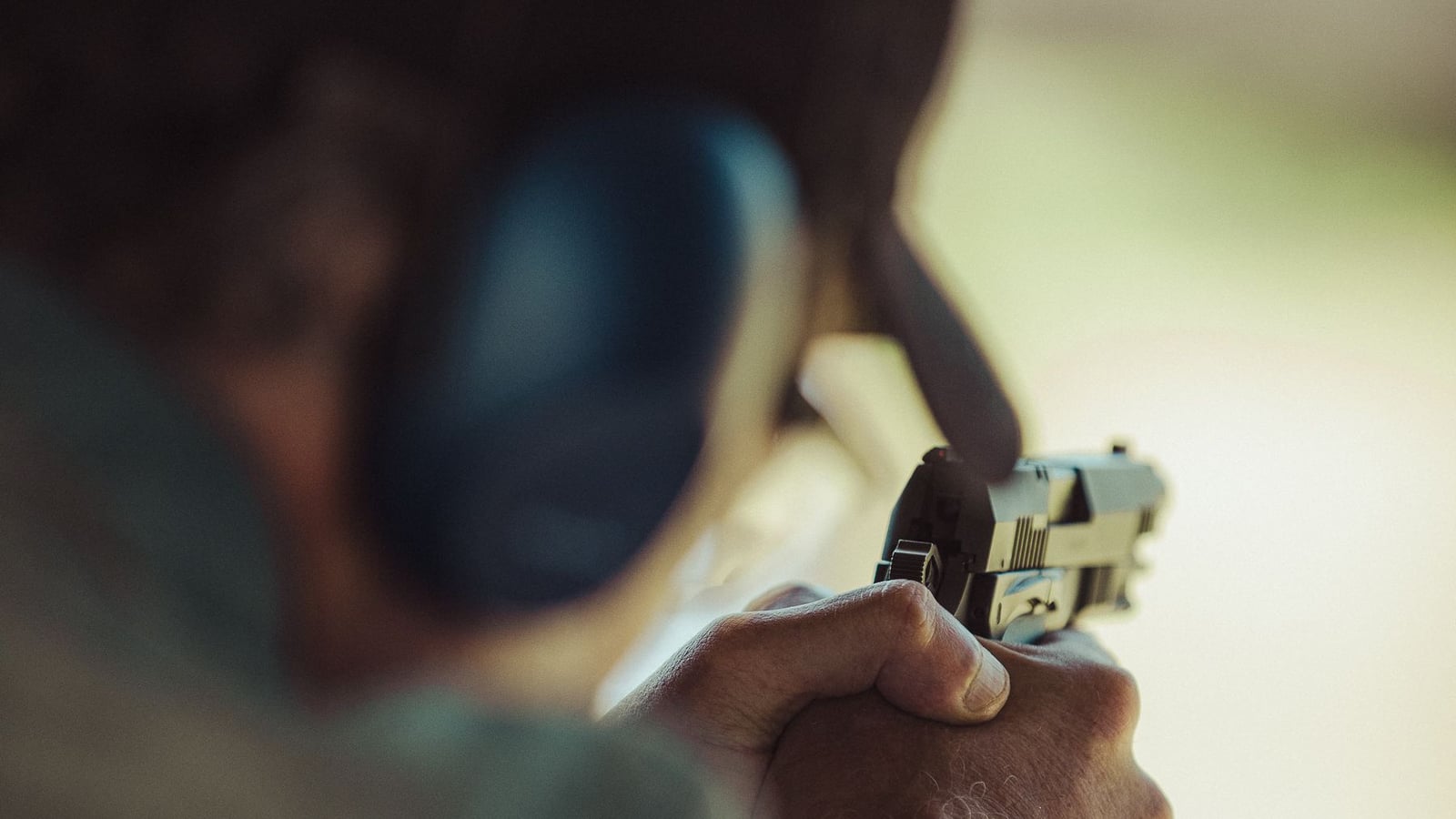
The Combined Event: a discipline with two faces
The 25m Pistol Combined Event (often shortened to “CE” in clubs) isn’t a minor variant of Standard Pistol. It’s a hybrid event that forces you to switch between two opposing shooting logics, within the same series and sometimes within the same minute. On one side, a precision phase where every tenth of a point counts. On the other, a speed phase where your ability to repeat an identical motion in a very short time makes all the difference.
This dual demand changes everything about your preparation. A shooter coming from Standard Pistol 25m often arrives with excellent precision fundamentals but a very different relationship to time: in Standard, the series are timed but generous, whereas in the Combined Event some phases are decided in a few seconds per shot. Moving from one to the other requires a real overhaul of how you manage your shooting, not just a tweak to caliber or stance.
Many shooters underestimate this discipline, thinking it’s “just faster.” In reality, the Combined Event tests your ability to manage two different heart rates, two different breathing patterns, and two different levels of muscle tension in the same competition. It’s this alternation that makes it stand apart, appreciated by shooters who love versatility and dreaded by those who’ve built their entire game around a single tempo.
This hybrid format also has an often-overlooked educational virtue: it forces you to identify your weaknesses precisely. A shooter can believe they’re “complete” as long as they’ve never faced a discipline that reveals, within the same series, a lack of speed or a lack of precision discipline. The Combined Event acts a bit like a developer: it leaves no room to hide behind a single dominant quality.
The format: how a Combined Event series unfolds
The Combined Event is shot at 25 meters on target, in several phases strung together within a single event. Concretely, you find an alternation between precision series (longer shot time, one shot after another at your own pace within the allotted limit) and speed series (very short shot time, often just a few seconds per shot, with target appearance and disappearance phases).
The fundamental difference with Standard Pistol 25m is that Standard offers a relatively homogeneous shot-time progression from one series to the next: you settle into a rhythm and keep it from start to finish. The Combined Event, on the other hand, forces you to change tempo between phases, which demands much better management of the mental transition. You can’t get by with a single “shooting mode”: you need at least two, clearly distinct, and you have to know how to switch between them without a moment of hesitation.
This alternation has a direct consequence on training: you can no longer settle for endlessly repeating the same motion with the same timing. You have to work differentiated blocks, with transitions deliberately provoked in training so you don’t discover them on competition day.
Another aspect of the format deserves attention: the order of the phases isn’t psychologically trivial. Starting with a precision phase lets you settle progressively into the competition, with a heart rate still close to resting. Then moving into a speed phase requires a real shift in state, often harder to negotiate late in the match than at the very start of a series, when concentration fatigue is already accumulating. This is one of the reasons the final phases of a Combined Event competition are often where the gap widens most between well-prepared shooters and the rest.
Format differences from Standard Pistol: what really changes
On paper, Standard and Combined Event look alike: same distance (25m), same target type, broadly the same family of authorized firearms. In practice, however, several structural elements differ.
- Shot time per phase: in Standard, the timed series stay closer to a classic precision rhythm. In the Combined Event, some phases impose a noticeably shorter shot time, typical of speed events.
- Scoring logic: in Standard, you’re chasing precision consistency across the whole event. In the Combined Event, your final score depends on your ability to avoid collapsing on the fast phases while staying competitive on the slow ones — a weakness in either component immediately drags down the total.
- Managing mental energy: Standard lets you settle into a stable bubble of concentration. The Combined Event forces you out of that bubble, to readjust, then return to it, several times within the same competition.
- Margin for error at speed: on the fast phases of the Combined Event, a fraction-of-a-second hesitation can cause you to miss the allotted time for the shot. In Standard, this risk barely exists.
- Reading your score mid-match: in Standard, you can get a fairly reliable sense of your performance level after a few series, since the rhythm doesn’t change. In the Combined Event, a good score on the slow phase says nothing about the result on the fast phase that follows, which makes the emotional management of the match more complex.
Many shooters starting the Combined Event after several years of Standard report the same feeling: the precision they hold effortlessly in Standard “crumbles” slightly as soon as they move into the fast phases, simply because their body hasn’t yet automated this tempo shift. That’s normal, and it’s precisely the heart of the training specific to this discipline.
There’s also a more subtle difference, often overlooked by shooters new to the Combined Event: how fatigue sets in. In Standard, fatigue is mainly postural and visual, accumulating linearly across series. In the Combined Event, it’s also nervous: the brain has to switch repeatedly between two information-processing modes, generating a different kind of fatigue, closer to what you feel after an exercise demanding divided attention. This kind of fatigue isn’t trained the same way as the classic postural endurance of precision shooting.
Authorized calibers and firearms
The Combined Event is shot with handguns falling within the categories authorized by your national shooting federation’s regulations for this discipline, in calibers comparable to those used in Standard Pistol 25m. Sport pistols in .22 Long Rifle remain the most widespread base in clubs, thanks to their shooting comfort, controlled ammunition cost, and availability.
Legally, these handguns fall under regulated categories requiring authorization: their acquisition and possession require a valid shooting license and the associated administrative steps. Nothing exceptional compared to what you already know if you practice Standard Pistol 25m with the same type of firearm — classification doesn’t change based on the discipline shot, but on the type of firearm and its technical characteristics.
Some shooters use the same gun for Standard and the Combined Event, which has the advantage of not multiplying handling habits. Others prefer a dedicated firearm, tuned specifically to withstand a faster shooting pace without the trigger becoming a friction point on the fast phases. The choice mostly depends on your budget and your skill level: a shooter just starting the discipline has no benefit in multiplying firearms before consolidating their basic technique.
Trigger tuning deserves particular attention in the Combined Event. A trigger that’s too heavy complicates the fast phases, where you don’t have time to “negotiate” a hesitant shot release. A trigger tuned too fine, conversely, can become a trap in the precision phase if you lack rigor in preparing the shot. The balance is worked out with a competent gunsmith and validated in training, never in competition.
The overall weight of the firearm and its mass distribution also play a non-negligible role. A gun slightly muzzle-heavy can help stabilize aim on the precision phases but become a handicap on the fast phases where the speed of reacquiring the sight between two shots becomes decisive. Here again, there’s no universal setting: each shooter has to test several configurations in training to find the compromise that suits them, rather than copying another shooter’s setup as-is, even an experienced one.
Sights deserve mention too. A well-contrasted front and rear sight, easy to align quickly, help both in the precision phase and the speed phase. Some shooters slightly adjust the rear sight notch width depending on their dominant practice, but a single, well-mastered setup often remains preferable to multiplying configurations that complicate muscle memory.
Ammunition and cartridges: what changes in practice
.22 LR dominates this discipline by a wide margin for practical reasons: limited recoil, reasonable cost per round over a large training volume, availability in clubs. On the fast phases of the Combined Event, ammunition consistency takes on added importance: a pressure irregularity or a temperamental round that would go almost unnoticed in slow precision shooting becomes a real problem when you have to string shots together in a few seconds.
Some experienced club shooters run consistency tests with several boxes of ammunition before a competition season, observing the groupings on target at slow speed and then at fast speed. The goal isn’t to find “the best ammunition on the market” (a notion that varies enormously depending on the gun and the shooter), but the one that works best with your specific firearm, across the two shooting regimes the Combined Event demands.
A point often neglected concerns storage and handling of ammunition between phases. In a competition with several consecutive blocks, it’s useful to organize your firing point in advance so you don’t lose precious time searching or reloading during phases where the clock doesn’t stop for you. Good material organization, however basic, avoids unnecessary stress that adds to the already real difficulty of the tempo change.
It’s also better to avoid switching ammunition lots right before an important competition, even if a new lot seems promising in training. Since the Combined Event leaves little room to adapt mid-match, the continuity and predictability of your equipment often matter more than chasing marginal extra performance.
Specific physical and mental preparation
Preparing for the Combined Event differs from Standard on one central point: you have to explicitly train the transition between the two tempos, not just each tempo taken separately.
An effective training scheme consists of working these elements in separate sessions, then progressively combining them:
- Pure precision blocks, at slow pace, to consolidate aim, breath control, and trigger release.
- Pure speed blocks, with deliberately shortened shot time, to automate a leaner, faster motion without sacrificing basic alignment.
- Mixed blocks, deliberately alternating both tempos within the same session, to accustom body and mind to the tempo change that characterizes real competition.
- Differentiated breathing work: calmer breathing in the precision phase, shorter, more controlled breathing in the speed phase, never falling into prolonged breath-holding that tires the eyes and stability.
Mentally, the main difficulty of the Combined Event isn’t technical but attentional. An experienced club shooter often describes this discipline as an exercise in “mental gear-shifting” more than a change of motion. Missing the start of a speed phase because you stayed on the slow rhythm of the previous phase is an extremely common mistake among beginners in this discipline.
General physical preparation matters too, even if it remains secondary to technical work. A shooter in better cardiovascular shape recovers faster between two intense phases and keeps better arm stability over the course of the match. Nothing extreme is needed: regular, moderate physical activity is plenty to support Combined Event practice, without needing to aim for elite-athlete-level preparation in another sport.
Mental visualization, a well-known technique in other precision sports, finds particularly useful ground in the Combined Event. Before a competition, taking time to mentally visualize the complete sequence of phases, including transition moments, helps reduce surprise and hesitation on match day. This mental preparation never replaces physical work on the firing line, but it usefully reinforces it.
The role of the shooting log in Combined Event preparation
Because the Combined Event combines two scoring logics within the same series, a simple total at the end of training doesn’t tell you much useful. What matters is knowing where your points are being lost: on the slow phases, on the fast phases, or in the transition between the two.
Keeping a detailed shooting log, explicitly separating results by phase rather than by overall score, lets you spot trends across multiple sessions: maybe your precision stays stable on the slow phases but consistently collapses on the first three shots of a fast phase, which would point to a transition problem rather than a pure speed-shooting problem. A tracking app that lets you segment your series by phase type gives you a far more actionable view than a simple final score jotted in a generic paper logbook.
This structured tracking also lets you measure your progress over time on each component separately. A shooter can very well plateau in overall score for several weeks while making clear progress on speed, if their precision drops slightly at the same time — information invisible without a detailed, comparable history from one session to the next.
Beyond raw scores, it’s useful to note more qualitative elements in your log: weather conditions, your fatigue level before the session, or the ammunition used. This information, cross-referenced with your results by phase, often helps explain why the same training routine produces different results from one week to the next. A performance gap that seems inexplicable in the moment sometimes has a very simple explanation once put back in its full context.
Another interesting use of the shooting log is noting, phase by phase, your subjective sense of fluidity on a simple scale. This feeling doesn’t always match the score exactly: sometimes a phase that felt fluid produces a disappointing score, or the opposite. This mismatch, once identified across several sessions, helps you better calibrate how much confidence to place in your feelings mid-match — valuable on competition day when you need to quickly decide whether to adjust something or trust the automatism already in place.
Common mistakes among shooters coming from Standard
Moving from Standard to the Combined Event generates recurring mistakes, almost always tied to habits poorly transferred from one discipline to the other.
- Keeping the same aiming tempo on the fast phases. The reflex to “finish your aim properly” before releasing the shot, essential in Standard, becomes counterproductive if the shot time doesn’t allow it: you need to learn to accept a “sufficient” rather than perfect aim on these phases.
- Underestimating the precision phase out of overconfidence in speed. Conversely, some shooters coming from dynamic disciplines neglect the rigor needed on the slow phases of the Combined Event, thinking their ease at speed will be enough to compensate.
- Not training the transition itself. Training only in separate blocks (all slow, then all fast) without ever stringing them together in the same session leaves a weakness that competition reveals immediately.
- Neglecting trigger tuning suited to both regimes. A trigger set up purely for precision can hinder the fast phases, and vice versa.
- Poorly managing breathing between phases. Keeping a slow-phase breathing pattern during a fast phase creates unnecessary tension and poorer stability.
- Trying to make up for a bad score by rushing even more. On an already tense fast phase, this instinctive reaction degrades precision further and turns a one-off poor showing into a catastrophic series.
- Neglecting warm-up specific to both regimes. Warming up only with slow shooting leaves the body poorly prepared for the abrupt shift to speed as soon as the match’s first fast phase begins.
Correcting these mistakes takes time and repetition, but they’re identifiable fairly quickly with an outside eye, for example an experienced coach observing your transition sessions. Filming your own sessions, when possible within the club, is also a valuable tool for spotting some of these flaws, especially those related to aiming tempo, which are often more visible from the outside than felt from within.
How to structure a typical training session
A session dedicated to the Combined Event benefits from following a logical progression rather than a random sequence of exercises. Here’s a structure that works well for most intermediate shooters:
- A classic grip and aim warm-up at slow pace, with no scoring stakes, to reconnect with basic sensations.
- A pure precision block, aiming for consistency rather than a raw score, to consolidate the day’s technical foundation.
- A pure speed block, progressively increasing the difficulty of the imposed shot time as the session goes on.
- A mixed block faithfully reproducing the sequence of a real competition, with the actual time constraints of both phases.
- A debrief time with the shooting log, right after, to note sensations and not just scores: where did you feel a hesitation, where did the motion stay fluid.
This structure lets you work the three dimensions of the discipline (precision, speed, transition) without ever fully isolating them from the reality of competition, which remains the ultimate goal of any serious session.
The length of each block deserves adjustment based on the shooter’s level. A beginner in the discipline benefits from spending more time on separate blocks before tackling mixed blocks, so as not to stack two difficulties at once (the motion and the transition) before having consolidated each separately. A more experienced shooter, conversely, can reduce the share of separate work in favor of longer time on mixed blocks, which come closest to real competition conditions.
Session frequency matters too. A regular training rhythm, even with shorter sessions, generally gives better results than a single long weekly session where fatigue accumulates and degrades work quality toward the end. It’s better to spread training volume across several short, well-built sessions than to concentrate all the effort into one marathon session, especially for a discipline that demands as much concentration as the Combined Event.
It can be useful, once every two or three weeks, to reproduce a session under near-real competition conditions, with the exact format of the phases as they unfold in a match, and not just simplified training variants. This regular repetition of the full format reduces the stress gap felt between training and official competition, which is often one of the most determining factors of performance on the big day.
Entering your first Combined Event competition
If you already practice Standard Pistol 25m at your club and want to try the Combined Event, the best approach is to talk to your coach or an experienced club shooter who already knows the discipline. They can point you to local competitions suited to your level and give you initial feedback on your ability to manage the alternating rhythms.
It’s generally advisable not to discover the exact format of a competition on the day itself. Many clubs organize introductory sessions or internal matches reproducing the actual course of a Combined Event, letting you experience the sequence of phases under near-competition conditions before entering an official event. This intermediate step considerably reduces stress and bad surprises during your first competitive outing.
For a first participation, it’s also advisable to set yourself a realistic goal, centered on managing the format rather than the final score. An experienced club shooter often reminds younger licensees that a successful first Combined Event competition isn’t necessarily the one with the highest score, but the one where you manage to handle the transitions calmly without letting the tempo change destabilize you. The score generally follows once that management is in place.
Finally, keep in mind that progress in the Combined Event is rarely linear at first: it’s common to see a shooter progress quickly on one of the two components (often speed, more spectacular to work on) and plateau for a while on the other. That’s normal, and it’s precisely this alternating learning curve that makes the discipline interesting over the long run.
Ancillary equipment: what makes the difference on the firing line
Beyond the firearm and ammunition, several pieces of ancillary equipment take on particular importance in the Combined Event, precisely because the format alternates between moments where precision of motion is paramount and moments where speed of execution becomes central.
Hearing and eye protection remain, of course, non-negotiable, as with any competitive shooting practice, but the comfort of this protective gear plays a bigger role than you’d think on the fast phases. Poorly fitted ear muffs or plugs that shift slightly during a series can distract enough to disrupt the timing of a speed phase, whereas the same annoyance would go almost unnoticed on a slower precision phase.
The holster or case used to store the firearm between phases, when the competition rules require it, also deserves careful selection. A fast, reliable storage system avoids wasting precious time, or worse, generating an involuntary hesitation when picking the gun back up for a timed phase.
Finally, clothing, often overlooked, has a real impact on stability and comfort. A sleeve that slightly interferes with the wrist, or overly loose clothing that catches during a fast motion, can be enough to disrupt a transition. Many experienced club shooters recommend wearing the same outfit in competition that was tested in training, rather than discovering new gear on match day.
The role of the coach and the club in progress
Progress in the Combined Event particularly benefits from outside guidance, even more than other purely precision disciplines. The reason is simple: transition flaws between phases are often hard to perceive yourself, since they show up as micro-hesitations or almost imperceptible posture changes at the moment they occur.
An experienced coach watching a Combined Event session can spot recurring patterns the shooter themselves doesn’t notice: a slight wrist stiffening at the start of a fast phase, too slow a re-acquisition of aim after the first shot of a timed series, or breathing that stays locked into the rhythm of the previous phase. These observations, once clearly stated, often allow rapid progress once the problem is identified and consciously worked on.
The club also plays a valuable role by organizing group sessions dedicated to this discipline, where several shooters train together on the same format. This collective setting recreates part of the competitive pressure, useful for accustoming body and mind to performing under an outside gaze, while benefiting from cross-feedback among practitioners of similar level. An experienced club shooter often points out that watching other shooters during their transition phases is as instructive as working on your own series, because it lets you spot mistakes you don’t necessarily see in yourself but that become obvious in another practitioner.
Progress over several seasons: what to expect
The progress curve in the Combined Event rarely follows a steady trajectory, and it’s useful to know that in advance so as not to get discouraged by plateaus or temporary setbacks. The first season of practice is often marked by rapid progress on the speed component, more easily perceptible and rewarding to work on, while precision on the slow phases can fluctuate slightly while the new transition automatisms settle in for good.
From the second season on, progress tends to rebalance: the shooter who has consolidated their transition management can then focus on the fine-tuning of each component separately, without one disrupting the other. It’s often at this stage that the discipline becomes most rewarding, as the two skills start reinforcing each other rather than competing for the shooter’s attention.
Over the long term, many experienced shooters consider that mastering the Combined Event indirectly improves their results in other pistol disciplines, notably thanks to the better time and stress management it imposes. This transferability is one of the arguments most often put forward by club coaches to encourage Standard shooters to try this discipline for at least a season, even without intending to specialize in it long-term.
The Combined Event versus other 25m pistol disciplines
The Combined Event isn’t the only hybrid variant offered at this distance, and it’s useful to place it relative to other formats to understand its specific standing. Some 25m pistol disciplines put the emphasis almost exclusively on pure speed, with extremely short shot phases from start to finish. Others, like Standard, stay centered on precision with a more generous, homogeneous shot time.
The Combined Event stands out by refusing to choose: it demands competence in both registers, which makes it a particularly formative discipline for a shooter who wants to develop a well-rounded profile rather than specializing in a single register. Many club coaches recommend the Combined Event as an interesting step for Standard shooters who want to broaden their technical range without fully reorienting toward exclusively fast disciplines.
This intermediate position also explains why some shooters choose to practice the Combined Event alongside Standard rather than as a replacement. The two disciplines feed off each other: the precision rigor built in Standard directly benefits the slow phases of the Combined Event, and conversely, the time management acquired in the Combined Event can help better manage the time pressure felt even on Standard’s more generous timed series.
FAQ
Q: Is the Combined Event harder than Standard Pistol 25m? A: It’s less about harder than about different: the Combined Event requires mastering two shooting rhythms and, above all, the transition between them, whereas Standard stays on a single precision logic. A shooter solid in Standard isn’t automatically comfortable in the Combined Event until they’ve specifically worked on the alternation.
Q: Do you need a different firearm for the Combined Event and Standard? A: No, the same handgun can generally serve both disciplines. Some shooters, however, prefer a slightly different trigger setup or a dedicated firearm once they progress, but that’s not a requirement to get started.
Q: Which caliber is most used in the Combined Event? A: .22 Long Rifle is by far the most widespread, for its shooting comfort and controlled ammunition cost over a large training volume, on both the precision and speed phases.
Q: How long does it take to properly absorb the discipline coming from Standard? A: This varies enormously depending on training volume and the shooter’s profile. What matters most isn’t the speed of learning but the consistency of work across the three dimensions: precision, speed, and the transition between the two.
Q: Is the Combined Event open to beginners in sport shooting? A: It’s generally recommended to already have a solid foundation in precision shooting, for example via Standard Pistol 25m, before jumping into the Combined Event. A club coach is best placed to assess whether your current level allows you to approach this discipline under good conditions.
Q: Is a classic shooting log enough to progress in the Combined Event? A: A log that doesn’t distinguish precision and speed phases gives an incomplete picture of your progress. Segmenting your results by phase type lets you pinpoint exactly where your room for improvement lies, which a simple overall score doesn’t show.