
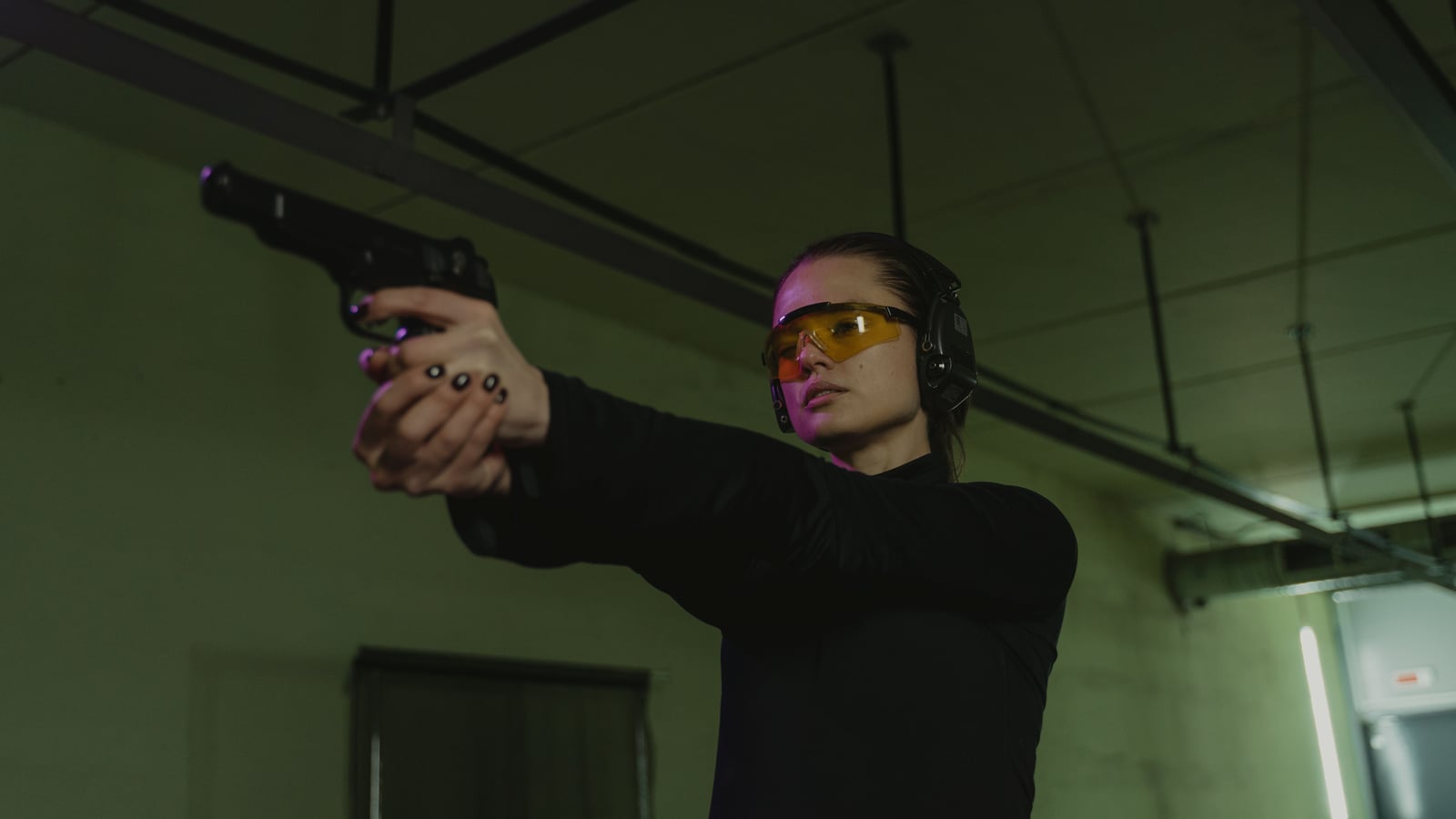
A sport long closed to women
Shooting sport has been part of the Olympic Games since 1896, but for decades the discipline remained an almost exclusively male domain. National federations organized their competitions around an audience of male shooters, often coming from military or paramilitary clubs at the origin of the sporting movement.
Women who wanted to compete at that time first had to find a club willing to enroll them. Many federal regulations simply didn’t provide for their presence, either in the rulebooks or in the facilities.
It wasn’t a question of skill or motivation. It was a question of access: no category, no license designed for them, and often a range environment that didn’t anticipate their arrival. The history of women’s Olympic shooting therefore begins as a story of access before it becomes a story of performance.
In this context, every woman who joined a club in the early decades of the twentieth century had to work within a framework designed without her in mind. This shaped a generation of practitioners used to asserting themselves in an environment that wasn’t expecting them.
Even the vocabulary of the era’s regulations reflects this lack of consideration: federal texts spoke of “shooters” using the generic masculine, never envisioning a feminine version of the competition categories. This drafting choice wasn’t neutral — it reflects a vision of the sport in which the question of mixed participation simply didn’t arise.
It’s also worth noting that this closed-off attitude wasn’t unique to shooting sport: at the same period it affected much of what were called technical disciplines, where access to equipment and coaching heavily shaped participation. Shooting, however, added an extra layer of difficulty — firearms regulation, which piles an administrative hurdle on top of the usual social barriers.
This firearms regulation, which varied by country and era, added an administrative layer that women had to clear just as men did in order to obtain a shooting license. But in a context where even getting into the club was already harder for them, this extra administrative step could discourage vocations that wouldn’t have survived a first refusal or a delay deemed too long.
The first competitors in mixed events
Before dedicated women’s categories were created, a few Olympic shooting events were open on a mixed basis, with no distinction by sex in the rules. That didn’t mean equal treatment within clubs or federations, but it did open a regulatory breach.
A woman who reached that Olympic level in a mixed event then had to face male competitors directly, under the same shooting standards, with no adjusted scoring. This was a rare situation for the era, in sport in general.
This mixed opening remained occasional and depended on the organizational choices specific to each edition of the Games. It wasn’t accompanied by a structural movement within clubs, nor by a deliberate federation policy to recruit more women.
The message sent remained ambiguous: Olympic competition tolerated a marginal female presence, without grassroots shooting sport, at the level of local clubs, opening up at the same pace. The gap between the Olympic summit and the federal base is a constant of this period.
This situation also created an interesting paradox: a shooter capable of competing directly against male rivals at the Olympic level then had to return to a club where her presence continued to be seen as exceptional rather than normal. Individual success didn’t automatically translate into collective change within her own federation.
This gulf between the international level and the local ground is also found across several Olympic shooting disciplines, where a lone competitor could carry her country’s colors without necessarily benefiting from a club that genuinely invested in the next generation of women behind her.
These occasional mixed events nonetheless carried significant symbolic value for the rest of this story: they demonstrated, as a matter of fact, that a woman could reach the highest international level in a shooting discipline with no adjustment to the technical scoring. This argument would later serve advocates of a broader opening of the sport to women, when discussing the creation of dedicated events.
The weight of social context on access to shooting
Shooting sport long carried the image of a technical and expensive activity, reserved for a narrow circle. For a woman of that era, joining a shooting club often meant clearing a social barrier before even thinking about competition.
Equipment, transport to a range, availability of training slots: all of it was designed around a male audience already established in the clubs. A new practitioner had to fit into collective habits that didn’t include her by default.
Some shooters of this period found support through a family circle already licensed, a father or a brother who was a shooter and opened the club door for them. Others relied on an experienced instructor willing to coach them without distinction, which was still far from the norm everywhere.
This context explains why the number of women competitors remained low for a long time, regardless of the actual level they could reach. The brake wasn’t athletic — it was structural.
It’s also worth mentioning how those around them viewed this practice: in many families of the time, competitive shooting simply wasn’t considered an activity for a girl or a woman, independent of any regulatory text. This social conditioning often preceded the question of material access to the club.
Some practitioners describe having to justify their choice to their own circle even before justifying it to a federation. This double barrier — family first, then institutional — explains why pioneering shooters’ paths often took longer to build than those of their male counterparts.
The role of the club as a social space also shouldn’t be underestimated in this equation. A club that cultivates an open, welcoming atmosphere, where a new member’s arrival is met without out-of-place comments about her legitimacy, greatly helps retain a beginner. Conversely, a club closed off in its old habits could discourage a motivated shooter from her very first sessions.
The gradual emergence of dedicated women’s events
Over the course of twentieth-century Olympic editions, specifically women’s events appeared on the shooting sport program. This evolution didn’t happen all at once: it advanced discipline by discipline, with withdrawals and additions depending on decisions made by international bodies.
The creation of dedicated events changed the dynamic for national federations, which now had to field women’s teams in order to hope for qualification. This pushed some clubs to open their doors more widely to women’s training, if only for reasons of national representation.
This dynamic remained uneven across countries and shooting disciplines. Some federations invested early in training top-level women shooters, while others continued to operate almost exclusively with men for a long time afterward.
This inequality between federations created, on an international scale, a multi-speed competition where some delegations arrived with shooters already seasoned in top-level competition, while others fielded competitors trained in a rush, for lack of a pre-built talent pool. This gap in preparation was directly felt in the results of the first editions featuring a dedicated women’s event.
The existence of a dedicated Olympic event therefore didn’t guarantee equivalent access to club-level practice. The top of the pyramid moved faster than its base, a phenomenon that runs through this entire history.
Creating these events also forced a rethink of national selection criteria: a federation that had never had to field a women’s team had to invent its own talent-scouting methods, often inspired by what already existed on the men’s side without always adapting it to the different realities faced by women practitioners.
This structuring work took time and explains why, in the years right after a dedicated women’s event was created, the international competition level could look uneven across delegations. Some countries already had a pool of recreational shooters to develop further, others started nearly from scratch.
What the first women’s medals changed
When a shooter won an Olympic medal in a women’s event, the effect went far beyond the sporting result itself. A medal made visible a practice that had until then remained marginal in public and media space.
For local clubs, this kind of result often served as an argument to justify opening dedicated slots for women or recruiting new members. A young female audience could then identify with a concrete achievement rather than an abstract idea of equal access.
This effect nonetheless remained gradual and didn’t immediately translate into an explosion in the number of licensed women. The structural brakes mentioned above (club access, equipment, coaching) didn’t disappear overnight just because a competitor succeeded at the Olympic level.
What changed lastingly was the perceived legitimacy of women’s presence in shooting competition. A federation that had already seen one of its members stand on an Olympic podium found it harder to justify a lack of interest in training women shooters.
This shift in perception is also visible in how the sport was covered by the media nationally. A standout performance briefly drew the attention of the local press, which could spark vocations in young girls who would otherwise never have considered shooting sport an accessible option.
This ripple effect nonetheless remained fragile and depended on the consistency of results: a single isolated podium, with no follow-up or built pipeline behind it, quickly faded from collective memory if the club or federation didn’t capitalize on it through sustained recruitment and training work.
It’s also worth noting that a medal’s value extends beyond the strictly national frame: internationally, it helps normalize the idea that a women’s Olympic shooting event is just as contested and technically demanding as a men’s event. This argument mattered in later discussions about expanding the number of dedicated events on the Olympic program.
The disciplines that opened first
Some Olympic shooting disciplines opened women’s events earlier than others, often linked to the nature of the event and habits already present in clubs. Rifle shooting, for example, benefits from a more widespread recreational practice among women in certain countries, which made it easier for competitors to emerge.
Pistol shooting followed a different trajectory depending on the federation, adopted more or less quickly depending on the national regulatory context around ownership of Category B firearms. Clay target disciplines also saw gradual opening, carried by rural clubs where mixed recreational practice already existed outside the Olympic framework.
This diversity of pace across disciplines shows there was no single, coordinated movement toward equality, but rather an accumulation of local and federal decisions made independently of one another. Each discipline has its own timeline of opening up.
Understanding this diversity helps put a too-linear view of history into perspective: Olympic women’s shooting advanced in successive waves, discipline by discipline, rather than through a general and simultaneous reform.
This pattern still holds true today in how members are distributed across disciplines within the same club: some rifle or clay-target sections show a long-established and well-embedded mix of genders, while other, more technical or equipment-costly sections remain, in practice, less attended by women, without any rule imposing that.
- Air rifle and precision rifle: relatively early opening, often linked to accessible recreational practice right from the club level.
- Precision and rapid-fire pistol: later opening depending on the federation, linked to the regulatory context specific to Category B.
- Clay target disciplines: progress carried by rural clubs where recreational mixed practice already preceded official competition.
This staggered timeline across disciplines also had consequences for individual paths: a shooter who starts out in a discipline still not very open to dedicated women’s competition sometimes has to wait several years before being able to aim for a clearly identified Olympic goal, whereas another, in a discipline opened earlier, can project a qualification timeline more quickly.
The role of clubs and women coaches in training
Behind every top-level competitor is a club and coaching that made her progress possible. A regional champion who then rises to national level generally owes her path to an instructor — man or woman — who believed in her progress from the very first sessions.
The gradual emergence of certified women coaches plays an underestimated role in this history. An experienced woman coach can represent, for a young shooter, concrete proof that progressing to a high level is possible in this sport, beyond theoretical talk about equal access.
Clubs that build specific support for their women members, with adapted time slots and a clear pedagogical progression, generally see more competitors emerge over time. It’s not a question of innate talent but of continuity in support.
This dimension remains poorly documented in accounts focused solely on Olympic results. Yet it’s often at this local level, in an ordinary club, that the rest of a shooter’s career is decided.
Another factor deserves mention: the presence, even a minority one, of women running clubs or sections has a ripple effect on the enrollment of new members. Seeing a woman hold a position of responsibility within the structure, and not just on the firing line, changes how families hesitant to enroll a young girl perceive the club.
This dynamic nevertheless remained a minority in the history of federated shooting sport, where leadership positions stayed overwhelmingly held by men for much of the twentieth century. Clubs that were an exception to this rule were often quiet but real drivers of local progress for women.
The quality of technical coaching also matters for how long a member stays engaged. A beginner who benefits from the outset from rigorous follow-up on her stance, movement, and stress management has statistically better odds of staying in the discipline over several seasons than a practitioner left to her own devices after a few introductory sessions. This finding, true for all groups, takes on particular significance for women active in clubs where they remained a minority.
Material and financial obstacles
Practicing shooting sport at a high level involves a substantial material investment: a weapon suited to the discipline, ammunition, hearing and eye protection, travel to competitions. This investment weighs differently depending on economic circumstances and available federal support.
For a long time, federations concentrated their support resources on men’s teams, seen as the priority for medal goals. An ambitious shooter then often had to finance part of her own path, or count on a club willing to invest in shared equipment.
This economic reality partly explains why some shooters came from backgrounds where recreational shooting was already established within the family, reducing the cost of entry into the discipline. Access to equipment remains a decisive factor, far more so than individual motivation.
This varies enormously by country and period; it would be inaccurate to generalize a specific figure or amount for these investments, given how much federal situations differ. What remains constant is that the material factor long favored shooters already in an economically advantaged position.
Clubs lending equipment remains, even today, an important lever allowing a beginner to try a discipline before investing in personal gear suited to her build and level. This practice of shared equipment has probably allowed more women to take the step into competitive commitment, without waiting until they could afford a full setup from the start.
Travel costs to regional or national competitions represent another often underestimated obstacle faced by the pioneers of women’s shooting. Without structured federal support, these trips largely depended on the shooter’s personal or family resources, which in practice limited access to competitors who already had a certain material comfort.
Available time is a final obstacle, less often mentioned than material cost but just as real: balancing regular training with a professional activity and family responsibilities was, for many shooters of that era, a balancing act with no real structural support from clubs or employers. This time constraint probably kept practitioners with real potential away from competition, for lack of training slots compatible with their schedules.
Portraits of typical paths, without a single glorified figure
Rather than focusing on one particular name, it’s useful to describe representative trajectories of what pioneering shooters experienced. A regional competitor often started with recreational shooting within the family, before joining a structured club as a teenager or an adult.
Another typical path: an established club shooter, already skilled in a recreational clay target discipline, who is invited by an instructor to move into federal competition. This switch often happened late, for lack of information about competitive circuits accessible to women.
A third common profile is that of a shooter who came from another individual sport, transferring her training discipline into shooting sport after meeting a local club. Mental discipline acquired elsewhere often eased her adaptation to the concentration demands of precision shooting.
These typical paths show one constant: a pioneering shooter’s success rarely rests on one isolated stroke of luck, but on a combination of encounters with available coaches and progressive access to a serious training structure.
A fourth profile deserves mention: the self-taught shooter who first progresses alone at a recreational range, on her own, before joining a club to formalize her license and access federal competitions. This path remains rarer since it already assumes personal access to a supervised range, which isn’t the most common situation.
What stands out when comparing these different paths is the diversity of starting points alongside a convergence in the steps that follow: all these trajectories eventually pass through a structured federal club, without which access to national-, then international-level competition remains very hard to seriously envision.
These typical portraits finally recall a sometimes-forgotten truth: there’s no single profile of a pioneering shooter, but a multitude of individual paths converging on the same passion for precision and the rigor of shooting sport. Reducing this history to a handful of exceptional trajectories would amount to erasing the mass of anonymous competitors who, collectively, moved the discipline forward.
The evolution of rules and international bodies
The international bodies governing Olympic shooting sport have gradually adapted their rules to fully integrate women’s events, with their own scoring and competition formats. This regulatory evolution comes with recurring debates about fairness of format between men and women.
Some decisions concern aligning the number of events offered to women with those offered to men, to reduce representation gaps in the Olympic program. Other decisions concern the technical standards of events, adjusted to reflect the same precision requirements regardless of competitors’ sex.
These regulatory changes are never made in a rush: they follow multi-year cycles between each revision of the Olympic program, with consultations of national federations. The pace therefore remains slow compared with other sports quicker to reform their competition structure.
It would be unwise to cite precise dates here for each specific regulatory reform, since they differ so much depending on the shooting discipline concerned (rifle, pistol, clay target). What matters is the underlying trend: a gradual convergence between men’s and women’s competition frameworks.
This regulatory work also comes with reflection on the fairness of the number of medals distributed, a subject regularly debated between international federations concerned with balanced representation and the logistical constraints of organizing the Games, which limit the total number of events on the program.
National federations, for their part, must follow these international developments and adjust their own selection circuits accordingly, which sometimes means entirely revisiting internal qualification criteria to stay aligned with the format adopted at the global level.
This ongoing back-and-forth between the international and national levels illustrates well the complexity of evolving an Olympic discipline: every regulatory reform, even a seemingly modest one, cascades down into how national competitions are organized, into athlete selection criteria, and ultimately into how local clubs shape their training policy for women members.
What this history changes for today’s practitioners
Today, a woman who joins a shooting sport club benefits from a regulatory framework that no longer makes any distinction in access to Olympic disciplines. This isn’t a longstanding given: it’s the direct result of the decades of gradual opening described above.
Most clubs today have integrated a de facto mix of genders into their training slots and coaching, even if local disparities persist depending on region and discipline. A new shooter today can aim for progress up to regional or national level without having to justify her presence on the firing line.
This normalization shouldn’t make us forget that the balance still has room for improvement in some clubs, particularly regarding representation in technical coaching or federal governing bodies. The history of Olympic women’s shooting isn’t a closed chapter — it continues to be written at the local level.
Understanding this past also helps measure how far things have come: a practitioner today benefits from access that’s historically anything but a given, built by generations of shooters who had to assert themselves in a framework that wasn’t expecting them.
This awareness also has practical value for today’s clubs: knowing the historical obstacles makes it easier to identify the remaining, often less visible ones that still limit some women’s engagement today, such as the availability of time slots or the makeup of technical coaching staff.
Intergenerational transmission within clubs
An often overlooked aspect of this history is the role of direct transmission between generations of shooters within the same club. A competitor who reaches a certain level almost naturally becomes a reference point for younger members discovering the discipline after her.
This transmission doesn’t necessarily go through an official coaching status: it also happens through informal advice given on the range, in sharing setup tips or competition stress management. This kind of informal mentoring has allowed many shooters to progress faster than they would have alone.
Some clubs have structured this transmission more formally, organizing mixed training sessions between experienced and beginner members, or entrusting an experienced shooter with an occasional mentoring role toward newcomers. This organization, however, remains highly dependent on the size and human resources of the club in question.
Over the long run, this club-to-club, generation-to-generation transmission probably had a more decisive effect on the democratization of women’s shooting than regulatory reforms alone coming from the top of international bodies. In reality, the two dynamics reinforced each other.
This transmission mechanism also explains why some clubs today show a proportion of women members clearly above the federal average: once a dynamic of women’s mentoring takes lasting hold within a structure, it tends to sustain itself over several decades, well beyond the passage of any single standout competitor.
The daily grind of training, far from the Olympic podium
The image retained from this history often focuses on podiums and regulatory turning points, but the essence of a shooter’s path lies in the patient repetition of training sessions, far from any competition. This everyday reality deserves to be recalled so as not to give a distorted picture of the sport.
A typical session for a competitor engaged in serious preparation combines technical work on shooting stance, specific work on breathing and trigger release, and a share of mental training to handle competition pressure. This triad remains valid whatever the discipline practiced — rifle, pistol, or clay target.
For a pioneer active in a club unaccustomed to coaching women competitors, this daily work often came with an extra burden: having to, implicitly, prove to the rest of the club the legitimacy of her presence through the regularity and seriousness of her training. This pressure, invisible in raw results, weighed on entire generations of shooters.
This extra mental load added to the already high demands of precision shooting, a discipline where concentration and consistency of movement matter as much as physical preparation. Managing this double level of pressure, athletic and social, demanded from these pioneers a capacity for mental endurance rarely mentioned in accounts focused solely on competition results.
This reminder of the daily training routine helps put the whole of this history into perspective: behind every regulatory advance or every media-covered podium lie hundreds of hours spent on an ordinary range, in an ordinary club, by women who simply wanted to progress in their discipline.
International competitions outside the Olympic framework
The history of women’s shooting isn’t limited to the Olympic cycle alone. World and continental championships, organized by the discipline’s international bodies, have often served as a springboard or testing ground for new women’s events before their potential inclusion in the Games program.
This parallel circuit plays an important role for shooters from nations where federal support for Olympic teams remains limited. A competitor can thus build an internationally recognized career among her peers without necessarily reaching Olympic qualification level, which widens the pool of high-level practitioners beyond just Games medalists.
These championships also offer a space where federations test competition formats before proposing them to Olympic bodies, notably on the question of the number of women’s events or qualification arrangements. This testing role is less visible in the media than the Games, but it mattered in the gradual construction of a credible women’s calendar.
This network of intermediate championships has also, over the decades, allowed rankings and international-level benchmarks specific to women’s shooting to be built up, independent of the Olympic calendar. These benchmarks now serve as a reference to objectively assess a shooter’s progress across several seasons, without having to wait for an Olympic deadline to measure her real level.
For a young shooter today, this international circuit outside the Olympic Games represents an accessible stage of progress before possibly considering an Olympic goal. It allows her to face international-level competition without waiting for the four-year cycle specific to the Games, and to measure her progress at a more regular pace.
This network of competitions, from regional championships to world championships by way of continental circuits, today constitutes a readable progression path for any motivated member, whatever her starting point. This readability of the competitive circuit, largely absent in the era of the pioneers, is perhaps one of the most concrete gains from this entire history.
FAQ
Q: Since when have women been able to take part in Olympic shooting sport? A: Shooting sport has been on the Olympic program since 1896, but real access for women came gradually — first through a few mixed events, then through the creation of dedicated women’s events over the following decades.
Q: Why did it take women so long to gain access to shooting competition? A: The obstacles were mainly structural: limited access to clubs, no women’s categories in the rules, the cost of equipment, and federations prioritizing men’s teams — rather than any lack of skill or motivation.
Q: Did all shooting disciplines open women’s events at the same time? A: No, each discipline (rifle, pistol, clay target) followed its own pace of opening, depending on practice habits already present in clubs and decisions specific to each international federation.
Q: Did local clubs play an important role in this journey? A: Yes, a shooter’s progress depended heavily on access to a structured club and coaching — such as an instructor willing to support her — far more than on isolated talent.
Q: Is the situation in shooting clubs today fully equal? A: Regulatory access to Olympic disciplines no longer makes any distinction, but local disparities still persist, particularly in representation within technical coaching and governing bodies depending on the club and region.
Q: Are there women’s shooting competitions outside the Olympic Games? A: Yes, the world and continental championships organized by the discipline’s international bodies offer a regular circuit for competitors, often used to test new event formats before their possible inclusion in the Olympic program.
Q: How can a beginner today move toward shooting competition? A: By joining a federal club, relying on an instructor to progress technically, and using club-loaned equipment if needed before investing in personal gear suited to her practice.