
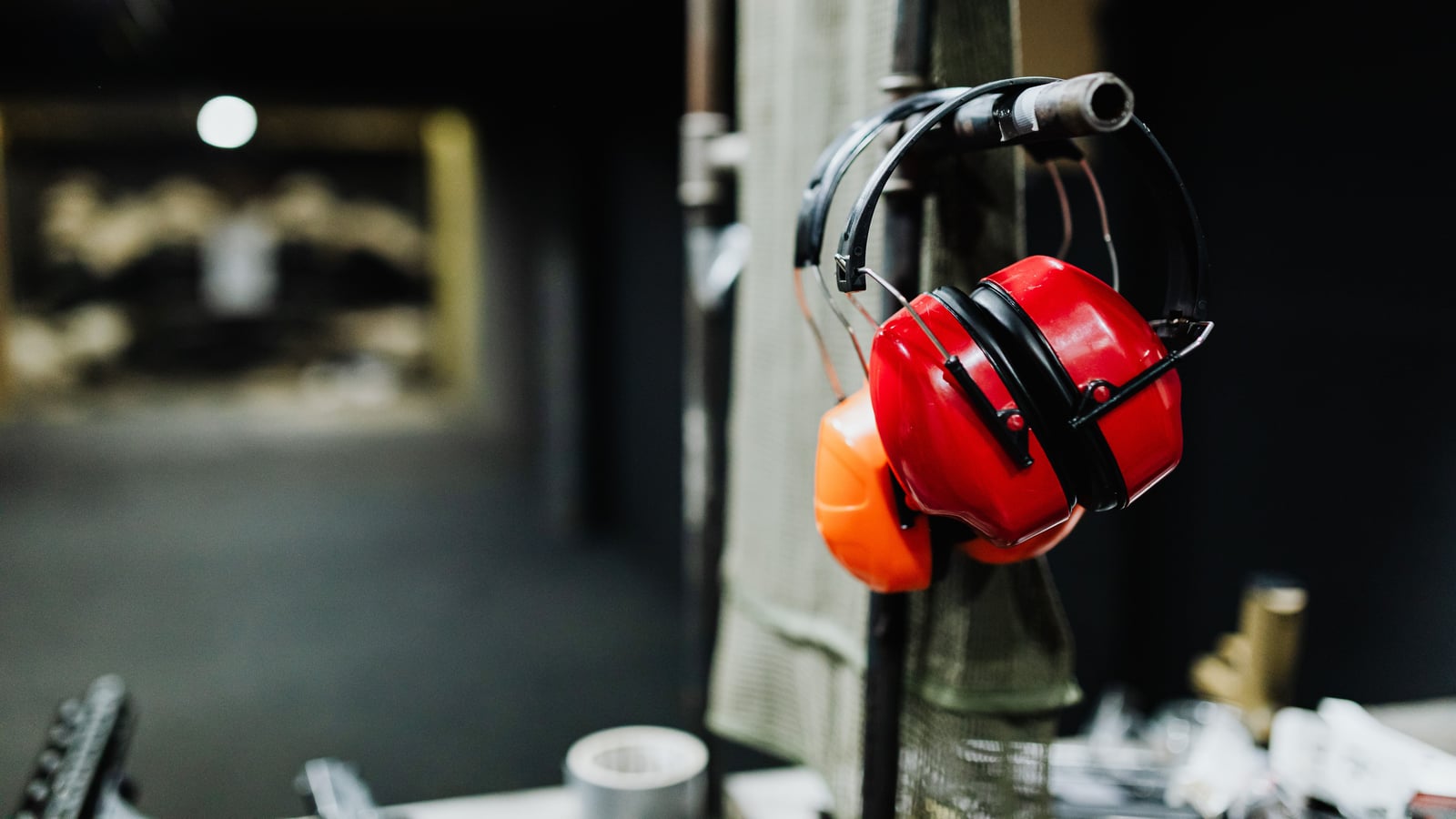
You can have the best rifle on the range and the cleanest trigger in the world, but if your protective equipment is poorly chosen, you’ll pay the price sooner or later. Hearing loss, a fragment in the eye, a powder burn on the forearm: these aren’t catastrophic scenarios, they’re ordinary incidents at a poorly equipped range.
This article takes full stock of what you need, why your body needs it, and in what order to invest when your budget is tight. No vague “buy some plugs and glasses” list: we’re going into the physiological detail and the real hierarchy of priorities.
We cover hearing protection in all its forms, eye protection against the three real risks on the firing line, clothing suited to each discipline, the specific needs of dynamic shooting, managing lead and residue, long-term maintenance, and finally the most common mistakes seen at the club. Enough to walk away with a clear checklist, not just a hunch.
Why hearing protection isn’t negotiable
A gunshot produces a sound pressure peak that far exceeds the human ear’s pain threshold, and that peak lasts barely a fraction of a second — more than enough to damage the hair cells of the cochlea. These cells don’t regenerate. Once destroyed, the hearing loss they cause is permanent.
The problem with a firearm’s noise is that it’s impulsive: unlike continuous noise (like a drill), the ear doesn’t have time to trigger its natural protective reflex, the stapedius reflex, which takes several tens of milliseconds to kick in. The pressure peak arrives before that reflex can act. That’s why no natural bodily protection is enough against a firearm, even outdoors, even with a single round fired.
Repeated exposure without protection doesn’t necessarily translate into sudden deafness. Most often, tinnitus sets in first, then a progressive loss of high frequencies, which makes understanding speech in noise harder long before you notice it in daily life. A shooter who trains regularly without protection for years loses part of their hearing without even realizing it, until the day they need to turn the TV up louder than everyone else.
Hearing protection is therefore not a comfort option: it’s the piece of gear that prevents irreversible, cumulative damage, invisible session after session.
Plugs, muffs, or double protection: what physics says
Foam or silicone earplugs attenuate sound by blocking the ear canal. Properly inserted, they offer decent attenuation, but their effectiveness depends entirely on how well they’re fitted: poorly inserted, they lose much of their protective value.
Earmuffs (external hearing protection) cover the entire outer ear and rely on the seal of the cup against the skull. Their attenuation is generally more stable over time than plugs, because it doesn’t depend on a precise insertion gesture, but it’s sensitive to anything that breaks the seal: glasses arms, long hair trapped under the cup, a poorly adjusted headband.
Double protection — plugs under muffs — doesn’t add the two attenuations in strictly arithmetic fashion, but the gain remains real and significant. It’s recommended on indoor ranges, where the sound of neighboring shots reverberates off walls and ceiling, increasing total sound exposure compared to shooting outdoors.
For rifle shooting with a powerful caliber, on indoor ranges, or for anyone firing several dozen rounds per session, double protection should be the norm rather than the exception. The cost of a pair of plugs is trivial compared to the cost of damaged hearing.
Electronic earmuffs: a real functional gain, not a gadget
Electronic earmuffs amplify faint ambient sounds (voices, range officer instructions, footsteps) through an internal microcircuit, while instantly cutting the amplification as soon as a sound exceeds a dangerous threshold, then restoring it between shots. The practical result: you hear safety instructions normally and communicate with other shooters, while staying protected the moment a shot goes off.
That’s a real advantage at the club, where understanding a real-time safety instruction (cease fire, incident on a neighboring lane) can make the difference. Classic passive muffs isolate you completely, which pushes some shooters to remove them between strings to hear — exactly the moment they expose their ears unprotected.
The extra cost of electronic muffs over passive ones is real, but it’s quickly justified for anyone who practices regularly or in a group. For an occasional shooter practicing alone on an outdoor range, passive muffs or good plugs do the job perfectly well.
One technical point deserves clarifying to avoid a common confusion: electronic muffs are not more powerful than passive ones at the moment of the shot itself. Their cutoff function above a dangerous threshold relies on an electronic circuit, which implies dependence on a battery. Electronic muffs with a weak or dead battery can behave in a degraded way at the worst possible moment, which means checking the charge level before every session rather than discovering it mid-shoot.
This electronic dependency is also why many experienced shooters keep a pair of classic plugs in reserve in their bag, independent of their electronic muffs. A weak battery or a malfunctioning headset should never become an excuse to shoot with no hearing protection at all: the backup plug, simple and electronics-free, remains the most reliable fallback in any circumstance.
Eye protection: against exactly what
Shooting glasses protect against three distinct risks, and it’s important to distinguish them to understand why they’re essential even when “everything goes fine.” The first risk is particle projection: powder residue, casing fragments, lead or copper particles that can be ejected backward or sideways depending on the firearm and ammunition.
The second risk concerns ricochets, particularly present in disciplines shooting at steel plates or clay targets, where fragments of the projectile or target can bounce back toward the shooter or neighboring shooters. The third risk, rarer but real, is mechanical failure: a bolt that ejects poorly, a case that ruptures, a local overpressure caused by defective ammunition.
A regular pair of prescription glasses doesn’t protect against these three risks: the lens isn’t designed to withstand impact, and the frame leaves open angles on the sides. Dedicated shooting glasses use an impact-resistant material (polycarbonate-type) and a wraparound shape that closes off the side angles. It’s this combination of impact-resistant lens and wraparound shape that makes the difference in the event of an incident.
Wearing eye protection must be systematic as soon as you’re on the firing line, including when you’re not shooting yourself but simply present next to an active lane. The risk doesn’t only come from your own firearm.
Vision correction adds a practical constraint you shouldn’t overlook. A shooter who wears prescription glasses must choose between protective overglasses worn over their usual correction, or shooting glasses with integrated prescription lenses, more comfortable long-term but generally pricier. Overglasses have the advantage of simplicity and compatibility with any existing prescription glasses, at the cost of slight discomfort and an increased fogging risk between the two stacked lenses.
Contact lenses avoid this stacking problem, but they offer no mechanical protection against a projection by themselves: they must always be paired with regular shooting glasses, exactly as for a shooter with no vision correction. Confusing visual correction with mechanical protection is a common mistake among beginners who wear contacts and wrongly believe they’re already covered.
Clothing: what your body takes and why cover it
Shooting generates heat and projections at specific points on the body, and appropriate clothing serves above all to protect these zones, not to look “nice” or “professional.” The first sensitive spot is the neck and neckline area on firearms with sideways or upward ejection: a hot casing landing in an open collar causes a superficial but painful burn, and the reflex to get it out immediately can cause a loaded firearm to swing off target.
A closed-collar shirt or a shooting scarf limits this risk by preventing the casing from lodging against the skin. It’s a detail many beginners discover the hard way, literally.
The second sensitive spot is the forearm and wrist of the support hand on slide-action firearms (semi-automatic pistols): a poorly positioned grip can end up in the slide’s path during recoil, with a risk of abrasion or bruising. A long sleeve of thick fabric offers minimal but real protection against this friction.
Finally, a closed shoe with a thin but stable sole is recommended for prone or kneeling rifle positions, where ground contact and stability of the rest directly contribute to accuracy, beyond simple comfort. An open shoe also exposes the foot to hot casings rolling on the ground after ejection.
Long hair also deserves a separate mention: tied back and gathered, it avoids getting trapped under the cup of earmuffs or between a glasses arm and the temple, two situations that compromise the seal of the protection without the shooter immediately noticing. It’s a simple, cost-free detail that many experienced female shooters apply systematically by reflex before settling on the firing line.
Specific protection for dynamic disciplines: what changes
In dynamic shooting disciplines (IPSC, Steel Challenge, USPSA), the shooter moves, changes position, and manipulates their firearm in situations where heart rate and physiological stress are higher than on a static firing line. Protective equipment must follow this context.
A cap or a stiff-brimmed visor protects the face from casing ejections that can come from a neighboring firearm on a multi-bay range, and also limits glare outdoors, which indirectly improves safety by keeping a clear view of cardboard targets and steel targets or plates on the course.
Light gloves, without being mandatory, protect the hands during rapid magazine manipulation and contact with metal surfaces heated by the sun or by previous shots on reactive plates. They must never compromise fine contact with the trigger: a glove that’s too thick degrades feel and increases the risk of imprecise manipulation.
The belt and holster worn in dynamic shooting demand real rigor in fitting: a poorly secured holster that moves during a movement is a direct risk factor, far beyond simple discomfort. It’s a point that club instructors systematically check before allowing a shooter to move around.
Manufacturers display attenuation ratings on their plugs and muffs, but these figures are measured in a lab under optimal conditions, rarely reproduced exactly on a real firing line. Poorly fitted muffs or badly inserted plugs can show a high rating on the packaging while offering markedly lower real protection once worn under imperfect conditions.
Too high an attenuation rating isn’t always desirable in every situation either: on a firing line where communication with a range officer or other shooters matters, excessive attenuation can isolate you to the point of making safety instructions inaudible, which pushes some shooters into the dangerous reflex of removing their protection to hear. The right choice therefore depends as much on the practice context (alone or in a group, indoor or outdoor range) as on the number printed on the box.
Rather than chasing the highest number on the market, it’s better to look for equipment whose fit truly matches your morphology: muffs that are too loose and don’t seal well, or plugs too small for your ear canal, will remain underperforming regardless of the advertised rating. Trying several sizes and models before buying, when possible at a specialty store, is far better than relying solely on a spec sheet.
An often-overlooked point concerns stacking with other head protection gear. A cap worn under earmuffs, or glasses arms too thick that slide under the cup, break the seal just as much as a stray strand of hair. The best test remains simple: if you feel an uneven pressure point or a thread of air passing under the cup when you move your head, the seal isn’t optimal and real attenuation suffers.
Without giving precise prices, which vary too much depending on the retailer, the model, and promotional periods, it’s possible to reason in relative orders of magnitude between the different pieces of equipment. A pair of basic foam plugs typically costs a small fraction of the price of dedicated shooting glasses, which in turn are generally cheaper than a decent-quality passive earmuff.
Electronic earmuffs sit well above these first two items, which explains why they come last in the priority hierarchy despite their genuine functional value. A beginner with a limited starting budget logically covers basic hearing and eye protection first, then progressively upgrades to more capable versions as their savings and practice intensity grow.
It’s also worth keeping in mind that the protective equipment budget doesn’t stop at the initial purchase: the periodic replacement of plugs, muff cushions, and scratched lenses must be budgeted as a recurring expense, not a one-time purchase made once and for all. A club can generally give you guidance on replacement frequency suited to the models it recommends or sells on site.
The secondhand market can also be a reasonable option for certain pieces of equipment, but not all. A used earmuff in good condition, with cushions still supple and an uncracked shell, can represent a sensible saving for a beginner. On the other hand, a used pair of shooting glasses with an unknown history of impacts or scratch exposure presents a risk that’s hard to assess: it’s better to buy new on that particular item, where the margin for error in the event of lens failure is smallest.
One last useful guideline for a tight budget: it’s better to own a single good-quality, well-maintained piece of equipment per protection category (one headset, one pair of glasses, one suitable outfit) than to accumulate several cheap pieces of equipment bought hastily and never really fitted to your morphology. Quantity never compensates for a poor fit.
Protection against lead and shooting residue
Shooting generates fine particles of lead and other heavy metals, particularly on poorly ventilated indoor ranges where air circulates little. These particles can settle on hands and clothing, and be inhaled in small quantities during the session itself.
The first simple and effective reflex is to wash your hands thoroughly after every session, before eating or touching your face, to limit accidental ingestion of residue. This basic gesture is widely underestimated, even though it costs zero euros and takes thirty seconds.
On busy indoor ranges, good ventilation of the premises is the club’s responsibility, but the regular shooter can supplement this with dedicated shooting clothes, washed separately, to avoid bringing particles home, particularly if there are children or a pregnant woman in the household. This is a general precaution, not a universal regulatory obligation, and it varies according to the health recommendations of the club and the federation.
Protection according to posture and firearm type
Precision shooting in the prone or kneeling position places heavy strain on the back during long sessions, especially with heavy rifles, where the weight of the firearm and the prolonged position create cumulative tension on the lower back. This isn’t an acute risk like noise or projections, but a wear-and-tear risk that builds up session after session.
A padded mat suited to the prone position reduces direct pressure on the elbows and pelvis, which limits postural fatigue and allows a stable position to be held longer without parasitic muscular compensation. A light lumbar support belt, used by some bench-rest or 300-meter rifle shooters during long sessions, can help limit fatigue during sessions that stretch over several hours.
This type of protection is secondary to hearing and eye protection, but it becomes relevant as soon as the frequency and duration of sessions increase, particularly for shooters practicing 300-meter shooting or bench-rest over extended sessions.
Priority hierarchy on a tight budget
Not every protection is equal in physiological urgency, and a beginner on a limited budget needs to know where to put their first dollars. Hearing protection comes first, without question: the damage it prevents is irreversible and cumulative, whereas a tight budget can always be topped up later.
Eye protection comes second, essentially tied in priority in practice since the two protections are inseparable on a firing line. A good basic pair of shooting glasses with impact-resistant lenses, even without advanced options, fulfills its essential function.
Suitable clothing (closed collar, long sleeve, closed shoe) comes next: it often costs zero extra dollars, since it’s simply a matter of choosing suitable clothing from your existing wardrobe rather than buying new. It’s the cheapest protection and the one most systematically neglected by beginners eager to get to the firing line.
Electronic earmuffs, advanced double hearing protection, and comfort accessories (lumbar belt, dedicated gloves) come last: these are real comforts and real functional gains, but they come after the hearing and eye fundamentals are covered, not before. A seasoned club shooter will always tell a beginner the same thing: basic plugs used properly at every session beat a high-end headset forgotten in the bag every other time.
Maintenance and lifespan of protective equipment
Protective equipment that ages poorly loses its effectiveness without this necessarily being visible to the naked eye. Foam plugs compress and lose density over time and repeated handling; they must be replaced regularly rather than reused indefinitely.
Passive earmuffs must be checked at the cushion level, which harden and crack with age and heat exposure, which compromises the seal against the skull and thus real attenuation. A cracked cushion must be changed, with most models offering cheap replacement cushions rather than requiring you to buy the whole headset again.
Shooting glasses must be inspected regularly for micro-scratches which, through repeated cleaning with unsuitable cloth, can weaken the lens over the long term and reduce its transparency in low light. Glasses that are visibly scratched or that have already taken an impact must be replaced without hesitation: their protective function isn’t visible to the naked eye once compromised.
The type of firearm changes the nature of the risk, even though the broad protection principles remain constant. With a rifle, case ejection generally happens to the side and forward, which limits the risk to the shooter’s own neck but exposes the neighboring shooter more if the lanes are close together. The length of the firearm also demands different space management: checking that the barrel never extends toward a neighboring bay during handling is a safety rule in its own right, independent of the equipment worn.
With a pistol, the proximity of the face to the slide and ejection port makes eye protection even more critical: the distance between the shooter’s eye and the ejection point is markedly shorter than with a rifle, which reduces reaction time in the event of an abnormal projection. This is one of the reasons why no pistol discipline should ever be practiced with a simple pair of sunglasses not certified for shooting.
In clay shooting disciplines, eye protection must also cope with the changing brightness of the sky: interchangeable lenses (light tint for overcast sky, darker tint for bright sun) improve perception of the clay in flight while retaining the basic protective function. This is one of the rare cases where the choice of lens tint has a direct impact on performance and not just on comfort.
Shooting with antique firearms or black powder adds an extra dimension: black powder combustion releases more visible residue and odor than modern powder, and some shooters choose reinforced, wraparound eye protection for this specific practice, in addition to even more systematic hand washing after the session.
Protection for instructors and young shooters
An instructor or experienced shooter supervising a beginner on the firing line is exposed to the same risks as the shooter themselves, sometimes more: they often stand closer to the firearm, in an observation or posture-correction position, without benefiting from the distance a shooter alone and focused on their own target naturally takes.
This proximity requires protective equipment identical to that of the supervised shooter, without exception and without “just for a few minutes.” An instructor who removes their headset to be better heard by the beginner exposes themselves to exactly the same hearing risk as an unprotected shooter, plus repeated exposure over an entire session with several beginners in a row.
In a club context, this reality justifies the fact that protective equipment isn’t seen as an optional personal item but as a prerequisite for access to the firing line, including for observation, safety, and instruction roles. A regional champion who volunteers to teach introductory courses generally applies this rule with the same rigor to herself as to her students.
The auditory pathways and ear canal of young shooters are still developing, which in theory makes them more sensitive to the cumulative effects of repeated sound exposure. The smaller morphology of the skull and outer ear also often requires specific sizes of headset or plugs, since a poorly fitted adult headset on a smaller head loses a significant portion of its seal.
Choosing correctly sized equipment therefore matters even more for a young shooter than for an adult: a headset that doesn’t close properly against the temples, even with good nominal attenuation advertised by the manufacturer, doesn’t protect as advertised once in a real situation on a smaller head.
Supervision by an instructor remains essential to check, before every session and not just at the initial purchase, that the fit remains correct: growth changes morphology over months, and equipment suited a year ago may no longer be so today. This is a point that clubs hosting youth sections take very seriously in their supervision.
Outdoor conditions and regulatory requirements
Weather conditions change how protective equipment functions, a point rarely discussed even though it concerns any year-round outdoor practice. In cold weather, thick gloves may be necessary for hand comfort, but they must stay thin enough at the index finger to maintain precise contact with the trigger; a glove unsuited to the cold pushes some shooters to shoot with unprotected hands, which isn’t a safety problem in itself but degrades comfort and thus concentration.
Rain poses a specific problem for eye protection: fog that forms on poorly ventilated lenses reduces visibility and pushes toward the dangerous reflex of removing protection to wipe the lens in the middle of an active firing line. Anti-fog treated glasses or ones with slight built-in ventilation limit this problem without compromising protection against projections.
In extreme heat, sweat degrades the seal of earmuff cushions against the skin, which progressively reduces real attenuation over the course of the session even if the headset stays correctly positioned. A regular check that the headset stays properly seated during hot, long sessions helps correct this loosening before it becomes significant.
Sports regulations governing competitions generally require wearing hearing and eye protection as a condition of access to the firing line, with requirements that can vary depending on the discipline and event organizer. These precise requirements (minimum attenuation level, lens certification standard) vary by federation and specific competition rules, so it’s better to check the rules of the discipline concerned and the club’s internal regulations rather than rely on a supposedly universal general rule.
At the club, outside any competition, internal rules generally set their own minimum protection requirements, sometimes stricter than the federal minimum out of caution by local management. These internal rules must be asked about directly at your club, as they vary from one facility to another depending on the type of range, its layout, and the disciplines practiced there.
The general principle remains constant everywhere: hearing and eye protection is a prerequisite for access to the firing line, not an option left to the shooter’s individual judgment, regardless of skill level or how long they’ve held a license.
Common mistakes seen at the club
The first classic mistake is removing your earmuffs between strings to “catch your breath” or chat, on a firing line where other bays remain active. The noise of an unanticipated neighboring shot, at that exact moment, exposes the ear with no margin of protection whatsoever.
The second mistake is wearing personal prescription glasses without side protection, thinking they’re enough because they cover the eyes. A regular frame leaves completely open angles on the sides, exactly where most projections in shooting arrive.
The third mistake is under-sizing hearing protection on an indoor range out of habits picked up outdoors: sound reverberation off the walls increases real exposure well beyond what the same firearm would produce outdoors. An experienced club instructor often reminds people that an indoor range systematically demands more protection, never less.
The fourth, more insidious mistake is treating protective equipment as a done deal once purchased, without ever checking its condition or fit. A poorly adjusted headset or badly inserted plugs give a false sense of security, which is almost worse than no protection at all since the shooter lowers their guard thinking they’re covered.
The fifth mistake, common among shooters starting out at a club after practicing alone, is underestimating the noise generated by neighboring bays on a shared firing line. A shooter focused on their own firearm and caliber doesn’t always realize that the bay next door may be using a noticeably louder firearm, which justifies keeping protection on continuously for the entire time spent on the firing line, not just during one’s own shots.
FAQ
Q: Is a classic passive headset enough, or should you always use double protection? A: For occasional outdoor shooting with a moderate-caliber firearm, a headset alone or good plugs are generally enough. Double protection becomes recommended on indoor ranges, with a powerful caliber, or for long and frequent sessions.
Q: Do corrective prescription glasses protect enough on a firing line? A: No, unless they incorporate impact-resistant lenses and a shape covering the sides. There are protective overglasses to wear over regular prescription glasses, a common and affordable solution.
Q: At what practice frequency does electronic headset become really worthwhile? A: As soon as you practice regularly at a club or in a group, where hearing real-time safety instructions matters as much as protection itself. For occasional and solo practice, a passive headset does the job just fine.
Q: Do you need different equipment depending on the discipline practiced? A: The hearing and eye fundamentals stay the same everywhere, but dynamic disciplines add specific needs like a visor, light gloves, and a well-secured holster, while long-distance rifle adds postural comfort considerations.
Q: Is the price of protective equipment a good quality indicator? A: Not systematically: price varies by club, retailer, and model, but basic protection that’s well fitted and well maintained beats high-end equipment used poorly. Consistency of use matters more than the budget invested.