Para-shooting, a discipline in its own right
Para-shooting is not a simplified version of classic sport shooting. It’s a fully-fledged Paralympic discipline, with its own classification rules, its own events, and its own competition calendar. It has been on the Paralympic program for several decades, making it one of the best-established disciplines in the Paralympic movement.
In France, para-shooting falls under the Fédération Française de Tir (FFTir), which has set up dedicated structures to welcome shooters with disabilities within the standard federal circuit rather than in a separate track. This integration changes how a shooter with a disability discovers the discipline: they join an ordinary FFTir club, with support adapted to their needs.
The fundamental principle of para-shooting rests on technical compensation and sport classification, not on relaxed accuracy requirements. A shooter classified in para-shooting has to reach the same level of precision as an able-bodied shooter in the same discipline; what changes is the support, position, or technical assistance authorized to compensate for a given physical limitation.
This article details the classification system, the disciplines open in official competition, and the structures that let a shooter join this circuit in France.
The principle of sport classification
Sport classification is the foundation that makes competition fair between shooters with very different disability profiles. Without it, a shooter with a mild impairment would end up competing against a shooter with a more severe impairment of the same limb, which would completely distort the sporting result.
The system relies on a medical and functional evaluation carried out by accredited classifiers. This evaluation isn’t limited to a medical diagnosis: it measures the shooter’s actual function in a shooting situation, meaning their ability to stabilize a firearm, operate the trigger, and hold a shooting posture for the duration of an event.
Every classified shooter receives a sport category that determines which competition group they shoot in and what compensation equipment they’re allowed to use. This category isn’t fixed for life: a classification can be reviewed if the shooter’s physical condition changes, in either direction.
There’s an essential distinction between two major families of classification used in international sport shooting:
- A classification linked to the nature of the disability (upper-limb impairment, lower-limb impairment, mixed impairment, trunk balance disorder).
- A classification linked to the actual functional level observed during testing, independent of the original medical diagnosis.
This dual approach prevents an identical diagnosis on paper from masking very different functional abilities from one shooter to another. Two people with the same condition can end up in distinct sport categories if their actual function diverges.
The international SH1 and SH2 categories
International Paralympic shooting mainly uses two broad classification categories, designated SH1 and SH2. Understanding this distinction is essential to placing a given shooter within the competitive landscape.
The SH1 category covers shooters able to carry and stabilize the weight of their firearm unaided, whether rifle or pistol, without needing a fixed support to hold it in shooting position. This category covers a wide range of disabilities affecting the lower limbs, trunk balance, or a partial impairment of an upper limb.
The SH2 category covers shooters who lack sufficient muscular function in one or both arms to carry the rifle’s weight unaided, and who therefore need a fixed mechanical support to hold the firearm in aiming position. This support never fires in place of the shooter: it only stabilizes the weight of the firearm, while aiming and trigger release remain entirely the shooter’s own action.
This SH1/SH2 distinction applies mainly to rifle events, where prolonged carrying of the firearm is the main limiting factor. Pistol events follow a different classification logic, centered on the ability to grip and stabilize a lighter firearm at arm’s length.
One point deserves clarifying: classification never presumes anything about a shooter’s sporting performance level. A regional champion classified SH2 can post higher scores than a less experienced SH1 shooter; the category organizes fairness in competition, it doesn’t rank sporting value.
Some international federations add subgroups within the SH1 and SH2 categories themselves, to further refine comparability between disability profiles that are close but not identical. A shooter classified in a given subgroup then competes against functional profiles very close to their own, which further strengthens the fairness of the final ranking. These subgroups aren’t systematically applied to every competition; their use depends on the specific rules of the event and the level of competition involved.
A shooter classified for the first time often finds that their final category is only confirmed after several different functional tests, carried out by the classifier in real shooting position, rifle or pistol in hand depending on the discipline targeted. This rigorous protocol explains why an initial classification can take longer than expected, particularly when the shooter’s functional situation sits at the boundary between two categories.
Rifle disciplines in para-shooting
The rifle remains the flagship discipline of para-shooting, with several official events directly inspired by classic Olympic formats, adapted to positioning and stabilization constraints.
The 10-meter prone event is often the entry point into competition, since the prone position is the most stable and accessible for a wide range of disability profiles. The shooter aims at a fixed target with an air rifle, in a format that rewards consistency of technique over a large number of shots.
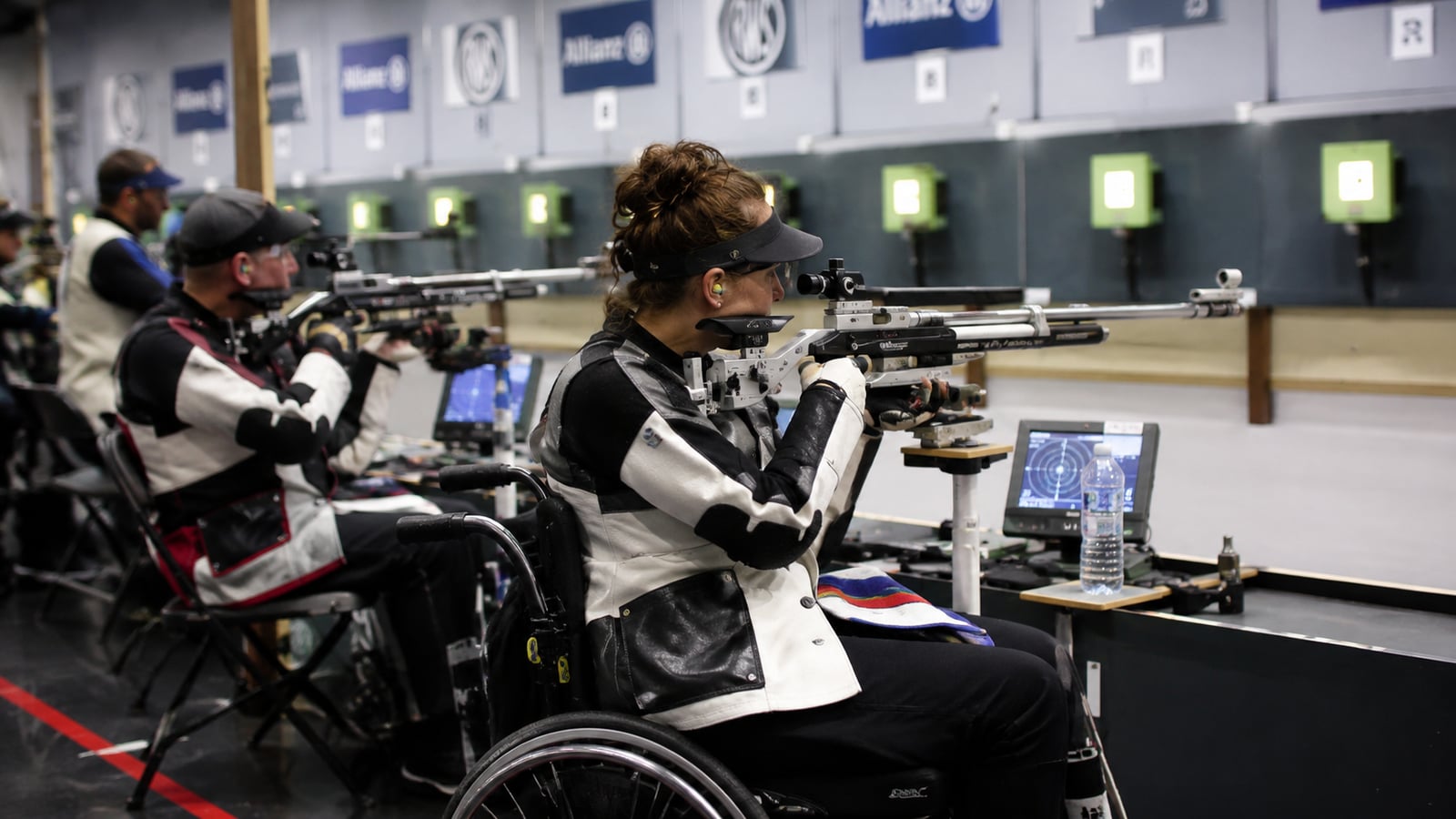
Seated events have developed significantly in recent years, particularly for shooters who use a wheelchair as a stable shooting post. Wheelchair stability then becomes a technical parameter in its own right, just as much as tuning a rifle for a standing shooter.
At longer distances, some national competitions offer 50-meter events that follow the standards of classic precision shooting, with position baskets adapted to the shooter’s classification category. These events demand significant postural endurance, particularly for shooters holding a prolonged prone or seated position.
Authorized compensation equipment varies by category: support straps, padded rests, wheelchair floor-anchoring systems, or rifle supports for shooters classified SH2. Every piece of compensation equipment must be certified before the competition, which avoids disputes on the day of the event.
Pistol disciplines in para-shooting
The pistol holds an equally structured place in the para-shooting circuit, with events testing pure precision rather than the postural endurance demanded by the rifle.
The 10-meter air pistol event is the most widespread event internationally. It’s shot standing or seated depending on the shooter’s classification, at a fixed target, with a number of shots set by the competition format.
For shooters who only have functional use of one arm, specific grip adaptations exist, including custom-molded grips and holding systems that never alter the shot’s trajectory, only the way the firearm is held. These adaptations are subject to certification, exactly like rifle compensation equipment.
Some national competitions also offer 25-meter pistol events, following a format close to classic rapid-fire shooting but with time constraints adjusted to the shooter’s sport category. These events remain less common than the 10-meter one, due to a lack of suitable infrastructure in every club.
Contrary to a common assumption, pistol classification isn’t limited to upper-limb impairments. A shooter with a trunk balance disorder can very well compete in pistol, since core stability plays a decisive role in holding a firearm at arm’s length for the duration of a string.
Disciplines open in official competition in France
At the French level, the FFTir organizes a para-shooting competition calendar structured around several levels: club competitions, regional championships, French championships, and selections for international circuits.
The events most frequently on the national calendar are 10-meter rifle prone and seated, 10-meter pistol standing and seated, plus some 50-meter events for shooters classified at a sufficient competitive level. The number of events offered in a given region depends directly on the number of clubs equipped with adapted ranges.
A shooter starting out in competitive para-shooting generally begins with club or departmental competitions before considering a regional championship. This step-by-step progression makes it possible to get familiar with the competition format, time constraints, and managing match stress, in a less demanding setting than a French championship.
Access to official competitions requires an FFTir license with an up-to-date sport classification, issued after being seen by an accredited classifier. This classification generally needs to be renewed at regular intervals, since the federation wants to make sure the assigned category still reflects the shooter’s actual functional situation.
An experienced coach who supports para-shooters often stresses one point: classification isn’t an administrative hurdle to endure, it’s a tool that guarantees a fair competition. A shooter who understands their category and the reasoning behind it approaches competition with far less apprehension than one who simply endures it without understanding the logic.
The format of competitions also varies by the level targeted. A club competition is often limited to a single discipline over one morning, with a reduced number of strings and a deliberately less formal atmosphere than a regional championship. A French championship, by contrast, usually spans several days and brings together several disciplines and categories on the same weekend, which requires much heavier logistical organization for shooters traveling from far away.
This difference in format directly influences a shooter’s preparation: training for a club competition doesn’t demand the same energy and timing management as a multi-day championship, where effort and concentration have to be spread across several consecutive events. A shooter discovering this reality for the first time often benefits from watching a competition at that level before taking part, simply to get familiar with the rhythm of the day.
Compensation equipment, its certification, and dedicated structures
Compensation equipment is the most visibly distinctive feature of a para-shooting event compared with a classic one. It’s never an additional technical advantage, but a strict compensation for a physical limitation documented by classification.
The most common equipment includes fixed rifle supports for SH2 shooters, torso or arm stabilization straps, shooting wheelchairs with floor-anchoring systems, and pistol grips adapted to a partial grip. Each piece of equipment is tied to a precise classification category and can’t be used outside of it.
Equipment certification generally happens before the competition, during a technical inspection where a referee or delegate checks that the equipment complies with the shooter’s category. This inspection protects the fairness of the event as much as it protects the shooter from a later dispute over their result.
One point many shooters discover late: changing compensation equipment mid-season can require new validation from the classifier, particularly if the change noticeably alters the stability achieved. It’s better to plan these steps several weeks ahead of an important deadline rather than discovering them the day before a championship.
The cost of compensation equipment varies a lot depending on how much custom fitting is needed; it depends heavily on the club, the manufacturer, and the level of adaptation required, so it’s best to check directly with your federal structure rather than rely on a generic figure.
Para-shooting in France relies on a network of certified clubs with accessible infrastructure and coaches specifically trained to support shooters with disabilities. This certification guarantees a minimum baseline of accessibility: wheelchair-accessible ranges, adapted restrooms, and the presence of trained staff.
Beyond the range’s physical accessibility, these clubs often have compensation equipment available on loan, letting a newcomer discover the discipline before investing in their own gear. This discovery phase is valuable because it allows testing several configurations before settling on a lasting choice.
The FFTir also works with the Comité Paralympique et Sportif Français to identify and support shooters with potential on their path toward international circuits. This bridge between the national federal level and the international level structures the path of a shooter aiming for selection to the French national team.
An established club shooter who turns to competitive para-shooting after an injury or accident often benefits from specific support for their sporting transition, distinct from the path of someone who discovers shooting directly in a situation of disability. Adaptation needs aren’t the same depending on whether shooting practice predates or follows the onset of the disability.
The sporting environment plays a decisive role in a competitive para-shooter’s success, even more so than in classic sport shooting because of how technical the compensation equipment can be. A coach trained in para-shooting knows how to adjust a position, a support, or a strap based on the shooter’s feedback, without imposing a standard configuration that wouldn’t suit their build or actual function.
The club also plays a networking role: talking with other shooters classified in the same category often helps uncover tuning tips or session-organization tricks that a coach alone might not necessarily have identified. This collective dimension of para-shooting is regularly cited by practitioners as a progress factor just as important as individual training.
Finally, communication between the shooter, the classifier, and the coach needs to stay continuous throughout the season, particularly if the shooter’s physical condition changes. A classification that no longer matches the shooter’s functional reality can have direct consequences on their competition ranking, in either direction.
The competition calendar and progression
The para-shooting calendar in France broadly follows the rhythm of the classic federal calendar, with a competition season spanning most of the year, punctuated by regional and national highlights. This varies by region though, depending on the number of equipped clubs and the availability of facilities.
A French para-shooting championship brings together the SH1 and SH2 categories across rifle and pistol events, with separate rankings for each category and sometimes by age bracket. This organization guarantees that every shooter is compared against genuinely comparable profiles within their own category.
For a shooter aiming for progression toward the international circuit, the first step remains building a regular track record in national competitions, generally a necessary condition for being spotted and offered a place at a talent-identification camp. A well-mapped-out progression path also helps structure training priorities from one season to the next.
Rigorously keeping a shooting logbook takes on particular importance here: documenting every session, every compensation equipment setting, and every competition result lets a shooter objectify their progress and discuss their settings concretely with their coach, rather than relying on a subjective impression of current form.
Selection to the French para-shooting national team follows precise sporting criteria, set each season by the federation in coordination with Paralympic bodies: ranking at national championships, results in international competitions already contested, and consistency of the shooter’s sport classification. These criteria can evolve from one Paralympiad to the next, so it’s best to refer directly to the current federal texts rather than to a supposedly fixed rule.
A shooter selected to the national team then joins a reinforced support structure, with easier access to national training camps and more advanced technical support than at club level. This step nevertheless remains the culmination of a long journey, built over several seasons of regular competition rather than a single isolated result.
Common early-stage mistakes and team events
A shooter discovering competitive para-shooting often makes the same mistakes as a classic beginner, amplified by the added complexity of classification and compensation equipment.
The first mistake is neglecting to validate classification before registering for an official competition. Without an up-to-date classification, a shooter can’t compete in their actual category, which can delay their entry into official competition by several months.
The second common mistake is changing compensation equipment right before an important deadline, without leaving enough training sessions to adapt to the new setup. A rifle support or a holding strap can change the feel of shooting quite significantly, and this adaptation time should never be underestimated.
The third mistake is underestimating the postural endurance needed for long formats, particularly for 50-meter events or high-volume matches. A shooter who only trains in short sessions often discovers in competition that their position deteriorates after the first few dozen shots, which directly affects the consistency of the grouping.
Finally, many shooters neglect the mental dimension specific to para-shooting competition, where managing preparation time between each shot can differ noticeably from a classic event. Mental preparation adapted to these time constraints often makes the difference between a shooter who handles their match calmly and one who rushes.
Beyond individual events, the French para-shooting circuit is gradually developing team formats, where several shooters from the same club or regional selection add their scores together on the same event. This format changes the dynamics of competition: individual performance still matters, but the group’s collective consistency counts just as much.
Team events sometimes mix shooters from different classification categories within the same ranking, using a coefficient system that adjusts each shooter’s score according to their category. This weighting mechanism is separate from the classification system itself: it doesn’t change the shooter’s category, it only adjusts the score comparison in a mixed configuration.
A club fielding a para-shooting team needs to plan for this scoring method well ahead of the competition, since it directly influences team-composition strategy. An experienced coach often balances a team between a very consistent shooter and a younger one still progressing, to smooth the overall score across the whole event rather than relying on a single strong element.
These team formats also play an important role in social integration, particularly for shooters discovering competition after a recent injury. Competing alongside a group reduces the individual pressure felt at a first official participation, which often eases the transition from club training to actual competition.
Physical preparation and progress tracking
Physical preparation for a competitive para-shooter differs noticeably from that of an able-bodied shooter, particularly around postural endurance and managing residual muscular fatigue. Core strengthening plays a central role, whatever the classification category.
For an SH1-classified shooter who carries the weight of their own rifle, regular core and shoulder-strengthening work helps delay the onset of fatigue tremors toward the end of a string. This work usually happens off the range, alongside shooting sessions, and requires weekly consistency rather than one-off preparation before a deadline.
For an SH2-classified shooter relying on a fixed support, physical preparation focuses more on torso stability and breath control, since the arm no longer has to support the weight of the firearm. The trigger release still demands fine finger precision though, which justifies specific dexterity work independent of the rest of the body.
A physiotherapist or physical trainer familiar with adapted sport can fine-tune this work to the shooter’s individual situation, but this depends heavily on locally available resources. Some regional committees set up shared support for several para-shooters in the same area, allowing this kind of rare expertise to be shared across several clubs.
Managing sleep and general fatigue deserves particular attention for a shooter whose physical condition already imposes a daily load. A shooter who arrives tired at a competition often compensates less well for small position variations than a rested one, which directly translates into a wider spread of the grouping toward the end of a match.
Documenting one’s practice takes on an even more strategic dimension in competitive para-shooting, since there are more variables to track than in classic shooting: support setting, exact wheelchair position, strap tension, on top of the usual aiming and breathing parameters.
A shooter who systematically notes the exact configuration of their compensation equipment at every session can identify much faster which setting produced which result, rather than rediscovering by trial and error an effective configuration forgotten weeks earlier. This documentary discipline becomes a real competitive advantage over the course of a season.
Numerical tracking also helps objectify the conversation with the classifier during a category review. A detailed history of sessions and results provides concrete elements for discussing an evolution in physical function, rather than a simple declarative impression that’s hard for the evaluator to assess.
Finally, comparing session-to-session results helps distinguish a performance dip caused by fatigue or stress from an equipment-setting problem, an essential distinction for adjusting a shooter’s preparation before an important deadline rather than changing several parameters at once without a method.
The move from recreational shooting to competition, and available support
Many shooters with disabilities discover sport shooting in a purely recreational setting, with no initial intention to compete, before taking the step toward the official circuit after a few months or seasons of regular practice. This path deserves to be spelled out, since the administrative and sporting steps differ noticeably between the two settings.
In recreational practice, a shooter trains freely at their club, with support from a coach but without a formalized sport classification. This phase allows testing different disciplines, positions, and types of compensation equipment without the pressure of an official ranking, making it a valuable step before any competitive commitment.
Moving to competition involves several concrete steps: obtaining an official sport classification from an accredited classifier, updating the federal license to note that classification, and certifying the compensation equipment used. These steps take time, which is why it’s recommended to start them several months before the first targeted competition rather than at the last minute.
An experienced coach generally advises taking part first in an internal club competition, outside any federal ranking stakes, to assess how the shooter handles stress and match format before committing to an official competition. This intermediate step, sometimes called a practice match, noticeably reduces apprehension before a first real competitive start.
The decision to move into official competition always remains personal and should never be presented as a mandatory progression. Many shooters practice para-shooting for years as pure recreation, with a regularity and enjoyment just as legitimate as a competition-oriented path.
Practicing competitive para-shooting involves specific costs tied to compensation equipment, travel to equipped clubs, and sometimes additional paramedical support. Several support schemes exist to ease this burden, even though their availability varies a lot from one region to another.
Some regional sports federations and some disability-sport committees offer occasional support toward purchasing compensation equipment or covering travel to distant competitions. These schemes depend on budgets allocated each season and priorities set locally, so it’s best to check directly with your regional committee rather than rely on a general rule.
Local authorities sometimes offer similar support for license holders residing in their area, particularly when a shooter represents their town or department at a national competition. This type of support remains highly variable and depends largely on local sports policy at the time.
At club level, pooling compensation equipment among several practitioners often helps reduce the cost of entering the discipline. A club with several rifle supports or several types of holding straps available on loan lets a new shooter test different configurations before investing in personalized equipment.
An often-overlooked point concerns human support: a shooter starting out in competitive para-shooting benefits greatly from informal mentoring by a more experienced practitioner at the same club, able to share their concrete experience of the classification process and first competitions. This companionship, though not institutionalized, remains one of the factors shooters cite most often to explain a successful integration into the competitive circuit.
Officiating and how a para-shooting event unfolds
The running of a para-shooting event follows a precise officiating framework, adapted to account for the time and equipment constraints specific to each classification category, without ever relaxing the accuracy requirements expected.
Before the event begins, a technical inspection checks that the compensation equipment matches the shooter’s declared category. This inspection covers the rifle support, holding straps, wheelchair configuration, or any other equipment subject to certification. A referee can reject non-compliant equipment, which underlines the value of getting your equipment validated well before match day.
During the event, some categories benefit from adjusted preparation or shooting time, particularly for shooters who need to set up a fixed support or stabilize a complex position before each string. This time adjustment is precisely defined by the category’s rules and is strictly monitored by the referees present on the firing line.
A judge or referee trained in para-shooting knows the specifics of each classification category and can tell an authorized assistive gesture apart from help that doesn’t comply with the rules. This officiating expertise is as valuable to the shooter as to the organization, since it prevents after-the-fact disputes over misinterpreted rule points.
In the event of a dispute over interpreting a rule or the compliance of equipment, the appeal procedure follows the standard federal framework, with a precise deadline for filing a substantiated complaint with the competition jury. A shooter or support person who anticipates this framework before the competition avoids a lot of unnecessary tension on match day.
FAQ
Q: Do you need a specific medical certificate to register for competitive para-shooting? A: Yes, an evaluation by an accredited classifier is required to obtain the official sport category, in addition to the standard medical certificate required for any sport shooting practice. The exact process varies by federal structure, so it’s best to check directly with your club or regional league.
Q: Can a shooter change classification category over the course of their career? A: Yes, classification can be reviewed if the shooter’s functional condition changes, in either direction. This review always goes through a new session with an accredited classifier, never a simple declaration by the shooter.
Q: Does compensation equipment cost more than classic shooting equipment? A: It depends heavily on the level of custom fitting needed and the manufacturer chosen; some equipment is close to standard pricing, other pieces need a more expensive individualized adjustment. It’s best to check directly with your club, which often has loaner equipment to test before you invest.
Q: Can you practice para-shooting at any FFTir club? A: Not automatically: competitive practice requires accessible infrastructure and trained support staff, mainly available at clubs certified for para-shooting. A club that isn’t equipped can still direct a newcomer to the nearest structure with suitable facilities.
Q: Does SH1/SH2 classification also apply to pistol? A: The SH1/SH2 distinction mainly concerns rifle events, because of the prolonged carrying of the firearm. Pistol follows its own classification logic, centered on grip and torso stability, with its own equipment adaptations.
Q: How do you know if you’re ready for a first official competition in para-shooting? A: The main criterion remains consistency at the club level in the targeted format (rifle or pistol, position, and distance), validated by the coach who oversees the sessions. Starting with a departmental or club competition before considering a regional championship remains the most sensible progression.