Sport shooting, a naturally accessible discipline
Shooting is one of the rare sports where disability closes almost no doors. Unlike disciplines that require overall body mobility, sport shooting relies on stability, breathing, and fine trigger control. These qualities don’t depend on your ability to run, jump, or carry weight.
This characteristic explains why shooting has been part of the Paralympic Games since their very first edition in Rome in 1960. This long history has allowed the discipline to develop a mature classification framework, tested over several decades, well before other Paralympic sports structured theirs.
At club level, para-shooting refers both to a recreational practice open to anyone with a disability, and to a supervised competitive pathway with its own categories. The two coexist without opposition: a shooter can practice purely as a hobby their entire life without ever seeking sport classification, and vice versa.
What strikes an instructor supervising a shooter with a disability for the first time is how minimal the necessary adaptations often are. A different support, a strap, a seated position instead of standing: the technical act of aiming and managing the trigger remains fundamentally the same for everyone.
This article covers the sport classification used in official competition, equipment and position adaptations depending on the type of disability, and the disciplines actually open under the FFTir’s authority. The goal is to give a clear picture to a concerned shooter, a relative, or an instructor who wants to better support this population.
The term “para-shooting” itself deserves clarification, since it covers two overlapping uses in practice. Broadly, it refers to any practice of sport shooting by a person with a disability, regardless of level or goal. More narrowly, in a competitive context, it refers specifically to the classified pathway that follows the international sport classification rules inherited from the Paralympic movement.
This distinction isn’t just a nuance of vocabulary. A shooter discovering shooting at a club under the label “para-shooting” sometimes wrongly thinks they must immediately enroll in an official classification process to have the right to shoot. That’s never the case: the vast majority of para-shooting practice happens outside any classification, in a recreational setting as easy to access as for any other beginner shooter.
Sport classification: general principles
Paralympic shooting and para-shooting in general rest on a central principle: classifying shooters by functional category rather than by type of disability. Two shooters with very different medical diagnoses can end up in the same category if their functional ability to hold a firearm and a position is comparable.
This functional logic avoids two pitfalls. First, it prevents a system fixed on medical diagnoses from quickly becoming obsolete or unfair given the real diversity of situations. Second, it guarantees sporting fairness: competition pits shooters with comparable physical constraints against each other, not administrative labels.
The classification schematically distinguishes two broad families recognized in Paralympic shooting: standing shooters with a disability affecting grip, balance, or a limb, and wheelchair shooters who shoot seated with or without back support depending on their level of trunk impairment.
A shooter who needs support to stabilize their wheelchair or torso is generally classified in a category that allows this support, while a shooter whose trunk remains stable without help competes in a category without compensatory support. This distinction prevents an equipment advantage from skewing the comparison between two different functional profiles.
At club level, outside classified competition, this rigor is largely relaxed. An instructor adapts on a case-by-case basis, without an official classification grid, simply seeking the most stable and safest position for each shooter. Strict sport classification really only comes into play once a shooter wants to compete in an approved framework.
An often little-known aspect of this functional classification is its evolving nature. A shooter whose physical condition changes over time, whether improving or deteriorating, can be reassessed and reclassified into a different category. This mechanism ensures the classification remains a faithful reflection of actual functional capacity at the time of competition, rather than a label fixed from the first assessment onward.
This periodic reassessment is generally accompanied by an appeal procedure if a shooter or club disputes a classification deemed unsuitable. This appeal mechanism, although rarely used in practice, exists precisely to prevent an initial assessment error from permanently penalizing a shooter over several competitive seasons.
The main groups of disability involved
Para-shooting welcomes very varied profiles, and each calls for different adaptations. Shooters with reduced mobility of the lower limbs, who practice in a wheelchair, represent a significant share of the discipline and benefit from a well-documented equipment framework.
Shooters with an impairment of an upper limb, whether congenital or acquired, need adaptations centered on grip and weapon balance. Some shoot with a single arm and a support strap, others use a fixed support that compensates for the missing counter-support of the missing arm.
Shooters with low vision or blindness practice a discipline in its own right, with sound-based aiming systems that entirely replace classic optical sighting. This is arguably the most spectacular adaptation in para-shooting, as it radically transforms how the shooter perceives their target.
People with a motor disability affecting trunk balance, following a neurological impairment for example, benefit from support and strap systems that stabilize the seated posture without replacing the shooter’s remaining muscular work.
Finally, some clubs also welcome shooters with a cognitive disability or intellectual impairment, in an approach geared more toward leisure and inclusion than toward high-level classified competition. Supervision here emphasizes repetition of the movement and safety above all.
There are also so-called “multiple disability” profiles, combining several types of functional limitations at once, for example a motor impairment associated with a grip difficulty. These situations require a tailor-made adaptation combining several already described solutions (strap, fixed support, seated position) rather than a single standardized answer. An instructor supervising this type of profile usually works hand in hand with a physiotherapist or occupational therapist to refine the position over sessions.
This multidisciplinary work, when possible, clearly improves the quality of the adaptation compared to a purely empirical approach led alone by the club. Some rehabilitation centers have even developed lasting partnerships with local shooting clubs, which eases the transition between medical follow-up and independent sports practice.
Position adaptations: the wheelchair
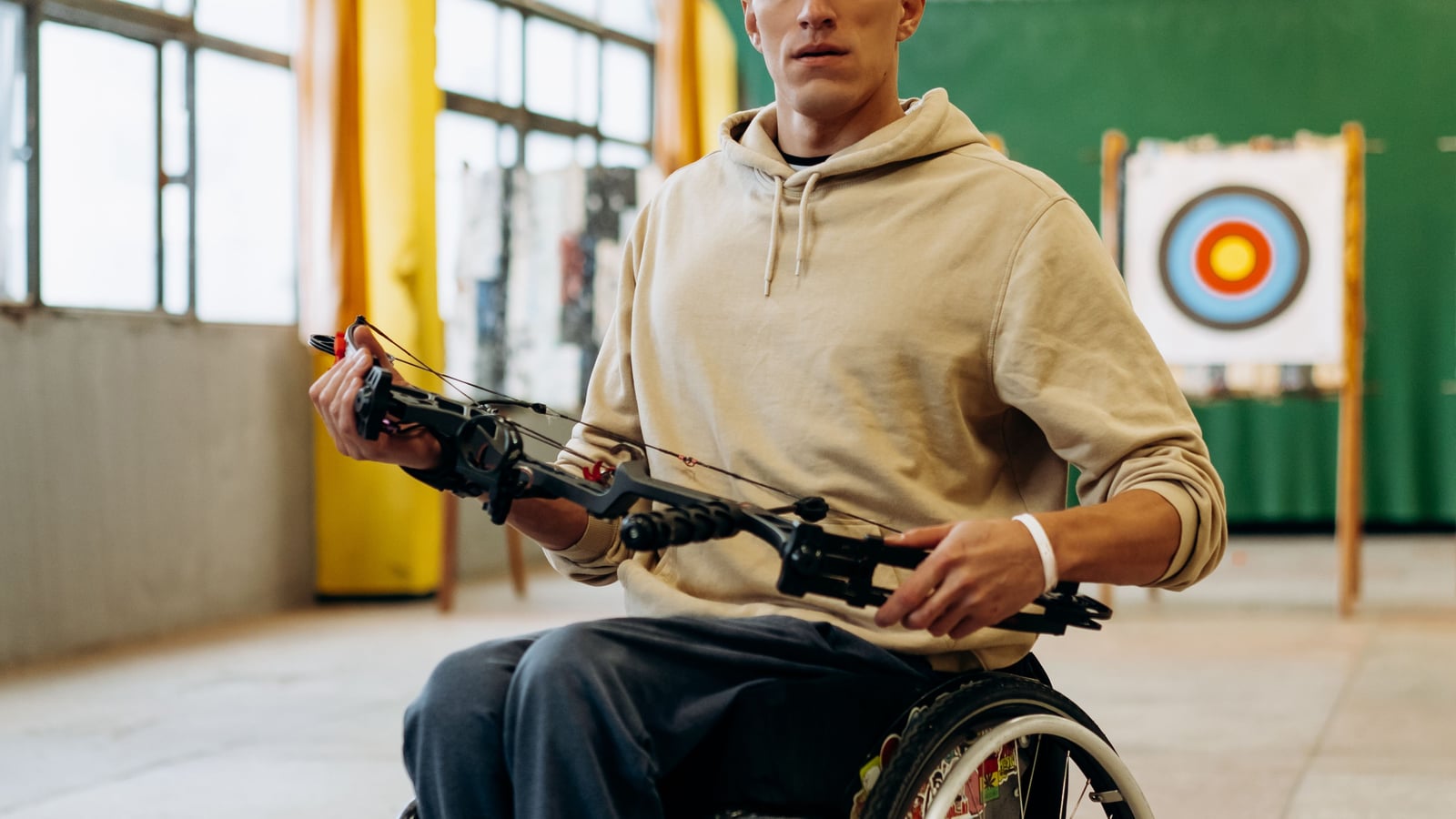
Wheelchair shooting is probably the best-known image of para-shooting, and for good reason: it’s an extremely technically accomplished configuration. The shooter’s wheelchair isn’t their everyday chair but often a specific competition chair, more stable and precisely positioned on the firing line.
With lower-body stability absent or reduced, all the work of managing recoil and stability falls on the upper body, the arms, and, when allowed by the classification category, on back support or a strap system. This weight shift completely changes how the shooter must manage breathing and firearm placement.
A key technical point: the wheelchair must be positioned and set rigorously identically at every session and competition, since the slightest variation in angle or height changes the sightline disproportionately compared to a standing shooter, who can more easily correct their position by adjusting their footing.
Some wheelchair shooters use a tray or armrest attached to the chair to relieve muscle fatigue during long shooting strings, particularly in rifle, where the number of rounds fired in competition can be high. This type of accessory is governed by classification rules to prevent it from becoming an excessive advantage.
Access to the firing line itself is among the adaptations to anticipate at the club: passage width, absence of a step, height of the loading bench. A range that has never hosted a wheelchair shooter often discovers these details on the first visit, hence the value of notifying the club in advance.
Loading the firearm poses a concrete practical question for a wheelchair shooter: the height of the loading bench or table, originally designed for a standing shooter, isn’t always suited to a seated position. Some ranges have a height-adjustable bench, others don’t, which sometimes forces the shooter to make do with a loading station slightly less comfortable than their shooting position itself.
The matter of case ejection also deserves anticipation: in a seated position, the ejection path of a semi-automatic firearm may end up closer to the body or the wheelchair than for a standing shooter. An attentive instructor checks this point from the very first sessions, adjusting the firing angle or the shooter’s position on the line if needed.
Position adaptations: upper-limb impairment
For a shooter with only one functional arm, the most common adaptation is using a support strap that stabilizes the firearm against the shoulder or torso, particularly in rifle, where the weight of the firearm over the course of a string weighs more heavily than for a pistol.
In pistol shooting, a shooter can aim and fire one-handed with a slightly modified grip to compensate for the missing counter-support of the second hand. The basic technique remains identical to that of an able-bodied shooter who also shoots one-handed in certain disciplines, which greatly eases integration at the club.
Some systems incorporate a fixed support or an adjustable tripod that takes on part of the firearm’s weight, particularly for shooters whose impairment affects the shoulder or whose muscle fatigue limits how long they can hold the position. This type of support is allowed in specific classification categories and precisely regulated in competition.
The bulk of the technical work in this case focuses on the repeatability of the shouldering or gripping motion, which must be strictly identical at every shot to guarantee a constant sightline. An instructor supervising this profile often spends more time on preparing the movement than on the actual shooting.
Reloading the firearm, between strings or between rounds depending on the discipline, also requires specific adaptation for a shooter with only one available hand. Some learn a one-handed reloading technique directly transposed from practices already known in other precision sports, others prefer to occasionally rely on an assistant for this step, which remains perfectly accepted at club level and in recreational competition.
The choice between full autonomy and occasional assistance for reloading depends above all on the shooter’s own preference. No rule imposes one way or the other outside the strict framework of classified competition, where the exact terms of allowed assistance are defined by the regulations of the relevant category.
Position adaptations: visual impairment
Shooting for shooters with low vision or blindness rests on a principle radically different from other adapted disciplines: aiming is no longer optical but sound-based. An electronic system captures the position of the barrel relative to the target and renders this information as an audio signal, generally a continuous tone whose pitch or intensity varies with pointing accuracy.
The shooter learns to interpret this sound signal the same way an able-bodied shooter visually interprets the alignment of their sights. The closer the sound gets to a reference pitch or intensity, the more the barrel is aligned with the center of the target. The trigger is squeezed the moment this signal indicates optimal alignment.
This discipline requires a specific learning period, since it calls on fine auditory perception and a different concentration than classic visual shooting. An instructor trained for this supervision generally insists on long repetition of the movement even before moving to live shooting, working on listening to the signal without ammunition.
At club level, supervising a shooter with low vision requires a trained assistant and heightened vigilance on safety, particularly for moving on the firing line and loading the firearm, which remains manual and thus identical to that of a sighted shooter, done by touch with rigorous training of the movements.
Target confirmation is also subject to a special procedure: before each string, an assistant or a control system checks that the firearm is indeed pointed at the corresponding target and nothing else. This double-check isn’t unique to shooting for the visually impaired, it exists to some extent for all shooters, but it takes on greater importance here since the shooter cannot visually confirm the overall alignment of their firing position themselves.
Sound-aiming equipment itself has evolved a lot in recent years, with increasingly precise systems for rendering the audio signal. A shooter discovering the discipline today benefits from generally more reliable and more comfortable-to-the-ear equipment than the first generations of devices, which eases initial learning.
Equipment adaptations: trigger, grip, and stock
Beyond position, a large part of para-shooting adaptations directly involves equipment: trigger, grip, stock. A trigger can be set with a different release weight, or repositioned slightly to suit the strength and mobility of the finger operating it.
Some shooters use an ambidextrous or offset trigger when their dominant hand isn’t the one normally intended by the firearm’s standard configuration. This type of adjustment is common and generally requires only a simple mechanical adjustment, without heavy modification of the firearm.
Grips and stocks can be modified or replaced with custom-molded versions, particularly for shooters whose grip is partial or asymmetric. A well-fitted grip compensates for much of the loss of grip strength by redistributing support points differently across the hand.
A point of caution that often comes up at clubs: any equipment modification intended for adapted use must remain compliant with the regulations applicable to the firearm’s category. Comfort or ergonomic adaptations generally raise no particular difficulty, but it remains essential to check each case with the club or gunsmith before any work is done on the firearm itself.
For rifle, counter-support devices, bipods or monopods, help stabilize the firearm for shooters whose strength or stability in the carrying arm is reduced. This equipment is also widely used among able-bodied precision shooters, which eases its acceptance at clubs and its availability from most equipment suppliers.
Some clubs have a workbench or small workshop allowing simple on-site adjustments, sparing a shooter from having to systematically go through a gunsmith for a minor trigger or stock-position adjustment. This ability to make quick adjustments at the club greatly eases progressive experimentation, with a shooter able to test a modification and refine it over several sessions before settling on a final setting.
A point not to be overlooked: any modification made to a firearm, even a minor one, is worth documenting in writing, with the date and the exact nature of the change. This documentation, often kept in the same log as training records, avoids losing track of settings if the instructor or club changes, a situation that happens more often than one might think over several years of practice.
A reminder is also in order regarding the legal classification of firearms in France, since it applies identically to all shooters, adapted or not, regardless of the discipline practiced. Category A groups firearms prohibited to private individuals, assimilated to military equipment. Category B concerns firearms subject to prefectural authorization, which includes most handguns and semi-automatics used in competition. Category C groups firearms subject to simple declaration, notably certain manually operated repeating rifles used in hunting or precision shooting. Category D brings together freely sold firearms or those subject to simple registration, such as low-power air guns or certain replicas.
This classification doesn’t change depending on whether the shooter has a disability or not: the administrative steps for acquisition and possession remain identical for everyone. What does vary, however, is the practical support offered by the club to ease these steps, particularly for shooters whose mobility complicates administrative travel. A serious club that welcomes this population systematically finds out about locally available aid and arrangements, which vary a lot from one prefecture to another, hence the value of asking directly at one’s own club rather than relying on a general rule.
Rifle and pistol disciplines open in para-shooting
Air rifle, shot at 10 meters, is one of the most accessible and most practiced disciplines in para-shooting, both recreationally and in classified competition. It’s offered standing for shooters with full upper-body function, and seated or in a wheelchair for other categories, with identical sighting equipment for all profiles.
Rimfire rifle (.22 Long Rifle caliber) is also widely represented in para-shooting, at the same distances practiced by able-bodied shooters. The heavier weight of the firearm and recoil management, though modest with this caliber, require more extensive position adaptation for wheelchair shooters or those with trunk impairment. These two rifle disciplines benefit from the most developed sport classification framework, with well-defined categories based on the degree of trunk impairment and the type of support allowed, and concentrate most of French shooting’s Paralympic representation.
An often underestimated technical point: the precision of wheelchair or support adjustment matters even more in rifle than in pistol, since the slightest variation in position carries over a longer shooting distance and thus into more visible spread on impact.
On the pistol side, 10-meter air pistol is the most widespread discipline in para-shooting, for obvious practical reasons: the firearm is light, recoil limited, and the shooting position easily adapts to one-handed shooting, in a wheelchair or standing with support. The .22 Long Rifle pistol at the classic distances of federal sport shooting is also accessible, with the same strap, support, or trigger adaptations depending on the shooter’s profile.
For shooters with an upper-limb impairment who shoot pistol one-handed, the basic technique largely matches that used by able-bodied shooters in disciplines that already require one-handed shooting, which simplifies initial learning and integration into group sessions.
Other federal disciplines, beyond rifle and pistol at 10 meters or in .22 Long Rifle, remain accessible depending on the shooter’s profile and category, notably certain precision shooting events on fixed targets at varying distances. The actual accessibility of each discipline mostly depends on the local club’s ability to provide the necessary infrastructure and equipment, which varies from one area to another.
Dynamic disciplines, such as speed sport shooting on cardboard or steel targets, remain harder to access for a large share of the para-shooting population, particularly wheelchair shooters, since they require quick movement between several firing positions. Some clubs develop local adaptations for these disciplines, but this remains the exception rather than the structured norm at federal level.
Recreational sport shooting versus classified competition
It’s important to clearly distinguish two realities that coexist in para-shooting: recreational practice at the club, open and flexible, and classified competition, which follows strict sport classification regulations. The vast majority of shooters with a disability who attend a club practice purely for leisure, without ever seeking to enter an official classification.
This recreational practice needs no particular classification process. An instructor simply adapts the session based on observed needs, without an administrative grid, with safety and shooting enjoyment as the sole goal. It’s often the first entry point before a shooter, if they wish, considers a more competitive path.
Moving into classified competition, on the other hand, involves a functional assessment carried out by trained classifiers, who determine the shooter’s category according to precise mobility and stability criteria. This assessment is generally done at regional or national level depending on the targeted competition level, and remains a fully self-contained, regulated process that the local club doesn’t manage directly.
A shooter interested in this path has every interest in discussing it early with their club and their regional league, since classification steps take time and good anticipation, particularly for shooters aiming for international competitions.
The most common path begins with a discovery at the club, often on the initiative of a rehabilitation center, a local disability sports association, or simply a relative who’s already a member, almost always for leisure and without an immediate competitive goal. After a few months of regular practice, some shooters express a wish to go further and turn to their regional league to learn about the terms of access to classified competition.
Progression to national level, or even to an international selection, remains a long path that follows a logic similar to that of an able-bodied high-level shooter: consistency of training, accumulation of competitive experience, reinforced technical support. Nothing in this path artificially shortens the effort needed to progress.
What often distinguishes the path of a shooter with a disability is the need to stabilize equipment and position much earlier than an able-bodied shooter, since any change in position potentially calls months of calibration into question. An experienced instructor generally encourages locking in settings as soon as the chosen position demonstrates its stability, rather than continuing to adjust it indefinitely in a quest for perfection.
One last point deserves emphasis on this path: nothing obliges a shooter to definitively choose between leisure and competition from the outset. Many practitioners alternate, over several seasons, between purely recreational periods and more intense phases of preparation for a specific deadline, without this harming their overall progress. Sport shooting, adapted or not, tolerates these variations in pace and commitment over time quite well.
The role of the instructor, the club, and officiating in welcoming shooters
Welcoming a shooter with a disability begins well before the first shooting session. A club that takes time for a preliminary conversation, in person or by phone, can anticipate most of the necessary adaptations: accessibility of the firing line, available equipment, availability of an instructor trained for this type of supervision.
Specific instructor training in para-shooting remains uneven from one club to another in France, which explains why some clubs are identified as regional references for welcoming shooters with disabilities, while others simply never had the opportunity to develop this expertise for lack of local demand.
An experienced instructor discovering this population for the first time benefits from reaching out to federations and leagues, which offer resources and sometimes dedicated training for supervising para-shooting. Progress in this area often happens through exchange between clubs rather than a single, fixed national doctrine. The shooting logbook plays a particularly useful role here in tracking progress objectively: for a shooter who has to manage a specific equipment adaptation, precisely noting the settings used at each session (trigger position, support adjustment, strap type) avoids starting from scratch with every change of equipment or instructor.
At the level of classified competition, officiating requires precise knowledge of classification categories, since a referee must verify that each shooter strictly complies with the conditions allowed for their category: type of support, presence or absence of a strap, allowed backrest height. This check is generally done before the event starts, during an equipment inspection similar to that carried out for any shooter in classified competition, but with an additional set of criteria specific to each functional category.
Referees trained in para-shooting generally undergo additional training beyond that of standard referees, provided by the relevant federal bodies. This dual competency remains sought after and not always available in every region, which can locally limit the number of competitions organized. A shooter preparing for their first classified competition therefore has an interest in finding out in advance about the exact terms of equipment inspection, to avoid any unpleasant surprise on the day of the event.
The role of an assistant or shooting aide, when the shooter’s category allows it, also deserves clarification. This person can step in for specific tasks such as loading, repositioning equipment between strings, or safety checks, but never to orient the firearm or influence the shooting motion itself. This strict boundary protects the sporting integrity of the competition while allowing legitimate logistical assistance.
A club wishing to organize a competition open to para-shooting must anticipate this need for trained assistants, in addition to the referees themselves. This dual organizational constraint partly explains why some classified competitions remain concentrated in a limited number of venues identified as regional or national reference hubs.
Financing and support for adapted equipment
Equipment specific to para-shooting, whether a competition wheelchair, a fixed support, or a custom-molded stock, represents a cost that varies widely depending on the level of fit sought. It’s hard to give a reliable order of magnitude given how much situations differ, but you should generally expect a larger investment than standard equipment, particularly for custom-made gear.
Several assistance schemes exist in France for financing adapted sports equipment, through federations, certain local authorities, or associations specialized in disability sports. This assistance varies significantly by region and by the applicant’s profile, which makes direct contact with one’s regional league or local disability sports committee essential rather than relying on a general rule.
Some clubs pool part of their adapted equipment, notably competition wheelchairs or fixed supports, to let a shooter try the discipline before investing personally. This pooling, where it exists, greatly eases the discovery of para-shooting for a new practitioner still unsure about their long-term commitment.
A gunsmith familiar with para-shooting can also point toward reconditioned used equipment, particularly for stocks and supports that don’t systematically require brand-new custom manufacturing. This option meaningfully reduces the starting budget for a shooter who simply wants to confirm their interest in the discipline before committing further.
Nor should the adjustment time needed once equipment is acquired be overlooked: a molded stock or adjustable support often requires several calibration sessions before reaching a stable, comfortable setting. This adjustment time is an integral part of the overall budget, on the same footing as the purchase itself, and a shooter in a hurry who skips this step risks having to start all over later.
Maintaining adapted equipment also requires particular attention over time. A fixed support or strap system wears out with regular use, sometimes faster than standard accessories because of the specific mechanical stresses it undergoes. Planning periodic inspection of this equipment, just as one maintains a firearm itself, prevents an unexpected failure from disrupting a session or competition.
Some associations specialized in disability sports also organize equipment trial sessions, letting a shooter compare several solutions before making a final purchase decision. This trial opportunity, where it exists locally, meaningfully reduces the risk of investing in equipment that ultimately proves poorly suited to the shooter’s actual profile.
Specific physical and mental preparation
Physical preparation in para-shooting follows the same logic as for an able-bodied shooter, with particular emphasis on the muscle groups actually engaged by the chosen position. A wheelchair shooter who shifts all stabilizing effort onto the upper body benefits from specifically strengthening the shoulders, back, and remaining abdominal support, rather than following a generic program designed for a classic standing position.
Managing fatigue takes on different importance depending on the profile: a shooter whose stability rests entirely on a reduced muscle group reaches a fatigue threshold that degrades precision more quickly. Splitting sessions, with more frequent breaks than for an able-bodied shooter, often helps maintain a consistent level of precision throughout a training session or competition.
On the mental side, preparation doesn’t fundamentally differ from that of an able-bodied shooter: managing competitive stress, focus on the shooting routine, controlled breathing. What sometimes changes is the symbolic weight some shooters place on their shooting practice as reclaiming physical autonomy, a factor that can work either positively, as a motivational driver, or negatively, adding extra pressure on competition day.
An instructor attentive to this dimension avoids adding pressure themselves around this symbolic aspect and stays focused on the usual technical fundamentals: consistency of movement, breath management, objective analysis of results rather than feeling alone. Shooting remains, above all, a matter of method and repetition, whatever the profile of the shooter practicing it.
The collective dimension of preparation shouldn’t be underestimated either. A club with several shooters with disabilities often creates, without seeking to, a dynamic of mutual support and experience-sharing between practitioners facing similar challenges. This social dimension, common to any club-based sports practice, takes on particular value when it allows a shooter to exchange concrete solutions with someone who has already gone through the same adaptation difficulties.
Some clubs also organize collective sessions specifically dedicated to para-shooting, outside usual time slots, which eases these exchanges and also makes it easier to pool available adapted equipment. This organization remains, however, at the initiative of each club and doesn’t constitute a generalized federal obligation.
Common misconceptions about para-shooting
A common misconception is thinking para-shooting is limited to wheelchair shooting, when reality covers a much broader spectrum of profiles: visual impairment, limb impairment, balance disorders, cognitive disability. Reducing para-shooting to a single image oversimplifies a practice that is in reality very diverse.
Another misconception holds that the precision achieved by a shooter with a disability is necessarily lower than that of an able-bodied shooter. Nothing generally supports this claim: precision depends above all on the quality of the movement, the repeatability of the position, and training, factors that have no mechanical link to the type of disability once equipment adaptation has been properly carried out.
Some also think that access to clubs remains very restricted for shooters with disabilities. The reality is more nuanced: accessibility mostly depends on the club’s infrastructure (access to the firing line, available equipment) and its instructors’ training, two factors that improve year after year but do remain uneven across the country.
Finally, a last frequent confusion consists of mixing up para-shooting with purely therapeutic recreational shooting offered in certain rehabilitation settings. While the two sometimes overlap in their audience, para-shooting as covered by the federal framework remains a sports practice in its own right, with its own rules, its own competitions, and its own technical progression, independent of any therapeutic aim.
One last misconception deserves correction: thinking adapted equipment systematically costs a fortune and makes the practice financially inaccessible. In reality, a large part of the adaptations described in this article, a simple strap, a trigger adjustment, a seated position on a club chair, requires no particular investment and can be set up from the very first session with equipment already present at most clubs. It’s only the pursuit of performance in classified competition that pushes toward more specific and thus more expensive equipment.
FAQ
Q: Do you need a specific medical certificate to practice para-shooting at a club? A: The basic administrative requirements remain the same as for any shooter, supplemented by a conversation with the club about the necessary adaptations. It’s best to check directly with your club, since welcoming practices vary from one club to another.
Q: Can a wheelchair shooter practice dynamic shooting like IPSC? A: Dynamic disciplines require movement that makes practicing them in a wheelchair very limited in most classic configurations. Some clubs offer occasional local adaptations, but this isn’t the generalized norm for para-shooting in official competition.
Q: Is sport classification mandatory for shooting at a club? A: No, classification only concerns classified competition under official regulations. At the club, a shooter with a disability practices freely for leisure without going through any functional assessment.
Q: How does loading the firearm work for a shooter with low vision? A: Loading remains a manual movement learned by touch, with reinforced support and heightened safety vigilance during learning. A trained instructor insists on repeating this movement even before moving on to shooting with ammunition.
Q: Can you try para-shooting without personal adapted equipment? A: Yes, most clubs that welcome this population have a base of pooled equipment (straps, basic supports) sufficient for a first discovery. Personal investment tends to come into play once practice becomes regular or competitive.
Q: Do purely para-shooting competitions exist in France, outside the Paralympic circuit? A: Yes, regional and national disability sport competitions exist outside the international Paralympic circuit, organized with the support of leagues and disability sports committees. Their frequency and format vary by region, hence the value of checking with your local league.