
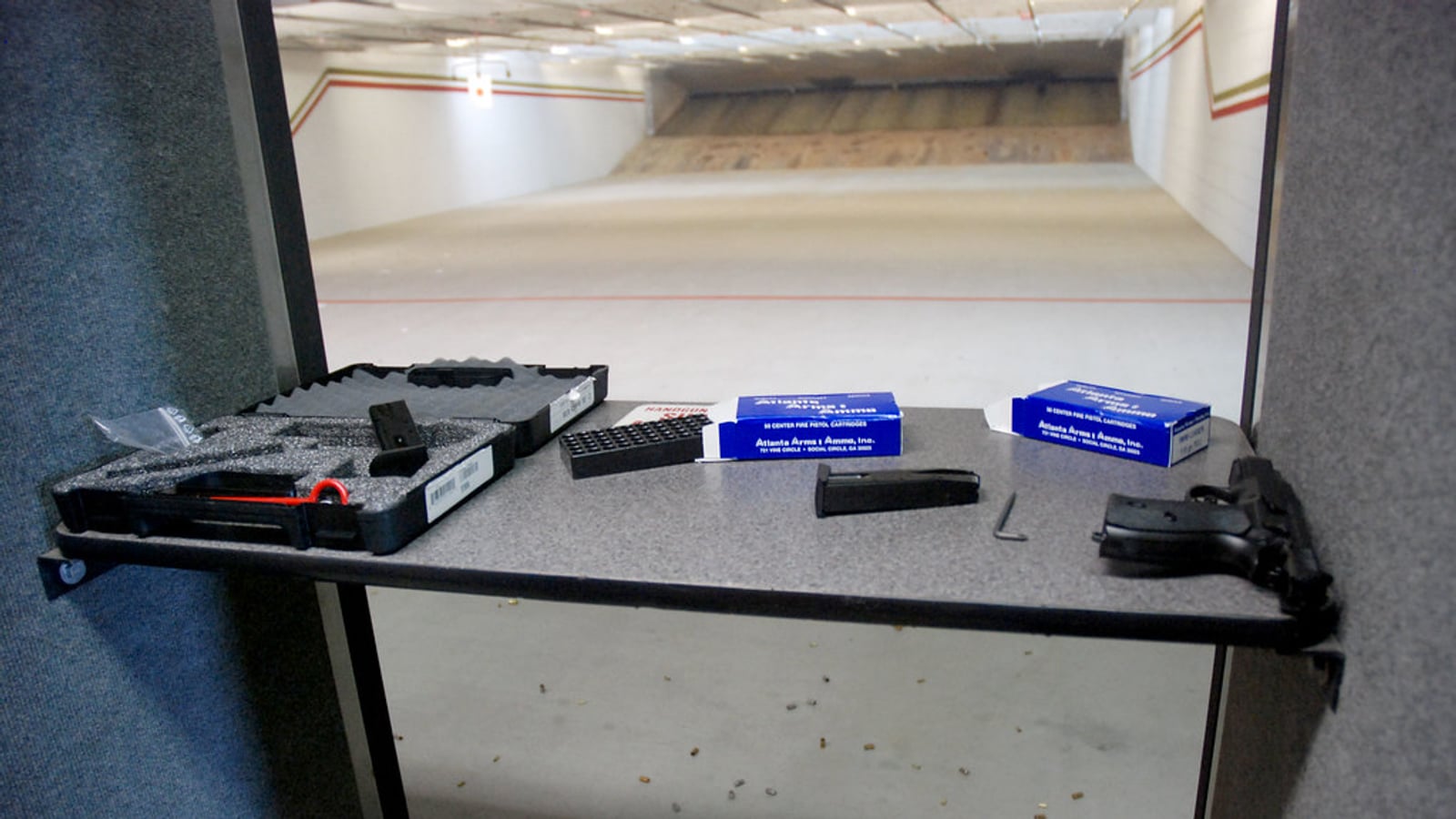
Two environments, one demand for rigor
An indoor range and an outdoor firing line don’t have much in common physically. The first is an enclosed lane, with walls that absorb sound, a ceiling that limits possible angles, a fixed distance, and constant lighting. The second can stretch over dozens of meters in the open air, exposed to wind, rain, changing light, and sometimes the presence of third parties outside the shooting perimeter.
This physical difference concretely changes how you need to think about safety. It’s not that one is more dangerous than the other — each setup has its own blind spots and its own traps. A shooter who only knows the indoor range and discovers outdoor shooting without adapting takes on risks they don’t even suspect.
The foundation stays identical in both cases: the four basic safety rules (muzzle always pointed in a safe direction, finger off the trigger when not firing, treat every gun as loaded, know what’s behind your target) apply everywhere, no exceptions. What changes is everything that gets added on top depending on the environment.
Managing firing angles: the heart of the difference
On a classic indoor range, the firing angle is constrained by construction. Side partitions, a low ceiling, and often mechanical stops at the firing points physically prevent the muzzle from deviating past a certain limit. The club’s internal rules reinforce this framework, but the architecture itself does part of the safety work for you.
Outdoors, that physical constraint disappears or becomes much wider. The firing line may allow an arc of several dozen degrees, even a 360° shot on some dynamic-discipline ranges. That freedom of movement is valuable for training on varied scenarios, but it shifts the entire responsibility for the angle limit onto the shooter and onto the referee or instructor supervising.
Concretely, this means you have to mentally hold limits that don’t physically exist. A firing sector marked on the ground, stakes, a colored line: these are visual reference points, not barriers. Nothing physically stops you from swinging the muzzle past them, unlike the wall of an indoor range. That’s where personal discipline takes over from architecture.
The number-one risk identified on outdoor ranges is unintentionally sweeping past a sector boundary during a transition between two targets. On an indoor range this risk barely exists since the trajectory is fixed. Outdoors, any movement of the torso or footing can rotate the muzzle past the limit without the shooter noticing under stress or speed.
This vigilance about angle isn’t limited to the moment of firing itself. It extends through the whole preparation phase: drawing the gun from the holster, reloading, holstering at the end of the course. Each of these seemingly minor actions can deviate the muzzle if the shooter doesn’t maintain constant awareness of their orientation relative to the sector’s limits. An experienced instructor often reminds students that a safety angle must be respected even at a complete stop, not just during the active firing phase.
The concept of a “safety cone” takes on its full meaning outdoors: it’s not just about respecting a limit at the precise moment of the shot, but about keeping a potential trajectory always oriented toward a safe zone, including during transitions when the gun technically isn’t firing. That permanent requirement contrasts with an indoor range, where the architecture makes this vigilance less critical outside the firing moment itself.
The role of the firing line and buffer zones
An indoor range generally has a single firing line, with individual bays separated by partitions. That physical separation limits interaction between shooters and reduces the risk that one person’s movement affects another’s safety.
On an outdoor range, particularly for dynamic or clay disciplines, the concept of a firing line becomes more fluid. Shooters can move, change position, sometimes work through an entire course. Buffer zones between the firing point and spectators, between the firing point and other bays, or between the firing point and the brass-recovery area must be clearly marked and respected to the letter.
These buffer zones aren’t just aesthetic recommendations. They exist to absorb a margin of error: a ricochet, a slightly deflected round, a shooter losing their balance. The more open the environment, the more generous these margins need to be, since nothing stops an unpredicted trajectory the way a berm or bullet-trap wall would on an indoor range.
On well-designed outdoor ranges, these zones are reinforced with earth berms, terrain rises, or vegetation screens that play the same role as an indoor range’s walls, just at a larger scale. Their maintenance and proper placement directly determine the site’s safety level.
Weather conditions: a factor an indoor range eliminates
This is arguably the most obvious difference, and yet its real safety impact is often underestimated. On an indoor range, weather doesn’t exist: stable temperature, no wind, no rain, constant artificial lighting. The shooter has one fewer variable to manage and can focus purely on technique.
Outdoors, every weather parameter becomes a safety factor in its own right, not just a performance factor. Strong wind can blow light objects (cardboard targets, index cards, cups) across the line of sight and trigger an unplanned reaction from a shooter mid-shot. Rain makes surfaces slippery, increases the risk of falling with a gun in hand, and can affect grip.
Light also changes things. A low, glancing sun late in the day can blind a shooter at exactly the moment they need to assess their surroundings and backstop. That factor simply doesn’t exist on an indoor range, where lighting is calibrated and constant year-round.
Fog or reduced visibility poses a specific problem for long-distance outdoor ranges: the ability to clearly identify what’s behind and around the target can be compromised. A serious club sets objective criteria (minimum visibility, wind threshold, no storms) that trigger a suspension of activities, rather than leaving that call to individual judgment under pressure.
Lightning deserves a special mention, since it’s a hazard with strictly no equivalent on an indoor range. An open outdoor site, sometimes without any protective terrain features, exposes shooters and staff to a direct electrical risk during a storm. Most clubs apply a simple rule: at the first sign of a nearby storm, activity is suspended immediately and participants take shelter, without waiting for the storm to be directly overhead.
Extreme cold and heat also play a specific role outdoors. Intense heat can promote dehydration and reduced alertness over a long session, while marked cold can reduce finger sensitivity and affect precise trigger control. On an indoor range, temperature stays stable year-round, removing this variable from the safety equation entirely.
The presence of third parties: a risk nearly absent indoors
An indoor range is by nature a closed, controlled space. Access is filtered, often through an airlock or locked door, and an unauthorized person’s presence on the firing line is nearly impossible without being immediately noticed.
Outdoors, the situation is structurally different. The land may border a hiking trail, farmland, a road, or simply be harder to secure across its entire perimeter. The possible presence of hikers, hunters, or nearby residents demands constant vigilance, including during setup phases when it might be tempting to let attention slip.
This constraint translates into specific protocols: a perimeter check before shooting opens, warning signs visible from every possible access point, sometimes a lookout post or a person dedicated to watching the surrounding area for the entire session. These measures have no equivalent on an indoor range, where simply closing a door solves most of the problem.
A club using an outdoor site shared with other uses (state forest, communal land) needs to be particularly strict on this point. The usual protocol is to stop shooting immediately as soon as a presence is reported in a risk zone, without waiting for certain visual confirmation. Doubt should always favor caution.
The period and timing of use also play a direct role in this risk. A site frequented by hikers on weekend afternoons doesn’t carry the same exposure as a session held early on a weekday morning. Some clubs adjust their opening slots based on this predictable foot traffic — something that simply makes no sense for an indoor range, where access is filtered the same way at any hour.
Signage itself needs to be thought through differently depending on the environment. Indoors, a “Shooting in progress” sign on a door covers essentially the whole access risk. Outdoors, signage must be spread across the entire accessible perimeter, at regular intervals, and remain legible despite vegetation, distance, or gradual weathering. An isolated sign blown out of place by the wind loses all its usefulness without staff necessarily noticing right away.
Organizing the command post and refereeing
Indoors, supervision is usually handled by an instructor or range officer with an overall view of every bay from a fixed position. The corridor layout makes this continuous monitoring easier.
Outdoors, especially on dynamic-shooting or clay courses, supervision often has to be spread across several referees or safety officers positioned at different points along the course. This networked organization, rather than a single post, responds to the geographic spread of risk zones.
The outdoor safety officer’s role goes beyond simply enforcing sporting rules. They must immediately halt the exercise (“stop” or “cease fire”) at the slightest doubt about an angle breach, a muzzle poorly oriented during a transition, or dropped equipment. That responsiveness must override every other consideration, including keeping a competition running smoothly.
This level of distributed vigilance requires specific training for referees, different from that of a simple indoor-range monitor. Many clubs run dedicated sessions on this role before the outdoor competition season opens.
Storing and transporting firearms by setup
Indoors, the distance between the parking area, the armory, and the firing point is generally short and clearly marked. The transport protocol (gun in a holster or case, unloaded, all the way to the bay) stays simple to apply and easy for club staff to check visually.
On a large outdoor range, especially for disciplines involving movement between several bays or stations, transport becomes more complex. A gun may need to move between several shooting zones over several hundred meters, multiplying the transition moments where risk increases.
The rule stays the same in principle: gun unloaded, hammer or striker uncocked, out of reach of the trigger, during any movement outside the active firing point. What changes is the frequency of these transitions and therefore the frequency of risky moments, which justifies heightened vigilance and more regular checks from staff.
Climate also plays a role here: a gun carried in the rain needs protection against moisture-related malfunctions, which can lead some shooters to extra handling (a cover, a waterproof case) that must itself respect basic safety protocols.
Managing noise and hearing protection
Indoors, the confined acoustics amplify the sound of every shot, which almost always requires reinforced hearing protection, sometimes doubled up (plugs and earmuffs together). The enclosed environment also concentrates gun smoke, which shapes the ventilation required by club standards.
Outdoors, sound disperses more into open space, but that doesn’t reduce individual protection requirements at all: cumulative exposure over a session remains dangerous for hearing, and nearby shots (other bays, other disciplines on the same site) add noise sources you don’t always consciously register.
The difference plays out more in how collective noise is managed toward the neighborhood. An indoor range is usually soundproofed or located in a zone already zoned for that use. An outdoor site has to work around neighbors, regulated opening hours, and sometimes seasonal restrictions tied to local wildlife or surrounding farm activity.
Protocols specific to outdoor dynamic disciplines
Disciplines like IPSC or Steel Challenge are practiced almost exclusively outdoors or on dedicated large-scale facilities, precisely because they require the shooter to move and to engage cardboard targets or steel plates at varied angles. That freedom of movement is incompatible with a classic indoor range’s geometry.
The corollary is much denser regulatory oversight for this kind of site. Each course of fire (“stage”) is designed and approved by a safety officer before the match, with a precise layout of no-shoot zones and the maximum angles allowed at each firing point. Nothing is left to improvisation, contrary to what the apparent fluidity of a skilled shooter on a course might suggest.
A systematic safety briefing precedes every session on this kind of terrain, covering the course boundaries, the zones where the gun must stay holstered or pointed at the ground, and emergency procedures in case of an incident. This level of formalization has no equally advanced equivalent on an indoor range, where the layout naturally limits the variables.
The shooter’s movement during the match adds an extra dimension: unlike an indoor range, where the shooter stays static at their bay, a dynamic course requires managing the gun while walking, running, or changing position (standing, kneeling, prone). Each of these transitions is a moment where the risk of muzzle misdirection rises, which is why safety officers position themselves precisely at the course’s most critical transition points rather than uniformly.
Reloading on the move, specific to dynamic disciplines, is also subject to precise rules about muzzle direction and where that action is allowed. A shooter who reloads outside an approved zone for that action, even out of habit or a speed reflex, commits a safety violation that simply has no equivalent on an indoor range, where reloading always happens in the same spot, facing the same controlled direction.
Maintaining and designing shooting facilities
An indoor range meets precise construction standards: wall thickness, absorbent materials on the floor and sides, a bullet-recovery system at the end of the trajectory, forced ventilation to clear gun smoke. Once these standards are met at construction, the facility offers a stable safety level over time, with maintenance limited to periodic checks of the recovery system.
An outdoor site demands continuous and much more visible maintenance. Earth berms erode from rain and frost, vegetation grows back and can hide a warning sign, the stakes marking firing sectors can be shifted by wind or local wildlife. Without regular checks, these passive safety elements lose reliability without it being immediately visible.
A serious club therefore plans inspection rounds before every season opening, and often before every major competition: checking the height and continuity of berms, verifying sign legibility, testing the sturdiness of target stands. This maintenance work is largely invisible to a shooter arriving on site, but it directly determines the session’s safety.
Weather also accelerates the wear of some outdoor equipment: metal target stands rust, recovery cables weaken from repeated freeze-thaw cycles. An indoor range, sheltered from the weather, experiences much slower and more predictable equipment aging.
Communication and collective safety signals
Indoors, communication between shooters and staff usually runs through clear, standardized audio signals (a bell, a voice command over a mic) that everyone hears distinctly in a confined space. A “cease fire” message reaches every bay instantly.
Outdoors, shooters spread across a large site or extended course complicate that transmission. Wind can carry away part of a voice message, distance between bays can make an audio signal less audible, and several groups may be working simultaneously in different zones of the same site.
To compensate, clubs running outdoor sites set up redundant systems: powerful, recognizable whistles, radios carried by each zone referee, visual signals (flags, colored pennants) that supplement the audio signal. That redundancy isn’t a luxury: it compensates for the absence of walls that, indoors, naturally concentrate sound toward each bay.
The emergency-stop protocol also needs to be repeated and understood the same way by every participant, regardless of their position on the course. A new shooter joining an outdoor session must always be briefed on the signals used at that specific site, since they vary from club to club, unlike the more standardized instructions of an indoor range.
The special case of variable-distance shooting and terminal ballistics
Indoors, the shooting distance is fixed and known in advance: 10, 25, or 50 meters depending on the discipline. The projectile’s behavior at the end of its trajectory is therefore perfectly anticipated, and the recovery system (bullet trap) is sized accordingly right from construction.
On an outdoor range, especially for variable-distance disciplines like some long-range rifle events, the projectile’s path travels through a much larger space before reaching its stopping point. That calls for different thinking about what lies not just behind the immediate target, but along the entire possible trajectory in case of a deflected shot.
This thinking about terminal ballistics must factor in the terrain’s relief: a well-oriented backstop uses the natural topography (a hill, a slope) to guarantee no projectile can leave the site’s perimeter, even in the event of an aiming error. That’s terrain-design work with no equivalent on an indoor range, where the question is settled once and for all by the construction of the walls.
For shooters, this translates into a simple but essential rule: never fire beyond the approved angle of the bay, even at a target that looks visually reachable. The sense of safety an open site gives can be misleading, since it masks the absence of a physical limit that would exist on an indoor range.
What stays the same in both environments
It would be a mistake to think an indoor range and an outdoor site are two worlds with nothing in common. Systematically checking the gun on arrival at and departure from the firing point, verifying it’s unloaded before any storage, and absolute respect for keeping fingers off the trigger outside the shooting zone apply everywhere the same way, with no exception tied to environment.
The shooter’s personal discipline also remains factor number one, whatever the setting. A well-built indoor range doesn’t protect against a shooter who doesn’t follow basic rules, just as a huge outdoor site doesn’t become dangerous if every participant rigorously applies the instructions. The environment changes the specific risks to manage, not the overall standard required.
Wearing personal protective equipment (hearing and eye protection) also stays non-negotiable in both setups, even if its role takes on a different nuance depending on location. Indoors, eye protection mainly limits the risk from fragments and shooting residue that can bounce off a nearby surface. Outdoors, it also protects against dust, dirt, or vegetation kicked up by the wind — a risk that simply doesn’t exist in a clean, enclosed environment.
The club’s responsibility toward every shooter present also stays fundamentally identical: clearly inform them of the applicable rules, make sure every participant has understood them, and step in without delay at the slightest observed deviation. Whether under a roof or under open sky, this responsibility can never be entirely delegated to the environment or the equipment, however well-designed they are.
Finally, initial training remains the common foundation: an experienced instructor will always insist that safety reflexes need to be built indoors before being transferred, with the necessary adjustments, to an outdoor environment that’s more demanding in terms of peripheral vigilance.
The shooter’s individual log book, whether kept on paper or through a dedicated app, keeps its full value in both environments. Noting the conditions of each session, including weather and terrain setup for outdoor outings, helps identify personal patterns: a wind condition that affects accuracy, a time of day when alertness drops. This record-keeping discipline, often seen as secondary, actually strengthens safety awareness over time by giving the shooter a concrete history of their own practice.
The checklist before opening a session
Indoors, starting a session follows a short routine: checking the lighting, checking the recovery system, unlocking the bays. The number of parameters to validate stays limited because the environment itself doesn’t change from one session to the next.
Outdoors, the opening checklist is necessarily longer and more variable depending on the season and the day’s weather. It typically includes: the condition of berms and buffer zones, the legibility of warning signs, the possible presence of third parties nearby, wind and visibility conditions, ground condition after recent rain, and the sturdiness of target stands after a frost or high wind.
This checklist isn’t just an administrative formality: it forms the first line of defense against risks specific to the outdoor environment. A club that standardizes it as a paper or digital form, filled out and signed by the session lead before every opening, considerably reduces the risk of missing a checkpoint under time pressure or out of habit.
Some clubs go further and build in a timestamped weather checklist, with precise thresholds beyond which the session is automatically postponed. That formalization removes the decision from the realm of personal judgment, often biased by the desire not to disappoint shooters already on site, and places it in an objective, documented framework.
Training new shooters based on their starting environment
Most shooting clubs start new members’ training indoors, and that choice isn’t incidental. The controlled environment, with no weather variable or open firing angle, lets students focus entirely on the fundamentals: grip, stance, trigger discipline, recoil management. The number of parameters to absorb at once stays deliberately limited.
That teaching choice has a direct consequence for later outdoor training: a beginner who has only known indoor shooting then has to learn, often in a single transition, to manage several new variables at once. That’s why experienced instructors recommend a guided progression rather than an abrupt shift from one environment to the other without support.
A well-built progression first introduces static outdoor shooting, at a fixed distance and without movement, before tackling dynamic disciplines that combine variable angles with shooter movement. This gradual increase in complexity lets each new variable be absorbed in isolation, rather than all at once on a full course.
An experienced instructor will also stress a point that’s often overlooked: confidence built indoors can become a liability if it isn’t questioned outdoors. A shooter who feels they’ve fully mastered the fundamentals can underestimate the extra mental load of simultaneously managing wind, potential third parties, and a physically unconstrained firing angle.
Adapting rather than transferring
The classic trap is believing that safety habits built indoors transfer as-is outdoors. An experienced club shooter discovering their first outdoor dynamic course has to relearn how to manage angle transitions, weather, and vigilance toward third parties, even if they’ve fully mastered the fundamentals.
Conversely, a shooter used to wide-open outdoor spaces who returns to an indoor range sometimes has to dial back their freer movement reflexes and readjust to a more constrained geometry, where certain moves that are natural outdoors would be a serious violation in an enclosed lane.
This ability to adapt, more than raw rule knowledge, is what separates a truly safe shooter from one who applies a routine without understanding its logic. Understanding why a rule exists in a given context lets you apply it intelligently to a different context, instead of applying it blindly or, worse, forgetting it because it didn’t seem necessary elsewhere.
A club that runs both indoor sessions and outdoor outings does well to explicitly name these differences to its members, rather than assuming they’re picked up implicitly. A simple verbal reminder before every environment change, formalized in the club’s internal rules, considerably reduces attention lapses caused by the change in reference points. This conscious, rather than automatic, transition is what separates a genuinely safe practice from one that runs on habit until the day circumstances change.
Handling malfunctions and incidents depending on the venue
A malfunction or shooting incident (a failure to fire, a jammed action, a poorly ejected casing) requires the same basic procedure everywhere: gun kept in a safe direction, finger off the trigger, immediate report to staff before any handling. This rule never varies by environment.
What changes is the context in which the incident occurs. Indoors, the shooter stays still at their bay, in a stable space, which makes it easier for the instructor to move quickly along the firing line to assess the situation and give appropriate instructions.
Outdoors, especially on a dynamic-discipline course, a malfunction can occur mid-movement between two bays. The shooter then has to stop immediately, sometimes in an awkward position, without letting themselves get distracted by the urge to finish the movement they’d started. The referee present on that section of the course needs to be trained to spot this kind of jam even while the shooter is moving, which demands a different kind of vigilance than at a simple fixed bay.
Wind and rain can also encourage certain types of incidents, particularly tied to ammunition moisture or sand or dirt getting into the mechanism on unstabilized ground. An indoor range, with its clean floor and enclosed environment, is much less exposed to this kind of incident cause, which is why cleaning and equipment-check procedures are generally stricter before an extended outdoor session.
FAQ
Q: Do the four basic safety rules change between an indoor range and an outdoor site? A: No, they stay identical and non-negotiable in both environments. What changes are the additional measures related to weather, open angles, and the possible presence of third parties.
Q: Why are dynamic disciplines mostly practiced outdoors? A: Because they require shooter movement and varied firing angles at cardboard targets or steel plates, which is incompatible with a classic indoor range’s constrained geometry.
Q: What should you do if someone is spotted near an outdoor site during a session? A: Shooting must be stopped immediately, without waiting for definite confirmation. Doubt should always favor caution, even if it means resuming the session after a full perimeter check.
Q: Can weather justify stopping an outdoor shooting session? A: Yes, most serious clubs set objective criteria (strong wind, storms, reduced visibility) that trigger a stop, rather than leaving that decision to individual judgment.
Q: Is a shooter experienced on an indoor range automatically ready for the outdoors? A: Not automatically. Fundamentals are transferable, but managing open angles, weather, and vigilance toward third parties requires specific training, often guided by an experienced instructor.