
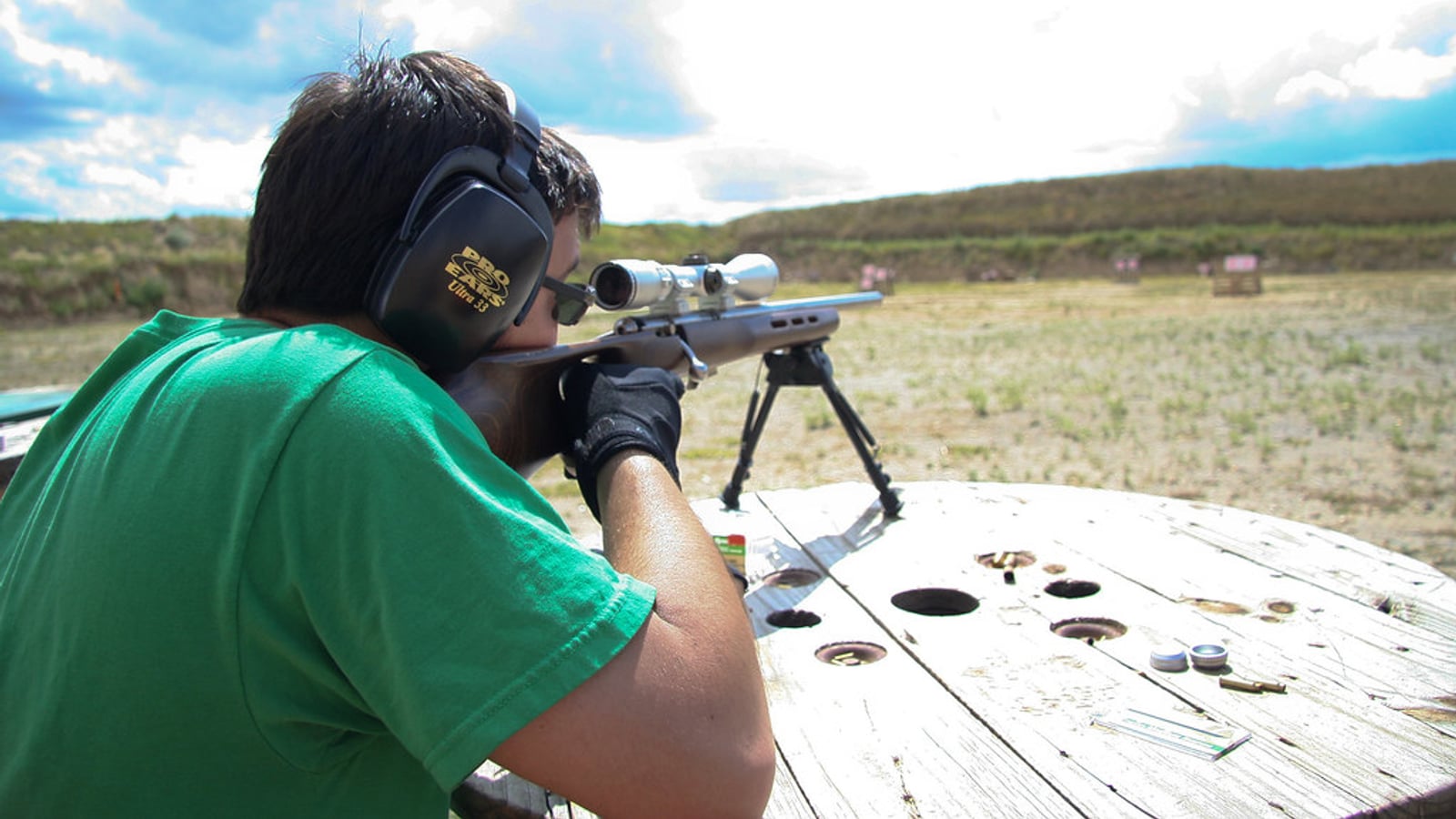
Sport shooting at the Olympics, a history spanning more than a century
Sport shooting has been part of the Olympic Games since 1896, the year of the first modern Games in Athens. This is extremely well documented: shooting is among the handful of sports that have almost never left the Olympic program since then, with a few occasional interruptions over the decades linked to program reorganizations.
Since then, the number and nature of events have changed enormously. Some historic disciplines disappeared (live pigeon shooting, certain military-origin events), while others emerged as civilian sport shooting became more widespread: air rifle, air pistol, skeet, trap. The current program has stabilized around 15 events, split across three major weapon families: rifle, pistol, and shotgun (smoothbore disciplines on clay targets).
This diversity reflects very different origins. Shotgun disciplines descend directly from hunting and clay pigeon shooting practiced since the late 19th century. Rifle and pistol disciplines, on the other hand, come more from precision shooting at fixed targets, inherited from civilian shooting competitions and traditional European ranges.
One point deserves clarifying up front to avoid any confusion: the targets used in all Olympic shooting disciplines are paper targets with concentric rings (rifle, pistol) or clay targets (shotgun disciplines). No Olympic event is based on a human-silhouette target, whether in the official rules or in official training.
This article aims to provide a complete, up-to-date overview of the 15 events in the Olympic program, discipline by discipline, covering the equipment used, the shooting format, and the qualification path that takes a shooter from the local club all the way to the Games. You’ll also find a section on the historical evolution of the program and on how these Olympic disciplines relate (or don’t) to what you practice at your club.
A useful terminology note for what follows: in this article, “trigger” always refers to the part your finger presses to fire the shot. The internal technical name for the mechanism is never used here, in line with recommended usage at the club.
Rifle disciplines: precision, position, and mental endurance
The Olympic rifle program consists of three main events, all shot with air or metallic ammunition depending on distance. 10m Air Rifle is the most universal event: shot standing, at a reduced target at 10 meters, with rifles calibrated for pure competition use — much more precise and heavier than an ordinary recreational rifle.
50m Rifle Three Positions adds an extra layer of difficulty: the shooter moves through prone, kneeling, and standing within the same series, which demands a rare technical versatility. Each position requires a different balance, different breathing management, and a specific hold. It’s often considered the most complete rifle event in the program.
There’s also a 50m Rifle Prone event, historically shorter, but it has been removed from the current Olympic program in favor of the three-position format, which tests a broader skill set. This kind of program adjustment is common from one Olympiad to the next: international federations evolve the event list to address issues of diversity, gender parity, and TV appeal.
Equipment used in Olympic air rifle falls, in France, under category D for models below the regulatory power threshold, making the discipline accessible from a young age at clubs. 50m metallic-ammunition rifles generally fall under category C (declaration), though the exact classification always depends on the specific model: always check this with your club or federation before buying.
What strikes a shooter discovering these events from a general club is the gap in technical rigor. An experienced instructor who coaches recreational 10m rifle at a club will tell you the Olympic version is an entirely different craft: every movement is timed, every breath is counted, and the tolerated margin of error is measured in tenths of a point on a target where the 10-ring is barely bigger than a pinprick.
Pistol disciplines: the most diverse family in the program
Olympic pistol brings together the largest number of distinct events, with very different requirements depending on the discipline. 10m Air Pistol works on the same principle as its rifle equivalent: a reduced target at 10 meters, shot standing, with an air weapon calibrated for competition.
25m Rapid Fire Pistol is arguably the most spectacular event in the pistol program. The shooter must engage five separate targets in a very short time, with series that progressively shorten as the event proceeds. It’s an exercise in combined speed and precision unlike any other discipline in the program.
25m Sport Pistol offers a different format: slow fire on a single target, followed by a rapid-fire phase at the same distance, which tests both sustained concentration and stress management at an accelerated pace. In the current Olympic format, it’s an event reserved for women, while rapid fire is reserved for men — a split that has shifted several times across Olympiads and continues to be debated within international bodies.
Weapons used in Olympic air pistol fall, in France, under category D, below the regulatory power threshold. 25m metallic-ammunition pistols, on the other hand, fall under category B, subject to prefectural authorization, like almost all handguns in France. This classification applies regardless of the level of practice: recreational or Olympic competition, the administrative rule doesn’t change.
A regional 25m pistol champion often tells her young teammates the same thing: the difficulty of this discipline is never purely technical. It’s managing time and the clock that wears on your nerves, far more than the precision of the movement itself, which becomes largely automatic after years of repeated practice.
Shotgun shooting: trap, skeet, and the culture of instinctive shooting
Shotgun disciplines differ radically from the two previous families: here, the target is moving, launched by a machine, and the shooter must intercept it in flight with a smoothbore shotgun. Olympic trap involves shooting clay targets launched from a trench in front of the shooter, on a trajectory that varies with every throw.
Olympic skeet is shot from a semicircular firing line, with clays launched from two opposing towers, sometimes single, sometimes as a simultaneous pair. Reading the trajectory differs from trap: the angles are more predictable in origin, but the interception speed is more demanding.
A third event deserves mention even though it isn’t always present at every Olympiad in this exact form: double trap, which adds a pair of clays launched simultaneously, multiplying the mental load of target management. The Olympic shotgun program has undergone several adjustments of this kind over the decades, depending on the Olympic committee’s decisions on the total number of permitted events.
Shotguns used in Olympic trap and skeet fall, in France, under category C for most manual repeating or classic semi-automatic models, subject to checking the exact classification of the model with a gunsmith. It’s a discipline where the equipment is highly specialized: stock adjusted to the millimeter, choke matched to shooting distance, ammunition calibrated to the regulatory lead load for competition.
An experienced club shotgun shooter always stresses one point with beginners: unlike static precision shooting, here instinct and automatic movement take priority over conscious thought. The decision time between the clay’s appearance and firing the shot is measured in fractions of a second, leaving no room for classic, deliberate aiming.
Qualification format: how you get to the Olympic Games
Olympic qualification in sport shooting rests on a multi-tier system, managed by the International Shooting Sport Federation in coordination with the International Olympic Committee. The general principle remains stable from one Olympiad to the next, even though the exact number of qualifying spots per event varies, so it’s best to check the precise quotas with your federation for the current Olympiad.
The first tier is made up of world championships and World Cups in sport shooting, which distribute part of the available qualifying spots for each event. These competitions take place over several years before the Games, meaning a shooter begins Olympic preparation well before the actual Games year.
The second tier rests on continental quotas, awarded through continental championships (the European Championship for French shooters, for example). This mechanism ensures broad geographic representation at the Games, rather than a concentration of spots among the nations historically dominant in sport shooting.
The third mechanism concerns universality places, awarded to national Olympic committees that haven’t secured any qualification through the first two channels, so that every continent and every participating country can send minimal representation. This system guarantees a diversity of participants, even though the sporting level among qualifiers varies greatly depending on the channel used.
Once a country has secured its qualifying spot, each national federation runs its own internal selection to designate the shooter(s) who will carry that spot to the Games. In France, this selection generally goes through a combination of criteria: results at national championships, international ranking, and performance minimums set by the federation, without any single, universally reliable figure that can be cited here, since these criteria are revised every cycle.
From the club to the Games: how does this relate to what you practice day to day
A licensed club shooter often wonders what real connection exists between their weekly practice and the Olympic program they watch on TV. The honest answer is nuanced: the technical foundation is the same, but the gap in level and demands is considerable.
Olympic air rifle and air pistol disciplines are practiced at a huge number of clubs in an essentially identical form, with the same distances and the same type of target, just with a different level of demand and entry-level equipment. A beginner discovering 10m rifle at a club is, broadly speaking, making the same movement as an Olympic athlete — the comparison largely stops there.
For shotgun disciplines, the connection is also direct: trap and skeet are practiced at many civilian clay shooting clubs, with setups that faithfully reproduce the principle of Olympic throws, even if the exact machine and trench configurations vary from club to club.
By contrast, some Olympic disciplines have no common equivalent at a general club, notably 25m rapid fire pistol, which requires a specific setup with synchronized moving targets and automated timing rarely available outside structures dedicated to high performance. An experienced instructor wanting to introduce students to this discipline often has to point them toward a specialized club or a dedicated regional training center.
Program history: what’s disappeared and what’s stayed
The Olympic sport shooting program has never been fixed. Since 1896, several disciplines have disappeared, others have been added, often in response to societal shifts or organizational constraints of the Games. Live pigeon shooting, practiced at the very first modern Games, disappeared quickly from the program, for example, gradually replaced by clay target shooting, which was more practical and, above all, more acceptable over time.
Certain events with a more military character or linked to historical war shooting, present in the early decades of the Olympic program, were also removed as the Olympic movement re-focused sport shooting on its purely civilian and sporting dimension. This evolution reflects the broader trajectory of Olympic sport shooting, now clearly rooted in recreational and civilian competitive practice, with no connection to a military training or law-enforcement context.
The introduction of women’s events forms another important chapter in this history. Women were gradually integrated into the Olympic shooting program over several decades, with dedicated events created over time rather than simultaneous integration across all disciplines. This evolution has continued recently with the introduction of mixed team events, which pair a male and a female shooter from the same nation in certain air disciplines.
The total number of events has also fluctuated. Some Olympiads featured more shotgun events, others reorganized rifle or pistol categories to arrive at the current balance of 15 events. These adjustments generally respond to a logic of strict parity between men’s, women’s, and mixed events, but also to practical organizational constraints at the Games venue.
Among the most notable developments of recent Olympiads is the introduction of mixed team events, which has changed the dynamic of several air disciplines. The principle is simple: a pair made up of a man and a woman from the same nation shoot alternately in the same series, with a combined score determining the team’s ranking.
This evolution was driven by a desire to strengthen parity structurally, beyond the mere existence of separate individual events for each sex. It has also had a positive side effect on sport shooting’s appeal as a spectator sport, adding a dimension of cooperation and team strategy to a sport historically perceived as purely individual.
Technically, the mixed team event demands a different way of managing pressure: the shooter is no longer solely responsible for their own result, which profoundly changes the mental dynamic of the competition. An experienced female shooter who has known both formats often describes this shift as the difference between carrying only your own score and, on top of that, having to manage the weight of not letting your teammate down.
The concrete unfolding of an Olympic event, from the draw to the podium
An Olympic rifle or pistol event isn’t just about the moment the shooter presses the trigger. Competition day generally starts several hours earlier, with a strict equipment check: weapon weight, stock dimensions, ammunition type — everything is verified by technical officials before the shooter can enter the firing line.
Then comes the qualification phase itself, in which all entrants shoot their full series within an allotted time, with real-time electronic scoring in most modern disciplines. Electronic targets have largely replaced manual scoring in top-level competitions, allowing instant score display and full transparency for both the public and the officials.
At the end of the qualification phase, only a limited number of shooters qualify for the final — generally the eight best scores from qualification. This final then takes place under different conditions: a shortened shooting format, progressive elimination of the lowest-ranked shooter after each series, and far higher psychological pressure linked to the live-displayed ranking in front of the crowd and cameras.
This progressive-elimination format completely changes the nature of the event compared with qualification. A shooter can dominate the qualification phase and still miss the podium in the final, simply because managing stress in front of a live-displayed ranking is an exercise in its own right, distinct from the simple pursuit of precision. An experienced instructor preparing shooters for this format always stresses this point to students: final-round mental toughness is trained specifically — it doesn’t automatically follow from a strong technical level in qualification.
For shotgun disciplines, the format differs slightly: the final often includes an additional series of clays under conditions comparable to qualification, but sometimes with a cumulative score that includes qualification results, depending on the rules in force for the Olympiad concerned. This kind of regulatory detail changes regularly, so it’s always better to check the exact rules published by the international federation for the current edition rather than relying on a format frozen in time.
Mental and physical preparation, an underrated pillar of Olympic shooting
Olympic sport shooting has an unfair reputation for being a physically undemanding sport. The reality of a top-level athlete’s preparation largely disproves this misconception. Holding a rifle weighing several kilograms perfectly still through long series, while standing, requires specific core work and muscular endurance that few sports demand in the same way.
Cardio-respiratory work also plays an important role in preparation. Managing heart rate becomes a direct performance issue: a shooter generally seeks to trigger the shot within a precise window of the breathing and cardiac cycle, when the body is at its most stable. This synchronization isn’t improvised — it’s developed over years with rigorous monitoring.
Mental preparation holds at least as central a place as physical preparation in an Olympic athlete’s journey. Visualizing the movement, managing competition stress, pre-shot routines repeated identically thousands of times in training: this work aims to make the shooting movement as automatic and as independent from the pressure of context as possible. An experienced club shooter who has attended high-level training camps often says how much of a discovery this mental dimension was, far more than the pure technique of shooting itself.
Sleep, nutrition, and managing nervous fatigue are also an integral part of this preparation, with monitoring approaching that of other demanding Olympic sports. The extreme concentration required over a qualification series, which can last more than an hour without real interruption, is far more nervously exhausting than a short burst of intense physical effort. This is an aspect that TV coverage, focused on the moment of the shot, almost never shows.
This overall demand also explains why the gap between a good club shooter and an Olympic athlete stays so wide, regardless of the level of equipment used. It’s not solely a matter of innate talent: it’s the result of years of structured work across dimensions that go far beyond the simple technical act of aiming and firing.
The role of technology and fine-tuning in Olympic performance
Beyond the weapon itself, Olympic performance rests on a set of fine adjustments that make the difference between two shooters of similar technical level. Rear and front sights (or the scope, depending on the discipline) are adjusted to within a tenth of a millimeter, using dedicated adjustment tools not found in ordinary recreational use.
The ammunition itself is subject to meticulous selection. In air rifle and air pistol, competition pellets are often tested lot by lot by top-level shooters, seeking the strictest possible consistency in weight and diameter, since the slightest variation can affect trajectory in the most closely contested competitions. This fine selection remains marginal in recreational use, where the resulting performance gap simply has no practical impact.
Video analysis and electronic trajectory-tracking systems are now part of national teams’ standard training toolkit. These tools make it possible to precisely visualize barrel movement in the moments before the shot fires — a parameter invisible to the naked eye but decisive for understanding the origin of a grouping deviation. An experienced instructor with access to this kind of tool at a regional center can help a shooter progress much faster than with simple visual feedback from the target.
This technological dimension, however, remains a complement — never a substitute — for the fundamental work on position and movement management. No measuring tool alone corrects an unstable position or recoil anticipation on its own: it merely helps objectify a problem that the shooter and coach had sometimes already identified instinctively. This is a point that top-level coaches regularly remind their young shooters of, when the latter are impressed by the technology available at national training centers.
Olympic competition equipment versus club equipment
The equipment used by Olympic shooters often has little in common with what you’ll find at a general gun shop for recreational use. Olympic competition rifles and pistols are highly specialized tools, adjusted to the millimeter to the shooter’s body shape, with trigger, stock, and balance settings that have no equivalent in an entry-level weapon.
This specialization comes at a cost that varies widely by model, brand, and desired level of customization: it’s best to check directly with a gunsmith specializing in high-level sport shooting rather than relying on a generic figure that wouldn’t reflect the current market reality. What remains true everywhere, however, is that the price gap between a club weapon and an Olympic competition weapon is measured in multiples, not percentages.
Competition clothing is another item often underestimated by beginners discovering Olympic disciplines. Rigid jacket and trousers for rifle, specific shoes, adjusted shooting glasses: the full kit of a top-level rifle or prone pistol shooter represents a significant investment, one to weigh against the daily training pace these athletes maintain over several years.
A reassuring point for club shooters wondering about this gap: basic technical progress (weapon hold, breath management, movement consistency) absolutely doesn’t require this level of equipment. Most clubs allow a complete introduction to Olympic air disciplines using shared equipment, more than sufficient to discover and progress in these disciplines before eventually considering a more substantial personal investment.
Some disciplines that once featured on the Olympic program are still practiced today outside the Olympic framework, in specialized national or international civilian competitions. That’s the case for several prone rifle formats at intermediate distances, removed from the Olympic program but still active in dedicated federal championships.
These “orphaned” disciplines of the Olympic program retain a loyal community of practitioners, often shooters who knew these events before their removal and continue to keep them alive locally. An experienced club shooter who practices these formats often says the discipline retains its full technical interest, regardless of its Olympic status or lack thereof. Following these “non-Olympic” disciplines also helps you better understand the history of sport shooting as a whole: they show that the Games program represents only a selection, within a far broader universe of civilian shooting disciplines, governed by national and international federal rules that exist independently of the Olympic calendar.
Following Olympic shooting as a club member
For a club shooter who wants to follow their discipline’s Olympic news, several avenues exist beyond simple TV broadcasts during the Games themselves. National and international federations regularly publish World Cup and qualifying championship results, allowing you to follow the international level outside the Olympic window alone.
Many clubs also organize watch parties or discussions around Olympic competitions — an opportunity for experienced instructors to comment on top athletes’ technical choices and connect them to what members practice at the club. This is often a chance to demystify aspects of Olympic shooting that seem obscure without explanation (how timing works in rapid-fire pistol, for example, or the principle of double clays in double trap).
Finally, drawing inspiration from Olympic shooting for your own club practice has limits worth knowing. The extreme rigor of Olympic preparation (video analysis, biometric monitoring, custom equipment) is neither necessary nor relevant for the vast majority of recreational or regional-competition practitioners. Drawing on it for general posture and training discipline, yes; trying to reproduce it identically, no.
Dominant nations and Olympic shooting versus civilian competitions outside the Olympiad
Olympic sport shooting shows a geographic distribution of performance quite different from other, more media-covered Olympic sports. Certain Eastern European and Asian nations traditionally show very solid results across the entire rifle and pistol program, driven by talent-scouting and youth-training pipelines that have been particularly well structured for a long time.
This dominance isn’t fixed: it evolves from Olympiad to Olympiad depending on national investments in infrastructure and training pipelines. A country that builds a national training center dedicated to shooting, with facilities to exact Olympic standards, often sees its results improve over several consecutive Olympic cycles, as young shooters trained in these structures reach international level.
France holds a respectable but not dominant position in the Olympic shooting landscape, with more consistent results in some air disciplines than others. The network of clubs remains dense across the country, but early talent identification and support toward the very highest level remain ongoing challenges for the federation, as in most nations that don’t devote massive resources to this specific discipline.
Shotgun disciplines show a different geographic distribution, with a tradition more firmly rooted in certain countries where hunting and civilian clay shooting are culturally more widespread. This difference in distribution between families of disciplines nicely illustrates how much each Olympic shooting event has its own national history, independent of any hypothetical single “Olympic shooting” culture that would uniformly encompass every event.
The Olympic program represents only a fraction of the international sport shooting competitive calendar. World shooting championships, organized by the international federation outside Olympic years, offer an event program that’s often broader than the Games’, including disciplines that have never had, or no longer have, a place in the restricted Olympic program.
This difference in program is explained by a constraint specific to the Olympic Games: the total number of events and athletes allowed across all sports is capped by the International Olympic Committee, forcing every sport federation to arbitrate between its disciplines to stay within its allotted event quota. Civilian sport shooting as a whole is thus far richer and more diverse than the single subset visible every four years on TV.
For a club shooter interested in competition beyond the Olympic spectacle alone, following world championships and World Cups in shooting gives a more complete picture of the international level, with disciplines sometimes closer to what’s actually practiced at clubs than the strictly Olympic events. It’s also a chance to discover top-level shooters in less publicized disciplines, who deserve just as much technical interest as the flagship events of the Games program.
This distinction between the Olympic program and the full universe of civilian sport shooting is worth keeping in mind: not being on the Games program says nothing about the value or interest of a shooting discipline. It’s above all the result of organizational trade-offs within the Olympic movement, not a judgment on the practice itself.
FAQ
Q: How many shooting events are there currently at the Olympic Games? A: The current program includes 15 events, split between rifle, pistol, and shotgun, with men’s, women’s, and mixed-team variants. This number has varied across Olympiads and may still evolve in future cycles.
Q: Since when has sport shooting been part of the Olympic Games? A: Sport shooting has been part of the Olympic program since 1896, the year of the first modern Games in Athens. It’s one of the historic disciplines of the Olympic movement, with a few occasional interruptions over time.
Q: Can you practice Olympic disciplines at a regular club? A: Yes, for most air disciplines (10m rifle and pistol) as well as trap and skeet, which are widely represented at clubs. Some disciplines, like 25m rapid fire pistol, however, require a specialized setup that’s less common.
Q: How does a shooter qualify for the Olympic Games? A: Qualification goes through a multi-tier system: spots distributed via world championships and World Cups, continental quotas, then universality places for nations not otherwise qualified. Final selection of the shooter then falls to their national federation.
Q: Is the equipment used at the Olympic Games classified in the same category as club equipment? A: Classification depends on the exact model of the weapon, not on whether it’s used for Olympic purposes. Air weapons below the regulatory threshold generally fall under category D, while metallic-ammunition weapons fall under category B (pistols) or C (rifles, shotguns), subject to checking each model individually.
Q: Are there shooting disciplines that have disappeared from the Olympic program? A: Yes, several historic disciplines such as live pigeon shooting or certain prone rifle formats at intermediate distances have been removed over the decades. Some survive today in civilian federal championships outside the Olympic framework.