
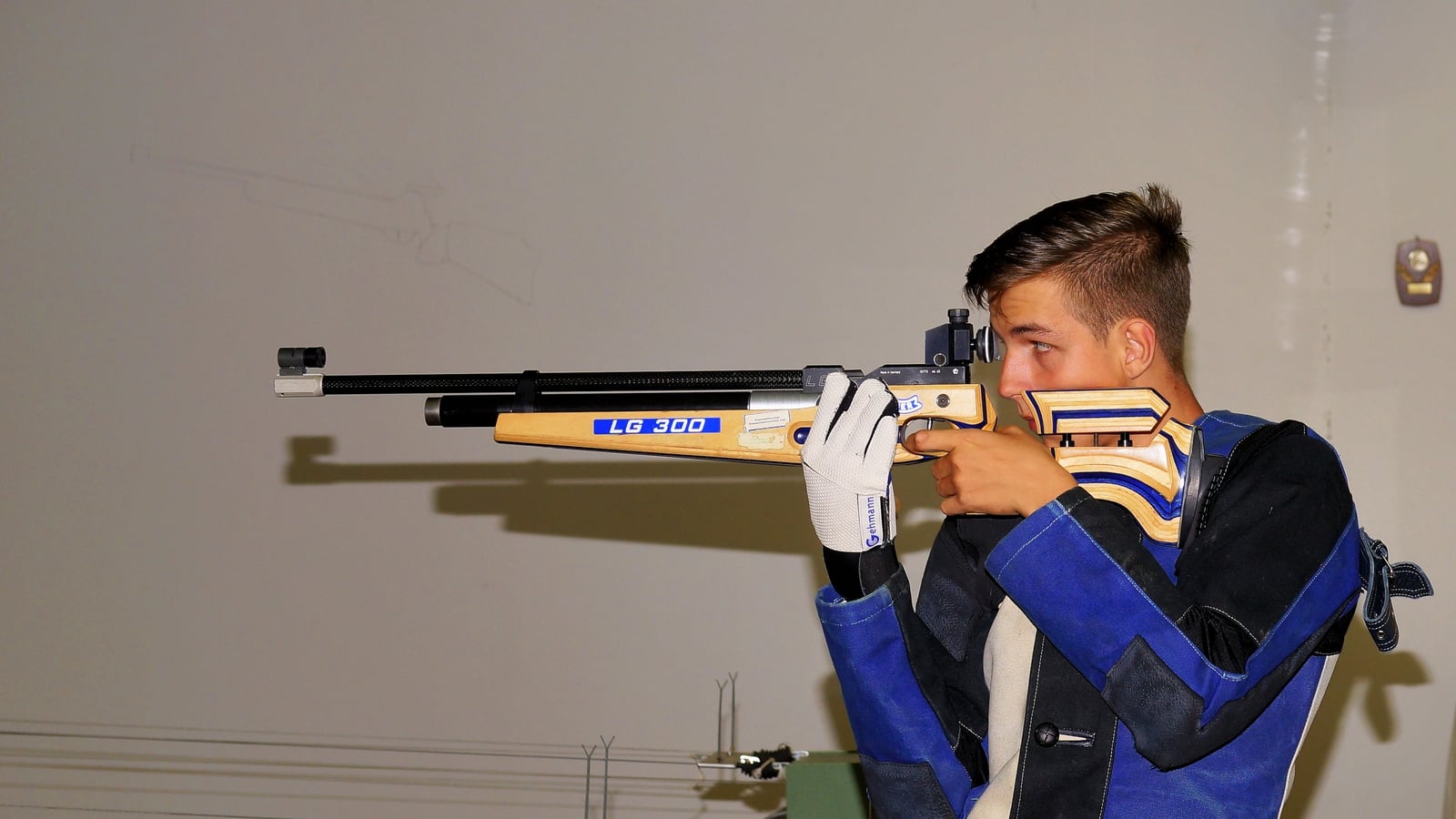
Why mindfulness directly concerns your shooting
Mindfulness refers to attention deliberately directed at the present moment, without judging what passes through your mind. Applied to shooting, this definition takes on a very concrete meaning: it’s the ability to stay fully in the movement you’re currently performing, without your attention drifting toward the result of the previous shot or anxiety about the final score.
Sport shooting is an activity where the mind drifts easily. Between shots there’s dead time — reloading, aiming, waiting your turn on the firing line — and it’s precisely in these intervals that intrusive thoughts take hold: counting points, comparing yourself to the shooter next to you, anticipating the next group. This mental drift has a measurable cost on the consistency of the movement.
This article covers the concrete application of mindfulness to the instant of shooting: the mechanisms at play, simple exercises you can transfer directly to the range, and the real limits of this approach. The goal isn’t to sell a miracle method, but to give you tools you can use starting with your next session, with honesty about what they can and can’t do.
An experienced club shooter who has practiced this approach for several years sums it up simply: “It never replaces technique, but it stops a good technique from being sabotaged by a head that wanders off.” That’s exactly the angle taken here — a complement to technical work, not a substitute.
More and more practitioners are interested in this approach because it requires no extra equipment and no change of discipline. It applies just as well to precision rifle as to pistol or dynamic shooting on cardboard targets, and it’s practiced just as well alone in training as in a competition context. It’s this universality that makes it a relevant topic for any shooter, regardless of level or main discipline.
What mindfulness is not
Before going further, a common confusion needs clearing up. Mindfulness is not a relaxation technique aimed at getting you to relax at all costs, nor a form of spiritual meditation disconnected from performance. It’s also not a method for “emptying your mind” or reaching a trance state.
What mindfulness actually offers is a training of attention: noticing where your mind is at a given moment, and deliberately bringing it back to what really matters in that precise moment — your breathing, your aim, the sensation of your finger on the trigger. It’s not the absence of thoughts, it’s a different relationship to those thoughts.
This distinction matters because a shooter who expects to “stop thinking about anything” during a string will systematically be disappointed and will quickly abandon the practice. The human mind produces thoughts continuously; the goal isn’t to stop that flow, but to stop letting yourself be automatically swept away by every thought that passes through, whether it concerns the shooting in progress or a concern totally unrelated to the session.
It’s also worth clarifying that mindfulness isn’t reserved for a particular type of shooter. It requires no belief, no religious practice, and no specific equipment. It’s an attention-training tool, comparable in principle to a physical exercise repeated to build a capacity, with no link to any spirituality or particular philosophical current.
The link between attention and movement consistency
Precision shooting relies on the faithful repetition of a sequence of movements: position, breathing, aiming, progressive pressure on the trigger. Every time attention drops out of this sequence — because it drifts toward the score, toward an outside noise, toward a thought unrelated to shooting — the movement loses a bit of its consistency.
This phenomenon is very concretely observed at the club. A shooter who runs through a string with a mind focused solely on the movement at hand generally produces a tighter group than a shooter whose attention navigates between the present shot, the previous shot, and anticipation of the next one. It’s not a question of raw talent, it’s a question of presence in the movement.
Attention works a bit like a spotlight: it illuminates whatever it’s pointed at, and leaves the rest in shadow. When that spotlight stays trained on the technical movement — the feel of the stock against the shoulder or hand, the breathing rhythm, the aim point — intrusive movements have less room to settle in. When the spotlight wanders elsewhere, the body keeps acting, but without the fine control that distinguishes a tight group from a scattered one.
This mechanism also explains why mental fatigue degrades precision faster than pure physical fatigue. A mentally exhausted shooter sees their attention fragment more easily, even if their muscles are still perfectly capable of the movement. Working on the stability of attention therefore indirectly delays the onset of this specific mental fatigue.
Breath anchoring as a starting point
Breathing is the most accessible tool for bringing attention back to the present moment, because it’s both automatic and voluntarily controllable. It’s also already a central element of classic shooting technique, which makes its use in mindfulness particularly natural for a shooter.
The basic exercise consists of paying full attention to three or four breathing cycles before starting a string, without trying to slow down or force the breath, simply by observing the air coming in and going out. This neutral observation, without judgment or an excessive will to control, is often enough to bring the mind back to the present moment after a distraction.
This same anchor can be used between two shots in a string, during the few seconds of reloading or repositioning. Rather than letting the mind comment on the previous shot, a shooter can use this dead time to return to one or two conscious breathing cycles, which has the effect of “resetting” attention before the next shot.
A complementary exercise consists of mentally associating the exhalation phase with the end of the progressive squeeze on the trigger, without this becoming a rigid rule to follow at all costs. This association helps some shooters naturally synchronize breathing calm with the moment the shot breaks, but it doesn’t work identically for everyone — some experienced shooters prefer briefly holding their breath rather than active exhalation, and both approaches are equally valid as long as they stay consistent from one session to the next.
Applying the body scan before a string
The “body scan,” a classic mindfulness exercise, consists of successively directing your attention to different areas of the body, simply noting the sensations present without trying to change them. Transposed to the shooting range, this exercise becomes a quick preparation tool before a string.
In practice, before raising the weapon, a shooter can spend a few seconds mentally scanning: tension in the shoulders, firmness of the grip, stability of footing, any clenching of the jaw or neck. This scan isn’t meant to artificially relax everything, but to become aware of unnecessary tension that often builds up without the shooter noticing.
This kind of scan frequently reveals intrusive tension far from the trigger hand — a clenched jaw, hunched shoulders, unevenly weighted footing. This distant tension influences overall movement stability more than one might imagine, and it stays invisible as long as attention isn’t specifically directed at it.
The value of this exercise lies in its speed: fifteen to thirty seconds is enough for a useful scan, which makes it perfectly compatible with the pace of a club session or a competition, without excessively slowing down the flow of shooting.
Observing thoughts without fighting them
One of the central principles of mindfulness is treating thoughts that arise as passing mental events, rather than as orders to execute or enemies to fight. Applied to shooting, this principle profoundly changes how you handle an intrusive thought like “I just missed, I’m going to miss again.”
The natural reaction to this kind of thought is often to fight it, to repeat the opposite to yourself (“no, I’m going to hit it”), or to judge yourself harshly for having had it. These three reactions share one thing in common: they feed the thought instead of letting it pass, and they consume attention that should be available for the technical movement.
The mindfulness approach proposes something else: notice the thought (“ah, there’s a thought of worry about the result”), without judging or fighting it, then deliberately bring attention back to the chosen anchor — breathing, the sensation of the finger on the trigger, the aim point. The thought doesn’t necessarily disappear instantly, but it loses its grip on the movement in progress.
This approach requires practice because it runs against the natural reflex to want to “fix” every bothersome thought. An experienced club coach often notices that a shooter new to this practice first tries to force mental silence, which generates additional frustration, before understanding that the goal is to let the thought pass rather than force it into silence.
Simple exercises you can transfer directly to the range
Here is a series of concrete exercises, applicable with no extra equipment and without significantly lengthening a classic training session.
- The three entry breaths: before starting a string, take three complete breathing cycles, simply observing the air coming in and going out without forcing it. This exercise serves as a transition between the mental “before the shot” and entering the technical movement.
- The single anchor point: choose a single sensory element to return to every time your mind checks out — the sensation of your finger on the trigger is an excellent choice, because it’s present on every shot and directly tied to the precision you’re after.
- The express body scan: fifteen to thirty seconds of mentally scanning tension, from shoulders to footing, before raising the weapon for a string.
- The conscious pause between shots: use the few seconds of reloading or repositioning to observe your breathing rather than mentally commenting on the previous shot.
- Returning to the present after a missed shot: when a thought of frustration arises after a disappointing hit, name it mentally (“frustration”) without dwelling on it, then immediately return to your anchor point before the next shot.
- Neutral observation of the result at the end of a string: rather than analyzing every hit during the string, train yourself to push that judgment back to the end of the complete string, to stay available to the movement while the string unfolds.
These exercises don’t need to be practiced all at once. A shooter new to this approach benefits from choosing one or two, repeating them over several sessions, before gradually adding others.
The difference between classic concentration and mindfulness
Many shooters already practice a form of intense concentration during their strings, without calling it mindfulness. It’s useful to understand the difference between the two, because they don’t produce exactly the same effect.
Classic concentration, as it’s often taught at the club, consists of strongly focusing attention on a precise target — the aim point, the desired result — while actively excluding everything else. This is a directed and sometimes tense attention, which works well as long as nothing disturbs it, but which can become brutally fragile when faced with a strong intrusive thought, such as a recent error or the stakes of a competition.
Mindfulness offers a more supple attention: it doesn’t actively exclude distractions, it notices them and lets attention return naturally to the chosen anchor, without a fight. This suppleness often makes it more resilient in the face of the unexpected, because it isn’t built on the idea that no intrusive thought should ever appear.
In practice, the two approaches complement each other rather than opposing one another. A shooter can use directed classic concentration during the fine-aiming phase, and mindfulness-type attention during the transition phases between shots, where the mind tends to drift more.
What the research says, with caution
A growing number of studies in sport psychology have looked at the effects of mindfulness on performance in precision disciplines close to shooting, such as golf, archery, or Olympic archery. The available results generally suggest a positive effect on attentional stability and management of competition stress, without this guaranteeing an automatic and systematic improvement in score.
Caution is warranted here: the scientific literature on this specific subject in civilian sport shooting remains more limited than for other precision disciplines, and the protocols studied vary a lot from one study to another in duration, intensity, and shooter population. Generalizing a precise improvement figure would be dishonest; what emerges more consistently is a tendency toward better emotional regulation and reduced rumination after an error.
This caution is deliberate: it’s better to acknowledge the limits of what we precisely know than to put forward statistics that would give a false impression of certainty. Mindfulness is not a miracle solution validated by absolute scientific consensus on sport shooting specifically — it’s a tool whose general mechanisms are well documented in the psychology of attention, and whose application to shooting remains plausible and consistent with those mechanisms, without definitive, quantified proof specific to this particular discipline.
It should also be noted that most of the protocols studied in the available scientific literature concern supervised, structured sessions followed over time, often accompanied by a professional trained in these methods. A shooter who practices alone, informally and irregularly, based on a few exercises read in an article, doesn’t exactly reproduce the conditions of these studies. That doesn’t make the practice useless, but it invites you to stay measured about the scale of effect you can expect compared to a supervised protocol.
Another point deserves honest mention: it’s likely that part of the effect observed in some studies is also explained by general mechanisms of stress management and emotional regulation, which aren’t strictly specific to mindfulness. Other mental preparation approaches, such as controlled breathing alone or a structured pre-shot routine, probably produce effects that partially overlap with those of mindfulness. This doesn’t diminish the value of the practice, but it invites you not to attribute to it an isolated and exclusive power that no study can affirm with certainty.
The real limits of the practice
Presenting only the benefits of mindfulness would be dishonest. This approach has concrete limits that are better known before investing in it, so as not to expect more from it than it can offer.
The first limit is that it never replaces technical work. A shooter who has perfect mastery of their attention but hasn’t worked on their progressive trigger squeeze or their position will keep producing scattered groups. Mindfulness optimizes the execution of a technique already in place; it doesn’t build that technique for you.
The second limit is the time needed to get a tangible benefit from it. As with any attention training, the effects are generally not immediate. A shooter who tries these exercises just once before an important competition risks being disappointed, because attentional stability is built over several weeks of repeated practice, not in a single isolated session.
The third limit concerns certain shooter profiles for whom attention turned too far inward — sensations, breathing, thoughts — can, on the contrary, feed a form of over-analysis that disrupts a movement that’s normally fluid and automatic. This phenomenon, sometimes called “analysis paralysis,” affects highly experienced shooters more, whose technical movement is already largely automated; for them, attention that’s too conscious of every detail of the movement can temporarily degrade fluidity rather than improve it.
Finally, mindfulness should never become a pretext for ignoring a real mental or emotional problem that goes beyond the scope of sport shooting. If anxiety, stress, or rumination significantly affect daily life beyond the range, these exercises don’t replace suitable support from a qualified professional.
One last, more practical limit concerns the time available at the club. A shared shooting range often imposes a pace dictated by other practitioners and reserved time slots, which sometimes leaves little room for extended attentional exercises before each string. This constraint doesn’t invalidate the practice, but it explains why the shortest, most discreet exercises — a few breaths, an express body scan — are generally more realistic to integrate than a long preparation, better reserved for solo training sessions where the pace is entirely under your control.
Integrating the practice into a training routine
Mindfulness benefits from being integrated gradually, rather than added all at once to an already busy routine. A shooter who tries to apply the six exercises presented above right from the first session risks feeling overwhelmed and abandoning it quickly.
A reasonable approach is to choose a single exercise — the three entry breaths, for example — and practice it systematically over several consecutive sessions, before adding a second. This step-by-step progression resembles the way you build any technical automatism in shooting: through regular repetition, not one-off intensity.
It’s also useful to practice some of these exercises outside the range, in a neutral setting, to build the skill before transferring it to real conditions. A few minutes of conscious breathing or a body scan at home, calmly, strengthens your ability to mobilize these same tools more quickly once on the firing line, where attention is under greater demand from the environment.
An experienced club shooter who has integrated this practice over several seasons notes that it progressively becomes more discreet and less conscious: the first months require an active effort to remember to return to your anchor, then the reflex settles in and requires less and less voluntary attention to trigger.
The use of mindfulness also doesn’t take the same form depending on the shooter’s experience and technical level. For a beginner, mental load is already occupied by learning the technical fundamentals — position, safety, weapon handling, basic aiming — and a single simple exercise, like the three entry breaths, is largely enough at this stage, more as a general calming habit than a fine-performance tool.
For an intermediate shooter, whose technical movements are starting to automate, mindfulness becomes more directly useful because available attention is no longer entirely absorbed by basic technical questions. It’s often at this stage that a shooter notices their best groups occur during sessions where they felt most present to the movement, which creates a natural motivation to explore these tools more seriously.
For an experienced shooter, the issue shifts to the consistency of attention under pressure, particularly in competition or during long strings where mental fatigue accumulates. An experienced practitioner generally benefits from finer work: recognizing their own personal patterns of attentional drift — for example, a systematic tendency to ruminate after a missed shot rather than anticipate the final score — to precisely target the anchor most useful in their situation. There’s also variation depending on the discipline practiced: a long, calm breath suits static shooting well, while a briefer, almost instant anchor adapts better to the pace of dynamic shooting on cardboard targets, where every second of preparation counts.
Mindfulness and managing competition stress
Competition stress generally amplifies all the attentional drift already present in training. The pressure of the timer, the stakes of the ranking, or the presence of an audience push the mind away from the present movement to project toward the final result or comparison with other shooters.
In this context, the mindfulness anchors worked on in training take on their full value, because they offer a familiar return point in the middle of an unfamiliar environment. A shooter who has repeated the return to their breathing hundreds of times at the club has a tool immediately available in competition, without having to improvise a stress-management strategy at the moment it’s most needed.
A competition-specific exercise consists of dedicating a few seconds, just before the start of a string or a relay, to a complete conscious anchor — breathing, a quick body scan, a reminder of the chosen anchor point. This short ritual doesn’t need to be long to be effective; its value comes from its constant repetition before every string, which makes it a familiar signal for the body and mind.
You also have to accept that a slight level of stress before a competition is normal and even useful for alertness. The goal of mindfulness isn’t to eliminate this stress entirely, but to prevent it from taking over completely and diverting attention from the technical movement during the string itself.
Mindfulness and mental visualization are often presented as two distinct practices, but they combine well within a shooting preparation routine. Visualization consists of mentally picturing the course of a shot or string before actually executing it, while mindfulness concerns attention to the present moment during the execution itself.
A simple sequence consists of using a short mindfulness exercise — a few conscious breaths — to stabilize yourself mentally, before moving into a brief visualization of the upcoming movement: the position, the sensation of stability, the aim point, the progressive pressure on the trigger through to the shot breaking. This combination prepares both the body and attention, rather than working on the two separately.
An experienced club shooter who uses this combination before every competition relay notes that visualization alone, without prior attentional stabilization, tends to be more superficial and less effective. The mind visualizes the movement correctly only when it isn’t already tied up with intrusive thoughts about the result or comparison with other competitors.
This complementarity also works the other way around: after a visualization, briefly returning to a mindfulness anchor — the sensation of your footing, your breathing — lets you exit the mental representation and come fully back to the present moment before actually raising the weapon. Without this transition, some shooters remain partially absorbed in the mental image rather than the sensory reality of the shooting in progress.
Common mistakes and tracking progress over time
Certain mistakes come up regularly among shooters discovering mindfulness applied to shooting, often out of not knowing what this practice really requires.
- Wanting immediate results: expecting a spectacular effect from the very first session almost always leads to giving up. Attentional stability is built through repetition, like any technical automatism.
- Piling on too many exercises too fast: trying to apply six different techniques from the start dilutes attention rather than strengthening it. It’s better to have a single, well-mastered anchor than several practiced superficially.
- Confusing mindfulness with total letting go: a shooter who is too relaxed loses the vigilance needed for precision. The goal is stable, available attention, not a state of drowsiness or laxness.
- Judging every mental distraction harshly: blaming yourself for having had an intrusive thought adds a layer of judgment that actually feeds the attentional drift you’re trying to limit.
- Giving up after a disappointing session: a session where the practice seems ineffective doesn’t mean the method doesn’t work; it’s a normal phenomenon in building any new mental habit.
- Ignoring basic technical work: no attentional anchor compensates for an unstable position or poorly mastered trigger control. Mindfulness optimizes a technique that’s already in place, it never replaces it.
An experienced coach who supports shooters discovering this approach generally recommends setting realistic expectations from the start: a few weeks of regular practice before objectively judging whether the tool brings a perceptible benefit to group consistency and how you feel in competition.
One last mistake deserves separate mention, because it affects shooters already experienced with the practice: believing that once the attentional anchor is automated, no more upkeep is needed. As with trigger technique or position control, attention progressively loosens without regular practice, even after months of good results. Returning occasionally to the basic exercises, even briefly, maintains the skill over time rather than letting it silently erode.
One of the classic traps with mental practices, including mindfulness, is relying solely on a subjective impression to judge their effectiveness. Human memory reconstructs sessions optimistically or pessimistically depending on mood at the moment, which makes it hard to know whether an attentional practice produces a real effect or whether the perceived improvement is just a coincidence tied to a good day.
That’s why structured tracking of sessions brings particular value to this work. Noting, after each session, not just the group result but also how you felt about the quality of attention during the string — stable presence, frequent drift, difficulty returning to the chosen anchor — lets you cross-reference these two pieces of information over several weeks and objectify a real link rather than an isolated impression.
A well-kept digital shooting log then becomes a valuable tool for this work, beyond its usual use for technical and equipment tracking. A shooter can thus notice, for example, that their sessions where they took the time to practice a breathing anchor before starting show tighter groups more consistently than sessions where they started directly without attentional preparation — an observation that’s hard to establish without data logged over time, session after session, over several months of practice.
This tracking also lets you spot finer trends: some shooters notice that their attention systematically degrades after a certain number of shots in a string, or under certain specific conditions like the presence of an audience or an imposed rate of fire. Identifying this personal pattern through a structured history lets you target attentional training exactly where it’s most useful, rather than practicing generically without knowing what concrete benefit to expect.
Keep in mind that progress on this front is rarely linear. Sessions where attention seems particularly unstable happen normally, even for a shooter who’s been practicing mindfulness for a long time, without that meaning a real regression in skill. The regularity of the underlying practice, more than the one-off performance of an isolated session, remains the most reliable indicator of progress over time — exactly as for any other technical aspect of sport shooting you’re looking to improve durably.
FAQ
Q: Do you need to meditate regularly outside of shooting for it to work at the range? A: It’s not mandatory, but regular practice outside the range, even just a few minutes a day, generally strengthens your ability to mobilize these tools more quickly in a shooting situation. The two practices reinforce each other without either being strictly indispensable to the other.
Q: How long before I feel an effect on my groups? A: It varies by shooter and by regularity of practice, so it’s hard to put forward a precise timeframe. Some notice a difference in feel after just a few sessions, while a more stable effect on group consistency generally requires several weeks of repeated practice.
Q: Can mindfulness replace working with a mental performance coach? A: No, these are complementary tools rather than substitutes. The exercises presented here are self-sufficient and accessible without support, but a qualified mental performance coach can go deeper and adapt the work to more specific difficulties than a general article can cover.
Q: Does it work as well in dynamic shooting as in static precision shooting? A: The principle applies to both, but the time window available to mobilize a conscious anchor is much shorter in dynamic shooting. The exercises between shots or before a string remain relevant in both cases, with a necessarily more condensed application in dynamic shooting.
Q: I can’t manage to “empty my mind” during my exercises — is that a failure? A: No, and that’s actually an expectation that needs correcting: the goal isn’t to make thoughts disappear, but to change your relationship with them by letting them pass without holding on. A mind that keeps producing thoughts during the exercise is normal functioning, not a sign of failure.
Q: Can you practice these exercises at the club without it being noticeable or bothering other shooters? A: Yes, all the exercises presented here are silent and discreet — breathing, mental body scan, returning attention — and require no visible gesture or special equipment. Nothing distinguishes, from the outside, a shooter practicing them from a shooter who’s simply preparing quietly.