
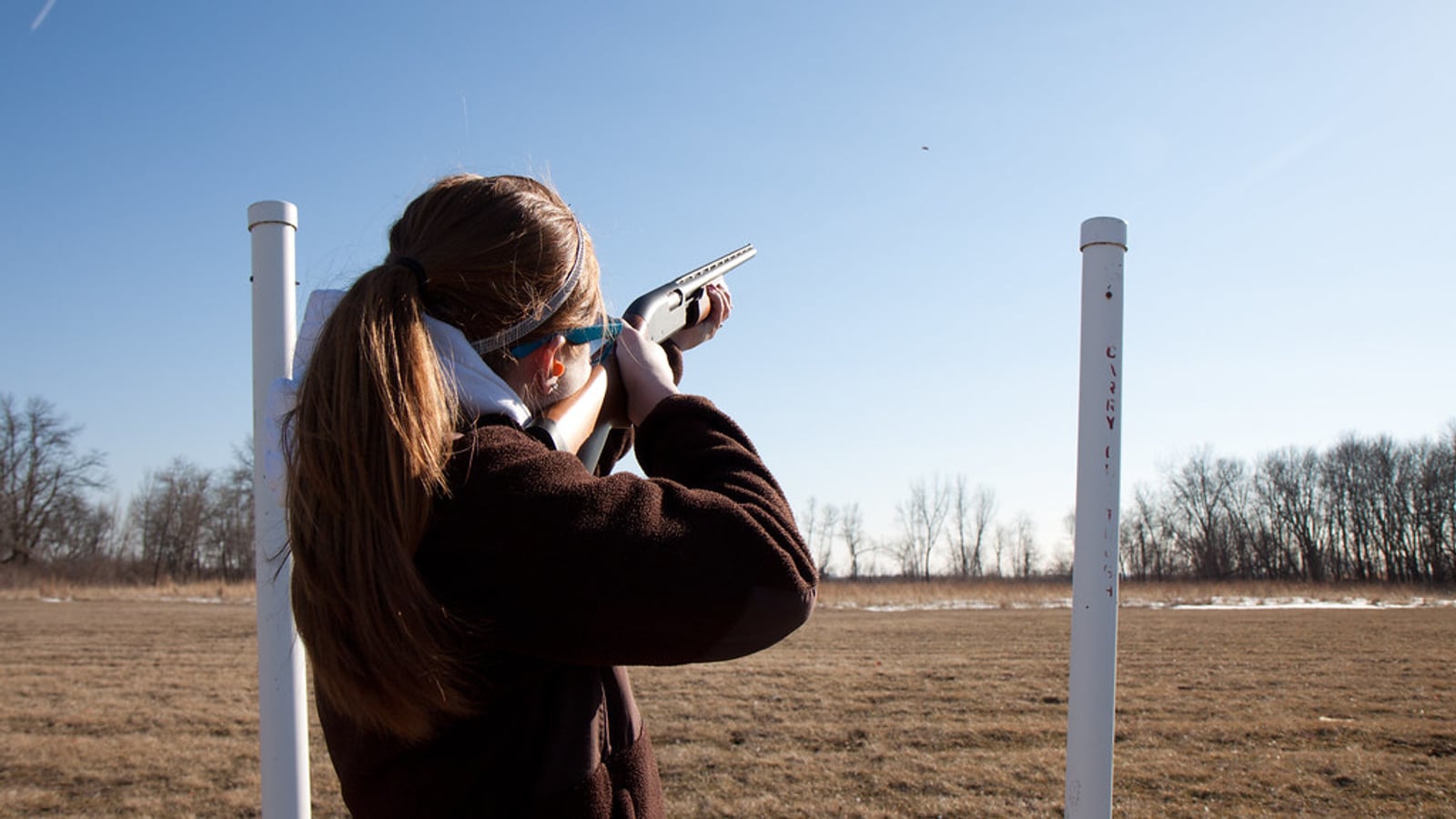
Two problems that get mixed up too often
A shooter who “doesn’t like recoil” almost always confuses two distinct things: the physical recoil of the gun, and their own psychological anticipation of that recoil. These are two different phenomena, with different causes and different solutions. Until you’ve clearly separated them in your head, you’ll keep treating the wrong problem.
Real recoil is pure physics: a mass (the bullet and the combustion gases) moves forward, and by conservation of momentum, the gun moves backward. This recoil is objective, measurable, and depends on the weight of the gun, the caliber, the powder charge, and any damping system. It can’t be “worked on” mentally — it’s managed through posture and equipment.
Anticipation is something else: an anticipated bodily reaction to an event that hasn’t happened yet. The brain knows a bang and a jolt are coming, and it tries to prepare in advance by tensing muscles, closing the eyes, pushing the gun downward. The problem is that this preparation often kicks in a fraction of a second before the shot breaks, so it disrupts the shot before the real recoil even begins.
This confusion has an important practical consequence: a shooter who thinks “I need to handle recoil better” when their real problem is anticipation will chase useless solutions (a heavier gun, a weaker caliber, a compensator) without ever addressing the real cause. They can swap gear ten times and keep exactly the same shooting flaw, because the flaw is in their anticipated movement, not in the gun.
The goal of this article is to give you the tools to make this diagnosis correctly on yourself, then to fix each of the two problems with the right tools: posture for real recoil, progressive desensitization for anticipation.
This distinction isn’t just an intellectual exercise — it has a direct impact on your progress. A shooter who treats an anticipation problem with material solutions (heavier gun, compensator, permanently reduced caliber) may see temporary improvement without ever addressing the root of the problem. The day they switch caliber or gun again, the flinch comes back intact, because it was never corrected — only worked around.
Conversely, a shooter with a genuine problem of poorly fitted equipment (a stock that’s too short and hits the shoulder, a grip too big for their hand, a gun too light for the caliber fired) who tries to solve it purely through psychological desensitization exercises will wear themselves out on a problem that isn’t in their head. That’s why this first diagnostic work deserves to be done seriously, before even choosing which exercises to practice.
How to recognize anticipation (the flinch)
The most classic sign of anticipation is a hit that lands low, often low-left for a right-handed shooter wearing gloves (and mirrored for a lefty). This dispersed, low-leaning grouping is almost never an aiming problem: it’s the body “pushing” the gun down just before or during the shot, in anticipation of the coming recoil.
The most reliable test to confirm this diagnosis is the surprise-ammunition test, often called the “ball and dummy drill,” which you can simply call the dummy-round test. A training partner (or you yourself, discreetly mixing the magazine without watching the order) randomly inserts a dummy round or an empty magazine among live ammunition. When the trigger is pressed on an empty chamber, the gun doesn’t fire — and if the barrel dips violently at the moment of the “click,” you have your answer: that’s pure anticipation, your body moved for an event that never happened.
Other signs often accompany the flinch: systematic blinking at the moment the shot breaks (sometimes both eyes, which cuts off the sight picture), tense, held breathing rather than naturally suspended breathing, a grip that suddenly tightens in the last half-second before the shot, or a tendency to “yank” the trigger instead of pressing it progressively to “get it over with” faster.
You need to distinguish this flinch from another problem that looks similar on the surface: trigger panic, where the shooter presses abruptly as soon as they judge the sight picture “good enough,” out of fear of losing alignment. Both are partly corrected by the same basic exercises (dry fire, surprise ammunition), but trigger panic comes from a lack of confidence in the stability of the sight picture, whereas flinch comes from anticipation of the jolt. A good diagnosis avoids treating one symptom in place of another.
Finally, an important point to normalize: having a bit of anticipation at the start of your practice is neither abnormal nor shameful. It’s a logical human reaction to a loud noise and a physical jolt. The problem isn’t having had this reflex once — it’s never having worked to defuse it.
Here’s a list of the most reliable signals to watch for in yourself or a training partner, in the order they generally appear most frequently:
- Impact that systematically lands low or low-lateral relative to the aim point, even though the sight picture seemed correct at the moment the shot broke.
- Barrel that visibly dips on an empty “click” during a surprise-ammunition test.
- Blinking or partial closing of the eyes at the exact moment the shot breaks, repeated almost systematically.
- Sudden tightening of the grip in the last fraction of a second before the final trigger press.
- Tendency to snap the trigger abruptly instead of a progressive, continuous press.
- Verbalized apprehension before the session (“I know I’m going to push again”), which is often a reliable admission from the shooter themselves.
Spotting these signals early saves months of training spent correcting a visible symptom (the dispersed grouping) without ever treating its real cause.
The physics of real recoil
Real recoil depends on several measurable factors. The first is the weight of the gun: the heavier a gun is, the more it absorbs recoil energy through inertia, and the less that recoil is felt by the shooter. This is one of the reasons precision competition guns are often heavier than their recreational equivalents.
The second factor is caliber and powder charge: a more powerful cartridge mechanically generates more energy to the rear. The third factor is the action type: a semi-automatic gun distributes part of the recoil energy into the reloading cycle (via the recoil spring or the gas system, depending on the design), which generally softens the felt sensation compared to a single-shot or manually operated repeating gun of comparable caliber and weight.
Recoil also breaks down into two distinct components: linear recoil, which pushes the gun straight back against the shoulder or hand, and “muzzle flip,” which rotates the gun upward because of the support point sitting below the barrel’s axis. Good posture mainly acts on this second component, reducing the amplitude of the flip and speeding up the return to the sight picture.
You have to accept a simple reality: real recoil never disappears completely, whatever your level. An experienced shooter doesn’t “feel” recoil the same way a beginner does, not because the recoil has changed, but because their body has learned to absorb it efficiently without it disturbing their sight picture or trigger movement. The goal, then, isn’t to eliminate recoil, but to make it invisible to the shooting process.
One last factor deserves mention, often overlooked: the relative position of the hand or shoulder to the gun’s center of gravity directly influences how the rotational torque (behind muzzle flip) is distributed. A gun held or shouldered too far forward or too far back of its natural balance point amplifies this phenomenon, regardless of any other setting. This is one reason a hands-on trial before purchase, at a club or gun shop, remains valuable: two guns of identical caliber can behave very differently depending on their mass distribution.
Pistol posture: absorbing without tensing up
With a pistol, recoil absorption starts with the grip. A grip that’s too high on the frame leaves too much leverage for the barrel to rise freely; a correct grip places the hand as high as possible under the slide, with the skin firmly in contact with the backstrap, leaving no dead space that would let the gun “slap” in the hand with each shot.
The grip should be firm but not clenched. A useful image many instructors use: the firmness of a genuine handshake, not that of a vise. A grip that’s too loose lets the gun move freely in the hand and amplifies the felt recoil and the return-to-sight time. A grip that’s too tense fatigues the muscles within a few dozen rounds, causes trembling, and degrades the precision of the shot break — without reducing real recoil by a single gram, since that depends on the physics of the cartridge, not grip strength.
Arm position matters just as much. Slightly bent elbows (never fully locked) let the joints absorb part of the movement instead of transmitting it entirely to the shoulders and torso. A shooter with fully extended, locked arms transmits recoil in a straight line, which increases the felt shock and slows the return to the sight picture.
In two-handed shooting, the division of labor between the two hands changes a lot. The weak hand (or support hand) provides most of the lateral and vertical control, wrapping around the strong hand without over-compressing it. A common beginner mistake is leaving the weak hand passive, as a mere support, when it should actively participate in controlling muzzle flip.
Finally, overall body posture matters: a torso leaning slightly forward, with weight distributed toward the front of the feet rather than the heels, helps counter the push backward and upward. A shooter leaning back in a defensive reflex instead amplifies the recoil movement rather than channeling it.
Here are the checkpoints to run through before every pistol string, in their natural setup order:
- Grip seated well under the slide, with no dead space between skin and backstrap.
- Grip firmness comparable to a genuine handshake — neither loose nor overly clenched.
- Elbows slightly bent on both sides, never locked in full extension.
- Weak hand genuinely active in controlling muzzle flip, not just resting as passive support.
- Torso leaning slightly forward, weight on the front of the feet rather than the heels.
- Wrists aligned with the barrel axis, with no lateral break that would deflect the return to the sight picture.
Wrist stability deserves its own mention, since it’s a point often underestimated by beginners. A wrist that’s too loose lets the muzzle “break” upward with every shot, which lengthens the return-to-sight time and fatigues the tendons over a long session. An overly locked, excessively rigid wrist, on the other hand, transmits a sharper jolt into the forearm and can, over time, contribute to joint pain in shooters who intensively practice powerful calibers.
Rifle posture: the shoulder mount and the contact point
With a rifle, the shoulder mount is the central point of recoil management. A poorly seated stock, resting on the arm instead of firmly in contact with the shoulder pocket, lets the gun gain speed before meeting real resistance — which increases the felt shock instead of spreading it progressively.
Contact must be firm and constant from the moment you mount the gun, not added at the last moment before the shot. A shoulder mount that only stabilizes just before the trigger press means the gun has slack that will close abruptly at the moment of recoil, producing a sharp jolt rather than a cushioned push.
Body position behind the gun matters too. In the standing position, a slight forward lean of the torso, in line with the shot, lets body weight counter the push of recoil instead of simply absorbing it passively. Lying prone or seated with support, aligning the body with the barrel’s axis (rather than at an angle) reduces the gun’s tendency to deflect sideways during recoil.
The cheek resting on the stock should stay in constant contact with steady pressure — neither glued on with excessive tension, nor floating a few millimeters away. A poorly positioned cheek that “bounces” on recoil not only disrupts the current shot but also the visual tracking of the impact, which hurts self-correction for the following shots.
For manually operated or heavy precision rifles, a well-adjusted bipod or support bag changes things considerably: stable front support reduces parasitic movement of the gun and lets the shooter focus on the shoulder mount and trigger rather than on maintaining the overall shooting platform.
The position of the rear gripping hand (the one holding the pistol grip or the wrist of the stock) also plays an underrated role. A hand that firmly pulls the stock rearward and into the shoulder, rather than simply resting on the grip, helps maintain the firm contact mentioned above throughout the firing cycle, including during the recoil phase itself. This slight pulling action, often taught under the term “pull-in,” complements the shoulder mount without requiring excessive force.
One last point to check regularly: the stock height relative to your build. An adjustable stock, when the gun allows it, should be set to your morphology rather than used at a generic setting. A poorly fitted comb height forces you to raise or lower your head uncomfortably, which degrades both cheek stability on the stock and the quality of shoulder contact.
The role of breathing in absorbing recoil
Breathing directly influences how the body absorbs recoil, often more than you’d think early in your practice. A shooter who holds their breath tensely, lungs full and chest maximally inflated, offers a rigid but strained mass that transmits the shock more abruptly.
The classic technique taught at clubs is to exhale partially before the shot, keeping a small reserve of air in the lungs — neither empty nor full lungs. This natural balance point, often called the “natural respiratory pause,” offers a stable but relaxed chest, able to absorb the movement instead of rigidly blocking it.
Regular, controlled breathing before the shot also has an important indirect effect on psychological anticipation: a body in respiratory tension is already an alert body, which precisely facilitates triggering the flinch reflex. Working on your breathing ahead of the shot isn’t just a matter of sight stability — it’s also a tool for managing anticipation.
A simple exercise to build into every session: before each shot, take three broad, slow breaths, then release about half the air on the third exhale, and mark a natural pause before finalizing the trigger press. This routine, repeated identically with every shot, builds a stable framework that leaves less room for nervous improvisation.
This breathing routine also has a valuable side effect on long strings: it naturally imposes a calmer firing pace. A shooter who presses the trigger too quickly, without marking this respiratory pause, mechanically has less time to stabilize their sight picture and a higher risk of triggering a shot out of anticipation rather than a deliberate decision to fire. Slowing the pace through breathing is often more effective than mentally repeating “don’t anticipate” — an instruction that, phrased that way, paradoxically keeps attention focused on the coming recoil.
Progressive desensitization exercises: the fundamentals
Progressive recoil desensitization relies on a simple principle borrowed from sports pedagogy in general: exposing the body to a stimulus in increasing steps, consolidating each step before moving to the next, rather than jumping straight to maximum intensity.
The first step, and the most underrated, is dry fire: no ammunition, with a gun checked empty several times before starting. This work lets you repeat the trigger-press motion dozens of times with no recoil and no bang at all, which rebuilds a clean trigger motion, independent of any anticipation. Many clubs and instructors consider dry fire the most cost-effective exercise for progress, across all disciplines.
The second step is switching to a reduced caliber on a similar gun, if your discipline allows it: for example using a rifle or pistol in .22 LR to train the movement before returning to your usual practice caliber. The nearly nonexistent recoil of the .22 LR lets you reinforce a clean trigger motion with a real shot break and a real bang, without the strong recoil stimulus that triggers the flinch. This step also exists in an air-gun version, an unregulated category in many places, particularly suited for intensive, low-cost training.
The third step revisits the surprise-ammunition test already described above, but used this time as a repeated training tool rather than a one-off diagnostic. By regularly inserting dummy rounds into the firing sequence without the shooter knowing in advance when they’ll come up, the body progressively learns that pressing the trigger shouldn’t generate any anticipation, since the outcome (fire or not) is unpredictable.
A practical summary of these three steps, to reuse at the start of every correction cycle:
- Step 1: repeated dry fire, gun checked empty, focus solely on the cleanliness of the trigger motion.
- Step 2: switch to a reduced caliber or an air gun to regain a real bang without the strong recoil stimulus.
- Step 3: supervised surprise ammunition, to verify the motion stays stable even without knowing whether the shot will fire.
These three steps aren’t meant to be run through once and then forgotten: they form a foundation worth returning to regularly, even after correcting a flinch, much like an experienced shooter keeps doing basic drills despite their level.
Progressive desensitization exercises: scaling up
Once the basic steps are solidly acquired, progress continues with a very gradual increase in power, never a direct jump to the most powerful caliber you practice. A shooter who has just corrected their flinch on a low-recoil gun and immediately returns to their usual heaviest caliber risks seeing the old reflex return almost fully, particularly in the first few sessions.
An effective method is to structure sessions in blocks: start each session with a series of dry-fire shots, then a few dozen low-recoil rounds if the equipment allows, and only then move to the real practice caliber, paying particular attention to the first shots of this last phase — that’s often where anticipation reappears first.
Video review, when available at a club, is a valuable tool at this stage. Filming your own session (from behind or the side, never toward other shooting lanes) lets you objectively spot signs of flinch — blinking, barrel dip, shoulder tension — that the shooter often doesn’t perceive in real time. Many shooters are surprised to see how much their anticipation still persists even after several months of practice, simply because they’d never had objective visual feedback on it.
A principle to keep in mind throughout this progression: it’s better to fire fewer rounds with a clean motion than many rounds reinforcing a bad reflex. A fifty-shot session with an uncorrected flinch only consolidates the flaw, whereas a twenty-shot session with a verified, clean motion builds a real, solid foundation going forward.
Fatigue deserves particular attention during this scaling-up. A flinch tends to reappear more easily toward the end of a session, when concentration drops and the grip or shoulder-mount muscles start to tire. It’s often more effective to end a session a bit earlier on a clean motion than to force the last rounds of a box and let the flinch take back over on those final shots — shots that leave the freshest imprint in motor memory before the next session.
The role of coaching and an outside eye
An entrenched flinch is often hard to perceive on your own, precisely because it’s a fast, largely unconscious reflex. An experienced instructor or a trusted training partner, positioned to observe without disturbing the shot, often spots in a few rounds signs that the shooter in question doesn’t notice at all in themselves.
Outside feedback is particularly useful for distinguishing a persistent flinch from a one-off issue linked to fatigue, competition stress, or poorly fitted equipment (a stock too short, a grip mis-sized for the shooter’s hand). A correct diagnosis avoids spending months attacking a psychological anticipation problem when the real cause is, for example, a poorly adjusted shoulder contact point that makes every shot physically more uncomfortable than it should be.
At a club, it’s common for an instructor to specifically offer the surprise-ammunition test under direct supervision, precisely because the shooter shouldn’t know the order of the dummy rounds for the test to be valid. A shooter who tries to reproduce this test alone, mixing their own magazine, often unconsciously biases the result by still anticipating the likely moment of the “click.”
An outside eye also helps on a more psychological level: voicing your difficulty with recoil to an instructor or partner often takes the drama out of the subject. Many shooters carry a form of embarrassment about admitting they “fear” recoil, even though it’s an extremely widespread phenomenon, including among experienced practitioners on certain calibers or disciplines they practice less regularly.
A regular training partner, even without official instructor status, can be enough for many of these checks, provided a relationship of trust is established where each person accepts receiving honest feedback without taking it as personal criticism. Many clubs actually favor this paired setup, precisely because the cross-observation between two shooters of similar level often catches more flaws than a solitary self-assessment, however rigorous.
Common mistakes that make the problem worse
The first classic mistake is trying to “compensate” for anticipation by gripping the gun harder, thinking that firmness will neutralize recoil. This strategy doesn’t work: it fatigues the muscles, degrades the finesse of the trigger motion, and has zero effect on the physics of recoil, which stays identical regardless of the grip force applied before the shot breaks.
The second mistake is swapping equipment as an automatic solution to a flinch, without first verifying the problem is genuinely tied to the equipment and not to an untreated personal reflex. A shooter who buys a heavier gun or a recoil compensator to “fix” their psychological anticipation risks seeing the same flinch reappear on the new gun as soon as the stimulus (noise, jolt, anticipation of the shot) becomes significant again.
The third mistake is stacking long strings without ever isolating the work on the motion itself. Running dozens of rounds in a row without going through dry fire or surprise ammunition often maintains the flinch instead of correcting it, simply because the faulty motion gets repeated as many times as the correct one.
The fourth, more subtle mistake is neglecting the physical comfort of shooting: insufficient or poorly fitted hearing protection, which lets through a bang that’s too loud and painful, sustains a good part of the anticipation all by itself. A shooter whose ears hurt with every shot will develop a tensing reflex almost mechanically, regardless of any technical work on posture or trigger. Checking your hearing protection is an integral part of a real flinch-correction approach, not a secondary detail.
The fifth, rarer but real mistake is trying to work on flinch correction only in competition or timed-drill settings, in a context of pressure and stress. This setting is useful in the final consolidation phase, but is counterproductive as a starting point: stress adds an extra layer of anticipation on top of the existing flinch, making the desensitization work much harder to isolate. It’s better to first consolidate a clean motion in a calm, low-stakes session, and only then test it under pressure.
One last mistake, common among shooters progressing on their own, is changing several variables at once: new ammunition, new grip, new stock adjustment, and a new breathing exercise all at the same time. When the result improves or worsens, it becomes impossible to know which change is responsible. Modifying a single parameter at a time, across several sessions, lets you isolate what really works for you rather than stacking adjustments whose real effect stays unclear.
Special cases by discipline
In precision rifle shooting (whether at a fixed target at 50 or 300 meters, or in the prone position with support), recoil is generally easier to manage thanks to the weight of the gun and the stability of the position. The main challenge there is often less recoil itself than maintaining a constant shoulder mount shot after shot across long strings, an essential condition for a tight grouping.
In dynamic disciplines like IPSC or Steel Challenge, where the shooter fires rapid strings at cardboard targets or steel plates laid out on a course, recoil has to be managed while moving and under time pressure. Recoil management there is inseparable from a fast return to the sight picture: a shooter who absorbs muzzle flip poorly loses precious time regaining alignment before the next shot, which directly penalizes their time on the course.
In shooting at animal-shaped metal silhouettes (chicken, pig, turkey, ram), the precision required at varying distance demands particularly rigorous recoil management right from the first shot, since there’s generally no second chance on a target that must be knocked down with a single, well-placed hit.
In black-powder shooting or with antique guns, recoil is often more pronounced and “duller” than with equivalent modern guns, which calls for a specific postural adjustment and heightened attention to the shoulder mount, particularly on the heaviest replicas in larger calibers.
Whatever the discipline, the principle stays the same: first isolate what belongs to real recoil (managed through posture and equipment) from what belongs to psychological anticipation (managed through progressive desensitization), then treat each component with the appropriate tool rather than hoping one solution will fix both at once.
In speed pistol shooting or on timed courses, the time constraint adds an extra dimension: the shooter has to manage the return to the sight picture after recoil while maintaining a fast pace. Here, training with a reduced caliber followed by a gradual scale-up makes complete sense, because a poorly corrected flinch under time pressure translates directly into a loss of precision on the last shots of a fast string, exactly when fatigue and pressure are strongest.
In slower-paced disciplines, like 10-meter rifle or air-pistol shooting, an unregulated category in many places, recoil is nearly zero, which makes it an excellent training ground for consolidating a flawless trigger motion before transferring it to calibers with more pronounced recoil. Many clubs actually recommend this discipline as a training base, even for shooters whose main practice is on other calibers.
Tracking your progress over time
Correcting a long-established flinch almost never happens in a single session. It’s work measured over several weeks, sometimes several months depending on how entrenched the reflex is and how regular the training is. Noting your observations from one session to the next — impact position, sensations during the shot, result of the surprise-ammunition test — lets you objectify a progress that, felt session by session, can seem very slow or uneven.
A shooting log, paper or digital, makes real sense here: recording the type of exercise practiced (dry fire, reduced caliber, surprise ammunition, practice caliber), your feeling about anticipation, and the grouping obtained lets you visualize an underlying trend rather than judging each session in isolation. A poor grouping on a given day, by itself, doesn’t mean much; a trend across ten sessions, on the other hand, is real information.
You also have to accept that occasional backsliding is part of the normal process. A shooter who has made good progress on their flinch may see the reflex partially reappear after a long break from practice, a change of gun, or simply a competition session under pressure. This isn’t a failure of the method — it’s a sign that a few repetitions of dry fire or surprise ammunition are needed to consolidate the gains again.
Finally, one last useful benchmark: the true measure of progress isn’t “I no longer feel the recoil,” which will never happen completely, but “recoil no longer disrupts my sight picture and trigger motion.” That’s a more realistic and more motivating reframe, one that avoids chasing an unattainable goal and getting discouraged along the way.
FAQ
Q: Can a flinch disappear completely one day? A: The reflex can become controlled enough that it no longer affects the shot, but it often stays latent and can occasionally reappear after a break or a change of equipment. The realistic goal is to keep it continuously under control, not to eliminate it once and for all.
Q: Does the surprise-ammunition test work if I do it alone? A: It’s possible but less reliable, since you inevitably know the rough order of the rounds you loaded yourself. Doing this test with a partner or instructor who preps the magazine without you watching gives a much more honest result.
Q: Is a heavier gun enough to correct anticipation? A: A heavier gun reduces the felt real recoil, which can help, but it doesn’t correct an already-established anticipation reflex. Dry fire and surprise ammunition remain necessary even with equipment that dampens recoil.
Q: How long does it take to correct an old flinch? A: This varies a lot depending on how entrenched the reflex is, how regular the training is, and the discipline practiced, so it’s hard to give a universal timeframe. Steady progress over several weeks with targeted exercises generally produces the first visible results.
Q: Can dry fire damage the gun? A: On most modern guns designed for it, no, but some older or more fragile mechanisms can be sensitive to repeated dry-firing. It’s worth checking with the manufacturer or a gunsmith whether a “snap cap” system (a dummy round that absorbs the firing pin’s impact) is recommended for your specific model.
Q: Is it a problem to still have a bit of anticipation after several years of practice? A: No, that’s not rare, particularly on a caliber or discipline you practice less regularly. What matters is being able to recognize the sign and resume a few targeted sessions of dry fire or surprise ammunition as soon as it reappears, rather than letting it settle in for good.