
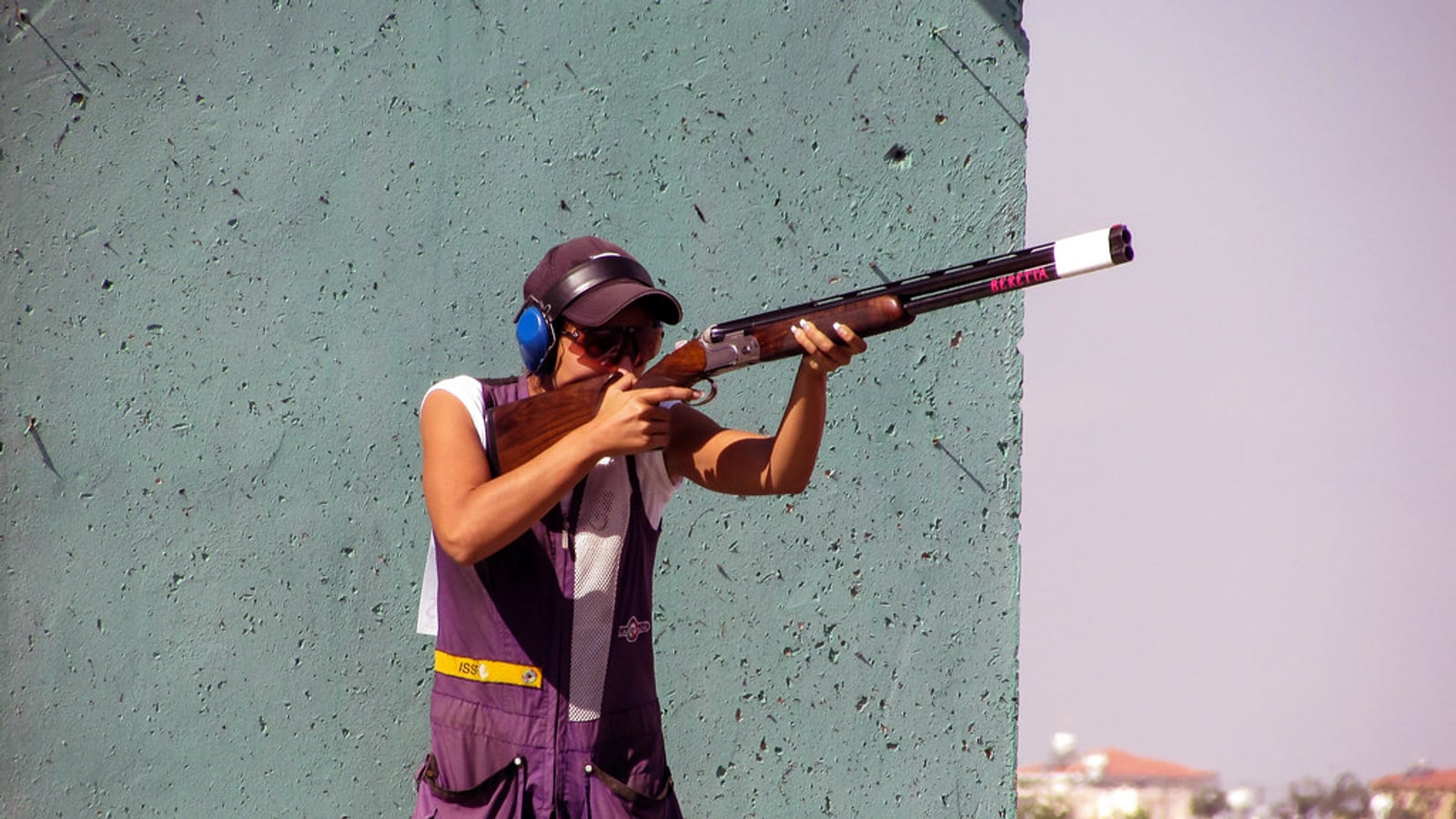
Nerves aren’t a flaw, they’re a signal
The first time you feel your hands shake before starting a string in competition, you think something’s wrong. It isn’t. Nerves are a normal physiological response to something your brain judges important. A shooter who feels absolutely nothing before a match isn’t necessarily performing better — often they’re just indifferent to the outcome.
So the goal isn’t to eliminate nerves, it’s to make them manageable. A seasoned club shooter who’s racked up matches for years still feels an adrenaline spike before their first string. The difference from a beginner isn’t the absence of stress, it’s the ability to keep executing the technical movement despite it.
This article gives you concrete tools: breathing, cognitive reframing, distinguishing paralyzing nerves from useful excitement, and generic experience reports from shooters who’ve been there. Nothing theoretical disconnected from the firing line — only what actually works in the moment.
Why your body reacts this way
Facing competition stakes, your autonomic nervous system switches to alert mode. Heart rate climbs, breathing shortens, hands get clammy or shaky, tunnel vision narrows on the target. It’s the same physiological mechanism that would make you react to real danger, except here the danger is purely symbolic: blowing the string, disappointing, performing badly in front of others.
This reaction isn’t controllable at the source. You can’t consciously decide not to have your heart race. What you can control is what you do with that activation: either you let it interfere with your technical movement, or you learn to channel it into concentration.
An often overlooked point: the intensity of nerves depends directly on how much importance you place on the result. The more personal stakes a match carries (qualification, ranking, social pressure), the stronger the stress response. This isn’t a fatality — it’s a mechanism that cognitive reframing, covered later, acts on directly.
Another factor influencing the intensity of the response is your actual level of preparation going into the match. A shooter arriving with insufficient or irregular training volume generally feels stronger nerves, not because they’re naturally more anxious, but because their brain detects — often correctly — a gap between the stakes and the preparation. This mechanism explains why serious technical preparation remains, ahead of any mental technique, one of the best anti-stress tools available.
Accumulated fatigue before a match also plays an often underestimated role. A nervous system already strained by lack of sleep, heavy work load, or a long trip before the event has fewer resources to regulate stress activation once on the line. Planning for proper recovery in the days before a match isn’t a minor detail — it’s a real lever for managing nerves, on par with breathing or reframing.
Paralyzing nerves vs. useful excitement: the real difference
Everyone feels some activation before a match, but it doesn’t produce the same effect in everyone. There’s a real difference between the nerves that degrade your performance and the excitement that, on the contrary, sharpens your focus.
Paralyzing nerves show several signs: thoughts looping on the result or others’ judgment, trembling that takes over the whole movement (not just slight, passing instability), a feeling of no longer sensing your stance or trigger, an urge to rush the shot to “get it over with.” In that state, you’re no longer thinking about your movement — you’re thinking about yourself and what others will think of you.
Useful excitement, on the other hand, shows up differently: heart beating faster but attention staying focused on the target and the movement, a form of impatience to start rather than to flee, clarity that stays intact on the technical sequence. A regional champion often describes this state as “being fully on but in the right place”: the energy is there, but it serves the shot instead of disturbing it.
The tipping point between the two rarely depends on the physiological intensity itself, but on the object of your attention. If your attention drifts outward (judgment, stakes, comparison), you slide into paralyzing nerves. If your attention stays on concrete, internal elements (breathing, aim, trigger pressure), you stay in useful excitement. All mental training consists of retraining that anchor point.
There’s also an intermediate zone worth knowing about: under-activation. A shooter who arrives totally relaxed, with no tension at all, rarely performs at their best either, because attention then lacks tone and precision. Optimal performance generally sits in a zone of moderate activation, neither too low nor too high, specific to each shooter. Some need a bit more tension to be effective, others a bit less: the mental work consists of learning to know yourself on this exact point rather than aiming for a theoretical absolute.
A simple indicator for locating where you stand on this scale is the quality of your immediate memory of the shot you just fired. In useful excitement, you can generally describe precisely your sight or front sight position at the moment of release. In paralyzing nerves, that memory becomes blurry, as if the shot happened without you. Once spotted, this indicator lets you objectively gauge your mental state between two strings, without waiting for the final result to judge the situation.
Breathing as the first lever for action
Breathing is the only physiological parameter tied to stress that you can directly and voluntarily modify. That’s why it’s the most effective entry point for defusing rising nerves before or during a string.
The basic principle is simple: an exhale longer than the inhale activates the parasympathetic system, the calming one. Short, high breathing (upper chest) on the contrary sustains the alert state. Many stressed shooters breathe short and fast without realizing it, which worsens the sensation of tension instead of reducing it.
A simple technique to apply before stepping up to the line: inhale for 4 counts through the nose, hold for 2 counts, exhale for 6 to 8 counts through the mouth, slowly. Repeat this cycle 4 to 6 times before your first string. The goal isn’t to relax completely (that would be counterproductive for concentration), but to bring your heart rate down to a manageable level.
During the string itself, breathing has a second role: it paces your shooting movement. The placement of the breath before release (a short breath hold, on a half-released exhale) should stay identical to what you use in training. This is a point many stressed shooters forget: they unconsciously change their shooting breath cycle in competition, which destabilizes everything else in the movement.
Finally, breathing also serves as a reset signal between two shots or strings. A deep, deliberate breath after a missed shot lets you cut the rumination loop before it contaminates the next shot. It’s a tool you can train specifically, not just endure passively.
One technical point deserves clarifying: breathing must never itself become an additional source of stress. Some shooters, upon discovering these techniques, start counting their breaths obsessively, which adds mental load instead of removing it. The goal remains simplicity: two or three well-executed breathing cycles are far better than a complex sequence poorly mastered under pressure.
It’s also useful to separate calibration breathing, practiced before the string to bring activation down, from shooting breathing, integrated into the technical movement itself. Confusing the two leads some shooters to try to excessively slow their breathing cycle during the aiming movement, which disturbs stability rather than improving it. Each of these two breathing patterns has its own function and should be trained separately before being combined in real conditions.
To anchor this technique over time, it’s recommended to practice it outside of shooting sessions too: on public transport, before a meeting, before a stressful appointment. The more automated the long breathing cycle becomes in everyday life, the more quickly and effortlessly it becomes accessible on match day, at a moment when attentional resources are already heavily taxed elsewhere.
Cognitive reframing: changing what you tell yourself
Nerves often feed on the sentences you repeat to yourself without even noticing. “I absolutely must not blow this string,” “if I lose it now it’s over,” “everyone can see me shaking”: this kind of internal dialogue amplifies activation instead of calming it.
Cognitive reframing consists of replacing that dialogue with formulations that direct your attention toward what you actually control. Instead of “I mustn’t blow it,” think “I’m doing my movement, like in training.” Instead of “everyone’s watching me,” think “no one sees what I’m feeling, only my movement matters.” The difference is subtle but it radically changes where your attention goes.
A concrete exercise: before a match, write down three recurring intrusive thoughts on a notepad, and for each one, craft a reframing sentence you’ll repeat if it comes up. Do this work in a calm state, away from the stress of match day, so the replacement sentence is already ready when you need it.
Reframing also applies to the very definition of success. If your only measure of success is the final ranking, you place all your self-worth in an outcome you only partly control (the level of other shooters isn’t up to you). If your measure of success includes process criteria (“I stuck to my routine,” “I handled my misses without falling apart”), you keep a sense of control even in a tough match.
An experienced instructor often sums this up for students like this: you check the ranking afterward. While you’re shooting, your only job is your movement. Mentally separating these two moments cuts down a large part of the pressure felt during the event.
Cognitive reframing also works on negative anticipation, the tendency to imagine failure scenarios ahead of time, even before the match starts. This phenomenon, very common in the days leading up to a deadline, sustains an anxious load that has no use whatsoever since it concerns events that haven’t happened yet. Spotting this type of thought as soon as it appears, and consciously replacing it with a neutral or positive image of your usual shooting sequence, limits its grip on the days before the event.
A useful variant of reframing consists of reformulating the stakes of the match itself. Rather than treating it as an exam that judges your worth as a shooter, you can treat it as one more opportunity to put into practice what you work on in training, under different conditions. This seemingly simple reformulation changes your emotional relationship to the deadline: a match becomes a testing ground rather than a verdict, which mechanically reduces perceived pressure.
Building a pre-shot routine that protects against stress
A pre-shot routine is a sequence of physical and mental actions you repeat identically before every shot or string, regardless of context. Its main function isn’t superstitious, it’s cognitive: it occupies your attention with known, mastered actions, which leaves less room for anxious rumination.
An effective routine generally combines several short elements: a calibration breath, a check of stance or grip, a precise visual focal point, and a mental trigger (a word or simple image) that signals “I’m ready to shoot.” What matters isn’t the exact content of the routine, it’s its consistency: it must be identical in training and in competition.
This is exactly where many shooters go wrong: they train without a stable routine, then try to improvise one on match day because they feel stress rising. As a result, the routine itself becomes an additional source of stress because it isn’t automated. The routine must be built in training, under varied conditions, until it becomes an automatism that no longer requires thought.
Logging your sensations and your routine session after session, for example in a digital shooting journal, helps you spot what actually works for you and what’s useless. Some details that seem trivial (a loading ritual, a precise order of gestures) can have a disproportionately stabilizing effect once they’re anchored.
The length of the routine matters too. A routine that’s too long becomes hard to maintain under the time pressure of competition, especially in timed formats, and the shooter ends up skipping steps at the worst moment. A short routine, barely a few seconds, but held fully every time, protects better against stress than an elaborate sequence that collapses as soon as the context gets tense.
It’s also useful to plan a stripped-down version of your routine for situations where time is short or the environment is unusual (strong wind, ambient noise, last-minute schedule change). This short version, practiced in advance, avoids full improvisation when the usual conditions aren’t met. A shooter with only one rigid version of their routine ends up stuck as soon as the context deviates, even slightly, from what they know.
Rising stress mid-string: what to do in the moment
All the preparation techniques don’t always suffice to prevent a stress spike right in the middle of a string, especially after a missed shot or against a running stopwatch. So you also need tools usable in real time, during the action.
The first useful reflex is to voluntarily interrupt the pace. If you feel your hands shaking or your breathing racing, it’s almost always better to pause for a few seconds than to force the next shot in a degraded state. This pause costs you a bit of time, but it saves you from stringing together several missed shots in a domino effect.
The second tool is a simple sensory anchor: deliberately shifting all your attention to a precise, neutral physical sensation (the contact of your feet on the ground, the pressure of the stock or grip in your hand, the weight of the firearm). This kind of anchor cuts short the spiral of anxious thoughts by bringing your attention back to the concrete present, away from projections about the final result.
A third tool, more specific: consciously accepting the imperfection of the shot in progress. Many stressed shooters chase the perfect shot every time, which increases pressure. Telling yourself “this shot doesn’t need to be perfect, just correct” often loosens tension enough to regain a smoother movement.
Finally, don’t underestimate the effect of brief eye contact with a fixed reference point outside the target (a spot in the surroundings, your gear laid on the ground). This few-second micro-gesture breaks the stress tunnel vision and lets you restart a new string with reset attention.
An additional, less well-known but effective tool consists of voluntarily releasing muscles that don’t need to be engaged in the shooting movement. Under stress, muscle tension tends to spread throughout the body, including areas that play no role in shot precision (jaw, shoulders, toes). A quick mental scan of these areas, with conscious release of each one, frees up attentional resources that were previously tied up uselessly in parasitic tension.
Facing a particularly disappointing string mid-match, it’s also useful to have a recentering keyword prepared in advance, different from the routine’s usual trigger. This word, chosen and tested in training, serves as an emergency signal to interrupt a negative spiral that’s starting to set in over several consecutive shots. Simply saying it internally can be enough to break the automatism of rumination and return to familiar ground.
Managing the wait: before the match and between phases
Nerves don’t only play out while you’re shooting. Often, the hardest phase mentally is the waiting: the drive to the range, the line before your turn, the dead minutes between two phases of a match. It’s during these moments that the mind drifts most easily into rumination.
An effective strategy is to deliberately structure this dead time rather than leave it empty. Plan a simple, familiar activity: checking your gear against an already written checklist, rereading your prep notes, running a few dry repetitions of your movement routine. The goal isn’t to distract yourself completely from the match, but to prevent your attention from drifting toward anxious anticipation of the result.
In particular, avoid spending this time intensely watching other shooters’ performance or comparing your gear to theirs. This reflex, very common among beginners, directly feeds the social comparison that is one of the main fuels of paralyzing nerves.
Food and hydration also play an underestimated role during this waiting period. Low blood sugar or mild dehydration amplifies the physical symptoms of stress (trembling, difficulty concentrating) without you always making the connection. Staying general here is more honest than giving a precise number: good practice varies with match duration, weather, and each individual body, but planning ahead applies to everyone equally.
The social environment during the wait also deserves particular attention. Chatting with other shooters before your turn can be a good distraction or, on the contrary, a source of stress contamination if the conversation revolves around the match’s stakes or other shooters’ difficulties. Learning to consciously choose your interactions during this phase, rather than enduring them out of politeness or habit, is an integral part of managing nerves.
Contact with your gear during the wait can also become a stabilizing tool rather than just a technical check. Calmly handling your firearm or equipment, in strict compliance with the range’s safety rules, with slow, familiar movements, brings your attention back to something concrete and familiar. This physical contact with a mastered object acts as an additional anchor point before waiting stress takes up too much room.
What seasoned shooters say about their own nerves
A reassuring point worth internalizing once and for all: nerves don’t disappear with experience, they change form. A seasoned club shooter who’s been practicing for years often still describes tension before their first string of the day, simply better channeled than in their early days.
A difference that comes up often in experience reports concerns the relationship to a missed shot. A beginner experiences a bad shot as an alarm signal that must be corrected immediately, sometimes by changing their technique mid-match. An experienced shooter has learned to let a missed shot “go” without an excessive reaction, refocusing on the next shot without immediate analysis.
Another frequent report concerns progressive mental preparation: rather than trying to eliminate nerves all at once, seasoned shooters report having built their stress tolerance match after match, by deliberately exposing themselves to matches of increasing level rather than avoiding stressful situations.
Finally, several club shooters report that one of the most useful shifts was to stop treating nerves as a problem to be solved once and for all, and instead treat them as a variable to manage at every outing, like the weather or the state of the gear. This shift in posture, on its own, reduces a large part of the emotional load associated with competition stress.
An interesting experience report also concerns the place of enjoyment in managing nerves. Several seasoned shooters report that by focusing solely on performance and stress management, they had ended up losing sight of the initial enjoyment of the practice. Consciously reintroducing an enjoyment goal, even in competition, alongside the outcome goal, often had the paradoxical effect of reducing felt pressure and improving performance consistency over time.
One last report, rarer but notable, concerns the usefulness of putting your nerves into words rather than hiding them. Some shooters report that openly admitting to a training partner or an experienced instructor that they feel strong apprehension before a match, rather than concealing it out of pride, lightened part of the mental load tied to fear of judgment. Hidden and denied nerves often demand more energy to manage than acknowledged, named nerves.
Adapting how you manage nerves to the competition format
Not all events generate the same type of mental pressure, and the tools to mobilize aren’t exactly the same depending on the format. A precision match on a fixed target, shot slowly, doesn’t activate nerves the same way as a timed event or a discipline with movement.
In precision disciplines (rifle or pistol on a fixed target, low rate of fire), nerves mainly show up as over-analysis: the shooter has time between each shot, and that free time becomes fertile ground for rumination and doubt. Here, the pre-shot routine needs to precisely fill that available time so it doesn’t turn into mental overload. Mentally counting your breathing beats or fixing a precise aiming point before each release helps fill that void without leaving it to anxious thought.
In dynamic disciplines like IPSC, Steel Challenge, or USPSA, nerves take a different shape: execution speed leaves little room for conscious analysis, so stress shows up more as motor rushing, sloppy transitions between cardboard or steel targets, or a safety checklist rushed through too fast. In this context, calibration breathing must happen before starting the timer, not during, since the course leaves no window for conscious breathing once you’re moving.
In team or collectively-ranked events, an extra layer of social pressure adds on: fear of penalizing the group often amplifies individual nerves. The useful reframing here is to remember that each shooter only controls their own performance, never the collective’s as a whole, and that stress multiplied by a sense of responsibility toward others never makes a shot more precise.
Finally, matches with multiple stages or spread over a full day require a different management of mental energy than a short event. The risk is no longer just the initial nerves, but concentration fatigue building up over hours. Planning micro-breaks for mental recovery between stages, even very short ones, prevents the buildup of nervous fatigue that, by day’s end, often shows up as a lapse in vigilance or an unexpected stress rebound.
After the match: digesting the performance without feeding the next round of nerves
Managing nerves doesn’t stop at the last shot fired. How you digest a match, good or bad, directly influences the stress level you’ll bring to the next one. This is a phase often neglected in mental preparation, even though it conditions a large part of the work ahead.
After a successful match, the natural reflex is to want to reproduce exactly what worked. That’s not a problem in itself, but it can become a source of pressure if success becomes a standard to be systematically matched rather than one reference point among others. A seasoned club shooter generally avoids sanctifying an isolated good performance, placing it instead within normal result variability.
After a disappointing match, the opposite risk is more common: excessive self-criticism, which directly feeds nerves for the next match. Analyzing your technical mistakes is useful and necessary, but that analysis must stay factual and separate from value judgment about yourself. The nuance between “I anticipated the release on the last three shots” and “I’m worthless under pressure” completely changes the mindset you bring back to training.
A concrete tool for structuring this digestion is a written debrief done in a calm state, ideally the next day rather than in the hours right after the event, when emotion is still too present for a level-headed analysis. Note three factual elements about your stress management that day (what helped, what didn’t work, what you’d change), without any global judgment about your worth as a shooter. Kept up over several matches, this habit becomes a personal database far more useful than in-the-moment feelings.
Finally, the time between two matches must include a real mental break, not just a technical one. Staying permanently in “next deadline” mode sustains a background of chronic tension that makes every new match harder to approach calmly. A shooter who allows themselves to fully disconnect from competition mode between deadlines generally comes back fresher and more mentally available than one who stays in continuous tension.
Common mistakes that make nerves worse
Some reactions, though intuitive, make nerves worse instead of reducing them. Spotting them lets you consciously avoid them.
- Wanting to “feel nothing at all” before shooting: this goal is unrealistic and creates additional pressure (“I’m still stressed, so I’m handling it badly”), which piles on top of the initial stress.
- Changing your technique or gear right before or during a match because doubt creeps in: this reflex destabilizes a movement already weakened by stress and strips away any reliable reference point.
- Focusing on the ranking during the event rather than after: mentally checking your position relative to others while shooting diverts attention from the technical movement.
- Completely ignoring nerves in the hope they’ll pass on their own: without specific work (breathing, reframing, routine), the activation stays diffuse and uncontrolled right when it’s rising the most.
- Loading up on coffee or stimulants before a match to “wake up”: this often amplifies the trembling and racing heart already present with stress.
- Comparing your own nerve management to that of other shooters you observe in competition: every shooter has their own sensitivity and history, direct comparison provides no useful information about your own progress.
Building your mental preparation over the long haul
Managing nerves isn’t only worked on match day, it’s built in training, over several months. Several concrete approaches allow you to progressively install these automatisms.
Simulating pressure in training is one of the most effective levers. Shooting timed strings, imposing an artificial stake on yourself (comparison with a personal score, a filmed string, shooting in front of other club members) recreates part of the activation felt in competition, in a setting where the error costs nothing. This progressive exposure directly trains your stress tolerance.
Keeping a mental tracking journal, alongside your usual technical tracking, lets you spot patterns over time: which contexts trigger the most nerves, which breathing or reframing techniques work best for you personally, how your stress management evolves match after match. This tracking makes visible a progression that, without notes, often remains invisible and discouraging in the short term.
Finally, mental preparation benefits from being discussed with other club shooters, especially those with more competition experience. These exchanges, as long as they stay on generic experience reports rather than miracle recipes, help put your own difficulties in perspective and pick up concrete approaches already tested by others.
Mental visualization complements the on-range work. It involves mentally picturing, with as much sensory detail as possible, the complete unfolding of a string or a stage, from getting into position to the last shot. This exercise, practiced regularly away from the range, strengthens the neural circuits associated with the technical movement and also lets you mentally rehearse managing your nerves in varied scenarios, including scenarios of a missed shot followed by a successful recentering.
It’s important to vary the visualized scenarios rather than always imagining a perfect run. Mentally training to also visualize the unexpected (a sudden noise, a missed shot, a last-minute change) and handling it successfully prepares the nervous system better than a purely idealized visualization, which leaves you helpless at the slightest hiccup on match day.
The last pillar of lasting mental preparation is consistency rather than one-off intensity. A few minutes of breathing, reframing, or visualization built into every training session produce, over several months, a far more solid effect than an isolated mental work session right before an important match. Managing nerves, just like shooting technique itself, is built through repetition, not last-minute improvisation.
FAQ
Q: Does nervousness disappear completely with experience? A: No, it mainly changes form and intensity. Seasoned shooters learn to channel it into useful excitement rather than eliminate it, which makes the technical movement more stable despite the physiological activation.
Q: What’s the main difference between nerves and excitement? A: It comes down to the object of attention: paralyzing nerves revolve around judgment and outcome, useful excitement stays centered on the movement and the concrete sensations of shooting.
Q: Is breathing alone enough to manage nerves? A: It’s an essential lever but rarely sufficient on its own. It works better combined with a stable pre-shot routine and cognitive reframing worked on ahead of the match.
Q: Should I change my technique if nerves make my hands shake in competition? A: No, it’s better to pause and return to your usual routine rather than modify an already-trained movement. Changing technique under the impulse of stress destabilizes more than the trembling itself.
Q: How do I know if my nerves are excessive enough to need outside support? A: If nerves become systematically paralyzing, spread to other areas of life, or cause complete avoidance of matches, support from a sports or mental-preparation professional can help — this varies by individual situation.
Q: Should mental preparation only start right before an important match? A: No, it’s built over time in training, through progressive exposure to pressure and regular tracking of your own reactions, not only in the days before a deadline.