
Two philosophies, one goal
Stabilizing a handgun with the human body isn’t intuitive at all. The pistol is light, the recoil is short but brutal, and any stray tension travels straight down to the barrel. Two schools of thought have proposed radically different answers to this problem: Isosceles and Weaver.
Isosceles relies on symmetry. Both arms extended, both shoulders aligned facing the target, the whole body becomes a rigid, predictable support. Weaver instead relies on controlled asymmetry: one arm bent, one arm extended, torso slightly angled, like a boxer absorbing a punch.
Neither is “the right one” in absolute terms. Each answers a different biomechanical constraint, and the choice depends mainly on your practice, your build, and your progression goals. This article strips both stances down to the bone so you can decide for yourself, without relying on a trend or a club habit.
An experienced club shooter once told me a phrase that sums up the topic well: “the perfect stance is the one you no longer need to think about.” We’re going to try to get you there, whichever stance you choose.
Isosceles: anatomy of a symmetrical position
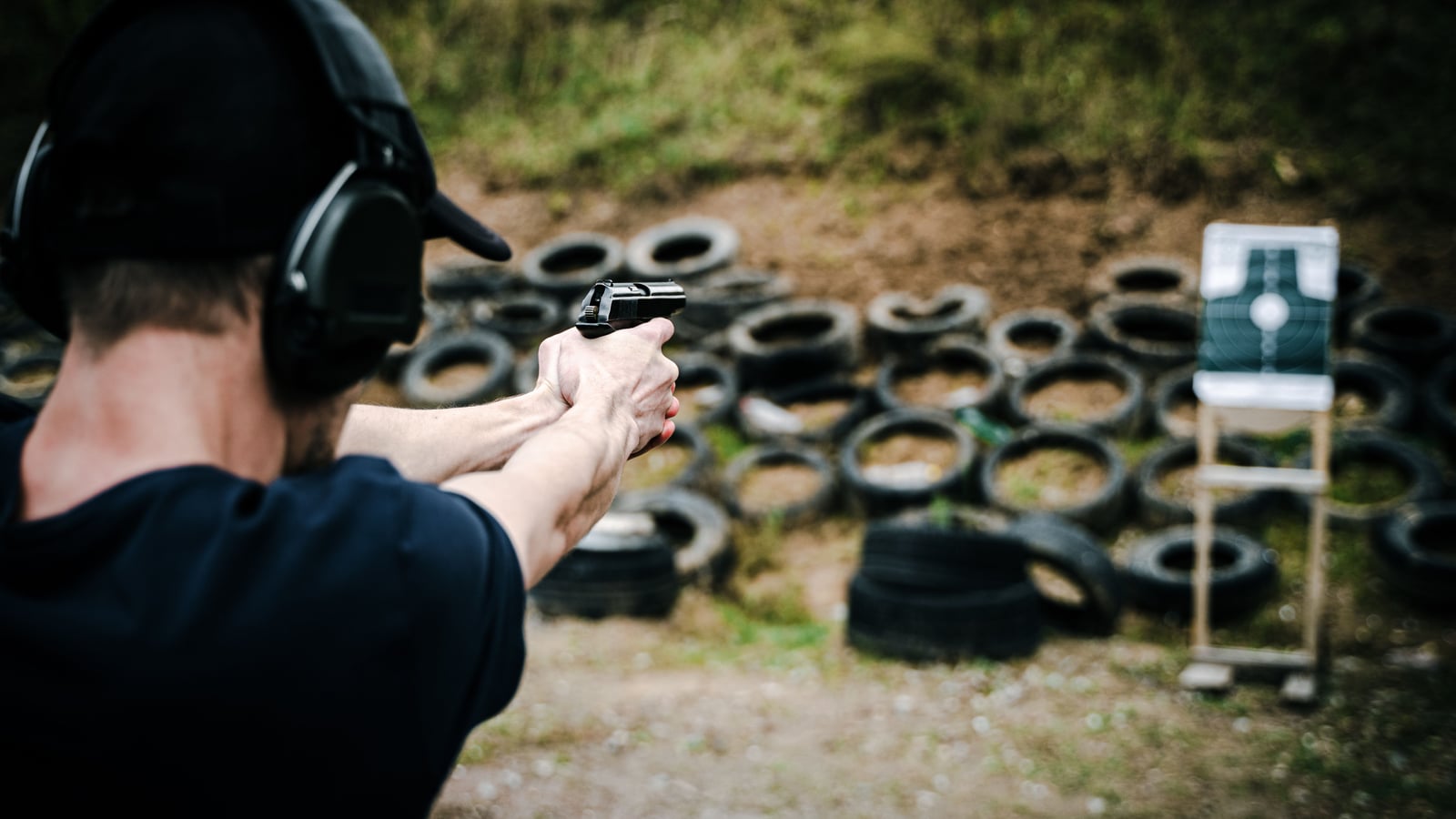
The Isosceles stance owes its name to the triangle formed by the two extended arms and the shoulder line: two equal sides, one shared base. In practice, you face the target, feet shoulder-width apart, weight evenly distributed between both legs, and both arms push the gun forward at the same time.
The torso leans slightly forward, never backward. This lean isn’t cosmetic: it places the center of gravity above or slightly ahead of your base of support, which helps absorb recoil along the axis instead of letting it tip the upper body. Elbows stay locked or slightly flexed depending on the school, but never fully relaxed.
The big advantage of this symmetry is repeatability. Because the body is in an identical configuration every time you set up, the sight return after a shot is more predictable: the gun broadly comes back on the same axis it left. That’s a valuable quality in dynamic shooting, where you need to chain targets without starting from scratch each time.
Isosceles also offers a wider peripheral field of view, since the shooter faces the shooting zone rather than presenting in profile. On a course with several cardboard targets set at different angles, this wider vision makes transitioning from one target to the next easier without having to rotate the shoulders excessively.
The weak point of Isosceles is precisely this frontal exposure: the whole torso faces the line of fire, which doesn’t matter at all in static precision shooting but can become less practical as soon as you need to move laterally between two shooting positions.
Weaver: the profile stance
Weaver puts the shooter in a semi-lateral position: the foot on the support-hand side steps back slightly, the shoulders rotate obliquely relative to the target, and above all the two arms no longer work symmetrically. The strong arm pushes the gun forward staying nearly straight, while the support arm pulls the gun backward, bending noticeably at the elbow.
This opposition of forces - sometimes called “push-pull” - creates isometric tension in both arms. It’s this tension, not body mass alone, that absorbs a good portion of the recoil and limits muzzle rise between shots.
The profile position reduces the body surface exposed along the line of fire, which doesn’t matter at all in civilian sport competition but has a real biomechanical benefit: it allows better leg anchoring during rotation, useful when the shooter needs to orient the torso toward offset targets without moving their feet.
Weaver demands more fine muscular coordination. The push-pull tension has to be dosed carefully: too strong, it stiffens the forearms and degrades trigger finesse; too weak, it no longer plays its shock-absorbing role. It’s a position that has to be trained, unlike Isosceles which comes closer to a natural two-handed presentation reflex.
A regional champion I was able to observe at a training camp explained that it took her several months to feel “where” to place the tension balance between her two arms in Weaver, whereas Isosceles had felt immediate to her from the first sessions.
Biomechanical comparison: dynamic vs static precision
Purely mechanically, the two stances handle recoil differently. Isosceles turns the whole body into a rigid symmetrical block: recoil travels up the axis of both arms, spreads across both shoulders, and comes back down through the legs evenly. It’s a “passive” recoil management, where mass and posture do the work. Weaver manages recoil more “actively,” through the muscular tension of the push-pull: in a shooter who masters it well, this tension can noticeably reduce muzzle rise between two fast shots, because the support arm literally pulls the gun down and back at the moment of recoil.
This active management, however, depends on the state of muscle fatigue. Over a long session or under high physical stress, Weaver’s tension can gradually degrade, while Isosceles’s passive rigidity stays more stable over time because it relies less on sustained muscular effort. Torso rotation also changes hip and knee mechanics: in Isosceles, the hips stay broadly facing the target, which limits torsional strain on the lower back, whereas in Weaver the slight torso rotation places more demand on the obliques and lower back - not a problem in itself, but it deserves an appropriate warm-up for long sessions.
These mechanical differences take on their full meaning once confronted with the two main fields of practice. In dynamic shooting, where you need to chain several cardboard or steel targets with fast transitions, Isosceles has gained the upper hand in most modern practice: the wide frontal vision, the symmetry that eases fast lateral transitions, and the predictable sight return make it a solid base. Weaver keeps followers in dynamic shooting, notably for its active recoil management which, in some well-trained shooters, can allow slightly faster rates of fire on a single target, but torso rotation complicates transitions toward very offset targets, which pushes many dynamic practitioners toward a hybrid variant rather than a pure Weaver.
In static precision, on a fixed target at a known distance - whether 10-meter air pistol or 25-meter pistol - the question changes nature: there are no transitions to manage, and the main stake becomes absolute arm stability and fine trigger control. Isosceles remains largely dominant in Olympic static precision, essentially because body symmetry reduces the parasitic shaking linked to asymmetric tension. Weaver, by imposing different tension on each arm, introduces an extra variable to master, which complicates the search for the extreme stability sought in pure precision.
The role of individual build
No stance is universal, because the human body isn’t either. Arm length, shoulder mobility, torso flexibility, and even old injuries directly influence the ability to comfortably adopt one position or the other.
A shooter with reduced shoulder mobility may find the symmetrical lock of Isosceles uncomfortable over time, while Weaver’s slight rotation actually relieves that joint by distributing tension differently. Conversely, a shooter with lower-back sensitivity often prefers Isosceles, which limits lower-back torsion.
Forearm strength and endurance also come into play. Weaver’s push-pull requires the ability to maintain asymmetric tension over the duration of a session; a shooter with fast forearm muscle fatigue may see their precision degrade faster in this position than in Isosceles.
There’s no single universal test to settle it, but a simple approach works well: take the same gun, the same ammunition, the same target, and shoot two identical strings in each position a few days apart, in comparable form. Then compare the grouping, the fatigue felt, and joint comfort, not just the raw score from a single session.
Grip - how your hand holds the grip - also interacts closely with the chosen stance and therefore with build. In Isosceles, both hands generally apply similar, symmetrical pressure on the grip, extending the symmetry logic of the whole upper body. In Weaver, the pressure split between the strong and support hand may differ slightly, with the support hand actively participating in the backward pull tension that characterizes the push-pull.
In both cases, the rule stays the same: pressure must stay constant from beginning to end of the shot, with no jerk when the finger presses the trigger. A grip that involuntarily tightens at the moment the shot breaks - a very common anticipation reflex among inexperienced shooters - systematically shifts the point of impact, regardless of stance. Grip size and how well it fits the hand also matter: a poorly fitted grip forces you to compensate with excessive finger tension, which plays out differently depending on whether that tension adds to Isosceles’s symmetry or to Weaver’s already-present asymmetry.
Common posture mistakes in each stance
On the Isosceles side, the first classic mistake is a straight or backward-leaning torso instead of a slight forward lean. A beginner who keeps the torso vertical lets recoil travel up into the shoulders and neck, which degrades sight return and tires the upper body faster than it should. Next comes excessive elbow locking: fully stiffened arms transmit recoil more brutally into the shoulders, while a slight bend absorbs part of the shock without sacrificing the overall rigidity of the position.
Feet too close together or poorly oriented also reduce the base of support and make the shooter unstable as soon as they need to handle several closely spaced shots; a shoulder-width stance with feet slightly staggered in depth offers a better base. Finally, many shooters neglect weight distribution between both legs: poorly distributed weight, too much on the rear leg for example, accentuates rearward recoil and complicates a quick return to sight between shots.
On the Weaver side, mistake number one is poorly dosed push-pull tension. Many shooters squeeze the support arm too hard thinking they’ll “control” the gun better, which stiffens the whole upper body and degrades trigger-finger finesse at the moment the shot breaks. Next comes excessive torso rotation, which reduces peripheral field of view and complicates transitions toward offset targets; moderate rotation, just enough to create useful asymmetry, is plenty.
A poorly positioned rear foot also causes problems: too far back or badly oriented, it unbalances the whole stance and complicates recoil absorption along the axis. Finally, some shooters forget to reassess their muscle tension over the course of a long session: the progressive fatigue of the support arm reduces the push-pull’s effectiveness without the shooter always noticing right away, which explains a gradual degradation of grouping toward the end of a session.
How to objectively test both positions
To seriously compare Isosceles and Weaver, you need to eliminate as many confounding variables as possible. Use the same gun, the same type of ammunition, the same distance, and if possible the same time of day for each test, so fatigue or lighting conditions don’t skew the comparison.
Start with static precision strings at a distance you already master well, alternating both stances across several separate sessions rather than within the same session. Switching position mid-session introduces cross-fatigue that makes the comparison less reliable.
Next, test each stance on a transition drill - two or three cardboard targets set at different angles - to assess how smoothly you move from one target to the next. Time yourself if you want to be objective, but above all observe your sense of control and fatigue at the end of each string.
Systematically note three things after each session: the size of the grouping, the feeling of muscular fatigue (shoulders, forearms, lower back), and how easily you return to sight quickly after a shot. These three indicators, cross-checked over several sessions, give a much more reliable picture than a one-off impression.
An experienced instructor often advises not judging a stance on a single session, because the body needs several repetitions to adapt to a new muscular configuration. A position that feels uncomfortable on first try can become natural after a few familiarization sessions.
Hybrid variants
Between pure Isosceles and pure Weaver, there are intermediate variants that many shooters adopt without even realizing it. “Modified Isosceles” keeps the general arm symmetry but allows the strong-side foot to step slightly forward, which improves front-to-back stability a bit without sacrificing frontal field of view.
The “Chapman,” sometimes presented as a Weaver variant, keeps the push-pull tension but with the strong arm fully extended and the cheek resting slightly on the arm - a configuration seeking a compromise between Isosceles’s rigidity and Weaver’s active absorption.
These hybrids exist precisely because few shooters match either theoretical model perfectly. Individual biomechanics - shoulder width, arm length, joint mobility - naturally push everyone toward a personal adjustment, even starting from a classic base taught in a club.
So there’s no need to reproduce a “textbook” position to the millimeter. The goal remains stability, trigger control, and repeatability of the motion, not conformity to a theoretical diagram. If a personal adjustment improves these three criteria without introducing instability, it’s legitimate to keep it.
Some instructors also propose a progressive approach rather than an immediate binary choice: start with a strict Isosceles base for the first sessions, then deliberately introduce a slight push-pull tension on a single arm to see if it improves the feeling of stability. This empirical method, tested over several sessions, often lets the variant best suited to the shooter emerge naturally, without having to choose upfront between two rigid categories.
What weapon type and discipline change
The weight and bulk of the gun directly influence the choice of position. A heavier gun, like those used in 25-meter precision, tolerates a purely symmetrical position better because the mass itself stabilizes the barrel more, reducing the value of Weaver’s active tension.
Conversely, a light gun used in dynamic shooting often benefits from the active recoil management push-pull allows, especially with harder-recoiling ammunition. The difference is felt particularly during fast strings on a single cardboard target, where every tenth of a second gained on sight return counts.
The discipline practiced also naturally steers the choice. In shooting on metal animal-silhouette targets at variable distance, where first-shot precision matters more than rate of fire, Isosceles generally remains preferred for its consistent stability. In dynamic courses with multiple cardboard targets, both stances coexist, with a slight practical edge for Isosceles on wide transitions.
Finally, the caliber practiced influences the comfort felt in each position. A caliber with pronounced recoil places more demand on Weaver’s muscular tension, which can become tiring over long, intensive training sessions, while Isosceles’s passive management tires differently, more at the shoulders than the forearms.
The shooter’s dominant eye also comes into play, independently of the dominant hand. A shooter whose dominant eye doesn’t match their strong hand already has to deal with a slight natural misalignment between the arm axis and the sight axis; adding torso rotation in Weaver can either partially compensate for this misalignment or accentuate it, depending on individual build. This is a point worth testing case by case rather than deducing from a general rule, with the help of an experienced instructor if doubt persists.
The shooting position’s layout also plays an often-underestimated practical role. On a narrow firing line or with closely spaced lanes, Isosceles’s more frontal posture fits easily into a tight space, while Weaver’s torso rotation may need a bit more lateral clearance to stay comfortable without encroaching on the neighboring lane.
Progression and transfer between the two stances
Switching from one stance to another doesn’t erase acquired reflexes, but it does require a real adaptation period. A shooter who built their reflexes in Weaver over several years will initially feel Isosceles as “empty” of reference points, lacking the muscular tension they’re used to.
The best approach for transferring from one stance to another is to temporarily return to slow, static drills, with no stopwatch or score stakes, until the new body pattern becomes fluid. Rushing into dynamic drills in a stance you haven’t mastered mainly leads to frustration and degraded groupings that don’t reflect the position’s real potential.
Some shooters deliberately choose to master both stances rather than settle definitively, especially when they practice both static precision and dynamic shooting. In that case, it’s better to dedicate separate sessions to each stance rather than mixing them in the same training, to avoid confusing motor reflexes.
Whichever stance you ultimately choose, training regularity matters more than the theoretical choice between the two schools. A stance well mastered after hundreds of repetitions will always outperform a stance “ideal on paper” but poorly ingrained.
A good marker for knowing whether the transfer succeeded is to observe the speed of setting up from a neutral state, arms down. As long as moving into the new stance requires conscious thought about foot placement or arm tension dosing, the automatism isn’t consolidated yet. Once setting up becomes a single fluid motion with no perceptible steps, the transfer can be considered complete, and the shooter can start pushing speed and the stopwatch again without fear of regression. Filming a few strings from the side, with the club’s permission, also helps objectify this fluidity better than a simple subjective feeling, particularly for spotting residual hesitation invisible to the shooter themselves.
Vision, breathing, and sight alignment
Body stance directly influences the quality of eye-front sight-rear sight alignment, even though we rarely think of it in these terms. In Isosceles, body symmetry naturally places the dominant eye on the axis of the extended arms, which simplifies initial alignment right from the draw or when raising from a low position. In Weaver, the slight torso rotation can offset the eye’s natural axis relative to the arm axis, forcing some shooters to compensate with additional head rotation - one more adjustment to automate.
Head position itself deserves attention in both stances. A head tilted too far forward to “search” for the sight picture, rather than letting the arms raise the gun up to eye level, tires the neck and degrades gaze stability on the sights. This flaw occurs in both positions, but is slightly more common in Weaver because of the torso rotation that disturbs the natural head-shoulder reference point.
Breathing also influences arm stability, and the two positions don’t interact with the breathing cycle the same way. In Isosceles, the rib cage faces the target symmetrically, which makes the breathing motion more visible along the sight axis: a deep inhale can slightly raise the extended arms. In Weaver, the slight torso rotation moves the rib cage a bit away from the strict sight axis, which can reduce this visible effect for some shooters, without this being an absolute rule.
In both positions, the basic technique stays the same: mark a natural respiratory pause, neither with full nor empty lungs, at the moment of the final press on the trigger. An experienced club shooter often reminds people never to hold their breath forcibly, which increases shaking rather than reducing it. Managing heart rate after exertion or under excitement is trained independently of stance, but the baseline stability offered by Isosceles can slightly better “absorb” an elevated heart rate, simply because body symmetry propagates micro-tremors less along the sight axis.
Dry-fire practice and equipment adapted to each position
Dry-fire practice - without ammunition, with a gun repeatedly verified empty and in a safe environment - remains one of the best tools for anchoring a new stance without the recoil and noise variables that disturb learning. It lets you work exclusively on posture, alignment, and trigger pressure.
For Isosceles, a simple drill is repeating the presentation from a low position, checking at each repetition the symmetrical shoulder alignment and the correct forward lean of the torso. Repeating this movement slowly, about fifty times per session, builds reliable muscle memory. For Weaver, dry-fire practice lets you specifically work on dosing the push-pull tension, without the distraction of real recoil: the shooter feels precisely the level of tension needed in the support arm before also having to manage the impact of a real shot.
This dry practice is particularly useful when changing stance, because it lets you reprogram motor reflexes without the pressure of performance or the cost of ammunition. Many clubs have dedicated spaces for this training, and some instructors recommend spending as much time there as on the actual firing line during the first weeks of a stance change.
Protective equipment also interacts differently with each stance. In Isosceles, facial symmetry relative to the line of fire makes for even, comfortable wear of glasses and ear protection. In Weaver, the slight head rotation needed to align the dominant eye can create asymmetric contact between the glasses’ temples and the face, or unusual friction of ear protection on one side of the head - a simple comfort point to adjust with gear well fitted to your build. Similarly, a jacket that’s too loose or too stiff at the shoulders can limit the range of motion needed for torso rotation in Weaver, while bothering Isosceles’s frontal posture less.
Competition stress and perceived stability
Competition stress, or simply the pressure of a timed shot, often amplifies the latent flaws of a poorly mastered stance. Under stress, overall body muscle tension rises involuntarily, which can destabilize a poorly dosed Weaver far more than an Isosceles, whose stability relies less on fine-tuned muscle tension dosing.
Conversely, some shooters report that under stress, the extra tension generated by the body blends more naturally into Weaver’s already-active push-pull pattern, whereas it disrupts the relative relaxation sought in Isosceles. These reports remain subjective and vary a lot from one shooter to another, which confirms there’s no universal answer on this precise point.
What comes through more consistently is that the stance that’s most automated - meaning the one on which the shooter has repeated the most movements - always resists stress better than the “theoretically superior” but seldom-practiced stance. Deep motor automatism overrides fine biomechanical considerations as soon as mental load increases.
An experienced instructor often insists on this point in amateur competition: it’s better to show up with an imperfect but fully automated stance than with a biomechanically optimal but still conscious and hesitant one. Fluidity of motion under pressure trumps theoretical elegance of posture.
This dynamic also explains why some experienced shooters advise against changing stance right before an important competition deadline. The theoretical biomechanical gain of a new position almost never compensates for the loss of fluidity caused by a still-fragile automatism, especially in a context where stress is already high for other reasons.
What history and club experience show
Weaver owes its name to an American assistant sheriff who popularized it in the 1950s, at a time when civilian sport shooting competitions were looking for new ways to gain speed on a single target. The stance spread through clubs via competitions and training camps, well before becoming a teaching standard in many federations. Isosceles became established later, carried by the rise of dynamic sport shooting in the following decades; its ease of learning and its coherence with modern two-handed shooting contributed largely to its spread in clubs and beyond. Neither stance was designed in a pure biomechanics lab: both were born from practice and continue to evolve with feedback from the field.
This historical evolution partly explains why Isosceles dominates initial teaching today: federations have gradually aligned their training programs with the stances easiest to transmit to a large number of beginner shooters. In club practice, instructors regularly observe that new shooters spontaneously gravitate toward some form of Isosceles, even without precise prior instruction, simply because symmetry corresponds to a natural two-handed grasping reflex toward an object. Weaver, conversely, almost always requires an explicit demonstration and time explaining the role of the push-pull, and remains practiced mainly by shooters coming from an older club tradition or by those who tested and adopted it knowingly.
This field observation doesn’t mean Isosceles is superior in absolute terms, but that it’s more accessible on first approach. Experienced shooters who later switch to Weaver generally do so after specifically seeking to improve a precise aspect of their practice, such as recoil management on a particular gun or engagement speed on a single target. Club feedback also shows that stance choice tends to settle after the first few years of regular practice, and that a later change requires real motivation and structured coaching, often with the help of an experienced instructor able to identify unconscious compensations carried over from the old stance.
Finally, one observation keeps coming back among coaches: the Isosceles-versus-Weaver debate fuels a lot of informal conversation among shooters, far more than it actually influences score progression in clubs. Training regularity, the quality of trigger work, and stress management objectively weigh more heavily on progress than a stance debate.
FAQ
Q: Is one of the two positions objectively better than the other? A: No, there’s no universal hierarchy. Isosceles dominates in static precision and wide dynamic transitions, Weaver keeps advantages in active recoil management on a single target, but the final choice depends mainly on your build and your discipline.
Q: How long does it take to properly master a new stance? A: It varies a lot depending on the shooter and training frequency. Expect several regular sessions before the new body configuration becomes a fluid automatism rather than a conscious effort.
Q: Does Weaver tire you out more than Isosceles over a long session? A: Generally yes at the forearm level, because of the continuous push-pull tension, whereas Isosceles places more demand on the shoulders more evenly. The feeling still varies according to individual build, though.
Q: Can you mix elements of both stances? A: Yes, many hybrid variants exist and are widely practiced. What matters is keeping stability, trigger control, and repeatability of motion, not following a theoretical diagram to the letter.
Q: Which position is recommended for a complete beginner? A: Isosceles is often taught first because its symmetry brings it close to a natural presentation reflex, which eases initial learning. That doesn’t mean Weaver is unsuitable, just that it requires a bit more coordination to acquire.
Q: Should you change position depending on the gun used? A: Not systematically, but the weight and recoil of the gun can make one stance more comfortable than the other. It’s worth testing both positions with your usual gear rather than a borrowed gun to form a reliable opinion.