
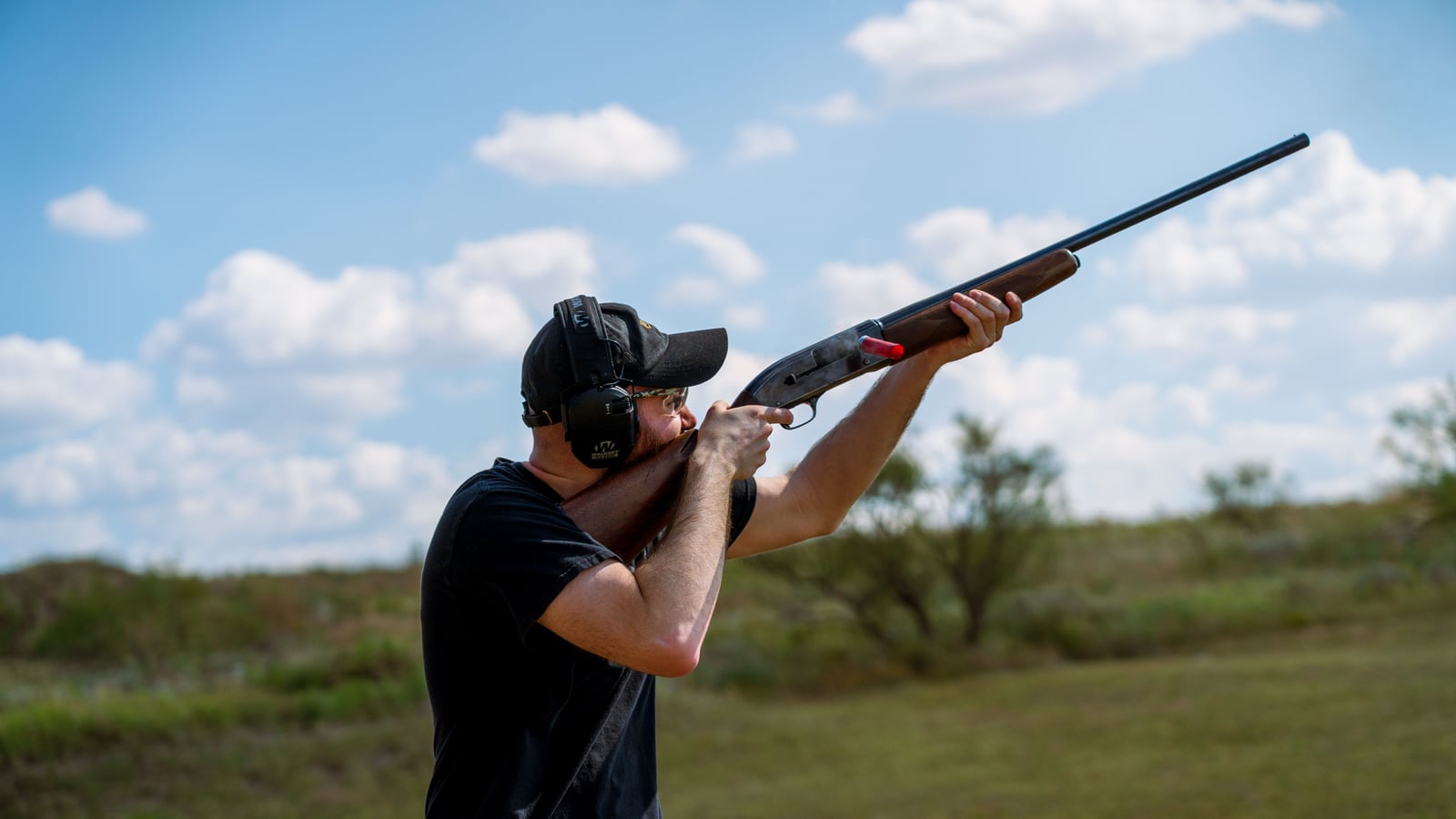
What a hunting course actually is
The hunting course, often called sporting clays by shooters who follow the English-speaking scene, is the clay discipline that comes closest to a real hunting outing - minus the live game. You move along an outdoor circuit, station after station, and at each station machines throw clays at you on trajectories meant to reproduce a bird’s flight or an animal’s run.
The founding idea is simple: instead of always repeating the same trajectory like in trap, each station on the course offers a different presentation. One station simulates a pheasant taking off in front of you, another a partridge crossing far ahead, another an imaginary rabbit rolling along the ground between the trees. The term “rabbit” actually refers precisely to that clay that bounces along the ground rather than flying.
This format developed in England out of hunting-shoot practice, before spreading worldwide as a sporting discipline in its own right. In France, it’s governed by the FFTir just like the other clay disciplines, with its own competition rules and rankings.
What really sets the hunting course apart from other clay disciplines is the terrain itself. You’re not shooting from a single firing point facing a trap: you walk from station to station across hilly, wooded, sometimes damp terrain, with views and terrain constraints that change at every stage of the course.
The name “sporting clays” comes from English and coexists in France with the term “parcours de chasse,” both referring to the same discipline. Some clubs use one or the other depending on their history or region, but the rules and the principle stay identical from one name to the other.
This discipline occupies a special place in the French clay-shooting landscape: it’s both the oldest in its inspiration (directly inherited from traditional hunting) and one of the youngest in its codified sporting form, having appeared well after Olympic trap and skeet.
The principle of the course: a succession of different stations
A complete hunting course generally has between ten and twenty shooting stations, each set up at a different spot on the grounds. The group of shooters moves from station to station, in an order fixed in advance, a bit like a golf course where each hole presents a distinct challenge.
At each station, a sign usually specifies the number of clays to shoot and sometimes the type of trajectory announced, even though surprise remains an essential component of the discipline. Some stations offer a single clay, others a double (two clays launched simultaneously or in rapid succession), which noticeably increases the difficulty of managing the shot.
Rotation between shooters happens station by station: each shoots their series, then the group moves together to the next station. This group organization gives the hunting course a more pronounced social dimension than trap, where shooters rotate faster on a single firing point.
The total number of clays shot on a complete course varies by club and competition, often between 50 and 100 clays for a standard course. A major competition can span two such courses in the same day, making it a discipline as demanding on endurance as on precision.
Each station generally has a name or number that stays the same from one session to the next, even though the machine settings change. A regular shooter at the same club eventually learns the general layout of the course, without being able to precisely anticipate the trajectory awaiting them, since the range staff regularly change the settings between visits.
The order of shooting within a group follows a simple rotation: the first shooter at one station becomes the last at the next, which guarantees fair positioning across the whole course. This simple rule prevents the same shooter from systematically shooting first, a position sometimes considered harder due to the lack of visual reference from previous shots.
The variety of trajectories: the heart of the discipline
This is where the hunting course stands out most clearly from the other clay disciplines. Where trap and skeet offer trajectories framed by precise rules and therefore relatively predictable once learned, the hunting course has almost no limits in how stations are designed.
One station might send a very high, fast clay, simulating a bird passing over the canopy. The next station might offer a low, skimming clay that crosses your field of view at shoulder height in a fraction of a second. Yet another might make a clay burst out from a point hidden behind a thicket, without you knowing exactly where it will appear.
“Teal” trajectories rise almost vertically before falling back, requiring completely different timing management than a clay crossing horizontally. “Rabbits” roll along the ground and bounce unpredictably over terrain irregularities, requiring a different kind of anticipation from anything practiced in other clay disciplines.
Some stations combine two machines to create a crossing double, where the two trajectories intersect in the air at a given moment. Others offer a clay moving away from you in an almost straight line, which complicates distance estimation and therefore the choice of choke and shot load.
This variety isn’t a staging gimmick. It forces the shooter to rebuild their trajectory reading at every station, unable to rely on a single automatism like in trap. That’s precisely what makes it, for many experienced shooters, the most technically complete clay discipline.
Other classic presentations are worth knowing before a first outing. “Quartering,” a clay crossing at an angle rather than purely horizontally or straight away, requires an angle anticipation radically different from a classic crossing shot. The “battue” clay, launched from a high point and diving down in front of the shooter, requires a vertical mounting movement rarely called for elsewhere.
The “chandelle,” a clay sent vertically then observed with a slight delay at the top of its arc before falling, teaches how to manage a dead time in trajectory reading, the opposite of the continuous rhythm of a crossing clay. Some stations also offer so-called “specialty” clays with a reduced diameter or shape (mini clays, compressed clays) that further increase the visual difficulty through their smaller apparent size in flight.
The sequence of presentations at the same station can also vary: a “true” double (both clays launch at the same time) differs fundamentally from a “following” double (the second clay launches the moment the shooter mounts or hits the first), which itself differs from an “on-call” double where the shooter triggers the second clay at their own pace. This diversity of triggering multiplies the scenarios to work on even further.
The outdoor terrain: a constraint and an asset
The hunting course almost always takes place in a natural outdoor environment: woods, valleys, wetlands, sometimes marked relief. This setting fundamentally changes the experience compared to a trap or skeet range set up on a flat, open platform.
The terrain’s relief directly influences how you read the clay. A station set below a mound offers a clear sky background that makes visual spotting easier, whereas a station tucked into undergrowth forces you to spot the clay against a backdrop of trees and foliage, much harder on the eye.
Weather also plays a more present role than in other disciplines. Wind alters the clay’s actual trajectory compared to the expected one, rain reduces visibility and makes the ground slippery between stations, and light changes depending on the station’s orientation to the sun at different times of day.
Walking between stations is an integral part of the experience. A complete hunting course can involve several cumulative kilometers of walking over sometimes rough terrain, with elevation changes, mud in wet seasons, and passages through undergrowth that demand normal hiking vigilance in addition to firearm safety vigilance.
This outdoor dimension specifically attracts shooters who appreciate the nature aspect of the discipline as much as the technical aspect. Many practitioners come from the hunting world and find in the hunting course an atmosphere close to the field, without the constraints of live game or the seasonality of real hunting.
The visual context of each station is often the subject of genuine design work by the course builders. A station can be arranged so the clay bursts out from a point hidden by vegetation, reproducing the surprise of a real flush rather than a trajectory announced in advance. Other stations use a natural slope to make the clay come down toward the shooter at higher speed than on flat ground.
The season also strongly influences the experience. A course walked in the height of summer, with dense vegetation hiding the launch points, doesn’t resemble the same course in winter, when the leaves have fallen and overall visibility changes. Some clubs take advantage of this seasonal variation to change the settings without physically changing the machines’ location.
The gear: shotgun, cartridges and matched chokes
The shotgun used in the hunting course is overwhelmingly a semi-automatic or an over-and-under in 12 gauge, sometimes 20 gauge for shooters looking for a lighter gun over a long walk. The choice between the two gauges mainly depends on the shooter’s build and their tolerance for cumulative recoil over a long session.
The choke, that screwed-in piece at the end of the barrel that tightens or opens the shot pattern, must be adapted to the distance and type of trajectory at each station. A station with a close, fast clay calls for an open choke for a wide pattern, whereas a station with a distant clay calls for a tighter choke to concentrate the shot at range. Many hunting-course shooters change chokes several times during the same outing.
The shotgun itself benefits from being equipped with two or three sets of interchangeable chokes carried in a dedicated pouch, rather than a fixed choke chosen once for the whole session. This equipment flexibility is one of the most concrete practical differences from trap, where the setting generally stays stable throughout the session.
On the cartridge side, shot size also varies by station: finer shot for close, fast clays, larger shot for distant clays that need more residual energy on impact. A shooter who takes the hunting course seriously carries several types of cartridges in their vest, not a single load for the whole outing.
Protective equipment stays the same as for other clay disciplines: hearing protection suited to repeated outdoor shooting, safety glasses against clay fragments, and clothing suited to walking and to the day’s weather since the session happens outdoors regardless of conditions.
The shooting vest deserves special mention in this discipline precisely because of this variable equipment management. A multi-pocket vest lets you carry several boxes of different-load cartridges at once, a choke pouch, and sometimes water for the walk, without needing to return to a central drop point between stations as is often possible in trap.
Some shooters also carry a notebook or app to record, station by station, the choke and cartridge used along with the result obtained, to rebuild useful setting memory for a future round on the same course. The barrel itself, its length and point of aim, also affects the feel across very varied trajectories: a longer barrel favors smooth follow-through on distant clays, a shorter barrel makes for quicker responsiveness on close, fast presentations.
Gun maintenance requires increased vigilance in this discipline, precisely because the session happens outdoors, sometimes in rain or mud. A more thorough cleaning after a hunting-course outing than after an indoor or covered-range trap session remains good practice, to avoid moisture or dirt residue building up on the mechanism during moves between stations.
The physical level required: more than simple static shooting
The hunting course demands a different physical condition than fixed firing-point disciplines. The cumulative walking on a complete course, often several kilometers with elevation changes and sometimes uneven ground, taxes endurance in a way trap or skeet don’t.
Carrying the shotgun and gear throughout the course adds extra load. A 12-gauge shotgun with its spare cartridges, choke pouch, and the rest of the equipment represents real weight to carry station after station, especially over a session that can last several hours.
Fatigue management directly influences performance toward the end of the course. A shooter who mismanages their effort on the early stations arrives tired at the later ones, with a less precise mount and degraded timing on trajectories that specifically demand a high level of reaction freshness.
This physical dimension explains why the hunting course sometimes attracts a different shooter profile than pure trap: practitioners who enjoy outdoor physical effort as much as technical precision. An experienced instructor often advises preparing a hunting-course outing like a light hike, with water, a food break, and effort management spread across the whole duration.
Cumulative recoil over a long session, sometimes with 100 cartridges fired over a full day, also strains the shoulder and back in a way that’s better anticipated with a warm-up and correct mounting posture, rather than pushing through on the final stations at day’s end.
Balance and stability on uneven ground also become a skill in their own right. Mounting correctly on sloped or unstable ground without losing gun alignment requires a different footing than what’s learned on a flat, stable range. A shooter used only to fixed firing-point disciplines can feel destabilized the first few times they have to shoot in precarious balance on rough terrain.
Heat in summer and cold in winter add a further physical management dimension, since unlike a covered range, nothing protects the shooter from the day’s weather conditions for several consecutive hours. Dressing in layers and planning sun or rain protection depending on the season is fully part of preparing for a hunting-course outing, just like choosing your cartridges.
Difference from trap: the end of repetition
Classic trap offers a trajectory framed by precise rules: the clay always launches from the same trap house, at an angle within a defined range, at a speed that varies little. Learning consists of automating a movement repeated dozens then hundreds of times.
The hunting course flips this logic. Each station offers a potentially new trajectory, and the same station can even change its setting from one competition to the next or one season to the next. There’s no single automatism to work on: the sought-after skill is the ability to quickly read a new trajectory and adapt to it in a fraction of a second.
This difference shows up in training. A trap shooter can improve by tirelessly repeating the same presentation until it becomes nearly automatic. A hunting-course shooter instead improves by multiplying exposure to different trajectories, to build a mental library of responses suited to varied situations.
Equipment usage also differs. Trap is often shot with a fixed choke optimized for the discipline’s typical trajectory, whereas the hunting course demands the setting flexibility mentioned above, station after station.
Finally, the social dimension and setting change radically. Trap is practiced on a fixed installation, often at the same club, with a compact infrastructure. The hunting course is experienced as a complete outdoor outing, in a group, on grounds that can span several hectares.
The mental reading of the discipline also diverges. A trap shooter develops a nearly metronomic rhythm, where the wait between the call and the clay’s release becomes predictable through repetition. A hunting-course shooter, on the other hand, must stay constantly alert, since the delay between the call and the clay’s release can deliberately vary from station to station precisely to break that anticipatory automatism.
Competition scoring also follows a different logic. Trap is generally judged on a uniform number of clays per round, with a well-known step-by-step progression among practitioners. The hunting course evaluates performance across a set of heterogeneous stations, which makes comparing two outings harder to interpret than a simple raw score, since the difficulty of the course walked is never strictly identical from one session to another.
Difference from skeet: two opposing reading logics
Skeet offers eight fixed stations around two houses (high and low), with trajectories crossing at angles known and memorized through training. Once the reading of each station is mastered, the trajectory doesn’t really vary anymore: it’s a discipline of repeated geometric precision.
The hunting course offers none of these geometric certainties. Distances, angles and speeds change from station to station and from course to course, without the fixed structure of skeet’s eight stations. A shooter used to skeet has to relearn a good part of their reference points when arriving on a hunting course.
Skeet is practiced on a compact installation and generally ends in about thirty minutes for a round of 25 clays. The hunting course stretches over several hours with walking between stations, which completely changes the pace of the session and energy management.
These two disciplines don’t oppose each other: many clubs offer both, and many shooters practice both in alternation to work on complementary skills. Skeet refines precision on known trajectories, the hunting course develops adaptability to the unknown.
Shooting distance also differs structurally between the two disciplines. Skeet imposes relatively short and constant distances from station to station, which standardizes the available reaction time. The hunting course, on the other hand, can offer very close clays at one station and very distant clays at the next, forcing you to constantly recalculate the reaction time actually available before possible impact.
The visual background also changes in nature between the two disciplines. Skeet is practiced on an open installation where the sky background stays broadly homogeneous from station to station. The hunting course offers very varied visual backgrounds - clear sky, undergrowth, backlighting, dense vegetation - adding a purely perceptual layer of difficulty absent from skeet.
Competition and scoring in the hunting course
The FFTir governs the hunting course as a competitive discipline in its own right, with its own categories and level-based rankings. Competitions generally take the form of complete courses, sometimes repeated twice in the same day for the biggest events, with the scores from both rounds added to establish the final ranking.
The score is simply counted as the number of clays broken out of the total number offered across the whole course. Unlike other disciplines that award differentiated points depending on the impact zone, the hunting course generally stays binary station by station: the clay is broken or not, which simplifies reading the score without taking anything away from the difficulty of the trajectory reading beforehand.
Hunting-course competitions often gather several dozen shooters spread across groups that walk the circuit at staggered times during the day, to avoid bottlenecks between stations. This logistical organization requires more coordination than a classic trap competition, where all shooters converge on a limited number of firing points.
The final ranking takes the shooter’s level into account, with categories that generally separate shooters by their results history, much like in other clay disciplines. A shooter discovering the discipline competes in a less demanding category before progressing to higher categories as their results in official competition build up.
Some circuits also offer unofficial formats, more geared toward leisure and conviviality, where the ranking matters less than the pleasure of discovering a new course or meeting up with a regular group. These less formal outings remain an excellent entry point for a shooter who wants to sample the discipline without immediately committing to an official competition calendar.
Comparing performance between shooters in the same group remains trickier to interpret than in a discipline with a fixed trajectory. Two identical scores obtained on two different courses don’t necessarily represent the same level of difficulty faced, since station design, the day’s weather, and the machine settings vary from one outing to another. A ranking in official competition therefore remains the only truly comparable reference, since there all shooters face exactly the same course under the same conditions.
Safety specific to moving as a group on an outdoor course
Safety on a hunting course adds a dimension absent from fixed firing-point disciplines: moving a group of armed shooters from station to station, on outdoor terrain that’s sometimes wooded and rough. Every club applies precise rules to manage this movement safely.
The gun stays open (action open or barrels broken depending on the shotgun type) and unloaded throughout the walk between two stations, an absolute rule shared by every serious club. Loading only happens once you’ve arrived at the next station, under the supervision of the group’s organizer or instructor, never while walking.
Carrying the shotgun during the walk also follows precise rules, barrel pointed up or down depending on club habits, but never at the height of another group member. This transport vigilance stays valid even on terrain that seems clear, since visibility can change abruptly in undergrowth or after a bend in the path.
Respecting the shooting order at each station avoids situations where several shooters would handle a loaded gun simultaneously without clear supervision. Only one shooter loads and shoots at a time at a given station, the other group members staying back, gun open, waiting their turn.
Verbal communication between the shooter and the clay thrower (often an electronic box triggered by voice or a starter) is also part of the safety protocol: the shooter clearly calls when ready, which prevents any surprise clay release while the gun isn’t yet properly mounted and the shooter isn’t in a stable position.
Where to practice and how to get started
Not all clay-shooting clubs have a complete hunting course, since the installation requires a noticeably larger area of land than a simple trap or skeet range. An FFTir-affiliated club that has one generally states it clearly in its list of facilities.
For a first outing, an experienced instructor almost always recommends starting accompanied, whether by a club instructor or by an experienced club shooter who already knows the course. The succession of different stations and the safety rules specific to group movement on outdoor terrain deserve a guided adjustment period.
Renting equipment is often possible for a first discovery, avoiding the need to invest before knowing whether the discipline really suits you. A serious club generally offers a loaner gun and cartridges by the unit or box for an introductory session.
The cost of an outing varies widely by club and region, with a rate depending on the number of clays included and whether or not there’s access to an instructor. It’s better to check directly with the club you’re targeting rather than trusting a generic figure, since these rates vary significantly from one club to another.
A first outing also benefits from practical preparation beforehand: walking shoes suited to the terrain rather than city shoes, clothing that allows good range of motion for mounting, and booking ahead since hunting-course slots can be more limited than trap slots at some clubs, given that the facility isn’t always available.
Many shooters discover the discipline during a course or discovery day organized by a club, a format that lets you test several representative stations without committing to a complete course the first time. This gradual approach remains a good way to check your interest in the discipline before investing in your own dedicated equipment.
Progressing on a hunting course
Progress in this discipline comes less from pure repetition than from exposure to as many different configurations as possible. An experienced club shooter often advises varying the clubs visited precisely to multiply the types of courses encountered, rather than always practicing on the same familiar ground.
Timing work stays central: unlike trap where the rhythm becomes predictable, the hunting course requires reassessing at each station the optimal moment to start the mounting motion, without being able to rely on a cadence learned in advance.
Managing choke and cartridge is an integral part of technical progress. Learning to quickly assess the distance and type of trajectory announced in order to choose the right setting before shooting becomes a skill in its own right, almost as important as the shooting motion itself.
Tracking your results station by station and noting the trajectory types that cause the most difficulty lets you identify precise areas to work on rather than sticking with a general impression of a good or bad session. That’s one of the concrete benefits of logging your clay-shooting outings, to spot over time which presentation types remain the priority weak point to work on.
Some clubs also offer dedicated practice stations, isolated from the full competition course, where a shooter can repeat a specific type of trajectory that gives them trouble without having to walk the entire circuit. This targeted format allows faster work on an identified weak point, before returning to test that progress in the full, varied context of the whole course.
Guidance from an instructor stays particularly useful in this discipline precisely because of its variety. An experienced outside eye often spots faster than a shooter alone whether the difficulty comes from a flaw in trajectory reading, a poor choke choice, or a posture problem that repeats on certain specific presentation types, like rising clays or close doubles.
Regularity of practice also matters more than one-off intensity in this discipline. A shooter who strings together several courses spaced out over time generally progresses better than a shooter who concentrates the same volume of clays into a single marathon outing, because the ability to adapt to new trajectories is built over time, session after session, rather than in a single intensive round.
FAQ
Q: Do you need to be an experienced shooter to start the hunting course? A: No, this discipline remains accessible to beginners provided you start accompanied by an instructor or an experienced club shooter. The variety of trajectories simply requires a longer adjustment period than trap, but nothing stops a newcomer from getting into it gradually.
Q: What’s the difference between a hunting course and compak sporting? A: Compak sporting follows the same principle of varied trajectories but on a compact installation, with a fixed or near-fixed firing point, whereas the traditional hunting course spreads over large outdoor grounds with walking between many distinct stations.
Q: How long does a complete hunting course take? A: It varies depending on the number of stations and group size, but generally counts several hours for a complete course including walking between stations, versus about thirty minutes for a round of trap or skeet.
Q: What gauge should you choose to start the hunting course? A: 12 gauge remains the most common in this discipline, but 20 gauge suits shooters looking for a lighter gun to carry over a long walk. The choice mainly depends on the shooter’s build and their tolerance for cumulative recoil over the session.
Q: Does the hunting course really simulate real hunting? A: It reproduces the trajectories and outdoor environment, making it excellent technical training for hunters, but it remains a sporting discipline in its own right, governed by the FFTir, with no live game involved.
Q: Can you practice the hunting course alone, without a group? A: Some clubs allow walking the stations solo or in a small, limited group depending on available slots, but group practice remains the discipline’s historical norm and also makes it easier to learn safety rules along the course.