
Why ammunition isn’t a product that lasts forever
A cartridge is a small, self-contained chemical and mechanical system: powder, primer, metal case, crimped bullet. Each of these components ages in its own way. It’s tempting to think a box of ammunition just sits quietly in its corner without any risk, but that’s only true if storage conditions are right.
Propellant powder is the most sensitive component. It’s a chemical product that degrades over time, and that degradation accelerates sharply with heat and humidity. Powder that has aged badly no longer burns evenly: muzzle velocity drops, dispersion increases, and sometimes you get outright misfires.
The primer is the second weak point. By nature it’s a compound sensitive to moisture, since its job is to ignite under mechanical shock. If moisture seeps in around the crimp, the primer can become hard to ignite or completely inert.
The case and bullet are more robust but not invincible. Brass can corrode at the surface — a historic black-powder rifle uses brass that’s even more sensitive to acidic residue. The lead or copper of the bullet barely moves over time, except in cases of persistent moisture that attacks the crimp.
Understanding this degradation mechanism is understanding why storage isn’t a minor detail but a real question of reliability and safety at the range.
Many shooters discover this subject only after an unpleasant surprise: a box forgotten for years in a damp corner, pulled out on competition day, gives strange results on target or outright firing incidents. Storage is nothing like a theoretical subject — it has direct, measurable consequences on what happens at the range.
What makes the question hard to pin down is that there’s no universal threshold beyond which ammunition becomes dangerous or unusable. Degradation is gradual, cumulative, and depends on a combination of factors rather than a single isolated parameter. That’s exactly why a factor-by-factor approach is more useful than a blanket rule like “throw everything out after X years.”
The point of this article isn’t to scare you or push you to toss a perfectly sound stock out of excessive caution. It’s to give you concrete markers to tell apart ammunition that’s aged without issue from ammunition that’s actually degraded, and to help you organize your storage so you limit that risk from the start rather than dealing with it after the fact.
Humidity, enemy number one
Humidity is by far the most destructive degradation factor for ammunition. It acts in two ways: slow infiltration through the crimp, and direct condensation on the metal when temperature changes suddenly.
The crimp between case and bullet is never perfectly airtight over the long run. Storage in a damp room, an uninsulated cellar, or a garage subject to seasonal swings encourages gradual infiltration that reaches the powder after several months or years.
Condensation is even sneakier. If you take a case of ammunition from a cold space into a warm, humid room, moisture forms on the metal, exactly like on a windshield. Repeat that several times a year and you get progressive corrosion that’s invisible to the naked eye at first.
A sustained high ambient humidity level, above 60-70%, is already a warning sign for a storage space. The ideal remains a dry, temperate space with the smallest possible swing in humidity, rather than a single number to hit at all costs.
The most visible sign of a moisture problem is green or whitish stains on the brass, or an unusual smell when you open the box. In that case, set the affected ammunition aside and don’t fire it, as a precaution.
Silica gel desiccant packets are a simple, cheap ally against this factor. Placed in the storage case, they absorb some of the residual moisture in the container’s ambient air. It’s not absolute protection if the space itself is structurally damp, but it noticeably reduces humidity swings inside the box.
Another useful habit is avoiding metal containers placed directly on a concrete floor, especially in a cellar. Concrete remains a surface that retains residual moisture and transfers it by direct contact to the bottom of the case. A simple pallet, a raised shelf, or an insulating support already changes a lot for basement storage.
You also need to distinguish constant ambient humidity, which acts slowly over months, from a one-off water incident, which acts brutally. A case of ammunition that got soaked even briefly, following a flood or a leak, should be considered suspect in its entirety, not just the cartridges visibly affected on the surface.
Temperature, an underestimated factor
Heat accelerates all chemical reactions, including the slow decomposition of propellant powder. Continuous high-temperature storage, like an attic under a roof in summer or a car trunk in full sun, measurably reduces the useful life of ammunition.
It’s not so much the occasional heat spike that’s the problem as the repetition of cycles. A space that goes from 10°C in winter to 40°C in summer, year after year, mechanically stresses the crimp and accelerates the chemical degradation of the powder far more than a stable space at moderate temperature.
Cold by itself doesn’t damage ammunition. A cartridge stored in an unheated but dry and stable space in winter doesn’t pose a particular problem. The real risk of cold is the thermal shock when you bring it back into a warm, humid environment, with the condensation phenomenon mentioned above.
For long-term storage, aiming for a moderate and above all stable temperature matters more than chasing a precise value never to exceed. A tempered utility room or a cabinet in a living space generally does better than a garage or an attic.
A point often overlooked: proximity to a direct heat source, even a modest one, matters over the long term. A radiator, a boiler, a hot water tank right next to the storage spot creates a warmer microclimate than the rest of the room, with heating and cooling cycles repeated daily. Better to choose a storage location away from this type of source.
Conversely, a shooter practicing in a region with a very contrasted climate, with very hot summers and harsh winters, is better off favoring a semi-underground space or an interior room of the house rather than an uninsulated outbuilding. The thermal inertia of a living space cushions extreme swings far better than a garden shed or a sheet-metal garage.
Light, and in particular prolonged UV exposure, adds to this thermal factor. It degrades certain ammunition components, especially if the case or packaging is plastic: UV radiation weakens polymers and can accelerate the decomposition of certain chemical residues on the surface.
In practice, this factor mainly affects ammunition stored near a south-facing window, in a sunroom, or in a space with intense, constant natural light. It’s not the number-one factor compared to humidity and temperature, but it adds to both.
The solution is simple: favor storage away from direct light, in the original box or an opaque case, in a closed cupboard or cabinet rather than an open shelf facing a bay window.
This principle ties into a more general preservation rule: anything that protects ammunition from light also indirectly protects it from heat, since an opaque container limits the localized greenhouse effect that can occur in a transparent package in full sun.
This factor also indirectly affects the labels and markings on the boxes themselves. Prolonged sun exposure eventually fades the cardboard and makes caliber or lot mentions less legible, which complicates tracking your stock over time. Storage away from light therefore preserves the ammunition itself as much as the information that lets you trace it.
Realistic shelf life: modern metallic ammunition
For a modern metallic cartridge with smokeless powder (rifle, pistol, revolver), stored properly in stable, dry conditions, useful life is generally measured in decades rather than years. That’s not an absolute guarantee, but an order of magnitude consistent with field experience.
This figure depends heavily on actual storage conditions more than on age itself. Ten-year-old ammunition stored dry in a temperate room can be more reliable than two-year-old ammunition that’s been through several summers in a damp garage.
The manufacturer, the production lot, and the type of powder also play a role, but these are variables the shooter doesn’t control and that it’s pointless to speculate about without precise data. What matters at the shooter’s level is what they control: the location, the packaging, thermal stability.
In all cases, old ammunition whose origin or storage history is unknown (secondhand purchase, inheritance, flea market) deserves a systematic visual inspection before any use, regardless of its stated age.
This kind of situation comes up regularly at clubs: a shooter inherits a lot of old ammunition from a relative, or picks up a secondhand case without knowing what conditions it was kept in for years. In this case, the total absence of history should take priority over the outward appearance of the box, which can look impeccable while hiding internal degradation invisible without careful inspection.
An experienced instructor often advises, faced with a lot of uncertain origin, to start with a visual check cartridge by cartridge rather than sampling just a few units. It’s tedious, but it’s the only way to spot isolated cases of corrosion or deformation that sometimes affect only a handful of cartridges out of a whole box.
Realistic shelf life: hunting cartridges and shotshells
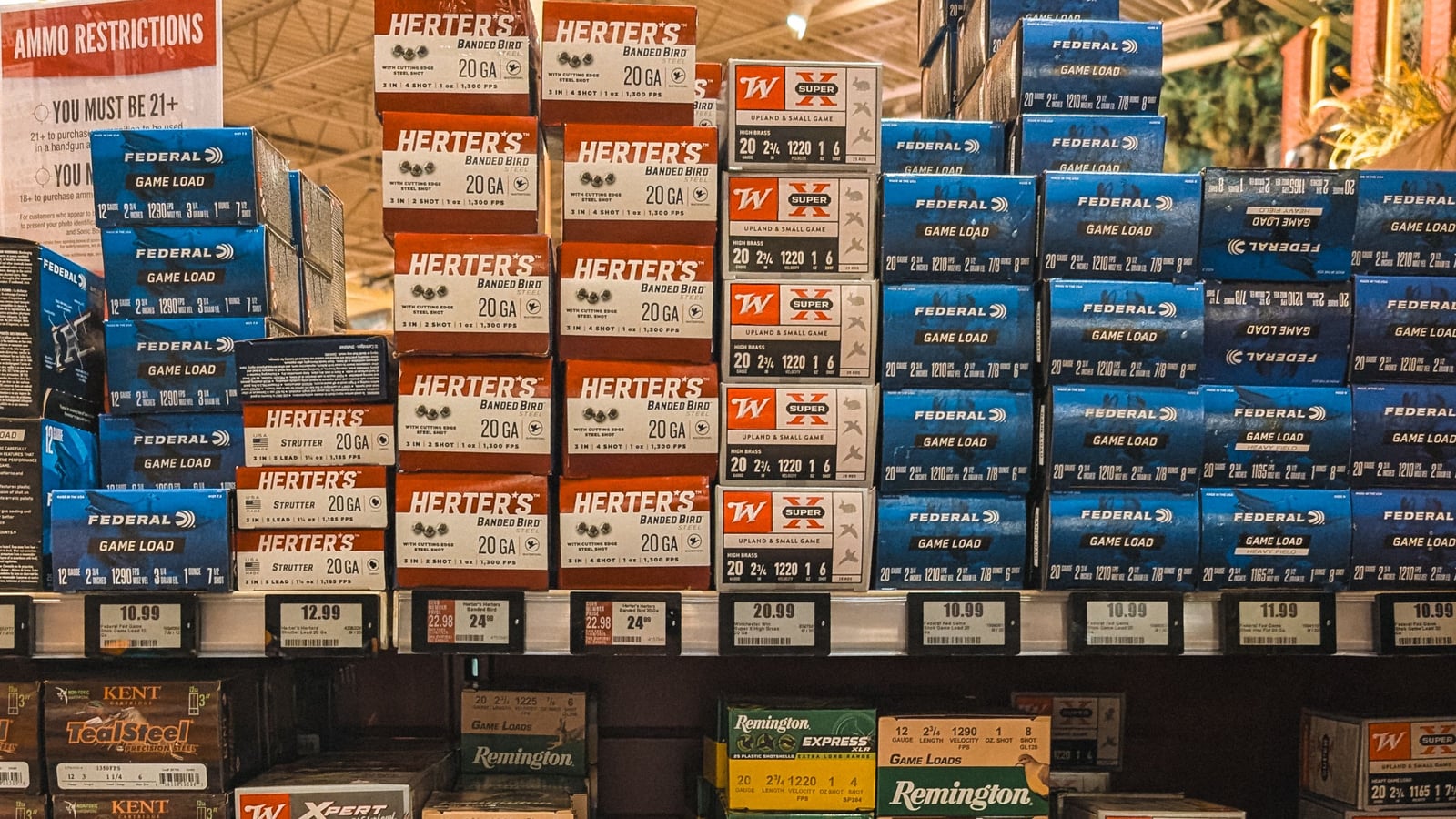
Shotshells used in trap or skeet have a different structure: plastic or cardboard hull, wad, and a powder charge that’s also sensitive to humidity. Plastic generally holds up well over time, but sealing at the crimp remains the weak point common to all ammunition.
A cardboard hull, used on some older or reproduction shells, is noticeably more moisture-sensitive than modern plastic. If you have any, particularly dry storage is essential, with more frequent visual inspection.
The lead shot itself barely degrades over time. The limiting factor remains the powder and the wad, not the projectile. A well-stored shotshell keeps decent reliability over a period comparable to metallic ammunition, provided the same humidity and temperature rules are respected.
One point specific to these cartridges concerns storage volume. Trap and skeet shooters generally use larger quantities per session than other disciplines, which pushes them to buy in batches of several hundred shells. This large volume makes storage organized by purchase date all the more useful, so an old batch doesn’t sit still while recent purchases get used first out of sheer convenience.
The plastic wad, which separates the powder from the shot charge, can stiffen slightly over time under repeated heat. That’s not a danger factor in itself, but it can affect the consistency of shot patterns on the range, something to keep in mind if you notice unusual spread with old shells.
Realistic shelf life: black powder and historical reenactment
Antique firearms and historical reenactment guns, fired with black powder, follow a different logic. Black powder is chemically more stable over time than modern smokeless powder, but it’s extremely sensitive to direct moisture, far more than modern powder.
The real risk here isn’t so much slow degradation as one-off moisture exposure: black powder that has picked up moisture, even briefly, loses much of its ability to ignite properly. It’s a more binary phenomenon than a gradual one compared to smokeless powder.
For someone practicing with antique firearms or historical shooting, airtight storage is even more essential than for other disciplines: a sealed container, a total absence of ambient humidity, and regular checks of the state of loose powder if you load your own ammunition.
The corrosive residue left by black powder also demands meticulous cleaning of the firearm after every session, a subject in its own right, but one that’s a reminder that this discipline demands heightened vigilance across the whole chain, from storage to post-shooting cleaning.
Ammunition or components for antique and collector firearms deserve a special mention: some historic cartridges, particularly rare or discontinued calibers, aren’t easily replaced if they degrade. Flawless storage matters even more when the ammunition itself is hard to find on the current market, a situation common for shooters of antique firearms in competition or historical demonstration.
Some practitioners choose to keep their loose black powder in a dedicated airtight container, separate from any other household chemical product, in a cool, dry space reserved for this purpose. It’s a reasonable practice that limits the risk of cross-contamination and makes regular visual checks of the powder’s condition easier.
Signs that ammunition should no longer be used
The first sign to check is the visual condition of the case. Green or whitish corrosion, oxidation stains, unusual discoloration of the brass are direct indicators that moisture has gotten in. In that case, the ammunition should be set aside.
The second sign is mechanical: a crimp that seems loose, a bullet that moves slightly in the case by hand, visible deformation of the base or body of the cartridge. Any shape anomaly is grounds for immediate rejection.
The third sign is olfactory or sensory: an unusual chemical smell when opening an old box, a packaging texture that’s changed (softened cardboard, brittle plastic). These are indirect but reliable clues to a storage problem.
The fourth sign shows up at the moment of firing itself: a misfire, an abnormal sound or feel when shooting, a velocity that clearly seems below normal. In that case, follow your range’s standard safety procedure for firing incidents, stop the session with that ammunition, and never try to reuse a cartridge that misfired.
When in doubt, the rule is simple and has no exceptions: suspect ammunition, even if it has a good chance of still being functional, isn’t worth the risk. The cost of a discarded cartridge is trivial compared to the risk of an incident at the range.
The question of disposing of rejected ammunition comes up often. A discarded cartridge doesn’t go in the regular trash or a standard collection point: it remains a small-scale explosive product that must be treated as such. The simplest thing is to ask your usual gun dealer or your club, who know the local take-back or destruction channels.
A cartridge that misfired at the range deserves special handling: never handle it immediately after the incident, respect the safety delay specified by your range’s rules before unloading the firearm, and always report the incident to the range officer or session supervisor present. This protocol exists precisely to cover the case where the primer reacted partially without the powder fully igniting.
Good storage habits for everyday use
Keep ammunition in its original packaging as much as possible. The manufacturer’s cardboard or plastic box is designed to offer decent protection against light and a basic barrier against ambient humidity — it’s not just transport packaging.
For long-term storage, favor a sealed secondary container, especially in a humid climate or a region with strong seasonal swings. A watertight case with a gasket, combined with a desiccant packet, very effectively limits moisture infiltration.
Absolutely avoid the floor of an uninsulated garage or cellar, as well as an attic under the roof in summer. A shelf in a temperate living space, a closed cupboard away from light, or a dedicated storage cabinet in a dry utility room are noticeably safer options.
Always separate ammunition by type and caliber, with clear labeling. It’s not just a matter of organization: it prevents caliber mix-ups when loading, one of the classic avoidable causes of incidents at the range.
Note the purchase or manufacture date on your box or in your logbook. That lets you rotate your stock, prioritizing the oldest ammunition, rather than letting boxes bought years ago sit at the back of a cupboard.
Also think about the height of your storage cabinet. Storage at floor level is more exposed to potential flooding, to residual moisture that pools at the bottom of a room, and to dust that accumulates more easily. A mid-height shelf or a raised cabinet limits these drawbacks at little cost.
Also avoid stacking boxes haphazardly on top of each other as you buy more. Organized storage, by caliber and date, with enough airflow between containers, limits the formation of damp microclimates that can build up between boxes packed too tightly together in a confined space.
One last simple habit: visually inspect the storage location itself, not just the ammunition. A crack in a cellar wall, a leak around a garage window, rising damp from the floor are signals to address at the source, before you even start thinking about the right container for your ammunition.
Storage and the French regulatory framework
Ammunition storage in France falls under a regulatory framework that depends on the category of the firearm involved. Reminder of the system: category A, banned for private individuals (war weapons, military equipment); category B, subject to prefectural authorization (handguns, most semi-automatics); category C, subject to declaration (certain hunting firearms and manually operated repeating rifles); category D, freely sold or subject to simple registration (low-power air guns, replicas, certain historic firearms).
Secure storage obligations (safe, security cabinet, separation of firearm and ammunition) vary depending on the category of firearm owned and are specified by the prefecture and the club affiliated with the FFTir federation. These rules evolve and depend on your specific situation, so the most reliable habit is to check directly with your FFTir club or your prefecture rather than relying on a general rule found online.
What’s certain in all cases is that physical separation between the firearm and the ammunition is a universally recommended good practice, regardless of the minimum legal obligations. An experienced club shooter applies this principle almost automatically as a safety reflex, beyond mere legal compliance.
If you load your own ammunition, storing loose powder and primers follows specific safety rules, distinct from storing finished cartridges, particularly regarding quantity and a dedicated space. It’s a technical enough subject to deserve its own article rather than a rough summary here.
Possession of ammunition is also capped in quantity depending on the category of firearm and the associated regime (authorization or declaration), with thresholds that can evolve and are set by national regulation. Here again, it’s better to check the exact figure currently in force with official sources or your club rather than relying on a figure you read elsewhere, including in this article, without recent confirmation.
Transporting ammunition outside a strictly personal context, for example to lend it or carry it for someone else, raises additional regulatory questions best clarified with your gun dealer or federation before any ambiguous situation arises. Regulatory caution is just as much part of responsible sport shooting practice as technical caution about physical storage.
Special case: ammunition in transit or travel
Traveling to the range or to a competition exposes ammunition to different conditions than storage at home: a car trunk in full summer sun, temperature swings over a long drive, mechanical shocks in a poorly packed bag.
A one-off exposure of a few hours in a hot trunk is nothing like permanent storage under the same conditions, but regular repetition over several competition seasons ends up having a cumulative effect that’s best avoided when possible.
The simplest solution is to transport your ammunition in its rigid original box, inside a dedicated bag or transport case, rather than loose in a soft bag. That limits both mechanical shocks and direct exposure to heat from the trunk.
After a competition or a trip to the range, systematically put your remaining ammunition back in its usual storage spot rather than leaving the transport case in the garage or the car trunk between outings. That’s a common lapse that needlessly exposes the stock to degraded conditions.
Multi-day competitions with on-site accommodation raise an additional question: where to store your ammunition overnight between two days of shooting. A locked vehicle in a hotel parking lot offers neither the security nor the thermal stability of storage at home, which is a good reason to limit the quantity carried for this kind of trip to the strict minimum rather than bringing your whole stock out of excessive caution.
The mode of transport itself matters too: a shooting bag with dedicated rigid compartments protects better than a plain sports bag where ammunition boxes knock against other gear during the trip. This modest investment in a good bag or transport case limits cumulative mechanical wear on ammunition over the course of competition seasons.
Managing your stock over time
Good stock management relies on the FIFO principle, first in first out: use the oldest ammunition first rather than grabbing at random from a stock that accumulates with each purchase.
Avoid building up a stock disproportionate to your actual practice. A stock that’s too large inevitably ages longer before being used, which mechanically increases the risk of degradation compared to a stock that’s renewed regularly.
A logbook, digital or on paper, helps you know exactly what you have in stock, since when, and under what conditions it’s been kept. It’s the same habit that helps you track your sessions and your settings: the more reliable data you have on your practice, the less you depend on memory or guesswork.
An experienced instructor generally recommends checking your ammunition stock at least once a year, on a fixed date, to spot any signs of degradation before they become a problem at the range rather than just an observation after the fact.
A digital shooting log, rather than a simple paper notebook, lets you go further by cross-referencing this information with your actual sessions: which lot of ammunition was used for which group, whether a series of unusual results coincides with the use of an old stock recently pulled out. This kind of correlation is hard to spot from memory but becomes obvious with a structured history. This tracking habit ties into a broader logic of improvement: a shooter who logs their sessions, settings, and gear over time more easily identifies the real causes of a poor performance, instead of guessing or wrongly blaming their gear or technique when the cause could be poorly preserved ammunition. For a shooter managing several firearms and several calibers, this tracking becomes even more useful: it avoids mixing up stocks or mistakenly rebuying ammunition when an old, perfectly usable stock is already sitting in a cupboard.
The ideal container for your use case
The choice of storage container depends directly on your practice and the volume you hold. For an occasional shooter with a few boxes of cartridges, the manufacturer’s original packaging, placed in a dry drawer or cupboard, is plenty without any extra investment.
For a regular competitor with a larger stock, a dedicated storage case with a gasket and carry handle becomes more relevant. This type of container, often also used for moisture-sensitive electronics, offers uniform protection against dust, humidity, and mechanical shocks.
Ventilated metal cabinets, sometimes used to store both firearms and ancillary gear, aren’t ideal for ammunition if they aren’t thermally insulated: metal transmits outside temperature swings almost without dampening. A wooden cabinet or an insulated box inside a temperate room generally protects better over time.
For shooters practicing several disciplines and different calibers, partitioned bins or drawers inside the same cabinet make organization easier without multiplying containers. The essential logic stays the same: a dry, temperature-stable space, away from direct light, with easy access for regular stock inspection.
Some shooters invest in a small electric dehumidifier for a dedicated storage space, especially in regions with a humid climate year-round. That’s a sensible choice for anyone with a large stock, but it’s not essential for occasional practice with a modest volume of ammunition properly stored in a classic sealed container.
Common mistakes seen at the club
The first classic mistake is storing ammunition directly in the same shooting bag as gun cleaning gear, especially solvents and cleaning oils. Certain chemical cleaning products can, in case of a leak or prolonged contact, degrade the case or the crimp of a cartridge. Always physically separate ammunition from these products.
The second common mistake is transferring ammunition from its original box into a generic, unlabeled container to save space. That makes it harder to identify the exact caliber when loading and loses all trace of the purchase date or lot, two pieces of useful information if you later have doubts about the state of the stock.
The third, more insidious mistake is trusting how long you’ve used a method rather than an actual check: “I’ve always stored my ammunition this way and never had a problem” isn’t a guarantee for the future, especially if conditions in the space have changed over time, for example after renovation work or a move.
The fourth mistake is underestimating the cumulative effect of mediocre storage over several years. Ammunition that spent a single summer in a hot garage probably poses no problem. The same ammunition that repeats this cycle for ten consecutive summers has a very different risk profile, even if nothing is visible from the outside before a careful inspection.
An experienced club shooter has generally learned these habits through experience or advice received during their initial training. For a more recent practitioner, it’s worth adopting these good habits from the start rather than waiting for an incident or an unpleasant surprise to take the subject seriously.
The fifth mistake, rarer but real, concerns shooters who regularly change home or storage location without reassessing the conditions of the new space. Moving from a temperate apartment to a house with a cellar or garage completely changes the storage risk profile, and deserves a full reassessment of habits rather than simply reproducing the previous setup.
FAQ
Q: Does ammunition really expire, like food? A: No, there’s no strict expiration date like for food. Ammunition progressively loses reliability depending on storage conditions, with humidity and temperature playing a far more decisive role than age itself.
Q: Can you fire ammunition that’s picked up a bit of moisture? A: No, as a precaution. Suspect ammunition should be set aside rather than tested at the range, since a misfire or abnormal powder combustion can cause an incident. The cost of a discarded cartridge is negligible compared to the risk.
Q: Are the freezer or fridge good storage solutions? A: No, that’s not recommended. The real risk isn’t the cold itself but the condensation cycles each time you take it out and put it back in the cold, which encourage exactly the moisture infiltration you’re trying to avoid.
Q: Does reloaded ammunition keep as well as factory ammunition? A: The same basic principles apply (humidity, temperature, visual inspection), but reloaded ammunition deserves even greater vigilance, since the quality of the crimp and priming depends directly on the reloader’s skill.
Q: How can I tell if my storage space is suitable without measuring equipment? A: A space that’s dry to the touch, with no musty smell, a stable temperature year-round, and no direct sun exposure already covers the essentials. A simple, inexpensive hygrometer remains a good investment if you want to get an objective read on the situation.
Q: Should primers and loose powder be stored differently from finished cartridges? A: Yes, these are distinct products with their own safety constraints and often specific regulatory rules on quantities and storage space. Check with your club or your prefecture rather than defaulting to the rules for storing finished cartridges.