
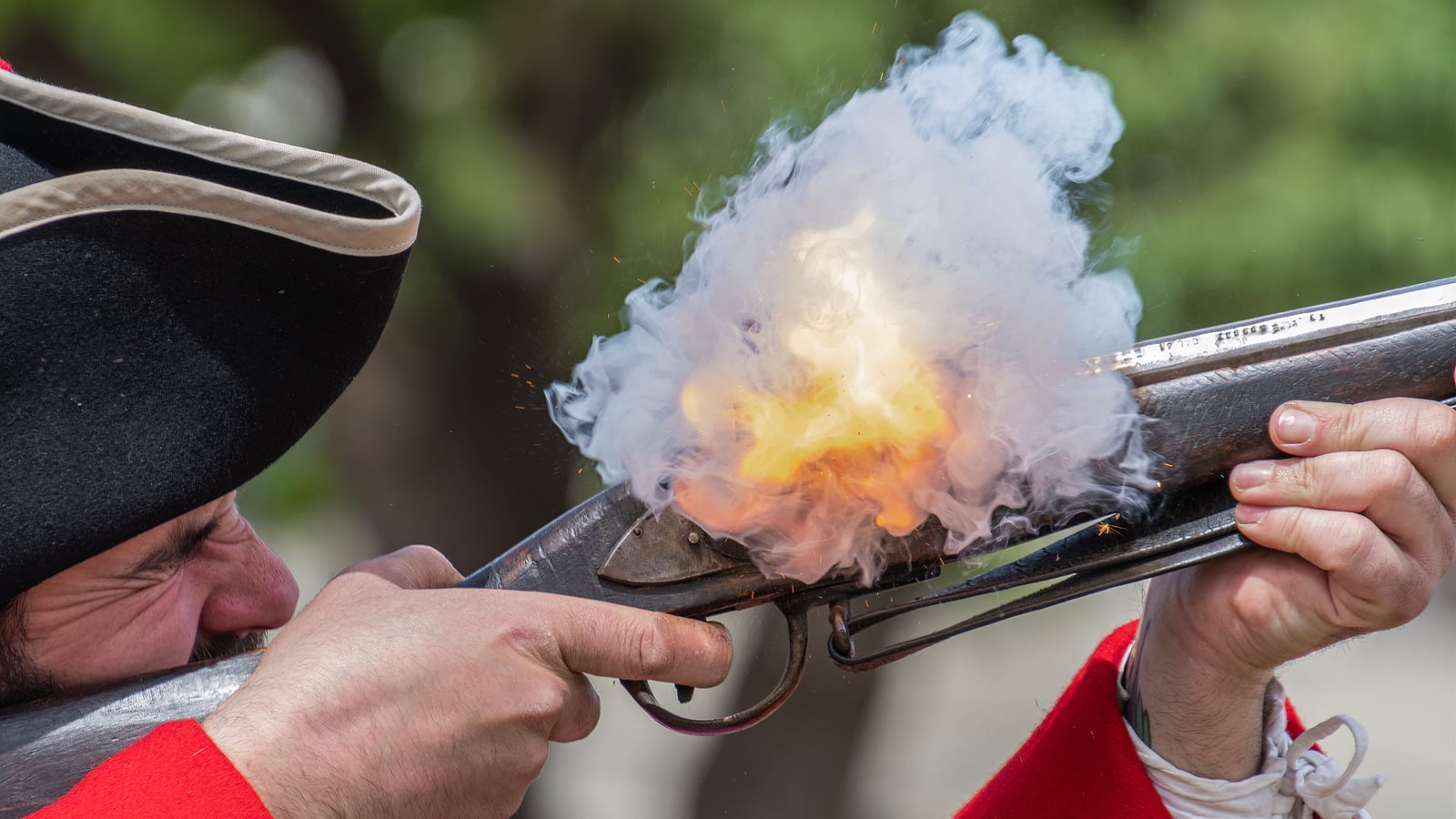
A shot that turns back time
Shooting black powder means rediscovering gestures that vanished with the modern metallic cartridge. Measuring powder by volume, wadding, seating the ball or shot, priming: every shot demands a preparation that no contemporary caliber requires anymore.
This discipline draws a varied crowd: history enthusiasts, fans of old mechanics, sport shooters curious to step outside the semi-automatic framework. What they share is a taste for the complete gesture, with no shortcuts.
Others come to it through mechanics first: understanding how a firearm worked before the invention of the metallic cartridge requires handling this kind of equipment in real conditions, not just reading about it in a book. Shooting then becomes a way to check theoretical understanding as much as an end in itself.
This practice is organized around two worlds that overlap without merging: black powder sport shooting run under national shooting federations, and historical reenactment carried by independent cultural associations. The two have fed off each other for decades.
What strikes a shooter coming from a modern semi-automatic is the shift in relationship to time. You stop counting rate of fire in rounds per minute and start counting minutes per round. This deliberate slowness isn’t a flaw — it’s the very heart of what the discipline offers: a different relationship to the firearm, closer to craftsmanship than to pure performance.
The federal discipline for antique firearms
Shooting federations recognize a discipline dedicated to antique firearms and their replicas, fired single-ball at scored cardboard targets. It’s practiced with pistol and rifle, at distances suited to the real range of these weapons.
Progression within this discipline follows a logic close to other federal disciplines: ranking by level, the possibility of representing your club at regional or national competitions, and a scoring system that rewards consistency of grouping rather than a single isolated shot. This structure reassures shooters coming from other federal disciplines, who find familiar reference points despite very different equipment.
The rulebook imposes safety procedures reinforced compared to modern shooting: controlled loading time, strict management of misfires and hangfires, extra safety distance before approaching the firing line in case of an incident. A misfire with black powder is never trivial — the firearm stays potentially loaded longer than with a modern cartridge.
Competitions are held in club teams or individually, with categories distinguishing flintlock, percussion, and sometimes black powder revolver replicas. An experienced instructor often stresses one point: consistency in the loading motion matters as much as the aim itself.
What fundamentally changes the experience is the pace. A black powder session produces a fraction of the round count of an equivalent modern session, but every shot is loaded with total attention.
Black powder shooting doesn’t live in isolation from the rest of civilian sport shooting. Many clubs offer, alongside their modern sections, an antique firearms section that shares facilities and sometimes instructors, which eases the crossover for an already licensed shooter wanting to diversify.
Shooting on animal-shaped targets, with metal silhouettes representing chicken, pig, turkey, or ram, also exists in variants using antique firearm replicas, alongside classic ball shooting on cardboard targets. This practice requires different management of loading time, since each plate hit counts against an overall clock.
Bench rest, a precision discipline where the firearm rests on a dedicated support rather than being held freehand, also has a black powder variant prized by shooters seeking maximum precision rather than speed of execution. This variant often attracts shooters coming from modern precision shooting, curious to find that level of demand again with old equipment.
Scoring in antique firearms competitions accounts for both grouping precision and strict adherence to safety procedures during the event. A shooter can see their result penalized for handling deemed dangerous, even with an excellent grouping on target, a constant reminder that safety comes before pure performance in this discipline.
This demand for rigor actually reflects positively on the same shooter’s modern practice: once used to controlling every loading motion with black powder, one returns to the semi-automatic with markedly stronger handling discipline. Several club instructors notice this skills transfer among members who practice both worlds.
Legal classification of black powder firearms
Most single-shot black powder firearms, flintlock or percussion, fall under the freely-sold category and are available for open sale or with simple registration, which partly explains their popularity with beginners in the discipline. Black powder revolver replicas follow specific rules that can vary by model and mechanism.
This lenient classification doesn’t excuse anyone from rigor: owning a freely classified firearm doesn’t mean it escapes basic safety rules or criminal liability in case of careless use. A serious club requires the shooting license and compliance with its internal rules before any use on its range.
For the exact status, thresholds, and administrative steps, these vary by jurisdiction and the exact type of mechanism, so it’s best to check directly with your gunsmith or club rather than relying on a general rule found online.
This relative accessibility has allowed many clubs to develop a black powder section without excessive administrative burden, which has largely contributed to the discipline’s vitality.
Possession of the powder itself, as an explosive product, follows regulation distinct from that of the firearm, with its own quantity thresholds and storage conditions. This double administrative layer — firearm on one side, ammunition components on the other — often surprises beginners coming from other sport shooting disciplines, used to a simpler regime for the modern cartridge.
A point many discover late: transporting an unloaded black powder firearm between home and club doesn’t follow the same common-sense rules as a modern firearm, because the residual risk differs depending on whether the firearm is primed or not. Here too, it’s better to follow the precise instructions given by your club rather than transposing a habit picked up elsewhere.
Antique firearm replicas intended for reenactment, notably those used for blank fire during demonstrations, also fall under a status that depends on their mechanism and their capacity to fire a real projectile. A serious association systematically checks this status before adding a piece to its demonstration collection, rather than assuming a weapon “just for show” escapes every rule.
The firearms used: flintlock, percussion, replicas
Black powder shooting covers a wide technical spectrum. Flintlock firearms represent the oldest mechanism still practiced in clubs: a flint strikes a steel frizzen, produces a spark that ignites the priming powder, which in turn carries the fire to the main charge. The delay between pulling the trigger and the shot going off, called “lock time,” is clearly noticeable and requires specific learning.
Percussion firearms, which appeared later, replace the flintlock pan with a nipple on which a percussion cap is placed. The system is more reliable, less sensitive to moisture, and remains the basis for many modern replicas sold for sport practice and reenactment.
Black powder revolver replicas, often based on nineteenth-century models, are loaded from the front of the cylinder: powder, then round or conical ball packed down with an integrated ramming lever. They’re valued for their accessibility and handiness compared to long guns.
An experienced club shooter often points out that powder quality and granulation directly influence shot consistency. Using a grain suited to the caliber and firearm isn’t a detail — it’s a safety and precision condition.
Unlike modern shooting where you buy a ready-to-use box of cartridges, the black powder practitioner manages several separate components: the powder itself, wads, balls or shot, and depending on the mechanism, percussion caps or flint. This multi-component management requires a minimum of organization and suitable storage.
Commercial black powder comes in several granulations, each suited to a precise use: priming the pan for flintlock firearms, main charge for the barrel depending on caliber. Getting the grain wrong isn’t trivial — it changes pressure and ignition consistency.
Many black powder shooters choose to cast their own round or conical balls from lead, using a mold calibrated to the firearm. This practice, passed from shooter to shooter within clubs, is an integral part of the discipline’s culture and allows better cost control compared to buying ready-made ammunition.
The choice between round and conical ball isn’t just aesthetic: ballistics differ noticeably, the conical ball generally offering better stability at longer range while the round ball stays true to the gesture and precision of the oldest firearms. An experienced club shooter adapts their choice to the firearm and intended shooting distance, rather than following a trend.
The barrel itself deserves particular attention depending on whether it’s smooth or rifled: a rifled barrel stabilizes the projectile through rotation and improves precision at distance, while a smooth barrel, closer to the oldest models, requires a perfectly fitted ball to limit dispersion. This technical distinction directly influences the choice of a firearm depending on the intended use, sporting or strictly historical.
Historical reenactment: a world of its own
Alongside sport practice regulated by shooting federations, historical reenactment constitutes a distinct cultural movement, carried by nonprofit associations dedicated to a specific period or event. These groups bring together volunteers passionate about military or civilian history who reconstruct costumes, encampments, and sometimes armed maneuvers with black powder in a commemorative or educational setting.
There’s a dense network of associations in this field, with groups centered on varied periods: the early modern era, the nineteenth century, the great wars of the twentieth century. Each association works on the authenticity of costume and equipment with an attention to detail that far exceeds mere shooting.
The educational dimension holds a central place: these associations often take part in heritage days, local commemorations, or school events, to pass on historical memory through living demonstration rather than through books alone.
Shooting has a place there, but a supervised and demonstrative one rather than a competitive one: it’s about showing a period gesture safely, with blank or ball ammunition depending on context and the authorization obtained, never improvising.
Historical reenactment places particular importance on clothing, which must match the represented period as faithfully as possible. This requirement pushes many members to sew or have their own outfits sewn, drawing on precise documentary research rather than aesthetic approximations.
This search for fidelity also concerns the roles represented: beyond armed figures, serious associations recreate the civilian life of the era, crafts, camp life, which considerably widens participation to members who never handle a firearm. The discipline thus attracts a mixed audience, well beyond the circle of shooters alone.
Black powder sport shooting also sees growing gender mix within clubs, with a proportion of women shooters that has been steadily rising in recent years according to on-the-ground feedback from clubs, without a precise national figure being confidently stated. A regional champion notes that the discipline demands as much mental discipline as physical strength, which largely levels the field between male and female shooters.
Some associations specialize in a very specific period, while others cover a broader spectrum, from nineteenth-century civilian costume to the great conflicts of the twentieth century. This diversity of specializations lets everyone find a group that matches their historical interest exactly, rather than settling for generic reenactment.
Reinforced safety at reenactments
Black powder maneuvers at reenactment events follow particularly strict safety protocols, often more demanding than on a classic shooting range, because they take place in front of an audience and involve several armed participants simultaneously.
An experienced group leader systematically checks spacing between participants, the direction of fire, the absence of ball loads during simulations, and the compliance of every firearm before the demonstration begins. Nothing is left to improvisation, even for a scene that looks simple from the stands.
Serious associations require internal training before a new member is authorized to handle a firearm in public, whatever their personal shooting experience. Collective logic always takes precedence over individual ease.
This level of demand explains why the best associations enjoy a solid reputation with town halls and organizers of heritage events: trust builds over years without incident.
A safety briefing systematically precedes any public demonstration, where every participant restates their role, their position on the ground, and the conduct to follow in case of the unexpected. This ritual, repeated before every event even for the most experienced members, keeps habit from replacing vigilance.
Events and gatherings
The calendar of reenactment and historical shooting events runs throughout the year, with a natural concentration in spring and summer. You’ll find reenactments tied to specific battles or periods, medieval festivals with antique firearm demonstrations, and days dedicated to military heritage in forts, citadels, or museums.
These events often mix several audiences: reenactors in period costume, sport shooters giving a technical demonstration, families curious to discover a slice of living history. This diversity is what makes the scene rich, provided each group respects the role and safety level expected by the others.
Major trade shows dedicated to antique firearms and black powder also bring together specialized gunsmiths, spare parts dealers, and collectors, letting newcomers discover the gear before committing to a club. These shows also serve as a place for technical exchange among enthusiasts, comparing settings, supply sources, and maintenance tips.
For exact dates and locations, it’s best to check directly with local association and federation websites, since the calendar changes each season and varies by region.
Some events are held indoors, in multipurpose halls or exhibition spaces, particularly during the cold season, while large outdoor reenactments favor the warm season, for obvious comfort reasons for reenactors and audience alike. This seasonal split largely structures the activity of the most active associations.
Joining a club or a dedicated association
Getting into black powder shooting at a club requires the shooting license, as for any other discipline, plus, more often than not, specific training given by an instructor qualified in this particular practice. Most clubs offer a supervised introduction before authorizing a shooter to load on their own.
For historical reenactment, the approach is different: you join an association based on the period that interests you, generally starting with costume and role before gaining access to weapon handling, which stays reserved for trained, trusted members.
A regional sport shooting champion who has also practiced reenactment highlights a difference in mindset: the shooting club seeks performance and consistency of gesture, the reenactment association seeks historical fidelity and the collective. Both require real rigor, but applied to different goals.
Some shooters end up practicing both worlds in parallel, which enriches their technical understanding: understanding why a nineteenth-century firearm was designed that way directly sheds light on the modern sport practice of the same weapon.
Before committing, it’s best to attend a session or event as a simple visitor: most clubs and associations gladly welcome curious onlookers during open days, which lets you judge the atmosphere and seriousness of the instruction before investing in a license or membership.
Gear and historically faithful replicas
The market for black powder firearm replicas has organized itself around specialized manufacturers who reproduce historical models with attention to mechanical and aesthetic fidelity. These replicas respect the original dimensions, materials, and function, while sometimes incorporating modern steels for the safety of the contemporary shooter.
Beyond the firearm itself, the full kit matters: a calibrated powder flask, suitable wads, bullet molds for shooters who cast their own projectiles, percussion caps or spare flints depending on the mechanism. Every accessory has its importance for shot consistency.
Maintenance differs radically from modern shooting: black powder heavily fouls the barrel and leaves corrosive residue that attacks steel if the firearm isn’t cleaned quickly after use. Cleaning with hot soapy water, followed by thorough drying and a protective oil, is an integral part of the ritual after every session.
For reenactment, the gear goes beyond the firearm: period uniforms or civilian clothing, transport equipment, sometimes reproduction of documents or everyday objects. This overall requirement is what sets serious reenactment apart from a simple costume.
Black powder shooting and historical reenactment also maintain close ties with the museum world. Many history museums or heritage sites call on reenactment associations to bring demonstrations to life, making collections dynamic rather than static behind glass.
Some collectors of antique firearms own pieces that are no longer fired, kept for their historical value or rarity, while others choose modern replicas precisely so they can keep shooting without risking damage to an original piece. This distinction between collector’s item and practice firearm shapes a good part of the market.
Restoring antique firearms is a skill in its own right, often passed down within clubs by experienced members who have acquired this know-how over years. An experienced club shooter often describes this restoration work as an almost as absorbing a discipline as shooting itself.
The choice between a new replica and an authentic antique firearm largely depends on the intended use. A genuine period firearm retains a heritage and sometimes financial value that a replica will never have, but it requires much deeper inspection expertise before any shooting, particularly regarding the condition of the barrel and mechanism.
Learning the right gestures: from theory to practice
Loading a black powder firearm safely always follows a precise, non-negotiable sequence: measure the powder charge with a dedicated tool, never by estimation, pour into the barrel, seat the wad, position the ball or shot, ram down firmly without forcing excessively, then prime last of all.
Reversing this order or skipping a step can cause a serious incident, notably insufficient packing that creates a dangerous air pocket during ignition. This is one of the first things an experienced instructor corrects in a beginner.
Managing misfires deserves particular attention: a black powder firearm that doesn’t go off on the first attempt must be kept pointed in a safe direction for a waiting period before any handling, since a hangfire remains possible for several seconds after the priming attempt.
Storage and transport also follow adapted rules: an unloaded black powder firearm must never be stored with a loaded barrel without supervision, and the powder itself requires specific storage away from any heat or spark source, in a compliant container.
Coaching a beginner in black powder requires a different teaching approach than modern shooting. The instructor must not only teach stance and aim, but also a complete loading gesture sequence, with a level of vigilance that tolerates no shortcuts. Training almost always starts dry, without powder or projectile, to anchor the sequence of gestures before introducing a real charge.
An experienced instructor also insists on reading the signals of a black powder firearm: the sound of loading, the feel of ramming, the smell and color of smoke upon ignition. These sensory cues, absent from modern shooting, are an integral part of learning and allow one to detect an anomaly before it becomes an incident. The teaching progression also includes learning to disassemble and clean, often neglected elsewhere but central here.
Personal protection remains non-negotiable, as on any shooting range: glasses and hearing protection at all times, even though the noise and smoke released by black powder differ noticeably from those of a modern cartridge. Some beginners underestimate this point, wrongly thinking an old firearm would be quieter or less dangerous than a contemporary one.
Transmission and living memory
What deeply distinguishes historical shooting and reenactment from other sport shooting disciplines is the dimension of transmission. You don’t practice only for personal performance, but to keep alive a concrete understanding of a period and a technique that, without this community, would remain confined to books and museums.
Clubs and associations regularly organize open days aimed at an uninitiated audience, where teaching takes precedence over a show of force. Explaining why a flintlock rifle demands a different gesture than a modern firearm is as much part of the mission as shooting itself.
This dimension also attracts a younger audience than the average for classic sport shooting disciplines, often via an interest in history before an interest in shooting. Many go on to discover other federal disciplines after a first experience in black powder or reenactment.
The community stays overall modest in size compared to Olympic disciplines, which fosters a friendly atmosphere where clubs know each other and technical mutual help circulates easily, notably regarding sourcing rare parts or restoring antique firearms.
This collective and intergenerational dimension is one of the major appeals of the practice: it’s not rare to see, within the same club or association, members of every generation sharing the same firing line or the same encampment, each contributing according to their experience and passing on know-how that few other disciplines cultivate with such care.
Social networks and video platforms have given new visibility to these practices in recent years, with content showing the loading motion or a reenactment in action. This exposure, well used, helps clubs and associations recruit new, curious members who wouldn’t have spontaneously thought of pushing open the door of a traditional shooting range.
Investment and entry budget for the discipline
Getting equipped to start black powder shooting represents a variable investment depending on the type of firearm chosen, the finish level of the replica, and associated accessories. A simple percussion firearm generally costs less than a flintlock model or a multi-shot revolver replica, but this varies a lot by manufacturer and build quality.
Beyond the firearm, the recurring budget covers powder, wads, balls or lead for casting, percussion caps or spare flints, and specific anti-corrosion maintenance products. This cost per session generally stays lower than for a modern cartridge discipline, since the number of rounds fired is lower.
For historical reenactment, the investment shifts largely toward costume and period equipment, which can represent a substantial budget depending on the level of authenticity sought. Many associations lend basic gear to new members while they build their own kit.
This varies by club, region, and locally available suppliers, so it’s best to check directly with a black powder section or a reenactment association before investing, rather than relying on a generic figure found online.
This heritage dimension also explains why many associations collaborate with local government cultural services to organize temporary exhibitions or demonstration days open to the general public, strengthening the link between sport practice and historical transmission.
Many beginners start by borrowing club gear before investing in their own equipment, a practice encouraged by most black powder sections to avoid a rushed purchase that wouldn’t match the shooting style eventually adopted. This trial period also allows comparing several mechanisms, flintlock and percussion, before making an informed choice.
Comparative view and outlook for the discipline
Compared to other European countries where historical reenactment and black powder shooting sometimes enjoy greater media visibility, the practice stays discreet but solidly established, carried by a dense associative network and a federal discipline that’s stable over time.
Renewing the ranks of practitioners remains a matter of attention for club and association leaders, in a context where civilian sport shooting demographics are evolving overall. Intergenerational transmission, between experienced shooters and newcomers, remains the main lever identified by clubs to maintain the discipline’s vitality.
Growing interest in living history, driven by social networks and a renewed curiosity for heritage, indirectly benefits these practices: more and more visitors discover black powder at a reenactment event before turning to supervised sport practice at a club.
This momentum stays fragile and largely depends on associative volunteering and clubs’ commitment to passing on a demanding technical know-how. It deserves to be supported by those who practice it, if only by introducing a curious acquaintance to a first supervised session.
For a licensed sport shooter looking to break the routine of modern calibers without losing technical rigor, black powder offers a complete learning ground, both mechanical, historical, and human. It’s a discipline that rewards patience far more than speed, and that’s precisely what gives it lasting value.
Whether coming for federal competition, associative reenactment, or simply out of curiosity for a vanished piece of mechanics, the best entry point remains the same: approach a local club or association, attend a first supervised session, and let the rigor of the gesture do the rest.
FAQ
Q: Do you need a license to shoot black powder at a club? A: Yes, supervised practice at a shooting club follows the same requirements as other federal disciplines, with a valid license. Additional training specific to black powder is generally required by the club before authorizing independent shooting.
Q: Can you freely buy a black powder firearm? A: Most single-shot black powder firearms fall under a freely-sold category, available for open sale or with simple registration depending on the model. Some revolver replicas follow different rules, so it’s best to check the exact status with a gunsmith before buying.
Q: What’s the difference between black powder sport shooting and historical reenactment? A: Black powder sport shooting is a competitive federal discipline on cardboard targets, regulated by federal rules. Historical reenactment is a cultural associative activity focused on memory and costume, where demonstrative shooting stays supervised but secondary to the educational goal.
Q: How do you start in historical reenactment? A: The simplest way is to contact an association dedicated to the period that interests you and first attend an event as a visitor. Most groups then welcome new members starting with costume and role before access to weapon handling, reserved for trained members.
Q: Is maintaining a black powder firearm different from a modern one? A: Yes, significantly. Black powder residue is corrosive and heavily fouls the barrel, requiring cleaning with hot soapy water shortly after every session, followed by thorough drying and oil protection.
Q: Are misfires more frequent and riskier than with a modern firearm? A: Misfires and hangfires are more frequent than with a modern cartridge, especially with flintlock mechanisms sensitive to moisture. Safety protocol requires keeping the firearm pointed in a safe direction for a waiting period before any handling after a misfire.
Q: Can you cast your own bullets for black powder shooting? A: Yes, it’s a common practice well rooted in the discipline’s culture, provided you use a mold precisely calibrated to the firearm in question. This skill is generally passed on within the club by experienced shooters rather than improvised alone.
Q: Does demonstrative shooting in reenactment use real ammunition? A: It depends strictly on the context and the authorization obtained by the association: some demonstrations use blank ammunition, others a supervised ball shooting at a dedicated target. No improvisation is tolerated; every setup follows a safety protocol validated in advance.