
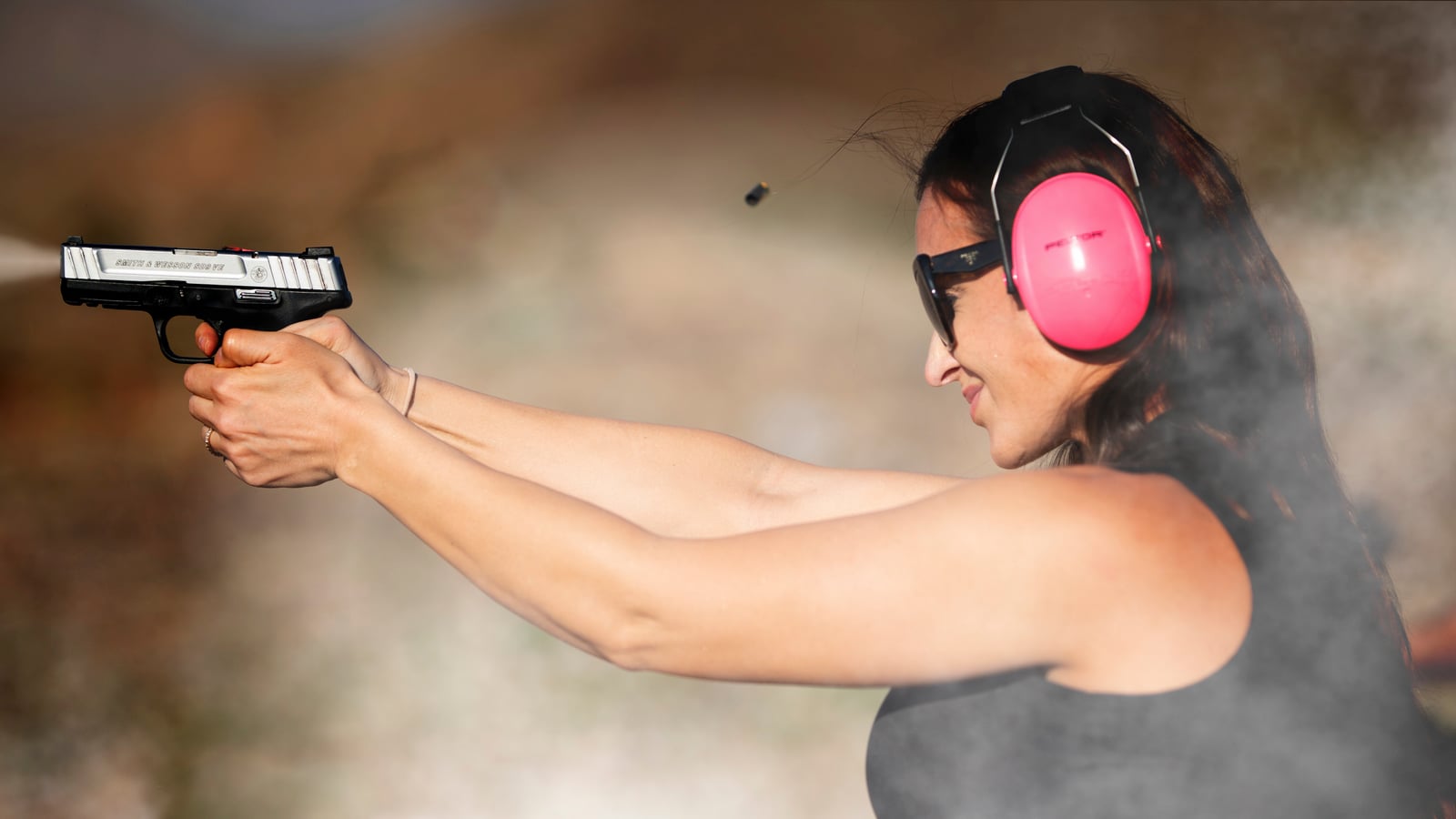
Gunshot noise: a physical phenomenon that’s widely misunderstood
When you press the trigger, you set off a controlled explosion in an enclosed chamber. That combustion generates a pressure wave that travels through the air at a speed far greater than a hand clap or a revving engine. That difference in nature is exactly what makes a gunshot so unusual — and so dangerous for your ears.
A “normal” sound — a conversation, a busy road, a concert — rises and falls in intensity fairly gradually. Your ear has time to react, at least a little, thanks to a natural protective reflex called the stapedial reflex. This tiny muscle in the middle ear contracts to limit the transmission of vibrations to the inner ear when a loud sound hits.
The problem with a gunshot is how fast it rises. We’re talking about a pressure peak reached in a fraction of a millisecond. The stapedial reflex, which physiological studies show takes 25 to 150 milliseconds to kick in, simply doesn’t have time to act. The shock wave hits the inner ear at full force, with no natural filter at all.
That’s why gunfire is classified as “impulse noise,” alongside a firecracker or an industrial explosion — a category fundamentally different from the continuous noise people often, wrongly, apply the same danger thresholds to. A shooter who’s never thought about this distinction almost always underestimates the real risk.
Decibels: a scale that fools your intuition
The decibel (dB) is a logarithmic unit, not a linear one. That means a 10 dB increase doesn’t mean “10% more noise” — it means roughly ten times the sound intensity. A 20 dB difference, then, isn’t double — it’s a hundredfold increase in sound energy.
This scale explains why numbers that look close on paper actually represent enormous differences in danger. A chainsaw at 110 dB versus a gunshot at 150 dB: that 40 dB gap corresponds to ten thousand times more sound energy — not “a bit louder.”
For general reference, well documented in the acoustics and occupational health literature:
- A normal conversation sits around 60 dB.
- A busy road runs around 80-85 dB.
- An amplified concert can exceed 100-110 dB.
- A chainsaw or a hammer drill runs around 100-115 dB.
Sporting firearm gunshots sit in a range that far exceeds all of these examples — often above 140 dB outdoors, and the exact level varies widely depending on caliber, barrel length, ammunition type, and the shooting environment. It’s precisely this variability that makes every range session different in terms of real risk, and that rules out giving a single universal number without being wrong.
Why caliber and environment change everything
The sound level of a gunshot isn’t a fixed property of “the gun” in general: it depends on a combination of factors that add up or offset each other.
Caliber and powder charge obviously matter: the larger the volume of expelled gas, the stronger the pressure wave generated. But barrel length matters just as much. A short barrel lets combustion gases escape with more residual pressure at the muzzle, which amplifies the perceived crack compared to a long barrel that gives the gases more time to expand before exiting.
The type of firearm changes things too: a handgun, a rifle, and a smoothbore long gun don’t produce the same acoustic signature even at comparable energy, because of barrel geometry and the position of the shooter’s ear relative to the muzzle.
The shooting environment is probably the most underrated factor for beginner shooters. A covered range, with walls and a ceiling, creates reverberations that increase real sound exposure compared to shooting outdoors, where the wave disperses freely. A poorly designed indoor range can make an identical gunshot feel noticeably more violent than outdoors, simply because of acoustic reflections off hard surfaces.
Finally, the shooter’s position matters: standing at the firing line doesn’t expose you the same way as being set back on an observation point, and shooting next to a lane neighbor using a louder caliber than yours exposes you to their noise as much as your own.
The concrete mechanism behind hearing loss
To understand why this noise damages the ear irreversibly, you have to look at what happens inside the inner ear, in the cochlea. This spiral-shaped structure contains thousands of hair cells — tiny sensors that convert mechanical vibrations into an electrical signal sent to the brain.
These hair cells cannot regenerate in humans. Once destroyed or permanently damaged, they don’t grow back and don’t repair themselves. This is a fundamental difference from other body tissues that can heal: the inner ear operates on a fixed capital set at birth, one that only erodes with noise exposure and natural aging.
A pressure wave as violent as a gunshot can damage these cells in two ways. The first is mechanical: the physical shock can literally break or bend the hair-like cilia of these sensory cells, a bit like trampled blades of grass that never stand back up. The second is metabolic: even without immediate destruction, intense sound stress exhausts the cell’s energy resources and can lead it to die in the hours or days following exposure — a phenomenon researchers sometimes call “delayed hearing loss.”
It’s this second mechanism that explains something many shooters have experienced without naming it: hearing that seems to have returned to normal by the same evening after a shooting session, but has actually degraded slightly and permanently, with no noise or pain to signal it.
The myth of “your ear getting used to it”
Many experienced shooters say that after years of practice, “the noise doesn’t bother them as much as it used to.” That’s a real observation — but interpreting it as the ear “toughening up” or “adapting” to noise is dangerous.
What’s actually happening is almost the opposite: hearing that has already deteriorated perceives high frequencies less intensely — precisely the ones most stressed and most vulnerable during a gunshot. The shooter isn’t “handling” the noise better — they’re hearing it less well because part of their hearing capital is already spent.
This phenomenon often comes with a warning sign that many people ignore for too long: temporary tinnitus after a session, that ringing or buzzing that lingers a few hours before fading. An experienced club instructor often reminds new members of this: tinnitus, even brief, is never trivial. It’s a signal that the cochlea has just taken a stress it didn’t fully absorb.
The hair cell makes no distinction between a beginner and a seasoned shooter. Hearing capital doesn’t get reinforced by repeated exposure — it only decreases, session after session, cumulatively and silently.
Single exposure versus repeated exposure
There’s an important difference between the risk of a single shot and the risk of regular practice spread over years, even though both deserve systematic protection.
A single, unprotected gunshot can, in some cases, cause acute acoustic trauma: a sudden hearing loss, sometimes accompanied by pain or a “plugged” ear sensation, generally affecting one specific frequency. This kind of incident thankfully stays rare among shooters who systematically protect their ears, but it illustrates that a single unprotected shot is enough to cause measurable damage.
The most insidious risk — and statistically the most common one among regular practitioners — remains cumulative hearing loss. Every unprotected or poorly protected shooting session adds a small dose of damage that stacks onto the previous ones. The shooter notices nothing dramatic after a single outing, but after years of practice, the cumulative result can translate into significant hearing loss, particularly at the high frequencies essential for understanding speech in a noisy environment.
It’s this cumulative dimension that should change how a shooter thinks about protection: it’s not a precaution “for today” — it’s capital you protect over a lifetime of practice.
The frequencies hit hardest, and why it matters
Not all frequencies are equally vulnerable to the impulse noise of a gunshot. Audiology studies show a particular vulnerability around 3,000 to 6,000 Hz, a high-frequency zone that corresponds to a specific region of the cochlea, mechanically exposed to intense sound shocks.
This frequency zone isn’t chosen at random by nature: it plays a central role in understanding speech, particularly for distinguishing certain consonants like “s,” “f,” or “sh.” That’s why shooting-related hearing loss often shows up, years later, as a characteristic complaint: “I can hear people talking, but I can’t quite understand what they’re saying anymore,” especially in a noisy environment like a restaurant or a family gathering.
This loss is generally asymmetrical in right- or left-handed shooters using a long gun: the ear closest to the muzzle, on the side opposite the supporting shoulder, generally takes a more direct hit than the other. It’s a detail confirmed by numerous audiograms of club shooters, and a reminder that identical, systematic protection for both ears is never a luxury.
How effective hearing protection actually works
Two main families of protection exist, and they aren’t mutually exclusive: earplugs and earmuffs (passive or electronic). Each has a different physical mechanism for attenuating sound.
Earplugs, made of expandable foam or molded silicone, work by blocking the ear canal. Their effectiveness depends heavily on how well they’re inserted: a foam plug that’s poorly compressed before insertion, or not pushed in far enough, can lose a large part of its theoretical attenuation. It’s a common mistake among beginners who think they’re “wearing protection” when it’s barely doing anything because it isn’t properly positioned.
Earmuffs cover the entire outer ear and block sound through a combination of sealing and absorption. Their effectiveness depends on the quality of the seal around the ear: the temples of shooting glasses, a poorly positioned cap, or long hair not properly tucked under the cushions can create a micro-leak that seriously reduces real attenuation.
Combining both — plugs under muffs — remains the option offering the highest and most reliable attenuation, particularly on a covered range where reverberations add extra sound exposure. Many clubs recommend this double protection especially for the most powerful calibers, or for shooters practicing dynamic disciplines with a sustained rate of fire.
The special case of electronic hearing protection
Electronic earmuffs, increasingly common on shooting ranges, deserve a separate explanation because how they work is often misunderstood. They don’t simply “block” sound like passive muffs: they amplify low-level ambient sounds, like an instructor’s voice or safety instructions, while instantly cutting amplification the moment a sound crosses a dangerous threshold — typically that of a gunshot.
This technology answers a real practical need: a shooter wearing classic passive protection hears instructions and exchanges with other practitioners less clearly, which can create situations where they take off their protection “just to listen” — exactly when they shouldn’t. Electronic muffs remove that temptation by keeping normal communication possible without sacrificing protection at the critical moment.
That said, you need to stay clear-eyed on one point: a poor-quality or badly adjusted electronic muff can offer insufficient attenuation against a particularly loud gunshot. The advertised protection level varies a lot from one model to another, and a regional champion practicing fast-paced dynamic disciplines often favors a model known for reliable cutoff performance over the cheapest option available.
Common mistakes that reduce real-world protection
Certain habits, often adopted without much thought, significantly reduce the effectiveness of hearing protection that was actually chosen correctly to begin with.
Wearing a foam plug that’s already been used several times, crushed and misshapen, no longer offers the same attenuation as a fresh plug properly compressed before insertion. The foam loses its elasticity and conforms less well to the shape of the ear canal.
Neglecting maintenance on a set of earmuffs is another classic mistake: hardened, cracked, or compressed cushions lose their sealing ability, even if the muffs still look intact from the outside.
Taking off your protection “just for a second” between strings of fire, to chat or adjust gear, while other shooters are still firing on the neighboring lane, exposes you to an unanticipated, unfiltered gunshot — often the most dangerous kind, since the ear has zero protection at the exact moment of impact.
Underestimating the noise of a covered range compared to shooting outdoors pushes some practitioners to lighten their protection indoors, when the opposite is often what’s actually warranted because of reverberation.
Finally, ignoring your own exposure as a spectator or companion on a range is a widespread oversight: noise makes no distinction between the person pulling the trigger and the person simply standing nearby.
The disciplines that expose the ear the most
Not all shooting sports expose the ear the same way, and knowing your own discipline’s risk profile helps calibrate your vigilance.
Low-cadence precision disciplines — rifle or pistol on a fixed target, shooting at 10, 25, or 50 meters — expose you to a limited number of shots per session, with recovery time between each shot. The risk is still there at every gunshot, but the cumulative volume per session generally stays more moderate than in a fast-cadence discipline.
Dynamic disciplines like IPSC, Steel Challenge, or USPSA, practiced on cardboard targets or steel plates arranged in a course, instead involve a rapid string of shots — sometimes dozens within a few minutes during intensive training. This sustained cadence gives the ear less recovery time between shots and often justifies reinforced protection, notably a double layer of plugs plus muffs.
Clay target shooting (trap, skeet, sporting clays) is almost always practiced outdoors, which limits reverberation, but exposes you over sometimes long sessions with a high number of consecutive shots. The immediate proximity of other shooters on the line, each with their own shotgun, adds a cross-exposure that shouldn’t be overlooked.
Black powder shooting and historical disciplines have a different acoustic signature, often perceived as duller or more spread out over time because of the type of powder used, but that doesn’t mean lower sound exposure at all: caution should stay the same, without giving in to the assumption that a “different” sound is automatically less dangerous.
Finally, crossbow shooting or low-power air disciplines don’t produce a gunshot in the true sense and don’t present this specific acoustic risk — a useful detail for a shooter practicing several disciplines, who needs to adjust vigilance according to the day’s activity rather than applying a single rule to all of their practice.
A shooter practicing several disciplines in the same season benefits from thinking in terms of cumulative exposure over the week or month rather than session by session in isolation. Stringing together a fast-cadence dynamic training session on Saturday and a clay shooting outing on Sunday represents a much heavier total sound load than either outing on its own, even if each one, taken separately, respects appropriate protection. This overall view of weekly or monthly sound load is rarely taught to new license holders, even though it concretely changes how you organize a training calendar over time — particularly for shooters aiming for regular competition who stack up training sessions.
Choosing the right protection for your build and your practice
The best hearing protection gear isn’t universal: it depends on the shooter’s build, their discipline, and the constraints of their shooting equipment.
A shooter who wears protective glasses — mandatory on nearly every range — needs to check that their glasses’ temples don’t create a rigid bridge under the cushions of a set of earmuffs. Some thin frames or certain low-profile muff models limit this problem better than others, and trying them on before buying remains the best way to check real compatibility.
For shooters with small ears or a narrow ear canal, standard foam plugs may not expand properly once inserted, reducing their real effectiveness. Properly sized plugs, or even custom-molded tips made by a hearing care professional, provide noticeably better comfort and attenuation than a poorly fitted generic solution in that case.
Young shooters, especially minor license holders discovering the discipline under an instructor’s supervision, deserve special attention: their hearing system is still developing, and systematic double protection from the very first sessions is a precaution many clubs apply without exception, even for modest calibers.
A shooter who already wears hearing aids for a reason unrelated to shooting absolutely must talk to their audiologist before practicing: some earmuff models don’t fit well over a standard hearing aid, and there are protection solutions specifically designed for this situation — not to be overlooked on the assumption that “it’ll be fine as is.”
Medical follow-up: a habit not to put off
Even the best protection doesn’t excuse you from regularly monitoring your hearing, if only to get an objective picture of your actual hearing capital rather than relying on a subjective impression, which is always misleading on this subject.
An audiogram, performed by a healthcare professional, measures hearing sensitivity across different frequencies and can detect a loss that’s still invisible in daily life, well before it becomes noticeable enough to hinder understanding a conversation. It’s a simple, painless test that generally takes little time.
For a regular shooter, getting a first “baseline” audiogram early in their practice, then repeating one at reasonable intervals, makes it possible to track the real evolution of their hearing over time rather than discovering it after the fact. It’s the only reliable way to distinguish age-related hearing loss from hearing loss accelerated by shooting noise exposure.
An experienced club instructor often recommends this approach to shooters who’ve been practicing for years without ever having their hearing checked, particularly those who admit they were less rigorous about their protection early on. It’s never too late to start monitoring, even if some damage is already done: at minimum, it lets you slow further deterioration by adjusting your practice.
The cost and details of such follow-up vary depending on the practitioner and region, and it’s best to check directly with a healthcare professional rather than relying on a generic figure that wouldn’t reflect each situation’s reality.
Some well-organized clubs build awareness of this medical follow-up into how they welcome new license holders, on the same footing as firearm-handling safety instructions. This collective approach helps normalize a step still too often seen as optional, even though it’s a full part of responsible long-term sport shooting practice. A shooter who shares their audiology follow-up experience with clubmates contributes, in their own way, to advancing this prevention culture.
Recognizing the warning signs
Certain signs should alert a shooter to possible ongoing hearing damage, even if it seems mild or temporary.
Tinnitus — ringing, buzzing, or a “bell” sensation — that appears after a shooting session and persists for several hours, or even into the next day, is never a trivial phenomenon to ignore. A seasoned club shooter reporting this kind of sensation should systematically review the quality of their protection, even if it seemed sufficient until then.
A “cottony” or muffled feeling in the ear after a session, as if hearing through a wall, generally signals temporary auditory fatigue that, with repetition, can become permanent.
A gradually growing difficulty following a conversation in a noisy environment, or needing to turn up the TV volume more than in the past, are signals not to brush off just because they set in slowly. Regular checkups with a healthcare professional remain the only reliable way to get an objective read on possible hearing loss before it becomes a daily nuisance.
Maintaining and replacing your gear over time
Hearing protection isn’t a one-time purchase you then forget about for years: it’s equipment that wears out, degrades, and needs to be monitored like any other piece of safety gear.
The foam cushions of a set of earmuffs harden over time, from the combined effects of sweat, heat, and simple material aging. A hardened cushion no longer conforms properly to the shape of the face and lets in micro-leaks of air that reduce real attenuation — often without the shooter noticing, since the muffs still look intact from the outside. Regularly checking by touch, gently pressing the cushions to check their flexibility, helps catch this aging before it becomes a serious problem.
The headband of a set of muffs also loses tension over the years and with repeated handling, which reduces contact pressure against the skull and therefore overall sealing. Muffs that feel like they “float” a bit more than when you bought them deserve to be compared against a new model to judge whether they still deliver the expected effectiveness.
For reusable molded silicone plugs, regular cleaning with manufacturer-recommended products prevents the buildup of earwax or residue that can, over time, slightly alter their shape and therefore their fit in the ear canal. Foam plugs, meanwhile, are designed for limited-time use and are worth replacing as soon as they lose their ability to spring back into shape after compression.
Investing in recognized quality gear, rather than the cheapest option found online with no clear indication of performance, remains a decision that pays off over the course of a sporting practice that often lasts decades. The exact budget to plan for varies enormously depending on the type of protection chosen and the manufacturer, and it’s better to compare several recognized models rather than rely on an isolated price.
Protecting your hearing outside the range too
A shooter’s hearing health isn’t decided only during shooting sessions: everyday lifestyle habits directly influence the ear’s ability to withstand — or not — the sound exposures tied to their sport.
An ear already stressed by significant recreational noise exposure — concerts, headphones at high volume, loud tools at work or at home — starts out with a resistance reserve already depleted before even arriving at the range. Stacking several sources of loud sound exposure within the same period, without giving the ear time to recover, increases overall risk of damage, even if each exposure taken alone seems reasonable.
Auditory rest between two strong exposures plays an underrated role: an ear that has just endured significant sound stress needs recovery time before facing another intense demand, much like a muscle needs rest after exertion. Stacking a shooting session with a concert or a loud night out on the same day doesn’t allow for that recovery time and can worsen damage that, taken separately, would have been better tolerated.
A shooter who also works a job exposed to noise — construction, workshop, industrial environment — stacks two exposure sources that add up against the same hearing capital. In that case, rigor about protection both at work and on the range becomes even more decisive, since the two exposures never offset each other: they add up, session after session, workday after workday.
Finally, adopting broader vigilance about overall sound exposure — turning down headphone volume, wearing protection on a noisy construction site, avoiding unnecessary proximity to a concert sound system — logically completes the efforts made on the range. Protecting your hearing only makes sense if that logic stays consistent across your whole life, not just during the few hours of a weekly shooting session.
Building an airtight protection routine
The best hearing protection in the world is useless if it isn’t worn systematically, from the very first shot of the session until the gear is packed away.
Checking the condition of your plugs or muffs before every outing should become as natural a reflex as your firearm’s safety check. Worn gear gets replaced without waiting for it to become visibly faulty.
Adjusting your protection level to the environment — covered range, outdoors, the caliber your lane neighbors are using — rather than sticking to the same habit out of pure automatism, lets you actually match your protection to the day’s real risk.
Encouraging newcomers at the club to wear double protection from their very first sessions, before they’ve developed bad habits, prevents years of negligence that are hard to make up for later.
Finally, keep in mind that hearing protection also protects the practice itself over the long run: a shooter with poor hearing struggles more to catch safety instructions, warning sounds on a range, or simply to fully enjoy their discipline for many more years to come.
Passing this rigor on to the shooters you mentor — whether a child, a partner, or a friend discovering the sport — is part of an experienced practitioner’s implicit responsibilities. Simply reminding someone to check their protection before stepping up to the firing line, without needing to think about it every time, becomes over time a collective reflex that benefits an entire club rather than a single isolated shooter.
At the end of the day, protecting your hearing isn’t some externally imposed constraint: it’s a decision that guarantees you can keep practicing your discipline in good conditions, year after year, without the enjoyment of shooting sports coming at the cost of hearing damaged for the rest of your life.
FAQ
Q: What decibel level does a gunshot actually reach? A: The exact level varies widely depending on caliber, barrel length, ammunition, and shooting environment, but it consistently exceeds the immediate danger thresholds for the ear, far beyond common industrial noise. It’s best to remember that any gunshot, regardless of caliber, requires systematic protection rather than looking for a single number.
Q: Can a single unprotected gunshot really damage your hearing? A: Yes, a single unprotected gunshot can cause measurable damage to the hair cells of the inner ear, which don’t regenerate in humans. The risk increases further with repetition, but a single unprotected shot is already enough to produce significant sound stress.
Q: Why do my ears ring after a shooting session? A: That ringing, or tinnitus, signals that the cochlea has taken sound stress it didn’t fully absorb, even if it fades after a few hours. It’s never something to ignore, and it should push you to review the quality and fit of your hearing protection.
Q: Do electronic earmuffs really protect better than classic earplugs? A: Electronic earmuffs offer the advantage of amplifying useful low-level sounds, like instructions, while cutting amplification during a gunshot, which reduces the temptation to remove your protection. Their protection level, however, depends heavily on the quality of the model and how it’s adjusted.
Q: Should you wear double protection, plugs and muffs, at every session? A: Combining both offers the most reliable attenuation, particularly on a covered range or with powerful calibers, and many clubs recommend it for these situations. It isn’t mandatory for every shooting setup, but it remains the safest precaution when in doubt.
Q: Can the ear get used to gunshot noise with experience? A: No — what some experienced shooters interpret as “getting used to it” is actually often hearing loss that’s already set in, which reduces perception of high frequencies. Hearing capital never strengthens with repeated exposure; it only erodes gradually.