Shooting without a stopwatch or a scoreboard
Fun shoot and plinking answer a simple question: why should every shooting session need a score to justify it? In most clubs, the bulk of practice revolves around performance, ranking, and progress measured on an official scorecard. That’s a sound logic, but it’s not the only one.
Fun shoot refers to sessions organized without any official ranking, where the goal is simply to mix things up: unusual targets, improvised formats, a relaxed vibe among shooters. Plinking, a term that mimics the sound of a hit on a metal target, refers more to informal shooting at reactive targets, often solo or with friends.
The two overlap a lot in spirit: no pressure to perform, no referee, no obligation to hold a strict position for a set time. You show up to shoot for the pleasure of the motion and the immediate feedback of a target that moves, falls, or rings.
This article covers the playful format with no official ranking, the reactive targets that make plinking so appealing, and why this seemingly trivial practice usefully complements more serious competitive preparation. We’re talking about civilian sport shooting, at a club or on approved land, in strict compliance with the usual safety rules.
This distinction between recreational and competitive practice isn’t unique to shooting sports: you find it in almost every individual sport, from running to golf to climbing. Shooting doesn’t escape this duality, even though its public image often gets reduced to the competitive or the safety angle alone, which masks a much more varied and convivial reality on the ground.
Nothing about fun shoot excuses you from the safety fundamentals: hearing and eye protection, respecting shooting zones, unloaded firearms off the firing line. The setting is more relaxed on atmosphere, never on the rigor of the instructions.
The term itself betrays its origin across the Atlantic, but the practice has become firmly established in French clubs, adapted to local context. This isn’t a cultural import applied wholesale, but a natural evolution of club life, which has long sought to offer something other than the sole alternation of competition range and technical training.
This need for variety isn’t new, but it’s taken a more visible place in club communication in recent years, particularly to reach a public that still associates sport shooting with an austere discipline reserved for a technical elite. Fun shoot breaks that image without taking anything away from the rigor of the legal and safety framework.
What sets fun shoot apart from standard competition
A competition session follows a precise framework: a defined shooting program, timed sequences, refereeing, standardized targets, and a score logged on an official sheet. Every parameter is standardized to allow a fair comparison between shooters.
Fun shoot flips that logic. The club or the group of shooters freely chooses the format of the session, with no federal-rule constraint on the precise proceedings. You might decide to shoot at varying distances, switch targets every five minutes, or mix several allowed weapon types in the same slot.
The absence of ranking profoundly changes your relationship with shooting. A shooter who misses their group in competition loses points, which weighs on morale and sometimes, through a snowball effect, on the technique of the following shots. In fun shoot, a missed shot has no consequence on any score: you adjust, you retry, you laugh off the miss, and you keep going.
This absence of stakes doesn’t mean an absence of technical rigor. Many seasoned shooters actually use fun shoot to work on a specific point without the tension of the clock: a stance transition, a scope adjustment, a new round to test. The relaxed setting frees up attention for experimentation.
The social format is also central. A club fun shoot session often brings together shooters of very different levels, from recent beginners to experienced license holders, because nobody feels judged on a ranking. This mix of levels creates an informal learning dynamic that doesn’t always exist in strict competition.
The very notion of “success” changes nature in fun shoot. In competition, a successful shot is measured against a precise scoring zone on a standardized target. In fun shoot, success can simply mean having tried a new stance, tested a new setting, or enjoyed shooting at an original target, with no number validating or invalidating the experience.
This redefinition of success has an interesting effect on how you relate to failure. A shooter who repeatedly misses a tough reactive target in fun shoot doesn’t experience that as a penalized underperformance, but as a challenge to try again next time. This tolerance for failure, cultivated in a relaxed setting, can later transfer usefully to how you handle misses in competition.
The free-form format also allows experimenting with scenarios that federal rules simply don’t provide for. A club can organize a station rotation with several target types on the same course, without it matching any existing official event. This creative freedom is often what keeps regular participants coming back to these sessions.
Plinking and reactive targets
The heart of plinking is immediate sensory feedback. A cardboard target gives delayed information: you have to walk up, look at the hits, count the points. A reactive target gives instant, physical feedback, which completely changes the shooting experience for a lot of practitioners.
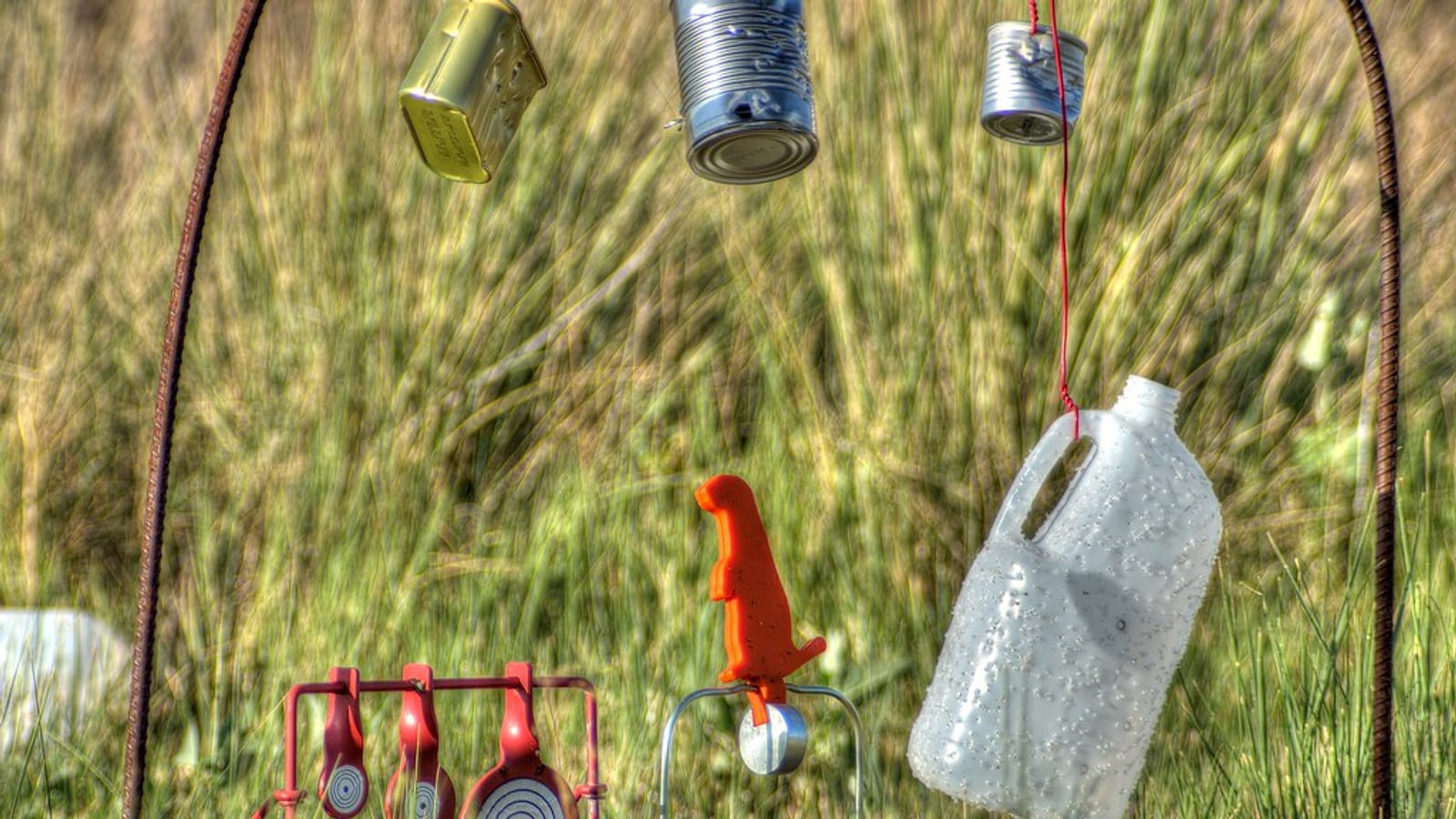
Swinging or pivoting steel plates are among the most common reactive targets found at ranges offering supervised plinking. A well-placed hit tips or rings the plate, giving sound and visual confirmation of the shot without needing to walk up and check a cardboard target.
Animal-shaped steel silhouettes, borrowed from the chicken, pig, turkey, or ram formats, work very well for plinking: they demand real precision on a defined zone while keeping a playful side through their recognizable shape and their reaction at impact.
Some ranges offer self-resetting targets that automatically stand back up after a validated hit, allowing shooters to keep firing without interruption to go reset a fallen target. This format speeds up the pace of the session and keeps a game-like dynamic going.
Suspended or moving targets add a motion variable that changes the technical challenge: you have to anticipate movement, continuously adjust your aim, and accept a different margin of error than with a fixed target. It’s an excellent exercise for visual tracking and timing management.
Other formats, such as targets that burst an inert plaster charge or splash colored powder on impact, provide spectacular visual feedback without particular technical complexity. This type of target often draws a non-licensed public during open house days, precisely because the result is instantly readable.
Water targets or ones filled with material that bursts on impact, where the range allows it, offer a fun variant with very visual feedback without requiring a complex mechanism. This kind of target remains subject to the range’s cleanliness and maintenance rules, though, which limits its use to facilities suited to that type of residue.
The layout of reactive targets on a plinking course also deserves thought. A too-predictable arrangement reduces the appeal of the format; many seasoned shooters prefer a layout with depth and varying distances, to keep at least a minimum of variation between one target’s aim and the next.
The characteristic sound of a hit on metal, which gives plinking its name, also plays a role in the immediate pleasure of the practice. That crisp acoustic feedback, distinct from the report of the shot itself, provides an almost playful confirmation of a successful hit, which partly explains this format’s lasting appeal even among very experienced shooters.
Maintaining reactive steel targets requires particular attention to shooting distance and ammunition type, to limit metal wear and ricochet risk. These parameters vary by manufacturer and plate thickness, hence the importance of scrupulously following the posted instructions at the range.
Organizing a fun shoot session at the club
Most clubs that offer fun shoot do so during dedicated time slots, separate from regular competition-oriented training. This separation keeps a clearly identified relaxed space, without encroaching on time reserved for shooters preparing for a serious deadline.
The variety of gear allowed during these slots depends entirely on the club’s internal rules and the weapon categories held by participants. An experienced instructor generally supervises these sessions to make sure the relaxed atmosphere never translates into a loosening of safety instructions.
Varying the targets is often the key to a good fun shoot session: combining steel plates, animal silhouettes, and classic cardboard targets lets every shooter find a format they enjoy, without monotony over the whole slot.
Some clubs organize internal mini-challenges with no official ranking, where the goal stays playful: number of targets hit within a set time, without that figure being logged anywhere or formally compared between participants. The atmosphere clearly takes priority over the numerical result.
Welcoming new license holders often happens through this kind of slot rather than a direct competition session. A shooter who discovers the club in a fun shoot atmosphere gets a positive first impression, far from the pressure of a ranking, which eases their gradual integration toward more regular practice.
Communication around these sessions also benefits the club as a whole: a well-organized fun shoot slot draws people in, energizes club life, and gives an accessible image to a discipline sometimes perceived from outside as austere or overly technical.
The logistics of a fun shoot slot still demand serious upfront preparation, even though the proceedings look improvised from the participants’ side. An experienced instructor generally sets up the target layout in advance, checks the condition of the reactive gear, and plans the station rotation so the session flows without dead time or a jam on the firing line.
The pricing model for these slots varies a lot from club to club: some include it in the annual membership fee, others charge a specific package tied to ammunition consumption or wear on the reactive gear. It all depends on each structure’s own economic and association-based model.
Some clubs also choose to occasionally open these fun shoot slots to outside groups, corporate committees, or unlicensed groups of friends, in a supervised and strictly secured setting. This occasional opening can represent an interesting recruitment source, provided all regulatory obligations tied to hosting a non-licensed public at a shooting facility are respected.
Why this practice complements serious competitive preparation
A shooter who only chases competitive performance often ends up associating every shooting session with an evaluation. This constant association between shooting and judgment can, over time, generate a mental fatigue that paradoxically hurts the technical progress being sought.
Fun shoot breaks that systematic link. By removing the pressure of a score, it restores a more direct relationship with the motion itself, without the anticipation of the outcome that sometimes gets in the way of concentration in competition. This mental release has a regenerating effect on motivation over the medium term.
Technically, plinking’s reactive targets force quick adjustment and immediate reading of the result, which keeps useful reflexes sharp even for a pure precision shooter. Moving from a fixed target to a moving or swinging one calls on an adaptability that’s sometimes missing from training that’s too repetitive on a single format.
Fun shoot’s social side also plays a role in the longevity of one’s sporting practice. A shooter who only experiences the club through competitive pressure risks burnout or fatigue. Regular sessions with no stakes keep the enjoyment intact, which supports engagement over the long haul.
Many experienced instructors actually recommend consciously alternating both approaches across a sporting season: rigorous, competition-oriented training blocks, interspersed with fun shoot sessions to decompress and rebuild the motivation before resuming a more demanding cycle.
This alternation also benefits stress management in real competition situations. A shooter used to varying shooting formats develops an adaptability that proves useful in the face of the unexpected during a match: a target different from usual training, a change of schedule, an unanticipated variable.
There’s also a less obvious benefit, tied to rediscovering the pure pleasure of shooting. A competitive shooter who strings together training camps, qualifiers, and deadlines sometimes ends up forgetting what drew them to the sport in the first place. A fun shoot session, with no stakes or evaluation, lets you reconnect with that original motivation, which is often simpler and more genuine than the pursuit of performance.
On a purely technical level, the variety of distances and formats encountered in plinking forces a constant adjustment that even a rigorous competition routine doesn’t always reproduce. Moving from a plate at fifteen meters to an animal silhouette at twenty-five meters within a few minutes keeps your aiming flexibility sharp, which benefits your practice as a whole.
A regional champion once mentioned the value of keeping, even in the thick of a competition season, a monthly fun shoot slot in her training schedule: not to progress technically in the strict sense, but to avoid the mental saturation that stalks any athlete engaged in demanding preparation over the long term.
Gear suited to fun shoot and plinking
Fun shoot and plinking impose no specific gear requirement beyond the categories each shooter is already legally allowed to hold. An off-the-shelf category-D air rifle, an already-owned category-B pistol, or a declared category-C weapon can all work depending on the format chosen by the club.
Replicas and historical category-D weapons often find their natural place in these relaxed slots, where the playful side and discovery take priority over timed performance. Many shooters use fun shoot to bring out gear they rarely use in regular competition.
Ammunition choice depends directly on the target format chosen and the range’s rules. Certain reactive steel targets impose distance or ammunition-type restrictions to protect the gear and the safety of nearby shooters, which varies from club to club and facility to facility.
.22 Long Rifle remains a very common choice for plinking, due to its moderate cost and low energy compared to more powerful calibers, which limits wear on reactive steel targets and makes safety management easier at a busy range. Other calibers remain possible depending on the format chosen, but require heightened attention to distance and plate orientation.
Optics and accessories aren’t fixed by any official discipline rulebook either: a shooter can try a different scope, a red dot, or a setup they wouldn’t dare test in a match for fear of disrupting a well-honed competition routine.
This freedom to experiment with gear has real practical value. A shooter torn between two optics setups before a competition season can try both under real conditions across successive fun shoot sessions, with no pressure to perform, and form an opinion based on their own feel rather than a spec sheet or someone else’s advice.
Gear maintenance remains a non-negotiable constant, whatever the setting of the session. Fun shoot is no excuse to skip checking your weapon before use; it’s actually a good opportunity to test gear in a less demanding context before validating it for a serious deadline.
The volume of ammunition used during a fun shoot session can be noticeably higher than in classic training, due to the faster pace and the playful side that pushes you to keep firing. That’s worth anticipating in your ammunition budget, especially for calibers with a high per-unit cost.
Historical weapons or ones with an atypical mechanism, sometimes sidelined in competition for lack of compatibility with a precise discipline’s rulebook, often get a second life in fun shoot. It’s a chance for a club shooter to share unusual gear with fellow enthusiasts, without having to justify the choice against a performance standard.
The role of the shooting log even in a relaxed session
Many shooters wrongly assume that logging a fun shoot session isn’t worth it since there’s no official score to record. That’s a mistake that deprives you of useful information about gear consistency and how your feel evolves across sessions.
Logging the type of ammunition tested, the optics setup tried, or simply the number of rounds fired keeps a usable record, even outside any competitive context. That data can prove valuable later, when a setting validated during fun shoot gets picked back up for more serious preparation.
A digital shooting log app makes this tracking easy without weighing down the relaxed vibe of the session: a few quick notes are enough, without turning a moment of pleasure into an administrative chore. The goal remains to keep a useful memory, not to recreate a competitive constraint.
Tracking over time also lets you spot trends a memory alone wouldn’t retain: which round gives better results on reactive targets, which setup you enjoy more in a relaxed session, which plinking format keeps coming back more often in a shooter’s choices.
This continuity between fun sessions and serious ones also helps objectify progress over the long run. A shooter who logs everything, including their leisure sessions, has a fuller history to identify what really works in their overall practice, beyond the competitive context alone.
The digital shooting log also lets you compare, over time, the frequency of fun shoot sessions against technical training sessions. A shooter can thus objectively see whether they’re spending too much or too little time on one approach or the other, and rebalance their schedule according to their personal goals.
Some tracking features also let you keep photos of a group or free-form notes about a particularly successful reactive target. This kind of record, purely personal and with no ranking value, still keeps a pleasant memory to revisit, a bit like a travel journal applied to shooting practice.
Fun shoot and introducing new audiences to sport shooting
Fun shoot plays a gateway role for a lot of people who would never have walked through a club’s door in a purely competitive setting. The image of strict rankings, complex federal rules, and a serious atmosphere can intimidate a curious but uninitiated public.
Open house days built around reactive targets and a fun shoot format give an accessible and immediately rewarding first experience. Hitting a steel plate that rings, or tipping over an animal silhouette, delivers direct satisfaction without needing to understand a complex scoring system.
This approach also makes it easier to support younger shooters or people initially uncomfortable with the gear. An experienced instructor can adapt the format in real time, change the target, shorten the distance, without having to stick to a rigid framework imposed by competition rules.
The move from fun shoot to more structured practice then happens naturally, at each person’s own pace. Some newcomers stay durably on relaxed slots by personal choice, others discover through fun shoot the urge to move toward a more formal discipline, rifle, pistol, or dynamic shooting, depending on their affinities.
This gateway indirectly benefits the whole discipline of civilian sport shooting: the more a broad audience discovers a supervised, safe, and convivial practice, the more the general image of sport shooting becomes accessible to a public that wouldn’t otherwise have thought about it.
Feedback gathered after this kind of day often shows a recurring surprise among newcomers: the rigor of the safety framework, widely underestimated before their first visit, contrasts with the sometimes loose image some had of recreational shooting. This discovery helps reinforce the credibility of the club and the discipline as a whole with a public that was previously outside it.
Supervising minors, where club rules and legislation allow it, very often goes through this kind of playful format as a priority. A young shooter supervised in a fun shoot session develops a positive and safe relationship with the practice, before considering, if they wish, a move toward a more structured competitive discipline as they gain maturity and experience.
Word of mouth around these accessible sessions remains one of the best recruitment vectors for a club. A participant satisfied with a first fun shoot experience naturally talks about it around them, which generates a steady flow of new curious faces, much more effective than classic institutional communication about the discipline’s merits.
Limits and the framework that must be respected
Fun shoot is no space for leniency on safety, even with a relaxed atmosphere. All the usual rules remain fully applicable: firing line respected, weapon pointed in a safe direction at all times, systematic hearing and eye protection, instructor’s directions followed without exception.
The legal framework for holding weapons stays identical regardless of the session’s context. A category-B weapon subject to prefectural authorization remains subject to the same rules in fun shoot as in competition; the relaxed nature of the session changes nothing about the legal status of the gear used.
Some plinking formats practiced outside a club, on approved private land, require particular attention to the environment: a sufficient safety zone, a suitable backstop, no third parties in the potential trajectory. This varies by terrain and applicable local regulation, which should be checked beforehand.
Fun shoot also doesn’t replace supervision for complete beginners. Even in a playful setting, the presence of an instructor or an experienced shooter remains essential to pass on the safety basics before any autonomy at a range or shooting ground.
Finally, moderation in ammunition consumption and respect for other shooters’ gear remain common-sense rules that also apply in fun shoot. A relaxed atmosphere never excuses mutual respect between practitioners sharing the same range.
Fun shoot outdoors and on private land
Beyond the club setting, part of plinking happens outdoors, on approved private land, often in a more informal context than a supervised session at a club facility. This practice has existed for a long time among shooters with access to suitable land, far removed from any tactical or paramilitary context.
Safety there rests entirely on the diligence of the shooter or shooters present, without the support of an instructor or dedicated infrastructure. The choice of backstop, often a natural or built-up earth berm, must guarantee the projectile is fully stopped, with a wide safety margin on the sides and in the background.
The safety distance from homes, paths, or busy areas is the direct responsibility of the shooter, in compliance with local regulations on firearm use outside a classified facility. This varies by municipality and prefecture, hence the importance of precisely checking the applicable framework before any such session.
Homemade reactive targets, salvaged metal plates, or improvised targets need to be chosen with discernment to avoid any risk of unpredictable ricochet. Metal that’s too thin or poorly angled can send a projectile fragment in an uncontrolled direction, which calls for heightened vigilance compared to a plate calibrated for this use at a supervised range.
Weather also influences this kind of session far more than at a covered range: wind, lighting, waterlogged or frozen ground change both safety and shooting comfort. An experienced club shooter who also plinks outdoors thus develops a reading of the terrain that complements their experience in an enclosed facility.
This practice on private land remains a minority compared to fun shoot organized at clubs, but it illustrates the general spirit of the approach well: a freer, more direct relationship with shooting, within a strict legal framework, without the structure of a competitive program.
Cleaning up the site after a session on private land is also part of the shooter’s responsibilities, whether that means collecting shell casings, fragments of improvised targets, or any waste tied to the session. This environmental diligence, often overlooked in descriptions of the practice, nonetheless directly contributes to the social acceptability of recreational shooting on private land near other uses.
Choosing your slot wisely and progressing at your own pace
The choice between fun shoot and classic technical training shouldn’t be experienced as a binary opposition. Most regular shooters naturally alternate between both formats depending on availability, fatigue, or simply what they feel like at the moment, with no universally right or wrong answer.
A beginner who has just received their license often benefits from multiplying fun shoot sessions before specializing in a specific discipline. This exploration phase lets them discover different types of gear and formats, which helps make a more informed choice of discipline once the safety basics are well established.
Conversely, a shooter already engaged in intense competitive preparation should be careful not to let fun shoot eat into time devoted to rigorous technical work as a deadline approaches. The balance between the two depends on each person’s personal goals and sporting calendar, with no universal rule applicable to every profile.
The pace of progress in fun shoot isn’t meant to be measured the same way as in competition anyway. An experienced instructor tends to assess overall ease, fluidity of motion, and the practitioner’s obvious enjoyment, indicators that are more qualitative than a numerical score but just as revealing of a shooter’s real progress.
There are also shooter profiles who, after years of competition, choose to durably reorient toward an almost exclusively fun shoot practice, without experiencing that choice as giving something up. An experienced club shooter can very well decide that the pleasure of the motion is now enough for them, with no need to chase a podium or a ranking to keep finding meaning in their regular practice.
This diversity of paths illustrates well the maturity of a discipline that doesn’t reduce to a single scale of value. Civilian sport shooting as a whole benefits from welcoming both the rigor of the top-level shooter and the ease of the Sunday shooter, each finding in fun shoot or in competition the format that matches their own expectations.
This freedom of pace is perhaps the most precious quality of fun shoot and plinking: in a sporting discipline often structured around performance and ranking, it offers a space where the only legitimate goal remains to shoot, to learn, and to enjoy yourself, with no further justification needed.
FAQ
Q: Is fun shoot reserved for experienced shooters? A: No, it’s actually one of the most accessible formats for discovering sport shooting, beginners included. The absence of ranking and the variety of reactive targets make it an ideal setting for a first approach supervised by an instructor.
Q: Do you need a specialized club to practice plinking? A: It depends on the format you’re after: many clubs offer fun shoot slots with reactive targets, but plinking can also be practiced on approved private land, provided you strictly follow safety rules and local regulations.
Q: Does fun shoot hurt competitive progress? A: On the contrary, many experienced instructors recommend alternating rigorous and relaxed sessions to preserve motivation and work on adaptability across varied target formats.
Q: What weapons can you use in fun shoot? A: Any weapon legally held by the shooter according to its category, from off-the-shelf category-D gear to already authorized or declared category-B or -C weapons, respecting the rules of the club or range used.
Q: Do you need to log fun shoot sessions in a shooting logbook? A: It’s not mandatory since there’s no official score, but it’s strongly recommended: noting the gear tested and the settings tried can prove very useful later for more serious preparation.
Q: Is plinking with reactive targets more dangerous than shooting at cardboard targets? A: Not inherently, but some steel targets impose specific distances or ammunition to avoid ricochets. This varies by target type and range; always check with the club or manufacturer before use.