
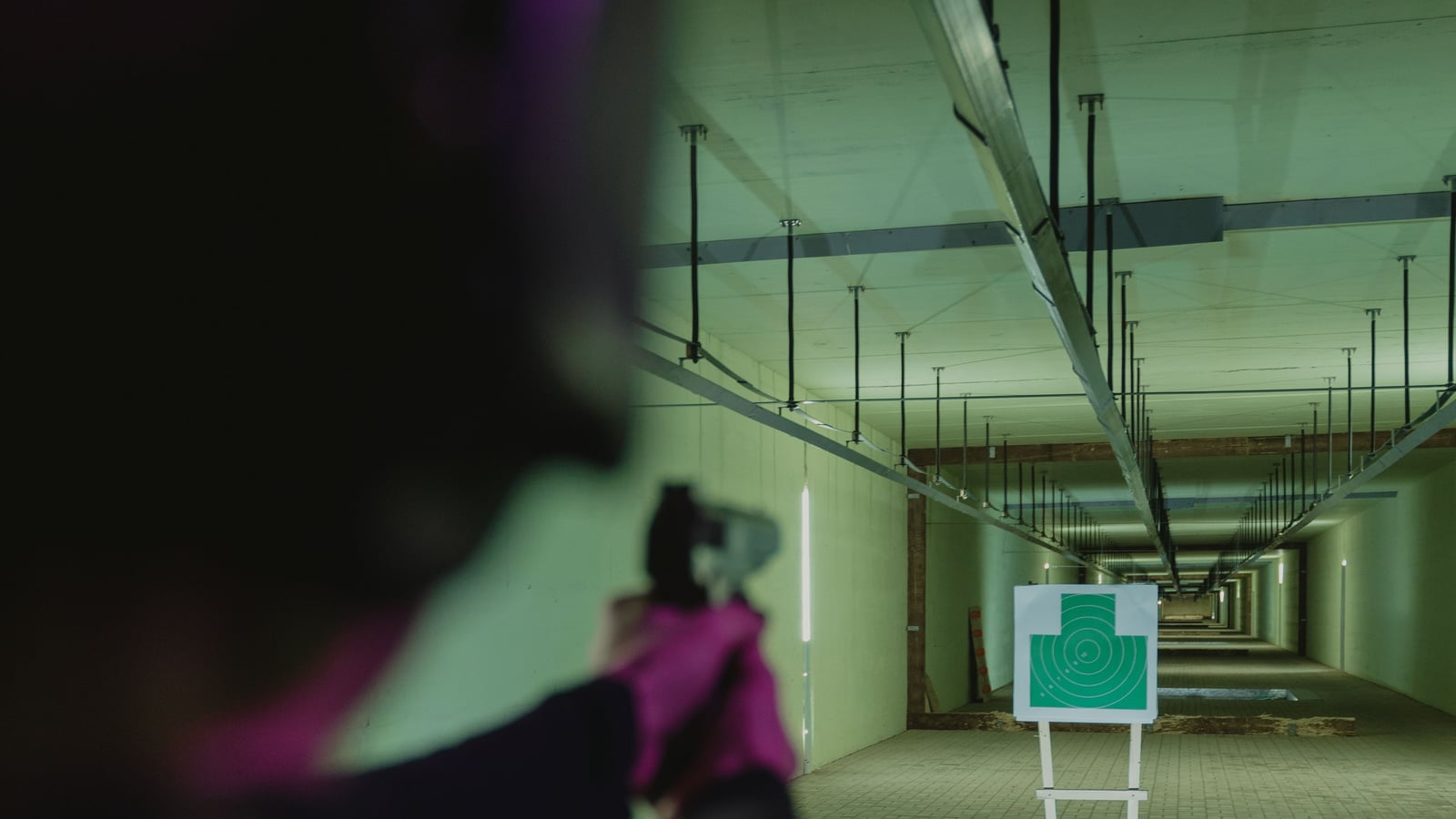
The shot doesn’t stop when you hear the bang
Most shooters think their job is done the instant the bullet leaves the barrel. That’s wrong, and it’s probably one of the most widespread technical mistakes, across every skill level. What happens in the 200 to 400 milliseconds after the shot breaks directly influences where the bullet ends up landing.
Follow-through is exactly that: actively maintaining your position, your sight picture, and your trigger pressure during and right after the shot, without releasing anything until the projectile has left the barrel and recoil has dissipated. The term comes from English, but the concept exists in every precision discipline: golf, archery, the arm swing in baseball. The motion doesn’t stop at the moment of impact with the ball or arrow — it continues into empty space.
In shooting sports, the logic is a bit different but the principle stays identical. The issue isn’t that you need to “guide” the bullet after it leaves — it’s physically impossible to influence a projectile that has already left the barrel. The real issue is that your brain and body anticipate the end of the shot before it actually happens, and that anticipation creates micro-movements that degrade accuracy at the single most critical moment of the whole process: the last instants before the bullet leaves the gun.
A shooter who understands this mechanism changes how they approach every string. This isn’t a cosmetic detail reserved for elite shooters — it’s a fundamental that separates a tight group from a scattered one, even with a perfectly zeroed gun and consistently good ammo.
This article breaks down the physical mechanics of follow-through, explains why its absence hurts real accuracy far more than people assume, and offers concrete drills to fix premature release. The goal isn’t to overcomplicate your motion, but to make sure you don’t wreck, in that last split second, all the work of grip and aim you built up beforehand.
This topic deserves even more attention because it’s rarely taught explicitly early in a shooter’s training. An experienced instructor usually emphasizes stance, grip, and breathing from the very first sessions, but follow-through often comes later in the progression, presented almost as an advanced refinement. That’s a sequencing mistake: the earlier a shooter internalizes this reflex, the fewer bad habits they’ll have to unlearn later.
What actually happens between trigger pressure and ignition
To understand follow-through, you first need to understand what your gun is doing while you press the trigger. It’s never instantaneous. Between the moment the trigger mechanism releases the firing pin and the moment the bullet leaves the barrel, there’s a lock time, followed by the bullet’s travel time down the bore.
On a handgun, that total time can add up to several dozen milliseconds. On a rifle, the bullet stays in the barrel proportionally a bit longer, depending on lower muzzle velocity or a longer barrel, depending on the configuration. That span of time seems trivial on a human scale, but it’s more than enough for a stray movement of the wrist, shoulder, or even the face to noticeably deflect the trajectory.
The problem is that your brain roughly knows when the shot is about to break. It has learned to anticipate the bang, the flash, and above all the recoil that follows. That anticipation triggers reflexive nervous-system responses well before the bullet has left the barrel — sometimes as early as halfway through the trigger’s travel.
This anticipation is at the heart of the follow-through problem. The shooter doesn’t relax after the shot breaks — they start relaxing before, while the bullet is still traveling down the barrel. Follow-through, then, is about fighting a reflex that fires earlier than intuition suggests.
Understanding this timeline changes how you approach the problem. It’s not about adding an extra motion after the shot — it’s about consciously delaying an anticipation reflex that, without specific training, systematically fires too early.
Recoil anticipation: the real culprit behind poor follow-through
Recoil anticipation and poor follow-through are two sides of the same coin. A shooter who anticipates recoil starts compensating physically before the bullet has even left the gun: they push slightly forward, drop their shoulders, close the support hand, sometimes even blink at the wrong moment.
This anticipatory compensation is almost always unconscious. The shooter doing it will swear, hand on heart, that they didn’t do anything unusual. That’s normal: these are reflexes governed by very fast neural circuits, much faster than conscious perception. The body reacts before the mind has time to register anything.
The visible result on target is distinctive: groups that spread downward and sometimes laterally, dispersion that increases with rate of fire, and a glaring gap between dry-fire groups (no ammo) and live-fire groups. If your dry-fire group is noticeably tighter than your live-fire group, recoil anticipation and poor follow-through are almost always the culprits.
The link to follow-through is direct: a shooter who has internalized good follow-through has, by construction, less room to anticipate, because their mental instruction is no longer “shoot then react to recoil” but “hold the sight picture regardless of what’s about to happen.” That instruction fundamentally changes how the nervous system behaves in the face of expected recoil.
The real impact on accuracy, beyond the myth
Many shooters think follow-through is just a matter of aesthetics — a kind of technical politeness with no real bearing on the outcome. That’s a costly mistake. Follow-through directly influences the muzzle’s exit angle at the moment the bullet leaves it, and that angle entirely determines the projectile’s subsequent trajectory.
Take a precision rifle barrel: an exit-angle deviation of a few tenths of a degree, invisible to the naked eye, translates into several centimeters of spread at 50 meters — and much more at longer range. That deviation has nothing to do with ammo quality, scope setup, or barrel cleanliness: it comes purely from the shooter’s movement at the critical moment.
That’s why a shooter with poor follow-through can have excellent gear, flawless ammo, and still get disappointing groups. The problem is never in the gun — it’s in that last split second of human motion. Many shooters swap ammo, grips, or triggers to fix a problem that comes purely from premature release.
The other consequence, less visible but just as important, concerns repeatability. A shooter whose follow-through varies from shot to shot, even slightly, introduces yet another variable into a system that already has plenty (stance, breathing, trigger pressure, sight alignment). Stabilizing follow-through amounts to eliminating a fully controllable source of error — unlike wind or temperature swings, which are beyond the shooter’s control.
Finally, follow-through plays a role in diagnosing your own mistakes. A shooter who maintains their sight picture after the shot breaks can precisely observe where the sight or front post was at the moment of the shot and right after, which gives immediate feedback on the quality of the shot, even before checking the impact on target. Without follow-through, that information is lost: the shooter releases too soon to know what really happened.
The telltale signs of insufficient follow-through
Certain clues let you spot a follow-through problem even before analyzing a group on target. The first is visual: if you watch your own motion (or a training partner’s) in slow motion or on video, you’ll often notice the head or eyes moving toward the target just before or during the shot, as if the shooter wants to “watch” the impact live.
The second sign is the muzzle or front sight dipping immediately after the shot, before the gun’s natural recoil has even finished. This “diving” motion reveals a premature relaxation of the arms or shoulders, often tied to letting go of breath control at the wrong moment.
The third sign, more subtle, concerns the support hand on a two-handed handgun grip: a grip that visibly loosens right after the shot, or conversely one that suddenly clenches in anticipation, shows the shooter isn’t maintaining constant tension throughout the firing cycle.
The fourth sign is purely statistical and shows up on target: a group that spreads noticeably more with a rifle shot standing than prone, or that degrades sharply as rate of fire increases, generally points to insufficient follow-through rather than a setup or ammo issue.
Spotting these signs requires regular observation, ideally with an outside eye (instructor, club partner), since the shooter themselves is often unaware of the moment they release. That’s precisely why keeping written, regular session logs helps make visible a problem that would otherwise stay invisible session after session.
Follow-through with pistol and rifle: two logics, one principle
With a pistol, follow-through means concretely maintaining sight alignment (or the red dot) on the target zone during and after the shot, without trying to “follow” the impact with your eyes. The most effective mental cue is telling yourself the shot isn’t over until the sight has settled back down after recoil.
Concretely, that means keeping the same grip pressure with both hands, not releasing the trigger finger after the shot but controlling the trigger’s return forward, and above all not moving your head to “check” the result before the gun has returned to a stable position.
A simple and very effective drill is dry firing (no ammo, gun cleared and verified, in a safe setting) while focusing solely on sight stability after the “click” of the firing pin. Since there’s no bang or real recoil, the shooter can observe without distraction whether their motion produces a stray movement at the critical moment. It’s one of the most used club drills to isolate this specific problem from noise and recoil.
Another drill has a partner load the gun randomly with live ammo or an empty case (always in a supervised, safe setting), without the shooter knowing in advance whether a shot will actually break. This very classic method in shooting-sports instruction instantly reveals any recoil anticipation: if the shooter flinches or dips the gun on an empty case, the problem is confirmed and located.
With a rifle, the logic changes in nature but not in principle: follow-through relies more on the stability of the support (shoulder, cheek on the stock, overall body position) than on an active finger motion on the trigger. The basic rule stays the same: don’t change anything in the position until recoil has fully dissipated and the barrel has naturally returned to stability.
Breathing plays a central role. Most club-taught methods recommend holding your breath at a natural pause (at the end of a normal exhale, without forcing it) just before and during the shot, then only resuming breathing after complete follow-through. Resuming breathing too soon, before the barrel has stabilized, is one of the most common causes of premature release with a rifle.
Cheek weld on the stock deserves particular attention. A shooter who lifts their head off the stock right after the shot, to check the impact faster, systematically breaks their follow-through and introduces a variable that hurts repeatability. The reflex to train is keeping the cheek down and watching the sight or scope return in the eyepiece before any head movement.
In the prone position with a bipod or shooting bag, follow-through is generally easier to maintain because the body-gun system is mechanically more stable. That’s exactly why the standing position, where the shooter is the sole support for the gun, exposes follow-through flaws far more severely: the slightest stray tension propagates directly into the barrel without being absorbed by outside support.
Progressive drills to fix premature release
Correcting a deficient follow-through follows a logical progression, from simplest to most demanding, and is best done over several weeks rather than a single session. Trying to fix this reflex all at once rarely works, since it’s about reprogramming an automatic nervous-system response, not just memorizing an instruction.
The first step is exclusively dry-fire work, gun cleared and in a fully safe setting, with no ammo at all. The shooter presses the trigger slowly while focusing solely on sight stability for the two to three seconds after the “click.” This step should be repeated dozens of times per session, because it’s repetition that reprograms the reflex, not intellectual understanding of the principle.
The second step introduces live ammo but at a very slow pace, one shot at a time, with a mandatory observation period after each shot before reloading or resetting position. The goal is to consciously force holding position a few seconds longer than the natural reflex would dictate.
The third step uses the random-loading method mentioned earlier (with or without ammo, decided by a partner or instructor), which lets you objectively check whether anticipation has disappeared or still persists despite dry-fire work.
The fourth step gradually increases rate of fire while watching that the group doesn’t degrade. If dispersion increases noticeably as the pace picks up, it means follow-through isn’t automated yet, and you should go back to a slower pace for several more sessions before trying again.
A complementary drill, widely used by experienced instructors, has the shooter describe out loud, right after each shot, the exact position of the sight at the moment the shot broke. This immediate verbalization forces the shooter to stay attentive a moment longer after the shot, which mechanically reinforces follow-through while also providing valuable diagnostic information on the quality of the motion.
Follow-through in clay shooting and dynamic disciplines
In clay-target disciplines (trap, skeet, sporting clays), follow-through takes a different but equally decisive form: it’s about continuing the swing of the shotgun after the shot breaks, exactly like in golf or tennis. A shooter who stops their rotation the moment they press the trigger systematically breaks their shot string and misses clays they should have hit.
The reason is mechanical: the time between trigger pull and the actual departure of the shot charge, combined with the pellets’ travel time to the clay, means the shotgun has to keep rotating to maintain the necessary lead on a moving target. Stopping the motion means systematically shooting behind the clay — a very common flaw, and one an experienced trap instructor spots easily.
In dynamic disciplines like IPSC or Steel Challenge, shot on cardboard or generic steel targets, follow-through shows up mainly in the transition between two targets: a shooter who releases their sight picture and grip too early to anticipate moving to the next target loses accuracy on the last shot of the current string, even if their overall goal is stage speed. Here too, the principle stays the same: don’t release until the current shot is truly finished.
An experienced club shooter who practices several disciplines often reports that follow-through work done in a precision discipline (10-meter rifle, precision pistol) transfers directly to dynamic disciplines, because the bodily reflex of holding the sight picture stays identical regardless of the execution speed otherwise demanded.
The mental dimension: why willpower alone isn’t enough
Fixing a deficient follow-through is as much mental work as it is purely physical, and this is often where shooters get their strategy wrong. Consciously telling yourself “I must not release” at the moment of trigger pressure actually adds extra cognitive load that can itself disrupt the motion, a bit like thinking too much about your breathing ends up making it irregular.
The approach that works best, according to many club instructors’ experience, is shifting attention rather than adding a negative instruction. Instead of focusing on “don’t release after the shot,” a shooter progresses faster by focusing all their attention on “precisely observe where the sight is right after the click or the bang.” This reframing turns a hard-to-hold-in-the-moment prohibition into an active observation task, which is more natural for the brain.
Mental fatigue also plays an underestimated role. At the end of a session or a match, when concentration drops, follow-through is often one of the first things to degrade, even before the shooter notices any drop in their grip or alignment. That’s a useful indicator: if your groups noticeably degrade toward the end of a session, check first whether your follow-through is still holding before looking for another explanation.
Competition stress amplifies the problem too. Under pressure, the nervous system tends to speed up every reflex, including premature release. A shooter who has automated good follow-through in training, in a calm setting, should specifically retest it under simulated stress (timer, audience, artificial stakes) before an important event, because a reflex that holds in training doesn’t necessarily hold the same way in a match.
Gear and setup: what helps (and what never replaces the motion)
Certain gear adjustments can make follow-through easier to work on, without ever fully replacing it. A trigger with a crisp, predictable break, rather than a mushy, progressive one, helps the shooter know precisely when the shot is about to go, which paradoxically reduces anticipation because the surprise of the break is smaller.
Conversely, a trigger that’s too heavy or inconsistent often pushes the shooter to “jerk” the trigger at the end of its travel, a motion almost always accompanied by immediate release once the shot breaks, out of relief from accumulated tension. A trigger adjustment suited to the shooter’s level and build, done by a qualified gunsmith, can therefore indirectly improve follow-through even though that’s not its primary purpose.
Stock length of pull also plays a role, especially with a rifle: a poorly fitted stock forces the shooter to compensate with extra muscular tension in the shoulder or neck, making it more tiring to hold the position after the shot and therefore more likely to break down over the course of a session or match.
Still, one thing needs to be kept in mind: no gear adjustment replaces working on the reflex itself. A shooter who swaps trigger, stock, or grip hoping to solve a follow-through problem on its own, without ever specifically working on the motion, will generally be disappointed with the result. Gear can make the work easier — it can’t do it in the shooter’s place.
Tracking your progress: why logging every session changes the game
Follow-through is a particularly hard flaw to correct alone, because it plays out in a split second and almost always escapes the shooter’s conscious perception at the moment it happens. This is an area where keeping written, regular session logs makes a real difference, far more than for other more visible aspects of technique.
Noting, after each string, the dispersion observed, the position (standing, prone, supported), the rate of fire, and any observations about your own feel (tension, breathing, the moment attention slipped) lets correlations emerge that are invisible session to session but obvious over months of accumulated data. An experienced club shooter often reports identifying their follow-through problem only by rereading several weeks of notes, where a single isolated session only showed a disappointing result with no clear explanation.
That’s exactly the kind of tracking a digital shooting logbook makes easier: quickly recording, after each string, position, rate of fire, the type of drill worked on (dry fire, random loading, slow pace), and the observed result, without having to reconstruct everything from memory weeks later. The value isn’t in a single session but in comparing sessions, which reveals underlying trends the eye alone doesn’t catch in the moment.
This tracking approach becomes even more meaningful when several factors combine: a session at the end of a tiring workday, an ammo change, or a new discipline practiced for the first time. Without precise notes, it becomes impossible to know which of these variables actually influenced the premature release observed that day. With a regular history, these coincidences become exploitable correlations, and a shooter might, for instance, notice their follow-through consistently degrades after a certain number of rounds fired, which points to muscular fatigue rather than a poorly automated reflex.
A shooter specifically working on their follow-through also benefits from noting their impressions on dry-fire drills, even if no numerical data comes directly out of it. The simple act of regularly documenting “today, sight stable 2 seconds after the click” or “another head movement detected” creates a form of accountability that speeds up correction, a bit like keeping a food diary changes behavior even without outside intervention.
Common mistakes that make the problem worse, and how to make them objective
Certain habits, seemingly harmless, noticeably worsen an already shaky follow-through. The first is rushing between shots during rate-of-fire drills: wanting to shoot fast to “rack up volume” during a session pushes nearly every shooter to release earlier and earlier, creating a vicious cycle where each shot reinforces the bad reflex instead of correcting it.
The second mistake is working on follow-through only in dry fire, without ever checking it under real conditions with live ammo. The body’s behavior in the face of actual recoil and an actual bang differs enough from what’s observed dry that the transition deserves dedicated work, using the random-loading methods mentioned earlier.
The third mistake is trying to fix follow-through at the same time as several other technical aspects (grip, breathing, alignment) in the same session. A shooter who tries to monitor everything simultaneously generally ends up fixing nothing effectively. It’s better to devote a whole session, or at least a good chunk of it, solely to follow-through work, accepting that other aspects of the motion are temporarily monitored less closely.
The fourth mistake, common among shooters progressing on their own, is judging their follow-through solely on the final result (the group on target) without ever directly observing the motion at the moment it happens. The result on target confirms or denies a problem, but never precisely shows where the error sits in the chain of motion: that’s where slow-motion video recording becomes useful. A simple smartphone on a tripod, filming the shooter in profile or slightly three-quarter, is enough to reveal stray movements completely invisible to the naked eye in real time, whether it’s a head tilt, a shoulder dropping, or a movement of the support hand.
The advantage of video over the shooter’s own feel is that it removes all subjective interpretation. A shooter can swear they didn’t move their head at the moment of the shot while doing it systematically, simply because the movement happens too fast and too early to be consciously perceived in the moment. The camera is never wrong on this point, unlike the shooter’s immediate memory.
For the analysis to be useful, you need to film several consecutive shots rather than just one, since an isolated shot can be a one-off fluke with no real significance. It’s the repetition of the same flaw across several shots that confirms a structural follow-through problem rather than a simple mishap on a single repetition.
A training partner or club instructor brings value the camera alone doesn’t provide: they can interrupt the shooter immediately after a suspect shot and ask them to describe what they felt while the sensation is still fresh. This immediate confrontation between subjective feel and objective outside observation noticeably speeds up awareness of the flaw, far more than a delayed analysis at the end of the session.
Sights and red dots: a follow-through that reads differently
Follow-through doesn’t show up the same way depending on the sighting system used, and this difference deserves to be understood so you don’t misdiagnose it. With mechanical sights (front post and rear notch, or aperture sight), the shooter has to maintain precise alignment between two distinct reference points, which makes any stray movement immediately visible in the misalignment of the two elements.
With a red dot, the logic changes: there’s only one reference point to hold on the target zone, which lightens the visual load but can also mask a follow-through problem, because the dot stays visible even if body position degrades slightly. A shooter equipped with a red dot must therefore pay particular attention to the stability of the dot itself after the shot breaks, rather than simply noting it’s still visible in the sight window.
With a precision scope on a rifle, follow-through shows up in maintaining the field of view and reticle on the target zone after recoil. A shooter who loses sight of the reticle immediately after the shot (because recoil pushed it out of the optical field, or because they moved their head) needs to reconsider either their magnification, their position, or their actual follow-through work — the three are linked but not identical.
In every case, the sighting system doesn’t change the fundamental principle: what matters isn’t which reference point you use, but whether you keep it active and stable throughout the entire firing cycle, including the instants immediately following the shot.
Integrating follow-through into a complete shooting routine
Follow-through never works in isolation: it concludes a chain of motions that starts well before trigger pressure. A coherent shooting routine is built around a few stable steps repeated identically for every shot: settling into position, breathing, sight alignment, progressive trigger pressure, then holding after the shot breaks.
Working on follow-through without reviewing this entire routine gives limited results, because a flaw upstream (poorly placed breathing, inconsistent trigger pressure) can by itself cause the premature release you’re trying to fix downstream. A shooter who rushes their initial alignment will naturally tend to want to “finish quickly,” which directly hurts holding position after the shot.
That’s why experienced instructors often recommend reworking the whole routine rather than isolated follow-through alone, at least during the first correction sessions. Once the routine as a whole is stabilized, the specific work of holding after the shot becomes easier to isolate and automate, since it’s no longer the only moving variable in the overall motion.
FAQ
Q: Is follow-through different between one-handed and two-handed pistol shooting? A: The principle stays the same, but one-handed shooting leaves less room for error since there’s no support hand to compensate for stray tension. A follow-through flaw generally shows up faster and more clearly shooting one-handed.
Q: How long do you need to hold position after the shot breaks? A: There’s no universal fixed duration, since it varies a lot depending on the gun, discipline, and shooter; what matters is holding position until recoil has visibly dissipated and the sight has settled, rather than aiming for a specific number of seconds.
Q: Does follow-through also apply to category D air rifle shooting? A: Yes, the principle still holds even with very light recoil, because the psychological anticipation of the shot breaking exists independently of the actual intensity of physical recoil.
Q: Can you work on follow-through alone, without an instructor? A: Largely yes, mostly through dry fire and verbalizing after each shot, but the random-loading drill needs a partner or instructor to stay objective and safe.
Q: Is good follow-through enough to guarantee a good group? A: No, it’s a necessary but not sufficient condition: grip, sight alignment, breathing, and trigger-pressure consistency remain just as decisive for the final result.
Q: Does lack of follow-through always explain vertical dispersion on target? A: It’s a common cause but not the only one; vertical dispersion can also come from inconsistent trigger pressure or an unstable support, so it’s worth isolating the variable before drawing a firm conclusion.