
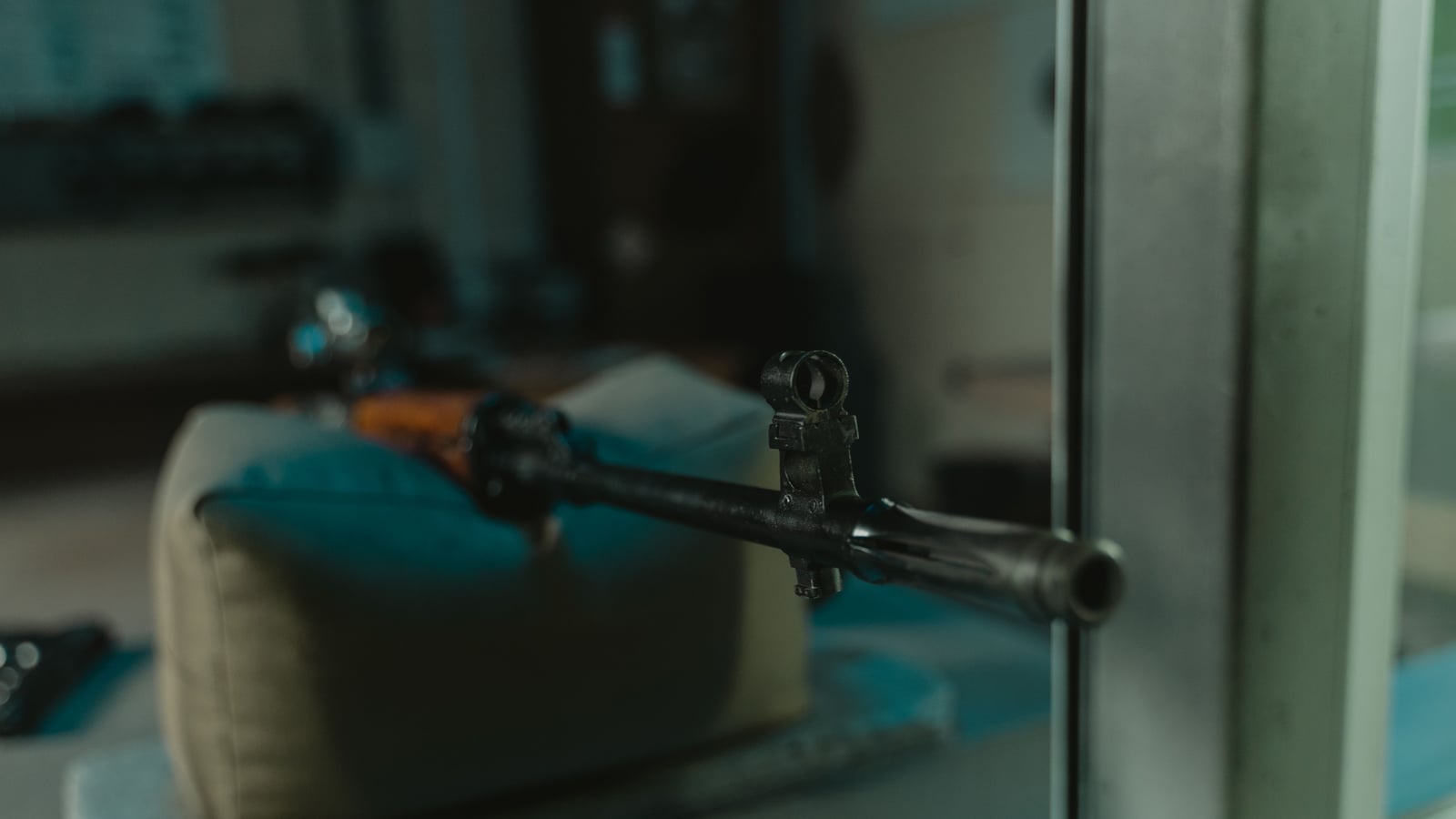
The cold bore shot: a phenomenon everyone has lived through without naming it
You arrive at the range, the gun is cold, the barrel hasn’t fired since yesterday. You settle into position, breathe, press the trigger for your first shot of the day. And the impact lands slightly off from the group you’re about to produce with the following shots.
This isn’t an aiming error. It’s not an equipment problem. It’s the cold bore shot: literally, the very first shot fired from a barrel that hasn’t warmed up yet, after a more or less long rest period since the last shot.
The phenomenon is well known among precision shooters who practice long-range shooting, but it actually affects every rifle discipline, including shorter distances where the offset remains measurable even if less dramatic. Many shooters discover it without naming it: they just notice that “the first shot always lands a bit off” without ever connecting it to barrel temperature.
What makes this topic important is that it touches two very different audiences with distinct stakes. On one side, the precision shooter aiming for a tight group starting with the first shot in competition; on the other, the hunter who will often have only a single shot to take in the field. In both cases, ignoring the cold bore shot means ignoring a very real part of your rifle’s dispersion — a part that never shows up in an average group calculated over a full string.
This subject deserves even more attention because it’s rarely addressed in a structured way at clubs. Most shooters hear about it informally, in bits of conversation, without ever having tested it methodically on their own gear. This article aims to fill that gap: understanding the mechanism, knowing how to diagnose it, and above all knowing what to concretely do about it — whether you’re at the club, in competition, or out hunting.
What physically happens inside a cold barrel
A firearm barrel is never a perfectly stable, invariant tube. Its temperature, its expansion, the state of copper fouling or powder residue left by previous shots all influence, to varying degrees, how the projectile is guided until it exits the barrel.
When the barrel is cold — meaning it hasn’t yet been warmed by one or more recent shots — several elements differ noticeably from the “warm” regime that sets in after a few rounds:
- The barrel’s metal is slightly more contracted when cold, which subtly changes the internal diameter and how the projectile is stabilized by the rifling as it passes through.
- Oil or cleaning solvent still present in the first few inches of the barrel, if it was cleaned recently, can affect the muzzle velocity and trajectory of the very first projectile fired.
- The absence of any shooting residue (copper, powder fouling) in a clean barrel slightly changes the friction between the bullet and the rifling, friction that only stabilizes progressively after a few rounds.
- The progressive thermal expansion of the barrel, which begins with the first shot and continues through the following ones, very slightly changes the internal geometry and therefore the projectile’s path inside the barrel.
- The consistency of muzzle velocity itself, which tends to stabilize after the first few rounds, once the barrel and ammunition reach a thermal equilibrium close to their usual operating regime.
None of these factors is enormous on its own. A tenth of a degree of expansion or a tiny trace of solvent doesn’t change anything dramatic by itself. But added together, they’re enough to shift the point of impact of the first shot by a few millimeters to a few centimeters, depending on shooting distance, the rifle used, and the chosen ammunition. An offset that may not matter much in casual practice, but that matters enormously when you’re aiming for a tight group in competition, or a single decisive shot while hunting.
This mechanism also explains why the cold bore shot isn’t a binary phenomenon, present or absent: it’s a continuum. Some rifles show a clear, systematic offset, others a barely measurable one, and the only way to know where your own setup falls is to go test it rather than trust what you’ve read or heard about other rifles.
Why this offset is particularly critical in both precision shooting and hunting
In precision shooting, the classic training logic is to fire strings of several shots to judge a group as a whole. The problem is that this approach almost completely masks the cold bore shot: the first shot of the string gets buried in the visual average of the final group, and the shooter never realizes they systematically have a particular offset on that first shot.
But in precision competition, especially in formats where every shot counts individually from the very start of the string and the score builds shot by shot with no chance to make up ground, this offset is far from trivial. A shooter who ignores their own cold bore shot risks losing points on the very first shot of every string or every station change, without ever understanding why this particular point keeps escaping them, competition after competition.
An experienced coach will often stress a simple but critical point: the “average” group you see form on a five- or ten-shot target tells you almost nothing about the specific behavior of your first shot. You need to analyze that first impact separately from the rest of the string, across several distinct sessions, to see whether there’s a recurring trend rather than an isolated fluke tied to a one-off execution error.
This confusion between the rifle’s average behavior and the specific behavior of the first shot is probably the most common analysis mistake among precision shooters who have never formalized this test. They work on their overall consistency, their average group, their dispersion over the string, but leave aside the specific question of the very first shot — which is precisely the one that matters most in certain low-round-count competition formats, or those organized across several stations separated by breaks.
The hunter, for their part, generally doesn’t have the luxury of firing a string of several shots to judge their group under real conditions. They have one shot, sometimes two, and the barrel of their rifle has been cold since the start of the stand or drive, often for several hours. The cold bore shot is therefore not a secondary technical curiosity for them: it is literally the only shot that counts, the one the entire hunting action rests on.
This reality completely changes how a hunter should approach zeroing their rifle and preparing before the season. A scope zero optimized on the average of five warm shots fired at the range actually has no reliable predictive value for the single, cold shot that will really happen in the field, under often different temperature and humidity conditions. The theoretical point of aim established at the range and the actual point of impact of the first shot in the field can diverge — sometimes enough to miss a vital zone at a distance that seemed perfectly mastered during zeroing sessions.
This is one of the reasons some experienced hunters recommend zeroing their rifle directly on the behavior of the cold bore shot rather than on the average of a warm string, even if it means sacrificing some of the theoretical precision of the following shots, which will never be used in a real single-round hunting situation anyway.
This logic also means rethinking how a hunting rifle is tested and zeroed before the season. Rather than firing several close-together strings to “confirm” a zero, it may be more relevant to let the barrel cool down completely between each test and systematically note where that isolated first shot lands, under conditions as close as possible to those actually encountered in the field.
How to methodically identify whether your rifle has a real cold bore shot
Not all rifles react the same way to this phenomenon. Some rifle-ammunition-barrel combinations show a clear offset that’s perfectly repeatable from one session to the next; others show almost none, within normal shot dispersion. The only way to know which category your specific setup falls into is to test methodically over time, not to trust a one-off impression or what you’ve heard about a similar rifle.
Here’s the most reliable method to rigorously objectify the phenomenon on your own rifle:
- Wait until the barrel is completely cold, ideally at the very start of a session or after a break of at least 30 to 45 minutes with no prior shots.
- Fire a single shot at a target dedicated to this test, and note precisely the position of the impact relative to the point of aim, ideally with a numerical measurement rather than just a visual impression.
- Then let the barrel warm up normally by firing a classic string of several shots at a separate target, and carefully observe the group produced by that string.
- Compare the position of the isolated cold shot to the average position of the warm group obtained right after: if there’s a consistent offset in the same direction across several different sessions, you’ve very likely identified a real, repeatable cold bore shot rather than chance.
- Repeat this complete protocol over at least three to five distinct sessions before drawing a final conclusion, because a single isolated test can always be skewed by a one-off shooting error or unusual weather conditions that day.
It’s essential not to confuse a real, repeatable cold bore shot with a simple isolated shooting mistake that has nothing to do with barrel temperature. An experienced club shooter knows that a single shot landing off target proves strictly nothing on its own: it’s the repetition of the same offset, in the same direction and with a comparable magnitude, across several clearly distinct sessions, that actually validates the phenomenon rather than just imagining it.
This methodological rigor is what distinguishes an actionable observation from a mere anecdote. Many shooters think they have a pronounced cold bore shot after a single bad experience, when a structured test across several sessions would actually show normal dispersion with no clear directional trend.
Factors that amplify or reduce the magnitude of the offset
The cold bore shot doesn’t have the same magnitude for every rifle and ammunition setup. Several parameters directly influence the size of the observed offset, and knowing them helps understand why your rifle reacts in one particular way rather than another.
- Caliber and barrel length: longer barrels and faster calibers generally tend to show a more pronounced offset, because the portion of the internal trajectory affected by temperature represents a larger share of the projectile’s total path inside the barrel.
- The barrel’s cleanliness at the time of testing: a freshly cleaned barrel, with solvent or oil residue still present in the first few inches, can show a more pronounced cold bore shot than that same barrel slightly “fouled” by normal recent use.
- The ammunition used for the test: some ammunition, particularly rounds specifically designed for precision with tighter manufacturing tolerances, is more sensitive to variations in internal friction than more standard, generic ammunition.
- The outside ambient temperature at the time of firing: a large temperature gap between the resting barrel and the day’s actual shooting conditions, such as extreme winter cold or intense summer heat, can amplify the differential thermal expansion phenomenon observed.
- The quality and consistency of the optic mount on the rifle: a scope or red dot that’s poorly fastened or not perfectly stable can introduce an offset that has strictly nothing to do with the cold bore shot, but that will skew your diagnosis if you haven’t ruled it out beforehand as a possible source of error.
- The overall weight and rigidity of the rifle: a heavier, stiffer rifle tends to better dampen micro-variations in thermal expansion than a lighter one, which can result in a statistically less pronounced cold bore shot for that type of setup.
Documenting the cold bore shot in your shooting log, session after session
The main problem with the cold bore shot is that it remains completely invisible if you’re not actively and methodically looking for it. The simplest and most rigorous solution is to systematically track it in your shooting log, session after session, rather than relying on memory or a general impression that fades quickly over time.
Here’s the essential information to record for every first shot of a session, so you can draw a real analysis from it later:
- The date, the precise time, and the ambient temperature at the time of firing, since these contextual elements help spot possible correlations with outside conditions.
- The exact rest time of the barrel before this first shot, meaning the number of hours elapsed since the previous shot, whether that was the day before or several days earlier.
- The barrel’s cleanliness at the time of testing, specifying whether it was cleaned recently or shows normal fouling from regular use.
- The exact ammunition used, including the lot number if you change it regularly, since a lot change alone can explain an observed variation.
- The precise position of the first shot’s impact relative to the point of aim, ideally measured in centimeters or in number of scope clicks rather than a rough approximate description.
- The group produced by the following shots in the same session, so you can directly and objectively compare the behavior of the first shot to the rest of the string fired right after.
Over time, this rigorous tracking lets you answer a very concrete, personal question: does YOUR rifle, with YOUR usual ammunition, show a measurable, repeatable cold bore shot, and if so, in which precise direction and with roughly what magnitude? This is strictly personal information that you won’t find in any generic manufacturer’s manual, and that can only be obtained by patiently accumulating data over several successive sessions.
A digital shooting log has a clear advantage over a traditional paper logbook for this kind of specific tracking: it lets you quickly filter every “first shot of the session” logged over several months of activity, and instantly see whether a clear directional trend emerges — something that would be particularly tedious to do by hand, flipping through dozens of pages of a classic paper logbook.
Should you “sacrifice” a first shot to warm up the barrel before shooting for real?
This is a question that comes up very often among shooters who discover the phenomenon: is it better to fire a warm-up shot just to heat the barrel before the shot that really counts, rather than facing that famous decisive first shot head-on?
The answer actually depends entirely on the practice context and the rules in effect:
- In precision competition, where every shot in the string fully counts toward the final score, you generally can’t afford to sacrifice a shot without a direct consequence on your result. The better approach is to know your own cold bore offset well and consciously correct your point of aim accordingly for that specific first shot of the string.
- In a casual training session, with no score at stake, firing a warm-up shot before starting serious technical work is a perfectly reasonable and widely used practice among shooters who want to work on their group under already-stabilized barrel conditions.
- In a real hunting situation, the question practically never comes up in practice: you obviously aren’t going to fire a shot “for nothing” right before the hunting action, which only reinforces the importance of knowing your rifle’s cold behavior in advance, rather than discovering it at the worst possible moment in the field.
A regional champion preparing for a precision competition will often explain that she has chosen to directly build in a known aiming correction for her first shot of the string, rather than vainly trying to eliminate a physical phenomenon that won’t disappear: the cold bore shot is an integral part of her rifle’s real, documented behavior, and it’s better to knowingly factor it into her shooting strategy than to fight it uselessly at every competition.
The role of barrel maintenance in the variability of the phenomenon
Regular barrel maintenance directly influences the observed magnitude of the cold bore shot, and it’s a parameter many shooters completely overlook by focusing solely on ammunition choice or optic zeroing.
A barrel cleaned right before a shooting session can behave noticeably differently from a barrel that’s accumulated normal fouling over several consecutive sessions. Some shooters find, quite concretely, that their cold bore shot is more pronounced right after a thorough, complete cleaning, until the very first shots fired slightly “re-foul” the inside of the barrel and restabilize the usual internal friction between projectile and rifling.
This obviously doesn’t mean you should neglect barrel maintenance: regular, rigorous maintenance remains essential for the rifle’s longevity and for overall long-term shooting consistency. But it does mean staying aware that your cleaning schedule itself can directly influence your cold bore shot diagnosis, and that it’s worth systematically noting in your log whether a complete cleaning happened right before the test session in question, so as not to skew your conclusions over time.
Adapting your competition or hunting preparation to your personal cold bore shot
Once you’ve identified and quantified your own cold bore shot on your usual rifle and ammunition setup, the next and most important question is how to concretely factor it into your preparation for an upcoming competition or hunting trip.
Several concrete approaches exist depending on the disciplines practiced and the regulatory context:
- Mentally adjust your point of aim for the very first shot of the string, knowing in advance the precise direction and approximate magnitude of your rifle’s usual offset.
- Plan a barrel warm-up period before the official start of competition, when the rules of the discipline explicitly allow it, so you don’t arrive with a completely cold barrel at the exact moment points start really counting.
- Avoid changing ammunition or doing a complete barrel cleaning right before an important event, if your previous tests showed that this significantly alters your usual cold behavior.
- Stay as consistent as possible in your preparation routine from one competition to the next, since the variability of your own personal routine can actually introduce more noise and uncertainty into your results than the cold bore shot itself.
An experienced club shooter preparing for an important event generally isn’t trying to completely eliminate the cold bore shot from their shooting, because it’s a real physical phenomenon that won’t just disappear through willpower or mental training. They’re rather trying to know it precisely enough that it definitively stops being an unpleasant surprise on the day the points really matter.
This same logic of adaptation also applies to disciplines organized across several separate shooting stations, where the shooter regularly changes position, thereby giving the barrel time to naturally cool down between two shooting sequences. In this specific case, the cold bore shot can reoccur several times over the course of the same competition, at every new station change, which mechanically multiplies its real impact on the final score compared to a format organized as a single long, continuous string. If your main discipline of choice involves multiple positions separated by breaks like this, this specific work deserves particular, recurring attention in your preparation.
The mental dimension of the first shot, beyond ballistics alone
The cold bore shot isn’t just a question of internal ballistics and barrel physics: it also has a very real mental dimension that many shooters largely underestimate in their preparation. Consciously knowing that your first shot of the day is statistically more likely to land slightly outside your usual group can, almost paradoxically, create additional tension right at the moment you press the trigger on that particular shot.
That additional tension can itself degrade the quality of technical execution: excessive anticipation of recoil, an involuntary tightening of the grip on the rifle, breathing poorly controlled due to extra concentration. The end result is a dangerously self-feeding cycle, where the anxiety tied to anticipating the cold bore shot sometimes worsens the final result more than the physical phenomenon itself ever could have.
The best countermeasure is to clearly separate the two issues in your overall mental preparation before every competition or outing. On one side, a technical adjustment known and anticipated in advance, such as a slight aiming correction if you’ve identified a consistent, documented offset across several sessions. On the other side, an execution of the technical movement strictly identical to any other shot of the session, with no extra concentration load or movement altered by poorly controlled apprehension. An experienced coach often reminds their students that the best possible first shot is the one executed exactly like the tenth shot of the string — with the aiming correction already in mind, but the technical movement itself perfectly unchanged.
This specific mental work builds progressively through repetition, ideally under realistic training conditions that faithfully reproduce the real competition or hunting context: a cold rifle to start, symbolic stakes deliberately placed on that isolated first shot, rather than always training exclusively on long strings where the first shot precisely loses its specific character and its own stakes.
Cold bore shot and changing rifle or ammunition setup
A common methodological trap is testing your cold bore shot only once, with a given rifle and ammunition setup, and then treating that result as permanently settled forever, even after changing ammunition, scope, or an important accessory on the rifle used.
In reality, every parameter in the full ballistic chain can noticeably alter the barrel’s cold behavior. A simple change of ammunition brand or lot changes the precise composition of the powder used, and therefore how it interacts with a still-cold barrel at the moment of firing. A new optic mount, for its part, introduces a potentially independent source of error, which can add to the real cold bore shot offset or, on the contrary, partially mask it in your observations. Even a change of bipod or shooting bag, by slightly altering how the rifle is supported and stabilized during firing, can interact unexpectedly with the barrel’s behavior in those very first moments of the shot.
The right practice, then, is to consider that the cold bore shot documented for a given setup is only truly valid for that precise, unchanged setup. As soon as any element in the full rifle-ammunition-optic-support chain changes significantly, it becomes necessary to fully restart the test protocol over several sessions before trusting the previously accumulated data again.
This is, incidentally, one of the reasons why shooters who frequently switch ammunition to compare respective performance often have more trouble pinning down a stable, reliable cold bore shot on their rifle: they’re constantly changing one of the variables that directly influences the phenomenon being studied, which makes overall analysis more complex to carry out, without making it impossible, as long as tracking stays rigorous and well documented over time.
Common mistakes that skew cold bore shot analysis
Many shooters who are just starting to seriously look into the cold bore shot fall into classic methodological traps that make their observations unreliable, or even completely unusable over time.
- Confusing a real, repeatable cold bore shot with a simple, isolated shooting mistake or a poorly controlled trigger release that day: a single isolated shot landing off proves absolutely nothing until repetition in the same direction is clearly established across several sessions.
- Testing the phenomenon over a single isolated session and immediately drawing a final conclusion from it, when several repetitions under comparable conditions are absolutely necessary to validate a real trend rather than a simple statistical fluke.
- Changing several parameters at once during testing, such as ammunition, barrel cleaning, shooting distance, or shooting position, which then makes it impossible to isolate the real cause of an observed offset in the results.
- Completely overlooking weather conditions and the ambient temperature of the day, which alone can explain a good part of the observed variability from one test session to another.
- Ignoring the precise state of the optic mount on the rifle, especially if the scope or red dot has been removed and remounted between two different test sessions, which can introduce a bias entirely independent of the cold bore shot itself.
What the cold bore shot reveals about the importance of rigorous tracking in precision shooting
Beyond the purely technical, ballistic question, the cold bore shot particularly illustrates why precision shooting remains a discipline where intuition alone is never truly enough. What you “feel” at the range on a given day can turn out to be misleading if you never confront it with real data patiently accumulated over time.
It’s a phenomenon that affects both civilian precision rifles used in competition and manually-operated repeating hunting rifles, generally falling under a declaration-required category, with the firearm’s administrative classification having absolutely no bearing on its actual thermal behavior at the moment of firing. The cold bore shot remains a purely physical, ballistic phenomenon, entirely independent of the regulatory category of the rifle used by the shooter or hunter.
A shooter who genuinely takes the time to document this phenomenon on their own rifle setup gains a real, lasting advantage over time: they turn a previously invisible and often frustrating variable into a known, anticipated, and perfectly mastered data point. This is exactly the kind of quiet, methodical groundwork that, over the long run, distinguishes a shooter who steadily improves from one who stagnates year after year, systematically blaming their performance gaps on chance or bad luck on the day.
FAQ
Q: Is the cold bore shot the same phenomenon for all rifles, including category D air rifles? A: The thermal phenomenon theoretically exists in any barrel, but it’s generally much less pronounced in category D air rifles than in powder rifles, because the expansion and fouling mechanisms at play are different. If you practice both types of shooting, it’s better to test each separately rather than assume identical behavior.
Q: How long does it take for a barrel to be considered “cold”? A: There’s no precise universal threshold; it varies by caliber, rifle, and ambient conditions. Many shooters consider that a break of 30 to 45 minutes without firing is enough to return to a state close to a cold barrel, but the only way to verify this for your own setup is to test and document it.
Q: Does cleaning the barrel remove the cold bore shot? A: No, cleaning doesn’t remove the phenomenon — it can even sometimes temporarily amplify it, due to solvent or oil residue present in the first few inches of the barrel. The cold bore shot is tied to the temperature and state of the barrel at the moment of firing, not solely to its cleanliness.
Q: Should you adjust your scope zero to compensate for the cold bore shot? A: It depends on the context: a hunter who will only get one real shot may benefit from zeroing based on cold behavior rather than the average of warm shots, while a competitive precision shooter will more likely mentally adjust their point of aim for the first shot without throwing off their optic for the following shots.
Q: Is a paper shooting log enough to document this phenomenon, or do you need a digital tool? A: A paper log works, but it quickly becomes hard to use for spotting a trend across several months of isolated first shots. A digital log lets you quickly filter and compare this data, which makes diagnosis much faster and more reliable.
Q: Does every shooter have a measurable cold bore shot? A: No, some rifle-ammunition-barrel combinations show a very small or even negligible offset, while others show a clear, repeatable one. That’s precisely why methodical testing across several sessions is necessary before drawing a conclusion about your own setup.