
Why this topic deserves your attention
A shooting range is a supervised environment, but it isn’t a risk-free one. You handle firearms, move ammunition around, and deal with hard surfaces, hot brass, lead, loud noise, and sometimes rushed movements. The odds of a serious accident stay low on a well-run range, but they’re never zero.
Most shooters think of “safety” in terms of firearm handling: the firing line, finger off the trigger, muzzle pointed downrange or in a safe direction. That’s essential, but it only covers part of the picture. The day something does go wrong, what makes the difference is whether the club and the shooters present can react fast and correctly in the first few minutes.
This article doesn’t replace any first aid training. It’s meant to lay the groundwork: why a first aid kit tailored to shooting isn’t just a generic kit, which basic steps every shooter should know, and what role the club needs to play so its range officers are actually ready. The thread running through all of it is simple: planning ahead beats improvising.
The incidents you actually see on a range
Before talking about kits or techniques, it helps to be clear about what actually happens. Incidents at a range aren’t just “accidental discharge.” The reality is more varied, and often more mundane.
The most common injuries on a range are:
- Cuts and scrapes from handling firearms, casings, or gear (sharp edges, mechanisms, magazines).
- Minor burns from contact with a still-hot ejected casing, especially in dynamic shooting or with semi-automatic firearms.
- Lead particles or target fragments splashing into the shooter’s area on clay or steel targets, which can hit the eyes or exposed skin.
- Fall-related injuries, especially on dynamic shooting stages where you move between positions.
- Feeling unwell, which often has nothing to do with the firearm itself: heat, low blood sugar, stress, fatigue, or a pre-existing condition flaring up in the moment.
- In rare cases, a gunshot injury linked to a mechanical malfunction, a handling error, or a safety rule that wasn’t followed.
A serious club prepares its range officers and its first aid supplies for this whole spectrum, not just the most dramatic scenario. Statistically, a twisted ankle on a stage or a fainting spell during summer heat is far more likely than a gunshot accident.
Another point worth stressing: the environment itself creates risks that have nothing to do with shooting. A poorly maintained outdoor range can expose you to protruding roots, slippery surfaces after rain, or wasp nests near a station. A poorly ventilated indoor range can trigger headaches or dizziness from a buildup of powder fumes, especially in older or under-ventilated facilities. These often-forgotten factors are part of any serious risk assessment.
It’s also worth distinguishing an isolated incident from one affecting several people at once — for example, a group fall on a slippery surface, or a cluster of heat-related fainting during a competition. This second scenario calls for a different kind of organization: you need to be able to triage victims by severity, a skill that goes beyond individual first aid technique and calls for slightly more advanced training, often offered alongside basic first aid courses.
What a shooting range first aid kit should contain
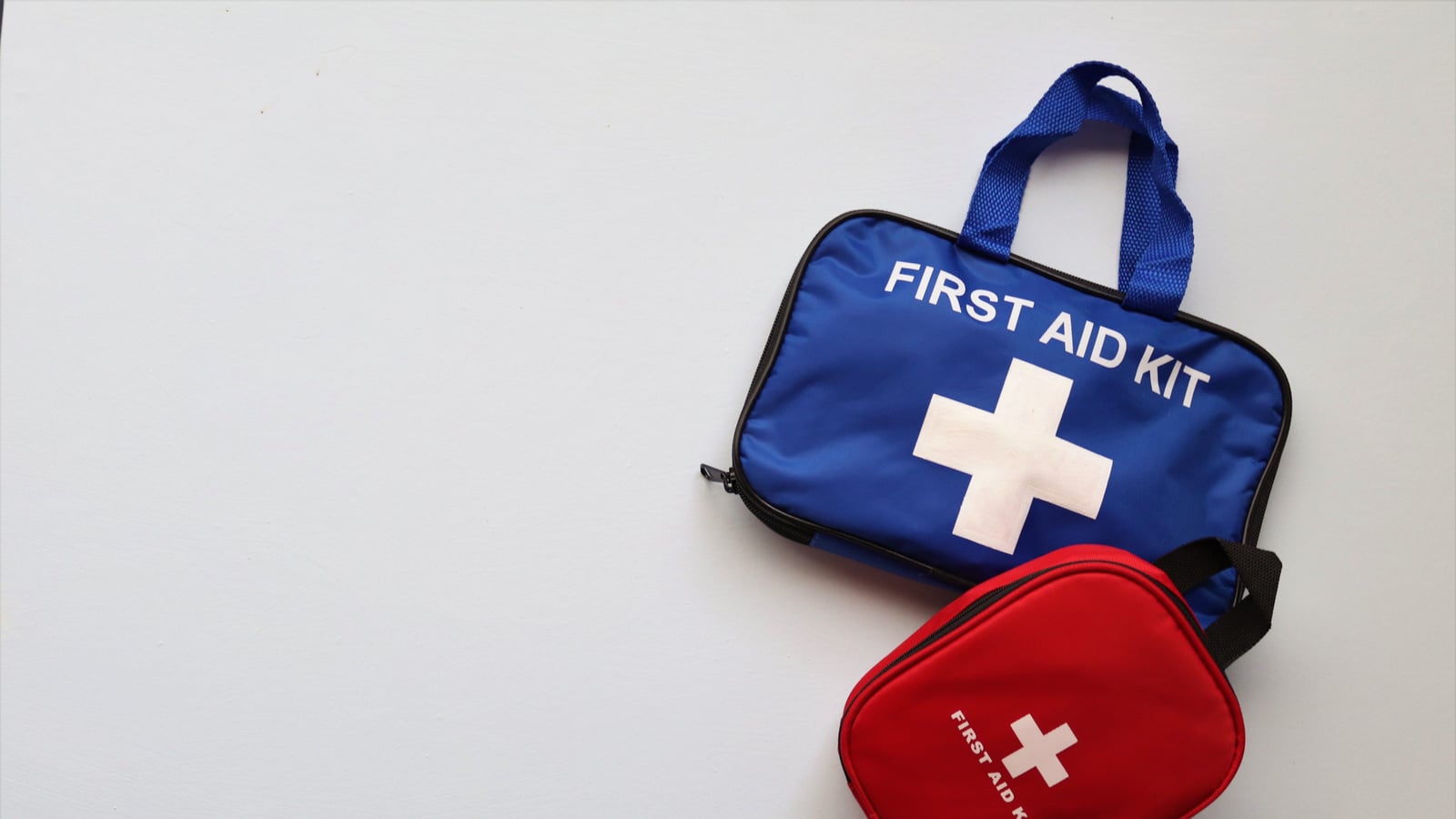
A generic first aid kit bought at the supermarket isn’t enough in this context. A shooting range has specific needs tied to the nature of possible injuries and the environment (outdoors, dust, heat, sometimes isolation).
The recommended basic contents include:
- Sterile dressings in several sizes, to cover anything from a small cut to a larger wound.
- Compression bandages and wraps, capable of maintaining firm pressure in case of heavier bleeding.
- One or more approved tourniquets, with clear instructions, for cases of massive limb bleeding where simple pressure isn’t enough.
- Disposable gloves in sufficient quantity, essential for anyone providing assistance, both for hygiene and protection against blood.
- An eye-rinse solution, useful for particle or lead splashes in the eye, which are common at clay or dynamic shooting stations.
- An emergency blanket, to fight hypothermia or simply stabilize a person in shock while waiting for help.
- Sturdy scissors capable of cutting through clothing or a strap quickly.
- What’s needed to treat a minor burn: hydrogel dressings or the equivalent, suited to contact with a hot casing.
- A reliable means of communication or a clearly posted list of emergency numbers, particularly on outdoor ranges where cell coverage can be unreliable.
This content needs regular checking: expiry dates on sterile dressings and solutions, tourniquet condition, gloves always available in sufficient quantity. A kit with expired or incomplete contents creates a false sense of security, which is almost worse than having no kit at all.
It’s useful to think in terms of two levels of kit rather than one generic set of contents for the whole club. A “light” kit, meant to be carried by an instructor or tucked into a bag, covers the essentials: dressings, gloves, eye rinse, a tourniquet. A “full” kit, kept in a clubhouse or club vehicle, adds larger quantities, spare supplies, and possibly more specialized equipment such as a flexible splint or a simple cervical immobilization device for falls with suspected trauma.
Some clubs also add less obvious but genuinely useful items: splinter tweezers for minor injuries from wooden fixtures, an antiseptic skin spray to quickly disinfect a superficial wound, or a pen and notebook to record the exact time of key events (when a tourniquet was applied, when emergency services were called) — valuable information for the medical team on arrival.
The budget set aside for this kit shouldn’t be seen as a minor expense. Compared to the overall cost of shooting equipment or facility upkeep, regularly renewing first aid supplies represents a marginal share of a club’s budget — one that’s easily justified by what it can help prevent in terms of how serious an incident becomes.
Where to place the kit and how to organize access to it
A good first aid kit is useless if it’s locked in a room on the other side of the site the day you need it. Location and accessibility matter as much as the contents.
A few simple principles to apply:
- The kit must be visible and identifiable at a glance, with clear signage (a cross, a recognizable color).
- It must be accessible without a key or code during the club’s operating hours, so no time is lost in an emergency.
- On an outdoor range with several distant stations, it’s better to have several kits spread out rather than one central kit too far from some positions.
- A dedicated, lighter kit can be kept in a vehicle or bag for trips to competitions outside the usual club.
- The session lead or the range officer present must always know where the nearest kit is before shooting even starts — not go looking for it once the incident happens.
This organization needs to be thought through ahead of time, when preparing a session or competition, not improvised in the moment. A club that builds this check into its opening routine gains precious time on the day it matters.
Access to the site for outside emergency services also deserves particular, often overlooked, attention. Many shooting ranges sit in rural or semi-isolated areas, sometimes at the end of a road that’s hard for an unfamiliar crew to find. A simple access plan, with a GPS landmark or a precise address different from the usual mailing address, should be available and passed on without delay during an emergency call. Some clubs go as far as designating someone to wait at the entrance to guide emergency responders in directly, which can save several critical minutes.
You also need to think about coordination between multiple kits when a club has more than one. Without a minimum of organization, you can end up with one kit overloaded with dressings but missing a tourniquet, while another has the opposite problem. A centralized inventory, even just a shared document, helps avoid this imbalance and shows exactly what needs restocking next time.
The basic steps to know before help arrives
No one expects a licensed shooter to become a professional paramedic. But a handful of basic steps, accessible to anyone after a short course, genuinely change the outcome of an incident in those first few minutes before professional help arrives.
The fundamental principles to know:
- Assess the situation before acting: identify any ongoing danger (a still-loaded firearm, an active shooting zone) and secure the area before providing assistance, so an incident doesn’t turn into two victims.
- Call for help as early as possible, with precise information: nature of the injury, exact location of the range, number of people involved.
- In case of heavy bleeding, apply firm, direct pressure to the wound with a dressing or, failing that, any clean available fabric.
- If bleeding is massive and confined to a limb and pressure alone isn’t controlling it, a properly applied tourniquet, with the application time noted, may be necessary while waiting for help.
- For an unconscious person who is still breathing, place them in the recovery position to protect their airway.
- For a person who isn’t breathing, start CPR immediately if you’re trained to do so, and use an automated external defibrillator if one is available.
- For a minor burn from contact with a casing, cool the area with tepid water for several minutes, without applying ice directly to the skin.
- For a splash in the eye, rinse thoroughly with clean water or saline solution, without rubbing, and see a healthcare professional promptly.
These steps sound obvious once spelled out, but under stress, what wasn’t learned beforehand is rarely executed well in the moment. That’s the whole value of hands-on training over just reading about it.
One point worth clarifying about priorities: when several problems pile up at once, the general rule is to deal first with whatever is immediately life-threatening (respiratory arrest, massive bleeding) before addressing what’s painful but not life-threatening (a closed fracture, a superficial burn). This prioritization, simple on paper, takes practice to apply correctly under pressure, which further reinforces the value of regular hands-on training over a single read-through at the start of the season.
It’s also worth reminding people of what not to do, since false beliefs still circulate widely. Never remove an object impaled in a wound, never loosen a tourniquet once applied without medical advice, and never make someone vomit or give them anything to drink if their level of consciousness is impaired. These actions, once seen as common-sense reflexes, are now discouraged by modern first aid protocols and can make things worse rather than better.
Why theory alone isn’t enough
Reading an article, even a thorough one, about first aid steps gives you an intellectual understanding of the topic. But a real incident comes with stress, noise, and sometimes collective panic, and theory alone tends to evaporate under those conditions.
That’s why first aid training relies on repeated practice: role-play scenarios, techniques rehearsed on a mannequin, simulated emergency calls. A shooter who has practiced applying pressure to a wound or applying a tourniquet on a mannequin, even just once, will react differently from someone who has only read about it in an article.
An experienced instructor who trains beginners often stresses this point: your first instinct under stress is never the one you imagine having — it’s the one you’ve actually trained. That’s one of the reasons this topic goes beyond an individual shooter’s own responsibility and directly involves the club’s organization.
This phenomenon is well documented in emergency response in general, not just in shooting sports: under acute stress, field of vision narrows, time perception distorts, and working memory becomes less reliable. It’s precisely to counter these effects that training relies on repetition and simulation, until the action becomes nearly automatic and no longer depends on conscious thought at the critical moment.
Another benefit of regular practice that’s often underestimated is the ability to stay clear-eyed about your own limits. A trained shooter is generally better at recognizing situations beyond their skill level that call for calling emergency services without delay, rather than attempting a risky intervention themselves. Paradoxically, training doesn’t push people to do more than necessary — it helps them do exactly what’s useful, no more, no less.
The club’s role in training its range officers
First aid training should never rest solely on the goodwill of one instructor or club official. It’s a collective responsibility of the club, especially for the people running sessions or hosting the public.
A club well-organized around this topic puts several things in place:
- At least one trained and identified first aid point of contact present at every opening session, whose role every member knows.
- A regular training or refresher program, since first aid skills fade over time without practice.
- Periodic checks of first aid supplies, built into the site’s regular maintenance routine, on par with checking targets or facilities.
- A written, posted emergency procedure, with useful phone numbers, the site’s precise address to guide emergency responders, and what to do in case of an incident.
- Awareness-raising for all members, not just range officers, since a shooter present at the time of the incident might be the first to step in, even before an official arrives.
A club that invests in this area isn’t just doing it out of regulatory or association obligation. It does so because members’ trust in the site’s safety rests as much on preparedness for incidents as on preventing them.
Adapting preparation to the discipline practiced
Not all shooting disciplines expose you to the same types of risk, and first aid preparation should reflect that rather than apply a single generic standard.
On a static range with rifle or pistol at 10, 25, or 50 meters, the dominant incidents remain firearm handling issues, hot casings, and feeling unwell from prolonged standing or summer heat. Movement risk is low, which simplifies access for emergency services.
In dynamic disciplines with cardboard or steel targets, where the shooter moves between several stations, you add the risks of falls, sprains, impacts against equipment, and greater difficulty precisely locating a victim on a large course. Clear station signage and a mobile kit become particularly useful.
In clay target disciplines, splashes of lead and clay fragments create a specific eye and skin risk, which justifies particular attention to eye-rinse equipment.
With antique firearms or black powder, risks include burns from handling powder and hand injuries during loading — a different context that deserves its own vigilance and sometimes specialized equipment.
The special case of competitions
A competition changes things compared to a regular club training session: more people, a faster pace, sometimes a less familiar layout for participants coming from other clubs.
Competition organizers need to plan ahead for several specific points:
- A clearly identified first aid station, accessible from every firing line used during the event.
- An initial safety briefing that covers not just shooting rules but also what to do in case of an incident and where the first aid supplies are located.
- Coordination with local emergency services beforehand for larger events, so the address and site access are already known if a call needs to be made.
- Extra attention to hydration and heat management during multi-hour outdoor competitions — a frequent cause of feeling unwell that has nothing to do with the shooting itself.
A regional champion used to these events often reminds newer competitors to locate the first aid station as soon as they arrive on site, even before warming up. It’s a simple reflex that costs nothing and can save precious minutes.
Documenting and tracking incidents to keep improving
An often-overlooked aspect of range safety is tracking incidents, even minor ones. A cut, a fainting spell, or a burn that’s never recorded anywhere keeps a club from spotting recurring patterns.
A club that keeps a simple log of incidents, even an informal one, might notice, for example, that a particular station causes more falls than others, or that a summer time slot sees a cluster of heat-related fainting. That information allows concrete adjustments: adding a water point, revising a floor surface, or targeting a reminder about a safety rule.
This tracking isn’t meant to punish anyone. It’s a continuous-improvement tool, on par with maintaining shooting equipment. A seasoned club member who has seen this kind of approach work elsewhere can be a good resource for convincing a still-reluctant club board to formalize the practice.
What every shooter can do at their own level
Range safety isn’t just the concern of range officers and club officials. Every shooter, regardless of level, can adopt a few simple habits that strengthen collective safety.
Habits worth building in, regardless of the discipline practiced:
- Ask, as soon as you join a new club, where the first aid kit is located and what the emergency procedure is.
- Immediately report any first aid supplies you notice are missing or expired on site, rather than assuming someone else will take care of it.
- Consider taking a basic life-saving course yourself, even a short one, independent of any shooting-related requirement — it’s useful in plenty of other everyday contexts.
- Never downplay a minor injury or feeling unwell, whether it’s your own or another shooter’s, and let an official present know, even if the situation seems mild at first.
- Stay calm no matter what: a panicking shooter communicates useful information to emergency services poorly and slows down the response.
This shared responsibility, combined with solid organization on the club’s side, forms a much more robust safety net than simply applying firearm-handling rules, essential as those remain.
Welcoming minors and beginners safely
Clubs that welcome minors or complete beginners carry extra responsibility around first aid, since this group has particularities that need to be anticipated differently than for experienced shooters.
Among younger shooters, the risk of feeling unwell from stress, heat, or simple apprehension in the face of noise and handling a firearm is higher than for an experienced adult. An instructor working with minors needs to recognize the warning signs of a fainting spell: paleness, cold sweats, a feeling of weak legs, even before the person loses consciousness. Early intervention — simply having the person sit or lie down and loosening tight clothing — often prevents a fall and a possible secondary injury.
For a beginner of any age, nervousness and unfamiliarity with handling techniques slightly increase the risk of an incident when loading, firing, or putting away the firearm. An instructor’s role therefore isn’t limited to watching the trajectory of shots: they also need to stay attentive to the physical and emotional state of the person they’re supervising, especially during the first sessions.
Clubs that structure how they welcome minors generally plan for:
- Closer supervision, with a more favorable instructor-to-student ratio than for experienced shooters.
- Information given to parents or legal guardians about the site’s safety conditions, including the first aid setup in place.
- Extra attention to hydration and breaks during longer sessions, especially in hot weather.
- A systematic reminder at the start of each session about what to do in case of feeling unwell or a minor accident, adapted for a group discovering the range environment for the first time.
Managing the aftermath: shock, communication, and returning to shooting
Handling an incident doesn’t end the moment emergency services leave with the victim, if that’s what happens. The phase that follows also deserves planning, since it’s often overlooked in discussions about range safety.
An incident, even a minor one, can strongly affect the people present, including those who weren’t directly injured. Seeing a fellow club member get hurt, even slightly, can create a real emotional shock for witnesses, especially younger members or newcomers. An attentive instructor should take the time, once things have settled, to talk with the people present rather than resuming the activity as if nothing happened.
Communication with the rest of the club also matters. An incident that’s poorly explained or kept quiet fuels rumors and can create a sense of insecurity out of proportion with what actually happened. Conversely, transparent communication about what happened, the measures taken, and any adjustments decided afterward strengthens members’ trust in how the club is run.
The question of returning to shooting also deserves a common-sense approach. Someone involved in an incident, even without physical injury, may need time before resuming an activity that involves handling a firearm. Forcing an immediate return under the idea that “you need to get right back in the saddle” isn’t always the right approach: everyone processes this kind of experience at their own pace, and respecting that is part of managing collective safety soundly.
Finally, when an incident involves equipment malfunction or an identified gap in a procedure, it’s important to draw concrete conclusions before resuming activity at the station involved: having the equipment checked by a competent person, adjusting the procedure if needed, and clearly informing subsequent users.
First aid alone or in a small group, away from a structured club
Not every shooter practices exclusively within a club with full-time supervision. Some activities — practicing on authorized land outside normal hours, or heading out with a few licensed shooters to a quiet range — reduce the number of people available if something goes wrong.
In that context, a few extra precautions really matter:
- Never shoot completely alone if it can be avoided, especially on an isolated site where calling for help would be delayed without someone to trigger it.
- Let a third party, even outside the club, know the time and place of the planned session — a simple habit that can save precious time if an emergency call needs to be made.
- Keep a minimal individual first aid kit on you, even when the site theoretically has its own supplies, since those may be temporarily unavailable or farther away than expected.
- Check before the session that your phone is charged and that you know the site’s cell coverage, since some outdoor shooting locations sit in poorly covered areas.
This individual vigilance doesn’t replace solid club organization, but it’s a reminder that responsibility for safety doesn’t stop at the door of the most structured club. It follows the shooter wherever they legally practice their sport.
Refreshing skills: training is never good forever
A common trap is assuming that first aid training taken once, several years ago, remains valid indefinitely. In reality, technical skills gradually fade without regular practice, and the protocols themselves evolve over time as medical knowledge advances.
A club that takes this seriously sets up a regular refresher schedule for its range officers and first aid contacts, rather than relying on an old initial course. Refreshers also update knowledge if protocols have changed since the original training, which happens more often than people think on topics like CPR or tourniquet application.
This refresher shouldn’t feel like an extra administrative burden. Many instructors who’ve been through it report that it’s actually a useful moment to share experiences among themselves, compare practices, and leave with sharper reflexes. Some clubs use the off-season, a quieter time competitively, to organize this kind of session with all available range officers.
Beyond formal refreshers, there are simple ways to keep these skills alive day to day: occasionally rereading the posted emergency procedure on site, checking that the kit’s contents still match what was covered in training, or simply discussing an incident — even a minor one — that happened at another club and got passed along through the regional association network.
Discipline-specific considerations: what the kit and training need to anticipate
Beyond the broad categories already covered, certain disciplines practiced in clubs call for more precise adjustments to first aid arrangements, worth detailing so nothing is left to chance.
In crossbow shooting, whether at short or longer distances, the main risk lies in the hands and fingers during cocking and loading, as well as in the limbs when retrieving bolts from the target. A puncture or deep cut to the hand calls for careful cleaning and appropriate pressure, with particular vigilance around infection risk if the object involved wasn’t clean.
In bench rest and static precision shooting with support, where the shooter stays still in the same position for long stretches, feeling unwell from prolonged immobility, sometimes in direct sun, is more common than traumatic injuries. Providing shade, water, and regular breaks is as much a part of prevention as the kit itself.
In para shooting sport, which welcomes shooters with disabilities, first aid organization needs to account for each participant’s specific needs: reduced mobility for quick access to a treatment area, personal medical equipment that must be respected and never moved without consent, and clear communication with the person themselves about their particular needs in case of an incident. The club should ask directly, in advance, rather than making assumptions.
In shooting schools using colored targets for younger or complete beginner shooters, the first aid concerns echo those already covered for minors: vigilance around fainting, close supervision, and age-appropriate explanations in case of a minor incident, to avoid disproportionate worry for the child involved.
This discipline-by-discipline approach doesn’t replace the common set of techniques and equipment already detailed above. It refines it so that every club, whatever its specialty, adapts its setup to the reality of what it practices rather than copying a standard designed for a different discipline.
FAQ
Q: Do you need specific first aid training to practice competitive shooting? A: It’s generally not an individual requirement to shoot, but it’s strongly recommended, especially for range officers. Check with your club about what training is offered, since content varies from club to club.
Q: Who should fund the first aid kit and its renewal? A: That depends on each club’s setup, but it’s generally a cost carried by the association itself, on par with facility upkeep. It’s a topic worth clarifying explicitly in the club’s internal rules.
Q: What should you do if you notice a first aid kit is incomplete or expired? A: Report it immediately to the club official or range officer present, without waiting. An incomplete kit should be treated as an organizational emergency, not a minor detail.
Q: Do first aid steps really differ depending on the shooting discipline practiced? A: The basic principles stay the same, but the dominant risks vary: eye splashes on clay ranges, falls on dynamic stages, burns with antique firearms. Preparation should account for these specifics.
Q: Is a defibrillator necessary at a shooting range? A: Its presence depends on the site and local regulations, but it’s a valuable piece of equipment regardless of the sporting context. Check with your club whether it has one or whether access is arranged nearby.
Q: How do I know if my club’s first aid training program is good enough? A: Compare what’s offered against the points covered in this article: an identified point of contact, regularly checked supplies, a posted emergency procedure, hands-on training rather than just theory. If several of these are missing, don’t hesitate to raise it openly with the club board.