A little-known but very much alive discipline
When people talk about competitive shooting in France, most licensed shooters immediately think of Olympic rifle and pistol disciplines, or dynamic disciplines like IPSC. Animal silhouette shooting remains a discipline in its own right, part of the official FFTir program, with its own rules, its own gear, and its own dedicated following.
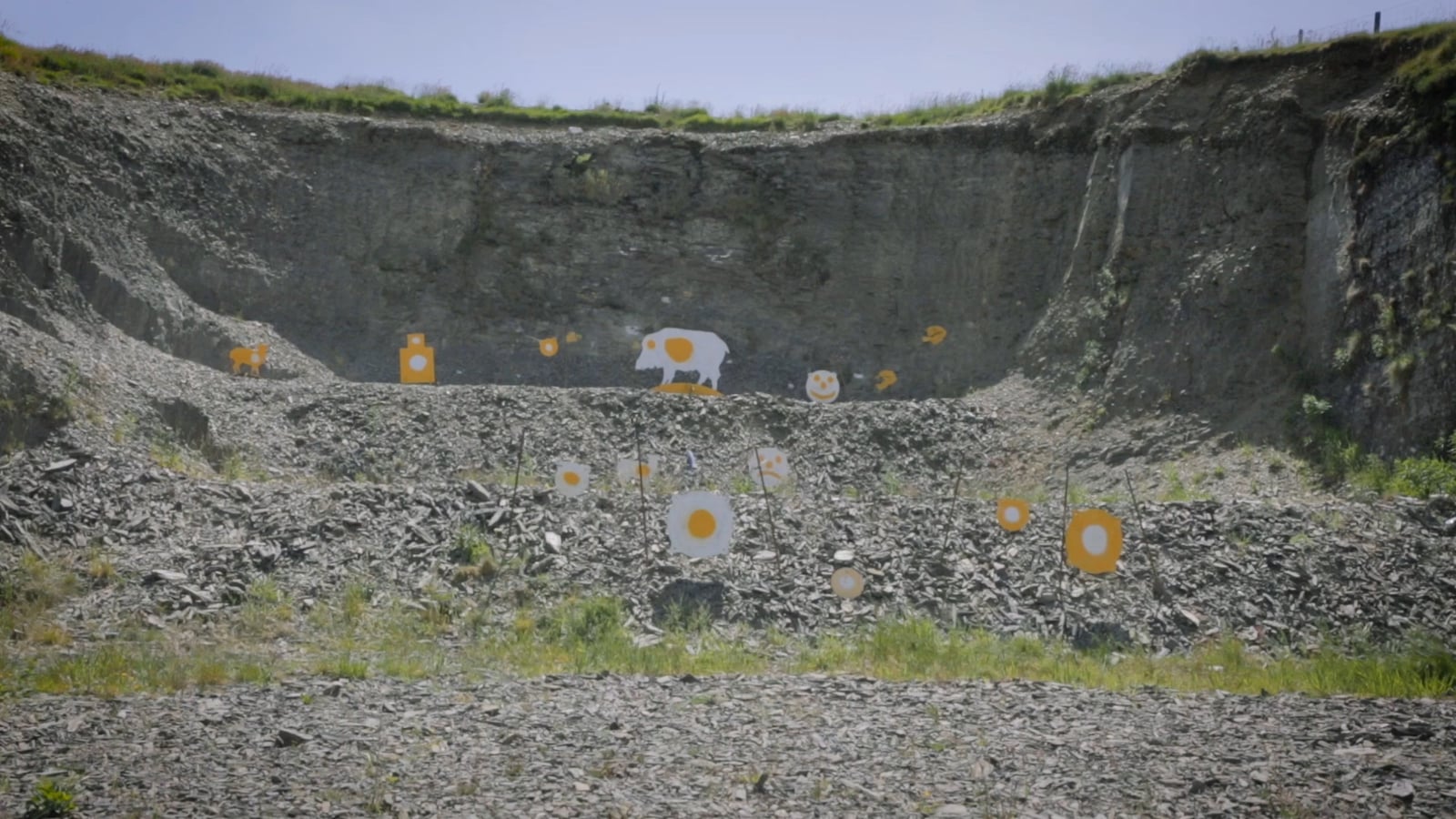
This discipline takes its name from its targets: four cut-out silhouettes representing farm animals, never a human shape. Chicken, pig, turkey and ram, lined up on a stand, make up the only family of targets used. The shooter has to knock them down with a clean hit, without pushing or grazing them.
The origin of this practice goes back to North American metallic silhouette shooting, a discipline born in the United States and practiced for decades on steel silhouettes that likewise depict animals, never human shapes. The version practiced in FFTir clubs keeps that spirit while adapting it to the French regulatory framework.
What sets this discipline apart from most other precision shooting disciplines is its success criterion: it’s not about aiming at a precise point on a paper target and measuring the distance from center, but about knocking down a whole shape thanks to the energy transferred by the projectile. The shooter therefore has to think in terms of trajectory, suitable caliber, and distance, far more than in terms of fine aiming on a bullseye.
This article covers the origin of the format, the four regulation silhouettes, the distances and mandatory firing order, the gear allowed under French weapon categories, as well as the fundamental differences with the North American metallic silhouette that inspired it.
The four regulation silhouettes: chicken, pig, turkey, ram
The FFTir rulebook for the animal silhouette discipline provides for exactly four cut-out shapes, all representing stylized farm animals. No other shape is allowed in official competition, and none of these silhouettes represents or suggests a human figure.
The chicken is the smallest of the four silhouettes and is generally shot at the shortest distance in the series. Its small size makes it the most demanding target in terms of aiming precision, even at close range: the margin of error needed to knock it over stays slim.
The pig is medium-sized, with a bulkier, lower profile than the chicken. It requires enough projectile energy to knock it over cleanly, otherwise it may simply shift on its mount without falling, which doesn’t count as a validated hit.
The turkey, with its elongated profile and characteristic neck, is often seen as the most technical silhouette of the group, since its shape offers a vertical strike surface different from the pig’s or ram’s. The shooter has to mentally adjust their aim point according to each silhouette’s specific shape.
The ram, finally, is usually the largest silhouette and is shot at the longest distance in the series. Its size partly offsets the difficulty tied to distance, but it demands rigorous long-range ballistics management and a properly adjusted optic.
These four silhouettes are made of steel or a resistant material depending on the club’s facilities, mounted on a stand or rail at regulation height. They’re designed to fall backward when they take a sufficient hit — a simple mechanism that nonetheless needs regular maintenance of the firing range to stay reliable over time.
The finish and paint on the silhouettes also matter more than one might think at first glance. A regularly repainted silhouette offers a sharp contrast that makes aiming easier, while a weathered or faded silhouette can blur the perception of its outline, especially under low, grazing light late in the day. Serious clubs schedule periodic maintenance of their silhouettes for exactly this reason.
The hinge or pivot that lets each silhouette tip over must also be carefully calibrated. A mechanism that’s too stiff requires disproportionate impact energy to trigger the fall, while one that’s too loose can knock a silhouette down at the slightest graze, which distorts the actual difficulty of the event. This mechanical calibration explains why two different clubs can offer the same discipline with a noticeably different feel of difficulty.
Origin and philosophy of the discipline
Animal silhouette shooting wasn’t born in France. It draws directly from the tradition of metallic silhouette shooting developed in North America, where shooting clubs began using steel cutouts depicting farm animals to simulate recreational shooting scenarios drawn from rural life.
This origin explains the choice of the four animals: chicken, pig, turkey and ram are familiar farm animals, associated with a friendly, popular style of shooting, with no connotation beyond the sporting and rural. These silhouettes were never meant to represent anything other than stylized animal targets.
When the discipline took shape in France under the FFTir umbrella, it kept this foundation while adapting it to the constraints of French regulations: allowed weapon categories, homologated distances, competition format, and shooter rankings by equipment category.
The spirit of the discipline stays fundamentally both playful and technical. It blends the precision of position shooting, the management of caliber and load (for shooters who handload their own ammunition), and an almost mechanical dimension: understanding why one silhouette falls and another doesn’t, at equivalent firing energy.
It’s also a discipline that values consistency over a one-off feat. A shooter who knocks down nine silhouettes out of ten consistently, session after session, generally progresses better than an irregular shooter who alternates perfect series with disastrous ones. This is where the shooting log really earns its keep: recording the number of silhouettes knocked down per series, per distance and per caliber makes it possible to objectively track real progress.
Regulation distances per silhouette
The core principle of the discipline is that each silhouette is shot at a different distance, increasing from chicken to ram. This progression isn’t arbitrary: it’s designed to balance difficulty between target size and distance, so that each silhouette represents a comparable challenge despite very different dimensions.
The chicken, the smallest silhouette, is shot at the shortest distance in the series. This proximity offsets its small size, but demands fine aim from the shooter, since the tolerance margin stays minimal.
The pig is shot at an intermediate distance, greater than the chicken’s. Its more generous size leaves a bit more margin on the aim point, but the increased distance complicates reading the trajectory, particularly with a crosswind.
The turkey is shot at an even greater distance. It’s often the silhouette where shooters notice the biggest gap between their grouping on paper targets and their actual success rate on silhouettes, since the vertical margin of error becomes significant.
The ram is shot at the longest distance in the series. It’s the largest silhouette, which partly offsets the distance, but it demands the best ballistic mastery of the whole course: trajectory drop, wind drift, and enough residual energy to trigger a clean fall.
The exact distances and format variants (reduced silhouette for certain weapon categories, historical format for older firearms) vary depending on regional commissions and the facilities available at each club. A shooter discovering the discipline should check directly with their club or the relevant regional FFTir commission to find out the exact format applied locally.
The mandatory firing order and why it matters
Unlike other disciplines where the shooter can manage their pace and target order as they see fit, animal silhouette shooting imposes a strict firing order: chicken, then pig, then turkey, then ram, in that precise sequence, never out of order.
This constraint isn’t cosmetic. It forces the shooter to change distance with every silhouette, so they have to readjust their aim point, their breathing, and sometimes their optic setting mid-series. It’s as much an exercise in mental management as in pure precision.
The increasing distance order also has a learning logic to it: starting with the closest, smallest target lets the shooter progressively get into the shooting rhythm before tackling the farther silhouettes that require finer ballistic management.
A shooter who misses a silhouette generally has to move on to the next one without going back, depending on the competition format in force. This rule prevents dwelling on a difficult target at the expense of the time available for the whole series, and pushes shooters to accept a one-off miss in order to preserve overall performance.
Time management is a factor often underestimated by beginners in this discipline. Each series is timed, which means a shooter who takes too long stabilizing their aim on the chicken risks running out of time for the ram at the end of the series. Pacing is an integral part of the skill being tested.
The specific challenge of each silhouette: chicken, pig, turkey, ram
Even though the chicken is shot at the shortest distance, it often remains the most dreaded silhouette among experienced shooters. Its small size demands a very narrow aiming tolerance, and a slightly off-center hit may not transfer enough energy to knock it down completely.
Seasoned shooters know that a missed chicken early in the series can mentally destabilize the rest of the run. Many club instructors therefore advise treating each silhouette independently, without letting a miss on the chicken disrupt concentration on the pig that follows.
Firing position stability is particularly critical on this silhouette, since the horizontal and vertical margin of error is tightened by its small size. A shooter with an imperfect firing position notices it immediately on this target, before even seeing it on the larger silhouettes that follow.
Some club shooters deliberately choose to train primarily on this silhouette during non-competition sessions, since mastering the chicken mechanically reinforces precision on the other three, more size-forgiving silhouettes.
The move from chicken to pig, then from pig to turkey, then represents the technical core of the series. This is the moment when the shooter has to manage two simultaneous changes: increasing distance and increasing target size, two parameters that move in almost opposite directions on perceived difficulty.
On the pig, difficulty mainly comes from the energy needed to trigger a clean fall. A projectile that hits the silhouette without enough residual energy may simply make it vibrate without knocking it down, which doesn’t validate the hit under the discipline’s rules. Caliber and load choice then become almost as important a factor as aiming precision.
On the turkey, reading the trajectory takes over. At this intermediate-to-long distance, trajectory drop starts becoming significant for most calibers used in competition, and a shooter who hasn’t anticipated it in their optic setting will see their hits consistently land low on the silhouette.
A regional champion of the discipline often tells her clubmates that the secret on these two intermediate silhouettes isn’t shooting faster, but precisely memorizing your aim point for each distance during training sessions, rather than recalculating it mentally during every competition series.
The ram finally closes out each series and represents the most demanding test in terms of ballistic mastery. At the longest distance of the course, the projectile’s trajectory has dropped significantly, and even a light crosswind can deflect the point of impact enough to miss the silhouette.
The ram’s generous size nonetheless offers a margin of tolerance that neither the chicken nor the pig have. It’s often the silhouette where the gap between shooters of different skill levels narrows the most, since the difficulty tied to distance affects all competitors comparably, regardless of their aiming finesse.
Many club shooters see the ram as more of a test of their optic setting and ammunition choice than of pure aiming talent. An experienced instructor often points out that a shooter who consistently misses the ram should first check their elevation setting and their ammunition before questioning their shooting technique.
Managing the time remaining at the end of the series also weighs heavily on this last silhouette. A shooter who has fallen behind on the first three targets often arrives at the ram stressed, which degrades their aiming quality at the worst possible moment in the series.
Allowed gear by weapon category
The FFTir animal silhouette discipline accepts several equipment categories depending on the event and the club’s or competition’s internal rankings. The French legal framework for firearms applies in full, with its four clearly defined categories.
Category B covers firearms subject to prefectural authorization, notably most handguns and semi-automatic rifles used in competitive shooting. An FFTir-licensed shooter wishing to use this type of gear for animal silhouette shooting must hold the corresponding authorization, issued through the current administrative procedure.
Category C covers certain firearms subject to simple declaration, notably manually operated repeating rifles, which can be used depending on the events offered by the club or regional league.
Category D covers gear that’s freely sold or subject to simple registration, in particular air guns under twenty joules. Some clubs offer animal silhouette events adapted to this type of gear, with reduced silhouettes and shortened distances proportional to the available energy.
Caliber choice remains an ongoing topic of discussion among practitioners of the discipline. A caliber that’s too light may lack the energy to cleanly knock down a pig or ram at distance, while an oversized caliber complicates recoil management on a series that requires stringing together four different shots quickly. The best approach remains checking with your club about the calibers commonly used and validated for the target event, rather than relying on a general rule.
Shooters who handload their own ammunition find this discipline a particularly interesting field, since the energy transferred on impact depends directly on the propellant charge and the weight of the chosen projectile. A poorly dosed handload can turn out insufficient to knock down a ram at maximum distance, even with a perfect aim, which pushes these practitioners to test and adjust their loads before each competition season.
Ancillary gear also deserves a mention: hearing and eye protection remain mandatory as in any shooting discipline, and choosing a suitable shoulder rest or sling can make a noticeable difference in accumulated fatigue during a competition with several consecutive rounds. Poorly adjusted gear worsens the muscle fatigue discussed later in this article, with a cumulative effect on the last silhouettes shot.
Optics and adjustment: a key factor for success
Unlike some disciplines where the naked eye or mechanical sights dominate, animal silhouette shooting sees a large proportion of experienced shooters use an adjustable scope, particularly for the silhouettes shot at the longest distances, like the turkey and the ram.
Scope adjustment has to anticipate the trajectory drop specific to each distance in the series. Some shooters memorize several distinct aim points for the four silhouettes rather than recalculating a single setting, which saves precious time when moving from one target to another in a timed competition.
A red dot can work well for the closest silhouettes like the chicken and pig, but often becomes less precise on the turkey and especially the ram, where the fineness of the aim point has to compensate for trajectory drop. The choice of optic therefore largely depends on the exact format of the event and the distances practiced at the club.
Regular maintenance of optical gear is also crucial in this discipline, since a shooter who changes caliber or ammunition between two sessions has to re-check their zero before showing up to competition, or risk seeing all their aim points shifted right from the first silhouette.
The choice of scope magnification also deserves thought. Magnification that’s too high reduces the field of view and complicates quickly spotting the next silhouette when switching targets in a timed series, while magnification that’s too low can lack precision on the turkey and ram at long range. Many club shooters opt for a variable-magnification scope, set to an intermediate value that stays a reasonable compromise across all four distances of the series.
Light and visibility conditions also strongly influence the choice and adjustment of optics. A competition held in bright sunlight with strong contrast doesn’t call for the same aperture or brightness settings as a session late in the day under an overcast sky, and a shooter who neglects this adjustment can lose aiming sharpness without even noticing, until they see their disappointing results on the silhouette.
Firing position and its influence on the result
The discipline generally requires a precise firing position depending on the event, the most common being standing unsupported, sometimes supplemented by seated or supported variants depending on the event’s rules and the weapon category entered. This positional constraint radically changes the difficulty compared to shooting from a stabilized rest.
Without support, every breath and every micro-movement of the torso translates directly into the aim point, a phenomenon that’s amplified as distance increases from the chicken to the ram. A shooter who manages their breathing well on paper targets often discovers that this skill becomes even more decisive on animal silhouettes, since failure is immediately visible and binary.
Muscle fatigue also plays an underestimated role. An animal silhouette series generally strings together several rounds, and the stability of the arm or shoulder carrying the weapon gradually degrades over the series. A club shooter who neglects general physical conditioning often sees their precision drop noticeably in the final rounds of a long competition.
Foot placement, torso angle relative to the firing line, and head position to align the eye with the optic or the mechanical sights must be repeated identically for every silhouette in the series. A position that varies slightly between the chicken and the ram introduces a systematic error that’s hard to correct mid-run, even though it could have been avoided with prior positioning work during training.
An experienced instructor often recommends filming yourself or having someone observe your position during your first sessions in this discipline, since shooters themselves rarely perceive their own postural drift from one silhouette to the next, whereas an outside eye spots it immediately.
Breathing deserves specific work of its own in this discipline. Unlike precision shooting on paper targets, where the shooter generally has all the time they want to settle their breathing cycle, the time constraint of animal silhouette shooting forces them to quickly synchronize breath-holding with trigger release, four times in a row and at four different distances. A shooter who masters this quick synchronization gains a real advantage in overall time management of the series.
The balance between speed and stability is arguably the most characteristic tension of this discipline. A shooter who’s too cautious and takes excessive time stabilizing each aim risks running out of time for the ram at the end of the series, while a shooter who’s too rushed sacrifices the precision needed to validate the hit on the smaller silhouettes. Finding that balance point requires specific training work, different from what pure precision shooting on paper targets demands.
Competition format and shooter rankings
Animal silhouette competitions organized under the FFTir umbrella follow a round-based structure, with each round consisting of a full run through the four silhouettes in the regulation order. The number of rounds per competition varies depending on the level of the event, from a simple club challenge to a regional or national championship.
Shooter rankings are generally established by equipment category, which prevents a shooter equipped with a Category D firearm from being compared directly to a shooter using a Category B or C firearm, since ballistic constraints and administrative authorizations differ greatly by category. This separation by category makes the discipline accessible to a wide audience, from the simply-equipped beginner to the seasoned competitor.
An additional ranking by age or license seniority also exists in several regional leagues, with youth, senior and veteran categories, each with its own scoring scale or adapted round format. A shooter starting out in the discipline therefore has every interest in finding out the exact category they’ll be ranked in before signing up for their first official competition.
Scoring follows a simple logic: each silhouette knocked down within the rules earns one point, and the round total corresponds to the number of silhouettes actually knocked down out of the four presented. Ties between shooters are generally broken by an additional shoot-off or by the total time taken to complete the series, depending on the competition’s specific rules.
Consistency between rounds often counts as much as performance in a single isolated round in the final ranking. A shooter who posts a perfect score in one round then a weak score in the next generally ranks lower than a more consistent shooter, which reinforces the idea that this discipline rewards technical steadiness more than a one-off feat.
Tracking your progress: the value of a shooting log for this discipline
Animal silhouette shooting lends itself particularly well to structured tracking thanks to the simplicity of its success criterion: each silhouette either falls or doesn’t, giving a binary result that’s easy to log session after session. A shooter who systematically records their success rate per silhouette quickly gets a clear picture of their weak points.
Logging only the overall score of a series often hides the most useful information. A shooter who totals eight silhouettes down out of twelve can have a very different profile depending on whether they systematically miss the ram due to a lack of long-range ballistic mastery, or rather miss the chicken due to a lack of fine precision at short range. Only detailed tracking per silhouette reveals this distinction.
The caliber, ammunition and optic setting used in each session also deserve to be logged, since a change of ammunition between two sessions can explain a drop in performance that would otherwise be wrongly attributed to a technical aiming or positioning problem. This traceability avoids looking for a complex explanation where the cause is simply material.
Weather conditions, particularly wind, play a disproportionate role on silhouettes shot at long distance, like the turkey and the ram. A shooter who systematically notes wind conditions during their sessions gradually builds a personal database that helps them anticipate their settings during outdoor competitions.
Over time, this tracking makes it possible to turn a practice that could stay purely intuitive into a genuine process of continuous improvement, comparable to what many precision shooters already do on paper targets by analyzing their groupings.
An experienced club shooter preparing for an important competition often uses their session history to set a realistic goal rather than an arbitrary one. Knowing you’ve averaged ten silhouettes out of twelve over the last three training sessions gives a far more reliable benchmark than a simple subjective feeling about your form on the day, and lets you approach competition with expectations consistent with your actual level of preparation.
Comparing your statistics from one season to the next also helps measure the real effect of a change in equipment or training method. A shooter who switches scopes or changes their handload can objectively check, thanks to this tracking, whether the change improved their success rate on the turkey and the ram, rather than relying on an impression that can be skewed by the novelty of the gear or the enthusiasm of the moment.
Difference from North American metallic silhouette shooting
North American metallic silhouette shooting, which the FFTir discipline draws directly from, nonetheless remains different on several structural points. Understanding these differences helps avoid confusion between the two practices, particularly for shooters who travel or discover the discipline through foreign sources.
The North American version historically uses larger silhouettes and often longer distances than the version practiced in FFTir clubs, with its own variants depending on local federations and the calibers traditionally used in this practice.
Competition format also differs: the structuring into categories, the number of silhouettes per series, timing, and ranking rules follow distinct standards between the two traditions, even though the basic principle — knocking down animal silhouettes in increasing order of distance — remains common to both practices.
The legal framework is the most fundamental difference. French practice fits strictly within the French law’s system of weapon categories, with its constraints of authorization, declaration, or free sale depending on the category of gear used — a framework with no direct equivalent in North American regulations.
Finally, the discipline’s culture also differs in its place within the overall sporting landscape. In France, animal silhouette shooting remains a niche discipline within FFTir, practiced by a smaller number of clubs compared to Olympic or dynamic disciplines, whereas it benefits from a historically broader base of practitioners in its country of origin.
Why this discipline is worth discovering
Animal silhouette shooting offers a shooting experience different from most classic FFTir disciplines, combining aiming precision, ballistic management, and a playful dimension tied to the visible, immediate fall of the target. Unlike paper target shooting, the result is instant and visually satisfying: the silhouette falls, or it doesn’t.
It’s also a discipline accessible to very different shooter profiles. An experienced club shooter coming from classic precision shooting finds a new technical challenge in it, while a more leisure-oriented shooter appreciates the concrete, immediate nature of the result, without needing the fine analysis of a grouping on paper.
Progress in this discipline is easy to measure: the number of silhouettes knocked down per series is a simple, objective indicator that lends itself well to tracking in a digital shooting log. Recording your results by distance, caliber and session makes it possible to quickly identify which silhouette remains the priority weak point to work on.
Finally, this discipline pushes shooters out of a purely static approach to precision shooting. It requires thinking in terms of a complete trajectory and transferred energy, a skill that indirectly benefits every other shooting practice, including pure precision shooting on paper targets.
FAQ
Q: Can you shoot animal silhouette with an air gun? A: Yes, some clubs offer adapted events with reduced silhouettes and shortened distances for Category D gear, notably air guns under twenty joules. Check directly with your club to find out the exact format offered.
Q: Why is the chicken-pig-turkey-ram firing order mandatory? A: This order follows the increasing distance of the silhouettes and structures the progressive learning of the series, in addition to being a regulatory constraint of the discipline. It also forces the shooter to readjust their aim point at every target change, which is an integral part of the exercise.
Q: Is FFTir animal silhouette the same thing as North American metallic silhouette? A: They share the same origin and the same principle of knocking down animal silhouettes, but differ in distances, competition format, and above all the legal framework, since French practice fits within the weapon category system specific to French law.
Q: What caliber should you choose to start this discipline? A: It depends on the club, the event format and the targeted weapon category: it’s better to check directly with your club about the calibers commonly used and validated for the event concerned rather than relying on a general rule, since energy needs vary noticeably between the chicken and the ram.
Q: Why can a silhouette fail to fall despite a visible hit? A: If the projectile hits the silhouette without transferring enough residual energy, the target may vibrate or move slightly without fully falling, which doesn’t validate the hit under the discipline’s rules. That’s why the choice of caliber and load counts just as much as pure aiming precision.
Q: Do you need a scope to practice this discipline? A: It’s not mandatory, but a large proportion of experienced shooters use one, particularly for the silhouettes shot at the longest distances like the turkey and the ram, where the fineness of the aim point has to compensate for trajectory drop.