
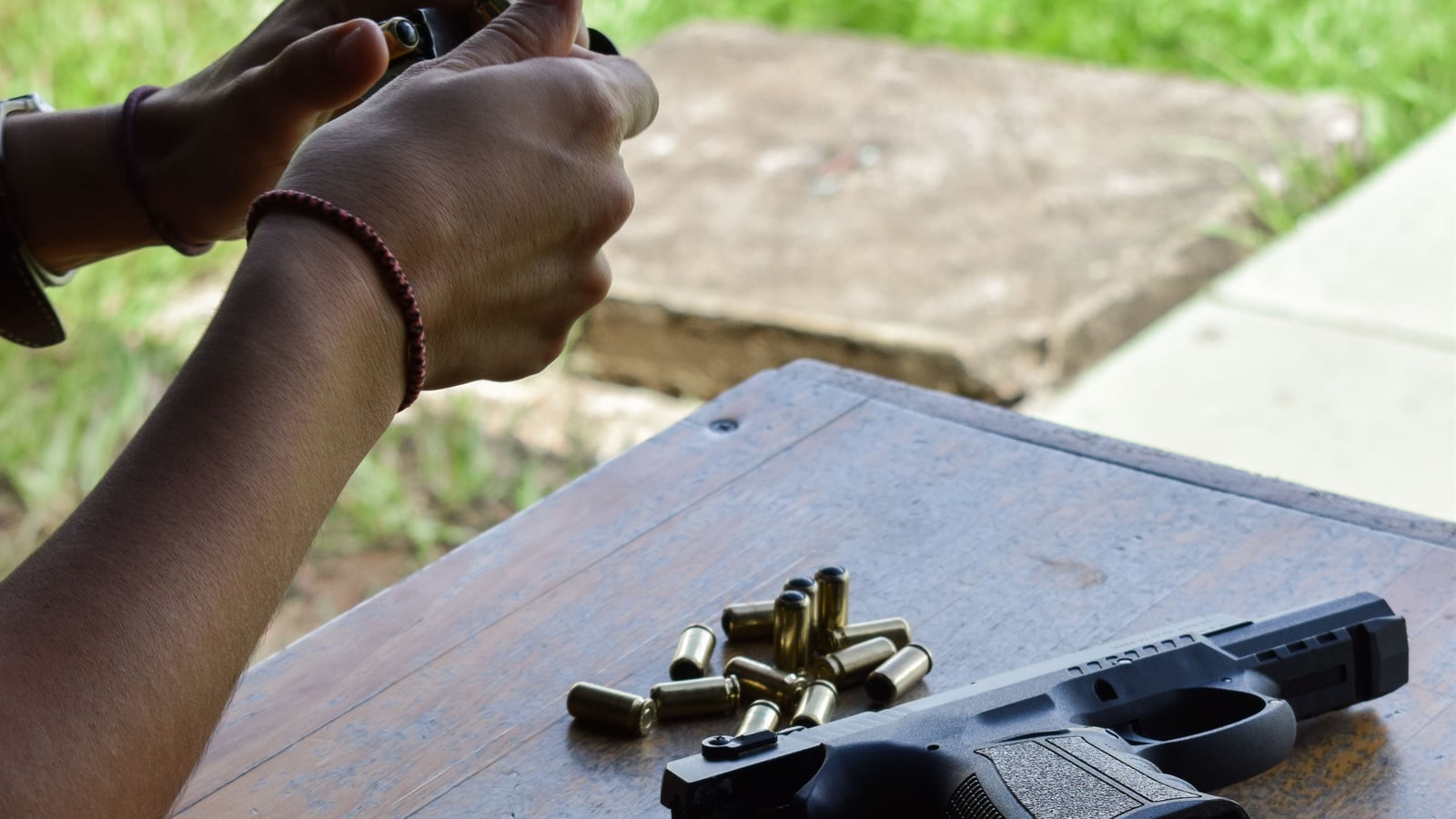
Why fast reloading makes the difference in competition
A reload is often the only moment in a dynamic shooting stage where you’re not firing at a target. On the clock, that dead time counts exactly as much as any shot: every tenth of a second lost handling your gun adds directly to your final time.
In an IPSC match or a dynamic shooting stage, the gap between two shooters of similar level very often comes down to these handling details rather than raw accuracy. A solid club shooter who reloads cleanly in one fluid motion can gain half a second on a stage — plenty to move up the rankings against someone who aims just as well but fumbles the reload.
What makes a fast reload difficult is that it combines several fine motions that need to chain together without conscious thought: eject the empty magazine, grab the full one, insert it, get back on target. Under the pressure of the clock and a complex stage, any of these steps can seize up if it hasn’t already been automated beforehand.
This article covers the whole subject: a precise breakdown of each phase of the reload, choosing and setting up your magazine pouch position, and a series of timed drills to progress in a measurable way. The goal is that you walk away with a concrete training method, not just general principles.
This work mainly concerns dynamic disciplines on cardboard or steel targets, where reloading happens on the move and under time pressure. That said, the same attention to method benefits any discipline involving a magazine change mid-string, even at a less intense pace.
It’s also worth saying what this article is not: a magic shortcut or a collection of gimmicky tricks. Fast reloading is a purely motor skill, one that’s built through repetition and degrades just as fast without regular upkeep. A shooter who reads this article without ever practicing the described motions will see no measurable benefit on the clock.
Distinguishing tactical reloads from emergency reloads
There are two broad families of reload, and confusing them is one of the first sources of lost time for shooters starting out in dynamic disciplines. The so-called “tactical” reload happens when the gun still has ammunition but the shooter anticipates needing full capacity before a tough part of the stage.
The emergency reload, on the other hand, happens when the gun is empty, usually signaled by the slide or bolt locking back depending on the type of gun. This second case is more common in competition because most shooters try to optimize how many magazines they use and therefore deliberately empty a magazine before switching.
The distinction matters because the motion and speed of execution aren’t the same. An emergency reload should be executed at maximum possible speed, with no particular care for the ejected magazine, which just falls to the ground. A tactical reload, rarer in a match but sometimes useful depending on the stage rules, can be done a bit more carefully since the context is less critical.
Many competition rules also impose constraints on picking up magazines dropped on the ground, particularly in categories where the number of rounds or magazines available is limited. Checking the exact rules for the discipline and category you practice before automating a motion that might not be allowed everywhere avoids bad surprises in a match.
Anticipating which type of reload you’ll need is an integral part of mental preparation for a stage. A shooter who rehearses their stage plan beforehand knows exactly when they’ll need to reload and what kind of reload it will be, which lets them commit to the motion without hesitation the moment it comes up, rather than discovering it mid-course.
A common confusion among shooters starting out in dynamic disciplines is wanting to optimize the number of rounds fired per magazine at all costs, to the point of needlessly complicating their stage plan. A poorly placed tactical reload, added only to “keep things tidy,” sometimes costs more time than the theoretical gain it was supposed to bring. The priority always remains the overall flow of the course, not the isolated optimization of a single variable.
The choice between the two types of reload also depends on the exact stage configuration and the layout of the shooting positions. A stage requiring a long movement between two positions naturally offers a window for a tactical reload with no real time loss, since the hand can work while the legs are already moving toward the next position. A more compact stage, where shooting positions follow each other quickly, leaves much less room for this kind of anticipation.
Breaking down the motion: ejecting the empty magazine
The first phase of the reload is releasing the empty or partially empty magazine from the gun. This motion seems trivial but accounts for a good chunk of the time lost by undertrained shooters, particularly because the thumb has to reach the release without the hand losing its overall grip on the gun.
The technical key is not to wait for the magazine to be fully ejected before starting the next motion. As soon as the thumb hits the release, the hand holding the spare magazine in reserve should already be moving toward the gun. The two actions overlap in time rather than following each other strictly.
A common flaw is watching the magazine fall, out of a natural visual reflex to check. That glance costs precious time and provides no useful information: the shooter can feel perfectly well, through the sensation in the hand, whether the magazine has dropped or not. The eyes should stay fixed on the area where the hand is going to reach for the spare magazine, anticipating the next phase.
Arm and elbow position during this phase also affects the fluidity of the motion. An overly extended arm or a gun held too far from the body makes it harder for the thumb to reach the release. Bringing the gun slightly closer to the chest during the manipulation, without overdoing it, eases the whole sequence while keeping the body ready to get back on target quickly.
The force applied to the release also deserves to be trained on its own. Too timid a press sometimes forces a second attempt, which cancels out the whole benefit of the overlapping motions mentioned above. Conversely, an excessive, jerky press needlessly destabilizes the overall grip on the gun. The right amount is found through repetition, by checking whether the magazine drops cleanly on the first press, without a parasitic wrist jerk.
Breaking down the motion: grabbing the spare magazine
Grabbing the full magazine is the phase where most of the time gained or lost on a fast reload is decided. A hand that has to search, fumble, or readjust its grip on the magazine before it can pull it out of the pouch adds up tenths of seconds across an entire match.
The basic rule is to always grab the magazine the same way, with the same hand orientation, regardless of fatigue or stress in the moment. That consistency only comes from repetition, which is why dry drills take up such an important place in reload training, well before moving on to live-fire drills.
The ideal grip point is generally toward the upper part of the magazine body, where the index and middle fingers can naturally rest along the magazine to guide its insertion. A grip too low, near the base of the magazine, forces a hand readjustment at the moment of insertion, breaking the fluidity of the overall movement.
A useful mental cue is to systematically orient the index finger toward the front of the magazine as soon as it comes out of the pouch, so the hand only has to guide the magazine toward the magwell without any extra rotation. This detail, drilled hundreds of times dry, becomes an automatic habit that no longer requires any conscious thought in a match.
Vision also plays a specific role here. Briefly looking at the pouch at the moment of grabbing is generally necessary, unlike during the ejection phase, because the precision of the grip depends on a reliable visual reference. However, the eyes should switch back to the gun and the shooting area as soon as the hand leaves the pouch, without waiting for the magazine to already be inserted.
Coordination between both hands during this phase deserves particular attention. While the reloading hand goes to grab the full magazine, the hand holding the gun shouldn’t stay passive: it prepares the magwell opening, sometimes by very slightly orienting the gun to ease the upcoming insertion. This micro-adjustment, almost invisible from the outside, is one of the details that separates a truly fluid reload from one that’s correct but mechanical.
A useful complementary drill is to practice grabbing the magazine alone, without even trying to insert it, to fully isolate this phase from the rest of the sequence. Repeating just this motion, hand after hand, lets you fix grip flaws without fatigue or concentration being diluted across the whole reload sequence.
Breaking down the motion: insertion and getting back on target
Inserting the magazine into the magwell is the moment where precision takes priority over raw speed. A shooter who rushes this phase regularly misses the insertion, which costs far more time than a slightly more measured motion that succeeds on the first try.
Guiding the magazine toward the magwell relies largely on tactile feel rather than vision, once the automatism is well established. The hand holding the gun acts here as a fixed reference point: it needs to stay as stable as possible so the inserting hand has a fixed target to converge on, rather than two hands moving toward each other.
Once the magazine is inserted and locked, getting back on target must follow immediately, with no pause in between. This is a point often neglected: some shooters treat the reload as an isolated action, finished once the magazine is in place, when it’s really just one step toward resuming fire. The eyes and attention should already be repositioned on the next cardboard target or steel plate before the hand even leaves the magazine.
On guns that require racking the slide or working the action after an emergency reload to chamber a round, that motion also needs to be integrated into the same overall fluidity rather than treated as a separate step. The hand that just guided the magazine can often flow directly into this manipulation without any unnecessary detour, depending on the gun’s configuration.
The legs and footing shouldn’t freeze during this final phase either. A shooter who locks their whole body during magazine insertion loses precious time when resuming movement or their shooting position. The upper body focuses on the precision of the reload motion, while the lower body stays ready to resume movement as soon as the sights are back on target, with no lag between the two.
Finally, the visual check of the next target or steel plate should very slightly precede the end of the insertion itself, not follow it. This slight overlap between the end of the reload and the start of getting back on target is one of the most reliable markers of a truly mastered reload, as opposed to one that’s simply correct but sequential.
Magazine pouch position and setup
The position of the magazine pouch on the belt is never a secondary detail: it’s one of the few pieces of gear setup that directly affects reload time, regardless of the shooter’s skill level. A poorly positioned pouch complicates the grab even for an otherwise very well-trained shooter.
The general rule is to position the pouch somewhere accessible without the arm having to make a wide movement or an excessive twist of the torso. For most right-handed shooters, that means a spot slightly forward of the left hip, but the exact position varies depending on body shape, arm length, and personal preference.
The tilt angle of the magazine in its pouch also matters a lot. A magazine that sits too vertically forces the hand into a wrist rotation to extract it properly, whereas a slight forward tilt allows a more direct extraction, in the natural continuation of the hand’s movement. This setting is tested and adjusted progressively, often with the help of an experienced coach observing the motion from outside.
The number of slots on the pouch and the order they’re used in should also be thought through in advance, especially if the discipline’s rules impose a specific number of magazines for a given category. Many solid club shooters adopt a simple rule: always empty the slots in the same order, so they never have to think about which slot is already empty mid-string.
The quality and tension of the pouch itself also play a significant role. A system that’s too loose lets the magazine move or fall at the wrong moment, while one that’s too tight slows down extraction and tires the hand over a long match. This setting is found through gradual trial and error rather than a universal value, since it varies by exact model and individual preference.
The height of the pouch relative to the belt also affects how much motion is needed to pull the magazine out. A mount that’s too high forces you to raise the elbow more, lengthening the hand’s path and introducing an extra variable into the motion. A lower mount brings the magazine closer to the hand’s natural resting line, but may get in the way of certain movements or position changes depending on the discipline.
It’s better to treat pouch setup as an ongoing process rather than a fixed choice made once and for all. Many solid club shooters slightly adjust their configuration season after season, as their motion, belt, or gear evolves, rather than treating an initial setup as final.
Dry practice: the foundation of all progress
Dry practice — that is, without ammunition — is the absolute foundation of any serious work on fast reloading. It lets you repeat the motion dozens of times per session, without the cost in ammunition or the safety constraints of an active range, provided you strictly follow basic safety rules with every manipulation.
Before any dry session, checking that the gun is completely unloaded and that the practice area contains no live ammunition whatsoever is a non-negotiable step. Many clubs and experienced coaches recommend dedicating a specific space to this practice, far from any ammunition, to eliminate any risk of mix-up.
Dry practice lets you break down each phase of the reload in slow motion before chasing speed. A shooter who skips this step and chases speed from the start often builds in motion flaws that become very hard to fix later, once they’ve been automated at a fast pace.
The classic progression is to repeat the full motion very slowly, consciously observing each hand and each transition, then gradually increase speed only once every phase is clean and hesitation-free. Speeding up before the motion is reliable amounts to automating a flaw rather than a skill.
A dummy training magazine, or a real magazine kept exclusively for dry practice, avoids unnecessary wear on competition gear and reduces the risk of confusing it with a loaded one. Some shooters visually mark their training magazines to remove any doubt at a glance.
Dry repetition also benefits from being filmed, when practical, to allow for after-the-fact analysis of the motion. A shooter’s own eye is often a poor judge of their own fluidity in real time, whereas watching in slow motion easily reveals hesitations, misplaced glances, or unnecessarily long hand paths. An experienced coach can also use this footage to fine-tune their advice.
The number of repetitions per session matters less than the quality of each rep. Twenty clean, focused reps beat a hundred sloppy ones at the end of a session, once fatigue starts degrading the precision of the motion. As soon as quality drops noticeably, it’s better to stop the session than to keep reinforcing a degraded motion.
Timed drills to make progress
Once the basic motion is acquired dry, moving to timed live-fire drills lets you objectify actual progress rather than relying on a subjective impression of fluidity. A simple stopwatch or tracking app is enough for this work — what matters is measuring consistently from one session to the next.
A first simple drill is to measure the time between the last hit before the reload and the first hit after getting back on target, on a single cardboard target at a moderate distance. This raw number, tracked session after session, gives a direct and reliable measure of progress on the isolated motion.
A second drill adds an element of movement, integrating the reload during a lateral move or while exiting a shooting position, as often happens on a real stage. Pure reload time rarely increases in this context for a well-trained shooter, whereas it often blows up for a shooter who has only ever drilled the motion standing still.
A third useful drill is to deliberately vary when the reload happens within a string, sometimes an emergency reload on an empty gun, sometimes a tactical reload with rounds remaining, to make sure both motions stay distinct and controlled under time pressure rather than blending together by reflex.
It’s worth logging these times in a training notebook or a dedicated app, clearly distinguishing the conditions of each drill: standing still or moving, emergency or tactical, early or late in the session when fatigue sets in. This granularity lets you pinpoint exactly which type of reload is stalling and deserves extra targeted work.
A final, more demanding drill is to chain several consecutive reloads within the same string, to simulate the hand fatigue and progressive loss of precision that can occur on a long stage or a match with many cardboard targets and steel plates. This type of drill often reveals flaws invisible on an isolated reload, particularly a loss of insertion precision after several closely spaced repetitions.
Comparing your times to an outside benchmark can also motivate progress, provided you stay careful with the interpretation. Two shooters don’t share the same build, the same gear, or the same experience level, so a reload time that looks excellent for one might be a realistic mid-term goal for another. What matters most is personal progress measured over time, more than a raw comparison with someone else.
Managing stress and the pressure of the clock in a match
The motion acquired through dry practice and confirmed in timed drills doesn’t always transfer automatically to match conditions. The pressure of a visible clock, the gaze of other competitors, and the stakes of the ranking often change the quality of execution of a motion that was nonetheless well automated in training.
The main trap in a match is rushing the motion beyond what the automatism actually allows, which is precisely what causes the insertion misses or dropped magazines that training was meant to eliminate. Competition speed should stay the speed mastered in training, not some higher speed hoped for under the effect of stress.
A simple mental preparation technique is to precisely visualize the reload sequence before starting a stage, including the exact moment it will occur in the course. This visualization reduces the decision load at the critical moment, since the motion has already been “rehearsed” mentally in the precise context of the upcoming stage.
Breathing also plays a significant role in managing stress during a reload in a match. A shooter who holds their breath out of an excessive concentration reflex often tenses their hands in a way that works against the very fluidity being sought. Keeping steady breathing, even during a fast manipulation phase, helps preserve the motion flexibility built up in training.
Progressively training in conditions close to a match — for example against other shooters or with the clock announced out loud — lets you bring the training motion closer to the motion actually produced in competition. This transfer is never perfect on the first try, but it improves with the accumulation of experience under real pressure.
Adapting the technique by weapon type and discipline
The general principle of fast reloading stays the same from one discipline to another, but its concrete application varies significantly depending on the type of gun used. A pistol and a rifle, for example, don’t require the same motion or the same pouch position, due to their difference in size and grip style.
With a rifle, the shooting position strongly affects how accessible the spare magazine is. Reloading standing doesn’t pose the same constraints as reloading from a kneeling or prone position, where access to the pouch and the space available to manipulate the gun are much more limited. Training only standing leaves a real skills gap for stages that require other positions.
With a pistol, the relative compactness of the gun generally makes for a faster motion, but the margin for error on the magazine’s insertion angle is also smaller, requiring greater motion precision compared to a rifle. Choosing the pouch and its setup then becomes even more important.
Some dynamic disciplines also impose specific rules on the number of rounds allowed per magazine depending on the equipment category, which directly affects how often you reload on the same stage. A shooter who changes equipment category needs to rethink their reload strategy accordingly, rather than keeping a habit acquired in another category unchanged.
Whatever the gun or discipline, the best reference point remains asking an experienced coach who knows the gear and the specific rules well, rather than transposing a technique seen elsewhere — including in this article — without adaptation.
Common mistakes that slow down the reload
Certain mistakes come up very regularly among shooters who progress slowly on this technical aspect, regardless of their overall shooting level. Spotting them in yourself is often the first step toward rapid progress, sometimes faster than their apparent simplicity would suggest.
Watching the empty magazine fall to the ground remains one of the most common mistakes, as mentioned above. This visual reflex provides no useful information and delays shifting the gaze to the next phase of the motion. An experienced coach spots this flaw immediately when watching a shooter on a training stage.
Searching blindly for the pouch, without a quick visual check at the moment of grabbing, is another common source of slowdown, particularly among shooters who have poorly set up their position or who change belt configuration too often. A stable position known by heart limits this problem over time.
Excessively tensing the hand holding the gun throughout the whole reload phase is a subtler flaw that indirectly slows down the overall motion by generating unnecessary fatigue and stiffness. This tension, often linked to stress or inexperience, is corrected through the accumulation of dry repetitions in a relaxed setting.
Finally, neglecting movement training in favor of exclusively static work leaves an incomplete skill set that gets brutally exposed on match day, on a stage requiring movement. Integrating movement as soon as the basic motion is acquired avoids this unpleasant surprise.
Building a sustainable training routine
Progressing on fast reloading requires consistency of training more than occasional intense volume. A few minutes of dry work several times a week generally produce better long-term results than one long isolated session followed by several weeks without practice.
A simple, sustainable routine can start with a few slow, conscious repetitions of the full motion, followed by a phase of progressively faster reps, stopping as soon as an execution error appears rather than continuing to repeat a degraded motion. Ending each session on a clean rep rather than a mistake reinforces the correct automatism.
Occasionally integrating timed drills with live ammunition lets you periodically verify that dry-practice progress actually translates into real conditions, without making it the bulk of the training volume, since dry practice remains more economical and more repeatable.
Finally, keeping a structured log of your reload times over time, rather than a one-off, isolated assessment, lets you distinguish a real progress trend from simple day-to-day variations. A well-kept digital shooting log, cross-referencing this data with the context of each session, gives a much more reliable view of actual progress than an often misleading instant feeling.
A fast, reliable reload doesn’t depend solely on the shooter’s motion: the condition of the gear used also largely determines the consistency of the motion. A deformed magazine, a worn spring, or slightly splayed magazine lips can turn a normally fluid reload into an unpredictable source of malfunction, right at the worst moment of a match.
Regularly inspecting the condition of every magazine used in competition is an integral part of serious preparation, just like cleaning the gun itself. A magazine that frequently hits the ground during emergency reloads undergoes real mechanical wear, particularly at the lips, which can eventually disrupt feeding or how it sits in the pouch.
The pouch itself deserves the same attention. A spring or friction system whose tension has changed over time, through wear or repeated exposure to weather, no longer reacts the same way as when it was first set up. Periodically checking that extraction stays as smooth as at the initial setup avoids discovering a gear problem mid-competition, when it could have been detected and fixed beforehand.
The belt itself, its rigidity and the quality of its fit around the body, also affects the stability of the whole reload system. A belt that shifts or slightly loosens over the course of a stage imperceptibly moves the pouch’s position relative to the hand, which can be enough to disrupt an automatism built around a precise position. A quick check of the fit before each stage start remains a simple, worthwhile habit.
Finally, testing your reload gear in the weather conditions actually encountered in competition — notably rain, cold, or intense heat — lets you anticipate any changes in how the system behaves. A wet or gloved hand, for example, doesn’t grab a magazine exactly the same way as a dry hand, and this detail deserves specific practice if your discipline regularly exposes you to these conditions.
Progressing over the long term: beyond the isolated motion
Fast reloading is never worked on in complete isolation from the rest of your shooting sport practice. The quality of your overall grip on the gun, breathing management, or the solidity of your footing — addressed in other aspects of training — directly affect the fluidity of your reload, even though it’s the subject of dedicated drills.
A shooter who progresses on their overall gun control often notices, almost as a side effect, an improvement in the fluidity of their reloads, simply because the stability of the hand holding the gun has improved. This obviously doesn’t excuse specific work on the reload itself, but it explains why some shooters progress faster than others on this precise point despite comparable dedicated training volume.
Progress on fast reloading rarely follows a linear curve. Plateaus of several weeks with no visible improvement on the clock are common, sometimes followed by sudden gains once an automatism truly stabilizes. A shooter who abandons a drill too early, thinking they’ve hit a ceiling, often deprives themselves of a gain that only needed one more repetition to show up.
Exchanging with other shooters in the same discipline, particularly during club sessions, remains a valuable resource for progressing on this topic. Watching an experienced shooter’s motion, asking concrete questions about their pouch setup or training method, often brings insights that no article, however detailed, can fully replace.
Finally, keep in mind that fast reloading is only one component of overall performance on a dynamic shooting stage, alongside accuracy, movement, and strategic course management. A shooter obsessed solely with reload speed at the expense of accuracy ends up losing more time to penalties or extra shots than they gain on their manipulations. The balance between these different aspects remains the key to genuinely measurable progress in competition.
FAQ
Q: On average, how long does it take to master a fluid fast reload? A: It varies enormously depending on the regularity of dry practice and the shooter’s prior experience with this kind of manipulation. Some make clear progress within a few weeks of focused practice, others need several months to reach stable fluidity under pressure.
Q: Do you absolutely need to dry practice before moving to live-fire drills? A: Yes, it’s strongly recommended, because dry practice lets you break down and correct the motion without the cost in ammunition or the added stress of live fire. Skipping this step often leads to automating flaws that later become harder to fix.
Q: What’s the best position for a magazine pouch on the belt? A: There’s no universal position — it depends on body shape, arm length, and the shooter’s preferences. The general rule is to aim for access without a wide arm movement or excessive torso rotation, adjusting gradually with the help of an experienced coach.
Q: Is fast reloading trained differently on a rifle versus a pistol? A: The general principle stays the same, but magazine accessibility, grip motion, and the influence of shooting position vary significantly between the two types of guns. Specific work for each discipline and shooting position remains necessary for real mastery.
Q: Is it dangerous to practice dry reloading at home? A: It remains safe as long as you strictly follow basic safety rules, notably checking that the gun is completely unloaded and that no live ammunition is present in the practice area. If in doubt about the regulations that apply to storage and handling at home, check with your club or local authorities.
Q: Can a bad reload penalize your score in competition, not just your time? A: Depending on the exact rules of the discipline, an improperly secured magazine or non-compliant manipulation can indeed lead to penalties beyond just lost time. Always check the exact rules of the category and discipline you practice with the organizers or a range officer.