
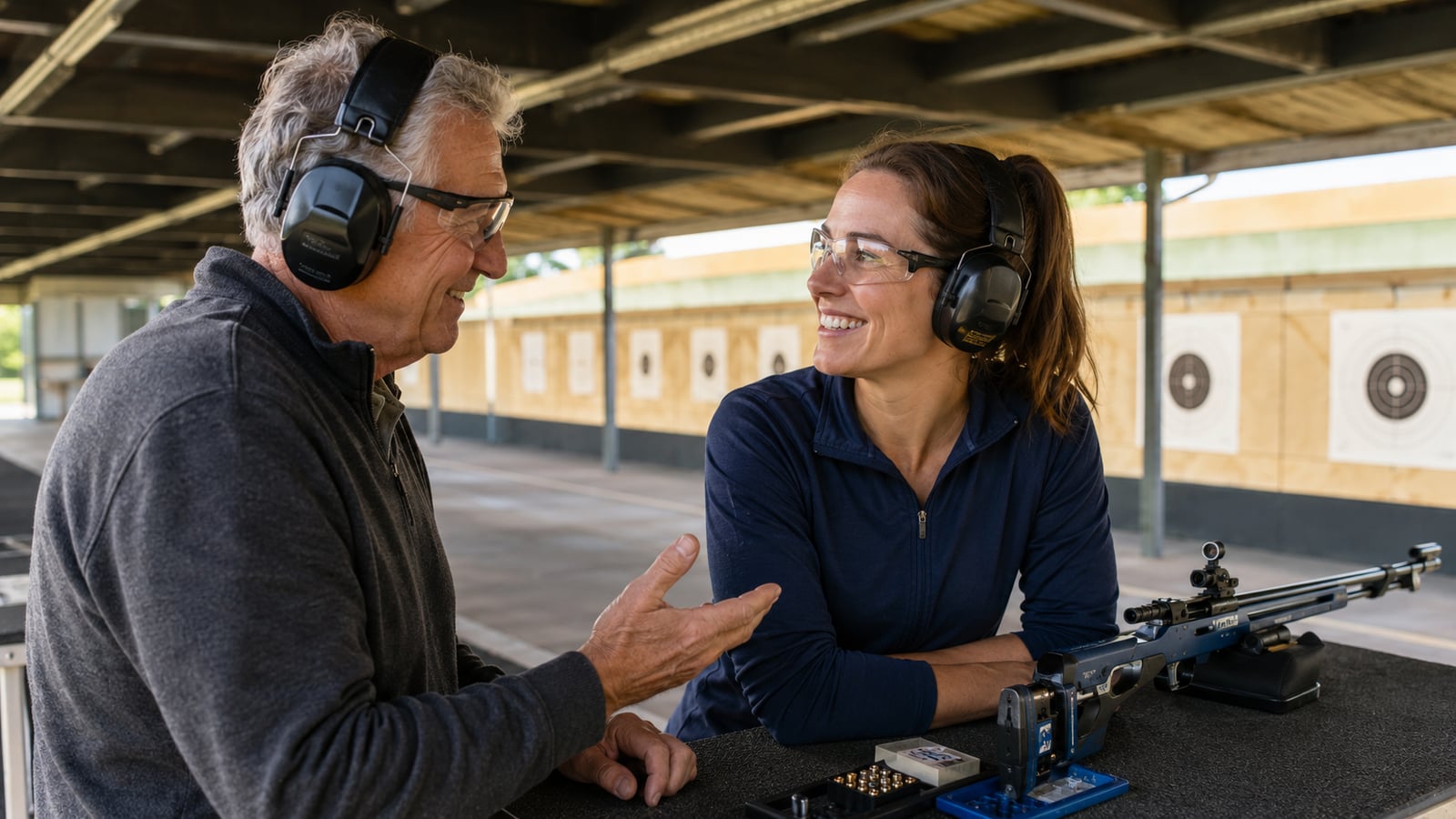
Why sport shooting passes down so well within families
Sport shooting has a rare trait among technical disciplines: it doesn’t demand dominant physical strength or a particular build, and you can practice it just as well at 14 as at 70, on the very same firing line. A teenager and their grandfather can go head-to-head on the same precision exercise with real chances on both sides — something that happens in almost no other sport.
This generational level playing field changes the nature of how the sport gets passed on. Unlike a sport where the adult systematically teaches and the child receives, shooting quickly establishes an equal footing on the firing line: everyone manages their own stress, their own focus, their own settings. A parent discovering the sport at the same time as their child is no less legitimate for it.
An experienced club instructor often shares the same observation: families who come to shoot together create a different dynamic than solo shooters. Motivation becomes collective, progress gets discussed on the drive home, and equipment purchases get thought through at the household level rather than the individual one.
Sport shooting is also one of the few activities where an individual progress log really makes sense in a family context. Each member can follow their own curve without being compared to an outside standard, which defuses unhealthy competition between generations while keeping positive encouragement alive.
Finally, practicing at a club naturally structures intergenerational bonds: a member who regularly brings a parent or child along often becomes a reference point for other families at the club, creating a snowball effect that reaches well beyond the initial family circle.
This transmission also works in the opposite direction from what you’d instinctively imagine. It’s not uncommon for a licensed child to draw a previously spectating parent into getting their own license, simply because they come back enthusiastic from their sessions and make you want to try it yourself. So the direction of transmission is never fixed — it flows both ways depending on the family and the moment in life.
The stories you hear most often at the club
Without attributing these words to any real, identifiable person, here are the kinds of things an instructor or club president frequently hears from practicing families.
A father who’s been licensed for several years typically recounts starting out alone, then gradually bringing his son or daughter along one Saturday morning out of curiosity. The story is often similar: the child expected something loud and intimidating, and instead discovers an activity that mostly demands calm, controlled breathing, and patience.
A mother who shoots regularly likes to bring up how her kids’ view of her changed after their first visit to the range: the discipline, the strictness of the safety rules, and the precision of the movements paint a different picture than her everyday domestic self. That shift in perspective comes up in a lot of similar stories.
On the grandparents’ side, the classic story is about the pride of sharing a skill with a grandchild rather than just passing down oral memories. Shooting becomes a concrete vehicle for exchange between generations, sometimes with genuine technical learning on both sides, when the grandchild progresses faster thanks to sharper eyesight or better stress management.
A couple who shoot together often say that practicing together changed how they share a hobby: instead of two separate activities, they now have a shared weekly appointment, with its own rituals — coffee before the session, a debrief on the drive back, updating the shooting log that same evening.
What stands out across all these stories is the recurrence of the same mechanism: sport shooting creates a protected, screen-free moment where the family comes together around a shared, measurable, and progressive goal.
What age to introduce a child
The question of age comes up systematically among families considering a first introduction. There’s no single number that applies everywhere: it depends heavily on the club, the discipline in question, the type of firearm used, and the federation’s insurance rules in force, so the general rule is to ask the target club directly rather than trust some supposedly universal standard.
Broadly speaking, the category D air rifle is often the most accessible entry point for younger kids, thanks to its low power and simplified handling. Many clubs run youth sections built around this kind of equipment, with dedicated coaching.
The instructor’s attention then focuses less on performance than on building safety reflexes: never point a firearm at anyone, keep the finger off the trigger until the target is acquired, follow the firing line commands without exception. These reflexes take hold all the better when they’re learned young and repeated often.
For disciplines requiring more strength or recoil management, the entry age is generally later and governed by precise federation rules that each club applies in its own way. A parent considering this progression must go through the club’s and federation’s official channels rather than rely on what they’ve seen elsewhere.
It’s also worth accepting that a child might not take to it right away. The discipline doesn’t suit every temperament, and forcing interest is often counterproductive. Instructors generally recommend a gradual, pressure-free introduction, with short sessions at the start.
Organizing a first family club outing
The logistics of a first group outing are best prepared in advance to avoid unnecessary stress that would spoil the experience. The first step is to contact the target club to learn its intake procedures: some clubs run discovery sessions specifically for families, others require individual pre-registration for each participant.
It’s worth clarifying beforehand who’s shooting and who’s watching. On a first discovery visit, not every family member necessarily practices at the same time: rotating between shooters and companions is part of the normal running of a range, particularly for safety and lane-availability reasons.
Travel and timing deserve special attention when children are involved. A shooting session requires concentration, and a child worn out by too long a drive or a poorly chosen time slot gets much less out of the discovery experience. Favoring a quiet time slot outside the club’s busy periods makes individualized coaching from the instructor easier.
On the equipment side, it’s worth checking beforehand what the club lends and what falls to the family. Hearing and eye protection is generally provided or available for rent on a first visit, but some clubs ask you to bring your own protective gear from the second session onward.
The shooting log takes on its full meaning from this very first outing: noting how each person felt, the first results, points to work on, gives a concrete basis for the next session and turns a one-off outing into the start of a regular practice.
Finally, it’s better to plan an activity or a break after the session rather than rushing straight into something else. The informal debrief, over a meal or a relaxed drive home, is often the moment when collective enthusiasm truly sets in.
Choosing the right discipline for a mixed-age family group
Not all sport shooting disciplines lend themselves equally well to a mixed family practice spanning different ages and skill levels. Choosing the entry discipline deserves some thought so that every generation finds real value in it.
Ten-meter rifle shooting, practiced standing at a paper target, remains one of the most accessible disciplines for a group start: relatively light equipment, short distance, a calm setting that’s not intimidating for a young or older beginner.
Ten-meter pistol shooting follows a similar accessibility logic, with a different handling style that can suit those who prefer a light handgun. Many clubs offer both disciplines in parallel, letting each family member find their preference without imposing a single choice on the group.
Dynamic shooting disciplines, involving movement through a course and engaging cardboard or steel targets, generally demand more physical fitness, speed of execution, and prior experience. They suit family practice better once everyone has mastered the basics of static shooting, rather than as a first discovery.
Clay target shooting, with disciplines on clay pigeons, offers another interesting option for a family that prefers outdoor, standing practice with a strong social dimension, since shooters often watch each other’s turns around the stand.
The final choice mostly depends on what the club closest to the family home actually offers. It’s better to start with the discipline that’s locally accessible than to aim for a more exotic one at a distant club, at the risk of making regular practice harder to sustain.
The shooting log and managing skill gaps between generations
Keeping an individual shooting log takes on a particular dimension when several generations of the same family practice together. Each member can track their own progress without results getting mixed up or unfairly compared between a beginner and a seasoned shooter.
A digital log makes this multi-user organization easier: each profile keeps its own session history, firearm settings, and personal notes, without having to juggle several paper notebooks that easily get lost between outings.
This individualized tracking also serves as a basis for constructive family conversations. Rather than comparing the raw scores of a teenager and their grandfather, the family can compare their respective progress curves, which values effort and consistency over immediate performance alone.
The log also becomes an educational tool for younger practitioners. Writing down their own impressions after each session, reviewing their mistakes and successes, builds a capacity for self-analysis that extends well beyond sport shooting and serves other learning contexts too.
For families practicing several disciplines in parallel, a centralized log keeps an overview of who’s practicing what, with which equipment, and how often, which also simplifies the logistics of planning future outings.
Reading through a log together after several months of practice is often a powerful moment for a family: seeing in black and white how far things have come since that first discovery session gives real, tangible value to the time and money invested.
One of the most common challenges in family practice is the skill gap that naturally forms between members, depending on their seniority, consistency, or simply their natural aptitude for the discipline. Well managed, this gap becomes a driver of mutual support rather than a source of frustration.
An experienced shooter in the household can play an informal mentoring role between sessions supervised by the instructor, sharing observations on a more beginner member’s stance or breathing. This role stays complementary to the instructor’s, never a substitute, particularly on safety matters, which remain the exclusive responsibility of the club’s coaching staff.
It’s worth explicitly accepting, as a family, that progress won’t be linear or comparable from one member to another. A child might progress faster than a parent on some fronts (eyesight, flexibility of focus) and slower on others (session endurance, competition stress management).
Avoiding direct public score comparisons, especially during a club’s first internal competitions, helps maintain a healthy family atmosphere. A shooter who constantly feels unfavorably compared to a relative risks losing motivation faster than one left to their own progress.
Some clubs offer categories or scales adapted to age and seniority, letting each generation compete within a fair framework rather than against unreachable benchmarks. Asking about these categories makes for a calmer family competitive practice.
Budgeting for family practice: plan ahead rather than get caught out
The budget question is rarely addressed head-on, even though it largely determines whether family practice can last. It’s better to plan for it from the start than to discover the costs month by month.
Federation licenses are paid individually, for each practicing member, which multiplies the cost as soon as several people in the household sign up. The exact rate varies by federation, the licensee’s age, and the chosen insurance options, so it’s better to ask the club directly for a precise figure rather than rely on a general estimate.
Personal equipment is the second expense category. Quality hearing and eye protection, suitable clothing, possibly a personal firearm depending on the discipline and regulatory category involved, represent an investment that can be spread out over time rather than made all at once.
A strategy many families adopt is to pool certain equipment at the start, especially for the youngest whose commitment is still uncertain: renting gear from the club, buying secondhand through the club’s network, or sharing the same firearm among several members before investing individually.
The ammunition line item deserves particular attention for families who practice regularly as a group, since the volume consumed rises proportionally with the number of active shooters. Some clubs offer group rates or packs that ease this cost for intensive family practice.
Finally, it’s reasonable to view this investment over several years rather than as a one-off cost: family practice that lasts benefits from a gradual scale effect, especially when equipment gets passed down or shared across generations within the same household.
Some families also choose to stagger registrations over time rather than licensing every member the same season, giving themselves time to confirm each person’s genuine interest before extending the financial commitment to the whole household. This gradual approach limits the risk of spending money on a member who, in the end, doesn’t stick with the discipline, and it lets the family budget be adjusted season by season instead of locking everything in at the first sign-up.
Safety: the non-negotiable rules in a family setting
The presence of children or inexperienced shooters in a family group never justifies relaxing fundamental safety rules. On the contrary, collective vigilance needs to be reinforced when several generations share the same firing line.
The basic rule remains universal and non-negotiable: a firearm is always treated as loaded, it never points at a person, the finger stays off the trigger until the target is acquired, and identifying the target and its surroundings comes before any shot. These principles apply identically to a 12-year-old beginner and a shooter licensed for twenty years.
In a family setting, it’s helpful to clearly designate who supervises whom at every moment on the firing line, in addition to the instructor’s oversight. A parent accompanying a beginner child should stay focused on that supervision rather than on their own simultaneous shooting session.
Children and non-shooting companions need to know the designated waiting areas and the range’s traffic rules before even the first session. An explicit reminder, given calmly before stepping onto the firing line, prevents unexpected movements that would needlessly worry other shooters present.
Wearing hearing and eye protection is mandatory for everyone present on the range, including companions who don’t intend to shoot themselves that day. Noise and particle spray don’t distinguish between an active shooter and a mere observer.
Finally, passing on safety as a reflex rather than an external constraint durably changes how a young shooter relates to the discipline. A child who understands why the rules exist follows them more naturally than a child who just puts up with them without explanation, and that reflex, learned young, stays with them for their whole shooting life, well beyond the family introduction period.
Building a lasting family routine instead of a one-off outing
Many families experience an exciting first outing that never turns into regular practice, for lack of having structured a rhythm from the start. Moving from a one-off event to a lasting habit takes minimal but real organization.
Setting a recurring time slot, even a modest one at first (one session a month, for example), anchors the practice in the family calendar just like any other regular activity. A fixed appointment holds up better against the whims of daily life than a vague intention to “go shooting again one of these days.”
Involving every member in part of the organizing, even the youngest, strengthens collective buy-in. A child who packs their own bag, checks their shooting log, or picks the day’s target invests more than one who’s just passively brought along by their parents.
Rotating roles within the group prevents fatigue: whoever was accompanying can become the active shooter next time, and vice versa. This rotation keeps everyone curious about the other family members’ practice.
Occasionally joining the club’s internal events (open days, friendly meets, end-of-season gatherings) widens the family’s social circle beyond the immediate family unit and anchors the practice within a broader community, which strengthens long-term motivation.
Finally, accepting quiet seasons is part of a realistic, lasting practice. A family that pauses practice for a few months for school, work, or personal reasons can absolutely pick it back up later, as long as they don’t dramatize the break as a definitive abandonment.
Involving several generations in club life
Beyond practicing on the firing line, a family can get more broadly involved in the club’s community life, which further strengthens the sense of collective belonging. This involvement takes various forms depending on each person’s availability and skills.
A parent might, for instance, get involved in organizing club events, maintaining shared equipment, or welcoming new members, while a licensed child takes part in internal competitions reserved for young shooters. This dual involvement, at different levels, weaves a strong bond between the family and the club structure.
Retired grandparents sometimes find in the club a regular social framework that goes beyond the sporting practice alone: attending grandchildren’s training sessions, occasionally helping with organization, chatting with other club members of the same age. Sport shooting then becomes a social anchor point just as much as a technical one.
Some clubs explicitly value multi-generational families by offering them adapted roles: an experienced club shooter can become a point of contact for welcoming other families, passing on their experience of balancing individual practice with collective organization.
This community involvement also indirectly benefits individual practice. A family well integrated into club life often gets earlier information about available time slots, courses on offer, or competitions accessible to beginners.
Before turning a one-off discovery into a lasting family commitment, several practical questions are worth asking the target club directly rather than assuming in advance.
It’s worth asking precisely which disciplines are offered, at what times, and whether specific slots exist for families or young shooters. Arrangements vary enormously from one club to another, even between two neighboring clubs of the same federation.
Asking about insurance and liability arrangements, particularly for minors, avoids unpleasant administrative surprises. Every club applies federation rules in its own way on this point, so direct clarification remains essential.
Asking whether there’s specific pedagogical support for multi-generational beginners helps choose the right club among several local options. Some clubs are better equipped than others to welcome a child, an adult, and a beginner senior at the same time.
Finally, asking about community life beyond just the practice itself (events, volunteering, general atmosphere) gives a fuller picture of what the family experience will be like over time, beyond just the first discovery session. These preliminary conversations with the club often avoid disappointments that would otherwise only surface after several months of commitment, once the practice rhythm is already established and more costly to adjust.
What sport shooting teaches beyond technique
The discipline of the firing line spills well beyond the sporting frame once it becomes part of a family’s daily life. Several qualities developed session after session show up in other spheres of family life too, without that being the primary goal of the practice.
Patience is probably the most cited quality by practicing families. A child used to waiting their turn on the firing line, repeating a movement without immediate results, accepting that a good streak builds over several weeks rather than one session, often transfers that tolerance for frustration to their schoolwork or other learning.
Stress management is a second cross-cutting skill. Learning to control your breathing before a precise action, not letting the failure of a previous shot disrupt the next one, is a concrete emotional lesson that few activities teach so directly and measurably.
Strict adherence to safety instructions, repeated without exception every session, also instills a personal discipline that goes beyond the range. A young shooter used to applying non-negotiable rules without arguing more easily understands, elsewhere, that some rules exist for good reasons even when they’re not immediately obvious to them.
Finally, the dimension of individual responsibility leaves a lasting mark on young practitioners. Handling equipment that demands rigor, being solely responsible for your own action at the moment of the shot, develops a relationship with autonomy different from a purely collective activity where mistakes get diluted within the group.
These benefits should never, however, become the main argument for convincing a reluctant child to practice. The most lasting motivation remains the one that stems from a genuine interest in the activity itself, with the side benefits coming afterward to reinforce a practice that’s already taken hold rather than justifying it in advance.
When the family passion grows: equipment, guidance, and first competitions
It sometimes happens that a family member, often a child or teenager, develops a noticeably stronger interest in sport shooting than the rest of the household. This imbalance in commitment deserves careful handling to remain a source of fulfillment rather than family tension.
A parent who introduced their child purely for the pleasure of sharing sometimes finds themselves overtaken by the investment that serious competitive practice demands: more frequent training, travel for regional competitions, more specialized equipment. Supporting this rise in intensity means accepting that the child may surpass the level or involvement of the parent who introduced them to the discipline.
Conversely, a passionate parent needs to stay alert never to turn their child’s activity into a projected personal project. Performance pressure, even when it seems well-meaning, remains one of the factors instructors most often cite to explain the early dropout of otherwise gifted young shooters.
A regular, honest conversation about everyone’s goals helps keep the balance: some family members are looking for a relaxed, social hobby, others aim for serious competitive progress. These two approaches can coexist within the same household without conflict, as long as they’re explicitly acknowledged rather than assumed.
The club plays a valuable role here as a neutral third party. An instructor or coach can objectively assess a young shooter’s level and potential far better than an emotionally involved parent, which helps the family make calmer investment or direction decisions, without the family relationship alone carrying that evaluative weight.
Finally, it’s worth remembering that the essential value of family practice isn’t measured by competition results. A family that keeps sharing regular outings to the range, even with no high-level ambitions, gets the essential relational benefits this activity can offer over time.
Suitable equipment also plays an underestimated role in the success of lasting family practice. A firearm that’s too heavy, a poorly fitted stock, or uncomfortable hearing protection can sometimes be enough to discourage a beginner, young or old, before they’ve even had the chance to appreciate the discipline itself.
For the youngest, the weight and bulk of the equipment often matter more than pure technical precision. Many clubs have introductory rifles or pistols sized for smaller builds, which keeps a child from fighting their equipment instead of focusing on their movement.
For older shooters, joint comfort and recoil management become decisive criteria. Certain low-recoil disciplines, or specific adjustments (a fitted stock, differently distributed weight), can extend comfortable practice over many years, well beyond what one might spontaneously imagine.
Hearing and eye protection deserve particular attention when shared between several household members of different builds. A hearing protector poorly fitted to a child protects less well than a correctly sized model, which is not a negotiable detail from a long-term hearing safety standpoint.
Finally, before investing in individual equipment for each family member, renting or trying gear through the club remains the best way to confirm everyone’s real preferences. A child or a senior may have very different affinities than initially assumed, once faced with several types of equipment in real conditions.
On the competitive front, many clubs organize friendly meets or internal competitions open to all levels, which often serve as a practicing family’s first competitive experience. These events differ noticeably from official federation competitions through their relaxed atmosphere and above all social purpose.
Taking part in this kind of gathering as a family, even without ranking ambitions, provides a concrete framework for measuring progress over several months. The stakes stay deliberately limited, letting beginners of every generation take part without the pressure of a classic federation competition.
These events are also an opportunity to meet other practicing families from the club, which widens the social circle around the activity. Many clubs organize a friendly get-together after the meet, a shared meal or an end-of-season drink, which further strengthens this web of relationships between families.
An experienced club shooter often recommends approaching these first internal meets as a pretext to get together rather than as a performance goal in itself. This approach defuses competitive anxiety in younger participants while keeping the event’s fun, community-building side.
For a starting family, signing up for an internal meet a few months after the first discovery session is often a natural, motivating step, giving regular practice a concrete horizon without requiring any particular technical level.
These first meets are also the moment when the individual shooting log takes on its full collective value: each family member can compare their own results to their last outing, rather than to another shooter’s, which keeps the experience motivating regardless of starting level. A child who gains a few points compared to their previous outing experiences a real personal win, independent of the event’s overall ranking.
FAQ
Q: At what age can a child start sport shooting as a family? A: It depends on the club, the discipline in question, and the federation rules in force, so there’s no single age that applies everywhere. The category D air rifle is often the most accessible option for a first young introduction, but it’s best to ask the target club directly.
Q: Does the whole family need to practice the same discipline? A: No, that’s not necessary. Many clubs offer several disciplines in parallel, letting each member find the practice that suits them best without imposing a single choice on the group.
Q: How do you manage skill gaps between a child and a grandparent practicing together? A: It’s better to compare individual progress curves rather than raw scores, and to avoid direct public comparisons. Some clubs also offer categories adapted to age and seniority for a fairer competitive practice.
Q: Is the budget for family practice much higher than for a solo shooter? A: Licenses are paid individually, which multiplies that cost item, but equipment can often be pooled or rented at the start. It’s better to ask the target club for a precise figure rather than rely on a general estimate.
Q: Is a shooting log really useful when practicing as a family? A: Yes, it lets each member track their own progress without mixing up results, which defuses unfair comparisons between generations. A digital multi-profile log makes this individualized tracking especially easy.
Q: How do you turn a first discovery outing into regular practice? A: Setting a recurring time slot from the start, even a modest one, anchors the practice in the family calendar. Involving every member in the organizing and taking part in club life also strengthens motivation over time.