
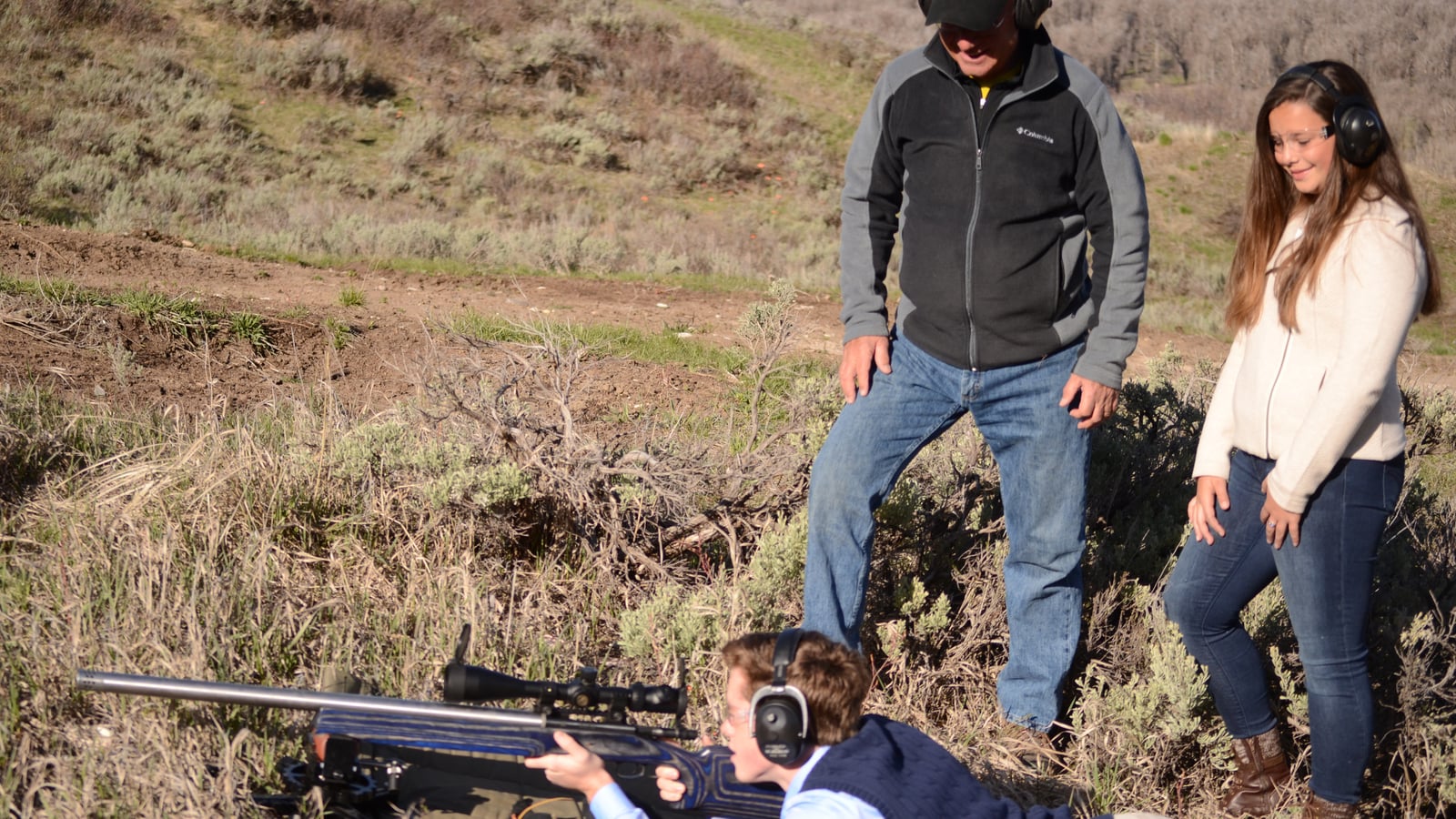
What is F-Class
F-Class is a very-long-range precision shooting discipline, fired exclusively off a rest. The “F” comes from “front rest”: the rifle sits on a bipod or a front support, complemented by a rear bag that stabilizes the stock. You never hold the rifle at arm’s length like in classic standing shooting.
The discipline was born in Canada in the 1990s, driven by shooters who wanted a precision practice accessible to body types and physical conditions that no longer allowed traditional sling-supported prone shooting. It then spread internationally and became structured with its own categories and rules.
The goal stays simple on paper: put as many hits as possible in the center of a target, at distances ranging from 300 meters up to more than 1000 meters depending on the competition. In practice, every parameter matters: wind, light, ammunition prep, consistency of technique.
What truly sets F-Class apart from other precision disciplines is its relationship to equipment. Here, the rest and the support are an integral part of the shooting system, not a mere accessory. An F-Class rifle, its rings, its bipod, and its rear bag form a set designed to eliminate as many human variables as possible and leave only ballistic and environmental ones.
This “everything on a rest” philosophy also changes the profile of shooters who come to F-Class. You’ll meet many former practitioners of other precision disciplines looking for continuity in their practice when sling-supported prone shooting or standing shooting becomes physically harder. The discipline requires neither the same mobility nor the same postural endurance as other sport shooting formats, making it one of the few very-long-range disciplines truly accessible over the course of a shooter’s lifetime.
The discipline’s name is sometimes confused with other terms using the letter “F” in the shooting world, but it has no connection to any weapons classification or regulatory category. F-Class refers solely to the competition format and its rest system, nothing more. This is worth clarifying right from the start, since the name alone tells you nothing about the equipment or legal framework involved.
The F-Open and F-TR categories
F-Class is divided into two main categories, F-Open and F-TR, which don’t carry the same level of equipment restriction. Understanding this distinction is the first thing to do before choosing your discipline.
The F-Open category is the most permissive. It allows bipods adjustable in every direction, custom-fitted adjustable stocks, large-diameter barrels, and a wide variety of calibers as long as they stay within the recoil and velocity limits set by the competition rules. It’s the category where equipment is pushed the furthest.
The F-TR category, for “Target Rifle,” is notably more restrictive and leans toward a “service rifle” spirit adapted for precision. The bipod must be a model fixed to the barrel or forend, without motorized lateral adjustment, and the caliber is generally limited to two families: .223 Remington and .308 Winchester (or their metric equivalents depending on the federation). The idea is to limit the equipment advantage in order to refocus the competition on the shooter’s technique.
This difference in restriction completely changes the approach to preparation. An F-Open shooter can chase tenths of a MOA by working with an ultra-stable bipod and a heavy barrel, while an F-TR shooter must work within fixed limits and rely more on wind management and shot consistency.
Some federations add subcategories (juniors, ladies, seniors, caliber-based categories), but the fundamental F-Open versus F-TR distinction remains the backbone of the discipline worldwide.
One thing that often surprises newcomers: F-Open and F-TR scoring is generally done on the same firing lines and at the same distances during the same competition, with separate rankings by category rather than separate events. This lets a club organize a single competition day welcoming both shooter profiles without doubling the logistics.
The choice between the two categories rarely comes down to budget alone. Some shooters deliberately prefer the F-TR constraint because it brings the competition closer to a “rawer” challenge, centered on wind reading and consistency of technique rather than equipment optimization. Others fully embrace the pursuit of equipment performance that F-Open allows and make it part of the enjoyment of the discipline, much like fine-tuning a precision instrument.
Shooting distances in F-Class
F-Class is practiced at distances that have nothing to do with “standard” precision shooting at 100 or 300 meters. National competitions often start at 300 or 500 meters for shorter formats and go up to 900, 1000 meters, and sometimes beyond at major championships.
At these distances, the bullet’s trajectory is no longer close to a straight line: it traces a real ballistic curve, with vertical drop measured in meters rather than centimeters. The scope’s adjustment must account for this drop through turrets graduated in mil or MOA, calculated from a precise ballistic table for the ammunition used.
Wind becomes the number-one factor in dispersion at these distances. A breeze of just a few kilometers per hour, invisible to the naked eye at the firing line, can shift a hit by several dozen centimeters at 1000 meters. Reading the wind flags set up along the range and anticipating gusts becomes a skill in its own right, often more decisive than the sheer quality of the equipment.
Bullet flight time also plays a role that’s underestimated at shorter distances. At 1000 meters, a bullet can take more than a second to reach the target, giving the wind time to change between the shot and the impact. Experienced shooters learn to “read” wind trends over several seconds rather than react to the present instant.
This distance management also explains why F-Class attracts shooters from other precision disciplines looking for a real ballistic challenge, beyond simple short-range grouping consistency.
Air density also influences trajectory at these distances, much more than at 100 or 200 meters. Firing point altitude, atmospheric pressure, and humidity change the resistance the bullet encounters throughout its path. A shooter switching competition venues therefore has to recalculate their ballistic tables rather than reuse data validated at their usual range as-is.
The Earth’s rotation itself comes into play at very long distances, a phenomenon called Coriolis drift. Its effect stays minimal compared to wind, but the most rigorous shooters factor it into their calculations beyond 800-900 meters, particularly in international competitions where ranking precision sometimes comes down to a single point.
This level of ballistic demand explains why many F-Class shooters use a dedicated ballistic calculator, on a phone or a standalone device, rather than relying solely on a fixed printed table. Conditions change from one string to the next, and recalculating the correction instead of estimating it from memory removes an avoidable source of error.
Allowed equipment in detail
A typical F-Class rifle starts from a precision action (often bolt-action) mounted in a specific stock, usually wider and more stable than a classic hunting stock, with a rail built in to attach the bipod up front.
The barrel is a central element. In F-Open, heavy large-diameter barrels are the norm because they dissipate heat better and vibrate less between shots, which improves grouping consistency over a long string. In F-TR, barrel diameter and weight stay closer to what you’d find on an enhanced service rifle.
The scope is almost always a high-magnification model, often above 20x, with precise, repeatable adjustment turrets. Scope quality matters as much as barrel quality at these distances: play in the turrets or a zero shift ruins an entire string.
The bipod or front rest changes nature depending on the category. In F-Open, you find very sophisticated supports with fine adjustments in height, tilt, and rotation. In F-TR, the rules mandate simpler solutions, generally fixed directly to the forend of the rifle.
The rear bag completes the rest system. It stabilizes the stock and lets you fine-tune vertical aim through slight hand pressure, without ever carrying the weight of the rifle at arm’s length. This is a skill in its own right: filling and shaping your bag well makes a real difference in competition.
On the ammunition side, reloading is nearly universal at competitive level. F-Class shooters adjust powder charge, bullet type, and seating depth to get the best possible muzzle velocity consistency, since every velocity variation translates into increased vertical dispersion at long range.
Action bedding — how the rifle’s action is fitted into the stock — plays a role that beginners often underestimate. A poorly fitted action, or one that moves slightly under recoil, introduces random dispersion that no scope adjustment can correct. Many F-Class shooters have their action bedded by a specialized gunsmith with epoxy resin to guarantee perfect, constant contact between action and stock.
Overall weight of the setup is another important technical parameter, especially in F-Open. A heavier rifle absorbs recoil better and limits residual movement between shot ignition and bullet exit from the barrel, which improves grouping consistency. This is one reason why some F-Open configurations, once mounted with scope and bipod, comfortably exceed 9 to 10 kilograms.
The muzzle brake, when allowed by competition rules, noticeably reduces the recoil felt by the shooter and limits rifle movement at ignition. It does, however, change the noise level experienced by neighboring shooters on the line, which pushes some clubs to limit or regulate its use on their own ranges.
Difference with PRS and terrain-oriented shooting
PRS (Precision Rifle Series) and related “field” precision shooting disciplines share a taste for long-range shooting with F-Class, but the philosophy is almost opposite on several key points.
In PRS, the shooter constantly changes position: standing, kneeling, prone, braced against an obstacle, a bag, an unstable tripod. Time is tight, often under a minute per stage, and you have to set up fast on imperfect supports. F-Class, by contrast, is almost always fired prone, with a comfortable preparation time and a rest system that’s stable and repeatable from one shot to the next.
PRS also multiplies distances and target types within a single course, with metal targets of varying sizes placed at different ranges within the same stage. F-Class focuses on a fixed distance per string, fired at a scored paper target, in a format much closer to classic Olympic shooting in terms of flow.
The physical dimension also differs a lot. PRS demands physical engagement: fast movement, position changes, breathing management after exertion. F-Class is almost entirely static, which explains why the discipline remains accessible to shooters who can no longer string together demanding physical positions.
Finally, allowed equipment diverges sharply. PRS often imposes total weight limits for the mounted rifle, precisely to prevent an overly heavy, overly stable system that would cancel out the mobility challenge. F-Class, especially in F-Open, has virtually no weight limit, which pushes equipment toward extremes of stability unthinkable in PRS.
These differences don’t make one discipline “better” than the other — they simply answer different practice goals: PRS simulates varied field shooting scenarios, F-Class isolates pure precision at a fixed distance with a stable rest.
Mental preparation also differs between the two disciplines. In PRS, the shooter must manage the stress of limited time and constant improvisation on unfamiliar positions. In F-Class, the mental difficulty is closer to that of classic Olympic shooting: maintaining stable concentration over a long string, with no position change to “break” the routine and release tension.
Some shooters actually practice both disciplines in parallel, since they complement each other more than they oppose. The ammunition preparation rigor gained in F-Class directly benefits the consistency sought in PRS, while the stress and unpredictability management learned in PRS helps stay calm during an F-Class string disrupted by an equipment incident or a sudden wind change.
How an F-Class competition unfolds
An F-Class competition generally runs over several “relays” (matches), each made up of a series of shots fired at a given distance, with a limited time for the whole string. A classic format strings several distances together over a single day or a full weekend.
Each shooter gets a preparation time before official timing starts, to set up their bipod, rear bag, and check their scope zero. Once shooting time begins, they must fire their string of shots while managing wind and noting corrections between each hit if the format allows it.
Scoring is calculated on a target with concentric zones, with a maximum score per shot at the center. At long distances, a “V-Bull” or reinforced central zone often breaks ties between the top shooters on equal scores, with centering precision then counting more than the raw score.
A distinctive aspect of high-level F-Class is the role of the “spotter” or coach, who watches the impacts through a spotting scope and relays wind corrections to the shooter between each shot, in some team-based formats. This two-person dynamic completely changes the preparation of each string compared to isolated individual shooting.
Competitions run in all weather, which makes F-Class a discipline where managing changing conditions (shifting wind, changing light, light rain affecting aim) becomes a skill in its own right, just as much as pure technical shooting mastery.
The team format also exists in some international competitions, where two or three shooters share a common string time and take turns at the firing line while a teammate handles observation. This setup adds a collective dimension to an otherwise very individual discipline and requires communication coordination rehearsed in advance between team members.
The final ranking of a competition generally combines the scores obtained at each distance on the program, sometimes weighted differently depending on the difficulty of the distance involved. A shooter can thus dominate a short distance and lose ground at the longest one if their wind reading there is less consistent, which rewards overall consistency rather than performance on a single isolated string.
Gearing up to start in F-Class
Getting into F-Class requires a more structured investment than many other sport shooting disciplines, mainly because of the cost of specialized equipment and the need to access a long-range firing point.
The first step is finding an affiliated club that organizes or hosts F-Class competitions, since few ranges natively offer distances beyond 300 meters. An experienced club instructor can steer a beginner toward a caliber and setup suited to their budget and goals.
To get started, many shooters opt for the F-TR category precisely because the caliber is limited and the base equipment is generally less expensive than the most advanced F-Open setups. A used rifle in .308 Winchester with a decent scope makes a reasonable learning base before investing in more specialized gear.
Reloading ammunition isn’t mandatory to start, but quickly becomes essential once you want to seriously improve long-range shooting consistency. It’s a discipline in itself, requiring rigor and patience before producing homogeneous batches.
On the administrative side, acquiring a manually operated repeating firearm of this type falls in France under Category C, subject to declaration, or Category B if the chosen model is semi-automatic and subject to prefectural authorization. The exact steps vary by model and prefecture, so it’s best to check directly with your club or gunsmith for the specific firearm involved. Rules vary by country, so check with your local shooting federation for equivalent classifications.
The spotting setup is an accessory often overlooked in the starting budget, yet a decent-quality spotting scope is almost as essential as the rifle scope itself. It lets you spot your own hits on the target at long range and observe the wind indicators placed along the course — two pieces of information you can’t get from the scope mounted on the rifle alone.
The overall budget for a complete, competitive F-Open setup can run several times that of an entry-level F-TR setup, notably because of the cost of the heavy barrel, the adjustable stock, and the high-magnification scope. It’s entirely possible to progress for several seasons with modest equipment before considering an upgrade, since most of the progress hinges on consistency of technique and reading conditions rather than equipment alone.
Joining a local competition even before owning your own gear often remains possible: many clubs run discovery days where an experienced shooter lends their rifle and coaches a beginner through their first long-range strings. It’s the best way to check whether you genuinely enjoy the format before investing in dedicated equipment.
The central role of wind and conditions
No other factor weighs as heavily on the final result in F-Class as wind reading. At 1000 meters, an estimation error of just a few kilometers per hour can be enough to push a hit out of the scoring zone.
Experienced shooters use several sources of information in parallel: wind flags placed along the shooting course, mirage visible through the scope in strong heat, movement of the surrounding vegetation, and sometimes an anemometer at the firing point to measure local wind, which can differ from wind further along the trajectory.
The real difficulty isn’t measuring wind at the firing point, but estimating the average wind over the entire trajectory, which can vary in strength and direction between the shot and the bullet’s arrival. This is a skill built over hundreds, even thousands, of shots, and it remains the main differentiating factor between shooters of otherwise equal equipment level.
Light and heat also play an important indirect role. Strong mirage in late morning can blur your aim and create a false impression of target movement, requiring the shooter to learn to filter out this visual disturbance rather than needlessly correct for it.
It’s precisely because these conditions constantly change that a detailed shooting log makes full sense in F-Class: noting wind conditions, temperature, and corrections applied for each string lets you reconstruct a usable history to improve from one outing to the next.
The wind flags themselves require specific reading skills. Their angle relative to the mast indicates wind strength, but their “rippling” movement also reveals gusts and lulls, a nuance an untrained eye doesn’t pick up immediately. Experienced shooters learn to watch several flags placed at different distances along the course, since wind is almost never uniform across the entire trajectory.
Air humidity and ambient temperature also indirectly influence wind reading, by changing air density and thus how the bullet reacts to an apparently equal wind strength. A visually identical wind can produce a different deflection depending on whether the session happens early morning in cool, dense air or in the full heat of the afternoon in lighter air.
Progressing in F-Class: the method
Progress in F-Class doesn’t rely solely on accumulating fired rounds. It requires a structured method, since every string is costly in ammunition and available range time.
Dry practice, without ammunition, remains an essential base even in F-Class, especially for getting set up on the rest and rear bag. Getting into position quickly and repeatably on your bipod, with a stable posture and natural body alignment behind the rifle, already avoids a good deal of unnecessary dispersion.
Developing a homogeneous handload is a project in its own right. An experienced club shooter often spends several sessions testing different powder charges, measuring muzzle velocities on a chronograph, and looking for the charge “node” that gives the best consistency, even before thinking about competition.
Wind reading is learned through repeated practice and after-the-fact analysis. Many experienced shooters recommend systematically noting your wind estimate before each shot, then comparing it to the actual impact, to calibrate your own judgment over successive outings.
A rigorous digital shooting log quickly becomes a valuable ally for this analysis work: recording distance, ammunition, scope setting, wind conditions, and the result of each string lets you spot trends that memory alone would never retain correctly, especially after several months of practice.
Finally, joining an active F-Class club or entering local matches before major competitions remains the fastest way to progress. Exchanging tips with more experienced shooters on equipment setup and wind reading speeds up learning far more than solo practice.
Physical progress matters too, even in such a static discipline. Holding a stable, relaxed prone position through a long string engages the back, neck, and shoulders differently than standing shooting, and some shooters specifically train their core to hold a comfortable position without tension for the whole duration of a timed string.
Breathing management remains a fundamental that never goes away, whatever precision discipline you practice. In F-Class, where preparation time is generally more comfortable than in dynamic shooting, many experienced shooters use it to settle their breathing into a slow, regular rhythm, only triggering the shot during a natural pause between two breaths.
Common mistakes among F-Class beginners
The first classic mistake is underinvesting in the scope in favor of the barrel or action. A mediocre-quality scope, with turrets that drift slightly, ruins setting repeatability far faster than a slightly less capable barrel.
The second common mistake is neglecting work on the rear bag and getting into position. A beginner often focuses all their attention on setting up the front bipod, forgetting that it’s the rear hand on the bag that fine-tunes the final vertical aim before the shot.
Many newcomers also underestimate the importance of homogeneous reloading. Using off-the-shelf ammunition with velocity that varies from one round to the next introduces vertical dispersion that completely masks the real quality of shooting technique and equipment.
Managing string time also causes trouble for beginners. Wanting to shoot too fast to “save time” on a timed string often leads to ignoring a visible wind change, which costs more points than a slightly slower shot better synchronized with conditions.
Finally, a subtle but frequent mistake is neglecting note-taking during training. Without a written history of settings and conditions, every session starts from scratch, whereas a shooter who builds on their data progresses noticeably faster over a full season.
Maintaining long-range equipment
An F-Class rifle undergoes a different usage regime than a short-range firearm: strings are longer, the barrel heats up more, and competition firing rate can heavily stress the whole mechanical assembly in a single day. Regular maintenance therefore takes on particular importance.
Barrel cleaning must be adapted to its nature. A heavy precision barrel fouls differently from a standard barrel, and many F-Class shooters follow a precise cleaning protocol between competitions, avoiding excessive brushing that would prematurely wear the crown (the barrel’s muzzle end), a zone critical to grouping precision.
The scope deserves regular checking of its zero retention, particularly after transport or an impact, even a light one. A simple method is to fire a control group at a known distance before every major competition, to confirm nothing has shifted since the last outing.
The bipod and rear bag, while less mechanically sensitive, also wear over time. A bipod pivot that develops play, or a bag whose fill packs down, changes the stability of the rest gradually and in a way that’s hard to spot without regularly comparing groups over time.
Finally, tracking round count per barrel remains common practice among serious shooters, since a barrel’s precision gradually degrades after several thousand rounds depending on caliber and barrel quality. Logging this figure in a tracking notebook lets you anticipate a barrel change before precision noticeably degrades in competition.
Where to practice F-Class at a club
F-Class remains a less widespread discipline than classic target shooting in the club landscape, mainly because it requires a range capable of hosting distances of 300 meters and beyond, which rules out many urban or nearby ranges.
Clubs that offer this discipline are often located in rural areas, on large outdoor sport shooting grounds capable of hosting long, secured firing lines. Some large regional clubs organize open-house days specifically dedicated to discovering F-Class, a good opportunity to try the discipline without any immediate equipment commitment.
To find a suitable club, the most efficient approach remains contacting your regional shooting federation directly or checking the long-range competition calendars published by the relevant sport commissions. An experienced club shooter can also point a beginner toward available training slots and local competitions suited to a first level.
Club membership and a shooting license remain the basic administrative prerequisites for accessing a supervised long-range firing point. These steps are identical to those for any other civilian sport shooting discipline, and a club active in F-Class will generally guide a new license holder well through their first steps.
FAQ
Q: Do you need a specific rifle to start F-Class, or can you use a classic precision rifle? A: A classic precision rifle fitted with a bipod and a rear bag lets you discover the discipline without immediate investment. To progress seriously, especially in competition, a rifle designed for a stable rest quickly becomes preferable, particularly in F-TR where caliber and bipod are regulated.
Q: What’s the main difference between F-Open and F-TR? A: F-Open allows highly adjustable bipods, adjustable stocks, and large-diameter barrels with no major caliber restriction. F-TR limits the bipod to a fixed model and generally restricts caliber to two families, which refocuses the competition on technique rather than equipment.
Q: Is F-Class harder than PRS? A: These are two different challenges rather than a matter of comparable difficulty. PRS tests speed of getting into position on varied, imperfect supports, while F-Class isolates wind management and shot consistency at a fixed distance with a stable rest.
Q: Can you practice F-Class without reloading your own ammunition? A: Yes, for starting out and training at short distance, but muzzle velocity consistency becomes decisive beyond 500-600 meters. Most competitive shooters end up reloading to get homogeneous batches, which greatly reduces vertical dispersion at long range.
Q: What distances are typical in F-Class competition? A: Formats generally range from 300 to over 1000 meters depending on the championship and category. National and international competitions often include several distances over the same weekend, requiring the shooter to readjust their scope settings between each relay.
Q: What firearm category does an F-Class rifle fall under in France? A: It depends on the model: a manually operated repeating firearm generally falls under Category C, subject to declaration, while a semi-automatic model falls under Category B, subject to prefectural authorization. It’s best to check the specific case with your club or a gunsmith before purchase. Check your own country’s regulations for the equivalent classification.