
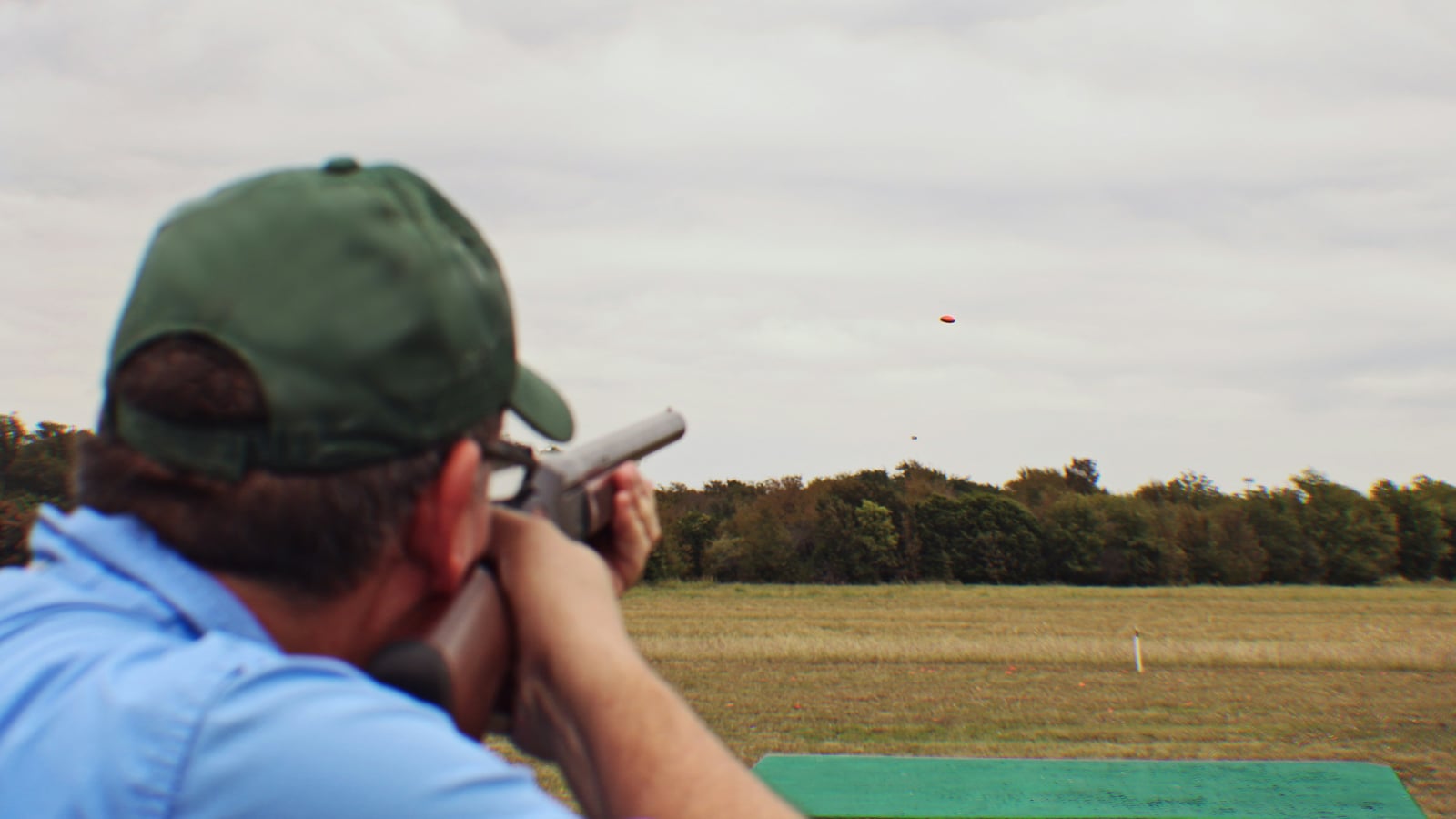
The principle of double trap in one sentence
On paper, double trap is just a simple variant of classic trap. On the firing line, it’s a completely different discipline. You call for the birds, two clays are released simultaneously from the buried trap house in front of you, and you get a ridiculously short window of time to break both before they hit the ground or leave the regulation zone.
The difference with single trap isn’t in the clay’s trajectory, which stays broadly comparable in speed and range. It’s that there’s no longer one target to process, but two, and they arrive at the same time. Your brain doesn’t get the luxury of processing information sequentially the way it naturally would.
This discipline is part of the men’s Olympic program (it also existed on the women’s side in the past, before being dropped from the Olympic program while remaining part of FFTir and international competition). Its reputation as the “fastest” clay shooting discipline isn’t a marketing line: it rests on measurable neuromuscular processing-time constraints documented by top-level coaches.
A club shooter discovering double trap after years of single trap or skeet is often thrown off from the first few rounds. That’s not a lack of talent — the discipline calls for a different decision-making mode than whatever you’ve automated elsewhere. Understanding that mode is the key to progressing fast instead of wearing yourself out repeating the same mistakes.
How a double trap round unfolds
The firing line is organized into five stations, arranged in an arc facing a buried trap house containing the throwing machines. You move from station to station through the round, just like in classic trap, but each station presents a different trajectory combination for the two clays launched simultaneously.
In FFTir and international competition, trajectory combinations are fixed by the rules according to the station you’re at: some pairs fly almost straight ahead with a moderate diverging angle, others show one clay climbing higher than the other, or a more pronounced angle gap. You don’t choose the combination — it’s dictated by your position on the line.
You shoulder the gun in the low-ready position, stock against the hip, just as in single trap. You call orally (“pull” or the club’s equivalent), and both clays are ejected at the same instant by the machine, without the staggered delay you might find in other clay shooting variants.
You have two cartridges and must decide, in a split second, which clay to take first. That choice is not trivial: it shapes the entire rest of the shot and is worked on technically well ahead of time, long before the clay even leaves the trap house.
A full round typically covers 25 pairs of clays (50 targets), spread across the five stations. In top-level competition, several rounds follow one another according to a qualification-then-final format, with the number of shooters progressively narrowing at each stage.
The tight timing: what makes the discipline unique
The feature that truly sets double trap apart from every other clay discipline is the absence of a sequential decision window. In single trap, you process one clay, break it or miss, then can slightly readjust your attention. In skeet, trajectories are known in advance and, while fast, the timing stays predictable clay by clay.
In double trap, both clays are in the air at the same time from the start. You have to engage the first one while the second is already visible at the edge of your field of view, which creates a cognitive load other clay disciplines don’t demand in the same way.
The useful flight time before the first clay becomes hard to break cleanly is measured in a handful of tenths of a second. This isn’t reaction time in the sprinter’s sense — it’s decision time, aiming time, fine adjustment, and shot release, all chained without conscious interruption.
What complicates things further is that the second clay keeps flying while you deal with the first. Its position by the time the gun swings back to it is no longer what it was at the throw: it has evolved in speed and trajectory, often already descending. So you never aim at a fixed point — you aim at a moving window that’s closing.
It’s this double time constraint — a fast decision on the first clay combined with anticipating a second clay in continuous motion — that earns double trap its reputation as the fastest clay shooting discipline. That’s not an empty phrase: it’s a fairly accurate description of what actually happens on the line.
Why reflexes matter more than strength
Contrary to a common misconception, success in double trap doesn’t rest on “raw” reflexes comparable to what a fast-paced video game tests. It rests on a set of trained, automated reflexes, built through repetition, that free the brain from the burden of conscious decision-making at the critical moment.
An accomplished club shooter starting double trap after years in another discipline often has good general reflexes, but not yet the specific reflexes for reading two trajectories simultaneously. That reading is learned — it isn’t something you already have, even if you’re very experienced elsewhere.
The technical motion relies on three distinct automatisms that must run in parallel without interfering with each other: precise aim on the first target, an approximate memory of the second clay’s position at the edge of your vision, and quickly re-engaging the gun toward that second position without consciously re-breaking down the movement.
What separates an experienced double trap shooter from a beginner, then, isn’t muscle speed — it’s how fast the brain recognizes an already-encountered pattern. An experienced instructor often stresses this point to students: double trap is trained by repeating known trajectory patterns, not by improving general quickness.
Nervous fatigue is also an underestimated factor. A double trap round demands far more intense attention than a single trap round of the same length. A shooter running several rounds without a break often notices a degradation in trajectory reading well before any classic muscular or physical fatigue sets in.
Choosing the first clay: a strategic decision
For every pair, you have to decide which clay to engage first. That choice depends on the trajectory combination specific to your station: generally, you take out the clay whose shooting window closes fastest first, saving the more “generous” one, time-wise, for the second cartridge.
This prioritization isn’t instinctive at the start. It’s learned station by station, combination by combination, through repetition on the line and after-the-fact analysis of misses. A beginner club shooter often gets the optimal order wrong, which isn’t strictly a shooting error but a mental preparation error made beforehand.
Some shooters deliberately train to always break the higher clay first, others the one moving faster in angle, depending on feel and advice received. There’s no single universal rule validated for every station: the best approach often depends on the station, the gun, and the shooter’s personal feel.
What matters above all is consistency in the decision. A shooter who changes the processing order every round, based on mood or a passing impression, doesn’t have time to build the necessary automatism. The best strategy is often the simplest one to repeat, not the theoretically most optimal one on paper.
Equipment requirements and fine-tuning specific to double trap
The gun used in double trap is almost always a 12-gauge semi-auto or over-under, as in single trap, but the settings differ noticeably. The discipline calls for a gun that naturally points “flat” rather than high, since the second clay engaged is often already descending.
Cartridge choice follows a trade-off logic between having enough shot density to break cleanly at short-to-medium range and controlled recoil, essential for quickly re-aiming at the second target. Poorly controlled recoil slows down re-engagement far more than it hurts the accuracy of the first shot.
The point of impact and rib adjustment are also more critical than in single trap, because you don’t have time to consciously correct a pointing discrepancy between the two shots. Many accomplished shooters have their gun adjusted (stock length, drop, lead) specifically for this discipline, even if they use a similar gun for classic trap.
Choosing shooting glasses deserves particular attention: the tint must let you clearly distinguish both clays in simultaneous flight, even under changing light conditions. A shooter who keeps the same tint all year, regardless of weather, often deprives themselves of an easy readability gain available with interchangeable lenses.
Finally, hearing protection and protection against repeated recoil matter more than you’d think over the course of a competition. Double trap imposes a sustained shooting pace across the whole round, and poorly fitted hearing protection or badly absorbed recoil fatigues you faster than a discipline with a more spread-out rhythm.
The role of mental training and visualization
Technical motion isn’t enough in double trap: mental preparation takes on a central role here, even more than in other clay disciplines. Because decision time is so short, any conscious doubt at the moment of the shot translates almost immediately into a miss.
Many accomplished shooters practice visualization before the round: they mentally replay the trajectory of both clays, station by station, even before shouldering the gun. This mental repetition doesn’t replace physical training on the line, but it reinforces the pattern recognition that’s at the heart of double trap performance.
Competition stress management follows a particular logic here: a stressed shooter tends to slow down their decision-making at the worst possible moment, which is the opposite of what the discipline demands. Mental work, then, aims less at “calming down” in the broad sense than at automating the decision so it no longer depends on the emotional state of the moment.
A stable pre-shot routine, identical down to the detail (foot position, breathing, the moment of the call), helps recreate the same decision conditions round after round. An experienced instructor often encourages students to film their rounds to make this routine objective, rather than relying solely on their own sense of it.
Common mistakes among shooters discovering the discipline
The first classic mistake is trying to process both clays “at the same time” with your eyes, trying to keep both in your central field of view. This reflex, inherited from other aiming practices, is counterproductive: you actually need to accept temporarily losing sight of the second clay in order to fully deal with the first.
The second common mistake is rushing the first shot in anticipation of the second, which degrades accuracy on the easier target to break. A shooter pressured by the second clay’s presence often botches the first movement, which is actually the simpler of the two to get right.
Another classic mistake is keeping a fixed processing order regardless of station, when the trajectory combination genuinely changes from station to station. What works at station one doesn’t necessarily work at station three or four, and a shooter who applies a single routine without discernment quickly plateaus.
Finally, many shooters new to double trap underestimate the impact of nervous fatigue over a long session. They run rounds without sufficient breaks and see their success rate drop toward the end of the session, not from lack of technique, but from attention saturation. A short break between rounds, even just a few minutes, often changes the result noticeably.
Progression, video analysis, and data tracking
Progress in double trap benefits from being broken down rather than tackled head-on. Many instructors start by having the shooter work on single clays thrown in typical double trap trajectories, before introducing the simultaneous pair. This isolates aiming mechanics from decision difficulty.
Once the basic mechanics are mastered station by station, gradually introducing the full pair lets the shooter focus solely on the real novelty: managing the second clay after the first shot. Jumping straight to the full round without this intermediate step often lengthens the learning curve instead of shortening it.
Rigorously tracking results station by station, rather than an overall round score, lets you pinpoint exactly where the difficulty lies. A shooter can perfectly well master three out of five stations and consistently struggle on the other two — an imbalance invisible if you only look at the final score.
Keeping a detailed shooting log, station by station and session by session, lets you objectify this progress instead of relying on a general impression. Many accomplished shooters also note the processing order chosen at each station, which helps spot the strategic choices that really work over time rather than those that just look good in a single session.
Consistency far outweighs volume. Frequent but short practice, with real work on reading trajectories, generally progresses faster than rare but long practice sessions where nervous fatigue degrades learning quality after the first few rounds.
Safety, starting out at a club, and regulatory basics
As with any clay shooting discipline, safety in double trap rests on strict rules for gun handling between stations and while moving. The gun stays open or unloaded outside the moment of shooting, and you only shoulder it once positioned and ready to call.
The discipline’s fast pace never justifies relaxing vigilance on these basic rules. A shooter pressured by double trap’s tight timing must, on the contrary, double down on rigor in gun handling between pairs, precisely because the temptation to “save time” exists more here than in a more relaxed-paced discipline.
Club supervision generally stresses this point from the very first introductory sessions: the execution speed required by double trap concerns processing the clays, never handling the gun outside the actual moment of firing. These are two distinct timeframes that must never be confused.
Most FFTir clubs equipped for single trap don’t necessarily have double trap installations, since the double throwing machine is more specialized and less widespread than classic trap equipment. Checking with your regional league or neighboring clubs remains the best first step to locating a suitable installation.
An instructor qualified in the discipline is a real asset for the first sessions: beyond safety, they help break down learning in the right order rather than letting the beginner face the full round from the start, which often leads to rushed habits that are hard to correct later.
Loaner equipment available at the club generally lets you discover the discipline without immediately investing in a dedicated gun. This gives you time to confirm genuine interest in double trap before considering a specific setup or purchase, knowing the discipline’s equipment needs differ from single trap’s on several points of detail.
Finally, the administrative process for practicing sport shooting stays the same regardless of the discipline targeted: FFTir license, medical certificate, and for acquiring a suitable gun, the steps corresponding to its category (semi-automatic repeating shotguns used in clay shooting most often fall under category C, subject to declaration, but this varies by exact model and should be checked precisely with your gunsmith or federation).
Double trap, single trap, skeet, sporting: placing the discipline correctly
The clay shooting landscape includes several disciplines that look alike from a distance but diverge sharply once you’re on the line. Single trap presents one clay at a time, in a broadly frontal direction, with moderate angle variation from shot to shot. Skeet offers known crossing trajectories thrown from two distinct towers, sometimes in pairs but with different timing and reading than double trap.
Sporting clays, another very popular clay discipline at clubs, bets on variety of trajectories and staged scenarios rather than pure decision speed. A shooter used to sporting clays finds in double trap a speed demand they don’t encounter the same way elsewhere, which explains why so many shooters accomplished in one discipline remain beginners in another.
What truly sets double trap apart from all these variants, then, isn’t the nature of the clay or the shooting distance, which stay broadly close from one discipline to another, but the imposed simultaneity of the two targets. No other Olympic clay discipline requires processing two independent trajectories launched at the same instant from a shared starting point.
A shooter who already practices single trap has a solid technical base (shouldering, recoil management, single trajectory reading) that speeds up their grasp of double trap. But they have to accept starting almost from scratch on the decision-making dimension, which takes a good dose of humility for a shooter used to performing well elsewhere.
Filming your rounds remains one of the most effective tools for progressing in double trap, precisely because execution speed prevents any fine analysis in the heat of the moment. A shooter who just missed a pair rarely can say precisely what went wrong: slow-motion footage lets you objectify what the immediate sensation can’t faithfully convey.
Video analysis typically reveals three recurring types of flaws. The first is a reaction time to the call that’s too long or too variable from one pair to another, which eats up a significant part of the useful window before even the first aiming movement. The second is excessive head movement to “search” for the second clay instead of leaving it in peripheral vision until the right moment.
The third flaw, more subtle, concerns swing speed between the two shots: some shooters unconsciously slow their re-engagement movement out of apprehension, while others rush it to the point of losing the aiming precision gained on the first clay. Video lets you clearly distinguish these two profiles, which call for nearly opposite corrections.
Comparing several filmed sessions several weeks apart also lets you measure progress that score alone doesn’t always show. A shooter can break the same number of clays across two sessions of very different execution quality, the second being noticeably more fluid and less draining nervously — something only visible on video.
This video work requires a certain amount of personal discipline to be truly useful: filming a session without ever reviewing the footage adds nothing beyond a simple memory. A shooter who blocks out a short slot after each filmed session, even just ten minutes to spot the two or three most revealing pairs, gets far more benefit than one who piles up hours of never-analyzed footage.
Competition, final format, and real shooting conditions
In FFTir competition as at the international level, double trap follows a qualification-then-final format that further amplifies the time pressure already inherent to the discipline. Qualified shooters run through a reduced number of pairs in the final, where every miss weighs proportionally heavier than during qualification rounds.
This competition structure changes the nature of the challenge: it’s no longer just about executing well technically, but about reproducing that execution under immediate, visible ranking pressure, often in front of an audience with real-time score display. A shooter who manages their stress perfectly in training sometimes discovers a different reality during their first final.
Managing the wait between rounds is also an integral part of competition performance. A qualified shooter sometimes has to wait a considerable time before their final appearance, which breaks the concentration dynamic built during qualification. Accomplished shooters develop specific routines for this wait: dry warm-up, renewed visualization, managing food and hydration.
Double trap ranking is built across all rounds, qualification included, meaning an average round early in competition isn’t fatal but seriously complicates access to the final. This reality pushes many shooters to prioritize consistency across all rounds over chasing a maximum score in just one of them.
Outdoor conditions play a more pronounced role in double trap than in many other shooting disciplines, simply because the decision margin is so short that even a minor loss of readability has a disproportionate impact on the result. An overcast, changing sky is reputed to be harder than a uniformly clear or uniformly gray one, because clays change contrast depending on angle and background.
Wind alters the clays’ actual trajectory compared to the “normal” trajectory memorized in training, which particularly disrupts the second clay, already harder to process because its position has shifted during the first shot. An accomplished shooter learns to spot these deviations from the very first pairs of a session and adjust their timing without rebuilding their whole technique.
Light late in the day or during indoor sessions under artificial lighting also changes the perceived speed of the clays, often underestimated in low-contrast conditions. Many clubs with double trap facilities schedule sessions at different times of day precisely to accustom their shooters to this variability, rather than always training under the same comfortable conditions.
Training only in ideal conditions is a fairly common mistake among shooters who progress fast at the club but stagnate in outdoor competition, where conditions are never chosen. Deliberately varying light and wind conditions in training, even at the cost of an occasionally worse score, better prepares you for the changing reality of a competition spread over several hours.
The choke, that internal barrel constriction which tightens or opens the shot pattern, plays a particular role in double trap because the two shots of the pair don’t happen at the same effective distance. The first clay, engaged early, is often closer than the second, processed a moment later after it has continued its flight.
Many accomplished shooters, when their gun allows it, opt for a barrel with interchangeable chokes set asymmetrically between the two shots — a more open choke for the closer first shot and a tighter one for the farther second. This setting isn’t universal: it depends on the gun, the station worked on primarily, and the shooter’s personal feel, and it’s built through successive trials rather than a ready-made formula.
Shot load itself is subject to similar trade-offs. A load that’s too light lacks the density to break cleanly at the second clay’s distance, while a load that’s too heavy increases an already penalizing recoil for re-engagement speed. This varies greatly depending on the gun, the shooter’s build, and the regulations specific to each competition category, which makes any precise numerical recommendation unreliable outside a particular context.
This fine-tuning work is ideally done with the support of a gunsmith specialized in sport shooting or an instructor experienced in the discipline, rather than by copying another shooter’s equipment. What works for a given build and swing style doesn’t necessarily transfer identically from one shooter to another.
The very nature of double trap, with its split-second decisions, makes a shooter’s spontaneous memory unreliable for analyzing their own progress. After a session of several dozen pairs, it’s common to retain only an overall impression (“pretty good session,” “station 3 was tricky”) without exploitable detail for the next session.
Systematically noting, station by station, the number of successful pairs, the processing order chosen, and the session’s conditions (weather, felt fatigue, equipment used) turns this vague impression into data comparable over time. That’s exactly the kind of structured tracking a digital shooting log lets you build without extra memorization effort on the shooter’s part.
Over time, this tracking reveals trends invisible to the naked eye from a single isolated session: a station progressing faster than the others, a systematic drop in success rate after a certain number of consecutive rounds, or better performance depending on time of day. This information guides upcoming sessions far better than general intuition, however experienced.
A shooter preparing for a competition also benefits from reviewing past sessions on the same type of installations or conditions, to find the settings and mental reference points that had worked. Without a reliable written trace, this memory fades quickly, especially when several months separate two visits to a similar range.
Double trap is a relatively recent development in clay shooting compared to single trap, whose origins go back to the nineteenth century. The discipline was built as an additional challenge for shooters already very accomplished in classic trap, seeking a variant more demanding in decision speed.
Its inclusion in the Olympic program came later than that of single trap or skeet, which explains why it remains less widespread at clubs than these two historic disciplines. The rarer number of dedicated installations is a direct consequence of that, rather than a sign of waning interest among practitioners.
The international regulations governing double trap are set by world sport shooting bodies, with a national implementation managed by FFTir for competitions organized in France. The precise parameters (distances, angles, round format) are documented in these bodies’ official regulations, which take precedence in case of doubt over the habits of a particular club.
A shooter who wants to know the exact regulatory parameters applicable to a given competition benefits from consulting the regulations in force directly with their federation, as these parameters can be subject to regular adjustments from one season to the next depending on decisions by the relevant bodies.
This relative youth of the discipline compared to single trap also has a practical consequence for a shooter looking to train: technical literature and instructors specifically trained in double trap are fewer in number than for the historic disciplines. A club that has both the right installation and competent coaching in this specific discipline therefore remains an asset worth identifying rather than something obviously available everywhere in the country, and it’s not uncommon for a motivated shooter to have to travel beyond their usual club to find this complete progression setup.
FAQ
Q: Is double trap harder than single trap for a beginner? A: The basic mechanics (shouldering, aiming) are comparable, but managing two simultaneous clays adds a real decision-making difficulty. Most shooters find the discipline more mentally demanding, even if they already master classic trap well.
Q: Do you need a different gun for double trap? A: Not necessarily at the start — a well-adjusted classic trap gun lets you discover the discipline. A more specific setup (flat pointing, recoil management) becomes relevant once genuine interest in regular practice is confirmed.
Q: Why is double trap said to be the fastest clay shooting discipline? A: Because the shooter must process two simultaneously launched clays with an extremely short decision window on the first, all while keeping in mind the position of the second, which keeps moving along its trajectory during that time.
Q: Is double trap still an Olympic discipline? A: It’s part of the current men’s Olympic program. The women’s version existed at the Games in the past before being dropped from the program, while remaining practiced in FFTir and international competition.
Q: How do you progress effectively in double trap? A: By breaking down the learning process (single clays before the full pair), working station by station with a consistent processing order, and keeping precise tracking of your results rather than an overall round score.
Q: Does double trap demand better physical condition than single trap? A: General physical condition matters less than concentration endurance. Nervous fatigue linked to the decision intensity of each pair often limits performance well before any classic muscular fatigue.