
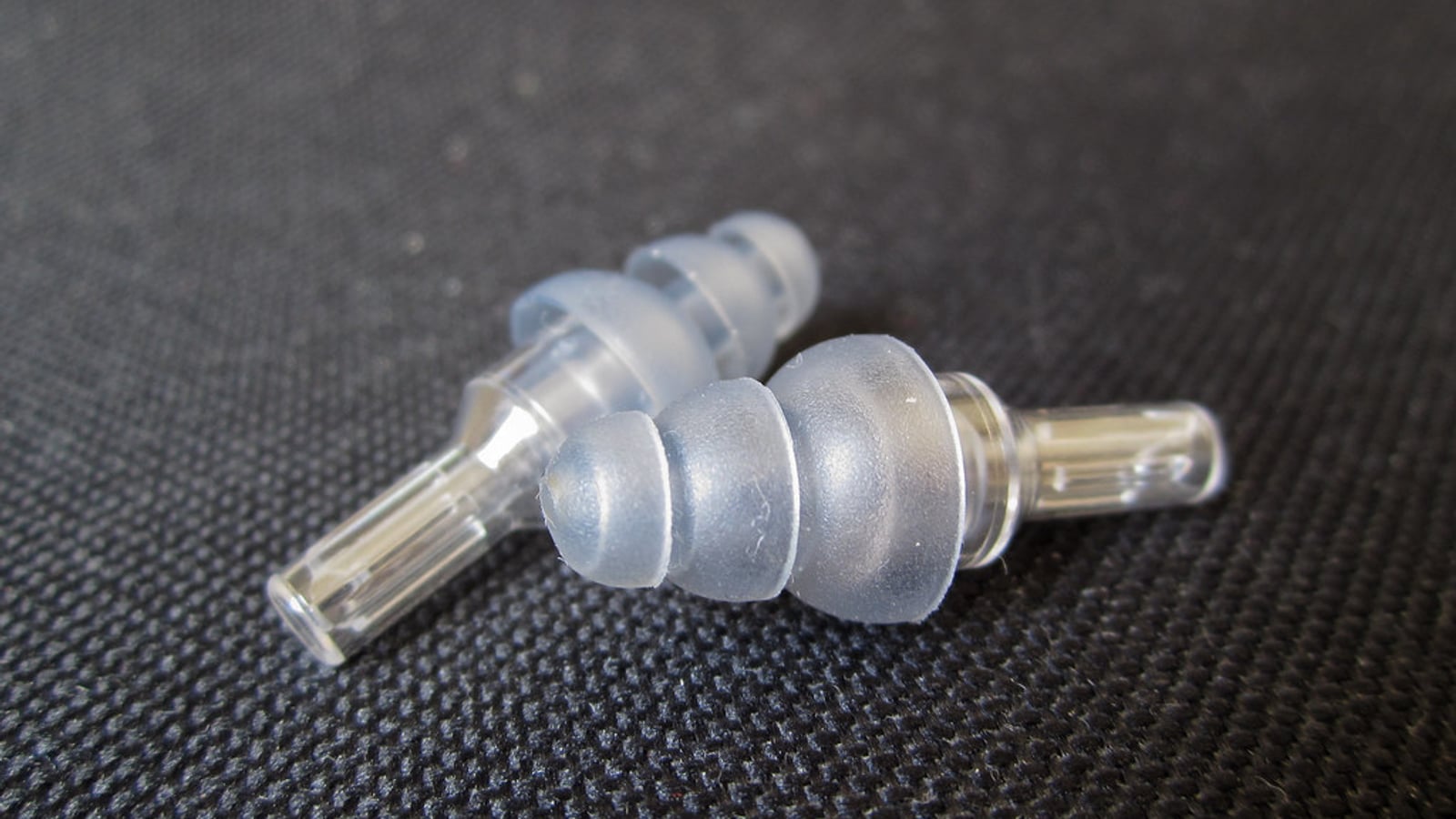
Why hearing protection isn’t negotiable
A gunshot produces a sound peak that far exceeds the pain threshold, in almost every discipline, from 10-meter pistol to 300-meter rifle. This isn’t a passing discomfort: it’s an acoustic trauma that accumulates shot after shot, session after session, even when you feel no pain at the moment.
The problem with shooting-related hearing loss is that it’s painless and progressive. You only realize it years later, when high-pitched sounds become blurry or tinnitus settles in permanently. A regular shooter who neglects their protection for years is taking a risk that no sporting performance can justify.
The good news is that the hearing protection market for sport shooting is mature today. Between disposable foam plugs, generic reusable plugs, electronic earmuffs, and custom-molded plugs, each solution has its strengths and limits. This article focuses on custom earplugs: what they really bring, what they cost over time, and where to go to get a pair made.
Before getting into detail, an obvious point worth repeating: the best hearing protection is the one you actually wear, every session, without exception. High-end equipment left in the bag protects no one. Comfort is therefore not a secondary luxury criterion — it’s the factor that determines whether you’ll actually use it over the long run.
A point often underestimated: the risk doesn’t come only from your own shots. On a club range or during a competition, you’re exposed to the noise produced by shooters at neighboring stations, sometimes with more powerful calibers than yours. Your protection should therefore be designed for the whole session, not just the moments when you’re the one pulling the trigger.
There’s also a cumulative dimension many shooters ignore: noise exposure isn’t limited to the range. A shooter who works a loud job during the week and neglects their protection at the range on weekends accumulates a double exposure that accelerates hearing degradation. This addition of exposures justifies even greater vigilance for anyone who already accumulates noise elsewhere in daily life.
Finally, hearing protection also concerns those around you. A child or companion present on a firing line, even without a weapon in hand, must wear suitable protection. The same principles of comfort and effectiveness apply, with heightened vigilance since a younger ear canal is also more sensitive to acoustic trauma.
The classic foam earplug: simple, cheap, but limited
The expanding foam earplug remains the most widespread solution on shooting ranges, and for good reason. It costs a few cents per unit, is available everywhere, and offers decent sound attenuation when properly inserted and compressed before placement.
The key word here is “properly inserted.” The vast majority of shooters using foam earplugs don’t compress them long enough before inserting them, or don’t push them deep enough into the ear canal. The result: actual attenuation far below what’s stated on the packaging, sometimes by ten decibels or more compared to the advertised value.
The other limitation of the foam earplug is long-term comfort. Worn for more than an hour, it becomes irritating, especially in hot weather or during extended club sessions. Many shooters end up removing it slightly between series to “get some air,” which cancels out part of the protection during the very moments when the ear is most stressed.
Finally, the standard foam earplug attenuates linearly: it cuts the dangerous frequencies of the gunshot just as much as the useful frequencies of speech or an instructor’s commands. On a collective range or in competition, this temporary artificial deafness can become a real communication handicap.
There are also so-called “high-fidelity” foam earplugs, designed to attenuate the high frequencies of a gunshot more while better preserving human voice frequencies. This technology, however, remains a low-cost compromise, far from the precision of a dedicated acoustic filter found on high-end custom models.
Another practical downside of the foam earplug concerns hygiene in a club context. Handled with hands sometimes marked with powder residue or maintenance grease, a disposable plug can introduce particles directly into the ear canal. It’s not a major risk in itself, but it’s a detail that regular shooters learn to watch over time.
Finally, the variability in ear canal sizes poses a real problem with standard foam, sold in one size or two generic sizes. A canal narrower or wider than average will systematically get worse attenuation than advertised, without the shooter being aware of it since they have no point of comparison with a plug actually fitted to their morphology.
Electronic earmuffs: the other benchmark on the market
Electronic earmuffs work on a different principle: external microphones capture ambient sounds and play them back amplified in the earpieces, while instantly cutting the circuit as soon as a sound exceeds a dangerous threshold, like a gunshot. You hear conversations and instructions normally, but the noise of the shot stays blocked.
This technology really changes the session experience, particularly in instruction or club settings where communication is constant. An experienced instructor can give their commands normally, without having to shout or make big gestures to be understood by a student wearing passive protection.
Electronic earmuffs have their own constraints, though. They’re bulky, which can interfere with cheek weld on some rifles or shotguns, particularly in the prone position where the shell bumps against the stock. They also require a battery, with the classic risk of finding it dead right when you’re about to shoot.
The comfort of the headband is also very dependent on morphology and duration of wear. Over a multi-hour competition session, the pressure of the cushions on the temples can become uncomfortable, especially combined with safety glasses whose arms create an additional compression point.
Climate also plays a non-negligible role. On an outdoor range in the middle of summer, sweat accumulating under the cushions of electronic earmuffs quickly becomes uncomfortable, and some shooters notice a decrease in acoustic sealing when the cushions soak up moisture over time. In winter, earmuffs retain the advantage of keeping ears warm, a secondary benefit appreciated on uncovered ranges.
The entry price of electronic earmuffs varies enormously, depending on microphone quality, circuit cutoff speed, and the brand chosen. An entry-level model may have a slightly slower reaction time than a premium model, letting through a fraction of extra sound with each shot. This difference, minimal on a single shot, can add up over the course of intensive practice.
Finally, electronic earmuffs remain the easiest option to try and replace: you can borrow one, test it at the club, switch models without any particular process. That’s a real advantage over custom earplugs, which require a longer commitment before you can judge whether the choice was the right one.
Custom earplugs: the principle and the promise
Custom earplugs start from a simple principle: instead of adapting your ear to a standard shape, a plug is made that exactly matches the unique geometry of your ear canal. This impression is taken once, then used to mold a durable silicone or acrylic plug.
The promise rests on three pillars. First, acoustic sealing: a perfectly fitted plug leaves almost no air leak around its edge, unlike a generic plug that relies on approximate compression. Then comfort: worn for several hours, a plug molded to your morphology causes neither irritation nor a foreign-body sensation. Finally durability: unlike disposable foam, a custom earplug can be cleaned and reused for years.
There are two broad families of custom earplugs for sport shooting. Passive models, which attenuate sound constantly regardless of its level, and models with an integrated active or electronic filter, which reproduce the same intelligent cutoff principle as electronic earmuffs but in a miniaturized format sitting directly in the ear.
This second category, more recent and more expensive, targets specifically shooters who want the best of both worlds: the discretion and comfort of a plug, the communication of electronic earmuffs. It remains a niche market but is progressing rapidly as electronic miniaturization improves.
The material used directly influences the final result. Medical silicone, soft and slightly flexible, adapts better to small jaw position changes while speaking or chewing. Acrylic, more rigid, offers superior durability and better wear resistance, at the cost of a slightly less forgiving fit if the initial impression wasn’t perfect.
The actual manufacturing process happens after the impression is taken: the professional sends the mold to a specialized lab that produces the final shell, sometimes with several back-and-forths if adjustment is needed. Some manufacturers also offer aesthetic customization, like a choice of color or finish — a minor detail but appreciated by some competitors who like to match their gear.
Finally, there are so-called “interchangeable filter” custom earplugs, where only the shell is molded to the shooter’s morphology while the acoustic filter screws or clips into it. This modular approach allows adjusting the attenuation level depending on context: more filtering for a covered, reverberant range, less filtering for a discipline where communication remains important.
Comfort: the real everyday difference
Comfort is probably the most tangible argument in favor of custom earplugs, and the one that convinces a shooter fastest after just one try. A generic foam earplug relies on radial pressure against the canal walls, a sensation many describe as a dull discomfort after an hour of wear.
A molded plug relies on no forced compression: it hugs the shape of the canal without excessive pressure, a bit like a key that fits exactly into its lock rather than a generic plug forced to adapt. This difference is particularly noticeable during long club sessions or competition days with several consecutive events.
Comfort also has an important side effect on safety: comfortable equipment is equipment you keep in place from the first shot to the last, without touching it. That’s exactly the weak point of the foam earplug, often removed or repositioned poorly mid-session because it becomes uncomfortable.
For shooters who wear safety glasses or ear defenders on top, the compact format of custom earplugs also avoids the bulk conflicts found with bulky electronic earmuffs. There’s no shell bumping against the glasses’ arm or the stock in the prone position.
Comfort isn’t limited to the sensation of wearing it: it also includes stability in motion. In dynamic disciplines where the shooter moves, crouches, or pivots quickly between shooting positions, custom earplugs stay firmly in place, while generic foam earplugs can loosen slightly under the effect of sudden movements and sweat.
The occlusion effect — that impression that your own voice resonates oddly in your skull when the ear is blocked — is also better controlled with a well-designed custom earplug. Some manufacturers integrate a slight venting channel into the shell to reduce this effect, a refinement rarely present on a basic foam earplug.
One last, often overlooked aspect of comfort: how easy it is to put in and take out. A custom earplug, once you’re used to its shape, goes in with a single motion, without the prolonged handling or prior compression that expanding foam requires. This time saving, minimal for a single instance, becomes noticeable during a competition with many shooting and pause phases.
Acoustic protection: what custom fitting really changes
Strictly on the acoustic side, the difference between a well-inserted generic plug and a well-made custom plug isn’t always huge in the lab. The real gain lies elsewhere: in the consistency of actual protection in the field, session after session.
A foam earplug offers attenuation that varies enormously depending on insertion quality, ear moisture, or the shooter’s fatigue at the end of the day when they insert their plug a bit too quickly. A custom earplug, once properly made, offers reproducible attenuation with each placement, because the geometry doesn’t change from one time to the next.
This reproducibility matters particularly for shooters exposed to powerful calibers or long indoor sessions, where sound reverberates off the walls of a covered range. In that context, protection reliability matters more than the raw attenuation figure printed on the packaging.
A point of caution worth knowing: a custom earplug taken from a poor impression, or made by a less rigorous professional, can on the contrary offer protection far below what the manufacturer states. The quality of the initial molding conditions the entire performance of the finished object, unlike a foam earplug whose variability is more predictable.
Another factor influences actual protection: the dominant frequency of the noise to be attenuated, which varies according to the caliber and weapon used. A handgun and a larger-caliber rifle don’t produce exactly the same acoustic signature, and some custom earplug filters are calibrated to specifically target the most dangerous frequencies associated with shooting rather than uniformly attenuating the whole sound spectrum.
Range context also influences the perceived result. A well-open outdoor range disperses part of the sound wave, while a covered or underground range bounces it back onto shooters through reverberation. In this second case, even protection that’s excellent on paper can seem insufficient if the environment multiplies sound reflections around the shooter.
Finally, one must distinguish protection against the impulsive noise of a gunshot from protection against continuous noise. Shooting essentially produces impulsive, brief and intense noise, which changes how the ear absorbs the shock compared to continuous industrial noise. This specificity justifies why manufacturers of dedicated shooting protection calibrate their filters differently than generic construction-site hearing protection.
Return on investment for a regular shooter
The price of a custom earplug remains clearly higher than that of a box of disposable foam earplugs, and it varies depending on the professional consulted, the technology chosen, and the region. It’s an upfront investment that can discourage an occasional shooter, but the calculation changes completely for a regular practitioner.
Unlike disposable foam, which gets repurchased continuously, a well-maintained custom earplug lasts several years. Over that time, the cost per session becomes very reasonable for a shooter practicing every week, whether at the club or in competition.
The return-on-investment calculation mostly depends on practice frequency. A shooter who goes to the range once or twice a month will amortize their custom earplug much more slowly than a competitor training several times a week. For this latter profile, the cost gap with disposable foam closes quickly over time.
You also need to factor in an indirect cost that’s often overlooked: long-term hearing health. Hearing loss related to shooting isn’t just annoying — it carries a medical and quality-of-life cost that far exceeds the price of protective equipment, even high-end gear. This reasoning, hard to quantify precisely, weighs heavily on the decision for many experienced shooters.
One last element to consider: some custom models offer replacement of tips or internal filters without redoing the full impression, which reduces the cost in subsequent years once the initial investment is made.
Practice profile also matters in this calculation. A shooter practicing a single indoor discipline doesn’t have the same needs as a versatile shooter alternating rifle, pistol, and dynamic disciplines on cardboard targets. This second profile, more exposed to varied sound environments, often draws a faster benefit from reliable, consistent equipment like custom earplugs.
You also shouldn’t neglect the replacement cost in case of loss. A lost or damaged custom earplug represents a much more significant financial loss than a disposable foam earplug, which pushes many shooters to invest in a dedicated storage case and always check their bag before leaving the range. This loss risk should factor into the overall return-on-investment calculation, without undermining the value of the approach for a dedicated practitioner.
Some clubs and associations occasionally offer group rates or partnerships with a hearing protection professional, which can lower the entry cost for several members starting at the same time. Checking with your club’s board before contacting a professional solo can therefore represent a non-negligible saving.
Custom earplugs vs. classic foam: the direct comparison
On raw protection, the two options can be equivalent if the foam earplug is perfectly inserted every time. In practice, custom earplugs win on the consistency of that protection, because they don’t depend on the quality of insertion at any given moment.
On comfort, the advantage clearly goes to custom earplugs for any session longer than an hour. Foam remains fine for a short, occasional session but quickly becomes tiresome over a long session or a competition with several events in a row.
On immediate cost, foam wins hands down: a few cents versus a substantial investment. On long-term cost for a regular practitioner, the gap narrows considerably, or even reverses, depending on practice frequency and the actual lifespan of the custom earplug.
On hygiene and practicality, disposable foam has the advantage of always being brand new with each use, requiring no maintenance. Custom earplugs need regular cleaning and a minimum of care to keep their sealing qualities over time.
On discretion and bulk, custom earplugs win handily over electronic earmuffs and remain equivalent to classic foam, since both sit entirely within the ear canal with no visible external part.
On compatibility with the rest of your gear, custom earplugs combine without any constraint with shooting glasses, a cap, or a hat, unlike electronic earmuffs, whose headband can interfere with these accessories. Classic foam shares this compactness advantage, without offering the same retention stability.
On adaptability to weather conditions, custom earplugs keep stable behavior between summer and winter, unlike expanding foam, whose texture can vary slightly with temperature and ambient humidity, becoming stiffer in cold weather and harder to compress properly before insertion.
Finally, on the environmental front, disposable foam generates waste with every use, which represents a non-negligible volume over years of intensive practice. Custom earplugs, reusable for several years, mechanically reduce that waste volume — a secondary argument but one increasingly considered by shooters who care about the issue.
Custom earplugs vs. electronic earmuffs: which for which use
The choice between custom earplugs and electronic earmuffs mostly depends on the communication need during the session. In instruction, at a club with an instructor giving commands continuously, or in group practice, electronic earmuffs remain more versatile for hearing normally between shots.
Conversely, for a shooter practicing alone or in competition where silence between shots is the norm, passive custom earplugs are more than enough and offer better long-term comfort, without the weight or bulk of a headband.
Custom earplugs with an integrated electronic filter fill exactly this gap: they reproduce the intelligent cutoff function of electronic earmuffs while keeping the compact, comfortable format of a plug. Their higher cost remains the main barrier to wider adoption.
A practical point not to overlook: some shooters combine both pieces of equipment, wearing custom earplugs under electronic earmuffs or passive ear defenders, particularly for very powerful calibers or especially reverberant ranges. This double protection noticeably increases total attenuation compared to a single piece of equipment worn alone.
Weather context also influences this choice. On a wind-exposed outdoor range, electronic earmuffs sometimes amplify wind noise against the external microphones, an annoyance that passive custom earplugs completely ignore since they depend on no onboard electronics. Conversely, this constraint doesn’t arise on a covered range that’s quiet between shots.
The question of available budget also weighs on the decision. A decent entry-level electronic earmuff often costs less than a custom earplug with an electronic filter, making it a more immediate access point for a shooter just discovering the value of smart protection. Custom earplugs remain more of an upgrade toward greater comfort once practice has become well established over time.
Finally, mechanical robustness differs between the two solutions. Electronic earmuffs, being bulkier, better withstand an accidental knock or a fall on the ground than custom earplugs, which are smaller and thus easier to misplace or damage if handled carelessly between storage.
Where to get fitted for custom molds
Making a custom earplug always starts with taking an impression of the ear canal, done by a qualified professional. This step is the most important in the whole process: a poorly taken impression will produce an uncomfortable or poorly sealed plug, regardless of the quality of the manufacturer behind it.
Several types of professionals offer this service. Audiologists, present in most medium and large cities, regularly take this kind of impression, sometimes in partnership with manufacturers specializing in hearing protection for shooting or hunting. Some optician-audiologists also offer this service alongside their main activity.
There are also stores specializing specifically in hearing protection for noisy trades and shooting activities, which sometimes organize impression-taking sessions directly at clubs or at shooting sport trade shows. This option is convenient for a shooter who wants to avoid a dedicated trip.
Before choosing a professional, it’s worth checking their specific experience with plugs meant for sport shooting rather than for swimming or sleeping, since the requirements for attenuation and fit under shooting conditions are different. An experienced club instructor or a regional champion can often point you to a local professional already proven by other club members.
Manufacturing time after the impression is taken varies depending on the professional and manufacturer chosen, and also depends on the complexity of the requested model, especially if it integrates a specific acoustic filter or electronics. It’s better to plan ahead of an important competition deadline rather than leaving it to the last minute.
The impression-taking session itself is quick and painless: the professional inserts a small protective cotton pad into the canal, then injects a silicone paste that hardens within a few minutes before being carefully removed. This impression captures all the features unique to each ear, including the small asymmetries between the left and right ear that are often different in the same person.
It’s recommended to show up for this appointment without having worn earplugs in the preceding hours, to let the ear canal return to its natural shape and avoid an impression distorted by residual compression. Some professionals also do a quick visual check of the canal before taking the impression, to make sure there’s no earwax blockage that could skew the result.
The cost of the impression is sometimes billed separately from the manufacturing of the plug itself, a distinction worth clarifying before committing, to avoid any bad surprise on the final quote. Some professionals offer an all-inclusive package covering the impression, manufacturing, and a first fitting check once the plug is received.
One last option exists for shooters far from any qualified professional: at-home self-impression kits, sent afterward by mail to a manufacturing lab. This solution remains less reliable than a professional impression, with a higher risk of handling error without a trained practitioner’s eye, but it can be a stopgap in poorly served rural areas.
Care and lifespan of custom earplugs
A well-maintained custom earplug lasts through several years of regular practice, but that lifespan directly depends on the care taken after each session. Simple cleaning with lukewarm water and thorough drying before storage is enough in most cases.
Avoid prolonged exposure to excessive heat, like leaving the plug in a car under full sun, which can slightly deform the material and impair sealing over time. Likewise, storage in a dedicated rigid case prevents accidental knocks and deformation between sessions.
Over time, the morphology of the ear canal can evolve slightly, particularly in younger shooters still growing or after significant weight loss. A periodic fit check with the professional who took the impression confirms the plug retains its optimal sealing.
The acoustic filter integrated into some models may need more frequent replacement than the shell itself, particularly on electronic models whose battery has a limited lifespan. Asking about this replaceable part at purchase avoids an unpleasant surprise later.
Regular cleaning also prevents a common annoyance with any reusable earplug: earwax buildup in the acoustic filter’s channels, which can gradually reduce attenuation effectiveness without the shooter noticing immediately. A soft, slightly damp cloth is generally enough, provided you never fully immerse a model with integrated electronics.
Some manufacturers provide a dedicated fine brush to clear the small openings of the acoustic filter, an accessory worth keeping carefully, since an unsuitable cleaning tool, like a pin or improvised sharp object, risks irreversibly damaging the filter.
Transport between home and the range also deserves particular attention. Systematically storing the plugs in their rigid case rather than loose at the bottom of a range bag avoids scratches, knocks, and losses — a simple habit that noticeably extends the equipment’s useful lifespan.
The false dilemma: hearing protection and overall gear budget
Many beginner shooters concentrate their budget on the firearm, optics, or ammunition, relegating hearing protection to the rank of a secondary accessory bought at the last minute. This hierarchy deserves to be questioned from the very first years of practice.
The budget for a custom earplug, spread over several years of regular practice, remains modest compared to the cumulative cost of ammunition consumed over the same period, which obviously varies depending on the discipline and caliber practiced. Seen from this angle, investing in durable, comfortable protection weighs little against the rest of a dedicated shooter’s budget.
An experienced club shooter generally reasons long-term: they know their protective equipment will accompany them through hundreds, if not thousands, of sessions, and that comfort directly influences their ability to stay focused on technique rather than on physical discomfort. This progressive approach, where protective equipment takes on a growing place among purchasing priorities, corresponds to a natural evolution with experience.
This prioritization is also reflected in how clubs approach training new license holders. An experienced instructor generally insists, from the very first sessions, on the importance of hearing and eye protection, even before addressing the technical subtleties of shooting. This early education durably influences the purchasing habits of beginner shooters, who come to see protection as a normal expense rather than an optional add-on.
It’s also useful to place custom earplugs within a full-equipment logic rather than as an isolated purchase. A competition belt, a proper holster, or a chronograph for reloading often represent sums comparable to or higher than custom earplugs, without directly protecting the shooter’s health. This contrast helps put the investment in hearing protection into perspective against the rest of the gear budget.
Finally, one last argument deserves to be stated clearly: unlike a rifle, an optic, or a spare magazine, hearing protection can’t be resold secondhand and has no resale value, since a custom earplug is shaped for a single morphology. It’s therefore not an investment you recoup financially, but one that pays off only in comfort and preserved hearing capital over a lifetime of practice.
FAQ
Q: Are custom earplugs more effective against noise than electronic earmuffs? A: Both can offer excellent attenuation if the model and fit are correct. Custom earplugs win on comfort and discretion, electronic earmuffs win on communication during the session.
Q: Do custom earplugs work for all shooting disciplines? A: Yes, passive or electronic custom earplugs adapt just as well to rifle, pistol, or dynamic disciplines on cardboard or steel targets. The choice mostly depends on the communication needs specific to each practice context.
Q: Does the impression need to be redone regularly? A: Not systematically, but a periodic check with the professional who made the mold confirms the fit stays optimal, particularly if the canal’s morphology may have changed.
Q: Can custom earplugs be used from the very first years of practice? A: Yes, nothing prevents a beginner shooter from investing in custom earplugs. It’s mostly a budget question: for an occasional practitioner, well-used classic foam remains a reasonable option while waiting for more regular practice.
Q: Can you combine custom earplugs with electronic or passive earmuffs? A: Yes, this double protection is used by some shooters exposed to powerful calibers or very reverberant ranges, and it noticeably increases total attenuation compared to a single piece of equipment.
Q: How do I know if my custom earplug is still sealing properly? A: A simple sign is a sensation of louder or sharper sound than usual when shooting, which can indicate an air leak around the edge. In that case, a check with the professional who made the impression is recommended.