A discipline unlike any other
Cowboy Action Shooting, often shortened to SASS (Single Action Shooting Society, the organization that formalized its rules), has nothing to do with classic dynamic shooting disciplines. Here, no tactical vest or modern holster: you put on a period costume, handle replicas of late 19th-century firearms, and run through scenarios inspired by westerns.
This discipline was born in the United States in the 1980s, driven by enthusiasts who wanted to shoot with historical gear in a playful rather than purely competitive setting. It later spread to Europe, where several French clubs and associations affiliated with historical or recreational shooting federations now organize regular matches.
What strikes a shooter discovering Cowboy Action Shooting for the first time is the contrast with everything they already know. The clock is very real, precision matters, but the atmosphere stays lighthearted. You’ll meet participants who give themselves Wild West stage names, wear hats and vests, and take as much pleasure in perfecting their look as in improving their time.
This article breaks down the competition format, the typical gear, the safety rules specific to the discipline, and gives you everything you need to get started if the idea appeals to you. We’re staying strictly within the frame of civilian recreational and competitive sport shooting here, with no tactical or military dimension whatsoever: Cowboy Action Shooting is above all a playful reenactment and a precision discipline.
What makes this discipline particularly interesting to watch is how it reconciles two worlds you might think incompatible: the technical rigor of precision sport shooting and the festive aspect of a costumed reenactment. A newcomer watching their first match might think it’s just a fantasy show, but watching the concentration of a shooter during their stage run is enough to understand that the skill behind the costume is very real.
This guide is aimed both at the curious shooter considering discovering this discipline at a club’s next open house, and at the seasoned practitioner of other disciplines looking to diversify their practice. Cowboy Action Shooting doesn’t necessarily require extensive prior experience, but solid mastery of basic shooting safety fundamentals remains essential before attempting the multi-gun sequences specific to this discipline.
The origins: from Hollywood westerns to the shooting range
Cowboy Action Shooting draws its inspiration from the imagery of the Wild West as popularized by mid-20th-century American cinema. The discipline’s founders, collectors and shooters passionate about antique firearms, wanted to create a setting where they could use their replica single-action revolvers and lever-action rifles rather than leaving them to gather dust in a display case.
The initial idea was simple: recreate the atmosphere of the duels and saloon scenes seen in movies, but in an entirely safe and sporting setting. There’s no notion of a real duel or confrontation involved: these are timed scenarios on steel targets, where the folklore serves as backdrop rather than a pretext for a violent staging.
The discipline structured itself around precise rules regarding allowed gear: single-shot or manually operated repeating firearms corresponding to models or reproductions predating a certain era. This technical constraint gives the discipline its whole flavor, since it forces a different set of movements than what’s practiced with a modern semi-automatic firearm.
In France, Cowboy Action Shooting remains a niche but loyal discipline, carried by clubs that organize regular gatherings. These gatherings often draw entire families, with some members shooting while others enjoy the costumed atmosphere as simple spectators or organizing volunteers.
The discipline’s establishment in France owes much to historical reenactment associations and antique firearm collecting groups, which progressively structured gatherings halfway between cultural demonstration and sporting competition. This dual heritage explains why some clubs insist as much on the historical accuracy of the gear as on timed performance.
An experienced instructor who has watched the discipline evolve locally often notes that its development follows a different dynamic than Olympic disciplines or more media-covered dynamic disciplines. Cowboy Action Shooting grows through word of mouth and the contagious passion of its practitioners, rather than through a large-scale federal development policy. This makes it a discipline where entry often happens through a personal encounter with a club rather than a classic institutional process.
The multi-gun format: the heart of the discipline
What fundamentally distinguishes Cowboy Action Shooting from other sport shooting disciplines is the requirement to use three different types of firearms on the same course. A typical stage runs one or two single-action revolvers, a lever-action rifle, and a smoothbore shotgun, generally lever or pump action depending on category.
This multi-gun constraint completely changes the shooter’s approach. It’s not about mastering a single repeated technical motion, but managing three distinct manipulations in a smooth, timed sequence. The transition from revolver to rifle, then rifle to shotgun, must be practiced and fluid so as not to lose precious time on the course.
The single-action revolver requires manually cocking the hammer before each shot, unlike modern double-action systems. This motion, which seems slow at first, becomes fast and precise with practice. An experienced club shooter can chain revolver shots at a surprising rate once the technique is mastered.
The lever-action rifle also requires specific learning: the cocking movement is done by working a lever under the stock, generally with a broad wrist or forearm motion depending on the model. The smoothbore shotgun, often used on closer plate targets, rounds out the trio and tests the shooter’s ability to handle a third type of manipulation at the end of the course.
This diversity of firearms is precisely what makes the discipline so formative. A shooter who regularly practices Cowboy Action Shooting develops a versatility of movement found in no other discipline, where you generally focus on a single category of firearm.
Managing your gaze is another challenge specific to this multi-gun format. Switching from a fixed-sight revolver to a lever-action rifle with its own sights, then to a smoothbore shotgun often lacking fine sights, forces the shooter to constantly readjust their perception of the sight line. This visual gymnastics, absent from single-gun disciplines, requires a specific adaptation time that only regular practice can smooth out.
The physical factor shouldn’t be overlooked either. Chaining three different manipulations against the clock engages varied muscle groups: the fine grip of the revolver, the strength and range of motion on the rifle’s lever, the broader shouldering of the shotgun. An experienced club shooter discovering this discipline after years of practicing with a handgun alone often reports a different kind of fatigue at the end of the course, linked to this cross-demand rather than to pure intensity effort.
The period costume: an obligation, not an option
Unlike most sport disciplines where attire is limited to practical or safety considerations, Cowboy Action Shooting imposes themed clothing. It’s not a simple folkloric accessory: most club rules and organized matches require an outfit consistent with the spirit of the discipline in order to compete.
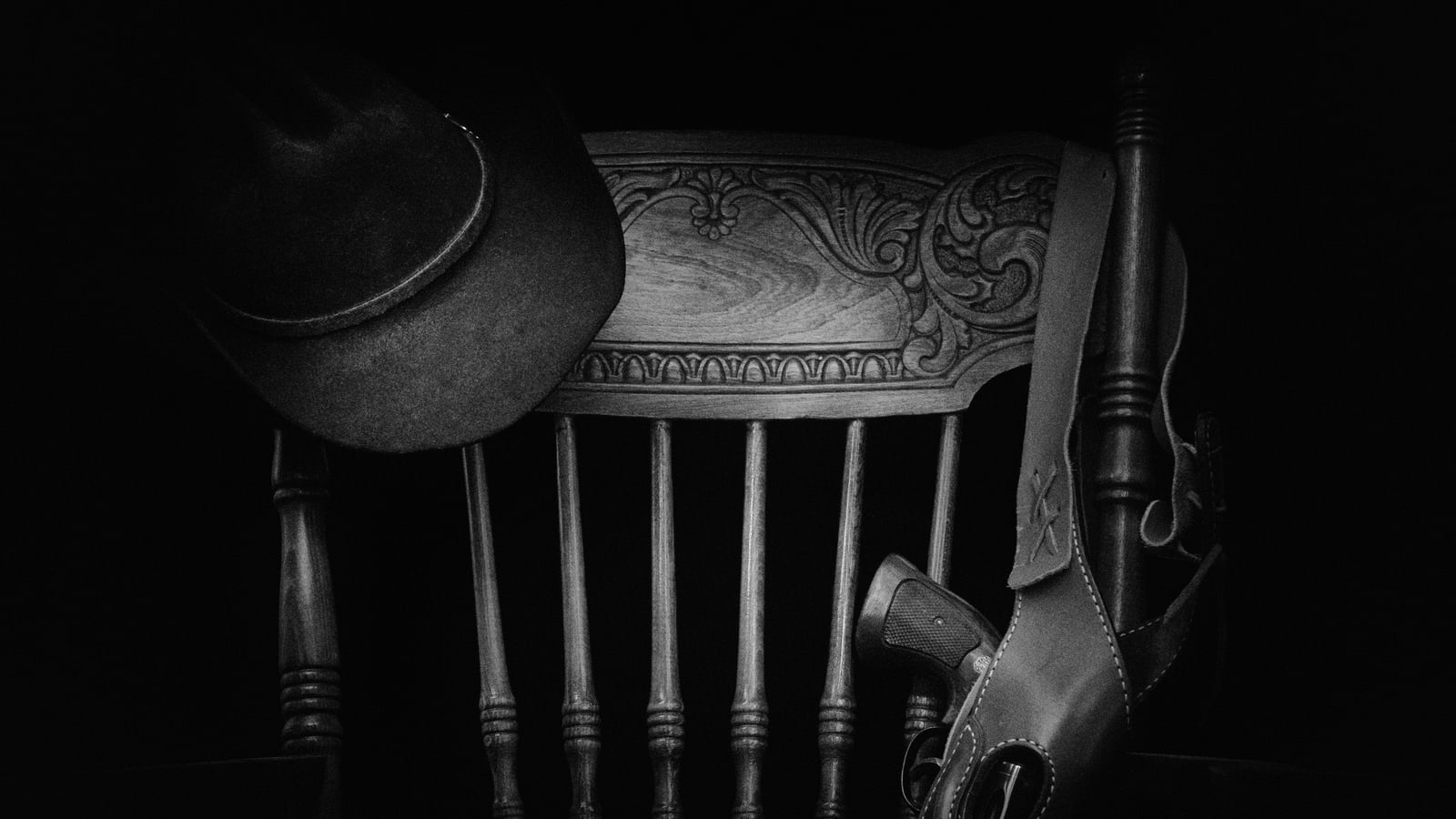
Concretely, this means a wide-brimmed hat, an old-style shirt, a vest, and often a leather cartridge belt. Some participants push the detail all the way to boots and spurs, while others make do with a simple but theme-respectful outfit. What matters is the spirit: you don’t show up in modern dynamic-shooting gear.
This clothing requirement has a strong social function. It creates a shared identity among participants, regardless of their shooting level, and reinforces the friendly, immersive side of the gatherings. A regional champion of the discipline and a beginner attending their first match both wear the same type of outfit, which partly erases the usual sporting hierarchy.
Choosing a costume often comes with choosing a stage nickname, a well-established tradition in the discipline. Participants adopt a western-inspired name for match announcements and rankings, a practice that further accentuates the playful, distinct nature of this discipline compared to more classic sport shooting competitions.
It’s worth noting that this costumed dimension never replaces safety requirements. Hearing and eye protection remain mandatory under the hat, and no piece of the outfit should hinder safe handling of the firearms or the shooter’s visibility on the firing line.
Many practitioners find an additional source of pleasure in researching and building their outfit over time. Some hunt for pieces at flea markets or from tailors specializing in historical costume, while others order modern replicas designed specifically for this sport. This “collection” dimension of the costume actually connects to the same passion that pushes shooters to take care of their gear.
There’s also fairly wide tolerance regarding the expected level of detail, especially for beginners. A welcoming club generally won’t demand a perfect reenactment from the very first participation: a hat and a suitable shirt are often enough for a first match, with the rest of the outfit naturally filling in with experience and the practitioner’s desire to refine their character.
The typical gear: period revolvers, rifles and shotguns
The gear used in Cowboy Action Shooting faithfully reproduces the iconic models of the late 19th century, whether modern replicas made with current technology or, more rarely, genuine period firearms carefully maintained.
The revolvers used are exclusively single-action models, meaning the hammer must be manually cocked before each trigger pull. This mechanism, inherited from historical Wild West revolvers, requires a particular set of movements quite different from the modern double-action revolvers found in other sport shooting disciplines.
Lever-action rifles reproduce historical manually-operated repeating models, where each new cartridge is chambered by working a lever located under the trigger guard. These firearms generally fire pistol calibers, which allows for some ammunition consistency with the revolver used on the same course — a practical arrangement appreciated by many shooters.
The smoothbore shotgun completes the typical arsenal, in a lever or pump version depending on competition category. It’s used on close targets, often plates or clay targets depending on the stage, and closes out the three-gun sequence.
An important point to know before getting started: this type of firearm falls into different categories in France depending on the exact model and its operating mode. Category D covers freely sold or simply registered firearms, which notably includes certain historical firearms or old replicas. Category C concerns firearms subject to declaration, such as certain manually-operated repeating rifles. Category B, subject to prefectural authorization, covers most modern revolvers and handguns, including certain replicas depending on their design. Check precisely with your club or gunsmith for each model you’re considering, as the exact classification varies according to manufacture and mechanism.
The caliber used also deserves particular attention. Most practitioners choose relatively moderate-power ammunition, notably because the revolver and rifle often share the same pistol caliber to simplify ammunition logistics at a match. This choice isn’t just about comfort: it also reduces cumulative recoil over a day of competition where dozens of shots per gun are fired in sequence.
Gear maintenance also holds an important place in this discipline’s culture. Single-shot and lever mechanisms, more exposed and often older in design than modern semi-automatic firearms, require rigorous, regular cleaning to maintain reliability. A practitioner who neglects this maintenance risks jams in the middle of competition, which costs dearly in time penalties on a timed stage.
Some shooters choose to own several versions of the same firearm, one for intensive training and another kept in better condition for competition. This practice, common among the most invested practitioners, illustrates well the particular relationship Cowboy Action Shooting enthusiasts have with their gear: beyond being a performance tool, the firearm here remains an object charged with history and care.
The targets: steel plates and poppers, never a human silhouette
A fundamental point to understand about this discipline concerns the nature of the targets used. Cowboy Action Shooting is practiced exclusively on steel targets like plates or poppers, never on silhouettes representing a human form. This is an essential characteristic that defines the whole sporting and playful spirit of the discipline.
Steel plates are flat targets, generally round, square or simple geometric shapes, suspended or fixed on a stand, which produce a characteristic sound and often tip over or fall when hit. This immediate sound and visual feedback is part of the discipline’s pleasure: every successful hit is heard and seen instantly.
Poppers are articulated steel targets, mounted on a pivot, which tip backward when hit with enough energy. They require a different management of shooting power compared to a fixed plate, and add appreciable variety to course design.
Some stages also incorporate clay targets or cardboard targets for the shotgun, always without any human form represented. The whole target setup aims to recreate a saloon or Wild West ranch atmosphere: fake metal bottles, jars, or geometric shapes inspired by western decor, never human silhouettes.
This rule isn’t unique to Cowboy Action Shooting alone: it fits into a broader practice within French civilian sport shooting, where silhouettes, when they exist, exclusively represent animal figures (chicken, pig, turkey or sheep silhouettes in certain FFTir events). Cowboy Action Shooting goes even further by ruling out any silhouette at all: only geometric shapes or stylized western objects make up the targets.
The arrangement of plates and poppers on a stage follows a staging logic thought out by the organizers, who seek to create a natural progression in the shooting sequence. A row of close plates for the revolver, followed by a series of more spaced-out poppers for the rifle, then one or two large poppers or a clay target to finish with the shotgun: this type of layout comes up frequently, while being played out differently depending on each organizing club’s creativity.
Maintaining the steel targets is also an important logistical aspect for clubs that organize these matches. Repeated impacts eventually mark and deform the plates, which need to be regularly replaced or reconditioned to guarantee consistent, predictable behavior during shooting. This maintenance, often handled by passionate volunteers, is an integral part of the discipline’s club life.
How a match unfolds: scenarios and timing
A Cowboy Action Shooting match generally consists of several stages, each recreating a scene inspired by westerns: a fictional stagecoach robbery, a ranch defense, a saloon scene, or a simple course of plates arranged according to a precise choreography. Each stage imposes a specific firing order for each firearm, defined in advance by the organizers.
The shooter generally starts with the revolver, continues with the lever-action rifle, then finishes with the smoothbore shotgun, but the exact order and number of rounds per firearm vary by stage. A shooting officer, often called a “range officer” by English-speaking tradition, supervises each run to ensure strict compliance with safety rules and validate the timing.
Time is measured from the first shot to the last, with penalties added for missed targets or procedural errors (wrong firing order, firearm not properly stowed). These penalties turn a raw time into a final time, which rewards both speed and precision of execution.
The theatrical dimension remains omnipresent: stages bear evocative names, scenarios tell a mini-story, and the organization encourages participants to play along right down to their announcements before starting to shoot. This staging, while fun, never excuses the seriousness required when handling real firearms.
An experienced instructor who supervises newcomers always insists on one point: the folklore should never make you forget the safety fundamentals. The pleasure of the costume and scenario comes on top of the rigor, never in its place.
A day of competition generally follows a well-established rhythm: welcoming participants, a collective safety briefing recalling the match’s general rules, then rotating groups of shooters between the different stages set up on the field. This rotation-based organization allows a substantial number of participants to be managed without excessive waiting time between runs.
Between two stages, the atmosphere stays resolutely friendly: shooters comment on their times, compare their revolver draw or lever manipulation techniques, and use these breaks to exchange tips. This ongoing mutual help throughout the day contributes greatly to the discipline’s appeal to newcomers, who quickly feel integrated into the group rather than coldly observed.
Competition categories
Cowboy Action Shooting includes several categories that take into account the type of gear used, the style of outfit, and sometimes the age or gender of the participant. This segmentation lets very different profiles compete under fair conditions, without the most refined gear systematically overwhelming other approaches.
Some categories require purely original metallic sights, with no optical device, for maximum historical fidelity. Other categories accept more modern adjustments to the mechanisms while retaining the general look and function of period firearms.
There are also so-called “traditional” categories, where the emphasis is on complete authenticity of costume and gear, as opposed to more permissive categories that tolerate practical adaptations for competition. This multi-level system lets a beginner progress without going broke on gear, before eventually aiming for more demanding categories.
Age is also taken into account in certain classifications, with categories dedicated to senior shooters, a practice that reflects the longevity of many practitioners in this discipline. Cowboy Action Shooting indeed attracts profiles of all ages, from young adults passionate about history to seasoned shooters who have practiced for decades.
The barrel type and caliber of the revolver or rifle can also influence ranking in certain match organizations, with sub-categories that separate, for example, lighter calibers from heavier ones. This additional granularity, which may seem complex at first, actually allows a fairer comparison between practitioners with very different gear choices.
A beginner generally doesn’t need to worry immediately about all these categorization subtleties. A welcoming club takes the time to progressively explain the system, often over the first two or three participations, rather than overwhelming the newcomer with a complete rulebook on their very first time on the firing line.
Safety: strict rules despite the relaxed atmosphere
Despite its festive atmosphere, Cowboy Action Shooting applies safety rules as strict as any sport shooting discipline, if not more so, because of the number of firearms handled successively on the same course. Managing transitions between revolver, rifle and shotgun is a point of constant vigilance.
Each firearm must be set down in a precise, checked state before moving to the next: hammer down, chamber checked, barrel pointed in a safe direction at all times. The range officer supervising the stage checks these points at every step, and any violation can result in disqualification from the stage, regardless of the time achieved.
Ammunition management also receives particular attention. Wearing the leather belt and cartridge holders, while thematic, must remain functional and allow safe reloading without any dangerous motion toward oneself or other participants. An experienced shooter quickly learns to organize their ammunition to smooth out their movements without ever compromising safety.
Wearing hearing and eye protection remains non-negotiable, as in any sport shooting discipline. The fact that the outfit is costumed changes nothing about this basic requirement, and serious clubs refuse firing line access to anyone who neglects this equipment, regardless of the participant’s level.
Finally, the presence of a smoothbore shotgun in addition to the revolver and rifle requires extra vigilance regarding firing angles and range safety zones, particularly in outdoor configurations where several types of trajectories must be anticipated in course design.
The safety briefing preceding each match remains an essential ritual, regardless of participants’ seniority in the discipline. An experienced club shooter competing in their hundredth match listens to this reminder with the same attention as a beginner — a culture of constant vigilance that sets the most serious clubs apart. This collective discipline of systematic reminders, rather than excessive trust in individual experience, considerably reduces incidents.
Verbal communication on the firing line is also an integral part of the safety protocol. The shooter generally announces certain key steps of their run out loud, a practice that lets the range officer precisely follow progress and intervene immediately in case of anomaly. This communication discipline, which may seem trivial, plays a real role in preventing handling errors during transitions between the three firearms.
Getting equipped to start: budget and first steps
Getting into Cowboy Action Shooting represents a bigger investment than many other disciplines, simply because you need to acquire or rent three different firearms rather than just one. The budget varies greatly depending on whether you choose new gear, used gear, or start by borrowing club equipment.
Most clubs that offer this discipline organize discovery sessions with loaned gear, an excellent way to test your interest before investing. This also lets you get familiar with the three distinct manipulations (single-action revolver, rifle lever, shotgun) before choosing your own firearms with full knowledge.
As for precise costs, they vary enormously depending on brand, finish, and the used-gear market, which stays active for this type of equipment. It’s better to check directly with a local club or specialized gunsmith rather than rely on general figures that quickly become outdated.
The costumed outfit also represents an expense to anticipate, even though it can be built up gradually. Many beginners start with a simple outfit and complete their equipment over subsequent matches, as they refine their character and style in the discipline.
One last practical piece of advice: joining a club that already practices Cowboy Action Shooting remains the best entry point. Mutual help is a strong value in this community, and it’s not uncommon for experienced practitioners to lend gear or give detailed advice to newcomers to ease their first steps.
The administrative steps related to acquiring firearms follow the general regulatory framework for French civilian sport shooting, with file preparation depending on the relevant category and proof of club-affiliated practice. This administrative process has nothing specific to Cowboy Action Shooting, but it requires anticipating timelines, which vary by prefecture and time of year.
The choice of the first firearm to acquire deserves some thought. Many instructors recommend starting with the revolver, often the most affordable of the trio and the one that allows for solo training at lower cost between club sessions. The rifle and shotgun can then be acquired progressively, once interest in the discipline is confirmed over several matches.
Progressing in the discipline: training and mentorship
Progress in Cowboy Action Shooting relies heavily on dry-practicing the handling movements, a practice found in most shooting disciplines but which takes on a particular dimension here due to the number of firearms involved. Practicing empty on cocking the revolver’s hammer, working the rifle’s lever and shouldering the shotgun lets you automate these movements even before using ammunition at the club.
Many clubs organize sessions dedicated to technique outside of official matches, where practitioners can work specifically on a transition that’s slowing them down or a movement that remains hesitant. These training sessions, less formal than a timed match, are often an opportunity for an experienced club shooter to pass on their tips to a more recent practitioner, in a spirit of mentorship quite natural to this discipline.
Video has also become a common progress tool, with many practitioners filming their own runs to analyze their transitions and spot the unnecessary movements that waste time. This self-analysis, combined with feedback from an experienced instructor or more advanced practitioners, clearly speeds up the learning curve compared to purely self-taught learning.
Intergenerational transmission holds a particularly visible place in this discipline. It’s not uncommon to see a seasoned practitioner accompanying their child or grandchild as soon as age and maturity allow, always in a supervised and progressive setting. This family dimension, reinforced by the costumed aspect that often appeals to younger people, contributes to the discipline’s long-term sustainability.
Why this discipline appeals to a different crowd
Cowboy Action Shooting attracts a shooter profile sometimes different from other sport shooting disciplines. You’ll find many history enthusiasts, antique firearm collectors, but also entire families who come as much for the social and costumed aspect as for pure competition.
This strong community dimension clearly sets the discipline apart. Matches often end with shared meals, exchanges about outfits and gear, and an atmosphere that recalls a friendly historical reenactment more than a classic sport competition. Rankings do exist, but they don’t dominate the overall experience of the day.
Having to master three different firearms rather than just one also appeals to shooters looking for a renewed technical challenge. Progress isn’t limited to a single movement refined endlessly, but to coordination between several manipulations, which maintains long-term technical interest.
Finally, the playful aspect of the costume and stage nickname offers an accessible entry point for people who might feel intimidated by the more serious or technical image of other shooting disciplines. This discipline proves that you can combine safety rigor, precision demands and pure costume fun in the same competition weekend.
Another appeal factor lies in the discipline’s heritage and cultural dimension. Handling a faithful replica of a 19th-century firearm, understanding its mechanical workings and its history, appeals to an audience interested as much in the historical aspect as in pure sporting performance. This curiosity about the Wild West’s technical and cultural heritage feeds, for many practitioners, a passion that goes beyond the mere framework of timed competition.
Finally, it should be stressed that this discipline remains, above all, a civilian sport shooting practice like any other: it requires a club license, compliance with firearm acquisition and possession procedures, and practice supervised by trained range officers. The folkloric dress-up should never make you forget that Cowboy Action Shooting remains subject to the same seriousness requirements as any other recognized sport shooting discipline.
Comparing Cowboy Action Shooting to other shooting disciplines
It’s useful to place Cowboy Action Shooting relative to the better-known dynamic shooting disciplines, like IPSC, Steel Challenge or USPSA, to properly understand what sets it apart. These dynamic disciplines use modern semi-automatic firearms and focus on pure speed combined with precision, on cardboard or generic steel targets, never a human silhouette either.
The fundamental difference lies in the required gear and the general spirit of practice. Where modern dynamic shooting values technical performance with contemporary gear, Cowboy Action Shooting imposes a historical constraint that changes the very nature of the challenge: it’s not about going as fast as possible with the most high-performance equipment on the market, but shooting fast and accurately despite the voluntary limitations of period gear.
This voluntary constraint paradoxically brings Cowboy Action Shooting closer to certain historical shooting disciplines practiced with antique black-powder firearms, where the authenticity of the gear also takes precedence over pure performance. The difference remains that Cowboy Action Shooting keeps a timed, dynamic competition format, while historical black-powder shooting is often oriented more toward static precision.
A shooter who already practices a modern dynamic discipline and discovers Cowboy Action Shooting often reports a rediscovery of the fundamentals: without the high rate of fire allowed by a semi-automatic firearm, every re-cocking movement becomes dead time to optimize, which completely renews the strategic reading of the course, even for a shooter experienced in other disciplines.
FAQ
Q: Do you have to own three different firearms to practice Cowboy Action Shooting? A: To take part in an official match, yes, you need a single-action revolver, a lever-action rifle and a smoothbore shotgun. Many clubs, however, offer loaner gear during discovery sessions, letting you try the discipline before investing.
Q: Is the period costume really mandatory to compete? A: In most organized matches, yes, an outfit consistent with the western spirit is required to compete. The level of requirement varies by club and category, with some being stricter on authenticity than others.
Q: Do the targets used represent human silhouettes? A: No, never. Cowboy Action Shooting is practiced exclusively on steel plates, poppers and sometimes clay or cardboard targets with no human form, in the pure sporting and playful spirit of the discipline.
Q: What firearm category covers the revolvers and rifles used in this discipline? A: It depends on the exact model: some historical firearms or replicas fall under category D (freely sold or simply registered), others under category C (declaration) or category B (prefectural authorization) depending on their design. Check precisely with your club or gunsmith for each firearm you’re considering.
Q: Is this discipline suitable for a complete beginner in sport shooting? A: Yes, provided you go through a club that seriously supervises learning the three firearm manipulations and the safety rules specific to the discipline. The friendly atmosphere also makes it easier for newcomers to fit in.
Q: Can you easily practice Cowboy Action Shooting in France? A: The discipline remains niche, but dedicated clubs exist and organize regular gatherings. The number of clubs and frequency of matches vary by region, so it’s best to check locally to find the closest venue.