
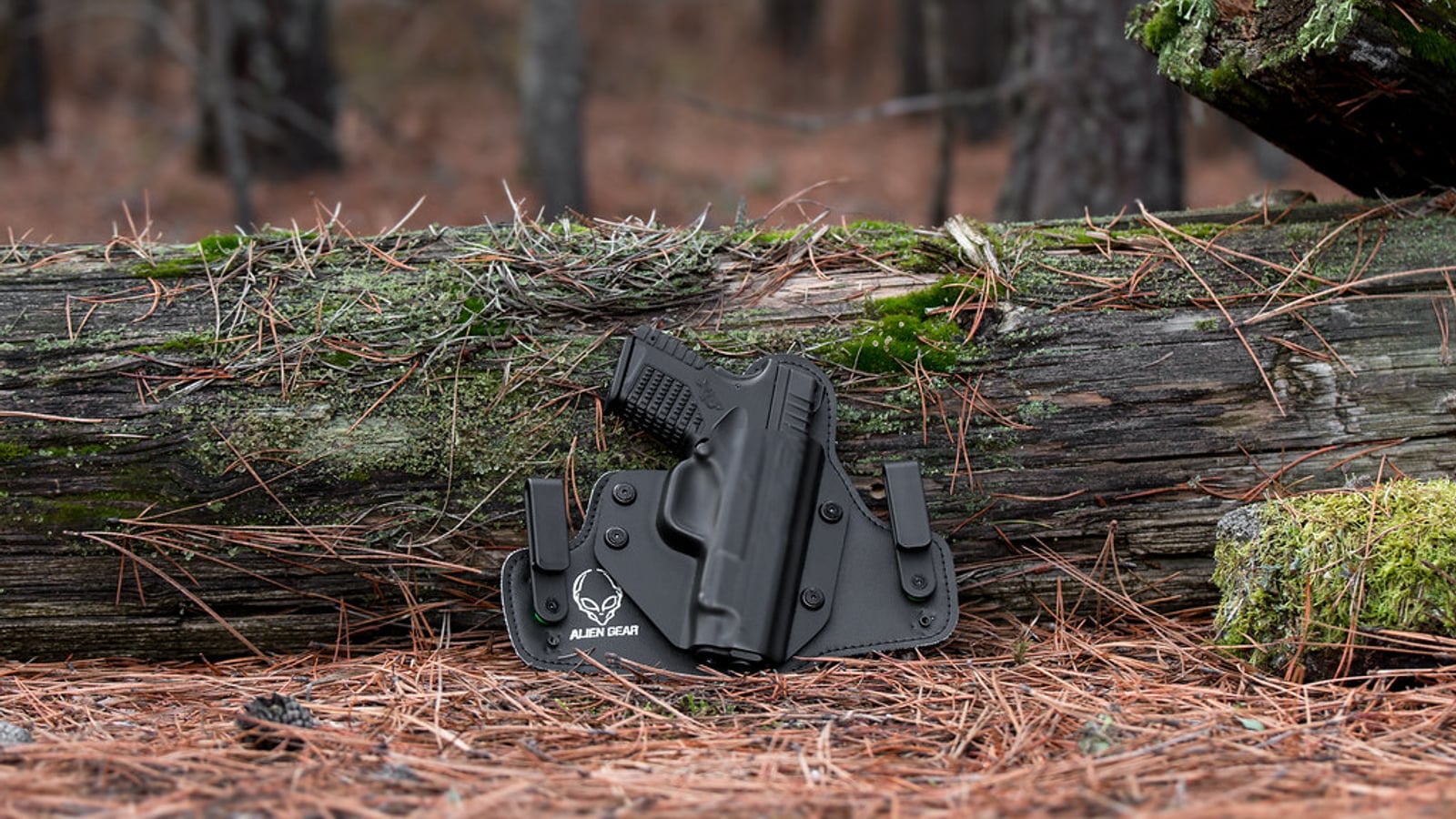
Why a holster is never a secondary accessory
Many beginner shooters see the holster as a box to tick after buying the gun. That’s a classic mistake. A poorly chosen or poorly adjusted holster can wreck your safety, your speed, and your comfort over an entire season of practice.
The holster is the interface between you and your gun 90% of the time it’s on you. At the club, in competition, during cold handling drills: it’s what protects the trigger guard, keeps the gun in place, and shapes how you draw.
A bad choice costs you dearly: a gun that shifts inside the holster, insufficient retention that worries range officers, or excessive retention that forces your draw and kills your fluidity. This guide covers holster types, materials, non-negotiable safety rules, and the differences between dynamic practice and recreational shooting.
One clarification before we start: this article deals exclusively with civilian sport shooting, recreational and competitive, run through a club or federation. Nothing here applies to professional use or any context other than the range.
This guide is aimed at beginners looking for their first holster as well as experienced shooters wanting to refine their gear for a specific discipline. The criteria aren’t the same whether you shoot twice a month for fun or you’re racking up regional matches in dynamic shooting.
Keep one simple principle in mind throughout this article: a holster that performs well but isn’t safe is useless, and a safe holster that doesn’t fit your practice always ends up at the bottom of the bag. The right choice satisfies both requirements at once, never one at the expense of the other.
The main holster families
There are three main families based on where they sit on the body, each with its own uses and limits.
The belt holster (OWB, “outside the waistband”) is worn outside the pants, secured by one or two loops or a clip system. It’s the most widespread format at clubs and the only one allowed on most ranges for recreational rifle or precision pistol shooting. It offers a good balance of stability, comfort, and ease of draw.
The thigh holster (drop leg or “thigh rig”) lowers the carry point below the belt via a strap that wraps around the thigh. It’s very common in dynamic shooting because it frees the hand from the rest of the gear worn on the belt (mag pouches, competition belt) and allows a more direct draw, without having to go around the arm.
The appendix holster (AIWB, “appendix inside the waistband,” sometimes worn outside) sits at the front of the body, between the navel and the hip. It appeals for its concealment and the speed of a straight-line draw, but demands absolute discipline around trigger management and isn’t suited to every build or every discipline.
Other formats exist on the fringe: the shoulder holster, rarely used in sport competition but sometimes seen in casual recreational shooting, or chest rigs for certain handgun-carbine practices. They remain a minority and are often less practical for regular use at the range.
There’s also an important distinction between so-called “competition” holsters, designed for a draw at the start of a timed stage, and transport or storage holsters, meant only to move the unloaded gun between the vehicle and the range. Confusing the two uses is a common beginner mistake: a transport holster often has neither the retention nor the ergonomics needed for dynamic use at the firing line.
The choice of holster family almost always follows from the discipline practiced, even before you think about material. A shooter who only does static precision shooting, for instance, has no reason to go for thigh carry, which is designed for movement constraints they’ll never encounter on their firing line.
Kydex: the reference material in competition
Kydex is a rigid thermoplastic, heat-molded directly over a replica or the gun itself to achieve a perfect fit. It’s now the standard in dynamic shooting, IPSC and USPSA leading the way.
Its rigidity guarantees constant retention over time: unlike leather, it doesn’t loosen up after hundreds of draws. The gun clicks in and out with a reproducible feel, which matters when consistency of the motion counts as much as speed.
Kydex resists moisture and sweat well, doesn’t warp in the sun on an outdoor range, and cleans up with a wipe of a sponge. Its main drawback is a drier draw sound and a less “warm” feel on contact than leather — a purely aesthetic or tactile point that doesn’t affect function at all.
Most modern Kydex holsters offer screw-adjustable retention, often at the trigger guard block or the barrel. This adjustment lets you tune the tension to balance safety and fluidity, a point we’ll come back to.
Custom molding is the real added value of Kydex: a craftsman or manufacturer heats a thermoplastic sheet and presses it directly around the gun, often with an inner foam mold to capture every detail of the frame. This process guarantees a fit that no generic holster can replicate, whatever material it’s made of.
A technical point beginners often overlook: the thickness of the Kydex sheet directly affects the holster’s rigidity and longevity. A sheet that’s too thin, used by some manufacturers to cut costs, can fatigue prematurely at the fold points and lose retention after a few months of heavy use. An experienced club shooter buying Kydex for the first time is better off checking the stated thickness rather than choosing on looks alone.
Kydex also comes in colored or textured versions, which remains purely cosmetic, but some manufacturers offer a slightly rough surface on the body side to limit the holster sliding on the belt. This detail can be genuinely useful for shooters who move a lot during a dynamic stage.
Leather: the historic material, still relevant
Leather remains very present in recreational shooting, static precision shooting, and certain historical or collector disciplines. It offers suppleness, comfort against the body, and an aesthetic appreciated on recreational ranges or at more traditional matches.
Its retention relies on the initial fit of the leather around the gun rather than millimeter-precise molding. Over time, leather loosens slightly and molds to the shape of the gun, which improves comfort but can reduce retention if the holster ages poorly or isn’t maintained.
Quality leather needs a minimum of care: protect it from prolonged moisture, avoid letting it dry too fast after getting rained on, and occasionally apply a suitable leather conditioner. A poorly maintained leather holster loses rigidity and can become dangerous if the gun no longer sits firmly in it.
In practice, leather suits a recreational shooter who isn’t chasing timed performance, or a practitioner of slower-paced disciplines very well. It’s less suited to disciplines with many draws under time pressure, where Kydex’s consistency takes the edge.
There are several grades of leather on the shooting-gear market, and they’re not all equal. Correctly tanned full-grain leather holds its shape far longer than lower-grade or bonded leather, which deforms quickly and loses its ability to hold the gun firmly. Price generally reflects this difference in raw material quality fairly faithfully.
Leather also has an often-overlooked advantage: it marks the gun less over time than certain rigid, poorly fitted polymers, particularly on the blued or treated finishes of some collector or historic firearms. That’s one reason it remains favored in historical shooting or old-gun disciplines, where preserving the finish matters as much as function.
New leather is often stiffer than broken-in leather: the first few draws can be harder until the material softens slightly around the exact shape of the gun. That’s a normal phenomenon, not to be confused with a manufacturing defect, but it’s worth planning for by buying your holster several weeks ahead rather than the day before a match.
Alternative and hybrid materials
Between all-Kydex and all-leather, several hybrid solutions exist and are worth knowing about before you buy.
Hybrid holsters combine a rigid Kydex or polymer shell, in direct contact with the gun, with a leather or technical-fabric backing against the body. This format aims to combine Kydex’s constant retention with leather’s comfort, at the cost of sometimes slightly greater bulk.
Injection-molded polymers (mass-molded holsters, not custom thermoformed) offer an economical alternative to artisanal Kydex. They’re reliable on common gun models, but the fit is less precise than individual molding, and retention can vary from one unit to another.
Ballistic nylon or technical fabrics mostly equip universal holsters, adjustable to fit several gun sizes. They’re handy to start out with or for occasional use, but they don’t offer the rigidity or consistent retention expected in competition.
Material choice should always follow actual use: a shooter who practices two different disciplines will sometimes benefit from owning two separate holsters rather than a compromise that serves neither one well.
The holster and the rest of your belt setup
A holster never works in isolation: it’s part of a system that includes the belt, mag pouches, and sometimes other accessories worn at the waist. In dynamic shooting, the relative layout of these elements directly shapes the fluidity of your manipulations.
The placement of mag pouches relative to the holster must allow a natural flow between reloading and returning to the firing position, without your hand crossing another item worn on the belt. Many beginners overlook this detail and end up with a layout that works fine at the practice range but becomes awkward under the stress of a timed match.
The holster’s belt attachment system deserves particular attention: double-clip models offer better resistance to tipping than single-clip models, especially for shooters who move around a lot or change position frequently during a stage. A holster that pivots on the belt at the slightest movement makes drawing harder and, in the worst cases, can expose the trigger guard area more.
Some modular systems let you slide the holster along the belt to fine-tune its position without disassembling the whole rig. This kind of adjustment is especially useful when breaking in new gear, while you find the optimal position for your body.
Choosing a holster for your gun’s model and size
The custom Kydex holster market works model by model: a holster designed for a compact pistol will never fit a longer or wider model, even within the same brand. Always check the manufacturer’s exact stated compatibility before any purchase, particularly regarding barrel length and the possible presence of a compensator.
Guns fitted with a red-dot optic need a holster specifically cut to clear the sight without it hitting the edges of the holster. A standard holster not designed for this addition can either prevent the gun from going in at all or, worse, press against the optic and damage it every time it’s inserted.
For shooters who own several guns of similar size (same family, same manufacturer, similar dimensions), some universal Kydex holsters within a lineup may fit multiple models. This mutualization remains the exception rather than the rule, though, and it’s better to check the precise stated compatibility than to assume a holster “from the same lineup” will automatically fit.
The gun’s weight also affects the choice of belt attachment system: a heavier pistol, especially with a compensator or a mounted light, puts more strain on the holster’s clip or belt loops. An attachment system undersized for the actual weight of the setup can loosen prematurely or accelerate holster wear.
Retention: safety concern number one
Retention refers to the force that keeps the gun in the holster and prevents it from coming out on its own, whether running, jumping an obstacle, or in a fall. It’s the safety feature most scrutinized by range officers in dynamic competition.
Federations that govern dynamic shooting generally require a minimum retention level: the gun must stay in place even upside down or shaken, and getting it out must require a deliberate motion, not simple gravity. A holster that’s too loose gets rejected at the gear check before the match.
Conversely, excessive retention isn’t a virtue in itself. A mechanism that’s too stiff forces you to muscle the draw, which degrades the precision of the movement and increases the risk of accidental contact with the trigger while drawing.
The right setting is found through progressive testing, unloaded, in a safe setting: tighten a notch, test the draw, repeat until you find the point where the gun is held firmly but comes out with a clean, controlled motion. This setting should be rechecked after every cleaning or extended transport, since retention screws can loosen from vibration.
Some manufacturers distinguish several “levels” of retention through additional active mechanisms: a safety catch that must be released with the thumb or index finger before the gun can be drawn, on top of the passive friction of the molding. These multi-level systems are mainly designed for use where the gun is worn for long periods without direct supervision — a scenario rarely encountered in civilian sport shooting, where the gun is generally handled under constant supervision at the club or in competition.
For the vast majority of sport shooters, a passive-retention holster (screw-adjustable friction from the molding, with no active safety catch) is more than enough and simplifies the draw. Adding an extra retention level mechanically slows down drawing the gun, which can be a deliberate choice for a safety-conscious recreational shooter but becomes a clear disadvantage in timed competition.
A point never to overlook: retention must be tested with the gun in exactly the configuration it will be used in, accessories included. A holster set up for a bare gun can behave differently once an optic or a light is mounted, since that slightly changes the contact points with the walls of the molding.
Trigger coverage: the rule that never gets negotiated
A holster worthy of the name fully covers the trigger guard and trigger the moment the gun is seated in it. It’s the most fundamental safety rule in choosing a holster, and it takes precedence over any consideration of style, price, or looks.
This coverage prevents any contact between a finger or an outside object and the trigger while the gun is holstered, during carry, and above all during the draw and re-holstering phases, statistically the riskiest moments. A holster that leaves the trigger even partially exposed, even over a small area, must be rejected without hesitation.
Always check, before any purchase, that the trigger guard area is fully closed on your exact gun model: a “universal” holster poorly matched to your trigger guard geometry can leave a minimal but sufficient gap. This is especially true of generic nylon holsters or old inherited leather holsters that have never been readjusted.
Re-holstering is the moment when vigilance must be at its highest, regardless of the shooter’s skill level. The correct motion is to clear every finger off the trigger even before starting the return to the holster, and to guide the gun in slowly while keeping an eye on the insertion area to keep any clothing or strap from slipping in.
Belt carry: the reference format at the club
The belt holster remains the logical starting point for the vast majority of sport shooters, at the club as well as in precision competition. Its carry height, generally at hip level, offers a good balance between accessibility and discretion of movement.
The choice of carry angle (straight vertical or slightly forward-canted, often called “rake” in gear jargon) directly affects comfort and draw speed. A neutral angle suits most beginners; a more pronounced angle is often adopted by experienced shooters looking to shave time.
The belt itself matters as much as the holster. A rigid, reinforced competition belt keeps the holster from sagging or tipping under the weight of the gun, especially with a heavy pistol or a setup with mounted accessories. A soft everyday belt doesn’t provide the stability needed for regular carry at the range.
For recreational rifle or static precision pistol shooting, belt carry covers the vast majority of needs: the gun is only drawn from the holster at the firing line, under the supervision of an instructor or official, and draw speed doesn’t come into play.
Thigh carry: advantages and limits in dynamic shooting
The thigh holster became established in dynamic disciplines because it frees the belt for mag pouches and clears the hand’s path during the draw, especially in setups with a vest or other gear worn at the waist.
It also lowers the wrist’s pivot point during the draw, which can smooth out the motion for certain body types, particularly taller shooters or those carrying a lot of gear on the belt in competition.
Its main drawback is the added bulk and weight on the leg, which can hinder quick movement or ground-position changes, common in dynamic stages. A poorly adjusted strap can also make the holster “float” and hurt draw precision.
This format also demands more rigor in choosing strap length: a thigh too wide or too narrow for the chosen model can create an unstable carry angle, which indirectly degrades the gun’s effective retention.
Appendix carry: discretion and demands
The appendix holster is worn at the front of the body, generally slightly offset to the side of the navel. It allows for a nearly straight-line draw toward the target, without the rotational arm movement needed with classic belt carry.
This position exposes the pelvic and upper-thigh area more in the event of poor trigger management during re-holstering. That’s why most clubs and federations that allow this carry require heightened vigilance, sometimes with strict criteria on the accepted holster type (full trigger guard coverage non-negotiable, sufficient rigidity).
Appendix carry doesn’t suit every body type: a shooter with a larger waist, or a preference for sitting frequently, may find this carry uncomfortable or even impractical over the course of a match.
Some dynamic disciplines strictly regulate, or even ban, this carry mode under their internal rules. Before investing in an appendix holster for competition, always check the rules of the relevant discipline and federation, as these can vary and change over time.
IPSC and USPSA: the specific requirements of dynamic shooting
Dynamic disciplines like IPSC or USPSA apply precise gear rules for holsters, checked before every match by a range officer. These checks cover retention, trigger coverage, and sometimes carry height or angle depending on the equipment division entered.
These disciplines are shot on stages combining movement and engagement of cardboard or steel targets, never human silhouettes. The holster undergoes far higher mechanical stress than in static shooting: falls, obstacle crossings, ground-position changes, all with the gun loaded and holstered most of the time.
Fast, repeated drawing under the clock demands gear that’s reliable and consistent over time: that’s the main reason Kydex dominates this type of practice so heavily. A holster whose retention varies from draw to draw becomes a direct handicap on the scoresheet, on top of the safety risk.
Equipment divisions in dynamic competition often define precise constraints on the holster type allowed (position, coverage, additional safety system). These rules vary by division and evolve over time: always check your federation’s and discipline’s current rulebook before investing in competition gear.
Gear checks before a dynamic match are generally done at the start of the day, gun unloaded, under the eye of a qualified range officer. This check covers the whole rig, not just the holster: mag pouches, belt, the relative carry position of each item. A shooter presenting non-compliant gear may be asked to fix it before being allowed to start, or may be reclassified into a different division under the applicable rules.
A point newcomers to dynamic competition often discover the hard way: most rulebooks require the holster to fully conceal the gun once re-holstered, without the barrel or the rear of the frame protruding beyond a certain limit. This criterion, again tied to safety, adds to the trigger coverage already mentioned above and should be checked as soon as you try the holster with your exact gun.
Recreational shooting: different needs, identical safety
The recreational shooter practicing static precision shooting, rifle or pistol on a fixed target, doesn’t face the same fast-draw constraints as the dynamic competitor. The gun mostly stays on the shooting bench or stored in a closed holster between firing phases, under an instructor’s supervision.
For this use, carry comfort over the duration of a session, ease of storage, and price often take priority over draw speed. A good entry-level leather or Kydex belt holster covers the needs well, provided the same requirement for full trigger coverage is respected.
It would be a mistake to think safety can be relaxed just because the pace is more relaxed. The number of manipulations often stays high during a typical training session, and every draw or holstering deserves the same rigor as in competition.
A beginner benefits from choosing a simple, sturdy holster well-fitted to their gun rather than a high-end model designed for dynamic competition. Needs evolve with practice, and it’s common for an experienced club shooter to own several holsters suited to their different activities.
Recreational shooting also covers practices where the gun is never carried on the belt during the shooting itself, notably rifle shooting on a fixed firing line, where the holster serves only for transport between the parking lot and the range, the gun always unloaded and often in a case or rigid sleeve rather than a belt holster. In this case, the criteria change again: transport durability, impact protection, and ease of storage take priority over any fast-draw consideration.
Finally, there are recreational shooters who gradually work into more dynamic exercises within a supervised club setting, without aiming for competition. For this intermediate profile, an entry-level Kydex holster with simple retention adjustment often represents a good investment: it lets you discover the basics of a supervised draw without needing the budget of a full competition rig.
Fit, maintenance, and lifespan
A holster, whatever its material, needs regular checking to make sure it still holds the intended retention level. Adjustment screws on Kydex models can loosen from transport vibration; leather can stretch with age and humidity.
The check is done unloaded, in a safe setting: insert the unloaded gun, turn the holster upside down, shake it gently. The gun must never come out on its own. If it does, tighten the retention or replace the holster without delay, regardless of its price or age.
Visible wear (cracks in Kydex, stretched stitching on leather, a belt clip that’s lost its tension) is a signal that should never be ignored. A holster is a safety consumable, not an object to keep out of habit or sentimental attachment.
Also remember to check the holster’s compatibility with any accessories mounted on your gun (optic, light, compensator). A holster not designed for these additions simply won’t fit, or worse, fits poorly and damages the accessory or strains the gun.
Common mistakes to avoid
The first mistake, very widespread among beginners, is buying a generic “fits-all-brands” holster before even knowing precisely their own gun model and future practice. This default choice almost always leads to a quick repurchase once practice becomes more defined, which ends up costing more than a well-thought-out choice from the start.
The second mistake is neglecting real-condition testing before the final purchase of a high-end holster. A holster that looks perfect on a spec sheet or an online video can turn out to be poorly suited to your exact body type, your stance, or your personal draw motion. Nothing replaces a physical test, ideally at the club, with the gun unloaded and under the supervision of an instructor or experienced shooter.
The third mistake is treating the retention setting as final once done at purchase. The material evolves, screws loosen, carry habits change: a real retention check should be part of your routine before every session or competition, not just on the day the holster was bought.
Finally, a subtler mistake concerns the choice of belt: investing in a high-end Kydex holster mounted on a soft everyday belt cancels out a good part of the intended benefit. The rigidity of the whole system, belt included, shapes stability just as much as the holster itself.
Choosing well according to your practice: practical summary
Before buying, systematically ask yourself the same questions: which discipline do I mainly practice, what draw pace do I actually need to support, and what’s my body type for the chosen carry?
- Recreational shooting on a fixed target: belt holster, leather or entry-level Kydex, priority on comfort and full trigger coverage.
- Dynamic shooting (IPSC, USPSA): custom-molded Kydex holster, adjustable retention, compliant with the rules of your division.
- Thigh carry: relevant if you already carry a lot of gear on your belt in competition, less useful for occasional recreational use.
- Appendix carry: reserved for shooters comfortable with heightened vigilance during re-holstering, to be checked against your discipline’s rules before buying.
Don’t hesitate to try several setups before investing in high-end gear. Many clubs and experienced instructors own different models to test, and the opinion of an experienced practitioner from your own club is often worth more than an online spec sheet.
The budget for a good custom Kydex holster or quality leather varies significantly depending on the manufacturer and the gun model involved: it’s better to compare several current sources at the time of purchase than to rely on a fixed figure.
FAQ
Q: Kydex or leather, which lasts longer? A: Kydex holds up better over time because it doesn’t deform with use, unlike leather, which stretches progressively. Well-maintained leather nonetheless remains durable for less intensive recreational use.
Q: Does a universal nylon holster work for beginners? A: It can help out occasionally, but always check that it fully covers the trigger for your exact gun model. For regular practice, a holster fitted to your gun remains preferable both for safety and comfort.
Q: How do I know if my holster’s retention is sufficient? A: With the gun unloaded, insert it in the holster and turn it upside down while shaking it gently: it must never come out on its own. If it moves or slips, tighten the setting or change holsters before resuming practice.
Q: Is appendix carry allowed everywhere in competition? A: It depends on the rules of each discipline and federation, which may strictly regulate or restrict this carry mode. Always check your discipline’s current rules before investing in this type of holster.
Q: Do you need a different holster for every gun? A: A custom-molded Kydex holster is generally specific to one exact gun model, sometimes even to a given accessory configuration. If you shoot with several guns of different sizes, having one holster per model is the norm, not the exception.
Q: Is price a good quality indicator for a holster? A: Not always: a high price doesn’t guarantee a perfect fit for your gun and your body. Favor a real test, the opinion of experienced shooters at your club, and systematically checking trigger coverage over price alone.