
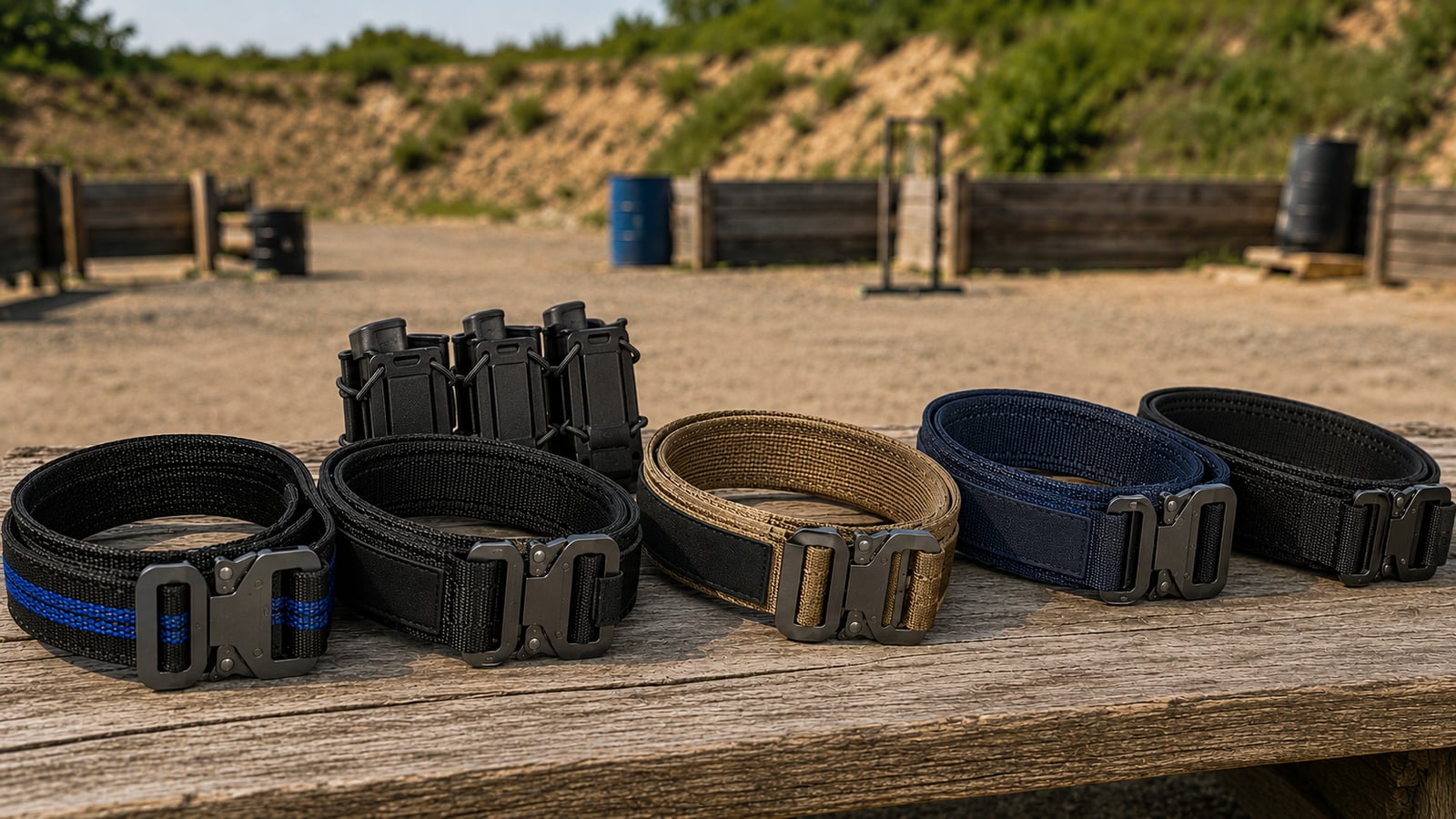
Why the belt changes everything in dynamic shooting
In IPSC or Steel Challenge, the belt isn’t an accessory — it’s a full-blown piece of competition gear. It carries the holster, the mag pouches, sometimes a light holder, and has to stay perfectly stable through movement, transitions, and reloads under the clock.
A belt that twists or slips during a stage costs you tenths of a second at every step: drawing, reloading, aiming. That’s not a cosmetic detail — it’s a measurable performance factor as soon as you start comparing your times on the range.
On the flip side, for beginners or pure hobby shooters, a simple belt is more than enough. The need for extreme rigidity only shows up once round count goes up and the same motion gets repeated hundreds of times per session.
This comparison aims to clarify the product families, the technical criteria that actually matter, and the budgets tied to each level of practice. The goal isn’t to crown “the best belt on the market,” but to help you pin down your real needs before you pull out your card.
The disciplines involved range from classic IPSC to Steel Challenge, through USPSA and certain dynamic rifle practices. In every case, the selection logic stays the same: rigidity, attachment, and compatibility with the rest of your rig.
Many shooters approach this choice too late, once a gear problem has already shown up mid-training or, worse, mid-match. Understanding the product families ahead of time avoids a default first purchase that quickly turns out to be limiting, followed by a corrective second purchase a few months later.
The principle behind the two-belt system
Almost every competitive dynamic shooter uses a two-belt system stacked on top of each other rather than a single belt. The first, called the “inner belt,” runs through the pant loops and stays fixed all day.
The second, the “outer belt,” carries the holster and mag pouches. It attaches to the first with a very wide hook-and-loop strip, sometimes backed up by security clips that mechanically lock the whole assembly.
This setup has a concrete benefit: you can remove the entire outer belt along with your gear in one motion, without unclipping each piece one by one — for example to sit down between stages or safely stow your kit in a bag.
An experienced club shooter moving into official competition often discovers this system at the same time as their first stage safety rules. The rigidity of the whole assembly depends as much on the quality of each belt as on the quality of how well they grip each other.
This two-layer setup clearly sets dynamic shooting apart from other sport shooting disciplines, where a simple support belt is more than enough. It’s one of the first pieces of discipline-specific gear a shooter coming from a static discipline discovers, even before turning attention to the holster or mag pouches themselves.
Some manufacturers only sell the two belts as a matched set, with strip widths calibrated for each other. Others sell separate pieces, which gives more freedom but requires checking width compatibility before buying.
The inner belt deserves just as much attention as the outer one, even though it stays hidden under your pants. A thin or poorly stiffened inner belt deforms under the weight of the full system, which cancels out part of the benefit brought by a higher-quality outer belt.
Entry-level ranges: flexibility and versatility
Entry-level belts are generally woven nylon or soft leather, with a classic buckle or a quick-release clip. They work perfectly for casual use, beginners, or disciplines where carrying a firearm doesn’t demand extreme retention.
Their main advantage is versatility: they can often double as an everyday belt, which makes them appealing for a beginner who doesn’t want to buy several belts in their first season.
The limit shows up fast once the holster is loaded with a gun and several magazines: soft nylon tends to sag on the hip, especially during fast movement or when crouching to aim under an obstacle.
A club instructor who runs beginner sessions generally recommends not investing in a rigid belt until the shooter has a few months of regular practice under their belt. The need arises naturally, not before.
This segment also stays relevant for shooters who practice dynamic shooting occasionally alongside another main discipline, without aiming for regular competition in this specific format. In that case, reinvesting in a dedicated rigid belt often doesn’t make economic sense.
Some entry-level models still include a thin stiffening strip inside the leather or nylon, which slightly improves retention without pushing the product into the “rigid” category. That’s a good reference point if you’re torn between a basic entry-level model and a first intermediate one.
Intermediate belts and rigid competition models
Between entry-level and pure competition sits a family of belts made of thick leather or semi-rigid composite material, often reinforced with an internal core of hard plastic or thin steel. They keep some flexibility when putting them on, which makes them comfortable, while offering noticeably better retention than a plain fabric model.
It’s a good compromise for a shooter who practices regularly at the club but isn’t yet aiming for the highest competition level. The main downside remains weight: this type of belt is heavier than a nylon model, which can become bothersome over a long session if you’re not yet used to wearing a loaded belt for several hours.
So-called “competition” or “race gun” belts, on the other hand, use a fully rigid internal structure made of injection-molded polymer or fiber-reinforced composite, covered by a textile or synthetic sheath. Their sole purpose is to never flex, no matter the weight carried.
The hook-and-loop attachment strip is particularly wide there, sometimes covering the entire height of the outer belt, to maximize contact surface and prevent any slipping during fast transitions between cardboard targets or steel plates.
That rigidity comes at a cost to comfort: a fully rigid belt can dig into the hip over a long competition day and requires a break-in period before it becomes transparent to the shooter. This is the format found on most regular IPSC competitors, regardless of the division practiced, once training frequency exceeds one or two sessions a week.
Between these two families, some manufacturers offer “reinforced semi-rigid” versions that blur the marketing line a bit. The best reflex remains to focus on the real technical characteristics (core material, thickness, attachment width) rather than the commercial label on the product.
Assessing rigidity and attachment quality
It’s hard to judge a belt’s rigidity from a product sheet alone. A reliable indicator remains the stated thickness: below 4-5 millimeters, a belt rarely stays perfectly flat with a loaded holster. The material of the internal core matters too: a dense composite or polymer holds its shape better than a simple reinforcement of compressed cardboard or rigid foam, which sometimes shows up in entry-level models sold as “reinforced.”
A good practical test in a shop or on a range consists of holding the outer belt horizontally, gripped by one end only. A quality rigid belt stays nearly straight; a flexible belt bends immediately under its own weight. Feedback from other shooters at the same club remains the best source of information, more than commercial descriptions that often use the word “rigid” rather loosely.
The attachment system between the two belts matters just as much as rigidity itself. The current standard relies on a wide hook-and-loop strip, sometimes backed by security tabs that prevent accidental unhooking mid-stage. Some manufacturers offer rigid clip systems that fully replace the hook-and-loop, with a mechanical click-lock: they add extra security against decoupling, at the cost of a slightly longer setup time.
The width of the contact strip directly affects stability: a narrow strip offers less resistance to lateral torsion, which translates into a slight wobble of the holster during fast movement. For club use without official competition, a classic, well-maintained hook-and-loop attachment is more than enough. The question of a security clip becomes relevant mainly as stage pace and intensity increase.
An often-overlooked point: hook-and-loop quality varies a lot from one manufacturer to another, even at identical strip width. Dense hook-and-loop with tight hooks holds its grip much longer than an entry-level version, which sometimes justifies a price gap that isn’t obvious from a simple product photo.
The rigidity of the buckle itself, often overlooked in favor of the hook-and-loop strip alone, also deserves a check. A thin plastic buckle can fatigue over time and under weight, while a metal or thick composite buckle keeps its shape for the entire life of the inner belt.
Compatibility with the holster and mag pouches
A belt is never chosen on its own: it must be compatible with the attachment system of the holster and mag pouches you already use, or plan to use later. Most competition mounts fit belts of a standardized width, generally around 4 to 5 centimeters.
Some holster and mag pouch manufacturers design their products for a specific belt range, with dedicated adapters. Mixing different brands often works, but requires checking width and clamping-system compatibility before buying, especially if you’re ordering online without being able to try it first.
A mag pouch poorly secured on a belt that’s too flexible tends to tip slightly forward or backward during movement, which makes gripping the magazine harder during a fast reload. Before investing in a high-end rigid belt, it’s worth checking that your whole rig (holster, mag pouches, any light holder) stays coherent with the new mount.
The number of mag pouches to install also affects belt choice: the more pieces attached, the more the outer belt’s rigidity becomes decisive to prevent the whole assembly from deforming under the combined weight, especially in divisions allowing a large number of magazines carried at once.
Brands specialized purely in competition carry systems generally offer better consistency across their own lineup: belt, holster, and mag pouches from the same range are designed to fit together without an extra adapter. Generalist brands, on the other hand, often offer an appealing price-to-accessibility ratio for entry-level and intermediate ranges, with wider availability at local gun shops.
The most reliable approach remains asking other shooters at the same club or discipline who’ve already tested several brands over time, rather than relying solely on spec sheets or isolated online reviews.
If you’re only changing your belt while keeping your current holster, plan on redoing a full position adjustment: the new mount’s rigidity slightly changes the holster’s angle and height compared to what you had with a softer belt. That initial adjustment is best done with a clear head, outside of a competition period.
Comfort, fit, and belt length
A competition stage rarely lasts more than a few minutes, but a match day can stretch over several hours with long waiting periods with a loaded belt on. Comfort then becomes a criterion in its own right, often underestimated at purchase time. Weight distribution plays an important role: a well-fitted rigid belt spreads the load of the holster and magazines across the whole waist, rather than concentrating pressure on a single hip point.
Interior padding, when present, limits friction points, especially for shooters wearing their belt all day during a regional or national championship. An experienced club shooter who runs several matches a season often insists on this: the most rigid belt isn’t always the most comfortable, and the best choice remains the one you forget you’re wearing once it’s on.
The season and clothing also play a role in perceived comfort. In summer, over a thin shirt, a rigid belt can feel rougher than in winter over thicker pants with reinforced loops. Some shooters even slightly adjust their competition outfit based on the gear worn on the belt, to limit direct friction points on skin or on fabric that’s too thin.
Proper fitting starts with length: an outer belt should be chosen with enough margin to adjust the exact holster position without running out of strap or having excess that gets in the way of the hook-and-loop strip. Most manufacturers offer several sizes based on waist measurement, sometimes with adjustable length via trimming or repositionable clip systems. It’s better to go a size above your exact measurement than too tight.
The inner belt’s fit deserves the same attention: too loose, and it lets the whole system slide; too tight, and it becomes uncomfortable over the course of a stage or a full competition day. An experienced instructor generally recommends trying the full belt, holster, and mag pouch setup loaded (but empty of ammunition) before the first outing, to spot uncomfortable spots before discovering them mid-stage under the clock.
The exact position of the buckle also plays a role: some shooters offset it slightly from the midline to keep it from interfering with the holster or the nearest mag pouch. This detail, specific to each body shape and gear configuration, can only be dialed in through repeated trial and error on the range.
Disciplines, body types, and special cases
Classic-division IPSC, with a clearly visible outer holster, imposes the strongest rigidity demands: fast draws, transitions between cardboard targets or steel plates, movement with sudden direction changes. Steel Challenge, where the shooter often stays static facing steel plates, puts less torsional stress on the belt but still requires reliable holster retention during fast shooting phases. USPSA broadly shares the same equipment requirements as IPSC, with rule variations by division that sometimes affect the allowed holster type.
Female body shapes sometimes call for a different adjustment than default-designed belts, particularly regarding the height of the outer belt and holster position relative to the iliac crest. Some manufacturers offer specific references with reduced height or a slightly different curve, though this isn’t a universal rule: individual body shape always takes priority over product category. A regional champion who’s practiced dynamic shooting for several seasons generally recommends trying several references before settling on a final choice, since the feel on the hip varies more from person to person than from brand to brand.
Young licensed shooters starting out in competition, as well as people with a waist size outside standard ranges, sometimes struggle to find a suitable rigid belt in typical market sizes. An instructor running a shooting school often mentions that at that age or for those body types, an intermediate reinforced-leather belt, adjustable over a wider size range, is sometimes more practical than a rigid competition model available only in more fixed sizes. Trying it on at a specialty shop or a range with loaner gear remains the best way to avoid an online order that wouldn’t fit.
Dynamic rifle disciplines, where the holster gives way to a sling or a long-gun carry system, put less stress on the belt itself but still require stable mag pouches for fast reloads between cardboard targets. The same logic of rigidity and attachment applies, with less pressure on the overall belt structure.
Price ranges by level of practice
Entry-level nylon or soft leather belts generally fall into a low price range, accessible for a beginner’s budget, often close to the price of a basic holster. That remains a modest investment compared to the rest of a dynamic shooting setup.
Intermediate models in reinforced leather or semi-rigid composite sit at a higher price point, consistent with their more regular club use and better durability under frequent wear. This intermediate segment often remains the best entry point for a shooter still undecided between staying at club level and moving into regular competition, since it lets you spread the purchase over several seasons without committing to the market’s top price.
Rigid competition belts, often sold by brands specializing in two-belt systems, represent the highest investment in this product family, to be weighed against the overall cost of a complete competition setup.
These amounts vary noticeably by brand, materials, and country of manufacture: it’s better to check current prices at specialty retailers or gun shops than to rely on a fixed figure, which risks being outdated quickly. A secondhand market also exists, notably through classified ads among club members, with mechanically lower prices than new.
A useful way to gauge your budget is to compare the belt’s cost to the rest of your rig rather than looking at it in isolation. A rigid competition belt generally represents a reasonable share of the total budget devoted to the holster, mag pouches, and belt itself, rather than a disproportionate expense compared to the rest of the gear.
In this secondhand market, the first thing to check is the condition of the hook-and-loop strip, which loses grip over time. The second is any deformation of the rigid core, if the belt was stored folded or rolled for a long time. Finally, size remains the most restrictive criterion: unlike a holster, which adjusts easily, a belt matches a precise waist size, which limits swapping between shooters of different builds.
Some clubs occasionally organize gear-trial sessions among members, alongside regular training, where several shooters pool their respective belts and holsters. That’s often the most economical way to get a concrete sense of the differences between ranges before deciding on a new purchase.
Maintenance, lifespan, and extra accessories
Nylon and synthetic composites resist moisture well and clean easily with plain water, making them practical materials for outdoor use, including in rainy weather at an uncovered range. Leather needs more attention: it must be cleaned and possibly treated with a suitable care product to keep it from stiffening excessively or cracking over time.
Extended sun exposure at an outdoor range speeds up the aging of most materials, leather and synthetic alike. Storing it in the shade between sessions, rather than leaving a loaded belt permanently in a vehicle exposed to heat, noticeably extends the lifespan of the whole system.
The hook-and-loop strip wears down gradually with repeated attachment and removal cycles. A noticeable loss of grip is a clear signal to replace the outer belt, regardless of the condition of the rest of the gear. Regularly checking the buckle, stitching, and hook-and-loop area visually helps catch wear before it becomes a safety issue mid-stage.
Beyond the holster and mag pouches, several shooters add a tool or accessory pouch to the belt, useful for carrying spare earplugs, a small screwdriver, or something to round out a range first-aid kit. A light holder can also attach to the belt for certain disciplines involving low-light shooting phases, provided the discipline’s rules explicitly allow it.
Some shooters also add an extra safety strap discreetly connecting the holster to the inner belt, as a backup to the main system, to guard against decoupling in case of premature hook-and-loop wear during an important stage. These accessories remain secondary to the core trio (belt, holster, mag pouches), but they illustrate that belt choice must factor in, from the start, the whole system the shooter plans to eventually attach to it.
Storage between sessions also deserves a bit of attention: keeping the outer belt flat, in a dedicated bag rather than crammed in with the rest of the shooting gear, limits the micro-deformations that build up over time and extends the lifespan of the whole system.
Common mistakes and the move to regular competition
The first classic mistake is buying a rigid competition belt in the very first sessions, before having any real sense of your own shooting style. That’s an investment that makes more sense once training frequency has stabilized. The second mistake is neglecting compatibility with the holster already owned, which sometimes forces a rework of the entire rig at once. A third, subtler mistake is choosing a belt purely on aesthetic appearance, without considering the actual material of the internal core or the exact width of the attachment strip.
Some shooters also underestimate the importance of the inner belt, focusing only on the visible outer belt. A poor-quality inner belt, however, compromises the stability of the whole system, even paired with an excellent outer model. Finally, choosing too tight a size for the sake of looks remains a recurring mistake: comfort and adjustment margin should take priority over visual appearance.
The most reliable signal to consider upgrading isn’t a date set in advance, but a repeated feeling: a holster that tips, a belt that rotates around the waist, discomfort during fast transitions. A shooter who starts signing up for official matches rather than internal club sessions often crosses that threshold naturally.
Sometimes the trigger comes from an outside observation rather than direct personal discomfort: a training partner or instructor noticing visible play in the holster during movement, even before the shooter concerned notices it themselves.
There’s no need to rebuy all the gear at once. Many shooters start by upgrading to a rigid outer belt while temporarily keeping their existing holster, before reworking the whole rig once budget allows. An experienced instructor often suggests making this transition gradually, testing the new gear during training sessions before bringing it to an official competition.
Another common mistake is copying exactly the gear of a more experienced club shooter, without accounting for differences in body shape or shooting style. What works well for one person can be a source of discomfort for another, even at a comparable level of practice.
Testing your gear before a match and tracking wear
Before a competition, a quick belt check avoids unpleasant surprises mid-stage. Checking that the hook-and-loop strip grips firmly across its full width is the first step, especially if the gear hasn’t been used in several weeks. Next, make sure the holster and mag pouches are positioned exactly as they were during previous training sessions: a shift of a few centimeters is enough to disrupt a motion learned through repetition.
Running through a few dry movements (no ammunition, weapon unloaded and checked) reproducing the typical movements of a stage lets you spot any play or friction point before it becomes a problem in a real, timed situation. Carefully storing gear between competitions, laid flat rather than folded or rolled, preserves the flatness of the rigid belt and avoids deformations that appear with prolonged storage in a compressed range bag.
This check takes barely a few minutes but avoids a classic match scenario: a mag pouch that shifts slightly during warm-up, noticed too late, once the shooter has already been called to their starting stage.
Systematically logging the gear used at each session, including the belt and carry system, lets you objectively link a drop in performance to gear wear rather than a purely technical shooting issue. A shooter who logs their sessions in a digital shooting journal might, for instance, notice that a series of slower draw times coincides with the appearance of play in the hook-and-loop attachment — information they might have missed without this regular tracking.
This kind of tracking also helps anticipate replacing gear before it becomes a real handicap in competition, rather than discovering it mid-official-stage. Beyond the belt itself, this structured tracking of sessions, gear, and how things feel remains one of the best levers for improving steadily in dynamic shooting, far more than the choice of high-end equipment alone.
This same journal also lets you objectively compare two belts tested a few weeks apart, by comparing draw and reload times on identical drills, rather than relying solely on an impression of comfort in the moment.
Practical summary to guide your choice
For casual use or a recent start, a soft nylon or thin leather belt remains largely sufficient, with an entry-level budget consistent with the rest of your starting gear.
For regular club practice, without aiming for intensive competition, an intermediate belt in reinforced leather or semi-rigid composite offers a good compromise between retention, comfort, and lifespan.
For dedicated competitive practice, in IPSC, Steel Challenge, or USPSA, a rigid competition belt with a two-belt system and wide hook-and-loop attachment quickly becomes a worthwhile investment in stability and consistency of motion.
In every case, compatibility with the holster and mag pouches, along with proper size fitting, should take priority over simply chasing the most expensive or most reputed model on paper.
Taking the time to precisely define your own practice profile before buying remains the best way to avoid a costly back-and-forth between several product ranges. A shooter who clearly knows whether they’re aiming for occasional hobby shooting, club regularity, or dedicated competition makes their choice much faster than by comparing isolated spec sheets.
The digital shooting journal, by logging the gear used session after session, also remains a valuable ally for making this choice objective over time, well beyond the initial belt purchase. It’s often this quiet tracking, more than a product’s spec sheet alone, that lets you choose your next belt with confidence when the time comes.
FAQ
Q: Can a soft belt be enough to start dynamic shooting? A: Yes, absolutely, for the first beginner sessions and infrequent hobby use. Moving to a more rigid belt becomes relevant once training volume and loaded holster weight increase.
Q: Is a two-belt system mandatory? A: It’s not mandatory for occasional hobby use, but it’s the standard in competition because it lets you remove all your gear in one motion and stabilizes the holster better. Most club rules accept it without requiring it below a certain level.
Q: Is leather better than nylon for a competition belt? A: Each material has its advantages: leather offers good retention with comfort, composite nylon resists moisture better and often weighs less. The choice mainly depends on how often you practice and your usual shooting conditions.
Q: How do I know if my belt is too soft for my use? A: If the holster tips visibly or the belt sags on the hip once loaded, that’s a clear sign. This effect gets worse as you add mag pouches and becomes more visible during fast movement.
Q: Is a rigid competition belt compatible with regular civilian pants? A: Yes in most cases, as long as the pant loops accept the width of the inner belt. Some shooters opt for specific pants or shorts with reinforced loops for extra stability.
Q: What budget should I plan for a first complete competition system? A: It varies a lot depending on the brand and tier chosen for the belt, holster, and mag pouches as a set. The best approach remains comparing current prices at several specialty gun shops before settling on a precise budget.