
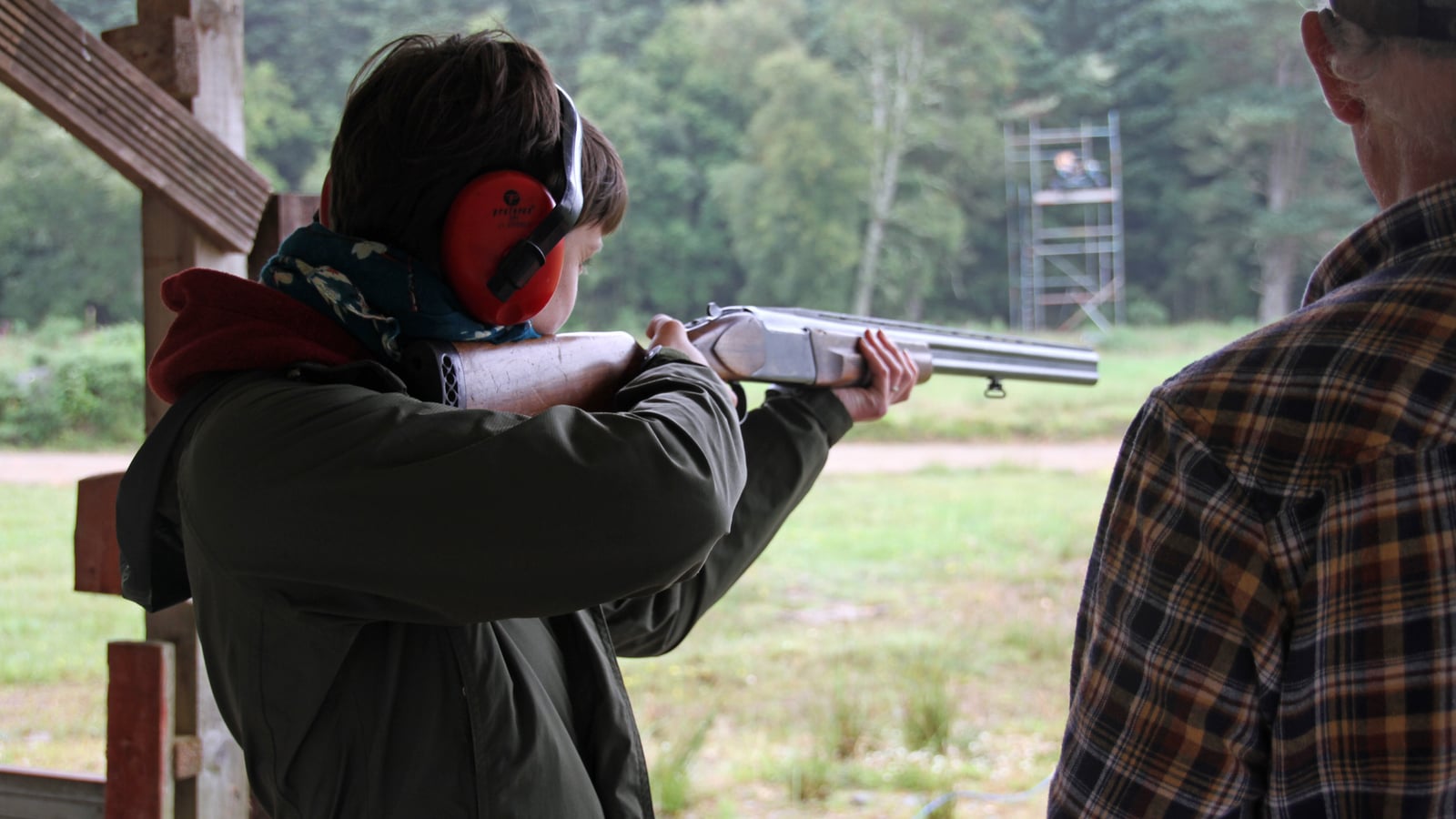
What compak sporting actually is
Compak sporting is a compact version of the classic hunting course (sporting, or “compak” in the strict sense of the term). The principle stays the same: simulate varied bird trajectories with clay targets, but from a fixed shooting position rather than moving from one station to the next along a sprawling course.
The difference lies in the setup. A traditional hunting course occupies several hectares of land, with stations scattered through vegetation and the group of shooters moving from one station to another. Compak sporting compresses that logic onto a much smaller footprint, with a limited number of trap machines arranged around a compact shooting area.
In practice, you stay on a fixed firing point or move between a handful of stations within a restricted area, and the machines send you clays on varied trajectories: high birds, low birds, crossers, going-away birds, teal (rising vertical targets), rabbit (rolling along the ground). The goal stays identical to classic sporting: break as many clays as possible on presentations that never repeat identically from one round to the next.
This discipline developed precisely because not every club has the land needed for a full hunting course. A compak sporting setup fits on a fraction of the terrain, which lets modest-sized clubs offer a varied clay discipline without needing an estate spanning dozens of hectares.
Compact format doesn’t mean simplified difficulty. The machines can be set to produce trajectories just as complex as a classic hunting course, with speeds and angles that vary enormously from one installation to another and from one setting to the next.
Why this discipline is a good entry point into varied clay shooting
Clay target shooting covers several disciplines that differ in their demands and logistics. Classic trap offers more predictable, repetitive trajectories, while the traditional hunting course demands time, a large plot of land, and often a full group to progress from station to station.
Compak sporting sits between these two extremes. You get the trajectory variety of the hunting course - which builds a much richer read of the clay than repetitive trap - without the logistical burden of a large estate and a group moving around for hours.
This accessibility shows up first in time. A compak sporting session often wraps up in an hour or two, versus half a day for a full hunting course with a group. For a shooter with a tight schedule, that difference matters a lot for keeping practice regular.
It also shows up in facility availability. A club without the land for a hunting course can very well have a compak sporting setup, which brings this discipline geographically closer to far more beginner shooters than traditional sporting.
The compact format also makes progressive learning easier. An instructor can set the machines to offer simpler trajectories first, then increase difficulty as the shooter improves, without needing to physically move stations or wait for the next turn on a full course.
Finally, the relative repeatability of a compact setup lets you work specifically on a trajectory type that’s giving you trouble. If a shooter struggles with going-away clays or rising teal, they can ask for several rounds focused on that presentation - something much harder to organize on a large hunting course where each station has a fixed trajectory.
Clay trajectories to know before your first session
Understanding trajectory vocabulary before you arrive at the range completely changes how you approach your first session. Each type of clay demands different anticipation and gun movement.
The going-away clay moves away from the shooter while gradually dropping, replicating the flight of a bird gaining distance after takeoff. The technique is to follow the clay while keeping a constant barrel speed, with no jerk at the moment the shot breaks.
The crossing clay travels across the field left to right or right to left, sometimes at high speed. This is often the trajectory that gives beginners the most trouble, because it demands a smooth pivoting motion and anticipation of the meeting point rather than simple visual tracking.
The high bird arrives above the shooter’s head or from a significant height, on a descending path. It demands managing the vertical angle and often tighter timing, because the useful shooting window is shorter than on a clay crossing at shoulder height.
Teal rises almost vertically from a low point, which completely reverses the usual reflexes: the barrel moves from bottom to top rather than following a horizontal or descending path. This presentation often surprises shooters discovering the discipline.
Rabbit rolls along the ground, bouncing off terrain irregularities, replicating a fleeing hare rather than a bird. The difficulty comes from unpredictable bounces that slightly change the trajectory moment to moment, which rules out any purely mechanical tracking.
A compak sporting setup generally combines several of these trajectories on the same shooting course, sometimes with doubles where two clays launch at the same time or a few instants apart. This combination is what makes every round different from the last, even on a compact installation.
The gear you need to get started
The shotgun remains the central piece of equipment, and the good news for a beginner is that compak sporting doesn’t require a high-end competition shotgun to start. A standard semi-automatic or over-and-under in 12 gauge, in good working order, is plenty for a first taste of the discipline.
The choice between semi-automatic and over-and-under mostly comes down to personal preference and what’s available to rent at the club. A semi-automatic absorbs part of the recoil thanks to its action, which can ease the first sessions for a shooter sensitive to kick. The over-and-under remains the most common gun in sporting competition because it allows quick choke swaps between the two barrels.
The choke deserves particular attention. For starting out on varied trajectories and distances that change from one clay to the next, an open or moderately tight choke (cylinder, quarter choke, half choke) suits better than a very tight choke designed for long distances. A too-tight choke reduces the margin for error on close clays, which penalizes precisely the beginner still refining their pointing accuracy.
Hunting or sporting shells, loaded with shot suited to the average clay distance (often size 7 or 7.5 depending on the club), round out the basic kit. Most clubs offering compak sporting sell shells on site, so there’s no need to stock up beforehand for a first discovery session.
Hearing and eye protection are non-negotiable on any clay range, just as on any other shooting line. The repeated report of shots over a full session justifies quality hearing protection, and eye protection guards against fragments of clay or shot.
A cartridge bag or pouch makes the session smoother by keeping ammunition within reach without constantly reloading your pockets. It isn’t essential for a first session, but it quickly becomes a welcome comfort once practice becomes regular.
Finally, suitable clothing matters more than it seems at first glance. A shoulder pad or reinforced patch on the garment reduces the discomfort of repeated recoil, especially over a session of several dozen shells. Closed, stable footwear for sometimes uneven ground rounds out a serious session outfit.
How a typical first session unfolds
Most clubs offering compak sporting run instructor-led discovery sessions, which is strongly recommended for a first approach to this discipline. The instructor first explains the safety rules specific to clay shooting, which differ noticeably from the rules of a fixed-target range.
Safety in clay shooting rests on strict principles: the gun stays open or pointed at the sky/ground until you’re at the shooting station, it’s only closed and mounted at the station facing the shooting area, and the shot only breaks once the clay is visible and the area is clear. These rules are non-negotiable, and an experienced instructor always covers them before the first shell.
Once the safety basics are covered, the instructor generally adjusts the mount and the shooter’s stance: lead foot forward on the side of the non-mounting shoulder, torso leaning slightly forward, stock well seated in the shoulder pocket. This stance directly determines the ability to track a fast clay without losing balance.
The first clays thrown are often simple, predictable trajectories, sometimes even announced in advance by the instructor so the beginner grasps the principle of tracking and anticipating the meeting point. This phase serves to calibrate the movement before introducing variety.
Gradually, the session introduces more varied trajectories: crossers, going-away birds, then possibly a teal or a rabbit depending on the beginner’s comfort level. The instructor adjusts the pace based on misses and hits, without trying to push too high a volume of shells in the very first session.
The debrief after each round matters as much as the shooting itself. An experienced instructor watches where the shooter looks, how they mount the gun, and at what moment they pull the trigger relative to the clay, which allows precise corrections rather than generic advice.
A first discovery session generally lasts between one and two hours, with shells and gun rental often included in the price. It’s a good way to test the discipline before investing in personal gear or an annual license.
What sets compak sporting apart from trap and skeet
These three Olympic or near-Olympic disciplines share the same basic principle - breaking clay targets launched by a machine - but diverge sharply in execution and technical demand.
Classic trap (Olympic or federal trap) launches clays from a single pit, with trajectories that broadly move away from the shooter within a limited spread of angles. That trajectory’s relative predictability makes it an excellent discipline for building consistency of technique, but it exposes you to less presentation variety than sporting.
Skeet offers crossing trajectories between two fixed machines (the high house and the low house), with angles and speeds that stay constant from one station to another because the machines don’t change settings. It’s a very codified discipline, with eight fixed stations and a sequence known in advance.
Compak sporting, by contrast, deliberately tries to break any predictability. The machines can be reprogrammed between courses, the order of trajectories changes, and the number of machines used can vary from one installation to another. This lack of strict codification is exactly what brings compak sporting closer to real hunting in feel.
For a shooter coming from trap or skeet, compak sporting demands a real adjustment: reflexes built on trajectories known in advance no longer suffice, and you have to redevelop the ability to quickly read each new clay. That’s often what makes this transition exciting for a shooter starting to get bored with overly repetitive trajectories.
Conversely, a shooter who starts directly with compak sporting develops a versatile reading ability from the outset, which later eases a possible transition to trap or skeet, since those disciplines’ trajectories are overall less varied than what’s encountered in sporting.
Gun maintenance specific to this discipline
A shotgun used in compak sporting takes a noticeably higher volume of shells than a fixed-target gun used occasionally. A discovery session alone fires several dozen shells, and a regular shooter can easily top a hundred in a single club outing. This heavy use requires more frequent maintenance than a beginner coming from other disciplines might expect.
Cleaning the barrels after each session remains the unavoidable basics. Powder residue and lead deposits build up quickly inside the barrel, which can eventually affect shot pattern consistency and therefore effectiveness on the clay. A rod pass with a brush and suitable solvent after every outing prevents this gradual buildup.
The repeating mechanism, whether semi-automatic or over-and-under, deserves particular attention at friction points: the bolt, extractors, and locking system accumulate residue that can eventually cause jams or irregular cycling. A poorly maintained semi-automatic is statistically more prone to malfunctions than an over-and-under, due to the added mechanical complexity.
Removable chokes, if used, should be taken out and cleaned regularly to prevent seizing in the barrel thread. A choke left screwed in too long without maintenance can become hard to remove, which complicates precisely the choke-swapping for different distances mentioned earlier.
Regular visual inspection of the stock and its attachment to the action is also recommended, particularly on a gun absorbing a lot of recoil session after session. Play that gradually appears between stock and action can affect point-of-impact consistency without the shooter immediately identifying the cause, wrongly blaming it on a technique flaw.
Finally, a personal shotgun used exclusively or mostly for compak sporting benefits from dedicated, documented maintenance tracking: number of shells fired between full cleanings, dates of the last gunsmith checks, history of chokes used per configuration. This simple tracking helps catch wear or a problem early, before it affects results on the line.
Compak sporting solo, in a club, or in competition: three different uses
The discipline lends itself to very different uses depending on the shooter’s goal, and it’s worth distinguishing these three contexts before committing to regular practice.
Casual individual practice means coming out to shoot a few rounds with no ranking ambitions, simply for the pleasure of the movement and the variety of trajectories. This is the most common use among shooters discovering the discipline, and it often only requires a one-off sign-up or a basic leisure license, with no commitment to a competition calendar.
Group club practice adds an important social dimension: many clubs organize regular group outings where several shooters take turns on the course, swap tips between rounds, and benefit from group motivation to improve. This collective dimension is often cited by practitioners as one of the most appreciated aspects of the discipline, alongside the technical variety of the shooting itself.
Competitive practice engages a different level of demand: regular training targeted at weak points, rigorous score tracking from one round to the next, and participation in an internal then regional competition calendar depending on progress. A shooter moving toward competition generally benefits from more structured coaching from a club instructor or coach, with progress goals set over several months.
These three uses aren’t fixed: many shooters start out purely for leisure, gradually discover the pleasure of measured progress, and naturally slide into more regular then competitive practice without having planned it at the outset. Nothing stops you from staying with leisure practice indefinitely either, since the discipline imposes no obligation to progress toward competition.
The choice between these three approaches directly influences the recommended practice rhythm and the type of gear to prioritize. A purely leisure shooter doesn’t need to immediately invest in a high-end competition shotgun or a full set of interchangeable chokes, whereas a competition-oriented shooter will find real benefit in gradually refining their gear based on identified weak points.
The administrative framework and the federal license
Practicing compak sporting at a club requires a license with the federation responsible for clay shooting (the Fédération Française de Ball-Trap, or FFBT, distinct from the FFTir which covers fixed-target shooting disciplines). Some clubs offer one-off discovery sessions without a license, but regular practice requires this affiliation.
Acquiring and owning a hunting or sporting shotgun for this discipline follows the classification rules for civilian firearms. A 12-gauge manually repeating or semi-automatic shotgun generally falls under category C, subject to declaration, or category B if certain technical features apply - the precise classification depends on the exact model, and it’s better to check directly with the gunsmith or club at the time of purchase rather than rely on a generalization.
A medical certificate is required to issue the federal license, following the same logic as other shooting sports disciplines. This certificate attests to the absence of any contraindication to shooting, and its validity and precise requirements vary by federation and sometimes change over time, so it’s best to check directly with the club when signing up.
The cost of a discovery session, an annual license, or gear rental varies widely from one club to another depending on region, facilities, and equipment level. There’s no reliable national reference price to cite, as each club sets its own prices based on how it operates and its costs.
Some clubs organize internal or regional compak sporting competitions, with a ranking system by level that lets a beginner compete against shooters of comparable level rather than being immediately pitted against seasoned competitors. It’s a good way to progress once the basics are acquired, without the pressure of facing veteran competitors from the very first outings.
Common beginner mistakes in this discipline
The first classic mistake is looking at the barrel rather than the clay. A beginner’s natural reflex is to visually check where the gun is pointed, which immediately breaks tracking of the clay and delays the shot. The correct technique requires keeping your gaze fixed on the clay and letting the barrel follow in peripheral vision.
The second common mistake is a gun mount that’s too slow or poorly synced with the call of the clay. A shooter who mounts too early tires their arm and loses stability at the moment of firing; a shooter who mounts too late no longer has time to adjust aim before the clay leaves the useful shooting zone.
The third mistake, very common among beginners coming from fixed-target shooting, is trying to precisely aim at the clay as you would aim at a fixed point on a stationary target. Clay shooting works on a principle of anticipation and following the movement, not static aiming - it’s one of the hardest mental shifts for a shooter coming from precision shooting to make.
The fourth mistake concerns choke choice. A beginner who directly mounts a tight choke to “get more precision” actually reduces their margin for error on close clays and makes learning more frustrating than it needs to be. It’s better to start with an open choke and tighten gradually based on the distances encountered.
The fifth mistake is firing too many shells in a single session while trying to fix a flaw through repetition rather than analysis. A string of ten missed clays for the same reason isn’t fixed by shooting twenty more without changing anything about the technique; it’s fixed by precisely identifying where the error lies with an instructor’s help, then adjusting one parameter at a time.
Finally, many beginners neglect foot position and overall body balance, focusing only on the arm and shoulder movement. An unstable stance limits the fluidity of the pivot needed to track a fast crossing clay, regardless of how good the upper-body technique is.
Progressing after the first sessions
Once the basics are acquired, progress in compak sporting mostly comes from the variety of installations you visit. Every club sets its machines differently, which exposes you to varied trajectories and speeds and prevents getting used to just one type of presentation.
Working specifically on the trajectories that give you trouble is more effective than only repeating what already works. An experienced club shooter often recommends asking the instructor for a round focused on the least-mastered clay type rather than running full courses that dilute training on presentations already mastered.
Regularity of practice matters more than one-off volume. A short but frequent session anchors reflexes better than a long occasional session followed by several weeks without practice. Clay shooting technique relies on motor reflexes that degrade fairly quickly without regular upkeep.
Filming your stance and movement, when the club allows it, offers visual feedback a shooter can’t get alone mid-action. Reviewing your mount, pivot speed, or trigger timing on video often reveals flaws that are invisible in the moment.
Taking part in internal club competitions, even with no high-level ambition, structures progress by setting concrete goals at regular intervals. Even modest competitive pressure also reveals stress-management flaws that don’t necessarily show up in pure training.
Finally, swapping notes with other club shooters about their own struggles and solutions often speeds up individual progress. A regional champion who went through the same blocks years earlier sometimes gives more relatable advice than an abstract technical explanation, simply because she lived through the same difficulty firsthand.
Keeping a training log, even a basic one, brings value often underestimated by beginners. Noting after each session the number of clays hit by trajectory type, wind or light conditions, and the choke setting used lets you spot trends that memory alone misses. A shooter who regularly reviews their own history spots faster whether a specific clay type is stalling despite training, which directs the next sessions straight at that weak point rather than continuing to work what already works well.
The mental side, often underestimated
Compak sporting is a discipline where mental management weighs at least as much as pure technique, which often surprises beginners coming from static shooting where concentration mostly focuses on stability and breathing.
The fast pace of decision-making - spotting the clay, following it, pulling the trigger, all in a fraction of a second - leaves little room for hesitation. A shooter who consciously thinks through each step of the movement during the shot is always too late on the clay. Technique needs to become automatic enough to free conscious attention for the trajectory alone.
Handling a miss is also an integral part of the discipline. A missed clay often generates immediate frustration that, if not managed, contaminates the next shot: the shooter tenses up, anticipates poorly, or overcompensates in the opposite direction from the previous error. Mentally starting fresh after every clay, hit or missed, is a skill trained just like the physical movement.
The pressure of other shooters watching, even in a perfectly friendly setting, also plays a real role for beginners. Shooting in front of a group watching every result can generate extra tension that degrades the fluidity of the movement. An experienced instructor generally helps defuse this social dimension by pointing out that every shooter in the group went through the same misses when they started.
Developing a simple mental routine before each shot - a breath, a visual fixation point, an always-identical starting stance - helps stabilize this psychological dimension the same way a routine stabilizes technique. This consistency reassures and reduces stress-related variability, particularly during the first internal club competitions.
Finally, accepting that a round sometimes ends in a disappointing result without the cause being immediately identifiable is part of the normal learning process for this discipline. Progress in compak sporting is never perfectly linear, and a club instructor generally stresses the importance of judging your progress over several months rather than a single isolated session.
Budget and practical organization over time
Committing to compak sporting long-term means thinking beyond the first discovery session, anticipating recurring expenses and the organization needed to maintain regular practice.
Shells are the most regular expense and the one most directly tied to practice volume. A shooter who trains often uses noticeably more shells than an occasional shooter, and this budget line deserves anticipating before committing to a sustained training rhythm rather than discovering it afterward.
The annual federal license and club fees make up a second recurring expense, whose amount varies by structure and region, as mentioned above. Some clubs offer membership packages that include a number of rounds per month, which can save money for a regular shooter compared to paying per session.
Gear maintenance, detailed above, represents an indirect but real cost: cleaning products, periodic servicing by a gunsmith, gradual replacement of chokes or other wear parts. This line generally stays modest compared to shells, but it shouldn’t be overlooked in a yearly budget view.
Travel to the club also deserves consideration, especially if the nearest compak sporting facility isn’t the one best suited to the shooter’s level or goals. The variety of installations recommended above for progress sometimes means traveling to several different clubs, which has a time and fuel cost to factor into the overall organization of practice.
Finally, organizing your practice around a realistic schedule - accounting for work and family constraints - remains the most decisive factor for long-term regularity, well ahead of purely material considerations. A shooter who blocks off a fixed, recurring slot in their calendar almost always progresses faster than one who fits it in “whenever they find the time,” even with an equivalent gear budget.
Pooling certain expenses with other club shooters, where possible, also lightens the overall budget. Some clubs organize group shell purchases, which reduces the unit cost compared to regular individual buying. Asking about these collective practices right at sign-up helps optimize the budget without compromising on gear quality.
FAQ
Q: Do you need a license to try compak sporting for the first time? A: Most clubs offer discovery sessions without a license, often with gun rental and shells included. A federal license becomes necessary for regular practice or to enter competitions organized by the club.
Q: What gauge shotgun should you use to start out? A: 12 gauge remains the most common standard for this discipline and the easiest to find for rent at clubs. Other gauges exist but offer no particular advantage for a beginner discovering the discipline.
Q: Does compak sporting hurt your shoulder if you’ve never shot a shotgun before? A: Recoil is mostly felt on the first shells and eases off with a correct stance and a suitable shoulder pad. A semi-automatic in good condition absorbs part of the recoil, which often makes the first sessions easier than with an over-and-under.
Q: How long does it take to get good at crossing clays? A: This varies enormously depending on the shooter, practice frequency, and quality of coaching received. What speeds up progress is targeted work on this specific trajectory rather than generalist practice diluted across every clay type.
Q: Can you go directly from compak sporting to a traditional hunting course? A: Yes, both disciplines share the same trajectory-reading logic, and experience gained in compak sporting transfers well to a full hunting course. The main adjustment concerns the logistics of moving between stations rather than the shooting technique itself.
Q: What’s the difference between “sporting” and “compak sporting” in club vocabulary? A: In common usage, “sporting” often refers to the traditional hunting course on large land, while “compak sporting” specifically refers to the compact version on a reduced installation. The two terms are sometimes used interchangeably depending on the club, so it’s best to check the exact format offered before signing up.