
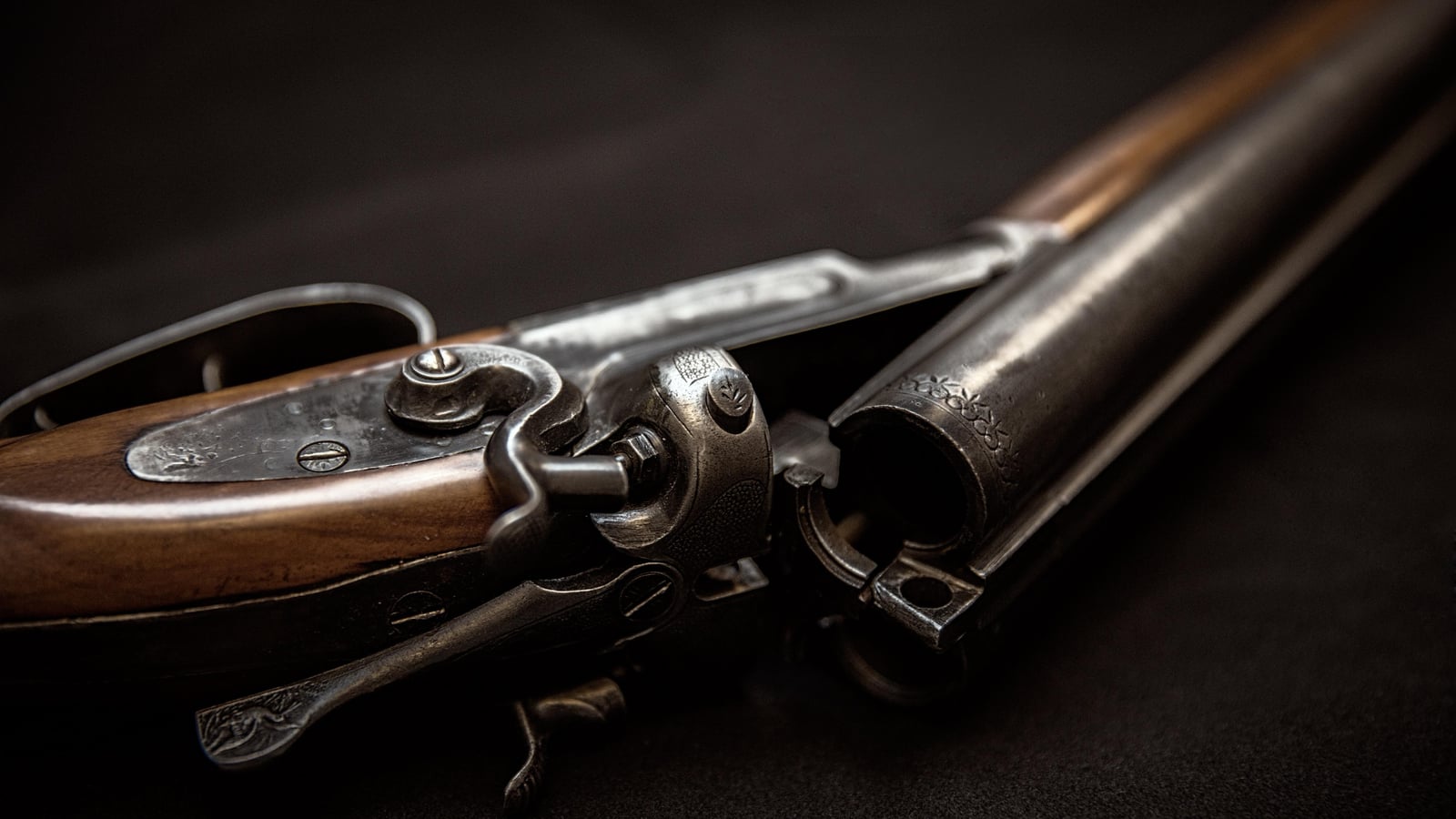
Why black powder forgives no delay
Black powder and blank ammunition leave residue that’s radically different from modern smokeless powder. This residue is hygroscopic: it absorbs moisture from the ambient air and forms a corrosive mixture as soon as it contacts metal. This isn’t a figure of speech — it’s a chemical reaction that starts the moment shooting stops.
With classic smokeless powder, you can go home, set your gun aside, and clean it the next day without much risk. With black powder or blanks, that delay can be enough for visible corrosion spots to appear in the barrel, under the action, or on the breech face. A black powder rifle neglected overnight can show surface rust as early as the next morning.
The salt in combustion residue attracts moisture like a magnet. The more time passes between shooting and cleaning, the more time the residue layer has to lock in that moisture deep down, especially in hard-to-reach areas: barrel threads, the flash channel on percussion guns, cylinder chambers on black powder revolvers.
This article gives you the express procedure to apply right on the firing line or just after, before you even head back to the clubhouse. The goal isn’t to replace a full cleaning at home, but to buy the critical hours that make the difference between a healthy gun and one pitted with rust.
The principle: neutralize before deep cleaning
The express procedure rests on a simple idea: you don’t need to fully strip your gun at the range, you need to chemically neutralize the residue as fast as possible. The thorough, complete cleaning with extensive disassembly can wait until you’re back home.
Neutralizing means two things: dislodging as much solid residue as possible with a suitable solvent, and leaving a thin protective film that keeps corrosion from setting in during the trip home. This is a transitional cleaning, not a final one.
This approach changes the usual maintenance logic. For a modern smokeless-powder gun, many shooters clean once they’re home, at leisure, with no particular urgency. For black powder, the useful window is measured in minutes to a few hours, not days. The express kit you bring must be designed for a quick, effective intervention, not a deep maintenance session.
The same reasoning applies to blank ammunition, often used in historical reenactment or specific disciplines: the powder charge, even without a projectile, deposits abundant combustion residue in the barrel and mechanism. The absence of a bullet changes nothing about the chemistry of corrosion.
The minimal gear to bring to the range, and when to replace it
You don’t need to bring your entire cleaning bench. An express kit fits in a small pouch and should stay permanently in your range bag if you shoot black powder regularly.
Here’s the minimal list covering the essentials:
- A soapy-water solvent or a dedicated black powder product (some commercial products are specifically formulated to dissolve sulfur residue).
- Enough cleaning patches or lint-free cloths — plan for more than with a modern gun, as residue blackens fabric fast.
- A short, foldable cleaning rod with a patch holder adapted to your caliber.
- A brass or nylon brush suited to the caliber to dislodge residue embedded in the rifling.
- A small bottle of fine oil or protective grease for the final anti-corrosion layer.
- Nitrile gloves, so you don’t transfer acidic hand sweat onto cleaned metal surfaces.
- A small suitable screwdriver if your gun needs a simple partial disassembly (buttplate, forend) to access critical areas.
All this gear should fit in a watertight container, since you’ll be handling potentially messy products in a range environment where space is limited.
The express procedure in six steps
Step 1, unload and secure before any cleaning action. Even before pulling out cleaning gear, safety comes first. Check that the gun is unloaded, action open or cylinder swung out, and that muzzle direction stays controlled throughout the handling. This step never changes, whether it’s an express or full cleaning.
For a muzzle-loading percussion or flintlock gun, make sure no residual charge remains and that the nipple or flash pan is clear before any solvent intervention. The risk of an unfired charge must always be ruled out first.
Remove the rifle or gun from the firing line before starting, following range rules on handling firearms outside the active shooting zone. An experienced range officer will always remind you of this rule before authorizing on-site cleaning.
Step 2, an immediate first wet pass through the barrel. As soon as the gun is secured, the priority action is running a solvent-soaked patch through the barrel, even just roughly. This first pass isn’t meant to clean perfectly: it aims to moisten and start dissolving residue before it hardens.
Run the rod back and forth with a wet patch along the full barrel length, focusing on where residue accumulates most: the chamber and the first few centimeters past it. That’s where residue concentration is highest.
If you’re shooting a smoothbore or rifled black powder gun, don’t hesitate to repeat this pass two to three times with a clean patch each time. Black, sticky residue needs more passes than plain smokeless powder fouling.
Step 3, treat the breech, action, and contact areas. The barrel isn’t the only critical point. The breech face, moving action, and contact areas between metal parts also accumulate residue, often as a sticky deposit or fine black dust that lodges in the smallest crevices.
Use a solvent-soaked, not soaked-through, cloth to wipe these surfaces without letting liquid run into fine internal mechanisms like the trigger group. Excess solvent can migrate to areas that don’t need wetting and dilute grease already in place.
On a percussion gun, pay particular attention to the flash channel and the area around the pan: it’s the direct passage point for combustion gases and therefore the zone most exposed to rapid corrosion. A cotton swab soaked in solvent reaches these tight corners.
For a black powder revolver, don’t forget the cylinder chambers one by one: each received its own charge and its own residue, and they don’t all get cleaned at once with a single sweeping motion.
Step 4, dry completely before applying protection. A common mistake is applying oil or grease directly onto surfaces still wet with water-based solvent. The mixture dilutes the protection and can trap residual moisture under the protective layer, which is worse than doing nothing.
Use dry patches and cloths to remove all visible traces of moisture before the next step. This drying doesn’t need to be long: a few passes with a dry, absorbent cloth are enough on the firing line.
If you carry compressed air spray (handy to slip into a cleaning pouch), a quick blast into the barrel and corners helps chase out residual moisture from hard-to-reach areas, especially barrel threads on takedown guns.
Step 5, apply a thin protective layer before the trip home. Once surfaces are dry, apply a thin layer of oil or protective grease to the barrel, action, breech, and all metal areas exposed to air. The goal is a thin, even film, not a thick coating that traps dust.
This protective layer acts as a temporary barrier until the complete cleaning at home. It never replaces thorough maintenance, but it keeps the ambient humidity of the trip back (car trunk, transport bag) from attacking the metal for several hours.
For internal areas hard to reach in express mode, like the inside of the ignition mechanism, a drop of fine oil applied with a toothpick or small brush is plenty. The idea is to cover without drowning.
Step 6, reassemble and check before storing the gun. If you did a light disassembly (buttplate, forend), carefully reassemble, checking that each screw returns to its original spot with proper torque. A rushed reassembly at the range is a classic source of loose screws discovered later.
Before storing the gun in its case, do a final visual check: no visible residue in the barrel when looking through it against light, no moisture traces, action functioning freely. This quick check takes less than a minute and prevents unpleasant surprises.
Store the gun in a breathable case rather than an airtight synthetic-fabric sleeve pressed against still-warm metal. A fully closed case around a gun that isn’t completely dry can create a humid micro-climate favorable to corrosion during transport.
The special case of blank ammunition
Blank ammunition, used notably in historical reenactment, controlled film productions, or certain specific disciplines, generates combustion residue comparable to black powder, sometimes even more abundant depending on the charge and primer type used.
The absence of a projectile doesn’t reduce residue deposits in the barrel and chamber at all: on the contrary, combustion energy disperses differently and can foul certain areas more, especially around the chamber and ejector on converted semi-automatics or guns specific to blank firing.
The express procedure stays identical: quick solvent moistening, treatment of contact areas, complete drying, light protection. Don’t ease up on your vigilance just because no bullet was fired — corrosion doesn’t care about the projectile, it reacts to powder residue.
Differences by gun type and legal category
Not all black powder guns get the same express treatment, even though the general principle stays the same. A flintlock gun, for example, adds a specific area to watch: the pan and lock, where priming powder leaves its own residue in addition to that of the barrel.
On a percussion gun, the nipple itself can gradually clog if not cleared regularly, including during express cleaning. A thin wire or dedicated pick lets you check the channel stays clear before storage.
For a black powder revolver, the multiple cylinder chambers slightly lengthen express cleaning time compared to a single-barrel gun, but each chamber must receive the same treatment, no exceptions, since each was exposed to its own combustion.
Larger-caliber black powder rifles and shotguns tend to generate more residue per shot, which justifies packing more patches in your express kit if you shoot this type of gun rather than a small-caliber percussion pistol.
Frequency and organization over a long session
If your shooting session stretches over several hours with many rounds fired, don’t wait until the very end of the session for a first express cleaning pass. A quick wet patch through the barrel every twenty to thirty rounds, depending on your shooting pace, limits residue buildup and makes the evening’s full cleaning easier.
This intermediate organization is especially useful in competition or on club days dedicated to black powder, where several shooters rotate through the same firing point and available time per person stays limited.
Note in your shooting log the number of rounds fired and the timing of each intermediate cleaning pass: this information becomes valuable for tracking barrel wear and anticipating deeper maintenance if you notice accuracy degrading over the session.
What to never do in a hurry
Some shortcuts seem to save time but actually worsen the risk of corrosion or damage. Never put a gun still wet with water-based solvent into a closed case without a drying step, even a quick one: it’s the best way to nurture an invisible rust spot for days.
Avoid using a solvent meant exclusively for modern smokeless powder to treat black powder residue: the chemical composition differs, and some modern solvents don’t effectively dissolve the sulfur and combustion salts specific to black powder.
Never neglect invisible areas just because they’re not seen at first glance: flash channel, barrel threads, uncleaned cylinder chambers are the points where corrosion sets in fastest and deepest, precisely because they escape a quick visual check.
Finally, never put off the express pass with the excuse “I’ll clean it properly at home tonight.” The critical window sits in the first hours, not the next day: a full cleaning done twelve hours too late can already come after the first corrosion spots have appeared.
The link with the full cleaning at home
The express procedure never exempts you from a full cleaning once home, with more extensive disassembly depending on the gun model, thorough brushing, and careful inspection of each part. Think of the range step as temporary insurance, not a definitive substitute.
Once home, go through a classic, complete cleaning procedure: disassembly per manufacturer recommendations, methodical cleaning of each part, final lubrication suited to storage conditions. It’s this full cleaning that guarantees the gun’s real longevity over years of use.
An experienced club shooter who regularly shoots black powder eventually makes this double routine — express at the range, full at home — an automatic reflex, on par with the safety check before any handling. It’s a habit to build, not a matter of particular skill.
Adapting the procedure to weather, location, and transport
Ambient humidity radically changes the urgency of the procedure. A black powder session in dry, warm weather leaves you a bit more margin than a session under a humid sky or by the sea, where humidity levels clearly speed up the fixing of corrosive residue on metal.
In humid or rainy weather, don’t skip any step of the express procedure, even if you’re eager to get somewhere dry. It’s precisely in these conditions that the immediate solvent pass makes the biggest difference between an intact gun and one marked by the next day.
In winter, the temperature contrast between cold outdoor air and the heated interior of a car or clubhouse can create condensation on the still-warm barrel metal. This fogging, invisible to the naked eye, is a sneaky source of corrosion if the gun hasn’t received its protective layer before this temperature change.
In summer, heat speeds up certain chemical reactions but also dries water-based patches and solvents faster, which can give a false impression that cleaning is finished while solid residue stays stuck under a dry film. Always check by touch and sight, not just by counting patch passes.
A covered range protects your guns from rain and wind during the session, but doesn’t eliminate the need for the express procedure: the ambient humidity of a poorly ventilated space, especially a basement, can sometimes exceed that of an outdoor firing line in dry weather.
Outdoors, at a club range dedicated to black powder or during an open-field historical reenactment, ambient dust and sand add to combustion residue. This dust can mix with solvent and form an abrasive paste if you don’t change patches often enough during express cleaning.
If your session happens in full sun, avoid applying solvent directly to a barrel still hot from a string of rapid shots: let it cool for a few minutes so the solvent can act normally instead of evaporating instantly on contact with hot metal.
For multi-day outdoor historical reenactment activities, like certain gatherings dedicated to antique firearms, plan an express kit in sufficient quantity to cover each shooting day, since restocking solvent or patches isn’t always possible on site.
Express cleaning of the gun itself isn’t enough if you then store it in a case impregnated with moisture or residue from a previous session. A foam case that absorbed moisture during a prior outing becomes a delayed-action corrosion source, even for a gun perfectly cleaned before storage.
Remember to regularly air-dry your transport case, especially after a session in the rain or in humid conditions. Interior foam holds moisture longer than you’d think, and prolonged contact with metal can be enough to create a localized rust spot, right where the gun touches the foam.
Also check your express cleaning kit itself: a cloth left damp and stored in the same pouch for the next session becomes a vector of moisture and sometimes mold instead of a healthy cleaning tool. Air-dry all the elements of your kit between sessions, not just the gun.
If you transport several black powder guns in the same case, separate them with partitions or individual sleeves rather than leaving them metal against metal. Direct contact promotes micro-scratches during transport and can also transfer moisture from one piece to another.
Some elements of your express kit wear out or get contaminated faster than others and deserve a check before each season of intensive black powder practice. Patches and cloths pose no particular problem as long as they stay clean and dry between uses.
Solvent, on the other hand, loses effectiveness once the bottle has been open a long time or exposed to significant temperature swings. This varies by product and formulation, so stay general on this point: if the solvent seems to have changed color, smell, or consistency, it’s better to replace it than to rely on it at a critical moment.
Brass or nylon brushes wear with the number of passes and lose their ability to effectively dislodge embedded residue. A brush with flattened or sparse bristles won’t perform the same as a new one, particularly in the most fouled areas like the chamber.
Store your express kit in a container that also protects the solvent bottle from prolonged direct sun exposure in a car trunk in summer, which can speed up its degradation or raise pressure inside the bottle.
Common mistakes among shooters discovering black powder
A shooter switching for the first time from a modern gun to a black powder gun often underestimates the scale of the maintenance shift required. The most common mistake is applying the same reflexes as with a smokeless powder gun: a quick cleaning once home, with no intermediate step at the range.
Another classic mistake is neglecting even the partial disassembly of easily accessible parts, settling for a superficial cleaning of the barrel without ever checking the breech face or contact areas. Residue left under a buttplate or in a forend corner continues its invisible corrosion work.
Some beginners also apply too much solvent at once, thinking a generous quantity makes up for shorter contact time. In reality, excess solvent dilutes protective grease already in place and can migrate to sensitive areas of the mechanism without any real added benefit for dissolving residue.
Finally, many newcomers to black powder ignore the need to check the flash channel or priming passage after every session, even though it’s often the first spot where a corrosion point appears, precisely because it escapes notice during a quick barrel check.
Compact checklist to bring to the firing line
So you don’t forget anything when packing up your gear at the end of a session, here’s a condensed checklist covering the whole procedure in order:
- Check that the gun is unloaded and secured before any handling.
- Run a first wet solvent patch through the barrel, focusing on the chamber.
- Treat contact areas with a cloth or cotton swab: breech, action, flash channel, or cylinder chambers depending on gun type.
- Fully dry all treated surfaces before applying any oil or grease.
- Apply a thin protective layer over all exposed metal surfaces.
- Reassemble any disassembled parts and check screw tightness.
- Do a final visual check of the barrel against the light before storage.
- Store in a breathable case, never an airtight sleeve on a gun that’s still warm or damp.
- Plan a full cleaning at home as soon as possible, ideally the same day or the next day at the latest.
Keep this checklist in your kit or on your phone: on a busy range, between chatting with other shooters and packing up the rest of your gear, it’s easy to skip a step without a simple reminder in front of you.
Beyond functional safety, a well-maintained black powder gun holds its value better, whether it’s recent or an antique piece with heritage character. A pitted barrel loses precision, resale value, and sometimes safety of use if corrosion progresses far enough to locally weaken the metal.
For antique or collector’s guns fired occasionally, often passed down or acquired with a particular history, express cleaning takes on an extra dimension: every avoided corrosion point preserves an object that can’t be replaced identically. A regional champion who owns an old family gun will apply this rigor with even more attention than a shooter using a recent replica.
This immediate maintenance reflex, with repetition, becomes a routine that no longer really requires thought: get out the kit, moisten, treat, dry, protect, store. A few minutes are enough once the motion is learned, for a benefit measured in years of healthy gun function.
Logging this maintenance tracking in a shooting journal, paper or digital, helps make objective what memory alone quickly forgets: the date of the last full cleaning, the number of sessions since the last thorough brushing, the areas that have already shown early corrosion in the past. This traceability becomes especially useful if you share a club gun among several shooters, where no one has a complete view of the maintenance history without a written record.
A shooter who owns several black powder guns, used according to season or discipline practiced, also gets real benefit from systematically noting which procedure was applied after each outing. A gun taken out only once a year for a historical reenactment deserves a different check than a rifle used every weekend at the club, and only a written log lets you keep that distinction clear over the months.
Comparing cleaning solutions and budgeting for the express kit
Several product families exist for the express procedure, each with its own advantages depending on your context. Warm soapy water, historically used by black powder shooters since forever, remains a simple and economical solution: it effectively dissolves sulfur residue but requires particularly careful drying, since water is by nature exactly what you’re trying to remove from the metal.
Commercial solvents specifically formulated for black powder often offer a practical compromise: effectiveness close to soapy water for dissolving residue, with a component that somewhat limits moisture reabsorption during drying. They cost more per use than soapy water but travel more easily in a small bottle in an express kit.
Some practitioners also use specific pre-soaked wipes, handy for a quick pass over external contact areas but generally insufficient alone for serious barrel cleaning, which requires running a rod and patch to reach the full length.
Whichever product you choose, the rule stays the same: what matters isn’t the brand or exact formulation, but the speed of intervention and the rigor of drying before protection. This varies by product and personal preference, so test several solutions over a season to find what suits your practice and budget.
Putting together a dedicated express kit represents a modest initial investment compared to the cost of a black powder gun or a barrel damaged by corrosion. The exact price varies by brand, product quality, and retailer, so stay general on this point rather than quoting a figure that might no longer be current.
Most of the budget goes toward solvent and consumables (patches, cloths), which get replenished session after session, rather than reusable tools like the rod or brush, bought once for several seasons of practice. An experienced range officer often recommends investing in a quality brush rather than an entry-level model that quickly loses effectiveness.
Consider this kit as an integral part of your practice’s ongoing maintenance budget, on the same footing as ammunition or targets, rather than as an exceptional expense. Over a season of regular practice, the cumulative cost of consumables stays well below that of repairing a rust-pitted barrel.
Some manually repeating black powder rifles, or historical guns reloaded with black powder in a supervised sporting context, fall depending on the case into Category C (subject to declaration) or Category D (free sale or simple registration) in French classification, depending on their exact configuration and manufacture date — check your own country’s classification, as rules vary by jurisdiction.
The precise classification depends on model-specific technical characteristics, so always check your situation with your gunsmith or federation rather than relying on a general rule: the regime applying to your own gun can vary based on criteria only a qualified professional can confirm with certainty.
On the maintenance side, this administrative classification changes nothing about the express procedure itself: whether it’s a declared category gun or a freely sold category gun, black powder residue acts the same way on metal, and the same cleaning rigor is required.
A common trait of all these manually repeating guns: the bolt or breech mechanism sometimes multiplies metal-on-metal contact points compared to a simple percussion gun, meaning more areas to treat during the express pass, particularly around locking surfaces.
FAQ
Q: How much time do I really have before corrosion starts after firing black powder? A: This varies with ambient humidity, metal type, and barrel finish, so it’s impossible to give a precise universal timeframe. The principle to remember is simple: the sooner you act, the less risk you take — ideally right on the firing line.
Q: Can I use the same solvent for black powder and my smokeless powder guns? A: Some solvents are multipurpose, but a dedicated black powder product dissolves the sulfur residue specific to this type of combustion better. Check the product label before relying on it for both uses.
Q: Is express cleaning enough if I don’t have time for a full cleaning the same day? A: No, it delays the problem but doesn’t solve it. Full cleaning with disassembly remains essential as soon as possible, ideally within 24 to 48 hours after the session.
Q: Do I need a different cleaning kit for each black powder gun caliber? A: Not necessarily a whole separate kit, but brushes and jags must be matched to each gun’s exact caliber. Store them together in the same pouch so you don’t forget anything at the range.
Q: Do blank cartridges really need the same vigilance as real black powder? A: Yes, combustion residue from blanks can be just as corrosive depending on the charge and primer composition. Don’t ease off your cleaning procedure just because no projectile was fired.
Q: What should I do if I find a rust spot despite express cleaning? A: A light surface spot is usually treated with a gentle specific paste or wool, applied carefully to avoid scratching the metal or the bluing. If the spot seems deep or located inside the barrel, get a gunsmith’s opinion rather than trying to fix it yourself.