
Why black powder demands a completely separate cleaning routine
If you shoot modern calibers and black powder in the same week, drop the idea right now that cleaning works the same way for both. Black powder residue has nothing in common with that of modern smokeless powder, and treating it the same way guarantees you a rifle or revolver pitted with rust within days.
Black powder is a mixture of saltpeter (potassium nitrate), sulfur and charcoal. Its combustion is incomplete: it leaves abundant solid residue, visible to the naked eye as blackish soot, and above all a hygroscopic chemical residue that draws in moisture from the surrounding air.
This hygroscopic residue is the heart of the problem. Unlike modern powders whose residues are relatively stable once cooled, the salts left by black powder combustion continuously absorb ambient humidity. The barrel literally turns into a water trap until it’s cleaned.
A shooter discovering black powder after years of modern calibers almost always underestimates this point at first. The usual reflex (“I’ll clean it tomorrow, no rush”) that works fine with smokeless powder becomes a costly mistake with black powder: the corrosion process starts well before “tomorrow.”
This difference in chemical behavior also explains why shooters who practice both modern shooting and vintage-arms disciplines in a club generally keep two completely separate cleaning routines, with different gear and different reflexes depending on which firearm came out that day. Mixing the two approaches out of habit or convenience means systematically under-protecting one of the two categories of firearms.
This article covers in detail why these residues are so corrosive, the soapy water cleaning procedure that remains the historical and practical reference, the immediate oiling that must follow without delay, and the real window you have before the first rust pitting appears.
The specific corrosiveness of black powder residue
Black powder residue isn’t just dirty, it’s chemically aggressive toward steel. Combustion produces sulfides and potassium salts which, combined with air humidity, form acidic compounds directly at the metal surface of the barrel.
This reaction doesn’t need visible liquid water to start. The moisture naturally present in ambient air is more than enough, which explains why a black powder firearm stored “dry” in appearance can still develop rust within a few days if it hasn’t been cleaned.
Another particularity: black powder residue is solid and abundant, far more than that of a modern powder. It visibly builds up in the rifling, around the touch hole (for a flintlock or percussion firearm) and in the ignition mechanism, creating zones where moisture stays trapped longer than elsewhere.
The combination of these two factors, abundant residue and hygroscopic residue, explains why experienced black powder shooters treat cleaning not as a comfort chore but as a rescue operation to be carried out the same day. Putting it off until the next day is not a reasonable option with this type of ammunition.
You should also know that this corrosiveness affects all surfaces exposed to combustion gases, not just the inside of the barrel. The breech face, the areas around the pan or nipple depending on the firearm type, and sometimes even part of the external mechanism near the ignition point undergo comparable exposure and deserve the same vigilance.
The gear to prepare and the soapy water principle
Unlike modern rifle maintenance, which mostly relies on specific solvents, black powder cleaning relies on a simpler and older principle: hot soapy water. Get your gear ready even before leaving the range, so you don’t waste time once home.
Here’s what you need to gather:
- Hot water, very hot to the touch if possible (but not boiling to the point of burning you while handling it).
- A mild soap, traditional Marseille soap or a neutral dish soap without a strong fragrance.
- Cleaning rods and brushes dedicated to your firearm’s caliber, plus a small soft-bristle brush for tricky spots.
- Clean patches or rags in generous quantity, you’ll use more than for modern powder maintenance.
- A fine gun oil or a grease specifically recommended for black powder firearms, to apply immediately after drying.
- An air dryer or, failing that, an absorbent microfiber cloth and a gentle heat source (radiator, warm air from a hair dryer at a reasonable distance).
- Gloves if your skin is sensitive to prolonged hot water or cleaning products.
Before touching anything, check that the firearm is completely empty and unloaded, as with any firearm. Flintlock and percussion black powder firearms each have their own verification particularities depending on the ignition system, so familiarize yourself with your exact model’s mechanism before starting.
Set up your cleaning station near a water source, sink or outdoor tap, because the soapy water method involves successive rinses. A poorly planned workspace, far from any water supply, will waste precious time exactly when speed matters most.
Hot soapy water remains the reference method for cleaning a barrel after black powder, and that’s no historical accident. Soap effectively dissolves solid residue while hot water dilutes it and helps flush it out of the rifling.
The principle is simple: black powder residue is largely water-soluble, unlike the copper fouling of a modern powder which requires specific chemical solvents. Hot soapy water dissolves soot and salts within minutes of contact, where a classic smokeless powder solvent would be far less effective on this type of residue.
The heat of the water plays a role beyond simple cleaning: it also warms the barrel’s metal, which then speeds up the evaporation of residual moisture during drying. That’s a detail that matters enormously for the rest of the procedure, as you’ll see further on.
Some experienced shooters add a bit of baking soda to the soapy water to more effectively neutralize the acidic aspect of the residue, a traditional practice that remains an interesting option without being strictly mandatory. What matters most is the combination of hot water and soap, correctly applied and above all followed by rigorous drying.
Many modern shooters, used to spray solvents and all-in-one products, are surprised the first time they’re told that water and soap are enough. Yet it’s the method that has always been used for this type of ammunition, long before modern chemical solvents appeared, and it remains perfectly suited.
The soapy water cleaning procedure, step by step
Partially disassemble your firearm as far as its type and mechanism allow, limiting yourself to operations you’re confident with and that the manufacturer’s manual permits. An accessible barrel greatly eases cleaning, but never force a disassembly you’re not familiar with.
Prepare a container of hot soapy water large enough to immerse the area concerned, or to pass a soaked cleaning rod through the barrel if full immersion isn’t possible on your model.
Run patches soaked in hot soapy water through the barrel several times in a row, changing the patch each pass. You’ll quickly see abundant black soot come off, that’s normal and expected with this type of residue.
Pay particular attention to the zones where combustion gases concentrate: the chamber, the area near the ignition system (pan, nipple, or equivalent depending on your firearm), and the first rifling grooves on the chamber side. These are the zones where residue accumulates most densely.
Then rinse thoroughly with clear hot water, no soap, to eliminate any soap residue that could itself retain some moisture if not fully rinsed out. Insufficient rinsing leaves a film that complicates complete drying.
Repeat the soap-then-rinse cycle as many times as needed until the patches come out with no trace of black soot. A clean black powder barrel yields a patch that comes out clear, without the slightest persistent gray or black mark.
Don’t forget the ancillary parts exposed to residue: the ramrod if your firearm uses one, ignition tools, and any part that was in direct contact with combustion gases during firing.
Complete drying: the most underestimated step
Drying is probably the most neglected step of the whole procedure, even though it directly determines the success of everything you’ve just done. A rinsed but poorly dried barrel recreates exactly the moisture conditions that favor corrosion, arguably worse, since the rinse water adds to the ambient humidity.
Start with a complete manual wipe-down using clean, absorbent cloths, paying attention to all accessible areas. Then run several dry patches through the barrel until they come out perfectly dry to the touch.
Heat considerably speeds up complete drying, including in the least accessible areas like the bottom of the rifling grooves. A gentle heat source, warm air at a reasonable distance or exposure near an ambient heat source, helps residual moisture evaporate faster than at room temperature alone.
Check especially the hollow areas and corners where water tends to pool: around the ignition system, in threads if your firearm has any, and in any cavity not directly visible without further disassembly.
An experienced black powder instructor often recommends letting the disassembled firearm rest for a good hour after manual drying, before proceeding to oiling, to let any invisible residual moisture rise and evaporate naturally. This extra patience makes a real difference to the reliability of the final result.
The day’s weather conditions also affect the drying time needed. In dry, warm weather, natural evaporation does a good part of the work and complete drying is achieved faster. In humid weather or during winter, allow more time and more passes with dry patches before considering the barrel truly ready for oiling.
One last useful reflex is to check drying not only by touch but also visually, under good lighting, angling the barrel to spot any residual moisture glint in the rifling. A barrel that feels dry to the cloth can still hold a thin film of water invisible to the naked eye under insufficient lighting, which is why it’s worth taking this extra verification time before moving on to the oiling step.
Immediate oiling: never delay this step
Once the barrel is perfectly dry, oil it immediately, without waiting. This is a point where the margin for error is nearly zero with black powder: the delay between drying and oiling must be as short as possible.
Apply a fine oil specifically suited to vintage or black powder firearms, or failing that a good-quality classic gun oil, to all internal barrel surfaces using a soaked patch. The film must coat the entire length of the barrel evenly, including the least accessible areas.
Don’t forget the exterior parts that came into contact with the cleaning water: breech or striking mechanism depending on the firearm type, exposed screws, and any metal surface that may have received splashes during rinsing.
Some experienced shooters apply a second coat of oil the next day, after checking that no trace of moisture or beginning corrosion has appeared in the meantime. This day+1 check is a good habit to develop, especially the first few times you handle this type of firearm.
For long-term storage, some prefer a thicker grease over a fine oil, applied in a more generous layer, particularly if the firearm won’t come out again for several months. In that case, still plan an intermediate inspection to make sure nothing has developed under the protective layer.
Not all gun oils are equal against black powder’s specific residue, and the choice of product deserves a separate word. Classic fine oils work well for everyday use with an outing planned in the following days: they penetrate the rifling easily, but their protective film remains relatively light and needs renewing more often than a thick grease. For longer storage, some experienced shooters favor greases specifically formulated for vintage firearms, sometimes based on traditional products like sheep tallow or wax-oil blends, which offer more lasting protection at the cost of a more generous application.
Whatever product you choose, avoid heavily scented oils or multi-purpose products not specifically designed for firearms: some additives can react unpredictably with trace salt residue still present, even after careful cleaning. Also renew your oil or grease stock regularly rather than keeping the same bottle opened for several years indefinitely: a product that has started to oxidize in its container protects less effectively against corrosion than a fresh one.
The critical window before rust appears
This is the question every newcomer to black powder asks: how much time do I really have before rust shows up? The honest answer is that this window varies with ambient humidity, temperature and the metal’s surface condition, so it’s impossible to give a reliable universal number.
What can be said with certainty is that this window is markedly shorter than with modern powder. Some experienced shooters report seeing the first traces of corrosion appear within just a few hours on an uncleaned barrel left in a humid environment, which gives an idea of the real urgency of the situation.
This variability is exactly why the most reliable practical rule isn’t a precise number but a principle: clean the same day, no exceptions, even if you’re tired after an outing or it’s late. Putting it off until the next day means gambling with a window you don’t know for certain.
An experienced black powder instructor generally insists on this point from a new shooter’s very first outings: cleaning isn’t an optional chore to squeeze in sometime during the week, it’s a step that’s an integral part of the outing itself, just like putting away your shooting gear.
If for some exceptional reason you really can’t clean completely the same day, a quick hot water rinse followed by drying and a summary oiling is far better than nothing at all, while waiting to do a full cleaning as soon as possible. It’s not the ideal solution, but it limits the damage in the meantime.
A match or club outing in a vintage-arms or muzzleloading discipline often lasts several hours, with successive turns on the firing line, which directly raises the question of what you can do before heading home. A simple first move on site is to run a dry or lightly oiled patch through the barrel between strings, if the discipline’s rules and the range’s setup allow it: it’s not a full cleaning, but it usefully delays the settling of the freshest residue.
Some experienced shooters bring a small insulated bottle of hot water and travel soap to do a first rough rinse right in the parking lot or at a water point at the club, before even hitting the road, when facilities allow it. If no on-site action is possible, at least avoid putting the firearm back in a closed, confined case for the whole drive home: an open transport bag or a cover simply laid on the seat limits moisture concentration slightly more than a fully closed case around a barrel still loaded with fresh residue. These intermediate measures never replace the full soapy water cleaning described above, they only serve to buy a bit of margin before corrosion sets in.
Particularities by ignition system: flintlock, percussion and revolver
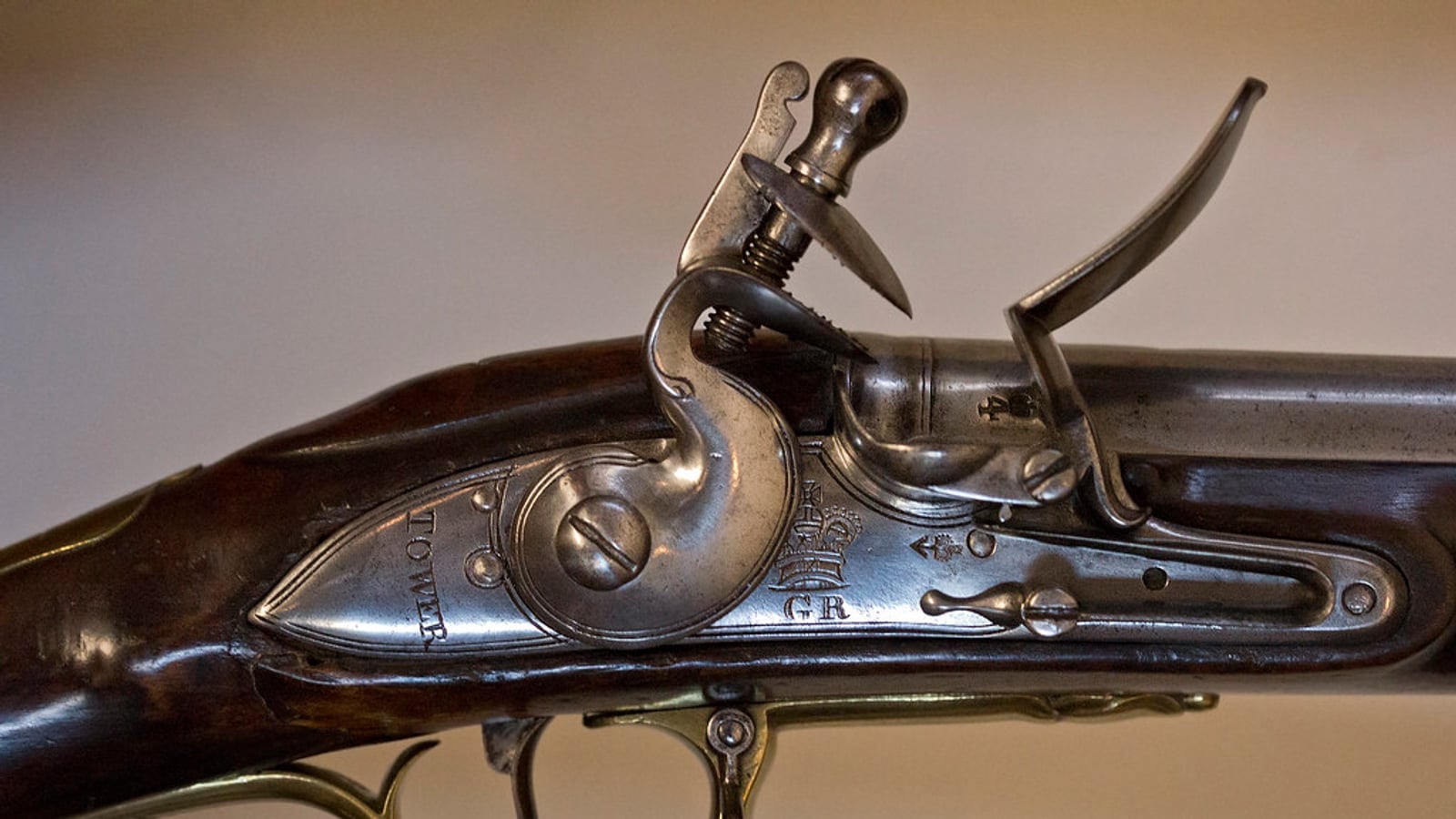
Flintlock firearms add an extra area of attention compared to other systems: the pan and touch hole, meaning the small channel that transmits the flame from the outer priming powder to the main charge in the barrel. This zone accumulates residue very densely, since it’s exactly the passage point of ignition.
Careful cleaning of the pan with a small brush and hot soapy water is essential on this type of firearm, checking that the touch hole itself isn’t blocked by dry residue. The lock, meaning the mechanism that operates the flint, also deserves careful wiping and a light touch of oil on its moving joints, even though it isn’t directly exposed to combustion gases. The flint and its fixing in the cock also deserve regular checking independent of anti-corrosion cleaning, since a worn or loosely fitted flint degrades ignition reliability.
Percussion firearms (sometimes simply called “percussion” as opposed to flintlock) concentrate residue around the nipple, the small threaded piece on which the percussion cap sits at the moment of firing. This nipple deserves very careful cleaning, including its internal channel that transmits the flame to the main charge: a small dedicated wire or needle, never an object that could deform the thread, helps clear this channel if residue has built up and dried there.
The hammer and its striking mechanism also receive residue splatter with every shot on this type of firearm, even though they’re less exposed than the nipple itself. Soapy water cleaning followed by drying and light oiling also applies to these moving parts.
For black powder revolvers, each chamber of the cylinder must be cleaned individually with the same rigor as the barrel itself, regardless of the ignition system otherwise used. Residue accumulates in each chamber comparably, and neglecting even one chamber is enough to trigger localized corrosion that can eventually affect the cylinder’s rotation geometry.
Long-term storage and periodic checks
A properly cleaned and oiled black powder firearm can be stored with peace of mind, but it deserves more frequent checks than a modern common-caliber firearm, especially in the first days following cleaning.
Check the firearm a few days after storing it, particularly if it’s kept in an environment with unstable humidity (garage, cellar, non-breathable case). This early check lets you catch the start of corrosion immediately, before it worsens.
Prefer a breathable case or cover over a fully airtight container for medium-term storage. An airtight container can paradoxically trap residual moisture against the metal, whereas a properly ventilated space lets ambient humidity circulate without concentrating on a single surface.
For storage of several months, for example between two seasons of practice, plan a mid-point inspection rather than discovering a problem only when taking the firearm back out. A simple quick visual check is usually enough to make sure nothing abnormal has developed.
Always store your black powder firearms separately from any product or packaging that might retain moisture, like a non-breathable synthetic fabric pressed directly against the metal. A clean, dry cotton cloth, changed periodically, protects better than a material that could trap a trace of moisture against the surface.
Safety reminders specific to black powder
Beyond cleaning, black powder itself deserves handling and storage precautions distinct from those of modern powders, because of its particular sensitivity to ignition.
Black powder ignites more easily than smokeless powder, including from a simple spark or a relatively modest heat source. Always store it in a dedicated, closed container, away from any heat or flame source, and in a reasonable quantity suited to your actual use.
Depending on your country’s firearms classification, keep in mind that the status of a black powder firearm depends on its type and date of design, and rules vary by jurisdiction, with many antique-style reproductions treated more leniently than modern cartridge firearms. The exact classification depends on the precise model, so always check your firearm’s status with a gunsmith or your national authority before any question of possession or transport.
Always handle your black powder firearm empty and pointed in a safe direction throughout the cleaning process, exactly as with any other firearm. This basic rule never changes, whatever the type of ammunition or ignition used.
Cleaning itself also deserves a few precautions distinct from a classic maintenance session. Very hot water and repeated handling can irritate sensitive skin over the course of a full cleaning session, hence the value of the gloves already mentioned in the gear list. Work in a properly ventilated space if possible, especially if you’re using scented soap or combining the water cleaning with a second pass of classic solvent on the exterior parts.
If you’re just starting out with black powder, an experienced instructor at your club remains the best resource for learning the precise disassembly and cleaning motions specific to your exact model. Every type of vintage firearm or reproduction has its own particularities, and nothing replaces an in-person demonstration the first time.
Maintenance schedule by discipline and practice frequency
Black powder covers several distinct disciplines in civilian sport shooting, from historical reenactment to precision shooting with vintage firearms, and the recommended maintenance frequency logically varies with your actual practice rhythm.
For a shooter who regularly practices vintage-arms shooting at an affiliated club, complete soapy water cleaning must happen after every session, no exceptions, even if the session involved only a few rounds fired. The volume fired matters less than the simple fact of having used black powder that day.
For an occasional shooter who only goes out a few times a year, every outing deserves exactly the same level of rigor as regular practice. The rarity of outings does nothing to reduce the corrosiveness of the residue left after a single shooting session.
Beyond post-session cleaning, plan a more thorough inspection of your firearm once or twice a year, particularly before and after an extended storage period between two seasons. This inspection covers the entire mechanism, not just the barrel, and helps spot emerging corrosion that may have escaped quick everyday checks.
An experienced vintage-arms instructor often recommends keeping a separate maintenance schedule for each black powder firearm in your collection, rather than a general rule applied to all of them. A firearm taken out frequently and another kept mostly on display don’t have exactly the same monitoring needs, even though post-shooting cleaning remains identical in both cases as soon as it’s used.
Loading accessories and modern substitute powders
Maintenance after a black powder outing isn’t limited to the firearm itself. The ramrod, whether integrated or separate, builds up residue along its whole length with each use: a complete wipe-down followed by a light touch of oil on the metal parts is usually enough, checking particularly the tip that comes into direct contact with the projectile and the charge.
Powder measures and loading funnels, if made of metal, deserve soapy water cleaning similar to the barrel’s, even though residue is less concentrated there, followed by complete drying before storage to prevent a measure stored damp from developing rust spots on contact with a fresh charge. Bullet molds, if you cast your own projectiles, are usually cleaned dry with a soft brush, without going through water, which could alter their dimensional precision. Store all of this gear in a dry space, separate from ammunition or powder in reserve, to avoid any cross-contamination.
Some shooters practicing vintage-arms disciplines today use substitute powders, designed to reproduce the ballistic performance of traditional black powder with a slightly different combustion profile. It’s worth knowing that these products don’t eliminate the need for specific maintenance: they generally leave less visible solid residue, which can give a false impression of cleanliness after shooting, but the chemical residue remains present and retains, depending on the product, a hygroscopic capacity comparable to that of classic black powder.
The simplest rule of caution is to apply exactly the same procedure, soapy water cleaning, complete drying and immediate oiling, whether you use traditional black powder or a modern substitute. Until you’re 100% certain of a specific product’s precise behavior against corrosion, it’s better to stick to the most rigorous method rather than take a shortcut that could prove costly. If you switch powder type between two outings, check with your club or instructor if you have any doubt about a cleaning particularity specific to that product: manufacturer datasheets remain the most reliable source on this point.
Logging your black powder outings so nothing gets forgotten
With black powder, memory alone isn’t enough to be sure you cleaned in time after every outing. A precise history of your sessions helps you verify that the delay between shooting and cleaning never exceeded the rule you set for yourself.
That’s exactly what PewPewLife, the digital shooting logbook for sport shooters, makes possible: every logged session keeps a record of the date and type of ammunition used, letting you easily cross-check against the date of your last complete maintenance.
Over time, this history also helps you spot a possible recurring issue, for example if a particular firearm in your collection develops corrosion traces more often than the others despite rigorously applied maintenance. A useful signal to prompt a deeper check with a gunsmith.
Beyond simply tracking cleaning, noting the conditions of the outing too (temperature, ambient humidity, time between shooting and returning home) builds over time a finer sense of your actual real safety margin against the risk of corrosion.
This tracking discipline really comes into its own when you manage several black powder firearms alongside modern-caliber practice. A single logbook that clearly distinguishes the type of ammunition used at each outing keeps you from accidentally mixing up maintenance-frequency reference points from one use to another, which remains a common source of error among shooters who practice several club disciplines in parallel.
FAQ
Q: Can a classic modern solvent be used instead of soapy water? A: Some modern solvents work partially, but hot soapy water remains the most reliable and economical method for dissolving black powder’s solid residue. Many experienced shooters stick to this traditional method precisely because it has proven itself on this particular type of residue.
Q: How long can you really wait before cleaning a black powder firearm? A: It varies with ambient humidity and temperature, so there’s no reliable universal window to give. The safest rule remains to clean the same day, no exceptions, rather than betting on a window you can’t know for certain.
Q: Should you oil before or after the barrel is fully dry? A: Always after complete, verified drying, never before. Oiling a barrel that’s still damp traps moisture under the oil film and actually promotes the very corrosion you’re trying to avoid.
Q: Is baking soda necessary in the cleaning water? A: No, it’s not mandatory, but some experienced shooters add it to more effectively neutralize the acidic aspect of the residue. Hot soapy water alone, well applied and followed by rigorous drying, remains amply sufficient.
Q: Are reproductions of antique black powder firearms subject to the same ownership rules as modern firearms? A: Classification varies by exact model and by country, with many reproductions treated more leniently than modern firearms while others fall under stricter categories depending on the firearm’s precise features. Always check the exact status with a gunsmith or your national authority before any question of ownership.
Q: Is soapy water cleaning also suitable for the wooden parts of the stock? A: No, limit soapy water to the metal parts exposed to combustion residue. Wood is cleaned and maintained separately, with a barely damp cloth and a suitable wood care product, to avoid any risk of swelling or warping.